roof AUDI S3 2011 User Guide
[x] Cancel search | Manufacturer: AUDI, Model Year: 2011, Model line: S3, Model: AUDI S3 2011Pages: 320, PDF Size: 75.79 MB
Page 90 of 320
Seats and storage
& WARNING (continued )
• Make certain that the feet of the roof rack are sitting exactly in
the four stamped marks -otherwise you risk an accident!
• After you have dri ven a few miles , and particularly during long
tr ips, inspect the attaching screws to make certain they a re tight .
• Do not make any modification to the roof rack -you increase
the risk of an accident. •
Applie s to v ehicl es : wi th roof r ails
Roof rack mounting locations
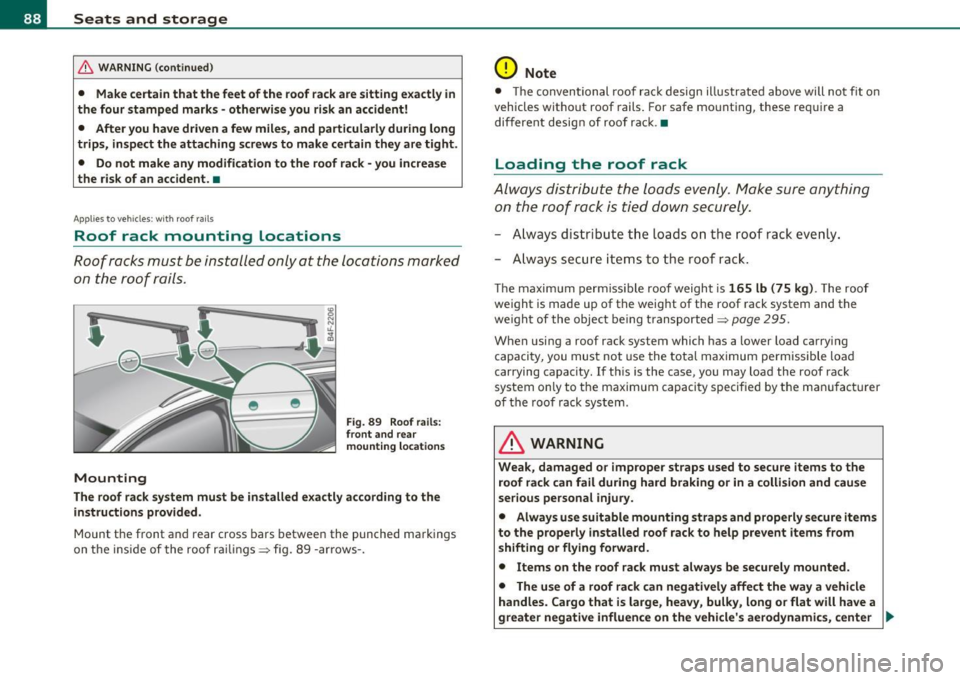
Roof rac ks must be install ed only at the locations mar ked
on th e roo f rails.
Mounting
Fig. 89 Ro of rai ls:
front and rear
mounting lo cat ions
The roof rack sy stem mu st be in stalled exa ctly according to the
instructions provided.
Mount t he front and rear cross bars between the punched mark ings
on the inside of the roof railin gs~ fig. 89 - arrows -.
0 Note
• T he conventional roof rac k de sign illustrated above will not fit o n
vehicles without roof rails . For safe mo unting, these req uire a
differen t desig n of roof ra ck.•
Loading the roof rack
Always distribute the loads evenly . M ake sure anything
on the r oof rack is tied do wn securely.
- Always dis tribute t he loads on the ro of rack e venly .
- Alwa ys se cu re i te ms to the roof rac k.
The maxim um permiss ible roof weight is 165 lb (75 kg ). The roof
we ight is made up o f the weig ht of the roof rack system and the
we igh t of the object be ing transported ~
page 295 .
When usi ng a roof rack system which has a lower load carrying
cap aci ty, you mus t not use the tota l maximum pe rmissible load
carrying capacity. If t his is the case , you may load the roof rack
system on ly to the maximum capacity speci fied by the man ufact urer
of the roof rack system .
L1}. WARNING
Weak, damaged or improper straps used to secure items to the
roof rack can fail during hard braking or in a collision and cause
ser ious personal injury.
• Always use suitable mounting straps and properly secure items
to the properly installed roof rack to help prevent items from
shifting or flying forward .
• Items on the roof rack must always be securely mounted .
• The use of a roof rack can negatively affect the way a vehicle
handles. Cargo that is large , heavy , bulky, long or flat will have a
greater negati ve influence on the veh icle's aerodynamics, center ..
Page 91 of 320

& WARNING (co ntinued )
of gra vity and o verall handling . Alwa ys dri ve slowly, avoid sudden
braking and maneuvers when tran sporting cargo on the roof of
your veh icle .
• Never exceed the maximum permi ssible load carrying capacity
of the roof of your vehicle, the permissible a xle weight s and the
permissible total weight of your vehicle ~
page 295 , "Weight s".
• Alwa ys d riv e slowly , avoid sudden b raking and maneuvers
when transporting carg o on the roof of your vehicle .
W For the sake of the environment
Sometimes i t may be easier to leave a roof ra ck i nstalled even tho ugh
you are not using it. Due to the increased air resistance your veh icle
wi ll u nne cessa rily use more f ue l. Remove the roof rack if you are not
going to use it. •
Cup holders
Cup holders in the center console
Fig. 90 Cup h older s
an d stor age tr ay in th e
c e nt er con sole
Up to two beve rages can be p laced in the cente r co nsole .
Cont rols a nd e quip
m en t Vehicle
OP-eration
Seats and storage
& WARNING
Spilled hot liquid can cause an accident and personal injury .
• Never carry any beverage container s with hot liquids, such a s
hot coffee or hot tea, in the vehicle while it is mov ing . In case of
an accident, sudden braking or other vehicle movement, hot liquid
could spill, causing scalding burns. Spilled hot liquid can also
c ause an accident and personal injury.
• Use only soft cups in the cupholder. H ard cups and glasses can
cause injury in an accident .
• Never use the cup holder or adapter as an ashtray· risk of fire.
0 Note
Only drink conta iners with lids should be carr ied in the c upholder.
L iq ui d could spill ou t an d damage your vehicle's e lec tron ic equipment
or sta in the upholstery, etc .. •
Cupholder in the rear center armrest
Opening the cup holder
Fig . 9 1 Rea r cente r
armrest : cu phol der
exten ded
- Press both spots ma rked with ii @ => fig. 91 => & -The
holde r ext en ds. .,_
Vehicle care Do-it-yourselt service iTechnical data
Page 134 of 320
-L_!:D~ r!:_! i~v ~in ~ g~S~ a.!_fe ~ LyL __________________________________________ _
& WARNING (conti nu ed )
• Never tran sport object s larger than those fitting completely
into the luggage are a because the rear lid cannot be fully clos ed.
• If you absolutely must dri ve with the rear lid open , observe the
following note s to reduce the risk of po isoning:
- Clo se all windows,
- Close the power roof*,
- Open all air outlets in the instrument panel,
- Switch off the air recirculation ,
- Set the fresh air fan to the h ighest speed.
& WARNING
Always make sure that the doors , all windows, the power roof*
and the read lid are securely closed and lo cked to redu ce the ri sk
of inju ry when the vehicle is not being used.
• After closing the r ear lid, always make sure that it is properly
closed and locked.
• Never leave your vehicle unattended especially with the rear lid
left open. A child could crawl into the vehicle through the luggage
compartment and close the rear lid becoming trapped and unable
to get out. Being trapped in a vehicle can lead to serious personal
injury.
• Never let children play in or around the vehicle.
• Never let passengers ride in the luggage compartment . Vehicl e
occupants must alway s be properly restrained in one of the
vehicle 's seating positions.
00 Tips
• The tire pressu re mus t cor respond to the load - see the tire pres
sure st icker on th e fuel filler doo r. •
The tire pressure must correspo nd to the load . The tire p ressure is
shown on t he tire press ure label. O n USA ve hicl es, t he tire press ure
label is located on the d river's s ide B-pillar. On Canada vehicles, the
tire press ure label is located either on the driver 's side B -pillar or
inside the fuel fille r flap . The t ire pressure labe l lists the recom
mended co ld ti re inflation pressures for t he ve hicle at its maximum
c apacity weight and the tires that were on yo ur vehicle at the ti me it
was manufactured. For recommended tire pressures for normal load
c ondi tions, p le ase see cha pte r=>
page 249. •
Tie-downs
The lugg ag e co mportment is equipped with four tie
downs to secure lugga ge and other items.
Use the t ie-downs to sec ure your ca rgo prope rly=> page 131,
"Loading the luggage compartment" .
In a co lli sion, t he laws of phys ics mean tha t even sma ller i tems th at
are loose in the vehicle will become heavy m issi les t hat can cause
ser ious injury. Items in the vehicle pos sess energy whi ch v ary wi th
vehicle speed and t he weight of the item. Vehicle speed is the most
significant factor .
For exampl e, in a fron tal col lis io n at a speed of 30 mp h (4 8 k m/h),
the forces actin g on a 10 -lb (4.S kg) o bject are about 20 times t he
normal weight o f the item. This means that the weig ht of the item
wou ld suddenly be abo ut 200 lbs. (90 kg) . You can imagine the inju
r ies tha t a 200 lbs. (90 kg) i tem flying freely thro ugh t he p assenge r
compartment could cause in a collision like this.
& WARNING
Weak , damaged or improper straps used to secure items to t ie
downs can fail during hard braking or in a collision and cause
ser ious personal injury.
Page 150 of 320
........ _A_ ir_ b_ a-=g :..- s.:o.y _s _t _e_ m _______________________________________________ _
defined in the elect ronic contro l unit~ page 157, "PASSE NGER AIR
BA G OFF l ight ".
Always r emembe r, a c hild safety seat o r infa nt ca rr ie r i nsta lled on th e
fro nt seat may be struc k and k noc ke d out of position by t he ra pidly
i nflat ing pass enge r's air ba g in a fr ontal c oll ision. Th e airba g could
g reat ly re duce the effectiveness o f th e ch ild restraint an d even seri
ousl y injur e th e child d uring inf lation .
For this r easo n, and b eca use the back seat is th e sa fest plac e for chil
dre n -whe n pro per ly restra ined acc ordin g to their age and size -we
s tr ong ly r ecommen d that childr en a lways sit in the back s eat
~ pa ge 167, "Child S afety".
& WARNING
A child in a rearward -facing child safety seat installed on the front
passenger seat will be seriously injured and can be killed if the
front airbag inflates - even with an Advanced Airbag System.
• The inflating airbag will hit the child safety seat or infant
carrier with great force and will smash the child safety seat and
child against the backrest, center armrest, door or roof .
• Always install rear-facing child safety seats on the rear seat.
• If you must install a rearward facing child safety seat on the
front passenger seat because of exceptional circumstances and
the PASSENGER AIR BAG OFF light does not come on and stay on,
immediately install the rear-facing child safety seat in a rear
seating position and have the airbag system inspected by your
authorized Audi dealer.
• Forward-facing child safety seats installed on the front
passenger's seat may interfere with the deployment of the airbag
and cause serious personal injury to the child.
& WARNING
If , in exceptional circumstances , you must install a forward-facing
child restraint on the front passenger's seat:
& WARNING (continued)
• Always make sure the forward-facing seat has been designed
and certified by its manufacturer for use on a front seat with a
passenger front and side airbag.
• Never put the forward-facing child restraint up against or very
near the instrument panel.
• Always move the passenger seat into its rearmost position in
the seat's fore and aft adjustment range, as far away from the
airbag as possible before installing the forward-facing child
restraint. The backrest must be adjusted to an upright position.
• Make sure that the PASSENGER AIR BAG OFF light comes on
and stays on all the time whenever the ignition is switched on.
& WARNING
To reduce the risk of serious injury, make sure that the PASSENGER AIR BAG OFF light will be displayed whenever a child
restraint is installed on the front passenger seat and the ignition
is switched on .
• If the PASSENGER AIR BAG OFF light does not stay on, perform
the checks described
~ page 156 , "Monitoring the Advanced
Airbag System ".
• Take the child restraint off the front passenger seat and install
it properly at one of the rear seat positions if the PASSENGER AIR
BAG OFF light does not stay on .
• Have the airbag system inspected by your authorized Audi
dealer immediately.
• Always carefully follow instructions from child restraint manu
facturers when installing child restraints.
& WARNING
If , in exceptional circumstances , you must install a forward or
rearward-facing child restraint on the front passenger 's seat:
Page 153 of 320

Airbag system -----------------=--=---
re stra ined in o ne of th e re a r-f acing or forward-fac ing inf ant
res traints (listed in F ed era l M oto r V ehicl e Sa fe ty Stand ard 2 08 wi th
w hich t he Adva nced Ai rbag System in your ve hicle was c ert ifi ed), th e
front a irbag on the passen ge r side may o r may not dep loy.
Th e
PASSENGER AIR BAG OFF ligh t com es on whe n the ele ctronic
cont rol u nit detects a tota l wei ght on t he front passenger seat that
re qui res th e fr ont a irbag to b e turned off.
If the PASSENGER AIR
BAG OFF
lig ht does not come on, the fro nt airbag o n the passenger
s ide has not bee n turned off by th e c ontro l un it an d can d ep loy i f the
cont rol unit senses an impact that meets t he conditions stored in its
memory.
I f th e tota l w eight on th e fro nt passenger sea t is mor e t han that of a
ty pical
1 yea r-o ld, but less tha n th e weight of a sma ll adult, t he front
a ir bag o n the pa ssenge r si de m ay de ploy (t he
PASSENGER AIR BAG
OFF
lig ht does not come on).
For example, the airbag may deploy if:
• a small child tha t is heav ier th an a typi cal 1 year-old child is on the
front passenger seat (regard less of whet he r the c hild is in o ne o f th e
c hild safe ty seats listed~
pag e 169),
• a child who has outgrown child rest raints is on the front passenger
seat .
If the front passe nger a irbag is turned off, the
PASSENGER AIR BAG
OFF
ligh t in the center of the i nstru me nt pan el will co m e on an d sta y
on .
Th e f ront a irba g on the passenger side may
not dep loy (the
PASSENGER AIR BAG OFF li ght does no t illum inate and s tay lit) if:
• a small adult or teenager is on the front passenger seat
• a pass enger w ho is no t si tting upri ght w it h t heir ba ck again st a
non-recline d backrest with their feet on t he vehicle floo r in front of
t he seat i s on the fro nt pa ssenge r seat .
If the fro nt passenger airbag deploys, the Federa l Standard req uires
t he a irbag to mee t the " low r is k" deployme nt crit er ia to hel p r educe
the risk of injury through interaction with t he a irbag. "Low r isk"
Controls and equip
ment Safety first Vehicle operation
dep
loyme nt occ urs in those c rashes that ta ke place at lowe r decele r
at ions as de fined in t he ele ct roni c cont rol uni t~
page 15 6.
Always remember: Even t hough your veh icle is equip ped with
Advanced Airbags, t he sa fest place for children is properly restraine d
on the ba ck sea t. Ple ase be sure to rea d the impor tant in forma tion i n
t he sections that follow and be su re to heed all of the WAR NINGS .
& WARNING
To reduce the risk of injury when an airbag inflates, always wear
safety belts properly .
• If you are unrestrained, leaning forward, sitting sideways or
out of position in any way, your risk of injury is much higher .
• You will also receive serious injurie s and could even be killed if
you are up against the airbag or too close to it when it inflates -
even with an Advanced Airbag~
page 145.
& WARNING
A child in a rearward-facing child safety seat installed on the front
passenger seat will be seriously injured and can be killed if the
front airbag inflates -even with an Advanced Airbag System .
• Although the Advanced Airbag System in your vehicle is
designed to turn off the front airbag when a rearward-facing child
restraint has been installed on the front passenger seat, nobody
can absolutely guarantee that deployment is impossible in all
conceivable situations that may happen during the useful life of
your vehicle .
• The inflating airbag will hit the child safety seat or infant
c arrier with great force and will smash the child safety seat and
child against the backrest, center armrest , door, or roof.
• Always install rearward-facing child restraints in the back seat.
• If you must install a rearward facing child safety seat on the
front passenger seat because of exceptional circumstances and the PASSENGER AIR BAG OFF light does not come on and stay on , _,.
Vehicle care Do-it-yourself service Technical data
Page 157 of 320

_______________________________________________ A_ ir_ b_ a_,,,g '--- s.:a.y _s _t_ e _ m ___ _
lower parts of the body . Front a irbags s upplement the t hree-poi nt
sa fety belts o nly in some fro ntal collis ions in which the vehicle decel
eration is high enough to dep loy the a irbags .
Front airbags will not deploy:
• if the ignition is switched off when a crash occurs,
• in s ide collisions ,
• in rea r-end collisions,
• in rollovers,
• when the crash decelerat io n me asured by the a irbag system is less
than the min imum threshold needed for a irbag deployment as reg is
tered by the e lectron ic con trol un it.
The front passenger airbag also will not deploy:
• when the fron t passe nger seat i s not oc cupied,
• when the weight on the front passenger seat as sensed by the
Advanced Ai rbag System in dicates that the front airbag o n the
passenger side has to be turned off by the e lectronic control unit (the
PASSENGER AIR BAG OFF li ght comes on and stays on).
& WARNING
Sitting in the wrong position can increase the ri sk of ser iou s injury
in crashes.
• To redu ce the risk of injury when the airbags inflate, the driver
and pas sengers mu st always sit in an upright position , mu st not
lean against or place any part of th eir body too close to the area
where the airbags are lo cated.
• Occupants who are unbelted, out of position or too close to the
airbag can be seriou sly injured by an airbag a s it unfolds with
great force in th e blink of an eye =>
page 147 .
Controls and equip ment Safety first Vehicle operation
& WARNING
A child in a rearward-facing child
safety se at installed on the front
pa sseng er seat will be seriously injured and can be killed if the
front airbag inflat es - ev en with an Ad van ced Airbag System .
• The inflating airbag will hit the child safety seat or infant
c arrier with great force and will smash the child safety s eat and
c hild against the backre st, center armre st, d oor or roof .
• Always install rear -facing child safet y seats on the rear seat.
• If you must install a rearward facing child safety seat on the
front passenger se at because of e xceptional circumstances and
the PASSENGER AIR BAG OFF light do es not come on and stay on ,
immediately install the rear -facing child s afety seat in a rear
s eating po sition and h ave the airbag system inspe cted by your
authoriz ed Audi d ealer.
& WARNING
Object s between you and the airbag will increase th e risk of inju ry
in a cra sh by int erfering with the way the airb ag unfold s or by
being pushed into you as the airbag inflates.
• Never hold things in your hand s or on your lap when the vehicle
i s in use.
• Never tran sport items on o r in the are a of the fr ont pa ssenger
seat. Obje ct s c ould move into the area of the front ai rbag s during
braking or other sudden maneu ver s and become dang erous
projectiles that can c au se se rious per sonal injury if the ai rb ags
infl ate.
• Never pla ce o r atta ch acce ssorie s or other objects (such as cup
holder s, telephone brac ket s, large, hea vy or bulky objects ) on th e
doors , ov er or near the are a marked "AIRBAG" on the stee ring
wheel, in strum ent panel , se at ba ckre sts or between th ose ar ea s
and yourself . These objects could cause injur y in a crash , especially
when the airbags infl ate .
9"'
Vehicle care Do-it-yourself service Technical data
Page 173 of 320

_____________________________________________ C _h_i_ld _ S_ a_ f_ e_ t__. y'--- __
& WARNING
Not using a child safety seat, using the wrong child safety seat or
improperly installing a child restraint increases the risk of serious
personal injury and death.
• All vehicle occupants and especially children must always be
restrained properly whenever riding in a vehicle.
- An unrestrained or improperly restrained child can be injured or killed by being thrown against the inside of the
vehicle or by being ejected from it during a sudden maneuver or impact.
- An unrestrained or improperly restrained child is at much greater risk of injury or death by being struck by an inflating
airbag.
• Commercially available child safety seats are required to
comply with U.S. Federal Motor Vehicle Safety Standard (FMVSS)
213 (in Canada CMVSS 213).
- When buying a child restraint, select one that fits your child and the vehicle.
- Only use child restraint systems that fully contact the flat portion of the seat cushion. The child restraint must not tip or
lean to either side. Audi does not recommend using child
safety seats that rest on legs or tube-like frames. They do not
provide adequate contact with the seat.
- Always heed all legal requirements pertaining to the instal
lation and use of child safety seats and carefully follow the
instructions provided by the manufacturer of the seat you are
using.
• Never allow children under S7 inches (1.45 meters) to
wear a
normal safety belt. They must always be restrained by a proper
child restraint system. Otherwise, they could sustain injuries to
the abdomen and neck areas during sudden braking maneuvers or
accidents.
• Never let more than one child occupy a child safety seat.
Controls and equip ment Safety first Vehicle operation
& WARNING
(continued)
• Never let babies or older children ride in a vehicle while sitting
on the lap of another passenger.
-Holding a child in your arms is never a substitute for a child
restraint system.
- The strongest person could not hold the child with the forces
that exist in an accident. The child will strike the interior of the
vehicle and can also be struck by the passenger.
- The child and the passenger can also injure each another in
an accident.
• Never install rear-facing child safety seats or infant carriers on
the front passenger seat . A child will be seriously injured and can
be killed when the passenger airbag inflates - even with an
Advanced Airbag System.
• The inflating airbag will hit the child safety seat or infant
carrier with great force and will smash the child safety seat and
child against the backrest, center armrest, door or roof.
• Always install rear-facing child safety seats or infant carriers
on the rear seat.
• Forward-facing child safety seats installed on the front
passenger's seat can interfere with the airbag when it inflates and
cause serious injury to the child. Always install forward-facing
child safety seats on the rear seat.
• If exceptional circumstances require the use of a forward
facing child restraint on the front passenger's seat, the child's
safety and well -being require that the following special precau
tions be taken:
- Make sure the forward-facing seat has been designed and certified by its manufacturer for use on a front seat with a
passenger front and side airbag.
- Always carefully follow the manufacturer's instructions
provided with the child safety seat or carrier.
Vehicle care Do-it-yourself service Technical data
Page 175 of 320

-Push the child safety seat down with your full weight to
get the safety belt really tight so that the seat cannot
move forward or sideways more than one inch (2.5 cm).
Infants up to about one year (20 lbs. or 9 kg) are best protected in
special infant carriers and chi ld safety seats designed for t heir age
group. Many experts believe that infants and small childr en should
r ide only in spec ia l restra ints in w hich the child faces the back of the
vehicle. These infant seats support the baby's back, neck and head in
a crash=> fig. 144.
The airbag on the passenger side makes the front seat a potentially
dangerous place for a child to ride. The front seat is not the safest
place for a ch ild in a forward-facing child seat.
It is a very dangerous
place for an infant or a large r child in a rear ward-fac ing seat.
& WARNING
Not using a child safety seat, using the wrong child safety seat or
improperly installing a child restraint increases the risk of serious
personal injury and death in a crash.
• Never install rear-facing child safety seats or infant carriers on
the front passenger seat· even with an Advanced Airbag System.
A child will be seriously injured and can be killed when the
inflating airbag hits the child safety seat or infant carrier with
great force and smashes the child safety seat and child against the
backrest, center armrest, door or roof=>
page 147, "Child
restraints on the front seat -some important things to know".
• Always install rear-facing child safety seats or infant carriers
on the rear seat.
• Never install a rear-facing child rest raint in the forward-facing
direction. Such restraints are designed for the special needs of
infants and very small children and cannot protect them properly
if the seat is forward-facing.
• If you must install a rearward facing child safety seat on the
front passenger seat because of exceptional circumstances and
the PASSENGER AIR BAG
OFF light does not come on and stay on,
Safety
first Vehicle OP-eration
Child Safety
& WARNING (continued)
immediately install the rear-facing child safety seat in a rear
seating position and have the airbag system inspected by your
Audi dealer.
• Always read and heed all WARNINGS whenever using a child
restrained in a vehicle is being used=>
page 135, "Safety belts",
=>
page 145, "Airbag system" and=> page 167, "Important
things to know ".•
Convertible child safety seat:s
Properly used convertible child safety seats can help
protect toddlers and children over age one who weigh
b etween 20 and 40 lbs. (9 and 18 kg) in a crash.
Vehicle care
Fig . 145 Schematic
overview: installation
of the attachments
applicable to a LATCH
seat
ti,
Do-it-yourselt service iTechnical data
Page 176 of 320
-Child Safety PJU __ .,.___ ____________ _
Fig. 146 Schematic
overview: installation
of the seat using the
vehicle's safety belt
system
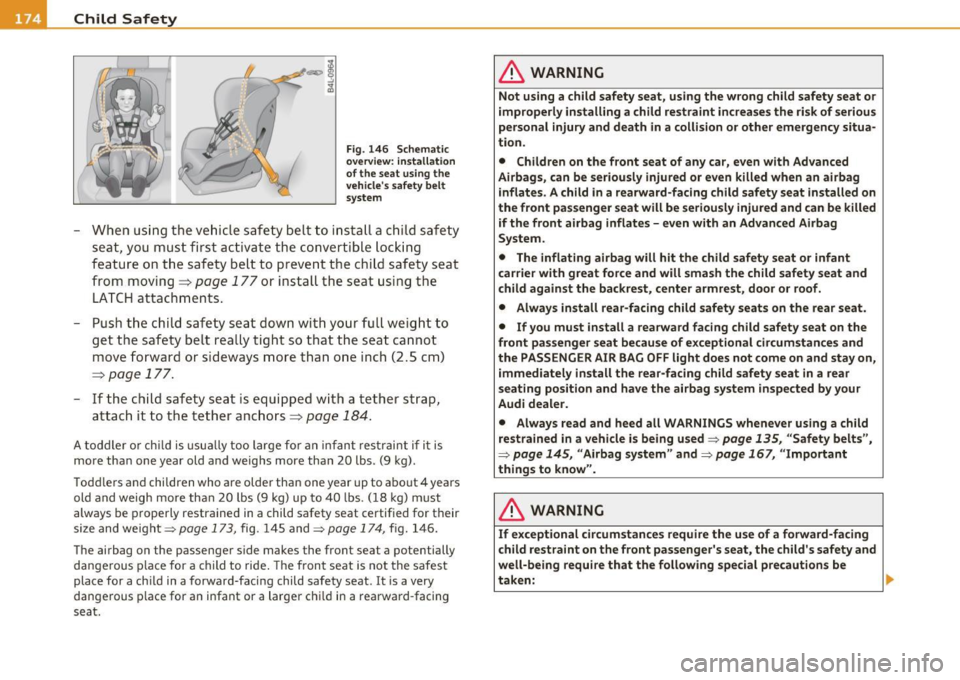
- When using the vehicle safety belt to install a child safety
seat, you must first activate the convertible locking
feature on the safety belt to prevent the child safety seat
from moving~
page 177 or install the seat using the
LATCH attachments.
- Push the child safety seat down with your full weight to
get the safety belt really tight so that the seat cannot
move forward or sideways more than one inch
(2.5 cm)
=>
page 177.
- If the child safety seat is equipped with a tether strap,
attach it to the tether anchors=>
page 184.
A toddler or child is usually too large for an infant restraint if it is
more than one year old and weighs more than 20 lbs . (9 kg) .
Toddlers and children who are older than one year up to about 4 years old and weigh more than 20 lbs (9 kg) up to 40 lbs. (18 kg) must
always be properly restrained in a child safety seat certified for their
size and weight~
page 173, fig. 145 and~ page 174, fig. 146.
The airbag on the passenger side makes the front seat a poten tially
dangerous place for a child to ride. The front seat is not the safest
place for a child in a forward-facing child safety seat . It is a very
dangerous place for an infant or a larger child in a rearward-facing
seat .
& WARNING
Not using a child safety seat, using the wrong child safety seat or
improperly installing a child restraint increases the risk of serious
personal injury and death in a collision or other emergency situa
tion.
• Children on the front seat of any car, even with Advanced
Airbags, can be seriously injured or even killed when an airbag
inflates. A child in a rearward-facing child safety seat installed on
the front passenger seat will be seriously injured and can be killed
if the front airbag inflates - even with an Advanced Airbag
System.
• The inflating airbag will hit the child safety seat or infant
carrier with great force and will smash the child safety seat and
child against the backrest, center armrest, door or roof.
• Always install rear-facing child safety seats on the rear seat.
• If you must install a rearward facing child safety seat on the
front passenger seat because of exceptional circumstances and
the PASSENGER AIR BAG OFF light does not come on and stay on,
immediately install the rear-facing child safety seat in a rear
seating position and have the airbag system inspected by your
Audi dealer.
• Always read and heed all WARNINGS whenever using a child
restrained in a vehicle is being used~
page 135, "Safety belts",
~ page 145, "Airbag system" and~ page 167, "Important
things to know".
& WARNING
If exceptional circumstances require the use of a forward-facing
child restraint on the front passenger's seat, the child's safety and
well-being require that the following special precautions be
taken:
11'-
Page 180 of 320
• .___C_ h_ il_d _ S_a _ f_ e _ t--= y '------------------------------------------------
& WARNING (cont inued)
• If the backrest is not securely latched, the child and the child
restraint will be thrown forward together with the backrest and
will strike parts of the vehicle interior. The child can be seriously
injured or killed.
• Never install rear-facing child safety seats or infant carriers on
the front passenger seat. A child will be seriously injured and can be killed when the passenger airbag inflates.
• The inflating airbag will hit the child safety seat or infant
carrier with great force and will smash the child safety seat and
child against the backrest, center armrest, door or roof .
• Always install rear-facing child safety seats or infant carriers
on the rear seat.
• Forward-facing child safety seats or infant carriers installed on
the front passenger's seat may interfere with the deployment of
the airbag and cause serious injury to the child.
• It is safer to install a forward -facing child safety seat on the
rear seat.
• Always read and heed all WARNINGS whenever using a child
restrained in a vehicle is being used~
page 167. Special precau
tions apply when installing a child safety seat on the front
passenger seat~
page 147, "Child restraints on the front seat -
some important things to know".
L1}. WARNING
Always take special precautions if you must install a forward or
rearward -facing child restraint on the front passenger's seat in
exceptional situations:
• Whenever a forward or rearward-facing child restraint is
installed on the front passenger seat, the PASSENGER AIR BAG
OFF light must come on and stay on whenever the ignition is
switched on.
& WARNING (co ntinued )
• If the PASSENGER AIR BAG OFF light does not come on and
stay on, perform the checks described
~ page 156, "Monitoring
the Advanced Airbag System".
• Take the child restraint off the front passenger seat and install
it properly at one of the rear seat positions if the PASSENGER AIR
BAG OFF light does not stay on whenever the ignition is switched
on.
• Improper installation of child restraints can reduce their effec
tiveness or even prevent them from providing any protection.
• An improperly installed child restraint can interfere with the
airbag as it deploys and seriously injure or even kill the child.
• Always carefully follow the manufacturer's instructions
provided with the child safety seat or carrier.
• Never place additional items on the seat that can increase the
total weight registered by the weight-sensing mat and can cause injury in a crash.
L1}. WARNING
Forward-facing child restraints:
• Always make sure the forward-facing seat has been designed
and certified by its manufacturer for use on a front seat with a
passenger front and side airbag .
• Never put the forward-facing child restraint up, against or very
near the instrument panel.
• Always move the passenger seat into its rearmost position in
the seat's fore and aft adjustment range, as far away from the airbag as possible before installing the forward-facing child
restraint . The backrest must be adjusted to an upright position.
• Make sure that the PASSENGER AIR BAG OFF light comes on
and stays on all the time whenever the ignition is switched on . _.