fuel AUDI S3 2011 Owner's Manual
[x] Cancel search | Manufacturer: AUDI, Model Year: 2011, Model line: S3, Model: AUDI S3 2011Pages: 320, PDF Size: 75.79 MB
Page 109 of 320
_________________________________________________ O_ n_ t_ h_ e_ r _o_ a_d _ __.fflll
Starting and stopping the engine
Starting the engine
The engine can only be started with your original Audi
key.
N ... q
i
Vehicles with a gasoline engine:
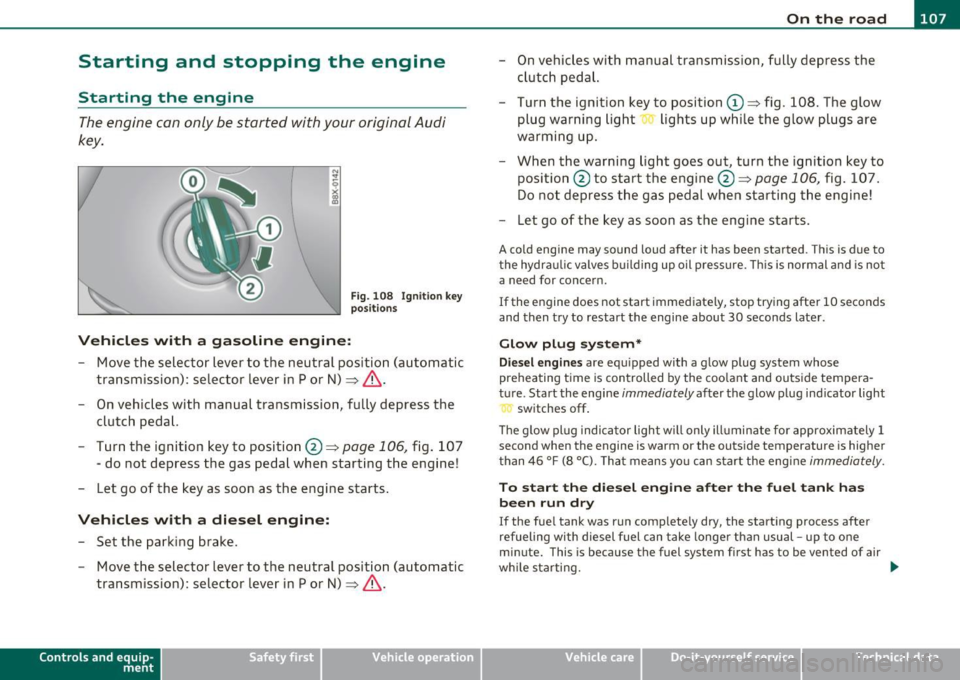
Fig . 10 8 Ignition key
p osit ion s
- Move the selector lever to the neutra l position (automatic
transmission): selector lev er in P or N) =>
& .
- On vehicles with manual transmission, fully depress the
clutch pedal.
- Turn the ignition key to position@ =>
page 106, fig. 10 7
- do not depress the gas pedal when star ting t he engine!
- Let go of the key as soon as the engine starts .
Vehicles with a diesel engine:
- Set the park ing b rake .
- Move the selector lever to the neutral position (automatic
transmission): selector lever in P or N) =>
& .
Con tro ls a nd e quip
m en t Vehicle
OP-eration
- On vehicles with manual transmission , fu lly depress the
cl utch peda l.
- Turn the ignition key to posi tion
(D => fig . 108. The g low
plug warning light lights up whi le the glow plugs are
warming u p.
- When the warning light goes out, turn the ig nition key to
posi tion @to start the engine @ =>
page 106, fig. 107 .
Do not depress t he gas pedal when starting t he engine!
- Let go o f the key as soon as the engi ne starts.
A cold engine may sound loud after it has been started . Th is is due to
t he hydra ulic valves buil ding up oil p ress ure. This is normal and is not
a need for concern.
If the engine does not start immediately, stop try ing after 10 seconds
and then try to restart the engine about 30 seconds later .
Glow plug system*
Diesel engines are equipped with a glow p lug system whose
preheating t ime is con trolled by the coo la nt and outs ide tempera
t u re . Start the engine
immediately af ter the glow p lug ind icator light
sw itches off .
Th e g low pl ug indica tor light w ill only ill uminate fo r approximately 1
second when the engine is warm or the outs ide temperature is higher
than 46 °F (8 °C). Tha t means yo u ca n sta rt the engi ne
immediately.
To start the diesel engine after the fuel tank has
been run dry
If the fue l tank was run complete ly dry, the start ing process after
refueling with diesel fuel can take longe r than usual -up to one
minute. This is because the fuel system first has to be vented of air
wh ile starting. _,.
Vehicle care Do-it-yourselt service Technical data
Page 111 of 320
_________________________________________________ O_ n_t_ h _ e_ ro_ a_d __ _
Releasing the parking brake
- Pull th e parking brak e leve r u p sligh tly and pr ess the
r ele ase b utt on at t he sam e tim e:::::;,
page 108, fig. 10 9
-a rrow-.
- Keep the release button pressed and lower the par kin g
brake:::::;, &,.
If you should drive off w ith the park ing brake still set, a warning tone
wi ll sou nd and t he following will appear in t he ins trumen t cluster to
remind you to release the parking brake:
Parking brake set
Th e p arking br ake wa rning comes on on ly af ter you have d riven for
longer than 3 seconds and faster than 5 mph (5 km/h).
T he pa rk in g bra ke wa rning ligh t Brake (U SA)/
(CD) (C DN) i lluminates
w hen the park ing b rake is set and you sw itch on the ign ition.
& WARNING
Always release the parking brake completely. A partially engaged
brake will overheat the rear brakes , reduce their effectiveness and
cause excessive wear. This could lead to brake failu re and an acci
dent.
0 Note
O nly a fter the vehicle has co me to comp lete stop, sho uld you firmly
se t the par king brake and either move the gearshift lever into 1st .
gear (manual t ransm iss ion) or
move the se lector leve r into "P" (Auto
matic transm ission). •
Controls and equip
ment Safety first
Parking
To p
reven t a parked ve hic le fr om rolli ng away, th ere a re
a fe w thing s yo u s hould do.
Wh en you par k yo ur vehic le, do t he foll owing:
- Stop the veh ic le usi ng the brake pedal.
- Set t he parking bra ke firmly .
- Mov e th e s ele ctor lev er i nto the
P p osi tio n (automatic
transmission)
or mo ve the g ears hift leve r i nto 1st . gear
(manual transmission) :::::;, &,.
- Swit ch o ff t he eng ine and rem ove the igniti on key fr om
t he ign ition l ock .
What else you should do when parking your vehicle
on an incline or decline
T u rn t he st eer ing whee l so tha t if the vehicle s hould start to roll, it
will roll into t he curb.
If you are par king on a
decline (the front of your ve hicl e facing down
hill), turn the fron t w heels to t he rig ht so t hat they point
toward the
curb.
If you are pa rking o n an incline (t he fon t of yo ur vehi cle facing uphill),
turn the front wheels to the left so that they point
away from the
curb.
Move the se lector lev er into the P p os it ion (automatic transmission)
or move the gearsh ift lever i nto 1st . gear (manual transmis sion ).
& WARNING
This is how you can reduce the risk of injury when leaving your
vehicle.
• Never park the vehicle where it can come in contact with dry
grass, spilled fuel or any other flammable materials.
Vehicle care Technical data
Page 134 of 320
-L_!:D~ r!:_! i~v ~in ~ g~S~ a.!_fe ~ LyL __________________________________________ _
& WARNING (conti nu ed )
• Never tran sport object s larger than those fitting completely
into the luggage are a because the rear lid cannot be fully clos ed.
• If you absolutely must dri ve with the rear lid open , observe the
following note s to reduce the risk of po isoning:
- Clo se all windows,
- Close the power roof*,
- Open all air outlets in the instrument panel,
- Switch off the air recirculation ,
- Set the fresh air fan to the h ighest speed.
& WARNING
Always make sure that the doors , all windows, the power roof*
and the read lid are securely closed and lo cked to redu ce the ri sk
of inju ry when the vehicle is not being used.
• After closing the r ear lid, always make sure that it is properly
closed and locked.
• Never leave your vehicle unattended especially with the rear lid
left open. A child could crawl into the vehicle through the luggage
compartment and close the rear lid becoming trapped and unable
to get out. Being trapped in a vehicle can lead to serious personal
injury.
• Never let children play in or around the vehicle.
• Never let passengers ride in the luggage compartment . Vehicl e
occupants must alway s be properly restrained in one of the
vehicle 's seating positions.
00 Tips
• The tire pressu re mus t cor respond to the load - see the tire pres
sure st icker on th e fuel filler doo r. •
The tire pressure must correspo nd to the load . The tire p ressure is
shown on t he tire press ure label. O n USA ve hicl es, t he tire press ure
label is located on the d river's s ide B-pillar. On Canada vehicles, the
tire press ure label is located either on the driver 's side B -pillar or
inside the fuel fille r flap . The t ire pressure labe l lists the recom
mended co ld ti re inflation pressures for t he ve hicle at its maximum
c apacity weight and the tires that were on yo ur vehicle at the ti me it
was manufactured. For recommended tire pressures for normal load
c ondi tions, p le ase see cha pte r=>
page 249. •
Tie-downs
The lugg ag e co mportment is equipped with four tie
downs to secure lugga ge and other items.
Use the t ie-downs to sec ure your ca rgo prope rly=> page 131,
"Loading the luggage compartment" .
In a co lli sion, t he laws of phys ics mean tha t even sma ller i tems th at
are loose in the vehicle will become heavy m issi les t hat can cause
ser ious injury. Items in the vehicle pos sess energy whi ch v ary wi th
vehicle speed and t he weight of the item. Vehicle speed is the most
significant factor .
For exampl e, in a fron tal col lis io n at a speed of 30 mp h (4 8 k m/h),
the forces actin g on a 10 -lb (4.S kg) o bject are about 20 times t he
normal weight o f the item. This means that the weig ht of the item
wou ld suddenly be abo ut 200 lbs. (90 kg) . You can imagine the inju
r ies tha t a 200 lbs. (90 kg) i tem flying freely thro ugh t he p assenge r
compartment could cause in a collision like this.
& WARNING
Weak , damaged or improper straps used to secure items to t ie
downs can fail during hard braking or in a collision and cause
ser ious personal injury.
Page 200 of 320
Driving and environment
New brake pads have to be "burnished in" before they have optimal
grab ~& .
Dur ing the break-in period, you should avoid putting severe loads on
the bra kes. Severe loads incl ude, for example, sudden hard braking,
in part icu lar at very high speeds or, for examp le, on mountain passes .
& WARNING
Until they develop th e ma ximum "bite " for b est stopp ing pow er,
the surfaces on new brake pads require some "breaking-in" during
the in itial 100 to 150 mile s (150 to 200 kilometers ) of normal
city dr iving. You can compensate for this by p ress ing the brake
pedal more firml y. Thi s applies whenever n ew pads are in stalled .•
Driving through water on roads
---
N ote the following to avoid vehicle damage when driving through
water, fo r example on flooded roads:
• Th e wate r mus t not be any higher th an the bottom of the ve hicl e
body.
• Do not dr ive faster t han wal king speed.
& WARNING
After driving through water, mud , slush, etc ., th e brak es may be
slow to take effect because of wet brake rotors and pads . Dry the
brakes first by braking carefully to restore the full braking effect .
0 Note
Vehicle components such as the engine, transmission, suspension or
electrical system can be severely damaged by driving thro ugh water.
W Tips
• Check t he dept h of the wa ter before dr iv in g thro ugh it.
• Do not stop the vehicle, drive in reverse or sw itch the engine off
when driving through wate r.
• Keep in m ind t hat on coming vehicles may cre ate w aves t hat raise
the water level and make it too deep for your vehicle to drive thro ugh
safe ly.
• Avoid dr iv in g through sa lt water because it can cause corros ion. •
Catalytic converter
It is very important that y our emiss ion con trol system
(ca talyti c converte r) is func tioning pr operly to ensure
that your vehicle is running i n an environm entally sou nd
manner.
- Always use lead-fre e gasoline => page 219, "Fu el supply".
- Never run the ta nk down a ll the way to empty .
- Never p ut too much mo tor o il in your engine=>
pag e 232,
"Adding engine oil~" -
- Neve r try to pu sh- or tow-start you r vehicle.
T he catalytic converter is an efficient "clean- up" device b uilt into the
exhaust system of the veh icle. The cata lytic converter b urns many of
t he poll uta nts in the e xhaust g as before they are released in to the
atmosphe re.
Th e ex clusive use o f unleaded fuel is c ritic ally impor tant for the life of
the cata lytic converte r and proper f unction ing of the engi ne. ..,
Page 201 of 320

_____________________________________________ D _r_ i_v _i_,ng and environment
& WARNING
• Do not park or operate the vehicle in areas where the hot
exhaust sy stem may come in conta ct with dry gra ss, bru sh, fuel
s pill or oth er mater ial wh ich can caus e a fire .
• Do not apply additional under co ating or ru stproofing on or
near the exhaust manifold, exhaust p ipes, catalytic converter or
heat shield s. During driving, the sub stance u sed for undercoating
c ould overheat and cause a fire .
0 Note
• Be aware that j ust one tank fi lling w it h le aded fuel w ill already
seriously degra de the performance of the catalyt ic converter .
• Do not exceed the correct engine o il leve l~
page 23 2.
• Do not dr ive until t he f uel tank be comes comp lete ly empty. The
eng ine could misfire . Unburned fue l cou ld also get into the exhaust
sys tem and t his co uld cause t he ca talyt ic conver ter to ove rhe at.
• Do not t urn off the ignition while the vehicle is moving .
• Do not continue to operate your vehicle under these conditions, as
otherwise fuel can reach the cata lytic converter. This cou ld resu lt in
over heat ing of the converter, req uir ing its rep lacemen t.
• T o ass ure efficient operation of the Emission Contro l System :
- Have your ve hicle maintai ned properly and in accordance with
t he se rvi ce recommenda tions in your Warran ty
& M ain tenance
book let .
- Lack o f prope r mai ntena nce as well as improper use of the
vehicle w ill impa ir the f unct io n of the emission control system and
co uld lead to damage .
<£> For the sake of the environment
Even when the Emission Contro l System is operating p roperly, the
exhaust gas ca n have a sulfur-like exhaust gas smell under some
ope rating states. This depends on the s ulfur content o f the fue l being
Controls and equip
ment Safety first Vehicle operation
used
. Using a differe nt brand of fuel may help, or filling the tank with
lead-free supe r grade g asoline .•
A pp lies to ve hicle s: with d ie se l pa rtic ul at e f ilte r
Diesel particu ate filter
The diese l particulate filte r filters nearly all of the soot part icles out
of the exhaust. The filte r cleans itself a utomat ically under normal
dr iv ing cond itions . If the fi lter cannot clea n itself (for example,
because you are only driving short distances), the filter becomes
clogged w it h soot and the symbol fo r the diese l particulate fi lter
ill uminates ~
page 34.
& WARNING
• Do not park your vehicle over flammable materials such as
grass or leaves because the high temperature of the diesel partic
ulate filter could start a fire .
• Do not apply an underbody prot ectant in the exhaust system
area or a fire could start.
[I) Tips
• When the diesel partic ulate f ilter becomes sat urated, the engine
speed increases to approx ima tely 1 ,S00 rpm w hile the vehicle is in
motion to initiate t he cleanin g of the diesel particulate fi lter auto
matically w it h out the wa rning lamp ligh ting up. If the war ning lamp
st ill appears, you sho uld drive to a qualified workshop. •
Avoid damaging the vehicle
When you are driving on poor roads, or ove r curbs, steep ramps, etc .,
m ake ce rta in t hat low-ly ing pa rt s such as spoilers and exhaust system
parts do not bottom out and get damaged.
Vehicle care Do-it-yourself service Technical data
Page 202 of 320
Driving and environment
This is especially true for vehicles with low-slung chassis (sports
chassis) and fully loaded vehicles. •
Operate your vehicle economically
and minimize pollution
General
Your personal style of driving will determine the economy
of your vehicle, as well as exhaust and noise levels.
Fuel economy, env ironmental impact, and wear on your eng ine,
brakes and tires largely depend on three factors:
• your personal driving style
• operat ing conditions
• technical lim itations
If you anticipate what you need to do next and drive economically,
you can easily cut your fuel consumpt ion by 10-15 percent. This
sect ion wi ll g ive you some tips on how you can help the environment
and your pocketbook.
[I) Tips
The consumption estimates as published by ENVIRONMENTAL PROTECTION AGENCY (EPA) and Transport Canada may not co rre
spond to your actual consumption on the road, which will vary
depending upon vehicle load and speed, road and weather conditions,
trip length, etc. •
Drive smoothl} and keep a lookout ahead
Vehicles use the most fuel when they are accelerating.
Avoid unnecessary accelerating and braking .
Vehicles use the most fuel when they are accelerating. If you antici
pate what is go ing to happen next, you will need to brake less and,
thus, accelerate less. Let the vehicle coast whenever possible - for example when you see that the next traffic light is red.
Avoid full throttle
Driving at moderate speeds saves fuel and improves your
mileage.
- Try and keep well below your car's maximum speed.
Accelerating gently reduces fuel consumption, engine wear, and does
not d isturb the env ironment.
Fuel consumption, exhaust emissions and engine noise increase
disproportionately at high speeds. If you drive at approximately three
quarters of top speed, fuel consumption will be reduced by one half.
Never drive faster than the posted speed limit and weather condi
tions perm it. •
Reducing unnecessary idling
Even when your car is just idling it burns up fuel.
- Shut the engine off when you are not driving the vehicle .
- Do not warm up the vehicle by letting the engine run at idle .
It makes sense to shut off the engine in traffic jams, when waiting for
trains to pass at railroad crossings, or at traffic lights that have long
wa its on red. Turn ing the eng ine off for just 30-40 seconds saves
more fuel than is burned starting the engine again.
It takes a long time for the engine to warm up fully when it is running
at idle. However, wear and noxious emissions are espec ially high
when the engine is warming up . So you shou ld drive away as soon as .,_
Page 203 of 320

Driving and environment
------------------------------------------------'
you start the engine and avoid running at high RPMs while the engine
is still warming up.
0 Note
Do not leave engine idling unattended after starting. If warning
lights should come on to indicate improper operation, they would go
unheeded. Extended idling also produces heat, which could result in
overheat ing or other damage to the vehicle or other property.•
Regular maintenance
A badly tuned engine unnecessarily wastes a lot of fuel.
- Have your vehicle serviced at regular intervals.
By having your vehicle regularly serviced by an authorized Audi dealer
helps to ensure that it runs properly and economically. The condition
of your vehicle not on ly affects its safety and ability to hold its value,
it also affects
fuel consumption .
Check your oil each time you fill your tank.
The amount of oil used is related to engine load and speed.
It is normal for the oil consumption of a new engine to reach its
lowest value after a certain mi leage has been driven.
You must drive you r vehicle about 3,000 miles (5,000 kilometers)
before you can properly assess oil consumption.
Thi s also applies to fuel consumption and engine output.
0 Note
• Have your vehicle maintained properly and in accordance with the
service recommendations in your Warranty
& Maintenance booklet.
Lack of proper maintenance as well as improper use of the vehicle will
impa ir the function of the emission control system and could lead to
damage.
Controls and equip ment Safety first Vehicle operation
•
Do not alter or remove any component of the Emission Control
System unless approved by the manufacturer.
• Do not a lter or remove any device, such as heat shie lds, switches,
ignition w ires, va lves, which are designed to protect your vehicle 's
Emission Control System and other important vehicle components.
Fewer short tr ips
Fuel consumption will always be relatively high on short
trips.
- Try to avoid driving short distances with a cold engine.
The engine and catalytic converter have to reach their optimal oper
ating temperature
to reduce fuel consumption and noxious emis
sions effectively .
• Just after starting, a cold eng ine in a mid-size car burns the fuel at
a poor rate of 6-8 miles per gallon (30-40 l/l00km). Half a mile down
the road, the mileage improves to 12 MPG (20 l/100 km). It will take
the engine no less than
two and a half miles (4 km) of driving to
warm up to its proper operat ing temperature and operate at an
economic mileage . This explains why taking the car for sho rt trips is a
rather wasteful convenience .
• Th e
outside temperature is also critical in this regard . Your car
consumes more fuel in the winter than in the summer.
Vehicle care Do-it-yourself service Technical data
Page 208 of 320
___ C_ le_ a_n_ i _n_ g=- a_ n_d__, p_ ro_ t_e _c_ t_ i_ o _ n ___________________________________________ _
Cleaning and protection
General information
Regular care preserv es ve hicl e val ue.
Any automobile is exposed to industria l fumes, co rrosive road salt,
e tc. A well ca red for Audi c an look lik e new many ye ars after pur chase.
Regu lar and correct care w ill contribute to mai nta in ing t he beauty
a nd valu e of your Au di.
Furthermore, good care may be a condition for substantiating a
warranty claim should corrosion damage or paint defects occur.
Yo ur au thori zed Audi d eale r ha s a var iety of dedicated vehicle- care
products
and can advise w hich ones to use for clea ning the exterior
an d inter io r of your ve hicle.
W het her you use products recommended by Aud i or other comme r
cially availab le cleaning agents , please make sure yo u appl y them
co rrectly .
& WARNING
• Cleaning agents may be poisonous . Keep them out of the reach
of children.
• Heed all caution labels .
• Always read directions on the container before using any
product. Follow the directions carefully.
• Most chemical cleaners are concentrated and have to be
diluted .
• Use spot removing fluids only in well ventilated areas.
• Do not use gasoline, kero sene , diesel fuel , nail polish remover
or other volatile fluids . They may be toxic, flammable or
hazardous in other ways. Do not wash, wax or dry the vehicle with
the ign ition on or the engine running .
& WARNING (conti nued )
• Do not clean the under sides of chassi s, fenders , wheel cover s,
etc. without protecting your hands and arms. You may cut your
self on sharp-edged metal parts.
• Moisture and ice on brakes may impair braking efficiency
~ page 191, "General information ". Test the brakes carefully
each time you wash the vehicle .
'£> For the sake of the environment
Select only envir onmenta lly fr iendly clea ning produc ts . Leftover
cleaning pro ducts sho uld not dis posed of i n the household waste .•
Care of exterior
Washing
F re quent w ashin g protec ts th e vehicle.
T he best protection aga inst env ironmental influences is frequent
w ashi ng and w ax in g.
How often th is is required depends on:
• How much the vehicle is used
• Where the veh icle is parked (garage, in the open unde r trees, etc .)
• Th e season al and wea ther conditions
• Environmental influences
Th e longer bird droppings, insects, tree resin, road and indus tria l
gr ime, ta r, soot, road sa lt and ot he r materials remain on the veh icle
body, t he mo re lasting their destructive effects wi ll be. .,.
Page 209 of 320

____________________________________________ C_l_e _a_ n_ i n--= g=--- a_n_ d----' p,__ r_o _t_ e_ c_ t_ i _o_ n __ lffll'II
High temperatures, as from exposure to intense sunlight, intensify
the corrosive effect particularly when humidity is high as well.
Under certa in circumstances,
weekly washing may be necessary .
Under other conditions, a month ly washing and waxing may be
adequate.
After the winter, the underside of the vehicle should be thoroughly
washed, preferably in a profess ional car wash.
& WARNING
Always read and heed all WARNINGS and other information
=> page 206.
0 Note
You should remove debris (such as insects) from the headlight lenses
on a regular basis, for example when refueling yo ur vehicle. Never
clean the headlights with a dry cloth or sponge. Use a wet cloth or
sponge. It is best to use soapy wate r.•
Automatic car wash
The vehicle can be washed in almost any modern auto
matic car wash.
The vehicle paint is so durable that the vehicle can normally be
washed without problems in an automatic car wash. However, the
effect on the paint depends to a large extent o n the design of the
facility, the filtering of the wash water, the type of wash and care
material, e tc. If the paint has a dull appearance after going through
the car wash or is scratched, bring this to the attention of the oper
ator immediately .
If necessary, use a different car wash.
Before going through a car wash, be sure to take the usual precau
tions such as closing the windows and panoramic sliding sunroof*.
Remove ante nna if applicable.
Safety first
If you have installed additional accessories on the vehicle - such as
spoilers, roof rack, etc. - it is best to ask the car wash operator if these
should be removed.
& WARNING
Always read and heed all WARNINGS and other information
=>page 206. •
Washing the vehicle by hand
A lot of water is needed when washing a vehicle by hand.
-Before you start wash ing, ma ke sure you have read and
understood the WARNINGS ~
& in "General informa
tion" on
page 206.
-First soak all dried dirt until it is soft, then rinse it off.
- As you clean your vehicle, start with the roof and work your
way down to the bottom, using a sponge, a sponge glove
or a clean brush.
- Rinse the sponge or the sponge glove often, flushing it
clean each time.
- Use special car shampoo only for very persistent dirt.
- Rinse the car thoroughly with water .
- Use a chamois leather to gently wipe the exter ior dry .
Use a separate sponge for cleaning the whee ls, door s ills and other
regions exposed to road dirt. In this way, you will not scratch the
paint with coarse particles imbedded in the sponge the next time you
wash the car . .,,
Vehicle care Technical data
Page 220 of 320
-~_C_ le_ a_n_ i_ n_ g=- a_ n_d___. p_ ro_ t_e _c_ t_ i_o _n ___________________________________________ _
Engine compartment
Be especially careful when cleaning the engine compa rt
men t.
Always switch off the ignition before cleaning the engine=:>& .
Plenum panel
Remove leaves from the plenum panel in front of the win dshi eld
unde r th e eng ine hood . T hi s prevents the water d rain holes from
becoming b locked, and it prevents debris from entering the vehicle
inter io r th rough the heat ing and vent ilation ducts .
Corrosion protection
The eng ine compartment and transmission have been cor rosion
protected at the factory.
Good ant i-cor rosion treatment is very impo rtant , pa rtic ular ly in the
w inter . If the vehicle is frequently driven on sa lt treated roads, the
en tire eng ine compar tment and plenum p anel sho uld be thoroug hly
cleaned at the end of winter and retreated to prevent salt damage. At
t he same t ime, the underside of the vehi cle should be washed as well.
If the e ng ine compartment is clea ned at any t ime with grease
removing so lutions
5>, or i f you have the engine washed , the anti
co rros io n treatment is a lmost a lways removed as w ell.
It is t herefore
essential to have a long-last ing corrosion p rotect ion reapplied to all
surfa ces, seams, jo ints and compo nents in the engi ne co mpa rt ment .
& WARNING
Be aware: The engine compartment of any motor vehicle is a
potentially hazardous area .
• Before working in the engine compartment, be sur e to read the
information =:>
page 218.
S) Use on ly th e co rr ect clean ing so lut ions. Never use gaso line or diese l fuel.
& WARNING (c on tinued )
• Before reaching into the front plenum panel , alway s remove
the ignition key. Otherwise, the windshield wiper system could unintentionally be switched on , possibly causing personal injury
from the moving wiper linkage.
• Never reach into the area around or touch the radiator fan. The
auxiliary fan is temperature controlled and can switch on suddenly
· ev en when the ignition is off.
• Do not wash, wax or dry the engine with th e engine running.
Moving or hot pa rts could injure you.
• Do not clean the underside of the chass is, fenders, wheel
covers, or other hard to reach part s without protecting your hands
and arm s. You may cut yourself on sharp-edged metal parts.
• Always read and heed all WARNINGS and other information
=:> page 206. •