warning lights AUDI S3 2011 Owner's Manual
[x] Cancel search | Manufacturer: AUDI, Model Year: 2011, Model line: S3, Model: AUDI S3 2011Pages: 320, PDF Size: 75.79 MB
Page 108 of 320
ffl..__O_ n_ t_h _e_ r_o _ a_ d _________________________________________________ _
Ignition Lock and ignition switch
Ignition lock
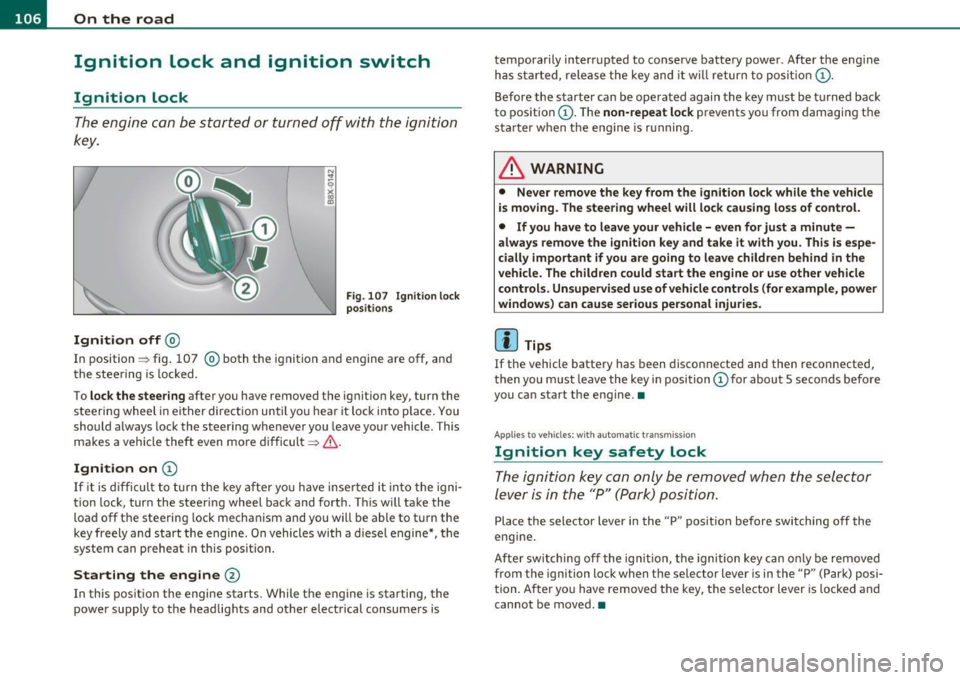
The engine can be started or turned off with the ignition
key.
Ignition off@
Fig. 107 Ignition l ock
p ositions
In position => fig. 107 @ both the ignition and engine are off, and
the stee ring is locked .
To
lock the stee ring after you have removed the ig nit io n key, turn the
steeri ng wheel in either direction until yo u hear it lock into place . You
should always lock the steering whenever you leave your vehicle . This
makes a vehicle theft even more difficult=> & .
Ignition on (D
If it is d ifficul t to turn the key af ter yo u have inse rted it in to the igni
tion lock, tur n the steering wheel back and forth . T hi s w ill take the
load off the steering lock mechanism and you wi ll be able to t urn the
key freely and start the engine . On vehicles with a d iese l engine *, t he
system ca n preheat in this position .
Starting the engine@
In this pos it ion the engi ne s tarts. While the e ngine is s ta rting, the
power supply to the headlights and other electrical consume rs is temporarily interrupted to conserve ba
ttery power . Afte r th e eng ine
h as st arted, relea se the key and it w ill retur n to posit io n (D .
Before the starter can be operated again the key must be t urned back
to positio n (D . T he
non-repeat lock prevents you from damaging the
s ta rt er when t he e ng ine is running .
& WARNING
• Never remove the key from the ignition lock while the vehicle
i s moving . The steering wheel will lock causing loss of control.
• If you have to leave your v ehicle -even for ju st a minute -
always remove the ignition key and take it with you. This is espe·
cially important if you are going to leave children behind in the
vehicle. The children could start the engine or use other vehicle
control s. Unsupervised use of vehicle controls (for example, power
windows ) can cause serious personal injuries .
(I) Tips
If the vehicle battery has been disconnected and then reconnected,
t hen yo u m ust leave the key in posi tion (Dfor abou t
5 seco nds befo re
you can start the eng ine. •
App lies to vehicles: with automat ic transmission
Ignition key safety lock
Th e ignition k ey can only b e removed when the selector
lever is in the "P" (Park) position.
Pla ce the selector lever i n the "P " pos it ion before swit ching off the
eng ine .
Afte r sw itching of f the igni tion , th e ignition key can o nly be re moved
from the ignition lock when t he selector lever is in the "P" (Park) posi
t ion. After yo u have remove d the key, t he selector lever is locked a nd
cannot be moved .•
Page 109 of 320
_________________________________________________ O_ n_ t_ h_ e_ r _o_ a_d _ __.fflll
Starting and stopping the engine
Starting the engine
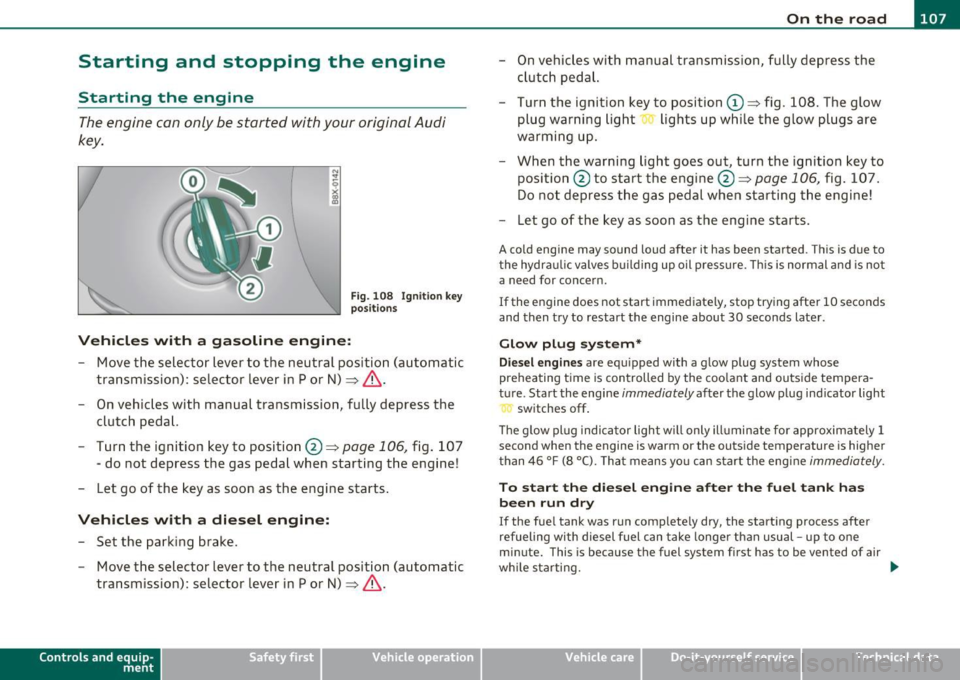
The engine can only be started with your original Audi
key.
N ... q
i
Vehicles with a gasoline engine:
Fig . 10 8 Ignition key
p osit ion s
- Move the selector lever to the neutra l position (automatic
transmission): selector lev er in P or N) =>
& .
- On vehicles with manual transmission, fully depress the
clutch pedal.
- Turn the ignition key to position@ =>
page 106, fig. 10 7
- do not depress the gas pedal when star ting t he engine!
- Let go of the key as soon as the engine starts .
Vehicles with a diesel engine:
- Set the park ing b rake .
- Move the selector lever to the neutral position (automatic
transmission): selector lever in P or N) =>
& .
Con tro ls a nd e quip
m en t Vehicle
OP-eration
- On vehicles with manual transmission , fu lly depress the
cl utch peda l.
- Turn the ignition key to posi tion
(D => fig . 108. The g low
plug warning light lights up whi le the glow plugs are
warming u p.
- When the warning light goes out, turn the ig nition key to
posi tion @to start the engine @ =>
page 106, fig. 107 .
Do not depress t he gas pedal when starting t he engine!
- Let go o f the key as soon as the engi ne starts.
A cold engine may sound loud after it has been started . Th is is due to
t he hydra ulic valves buil ding up oil p ress ure. This is normal and is not
a need for concern.
If the engine does not start immediately, stop try ing after 10 seconds
and then try to restart the engine about 30 seconds later .
Glow plug system*
Diesel engines are equipped with a glow p lug system whose
preheating t ime is con trolled by the coo la nt and outs ide tempera
t u re . Start the engine
immediately af ter the glow p lug ind icator light
sw itches off .
Th e g low pl ug indica tor light w ill only ill uminate fo r approximately 1
second when the engine is warm or the outs ide temperature is higher
than 46 °F (8 °C). Tha t means yo u ca n sta rt the engi ne
immediately.
To start the diesel engine after the fuel tank has
been run dry
If the fue l tank was run complete ly dry, the start ing process after
refueling with diesel fuel can take longe r than usual -up to one
minute. This is because the fuel system first has to be vented of air
wh ile starting. _,.
Vehicle care Do-it-yourselt service Technical data
Page 127 of 320

Driving Safely ---------------------"~'---
Important things to do before driving
Safety is everybody's job! Vehicle and occupant safety
always depends on the informed and careful driver.
For your safety and the safety of your passengers, before
driving always:
- Make sure that all lights and signals are operating
correctly.
- Make sure that the tire pressure is correct.
- Make sure that all windows are clean and afford good visi-
bility to the outside.
- Secure all luggage and other items carefully::::>
page 91.
-Make sure that nothing can interfere with the pedals.
- Adjust front seat, head restraint and mirrors correctly for your height .
- Instruct passengers to adjust the head restraints according to their height.
- Make sure to use the right child restraint correctly to
protect children ::::,
page 167, "Child Safety".
- Sit properly in your seat and make sure that your passen gers do the same::::,
page 73, "General recommenda
tions".
- Fasten your safety belt and wear it properly. Also instruct
your passengers to fasten their safety belts properly
=:> page 135. •
Controls and equip
ment Safety first Vehicle operation
What impairs driving safety?
Safe driving is directly related to the condition of the
vehicle, the driver as well as the driver's ability to concen
trate on the road without being distracted .
The driver is responsible for the safety of the vehicle and all
of its occupants. If your ability to drive is impaired, safety
risks for everybody in the vehicle increase and you also
become a hazard to everyone else on the road::::,,& . There
fore:
Do not let yourself be distracted by passengers or by using
a cellular telephone.
NEVER drive when your driving ability is impaired (by
medications, alcohol, drugs, etc.).
- Observe all traffic laws, rules of the road and speed limits
and plain common sense .
- ALWAYS adjust your speed to road, traffic and weather
conditions.
- Take frequent breaks on long trips. Do not drive for more than two hours at a stretch.
- Do NOT drive when you are tired, under pressure or when
you are stressed .
& WARNING
Impaired driving safety increases the risk of serious personal
injury and death whenever a vehicle is being used.•
Vehicle care Do-it-yourself service Technical data
Page 138 of 320
-Safety belts pn, _______________ _
-Make sure that your passengers also buckle up a nd prop
erly wear their safety belts .
- Protect c hildren with a child rest raint system appropria te
fo r the size and ag e.
The warn ing light ~ in the instrument cluster lights up when the igni
tion is sw itched on as a reminder to fasten the safety belts. In addi
tion, you w ill hear a wa rning tone for a certa in period of t im e.
Fasten your safety belt and ma ke sure that your passenge rs also
properly put on their safety belt s.
& WARNING
• Safety belts are the singl e most effective means available to
reduce the risk of serious injury and death in automobile a cci
dents . For your protection and that of your pas senger s, always
co rrectly wear safety belts when the vehicle is mo ving .
• Failure to pay attention to the warning light that come on,
could lead to personal injur y.
u
Why safety belts?
Frontal collisions and the law of physics
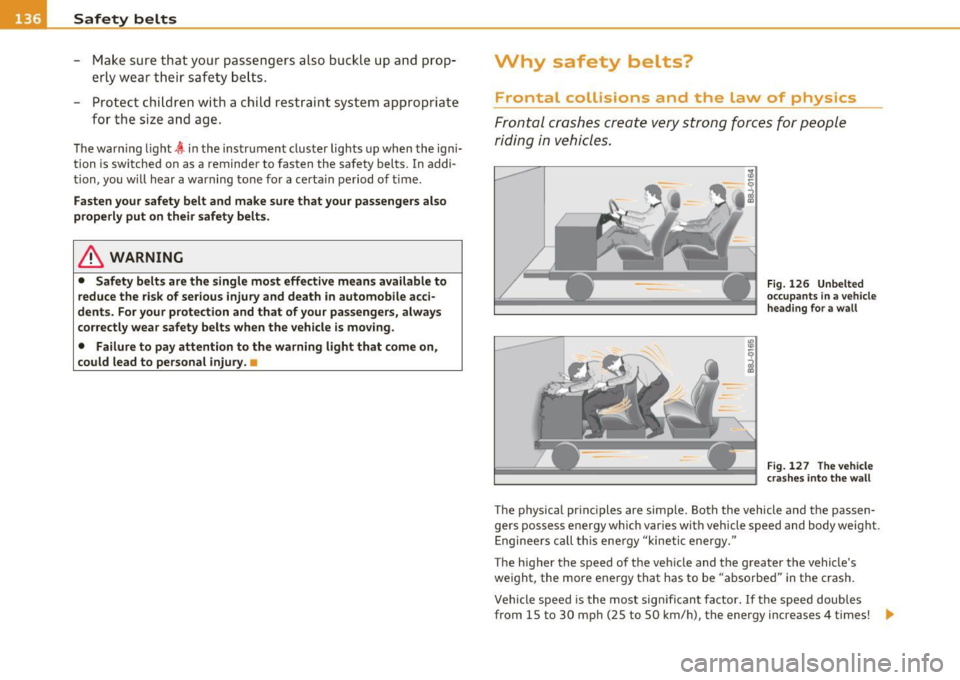
Frontal crashes create very stron g forc es for people
riding i n vehi cles.
Fig . 12 6 U nbelted
o ccupa nts in a vehicle
h eadin g for a w all
Fig . 127 The ve hicle
cr as hes int o t he w all
T he p hys ica l pr inc iples are simple. Both the vehicle and the passen
gers possess energy which var ies wit h veh icle speed and body weight.
Enginee rs ca ll t his ene rgy "kinetic energy."
The higher the speed of the veh icle and the greater the vehicle's
we ight, the more energy that has to be "absorbed" in the crash .
Vehicle speed is the most sig nifican t fa ctor. If t he speed doubles
from 15 to 30 mph (25 to 50 km/h), the energy increases 4 times! .,
Page 203 of 320

Driving and environment
------------------------------------------------'
you start the engine and avoid running at high RPMs while the engine
is still warming up.
0 Note
Do not leave engine idling unattended after starting. If warning
lights should come on to indicate improper operation, they would go
unheeded. Extended idling also produces heat, which could result in
overheat ing or other damage to the vehicle or other property.•
Regular maintenance
A badly tuned engine unnecessarily wastes a lot of fuel.
- Have your vehicle serviced at regular intervals.
By having your vehicle regularly serviced by an authorized Audi dealer
helps to ensure that it runs properly and economically. The condition
of your vehicle not on ly affects its safety and ability to hold its value,
it also affects
fuel consumption .
Check your oil each time you fill your tank.
The amount of oil used is related to engine load and speed.
It is normal for the oil consumption of a new engine to reach its
lowest value after a certain mi leage has been driven.
You must drive you r vehicle about 3,000 miles (5,000 kilometers)
before you can properly assess oil consumption.
Thi s also applies to fuel consumption and engine output.
0 Note
• Have your vehicle maintained properly and in accordance with the
service recommendations in your Warranty
& Maintenance booklet.
Lack of proper maintenance as well as improper use of the vehicle will
impa ir the function of the emission control system and could lead to
damage.
Controls and equip ment Safety first Vehicle operation
•
Do not alter or remove any component of the Emission Control
System unless approved by the manufacturer.
• Do not a lter or remove any device, such as heat shie lds, switches,
ignition w ires, va lves, which are designed to protect your vehicle 's
Emission Control System and other important vehicle components.
Fewer short tr ips
Fuel consumption will always be relatively high on short
trips.
- Try to avoid driving short distances with a cold engine.
The engine and catalytic converter have to reach their optimal oper
ating temperature
to reduce fuel consumption and noxious emis
sions effectively .
• Just after starting, a cold eng ine in a mid-size car burns the fuel at
a poor rate of 6-8 miles per gallon (30-40 l/l00km). Half a mile down
the road, the mileage improves to 12 MPG (20 l/100 km). It will take
the engine no less than
two and a half miles (4 km) of driving to
warm up to its proper operat ing temperature and operate at an
economic mileage . This explains why taking the car for sho rt trips is a
rather wasteful convenience .
• Th e
outside temperature is also critical in this regard . Your car
consumes more fuel in the winter than in the summer.
Vehicle care Do-it-yourself service Technical data
Page 205 of 320

Mirrors
If you are unable to see the traffic beh ind you using the regular
outs ide mirrors, then you
must i nstall extended mirrors. It is impor
tant that you
always have clear vision to the rear.
& WARNING
After removing the trailer hitch, do not store it in your vehicle. In
case of sudden braking, the hitch could fly forward and injure you
or your passengers. •
Operating instructions
Maximum trailer weight
A trailer for your vehicle is lim ited to a typ ical class 1 or class 2 tra iler.
Trailer load distribution
Be sure the load in the trailer is held securely in place to guard aga inst
shifting, be it fo rwa rd, backward or sideways.
Never allow a passenger to ride in a trailer ~ & in "Driving instruc
tions".
Tire pressure
When towing a tra iler, inflate the tires of yo ur veh icle to the co ld tire
pressure listed unde r "Full load" on the sticker on the right doorjamb.
Inflate trailer tires to trai ler and tire manufacturers' specifications.
Lights
T he headlight settings sho uld be checked with the trailer attached
before driving off . Adjust as necessary so that you can see the road
ahead but not blind oncoming traffic.
Check p roper working of vehicle and tra iler lights.
Controls and equip
ment Safety first Vehicle operation
Safety
chains
Be sure trailer safety chains are properly connected from the trailer
to the hitch on the vehicle. Leave enough s lack in the chains to permit
turning corners . When you install safety chains, make sure they will
not drag on the road when you are driving.
The chains should cross under the trailer tongue to prevent it from
dropping in case of separation from the hit ch. •
Driving instructions
Driving with a trailer always requires extra care and
consideration.
To obtain the best possible handling of vehicle and trailer,
please note the following:
- Do not tow a loaded trailer when your car itself is not
loaded .
- Be especially careful when passing other vehicles.
- Observe speed limits.
- Do not drive at the maximum permissible speed .
- Always apply brakes early.
- Monitor the temperature gauge.
Weight distribut ion
Towing a loaded trailer with an empty car results in a highly unstable
distribution of we ight. If th is cannot be avoided drive at very low
speeds only to avoid the risk of losing steering control.
A "balanced " rig is easier to operate and control. This means that the
tow vehicle should be loaded to the extent possible and permiss ible
whi le keeping the trai ler as light as possible under the circumstances .
Whenever possible, transfer some cargo to the luggage compart-
Vehicle care Do-it-yourself service Technical data
Page 209 of 320

____________________________________________ C_l_e _a_ n_ i n--= g=--- a_n_ d----' p,__ r_o _t_ e_ c_ t_ i _o_ n __ lffll'II
High temperatures, as from exposure to intense sunlight, intensify
the corrosive effect particularly when humidity is high as well.
Under certa in circumstances,
weekly washing may be necessary .
Under other conditions, a month ly washing and waxing may be
adequate.
After the winter, the underside of the vehicle should be thoroughly
washed, preferably in a profess ional car wash.
& WARNING
Always read and heed all WARNINGS and other information
=> page 206.
0 Note
You should remove debris (such as insects) from the headlight lenses
on a regular basis, for example when refueling yo ur vehicle. Never
clean the headlights with a dry cloth or sponge. Use a wet cloth or
sponge. It is best to use soapy wate r.•
Automatic car wash
The vehicle can be washed in almost any modern auto
matic car wash.
The vehicle paint is so durable that the vehicle can normally be
washed without problems in an automatic car wash. However, the
effect on the paint depends to a large extent o n the design of the
facility, the filtering of the wash water, the type of wash and care
material, e tc. If the paint has a dull appearance after going through
the car wash or is scratched, bring this to the attention of the oper
ator immediately .
If necessary, use a different car wash.
Before going through a car wash, be sure to take the usual precau
tions such as closing the windows and panoramic sliding sunroof*.
Remove ante nna if applicable.
Safety first
If you have installed additional accessories on the vehicle - such as
spoilers, roof rack, etc. - it is best to ask the car wash operator if these
should be removed.
& WARNING
Always read and heed all WARNINGS and other information
=>page 206. •
Washing the vehicle by hand
A lot of water is needed when washing a vehicle by hand.
-Before you start wash ing, ma ke sure you have read and
understood the WARNINGS ~
& in "General informa
tion" on
page 206.
-First soak all dried dirt until it is soft, then rinse it off.
- As you clean your vehicle, start with the roof and work your
way down to the bottom, using a sponge, a sponge glove
or a clean brush.
- Rinse the sponge or the sponge glove often, flushing it
clean each time.
- Use special car shampoo only for very persistent dirt.
- Rinse the car thoroughly with water .
- Use a chamois leather to gently wipe the exter ior dry .
Use a separate sponge for cleaning the whee ls, door s ills and other
regions exposed to road dirt. In this way, you will not scratch the
paint with coarse particles imbedded in the sponge the next time you
wash the car . .,,
Vehicle care Technical data
Page 210 of 320
-~_C_ le_ a_n_ i_ n_ g=- a_ n_d___. p_ ro_ t_e _c_ t_ i_o _n ___________________________________________ _
in. WARNING
• Do not clean th e undersid e of th e chassis, fend ers, wheel
c over s, or other hard to reach part s without protecting your hand s
and arms. You may cut yourself on sharp -edged m etal p art s.
• Always read and heed all WARNINGS and other information
~page 206.
0 Note
• Never try to remove dirt, mud or d ust if the surface of the vehicle
is d ry. Never use a d ry cloth or s ponge, since this could scratch your
vehicle's paint or windows.
• N ever was h your car in br ight sunlight. D rops of wa ter a ct as
magnifying lenses and may damage your pa int.
• When you was h yo ur c ar in the winter: i f you rinse your vehicle w ith
a hose, be careful not to a im the stream of water direct ly at locks, or
a t doo r o r hatch open ings -they can free ze s hut.
• Never use sponges des igned to remove insects, or any kitchen
s co ur ing sponges o r similar pro ducts. They can damage yo ur paint
fi ni sh .
• Never use a dr y clo th o r sp on ge to clean t he he adlights . Only use
wet cloths or sponges to prevent scratches.
It is best to use soapy
w ate r.
c£> For the sake of the environment
In the in terest of the envi ronme nt, the ve hicl e should o nly be washed
in special wash bays. •
Washing your vehicle with a power washer
Cleaning the ex terior of your c ar with a high-pressure
po wer washer is safe as long as y ou observe a few sim ple
rules.
- Before using the power washer, make su re you have read
and unders tood the WA RNINGS=>
& in "General info r
ma tion" on
page 206.
- Always fo llow t he operat ing inst ructions fo r the powe r
washer.
- Make sure t hat the jet o n the spray hose produces a "fa n
shaped spray".
- Do
not hold the spr ay nozz le too close t o soft ma ter ials .
When cleani ng the vehicle wi th a p owe r w ashe r always follow the
operat ing instruct ions . T his applies part icu larly to the operating
pressure
and the spraying distance. M ain tain a suffic ien t distan ce to
so ft mater ia ls such as rubber hoses and sound/v ibration deaden ing
materials (particularly on the unde rside o f the engine hood). Do not
use a jet wh ic h sprays water in a
direct stream or o ne that has a
rotating jet.
W ate r temperatu re s hou ld not ex ceed 140
°F (60 °().
& WARNING
Never wash tires with a jet that sprays water in a direct stream .
This could cause in visible damage to the tires and weaken them ,
even if the spray i s from a relatively long distance and for a short
time . Damaged and weakened tires can fail and c ause accidents
and personal injur y.
~
Page 232 of 320
___ C_ h_ e_c _k _i _ n _g ~ a_n _d_ f_il _l_in _ g _________________________________________ _
Under some circumstances the engine oil should even be changed
more frequently. Change oil more often if you drive mostly short
distances, operate the vehicle in dusty areas or mostly under stop
and-go traff ic conditions, or when you use your vehicle where temper
atures stay below freezing point for long periods .
Detergent additives in the oil will make fresh oil look dark after the
engine has been run ning for a short time . This is normal and is not a
reason to change the oil more often than recommended .
Damage or malfunctions due to lack of maintenance
It is essentia l that you change your oi l at the recommended intervals
using only engine oil that complies with Audi oi l standard VW 502 00
(vehicles with gasoline engine) or VW 507 00 (vehicles with diesel
engine). Your Limited New Vehicle Warranty does not cover damage
or malfunctions due to failure to follow recommended maintenance
and use requirements as set forth in the Audi Owner's Manua l and
Warranty
& Maintenance booklet. Your dealer will have to deny
warranty coverage unless you present to the dealer proof in the form
of Service or Repair Orders that all scheduled maintenance was
performed in a timely manner .•
Engine oil consumption
The engine in your vehicle depends on an adequate
amount of oil to lubricate and cool all of its moving parts.
In order to provide effective lubrication and cooling of internal
engine components, all internal combustion engines consume a
certain amount of o il. Oil consumpt ion varies from engine to engine
and may change significant ly over the life of the eng ine. Typically,
engines with a specified break- in period (see~
page 197) consume
more oi l during the break-in period than they cons ume after oil
consumption has stabilized.
Under normal cond itions, the rate of oil consumpt ion depends on the
quality and vis cosity of the oil, the RPM (revol utions pe r minute) at
which the engine is operated, the ambient temperature and road
conditions. Further factors are the amount of oi l dilution from water condensation or fuel residue and the ox
idation level of the o il. As any
eng ine is subject to wear as mileage builds up, the oil consumption
may increase over time until replacement of worn components may
become necessary.
With all these variab les coming into play, no standard rate of oil
consumption can be established or specified. There is no alternative
to regular and frequent checking of the oil level , see
Note .
If the yellow engine oil level warning symbol in the instrument
cl uster .... lights up, you should check the oil level as soon as possible
with the oil dipstick~ page 231. Top off the o il at your earliest
convenience ~
page 232.
& WARNING
Before you check anything in the engine compartment, always
read and heed all WARNINGS~
& in "Work ing in the engine
compartment" on
page 226.
0 Note
Driving with an insufficient oil level is likely to cause severe damage
to the engine .
[ i ] Tips
• The oil pressure warning display 't::r. is not an indicator of the oil
level. Do not rely on it. Instead, check the oil level in your engine at
regular intervals, preferably each time you refuel, and alway s
before going on a long trip.
• If you have the impression your eng ine consumes excessive
amounts of oi l, we recommend that you consu lt your authorized Audi
dea ler to have the cause of your concern properly diagnosed. Keep in
mind that the accurate measurement of oil consumption requires
great care and may take some time . Your authorized Audi dea le r has
instructions about how to measure oil consumption accurately. •
Page 242 of 320
-L~C::!h~e~c~k:.!_i~n~g~a~n~d~f~il~l:!_!in~g !...._ ________________________________________ _
The following WARNINGS are very important when
working on the battery:
Always heed the following WARNING SYMBOLS and safety pre cautions when working on the battery .
@
®
Always wear eye protection.
Battery acid contains sulfuric acid. Always wear
gloves and eye protection.
No
• s parks
- flames
• smoking .
When a battery is charged, it produces hydrogen
gas which is explosive and could cause persona l
injury.
Always keep the battery well out of reach of chil
dren .
& WARNING
Whenever working on the battery or on the electrical system,
there is the risk of injury , accident and even fire. Read and heed
the following WARNINGS:
• Always wear eye protection . Do not let battery acid or any lead
particles get on your skin or clothing. Shield your eyes . Explosive
gases can cause blindness or other injury!
• Battery acid contains sulfuric acid. Sulfuric acid can cause blindness and severe burns.
-Always wear gloves and eye protection. Do not tilt the
battery because acid could leak out of the ventilation open
ings.
& WARNING (co ntinued )
-If you get battery acid in your eyes or on your skin, immedi
ately rinse with cold water for several minutes and get medical
attention.
- If you should ingest any battery acid, seek medical attention
immediately.
• Do not expose the battery to an open flame, electric sparks or
an open light .
• Do not smoke.
• Do not interchange the positive and negative cables.
• When working on the battery , be sure not to short-circuit the
terminals with tools or other metal objects. This would cause the battery to heat up very quickly, which could lead to damage or
explosion and personal injury.
• When a battery is charged , it produces hydrogen gas which is
explosive and could cause personal injury.
• Always keep the battery well out of the reach of children.
• Before work is done on the electrical system, disconnect the
negative ground cable.
• Before performing any work on the electrical system, switch
off the engine and ignition as well as any electrical equipment.
The negative cable on the battery must be disconnected . If you are
just going to replace a light bulb, then it is enough to switch off the lights.
• Before disconnecting the battery, switch off the anti-theft
alarm system! Otherwise you will set off the alarm .
• When disconnecting the battery, first disconnect the negative
cable and then the positive cable .
• Before reconnecting the battery, make sure all electrical
consumers are switched off . Reconnect the positive cable first and
then the negative cable. Never interchange the cables· this could start a fire! ..,_