brake AUDI S3 2011 Workshop Manual
[x] Cancel search | Manufacturer: AUDI, Model Year: 2011, Model line: S3, Model: AUDI S3 2011Pages: 320, PDF Size: 75.79 MB
Page 249 of 320

________________________________________________ T_i_re _ s_ a _ n_d_ w_ h_ e_ e_l_s __ lffll
Groove
means the spa ce between two ad jacen t tread ribs .
Load rating (code)
mea ns the max imu m load th at a tir e is ra te d to c arry fo r a give n infla
tion pressure. You may not find this information on all t ires beca use
i t is no t required by law .
Maximum load rat ing
me ans the load r ati ng for a t ire at th e maxi mum p ermis sib le in flation
pressure for that tire.
Maximum loaded vehicle weight
means the sum of:
(a) Curb weight
(b) Accessory weig ht
(c) Vehicle ca pacity we ight, and
(d) Pro duct ion op tions weigh t
Maximum (permissible) inflation pressure
means the m aximu m cold infla tio n pr essur e to whi ch a t ire may be
inflated . Also called "maximum inflat ion press ure."
Normal occupant weight
means 150 lbs. (68 k ilog rams) times t he num ber of occupants seate d
in t he vehi cle up to the total sea ting cap aci ty of yo ur vehicl e.
Occupant distribution
means d is tribut ion of occ upan ts i n a vehicle.
Outer diameter
means the ove rall d iameter of an inflated new tire.
Overall width
means the linear distance betwee n the exter iors of the s idewalls of
a n in flated tire, in cludi ng eleva tions due to la beling, dec ora tions, o r
protective bands or ribs.
Safety first
Ply
means a layer o f rubbe r-coate d para llel co rds.
Production options we ight
me ans the co m bine d we ight of tho se in stalled regu lar pr oduction
options weighi ng over 5 lbs. (2.3 kg) in excess of t hose standard
i t ems w hic h they replace, not previously considere d in c urb we igh t o r
accessory weight, includ ing heavy duty brakes , ride levelers, roof
rack, heavy duty battery, and s pecial tr im.
Radial ply tire
me ans a pneuma tic tir e in wh ich the pl y cords that extend to t he
beads are laid at substantially 90 degrees to the centerline of the
t rea d.
Recommended inflation pressure
see => page 246 , "C old tire in fla tion pr essu re".
Reinforced tire
mea ns a t ire designe d to ope rate at hig her loads an d at higher infla
tion pressures than the co rresponding standard ti re. Reinforced t ires
my be iden tifi ed as " XL", "xl", "E XTRA LOAD", o r "R F" on the s idew all.
Rim
mea ns a metal suppo rt fo r a tire or a tire and tube assemb ly up on
wh ic h the t ire beads are seated.
Rim diameter
means nom inal d iameter of the bead seat . If you change yo ur whee l
si ze, yo u w ill have to purchase new tires to ma tc h the new r im diam
eter .
Rim size designation
means r im diamete r and width.
Rim width
mea ns nom inal dis tance be twee n rim flanges.
Vehicle care Technical data
Page 253 of 320

Tires and wheels Ill
----------------
Engine Tire designation Tire pressure front Tire pressure rear
(displace- normal load normal load
ment in
liter ) condition (up full load condition (up full load
to 3 occu- condition to 3 occu- condition
pants) pants)
PSI kPA PSI II kPA PSI II kPA PSI II kPA
4-cylinder 205/55 R1 6 91H All Season 36 250 39 270 30 210 36 250
2 .0 TDI
225 /45 Rl 7 94H XL All Season 38 260 41 280 32 220 38 260 (clean diesel )
225 /45 R1 7 94V XL High Performance
35 240
38 260
30 210
35 240
225
/40 R18 92V XL High Performance 35 240 38 260 30 210 38 260
Compa ct spare wheel T125 /70 R18 60 420 60 420 60 42 0 60 420
XL = reinforced or extra load tire . It may also appear as x i, EXTRA LOAD , or RF on the tire sidewall.
The correct tire pressure for the
spare wheel is located on a label
ei ther on the driver 's s ide B -pillar or inside the fuel fille r flap.
Because technical changes may be made to vehicle equipment dur ing
the model year, a lways compare the tire size des ignation on the tire
pressu re label on you r vehicle w ith the t ires on your veh icle . Make
sure that the tire si ze information on the vehicle labe l is the same as
the s ize of the t ires o n the vehicle . This is especially important if the
vehicle belongs to someone else or you bought the vehicle with
different r ims/ tires or you bo ugh t the vehicle as a previously owned
vehicle. pants and
luggage or other cargo that the vehicle can carry. For the
location o f the tire p ressure label=>
page 249, fig. 17 1.
& WARNING
Overloading a vehicle can cause lo ss of vehicle control , a cra sh or
othe r accident, serious personal injury , and even death .
• Carrying more we ight than your vehicle wa s designed to carry
will p revent the vehicle from handling prope rly and increa se the
risk of a lo ss of vehicle control.
• The brake s on a vehicle that has been o verloaded may not be
able to stop the v ehicle within a saf e distance .
• Tires on a vehicle that has been ove rloaded can fail suddenly
causing loss of control and a crash .
• Always make sure that the tot al load being transported -
including the weight of a trailer hitch and the tongue weight of a
loaded trailer -doe s not make the vehicle hea vier than the
I
I
Remember, your safety and tha t of your passengers also depends on
maki ng sure that load lim its are not exceeded . Vehicle load includes
everybody and everything in and on the vehicle. These load limits are
technically referred to as the ve hicle's G ross Vehicle Weig ht Rating
("GVWR") . The Gross Axle Weight Rat ing ("GAWR") is the max imum
load th at c an be applied at ea ch of the veh icle 's two ax les. The G ross
Vehicle Weight Rat ing and the Gross Ax le We ight Rating are listed on
t he safety comp liance st ic ke r label lo cated ei ther on the d river 's s ide
B-pillar or on the inside of the fuel filler f lap. The tire p ressure label
on yo ur Audi lists t he maximum com bined weight o f all of the occu -
vehicle 's Gross V ehicle We ight Rating. ~
Safety first Vehicle care Technical data
Page 256 of 320
_L_T.:...:..: i r~ e:.: s~ a:::. n:..:..:: d:.....: w..:...:. h::e:.: e::.:: ls::::._ ______________________________________________ _
is more difficult to stop. Overloading can not only lead to loss of
vehicle control, but can also damage important parts of the vehicle
and can lead to sudden tire failure, including a blowout and sudden
deflation that can cause the vehicle to crash.
Your safety and that of your passengers also depends o n making sure
that load limits are not exceeded. Vehicle load includes everybody
and everything in and on the vehicle. These load limits are techn ically
referred to as the veh icle's
Gross Vehicle Weight Rating ("GVWR").
Th e "GVWR" includes the weight of the basic vehicle, all factory
installed accessories, a full tank of fuel, o il, coolant and other fluids
plus maximum load. The maximum load includes the number of
passenge rs that the vehicle is intended to carry ("seating capacity")
with an assumed weight of 150 lbs (68 kg) for each passenger at a
designated seating posit ion and the total weight of any luggage in
the vehicle. If you tow a trailer, the weight of the trailer hitch and the
tongue weight of the loaded trailer must be included as part of the
vehicle load.
T he Gross Axle Weight Rating ("GAWR") is the maximum load that
can be applied at each of the vehicle's two ax les.
The Gross Vehicle We ight Rating and the Gross Axle Weight Rat ing
are listed on the safety compliance sticker label located e ithe r on the
dr iver's s ide B-pillar or on the inside of the fuel filler flap. Your Audi
has 5 seating positions, 2 in the front and 3 in t he rear for total
seating capacity of 5. Each seating position has a safety belt
=> page 135, "Safety belts".
The fact that there is an upper limit to your veh icle's Gross Veh icle
Weight Rating means that the total weight of whatever is being
carried in the veh icle (in cluding the weight of a trailer hitch and the
tongue weight of the loaded trailer) is limited . The more passengers
in the vehicle or passengers who are heavier than the standard
we ights assumed mean that less we ight can be carr ied as luggage.
Th e tire pressure label on your A udi also lists the maximum combined
we ight of all of the occupants and luggage or other cargo that the
vehicle can carry. For the location of the labe l=>
page 249, fig. 171.
& WARNING
Overloading a vehicle can cause loss of vehicle control, a crash or
other accident, serious personal injury, and even death.
• Carrying more weight than your vehicle was designed to carry
will prevent the vehicle from handling properly and increase the
risk of the loss of vehicle control.
• The brakes on a vehicle that has been overloaded may not be
able to stop the vehicle within a safe distance.
• Tires on a vehicle that has been overloaded can fail suddenly,
including a blowout and sudden deflation, causing loss of control
and a crash.
• Always make sure that the total load being transported -
including the weight of a trailer hitch and the tongue weight of a
loaded trailer -does not make the vehicle heavier than the
vehicle's Gross Vehicle Weight Rating .•
Determining correct load limit
Use the example below to calculate the
total weight of the passengers and luggage
or other things that you plan to transport so
that you can make sure that your vehicle
will not be overloaded. ._
Page 259 of 320

________________________________________________ T_ i_ re _ s_ a_ n_d_ w_ h_ e_ e_l _s _ ....... 91
Incorrect wheel alignment
In correct whee l al ignme nt can ca use excessive tir e wea r, impairing
th e sa fety o f the vehicl e. If t ires show excessive w ear, hav e the w heel
alignment checked by a n authorized A udi dea ler or qualifie d work
shop.
All Wheel Drive
Vehicles wi th quattro® must always have tires of the same size ,
con st ruct ion an d tread type . For details see~
page 194.
& WARNING
Sudden tire failure can lead to los s of control, a cra sh and serious
personal injury!
• Never drive a vehicle when the tread on any tire is worn down
to the wear indicators.
• Worn tires are a safety hazard, they do not grip well on wet
roads and increase your risk of "hydroplaning" and loss of control.
• Always keep chemicals that can cause t ire damage, such as
grease , oil, gasoline and brake fluid away from tires.
• Tires age even if they are not being used and can fail suddenly,
especially at high speeds. Tires that are more than 6 years old can
only be used in an emergency and then with special care and at
lower speeds.
• Never mount used tires on your vehicle if you are not sure of
their "previous history. " Old used tires may have been damaged
even though the damage cannot be seen that can lead to sudden
tire failu re and loss of vehicle control. •
Vehicle OP-eration
New tires and replacing tires and wheels
New t ires an d w hee ls have to be brok en in .
Fig. 175 Tire specificat ion codes on th e sidewall of a tire
No.
©
®
®
©
©
©
Description
Passenger car tire (where applicable)
Nom inal wid th of ti re in mil limeters
Ratio of hei9ht to width (aspect ratio)
Radial
jj Rim diameter code
L oa d index and speed rating
Vehicle care Do-it-yourselt service iTechnical data
Page 262 of 320
-~_T_ i_ re _ s_ a_n _ d_ w_ h _e_ e_ ls _________________________________________________ _
& WARNING (conti nu ed )
ev en though the damage cannot be seen that can lead to sudden
tire failure and lo ss of vehicl e control.
• All four wheels must be fitted with radial tires of the same
type, size (rolling circumference ) and the same tread patte rn .
Driving with different tires reduces vehicle handling and can lead
to a los s of control.
• If the spare t ire is not the same as the tires that are mounted
on the vehicle -for example with winter tires -only use the spare
tire for a short period of time and drive with e xtra care. Refit the
normal road wheel as soon a s safely possible.
• Never drive faster than the maximum speed for which the ti res
on your vehicle are rated because tires that are driven faster than
their rated speed can fail suddenly .
• Overloading tire s cau se heat build-up, sudden tire failure,
including a blowout and sudden deflation and loss of control.
• Temperature grades apply to tires that are properly inflated
and not o ver or underinflated.
• For technical reasons it is not always possible to use wheels
from other vehicle s- in some cases not even wheels from the same
vehicle model.
• If you install wheel trim discs on the vehicle wheels, make sure
that the air flow to the brakes is not blocked. Reduced airflow to
the brakes can them to overheat , increa sing stopping distance s
and causing a collision.
• Run flat tires may only be used on vehicles that were equipped
with them at the factory. The vehicle must have a chassis designed
for run flat tires and a factory-in stalled tire pres sure monitoring
sy stem* that indicates a loss of tire pressure . Incorrect use of run
flat tires can lead to vehicle damage or accidents. Check with an
authorized Audi dealer or tire speciali st to see if your vehicle can
be equipped with run flat tires .
If run flat tires are used, they must
be installed on all four wheels. Mixing tire types is not permitted .
0 Note
• For tech nica l reasons, it is no t gene rally poss ible to use the wheel
r ims from other vehicles. This ca n hold t rue for w heels of the same
vehicle type .
• If the spa re tire is different from the tires t hat you have mounte d
on you r vehi cle (fo r exa mple w inte r tir es or wide profi le tires), then
use the spa re t ire for a short perio d of time on ly and d rive with e xtra
c are. Replace t he f lat tire w it h t he ti re m atch ing t he ot hers on yo ur
vehicle as soon as possible.
• If you put diffe rent whee ls and t ires o n your ve hicle (e.g . winter
w heels and tires), yo u must be certain t hat the whee ls and tires are
c omp atib le w ith the tire press ure mon ito ring system* . O th erwise the
system will register a malfunction and a fault message w ill be
displayed. For m ore infor mati on, con ta ct y our au thor ized Aud i
dea ler.
• N ever dr ive witho ut the valve stem c ap. The valves could get
damaged.
For the sake of the environment
Dispose of old t ires in accordance with the loca l requ irements. •
Uniform tire quality grading
• Tread wear
• Tr act io n AA A B C
• T emperat ure A B C
Q uali ty g rades can be fo und where applicab le on the tir e s ide wall
between tread sho ulder and max imum sect ion width ~
page 257,
fig. 175.
For example: Tread wear 200, Tract ion
AA , Temperat ure A.
All passenger ca r tires must confo rm to Federa l Safety Requirements
i n addition to these grades. .,_
Page 265 of 320
________________________________________________ T_i_re _ s_ a _ n_d_ w_ h_ e_ e_l_s __ _
& WARNING (co ntinued )
• Snow chain s are available in different sizes. Always make sure
to follow the instructions provi ded by the snow chain manufac
turer.
• Wh en driving with snow cha in s never drive fa ster than the
speed permitted for your specific snow chains .
• Always observe local regulations.
0 Note
• Remove snow chains before d riving on roads not cove red w it h
snow to avoid damaging t ires and wearing t he snow chains down
unnecessar ily .
• Snow chains, which come into direct contact wi th the wheel rim,
can scratch or damage it . The refore, make s ure that the snow chai ns
are sui tably covered. Chec k the pos it ion o f the snow cha ins afte r
driving a few yards and correct if necessary . Follow the instructions
from t he snow chain man ufacturer when doing so .
[ i] Tips
• Where snow chains are mandatory on certa in roads, this normally
also app lies to ve hicles wi th A ll W hee l Dr ive.
• If snow chains are installed, the tire p ress ures s houl d not be
sto red in the tire pressure moni to ring system (TPMS) . Otherwise the
system could malfunction ~
page 267. •
Wheel bolts
Wheel bolts must al ways be tight ened to the c orrect
torqu e.
The desig n of whee l bolts is matc he d to the fa ct ory in stalled rims. If
different r ims are fitted, the cor rect wheel bo lts wi th t he r igh t length
and correctly s haped bolt hea ds must be used . Thi s ensures that
Safety first
wheels are fitted securely and that the brake system funct ions
cor rectly .
I n certa in circumstances, yo u may not use wheel bo lts from a
different vehicle -even if it is the same mo del.
& WARNING
Improperly tightened or maintained wheel bolts can be come
loose causing loss of control, a collision and serious personal
injury.
• Always keep the wheel bolts and the threads in the wheel hubs
clean so the wheel bolt s can turn easily and be properly tightened .
• Never grease or oil the wheel bolts and the th reads in the wheel
hub s. They can become loose while driving if greased or oiled, even
if tightened to the specified torque.
• Only use wheel bolt s that belong to the rim being installed .
• Never use different wheels bolts on your vehicle .
• Always maintain the correct tightening torque for the wheel
bolts to reduce the risk of a wheel loss. If the tightening torque of
the wheel bolts is too low, they can loo sen and come out when the
vehicle is moving . If the tightening torque is too high , the wheel
bolt s and thread s can be damaged and the wheel can become
loose.
0 Note
T he specified torq ue for the wheel bo lts is 90 ft lb (120 Nm) with a
t o le rance of ± 7,4 ft lb( ± 10 N m). Tor qu e wheel bo lts diagonally.
After cha nging a wheel, the torque must be checked as soon as
pos sible wi th a t orque w rench -prefer ably by an auth oriz e d Aud i
dealer or qualified workshop .•
Vehicle care Technical data
Page 274 of 320
-What do I do now? Pllf...__ ______________ _
& WARNING (continued)
no circumstances should you store the spare wheel or jack and
tools uns ecured in the passenger compartment. Thi s could cause
serious personal injury to passengers in the vehicle in case of a
c ollision.
• The compact spare ti re is for temporary use only and is so
marked on the sidewalls .
• Do not d riv e at speeds e xceeding 50 mph (80 km/h ) with the
compact spare wheel mounted . Also rapid acceleration, hard
braking and hard corne ring must be avoided to help prevent loss
of vehicle control.
• Any continuous road use of the compact spare tire may result
in tire failure, los s of vehicle control and injury to vehicle occu
pants.
• Do not put a snow chain on your compact spare tire. Due to the
smaller tire size, the chain will not fit properly and can thus
damage your vehicle. You could also lose th e chain, as well as
control of the vehicle .
• If you have a flat front tire in road cond itions which require
snow chains , first remove the undamaged rea r wheel and mount
the compact spare wheel in its place . Then remove the damag ed
front wheel, take the snow chains off it and attach them to the
wheel taken from the rear. Thi s wheel can now be mounted on the
front with its snow chains. Check and adjust tire pressure
promptly.
• Never use two or more compact spare tires at the same time .
0 Note
When using the compact spare wheel, note the following:
• After i nstalling the compact spare w heel, the t ire inflation pres
sure should be checked and, if necessary, increased to 60 ps i
(4.2
bar). •
The load carry ing capac ity is marked on t he tire sidewalls and
mus t not be excee ded.
• After installing the compact spare wheel, make sure that yo u
remoun t the fla t ti re in its sto rage are a properly.
• The compact spare tire should be properly remo unted in its
st ora ge area as soo n as th e s tand ard road ti re c an be repla ced.
• Beca use the compact spare tire was specif ically des igned for your
veh icle, it must not be use d on any other veh icle . Likew ise, compact
spare wheels from other vehicles m ust not be used on your vehicle.
• Th e compac t spare tire must not be mounted on any other w heels,
nor m ust standard t ires, snow tires, wheel covers or tr im rings be
used w ith the compact spa re wheel.
If suc h use is a ttempted, damage
to these items or othe r vehicle components may occur.
[ i ] Tips
Check the inflation p ress ure o f the compact spare tire (60 psi/4.2
bar) pe riodic ally to kee p t he ti re read y for use. •
Wheel change
Before changing a wheel
Observe the f oll owing pre cautions for your own and your
passenger's safety when changing a whee l.
- After you exper ience a t ire fa ilure, pu ll t he ca r well away
from movin g traf fic and try to reach
level grou nd before
you stop => & .
- All p asse ngers s hou ld
leave the car a nd move to a safe
locat ion (for instance, beh ind th e guardrai l) => & .
- Apply the
parking brake fi rmly=> &.
Page 275 of 320
What do I do now? -________________ Vflll
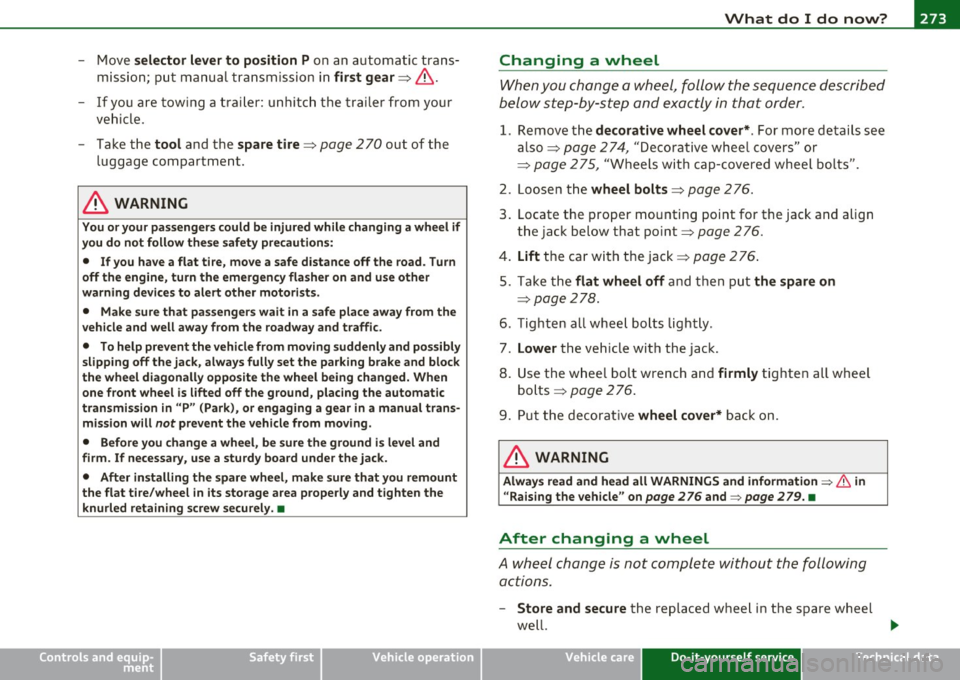
- Move selector lever to position Pon an automatic trans
mission; put manual transmission in
first gear=> &.
-If you are towing a trailer: unhitch the trailer from your
vehicle.
- Take the
tool and the spare tire=> page 270 out of the
luggage compartment.
& WARNING
You or your passengers could be injured while changing a wheel if
you do not follow these safety precautions:
• If you have a flat tire, move a safe distance off the road. Turn
off the engine, turn the emergency flasher on and use other
warning devices to alert other motorists.
• Make sure that passengers wait in a safe place away from the
vehicle and well away from the roadway and traffic.
• To help prevent the vehicle from moving suddenly and possibly
slipping off the jack, always fully set the parking brake and block
the wheel diagonally opposite the wheel being changed. When one front wheel is lifted off the ground, placing the automatic
transmission in "P" (Park), or engaging a gear in a manual trans
mission will
not prevent the vehicle from moving.
• Before you change a wheel, be sure the ground is level and
firm. If necessary, use a sturdy board under the jack .
• After installing the spare wheel, make sure that you remount
the flat tire/wheel in its storage area properly and tighten the
knurled retaining screw securely. •
Safety first
Changing a wheel
When you change a wheel, follow the sequence described
below step-by-step and exactly in that order.
1. Remove the decorative wheel cover*. For more details see
also =>
page 274, "Decorative wheel covers" or
=> page 275, "Wheels with cap-covered wheel bolts".
2. Loosen the
wheel bolts=> page 276.
3. Locate the proper mounting point for the jack and align the jack below that point=>
page 276.
4.
Lift the car with the jack=> page 2 76.
5. Take the
flat wheel off and then put the spare on
=> page 278.
6. Tighten all wheel bolts lightly.
7.
Lower the vehicle with the jack.
8. Use the wheel bolt wrench and
firmly tighten all wheel
bolts=>
page 276.
9. Put the decorative
wheel cover* back on.
& WARNING
Always read and head all WARNINGS and information~ & in
"Raising the vehicle" on
page 276 and~ page 279. •
After changing a wheel
A wheel change is not complete without the following
actions.
- Store and secure the replaced wheel in the spare wheel
well. .,._
Vehicle care Do-it-yourself service Technical data
Page 279 of 320

_____________________________________________ W __ h_a _ t_ d_o_ I_ d _ o_ n_o_ w_ ? _ ___.fl'I
F ig. 190 Close -u p :
pro per po sit io ning of
lifting ja ck
- Activate t he parking brake so the vehicle wi ll not ro ll unin
tentionally .
- S hift into 1st gear on vehicles wit h manua l tra nsmiss ion,
o r mov e the selector lever to the P position on vehicles
with automatic transmissio n.
- Position t he jack be low the door sill under the mounting
point that is closest to the whe el to be chang ed
~ page 276, fig . 189 .
- Turn the jack handle cloc kwise un til the jack arm just fits
underneath t he rib running along t he under body
~ &, .
- Align the jack so that the jack arm claw~ fig . 190 @fits
snugly a round the underbody rib an d the mova ble base
plate ® sits flat o n the groun d. T he base ® must be
vertical unde r th e lifting point @.
- W ind the jac k up fu rt h er u ntil the flat whee l co mes o ff the
groun d~ &, .
Recesses at the front and rear of the u nderbody rib mark the proper
mounting lo cat io ns for the jack =>
page 2 76, fig. 189. The re is only
one
designated jack mount ing point for each wheel. Do not apply the
j a ck anywhe re else:::::, &.
Vehicle OP-eration T
he jack shou ld be posi tioned appro ximately 6 in . (15 cm) behind the
front wheel or 10 i n. ( 25 cm) in fron t of t he rea r w heel.
An
un stable surface u nder the jack can cause the vehicle to slip off
the jack. Always provide a firm base for the jack on the grou nd .
If
necessary pla ce a st urdy boar d or sim ilar su ppo rt unde r the jack. On
hard , slippery surf aces (s uch as ti les) use a rubber mat or s imilar to
preven t the j ack from sli pping =>& .
& WARNING
• You or your passengers could be injured while changing a
wheel if you do not follow safety precautions:
-Mounting the jack under the vehicle at any other place than
indicated above may damage the vehicle or may result in
personal injuries.
- A soft o r unstable surface under the j ack may cause the
vehicle to slip off the ja ck . Alway s provide a firm base for the
jack on the ground.
If necessary, use a sturdy board under the
jack.
- On hard , slippery surface (such as tiles ) use a rubbe r mat or
similar to prevent the ja ck from slipping.
• To help prevent injury to yourself and your pa ssengers:
- Do not raise the vehicle until you are sure the j ack i s securely
engaged.
- Passengers must not remain
in the vehicle when it is ja cked
up.
- Make su re that passengers wait in a safe place away from the
vehicle and well away from the roadway and traffic.
- Make sure jack position is correct, adjust as necessary and
then continue to raise the jack. •
Vehicle care Do-it-yourself service iTechnical data
Page 280 of 320
lffll.,___W_ h_ a_t _ d_ o_ I_d_ o_ n_o _w_ ? ___________________________________________ _
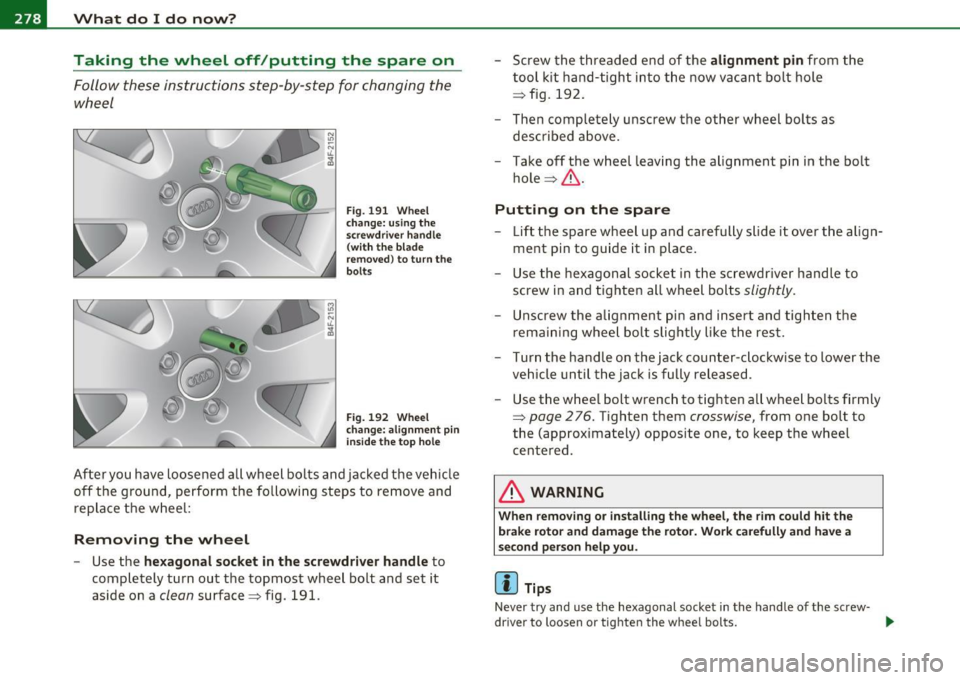
Taking the wheel off/putting the spare on
Follow these instructions step-by-step for changing the
wheel
M
"' ;;; u.
1li
Fig . 191 Wheel
change: using the
screwdriver handle
(with the blade
removed) to turn the
bolts
Fig. 192 Wheel
change: alignment pin
inside the top hole
After you have loosened all wheel bolts and jacked the vehicle
off the ground, perform the following steps to remove and
replace the wheel:
Removing the wheel
- Use the hexagonal socket in the screwdriver handle to
completely turn out the topmost wheel bolt and set it
aside on a
clean surface=> fig. 191. -
Screw the threaded end of the
alignment pin from the
tool kit hand-tight into the now vacant bolt hole
=> fig. 192.
- Then completely unscrew the other wheel bolts as
described above.
- Take off the wheel leaving the alignment pin in the bolt
hole=> &.
Putting on the spare
- Lift the spare wheel up and carefully slide it over the align
ment pin to guide it in place.
- Use the hexagonal socket in the screwdriver handle to
screw in and tighten all wheel bolts
slightly.
Unscrew the alignment pin and insert and tighten the
remaining wheel bolt slightly like the rest.
- Turn the handle on the jack counter-clockwise to lower the vehicle until the jack is fully released.
- Use the wheel bolt wrench to tighten all wheel bolts firmly
=>
page 276. Tighten them crosswise, from one bolt to
the (approximately) opposite one, to keep the wheel
centered.
& WARNING
When removing or installing the wheel, the rim could hit the
brake rotor and damage the rotor. Work carefully and have a
second person help you.
(I) Tips
Never try and use the hexagonal socket in the handle of the screw-
driver to loosen or tighten the wheel bolts.
~