engine AUDI S3 2015 Owners Manual
[x] Cancel search | Manufacturer: AUDI, Model Year: 2015, Model line: S3, Model: AUDI S3 2015Pages: 310, PDF Size: 76.15 MB
Page 278 of 310
2 76 Fuses and bulbs
Fuses and bulbs
Electrical fuses
Replacing fuses
Fuses that have blown will have metal strips
that have burned through.
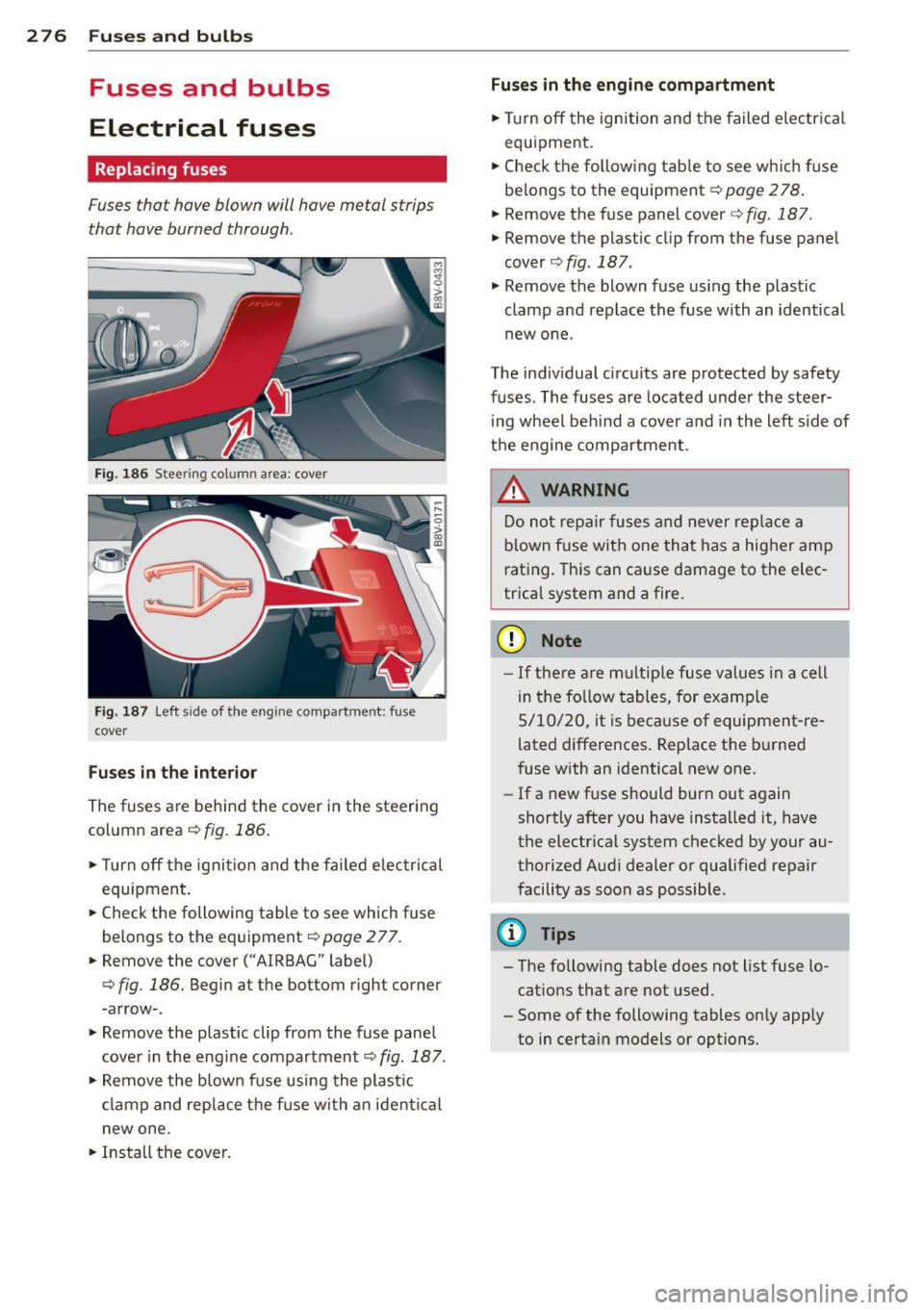
Fig. 186 Steering column area: cover
Fig. 187 Left side of the engi ne co mpar tmen t: fuse
cover
Fuses in the interior
The fuses are behind the cover in the steering
column area
¢ fig. 186.
"'Turn off the ignition and the failed electrical
equipment.
"'Check the following table to see which fuse
belongs to the equipmen t
¢page 277.
"'Remove the cover ("AIRBAG" label)
c:> fig. 186. Begin at the bottom right corner
-arrow- .
"' Remove the plastic clip from the fuse panel
cover in the eng ine compartment
c:> fig. 187.
"' Remove the blown fuse using the plast ic
clamp and replace the f use with an ident ica l
new one.
"'Install the cover.
Fuses in the engine compartment
"'Turn off the ignition and the failed electrical
equipment.
"' Check the following table to see which fuse
belongs to the equipment
c::;, page 2 78.
"'Remove the fuse panel cover ¢fig. 187 .
"'Remove the plastic clip from the fuse panel
cover
c:> fig. 187.
"' Remove the blown fuse using the plastic
clamp and replace the fuse with an identical
new one.
The indiv idual circuits are protected by safety
fuses. The fuses are located under the steer
ing wheel beh ind a cover and in the left side of
the engine compartment .
_&. WARNING
-
Do not repa ir fuses and never replace a
blown fuse with one that has a higher amp
rating. This can cause damage to the elec
trica l system and a fire.
(D Note
- If there are multip le fuse values in a cell
in the follow tables, for examp le
5/10/20, it is because of equipment-re
lated differences. Replace the burned
fuse with an identical new one .
-If a new fuse should burn out again
shortly after you have installed it, have
the electrical system checked by your au
thorized Audi dealer or qualified repair
facility as soon as possible .
(D Tips
- The following table does not list fuse lo
cations that are not used.
- Some of the following tables on ly apply
to in certain models or options.
Page 279 of 310
....,
N
0 > co
rl I.O
"' ....,
"' rl
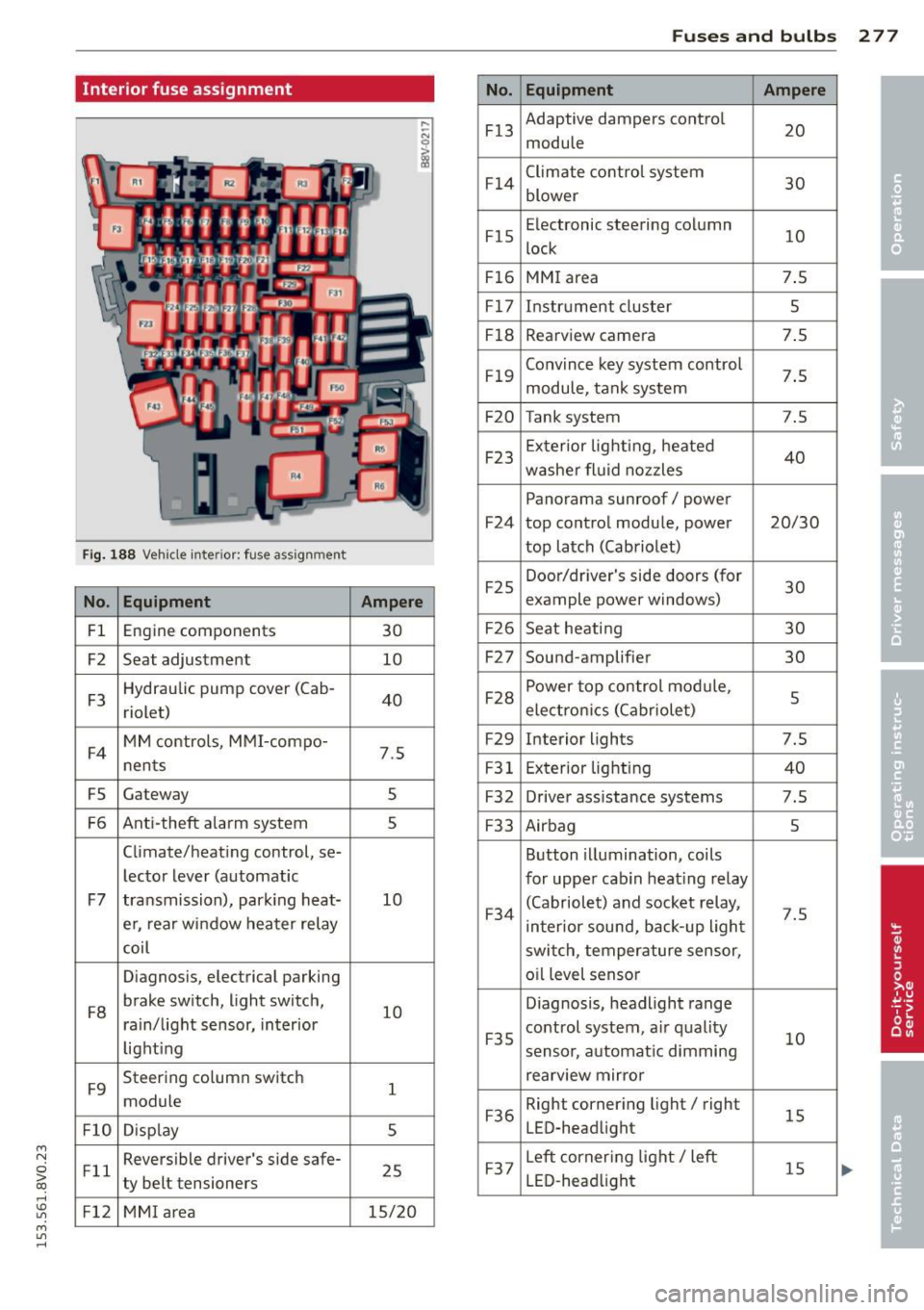
Interior fuse assignment
Fig. 188 Vehicle inter ior: fuse assignment
No . Equ ipment
Fl Engine components
F2 Seat adjustment
F 3 Hydraulic pump
cover (Cab-
riolet)
F4 MM controls, MMI-compo-
nents
FS Gateway
F 6 Anti-theft alarm system
Climate/heating control,
se-
lector lever (automatic
F7 transmission), park ing heat-
e r, rear window heater relay
coil
Diagnosis, electrical parking
F 8 brake
switch, light switch,
rain/light sensor, interior
light ing
F9 Steering
column switch
module
Fl0 Disp lay
Fll Reversible driver's
side safe-
ty belt tensioners
Fl2 MMI a rea
No .
Fl 3
Fl4
Fl5
Fl6
Fl7
Fl8
Fl9
F20
F23
F24
F25
Ampere
30 F26
10 F27
40 F28
F29
7.5
F31
s F32
5 F33
10 F34
10 F35
1 F36
5
25 F37
15/20
Fu se s and bulb s 2 77
Equipment Ampere
Adaptive dampers control
20
module
Climate control system 30
blower
Electronic steering column
10
lock
MM I area 7.5
Instrument cluster 5
Rearview camera 7.5
Conv ince key system control
7.5
module, tank system
Tank system 7.5
Ex terior lighting, heated
40
washer fluid nozzles
Panorama sunroof/ power
top control modu le, power 20/30
top latch (Cabriolet)
Door/dr iver's side doors (for
30
example power windows)
Seat heati ng 30
Sound-amplifier 30
Power top con trol module,
5
electron ics (Cabriolet)
Interior lights 7.5
Ex terior lighting
40
Driver assistance systems 7.5
Airbag 5
Button illumination, coils
for upper cab in heat ing relay
(Cabriolet) and socket relay,
7.5
interior sound, back-up ligh t
switch, temperature sensor, o il level sensor
Diagnosis, headlight range
control system, air quality
10
senso r, a utomat ic dimming
rearview mir ror
Right corner ing light/ right
15
LED-headlight
Left corner ing light/ left
15
LED -head light
Page 280 of 310
2 78 Fuses and bulbs
No . Equipment Ampere
Door/front passenger's side
F39 doors (for example, power 30
windows)
F40 Sockets 20
F41 Reversible front passenger·s
25
side safety belt tensioners
F42 Central locking components,
40
windshield washer system
F43 Headlights , light ing 30
F44 all wheel drive
15
F49 Starter, clutch sensor, head-
s light
relay coil
FS3 Rear window defogger
30
The power seats* are protected via
circuit
breakers
that automatically switch on after a
few seconds after the overload has been re
duced.
@ Tips
Note that the following table was accurate
at the time of print ing and is subject to
change.
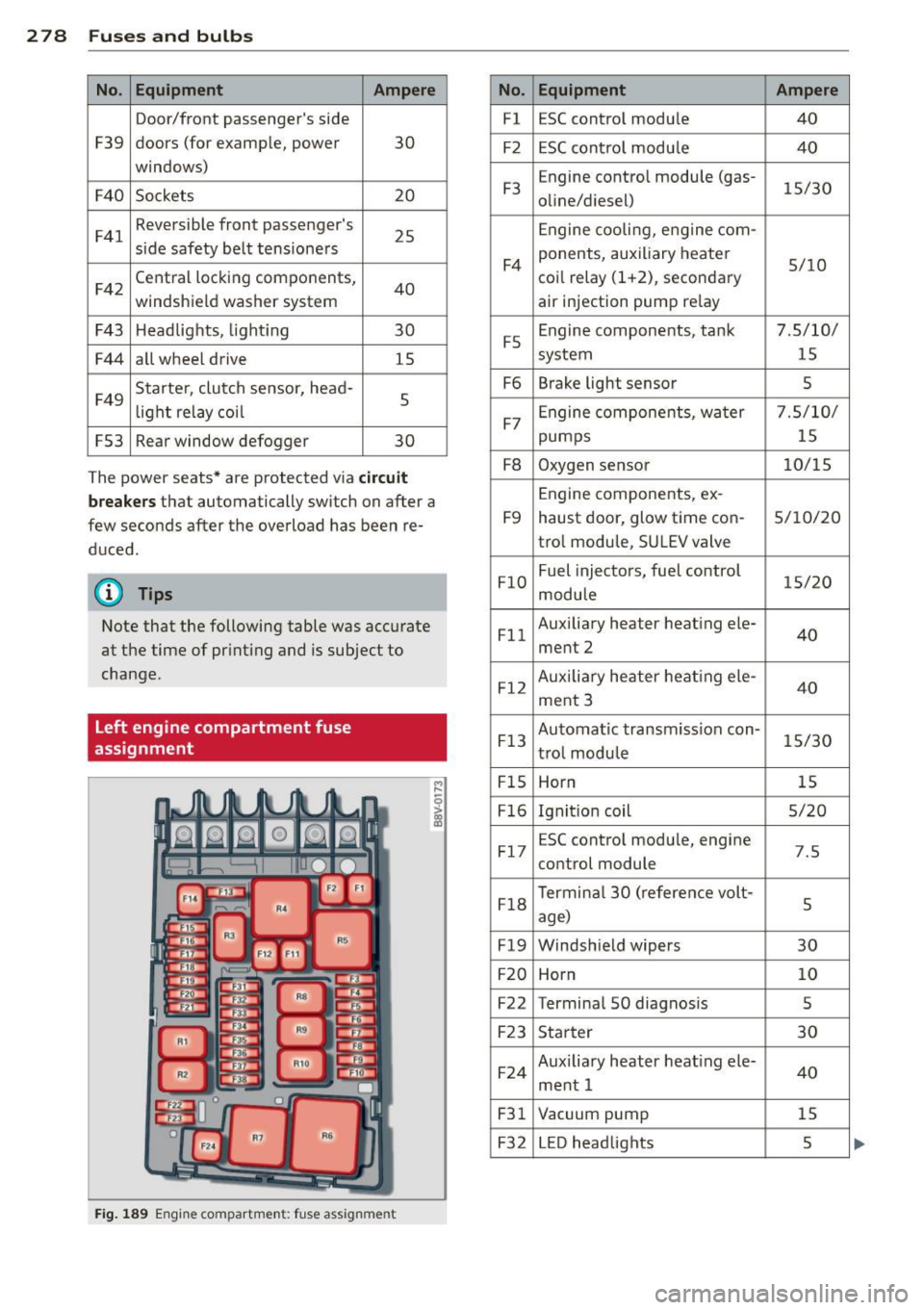
Left engine compartment fuse
assignment
Fig. 189 Engine compartment : fuse assignment
No.
Fl
F2
F3
F4
F5
F6
F7
F8
F9
FlO
Fll
Fl2
Fl3
Fl5 Fl6
Fl7
Fl8 Fl9
F20 F22
F23
F24
F3 1
F32
Equipment Ampere
ESC control modu le 40
ESC cont rol module 40
Engine control module (gas-
15/30
oline/diesel)
Engine cooling, engine com-
ponents, auxiliary heater 5/10
coil relay (1+2), secondary
air injection pump relay
Engine components, tank 7.5/10/
system 15
Brake light sensor
5
Engine components, water 7.5/10/
pumps 15
Oxygen sensor 10/15
Engine components, ex-
haust door, glow t ime con-
5/10/20
trol module, SU LEV valve
Fuel injectors, fuel control
15/20
module
Auxiliary heater heating ele-
40
ment2
Auxi lia ry heater heating ele-
40
ment 3
Automatic transmission con- 15/30
trol module
Horn 15
Ignit ion coil 5/20
ESC contro l module, engine
7.5
control module
T ermina l 30 (reference volt-
5
age)
Windshield wipers 30
Horn 10
Terminal SO diagnosis 5
Starter 30
Auxiliary heater heat ing ele-
40
ment 1
Vacuum pump 15
LED headlights 5
Page 281 of 310
M N
0 > co ,...., \!) ..,.,
M ..,., ,....,
@ Tips
Note that the following table was accurate
at the time of pr int ing and is subject to
change.
Bulbs
Replacing light bulbs
For your safety, we recommend that you have
your authorized Audi dealer replace burned out bulbs for you.
It is becoming increas ingly more and more
d ifficult to replace veh icle light bulbs since in
many cases, other parts of the car must first
be removed before you a re able to get to the
bu lb. This app lies especia lly to the light bu lbs
in the front of your car which you can on ly
reach through the engine compartment .
Sheet metal and bulb ho lders can have sha rp
edges that can cause ser ious c uts, and parts
must be co rrectly taken apart and then prop
erly put back together to help prevent break
age of parts and long term damage from wa
ter that can enter hous ings that have not been
properly resealed.
F or your safety, we recommend that you have
your authorized Audi dealer rep lace any bulbs
for you, since your dealer has the proper tools,
the correct bulbs and the expertise.
G as discha rge l amps (Xenon light s):
Due to the high elect rical voltage, have the
bu lbs rep laced by a qualified technician.
Headlights wi th Xenon light can be identified
by the high voltage sticker .
L ED headlights* requ ire no ma intenance .
Pl ease contact yo ur a uthorized Aud i dealer if a
bu lb needs to be replaced.
A WARNING
Contact with high-voltage components of
the electrica l system and improper re
placement of gas discharge (Xenon) head
light bulbs can cause serious personal in
jury and death .
Fuses and bulb s 2 79
- Xenon bu lbs are pressur ized and can ex
plode when being changed.
- Changing Xenon lamps requires the spe
cial tra ining, instructions and equip
ment.
- On ly an authorized A udi dealer or other
qualified workshop should change the bulbs in gas discharge lamps.
A WARNING
There are parts with sharp edges on the
openings and on the bulb holders that can
cause ser ious cuts .
- If you are uncertain about what to do,
have the work performed by an author
ized Audi dealer or othe r qualified work
shop. Ser ious personal inju ry may result
from imprope rly performed wo rk.
(D Tips
- If you still prefer to replace the light
bulbs you rself, be aware that the engine
compartment is a hazardous area to
work in
c:::> page 21 lc:::> &
- It is best to ask your authorized Audi
dealer whenever you need to change a
bulb.
-
•
•
•
Page 282 of 310
280 Emergency situations
Emergency situations
General
This chapter is intended for trained emer
gency crews and working personnel who
have the necessary tools and equipment to
perform these ope rations.
Starting by pushing or
towing
Q;) Note
Vehicles w ith an automatic transmission
cannot be started by pus hing o r tow ing.
Starting with jumper
cables
If necessary, the engine can be started by
connecting it to the battery of another vehi
cle.
If the engine should fail to start because of a
discharged or weak battery, the battery can be
connected to the battery of
another vehicle,
using a
pair of jumpe r cables to start the en
g ine .
Jumper cables
Use only jumper cables of sufficiently large
cross section to carry the starter current safe
ly. Refer to the manufacturer's specif ications.
Use only jumper cables with
insulated termi
na l clamps which are distinctly marked:
plus(+) cable in most cases colored red
minu s(-) cable
in most cases colored black .
A WARNING
Batteries contain electricity, acid, and gas.
Any of these can cause very serious or fatal
inju ry. Follow the instructions below for
safe handling of your veh icle's battery.
- Always shield you r eyes and avoid lean
ing over the battery whenever possible.
- A discharged battery can freeze at tem
peratures just be low 32 °F (0 °C). Before connecting a
jumper cable, you must
thaw the frozen battery complete ly, oth
erwise it could explode.
- Do not allow battery acid to contact eyes
or skin . Flush any contacted area with
water immediately .
- Improper use of a booster battery to start a vehicle may cause an explosion.
- Vehicle batteries generate explosive gas
es. Keep sparks, flame and lighted ciga
rettes away from batteries.
- Do not try to jump start any vehicle with a low acid level in the battery.
- The vo ltage of the booster battery must
also have a 12-volt rating. The capacity
(Ah) of the booster battery should not be
lower than that of the discharged bat
tery . Use of batteries of d ifferent voltage
or substantially different "Ah" rating
may cause an exp losion and personal in
jury.
- Never charge a frozen batte ry. Gas trap
ped in the ice may cause an explosion.
- Never charge or use a battery that has
been frozen. The battery case may have
be weakened.
- Use of batter ies of different voltage or
substantially different capacity (Ah) rat
ing may cause an exp losion and injury.
The capacity (Ah) of the booster battery
should not be lower than that of the dis
charged battery.
- Before you check anything in the engine
compartment, always read and heed a ll
WARNINGS
¢page 217.
(D Note
-App lying a higher voltage booster bat
tery will cause expensive damage to sen
sitive electronic components, such as
contro l units, relays, radio, etc .
- Th ere must be no electrical contact be
tween the vehicles as otherwise current cou ld already start to f low as soon as the
positive(+) terminals are connected. .,.
Page 283 of 310
....,
N
0 > co
rl I.O
"'
@ Tips
The discharged battery must be pr operly
connected to the vehicle's electrical sys
tem. When jump starting or charg ing the
battery, never connect the negative
ground cable to the batte ry negative post
because the ba ttery manager system must
be able to detect the battery's state of
charge. Always connec t the negative
g roun d cab le to t he negative ground pos t
of t he battery manager cont ro l unit.
Using jump start cables
Connect the jump start cables in the e xact or
der described below .
Fig . 190 Eng ine co mpar tment : connecto rs for jum p
star t cab le s an d a charger
Fig. 1 91 Jump start in g the batte ry w ith anot her ve hi
cle: @-dra ined battery ,@ -starte r bat tery
The batte ry is located to the left in the eng ine
compartment.
Do not jump start a frozen or
thawed battery
¢ A in Starting with jumper
cables on page
280 ! Replace the battery. The
p rocedu re for connecting jump start cab les
that is descr ibed next is designed to he lp
jump sta rt your ve hicl e.
Vehicle with drained battery:
~ .. Read the following carefully ¢ page 280 rl
Emergency situ ation s 281
.. Set the parking brake and p lace the selector
lever in the P position.
.. Turn the ignition and e lectr ica l equ ipment
off in both vehicles.
Connecting the negati ve terminal (-) to
the negat ive terminal (- ) ( black )
.. To r each the battery term inals, flip the bat
tery cover cap to the side ¢
fig. 190.
1. Clamp the end of the red jump start cable
to the terminal (!)¢
fig. 191 on the dead
battery @ ¢CI)
in Starting with jumper
cables on page 280 .
2. Clamp the othe r end of the red jump star t
c able to the termin al@ on t he charging
battery @.
Connect NEGATIVE (-) to NEGATIVE (-)
(black )
3. Clamp the blac k end of t he j ump sta rt ca
ble
preferably at the ground point , or on
the nega tive terminal @ on the charging
batte ry @ .
4. Clamp the other black end of the jump start cab le
onl y on the ground point@
on your vehicle @ ¢CI).
S. Route the jump start cab les so they can
not get ca ugh t in the moving parts in the
engine compa rtment.
St arting the engine
6. Start the engine in the vehicle giving the
charge and let it run at idle.
7 . Start the eng ine in the vehicle with the
dead battery and wait two to three m i
nu tes unti l it "runs smoothly".
8.
If t he engine does not s tart: Stop the
st art ing procedure afte r 10 seco nds and
then repeat it afte r approximately 30 sec
onds.
9 . In the vehicle that is be ing jump started,
switch the heater fan and rear window de
froster on to reduce any voltage peaks
t hat may occur when disconnecting the
j u mper cables . The headlights must be
switched off .
10 . Wi th the e ngin es runn ing , remov e th e ca
bles in
rever se orde r of the way t hey were ..,.
Page 284 of 310
28 2 Em ergency sit uat ions
installed. Make sure the cables do not get
caught in moving engine components .
11. Sw itch the heater fan and rear window de-
froster
off.
12. Close the battery cover.
The battery is vented to the outside so that
not gases enter the passenger compartment.
Make sure that the connected positive termi
nal clamps on the jump start cable have suffi
cient contact with metal.
A WARNING
Follow the warn ings and instructions from
the jump start cable manufacturer to re
duce the risk of ser ious injuries and vehicle
damage.
If you are uns ure about anyth ing,
call roadside assistance.
- T he jump start cables must be long
enough so that the vehicles do not
touch.
- Route the jump sta rt cab les so they can
not get caught in the moving parts in the
engine compartment .
- Always read and follow the warn ings be
fore checking anything in the engine compartment ¢
page 217.
([) Note
Correctly jump start cables incorrect ly can
destroy the a lternator .
- Always connect the positive terminal(+)
to the positive terminal( +) and the neg
at ive termina l(- ) to the negative termi
nal(-) on the body ground point, b ut not
the negative termina l on the battery.
- Make sure the screw plugs on the battery ce lls are insta lled securely.
If not, tig ht
en the plugs before connecting the
clamps to the negat ive terminal on the
battery.
- Please note that the connecting process
described be low for the jump start ca
bles is intended for when your vehicle is
being jump started . If you are jump
starting another vehicle, do not connect
the negat ive cab le to the negative termi
nal (-) on the drained battery, but rathe r connect it to a
large metal component
that is bolted securely to the engine block, or to the engine block itsel f. If the
battery in the vehicle being jump started
is not vented to the outside, there is a
risk of explosion due to hydrogen gas .
- Make sure that the connected positive
terminal clamps have sufficient contact
w ith metal.
- Do not use the battery negative terminal
for jump start ing or a malfunct ion could
occur in the vehicle electrical system.
Emergency towing
with commercial tow
truck
General hints
Your Audi requires special handling for tow
ing .
The following information is to be used by
commerc ial tow truck operators who know
how to operate the ir equipm ent safely .
-Never tow your Aud i. Towing will cause
damage to the engine and transmission.
- Never wr ap the s afet y chains or winch ca
bles around the b rake lines.
- To p re v ent unnece ssary damage , your Aud i
must be transpo rted with a flat bed truck.
- To load the vehicle on to the fl at bed, u se
the towing loop found in the vehicle tools
and attach to the front or rea r ancho rage
c;,page 283 and c;,page 283.
A WARNING
A vehicle being towed is not safe for pas
sengers . Never allow anyone to ride in a
vehicle be ing towed, fo r any reason.
-
Page 287 of 310
M N
0 > co ,...., \!) ..,.,
M ..,., ,....,
fall fro m a lift if the re is a c hange in ve
h icle we ight d istr ibut ion a nd ba lance.
This might happen, for e xamp le, w hen
heavy compone nts such as the engi ne
b lock or transmiss io n are removed .
- Whe n remov ing heavy components li ke
t hese, ancho r vehicl e to hoist o r add cor
r es pond ing w eig hts to mai ntain the cen
t e r of g ravity . Othe rwise, the v ehicl e
m ight til t or slip off th e hois t, causi ng
serious person al inju ry.
(D Note
- Be awa re of the fo llowing po in ts befo re
li fting the vehicle:
- The vehicle should never be lifted or
jacked up from unde rneath the engine
oil pan, the transmission housing, the
front or rear axle or the body side
members. This could lead to serious
damage .
- To avoid damage to the underbody or
chassis frame , a rubber pad must be
inserted between the floor jack and
the lift points.
- Before driving over a workshop hoist,
check that the vehicle weight does not
exceed the permissible lifting capacity
of the hoist.
- Before driving over a workshop hoist,
ensure that there is sufficient clear ance between the hoist and low parts
of the vehicle .
Emergency situations 285
•
•
•
Page 288 of 310
286 Technical data
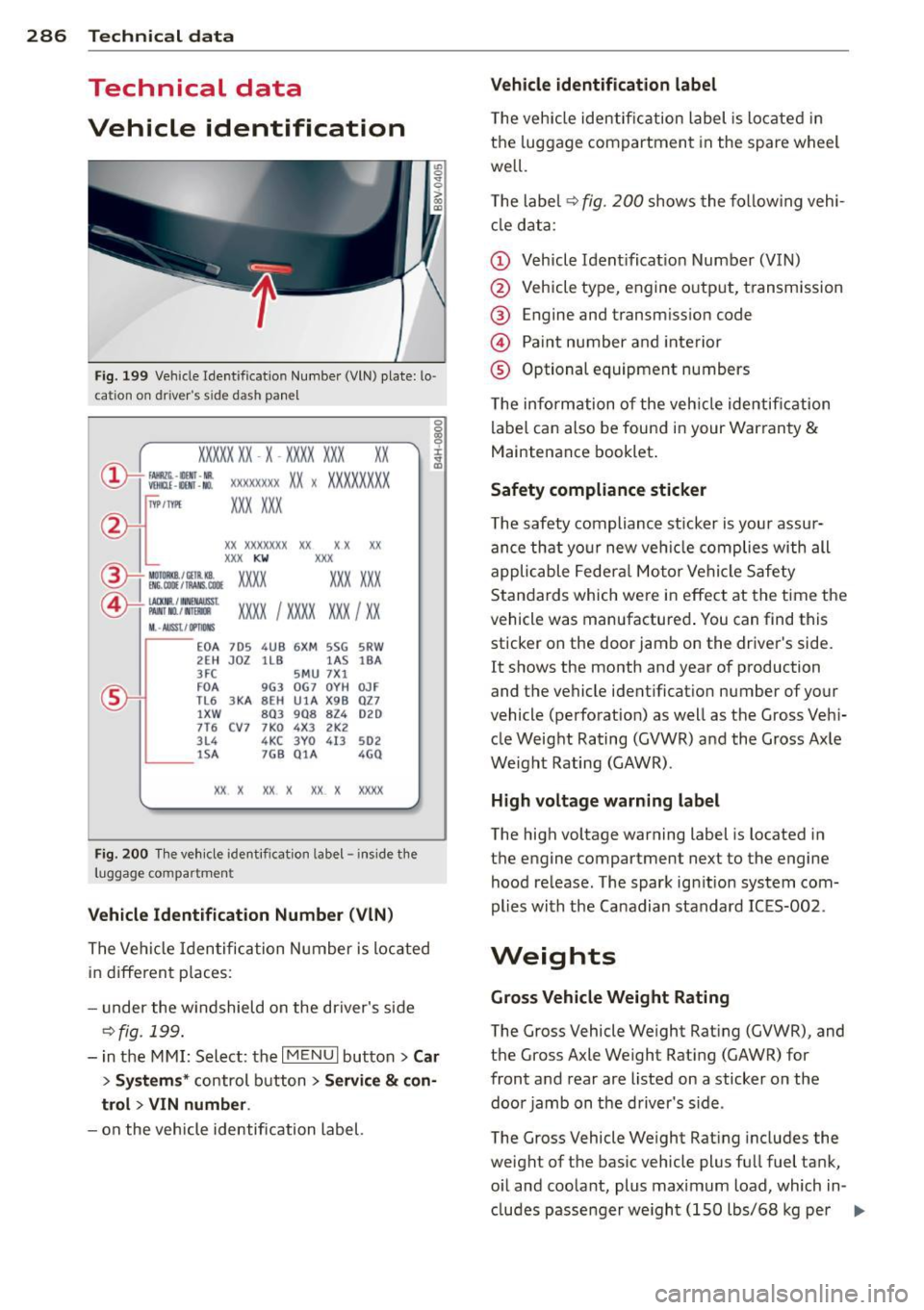
Technical data
Vehicle identification
F ig. 199 Vehicle I dent ifica tion Numbe r (VlN) pla te: lo·
cat ion on driver 's side dash pane l
XXXXX XX · X -XXXX XXX
r,"\__l f~ -11!11 1 · NII. ~ V!Hlll -llllll . NO.
xx
XXXXXXXX XX X XXXXXXXX
XXX XXX IYP IT'fl'E
XX XXXX XXX X X X X XX
XXX
KW XXX
®i ~~: f :l~~ XXXX XXX XXX
@+ ~~r= XXXX I XXXX XXX I XX M,. AIIISl. / lflllllS
EO A 7D5 4 UB 6XM SSG 5RW
2E H JDZ llB l AS lBA
3FC 5MU 7Xl
FO A
9G3 OG7 O
YH OJF
TL6 J
KA BEH
UlA X9B QZ 7
l XW
8Q3 9Q8 82 4 020
7T6 CV 7 7KO 4X3 2K2
3L4 4 KC 3YO 4I3 502
lS A 7GB Q1A 4GQ
XX X XX X XX X XXXX
Fig. 2 00 Th e ve hicle identi ficat ion label -inside the
luggage co mpa rtmen t
Vehicle Id entification Number (VlN )
The Ve hicle Identific ation Number is located
in different p laces:
- under the w indshield on the driver's s ide
~fig . 199.
- in the MMI : Select: the I MENU I button> Car
> Sy ste m s* control button > Se rvic e & con
trol
> VIN number .
-on the vehicle identification label.
Vehicle identification label
The vehicle identific ation label is lo cate d in
the luggage compartment in the spare wheel
we ll.
T he label~
fig. 200 shows the fo llowing vehi
cl e d ata:
(D Vehicl e Ident ificat ion Number (VIN)
@ Vehicle type, engine outp ut, transmission
@ Engine and transm ission code
@ Pain t number a nd inte rior
® Optional equipment numbers
T he inform ation of the vehicle identification
label can also be found in your Warranty
&
Maintenance booklet.
Safety compliance sticker
T he safety complianc e sticker is your assur
ance th at your new veh icle complies with all
applicable Fede ra l Motor Vehicle S afety
Standards which were in effec t at the time the
vehicle was manufactured . You can find this
sticker on the door jamb on the driver's side.
It shows the month and year of production
and t he vehicle identificat io n number of your
vehicle (perfo ration) as well as the Gross Veh i
cle Weight Rating (GVWR) a nd the Gross Ax le
Weight Rating (GAWR) .
High voltage warning label
The high voltage warning label is located in
th e engine compartment next to the engine
hood re lease . The spark ignit ion system com
plies with the Canadian standard ICES-002.
Weights
Gross Vehicle Weight Rating
The Gross Vehicle Weight Rating (GVWR), and
the Gross Axle Weight Rat ing (GAWR) for
front and rear are listed on a sticker on the
doo r jamb on t he d river's side .
The Gross Vehicle Weight Rat ing includes the
weight of the basic vehicle plus full fuel tank,
o il and coo la nt, plus maximum load, which in
cludes passenger we ight (150 lbs/68 kg per .,..
Page 290 of 310
288 Technical data
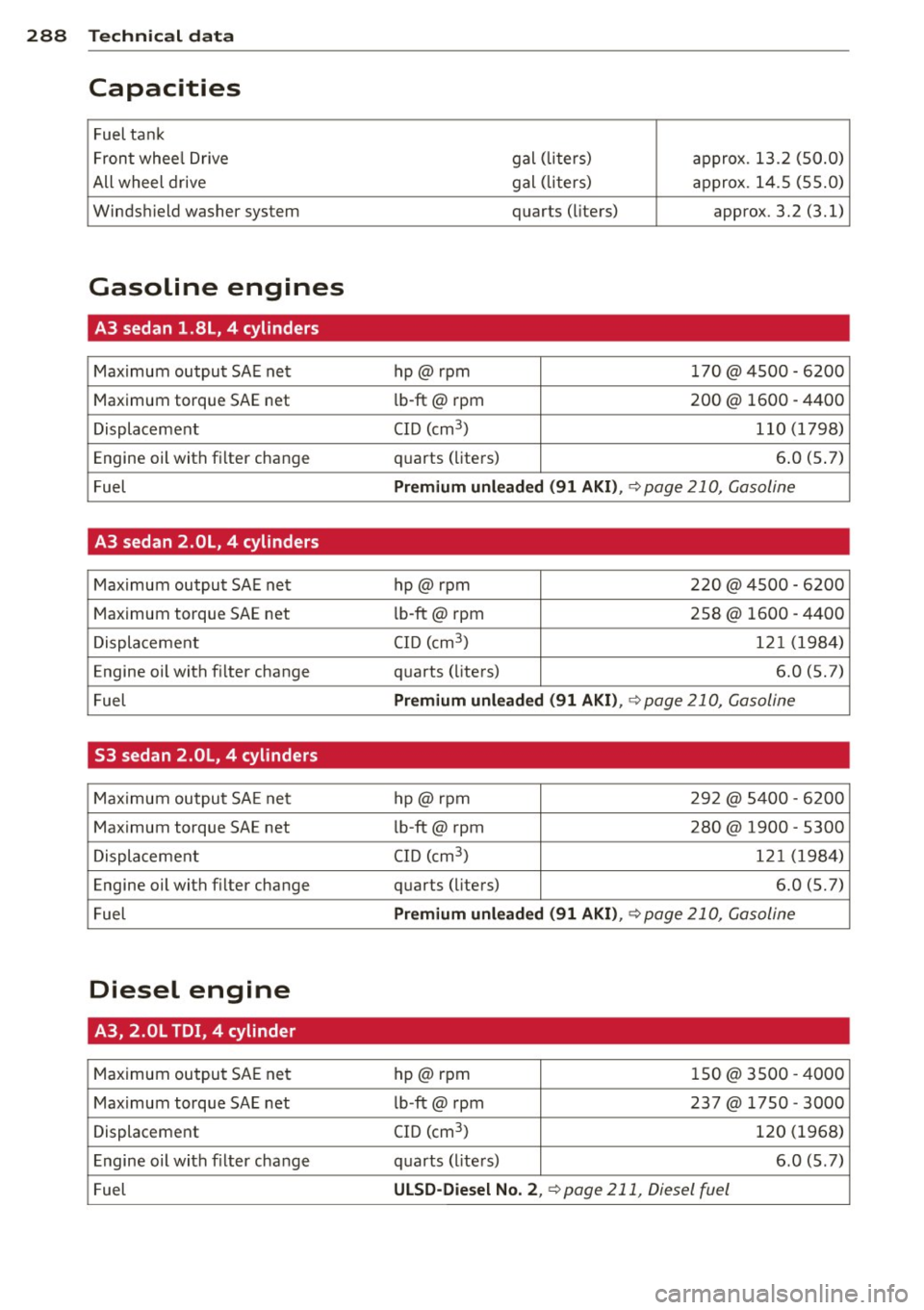
Capacities
Fuel ta nk
Front whee l Drive gal (
liters)
approx. 13.2 (50.0)
All wheel drive gal (li
ters) approx. 14.5 (5 5.0)
Winds hield washer system quarts (lite rs) approx. 3.2 (3.1)
Gasoline engines
A3 sedan l.8L, 4 cylinders
Maximum output SA E ne t hp@rpm 170 @ 4500 - 6200
Ma ximum torque SAE net l
b-ft@ rpm 200@ 1600 - 4400
Displacement CID (cm
3
) 110 (1798)
Engine oil with filter change q
uarts ( lite rs) 6.0( 5.7)
Fuel
Premium unleaded (91 AKI) , ~ page 210, Gasoline
A3 sedan 2.0L, 4 cylinders
Max imum outpu t SA E net hp@rpm 220 @ 4500 - 6200
Maximum torque SAE net l
b-ft@ rpm 258@ 1600 - 4400
Displacement C
ID (cm
3
) 12 1 (198 4)
Engine oil with f ilter change quarts (li ters) 6.0(5.7)
Fuel
Premium unleaded (91 AKI) , ~page 210, Gasoline
S3 sedan 2 .0L, 4 cylinders
Max imu m outpu t SA E net hp@rpm 292 @ 5400 - 6200
Maximum torque SAE net lb-ft@ rpm 280@ 1900 - 5300
Displa cement CID
(cm
3
) 12 1 (198 4)
Engine oil with filter change quarts ( liters) 6.0(5.7)
F uel
Premium unleaded (91 AKI) , ~ page 210, Gasoline
Diesel engine
A3, 2.0L TOI , 4 cylinder
Maximum outpu t SA E net hp@rpm 1
50@ 3500 -4 000
Ma ximum torque SAE net lb-ft@ rpm 237@ 1750 -3000
Displacement CI
D (cm
3
) 12 0 (19 68)
E ngine oil with filter change q uarts (lite rs) 6.0(5
.7)
Fuel
ULSD-Diesel No. 2 , ¢ page 211, Diesel fuel