engine AUDI S3 2015 Repair Manual
[x] Cancel search | Manufacturer: AUDI, Model Year: 2015, Model line: S3, Model: AUDI S3 2015Pages: 310, PDF Size: 76.15 MB
Page 203 of 310
M N
0 > co ,...., \!) 1.1'1
M 1.1'1 ,....,
-Do not alter or remove any component of
the Emission Contro l System unless ap
proved by the manufacturer.
- Do not alter or remove any device, such
as heat shields, switches, ignition wires,
valves, wh ich are designed to protect
your vehicle's Emission Control System and other important veh icle compo
nents.
Fewer short trips
Fuel consumption will always be relatively
high on short trips .
~ Try to avoid driving short distances with a
cold eng ine.
The engine and catalytic converter have to
reach their optimal
operating temperature to
reduce fuel consumption and noxious emis
sions effectively.
Just after starting, a cold engine in a mid -size
car only achieves a fuel economy of 6-8 miles
per gallon (30-40 l/100 km). After about a
half a mile, fuel economy climbs to 12 mpg
(20 l/100 km). After about
2 .5 m iles (4 km),
the engine is at its proper operating tempera
ture and fue l economy has reached a normal
l eve l. So you can see that you should avoid
short trips wheneve r possible.
The
outside temperature is also critical in this
regard . Your car consumes more fuel in the
winter than in the summer.
Driving and the environment 201
•
•
•
Page 204 of 310
202 Trailer towing
Trailer towing Driving with a trailer
General information
Your Audi was designed primarily for passen
ger transportation .
If you plan to tow a tra iler, p lease remember
that the addit ional load will affect durab ility,
economy and performance .
T railer towing not on ly places more stress on
the vehicle, it also calls for more concentra
tion from the driver.
F or this reason, always fo llow the operating
and drivi ng i nstr uctions provided and use
common sense.
Technical requirements
Traile r hitch
Use a weight-carrying hitch conforming to the
gross trailer we ight. The hitch must be suita
b le for your veh icle and trailer and mu st be
mounted secure ly on the ve hicle's chassis at a
technically sound location . Use only a trailer
h itch with a removab le ball mount. A lways
check with the tr ailer hitch manu fac tur er to
make sure tha t you are using t he cor rect
hitch.
Do not us e a bumper hitch .
The hitch must be installed in such a way t hat
it does not interfe re with t he impact-absorb
ing bumper syst em . No mod ifications should
be made to the vehi cle exhaust and brake sys
tems . From time to time, check th at a ll hit ch
mo unt ing bo lts remain secure ly fastened.
When you are not towing a trail er, remove the
tra iler hitch ba ll mount. This prevents the
hi tch from causing d amage sho uld your ve hi
cle be str uck from be hind
¢ A .
Trailer brakes
If you r tra ile r is eq uipped w ith a braking sys
tem, check to be su re that it conforms to a ll
r egulat ions . T
he trailer hyd raulic brake system mus t not be
direct ly connected to the vehicle's hydraulic
brake system .
Safety chains
Always use s afety chains be tween your ve hicle
and t he tra ile r.
Trailer lights
Tra ile r li ghts must meet all regulations. Be
su re to c hec k w ith your Audi dea le r fo r cor rect
wiring, swi tches and relays.
Mirrors
If you are unable to see the traffic behind you
u sing the regular o utside m irrors, then you
must insta ll ext ended mirro rs . It is important
t h at you
always have clea r vis io n to the rea r.
,8. WARNING
-
Afte r removing t he trailer hit ch, d o no t
s tore it in yo ur vehicle . In case of sudden
br aking, t he h itch cou ld fly forward an d in
j ur e you or yo ur passengers .
Operating instructions
Maximum traile r weight
A trai le r fo r you r vehicle is limited to a typi cal
class 1 or class 2 trai le r.
Trailer load distribution
B e sure the load in the t ra ile r is held secure ly
i n p lace to p reven t it from shift ing forw ard,
backw ard or sideways.
Never allow a passenger to ride in a trailer
¢ A in Driving instru ctions on page 203.
Engine cooling system
Towing a trailer makes the engine work hard
er . It is impo rtant that the cooling system 's
performance is up to the additional load .
Make su re that the coo ling system has enough
fl uid .
Tire pressure
When towing a trailer, inflate the tires of your
vehicle to t he cold tire pressure listed under
ll>
Page 205 of 310
M N
0 > co ,...., \!) 1.1'1
M 1.1'1 ,....,
"Full load" on the label located on the driver's
side B-pillar (visible when the door is open).
Inflate trailer t ires to tra iler and t ire manufac
turers' specifications.
Lights
Check to make sure both vehicle and trailer
lights are working properly.
Safety chains
Be sure tra iler safety cha ins are properly con
nected from the trailer to the hitch on the ve
hicle. Leave enough slack in the chains to per
mit turning corners. When you install safety
chains, make su re they wi ll not drag on the
road when you are driving.
The chains should cross under the tra ile r
tongue to prevent it from dropping in case of
separation from the hitch.
Driving instructions
Driving with a trailer always requires extra
care and consideration.
To obtain the best poss ible handling of vehicle
and traile r, p lease note the following:
~ Do not tow a loaded tra iler when your car it
self is not loaded.
~ Be especia lly careful when passing other
vehicles.
~ Observe speed limits .
~ Do not drive at the maximum permissible
speed.
~ Always apply brakes early.
~ Monitor the temperature gauge.
Weight distribution
Towing a loaded trai ler with an empty car re
sults in a highly unstable distribution of
weight. If this cannot be avoided, drive at very
low speeds only to avoid the risk of losing
steering control.
A "balanced" rig is easier to operate and con
trol. This means that the tow vehicle should be loaded to the extent poss ible and permiss i
ble, wh ile keeping the trailer as light as poss i
ble under the circumstances . Whenever possi-
Trailer towing 203
ble, transfer some cargo to the luggage com
partment of the tow vehicle while observing
tongue load requirements and vehicle load ing
considerations.
Speed
T he higher the speed, the mo re difficult it be
comes for the driver to control the rig. Do not
drive at the maximum permissib le speed. Re
duce your speed even more if load, weather or
wind conditions are unfavorable -particularly
when going downhill.
Reduce veh icle speed
immediately if the trail
er shows the slightest sign of swaying .
Do not
try to stop the swaying by accelerating.
Observe speed limits . In some areas, speeds
for vehicles towing trai lers are lower than for
regular vehicles .
Always apply brakes early. When driving
downhi ll, shift into a lower gear to use the en
gine braking effect to s low the vehicle. Use of
the brakes alone can cause them to overheat
and fail.
Coolant temperature
The coolant temperatu re gauge <=> page 12
must be observed carefu lly. The coolant tem
perature can increase if you drive on long in
clines in a low gear at high engine speeds. Re
duce your speed immediately if the LEDs in
the top part of the display turn on.
For more information about indicator lights,
refer to .<=>
page 20.
A WARNING
Anyone not properly restrained in a mov
ing vehicle is at a much greater risk in an
accident. Never let anyone ride in your car
who is not properly wearing the restraints
provided by Audi.
Trailer towing tips
Important to know
Your vehicle handles d ifferently when towing
a trailer because of the additional weight and ..,.
•
•
•
Page 206 of 310
204 Trailer towing
different weight distribution. Safety, perform
ance and economy wi ll greatly depend on how
carefu lly you load your trailer and operate
your rig.
Before you actually tow your trailer, practice
turning, stopping and backing up in a n area
away from traffic. Keep practicing until you
have become comp letely fam iliar with the way
your veh icle-trailer comb ination behaves and
responds.
Backing up is d iff icult and requires practice.
Backing up with a tra iler genera lly requires
steering action opposite to that when back ing
up your veh icle without a trailer.
Maintain a greater distance between your ve
h icle and the one in front of you. You will need
more room to stop. To compensate for the
trailer, you will need a larger than normal
turning radius.
When passing, remember that yo u cannot ac
celerate as fast as you normally would be
cause of the added load. Make sure you have
enough room to pass. After passing, allow
p lenty of room for your tra iler before chang
ing lanes aga in.
Avoid jerky starts, sharp turns or rapid lane
changes.
(D Tips
- Do not tow a tra iler dur ing the break-in
period of you r vehicle.
- If you tow a trailer, your Audi may re
quire more frequent maintenance due to
the ext ra load
¢ page 289.
Parking on a slope
Do not park on a slope with a trailer. If it can
not be avoided, do so only after doing the fol
lowing:
Wh en park ing:
.. Apply the foot brake .
.. Have someone place chocks under both the
vehicle and the trailer wheels. ..
With chocks in place, slowly release the
brakes unti l the whee l chocks absorb the
load.
.. Turn the whee ls towards the curb.
.. App ly the parking brake.
.. Select the P selector lever posit ion.
When re starting afte r park ing :
.. App ly the foot brake.
.. Start the engine.
.. Select the D/S se lector lever position.
.. Release the parking brake and s lowly pull
out and away from the wheel chocks .
.. Stop and have someone retr ieve the wheel
chocks .
@ Tips
If you move the selector leve r of the auto
matic transmission to P befo re applying
the pa rking brake and before bloc king the
whee ls, you may h ave to use more force
la ter to move the lever out of the P posi
tion .
Page 212 of 310
210 Checking and Filling
Checking and Filling
Gasoline
Fuel supply
Applies to vehicles: with gasoline engine
Using the right fuel helps keep the environ
ment clean and prevents engine damage .
Fuel recommendation
The fuel recommended for your vehicle is un
leaded premium
grade gasoline . Audi recom
mends using TOP TIER Detergent Gasoline
with a minimum octane rating of91 AKI (95
RON) . For more information on TOP TIER De
tergent Gasol ine, please go to the official
website (www .toptiergas.com).
The recommended gasoline octane rating for
your engine can also be found on a label locat
ed on the ins ide of the fuel filler flap. This rat
ing may be specified as AKI or RON .
Your vehicle may also be operated using un
leaded regular gasoline with a minimum oc
tane rating of 87 AKI/91 RON . However, using
87 AKI/91 RON octane fuel w ill slightly re
duce engine performance.
Use unleaded gasoline only. Unleaded gaso
line is available throughout the USA, Canada,
and in most European countries. We recom
mend that you do not take your vehicle to
areas or countries where unleaded gasoline
may not be available.
For more information on refueling your vehi
cle, see
~ page 212.
Octane rating
Octane rating ind icates a gasoline's ability to
res ist engine damaging "knock" caused by
premature ign ition and detonation . Therefore,
buying the correct grade of gasoline is very
important to help prevent possible engine
damage and a loss of engine performance.
Gasoline most commonly used in the United
States and Canada has the following octane
r atings that can usually be found on the filler
pump : - Premium Grade: 91
-96 AKI
- Regular Grade: 87 -90 AKI
Explanation of the abbreviations:
AKI= Anti Knock Index= (R+M)/2 = (RON
+MON)/2
RON= Research Octane Number
MON = Motor Octane Number .
@ Note
-Do not use any fuel w ith octane ratings
lower than 87 AKI or 91 RON otherwise
expensive engine damage w ill occur.
- Do
not use leaded gasoline. The use of
leaded gasoline will severely damage
your vehicle's catalytic converter and its
ability to control exhaust emissions.
Blended gasoline
Applies to vehicles: with gasoline engine
Use of gasoline containing alcohol or
MTBE (methyl tertiary butyl ether)
You may use unleaded gasoline blended with
alcohol or MTBE (commonly referred to as
oxygenates) if the blended mixture meets the
following criteria:
Blend of gasoline methanol (wood alcohol or
methyl alcohol)
-Anti-knock index must be 87 AK I or higher.
- Blend must contain no more than 3% meth-
anol.
- Blend must contain more than 2% co-sol-
vents.
Blend of gasoline and ethanol (grain alcohol
or ethyl alcohol)
-Anti-knock index must be 87 AKI or higher.
- Blend must not contain more than 15%
ethanol.
Blend of gasoline and MTBE
-Anti-knoc k index must be 87 AK I or higher.
- Blend must contain not more than 15%
MTBE.
Seasonally adjusted gasoline
Page 213 of 310
Many gasoline grades are blended to perform
especially well for winter or summer driving. During seasonal change-over, we suggest that
you fill up at busy gas stations where the sea sonal adjustment is more likely to be made in
time.
Q;) Note
- Methanol fuels which do not meet these requirements may cause corrosion and
damage to plastic and rubber compo nents in the fuel system .
- Do not use fuels that fail to meet the
specified criteria in this chapter .
- If you are unable to determine whether
or not a particular fuel blend meets the
specificat ions, ask your service station or
i ts fuel supp lier.
- Do not use fuel for which the contents cannot be identified.
- Fuel system damage and performance
problems resulting from the use of fuels
different from those specified are not
the responsibility of Audi and are not
covered under the New Vehicle or the
Emission Control System Warranties.
- If you experience a loss of fuel economy
or driveability and performance prob
lems due to the use of one of these fuel
blends, we recommend that you switch
to unblended fuel.
Gasoline additives
A major concern among many auto manufac
turers is carbon deposit build-up caused by
the type of gasoline you use .
Although gasoline grades differ from one manufacturer to another, they have certain
things in common. All gasoline grades contain substances that can cause deposits to collect
on vital engine parts, such as fuel injectors
and intake valves. Although most gasoline
brands include additives to keep engine and
M
N fuel systems clean, they are not equally effec-o
iii tive. ,...., \!) ..,.,
M ..,., ,....,
Checking and Filling 211
Audi recommends using TOP TIER Detergent
Gasoline . For more information on TOP TIER
Detergent Gasoline, please go to the official
website (www.toptiergas .com).
After an extended period of using inadequate
fuels, carbon deposit build-ups can rob your engine of peak performance.
CJ) Note
Damage or malfunction due to poor fuel
quality is not covered by the Audi New Ve
hicle Limited Warranty.
Diesel fuel
App lies to vehicles : wit h diese l eng ine
Always use ULSD (Ultra Low Sulfur Diesel)
No. 2 . The ULSD No. 2 meets the ASTM D975.
Diesel fuel with concentrations of biodiesel
higher than 5
% such as B11, B2O or B1OO are
strictly prohibited.
Service station fuel pumps are labeled with
the correct fuel information for easy recogni
tion by the user.
If the diesel fuel pump is not
labeled ask the station operator what fuel is
being dispensed before filling up your vehicle.
ULSD No. 2 may not be available outside the
USA and Canada. Be sure to check before trav
eling to other countries.
ULSD No. 2 can become thicker in very cold
temperatures, and this can impair the en
gine's starting and running. Depending on the
season, gas stations provide ULSD No . 2 that
flows better in cold temperatures so that you
can continue operating your vehicle as usual.
(D Note
- Your vehicle's diesel engine was de
signed solely for use with ULSD No. 2.
Therefore, never use gasoline, heating
oil, other fuels or flow improvers. These
contain substances that will severely
damage the fuel system and the engine.
Such damage will not be covered by your
New Vehicle Limited Warranty.
ll>
•
•
•
Page 214 of 310
212 Checking and Fill in g
- If you put any amount of incorrect fue l in
the fue l tank, do not start the engine un
der any circumstances. Immediately con
tact the nearest authorized Audi dealer
or authorized Audi Service Facility for as
sistance. These fuels contain substances
that can severely damage the fuel sys
tem and the engine if the engine is start
ed.
- If the diesel fuel quality is poor, it may
be necessary to have the water drained
from the water sepa rator in the
f ue l fi l
te r
more often than specified in the
maintenance schedu le . This can help re
duce engine ma lfunctions
Q page 24.
Fuel tank
Fuel filler neck
The fuel filler neck is located on the right rear
side panel behind the fuel fi ller flap.
If the power locking system should fail, you
can st ill open the flap manually- for detailed
instructions
seer:::.> page 214.
You can find the fuel tank capacity of your ve
hicle in
Qpage 288.
The label on the inside of the fuel filler flap
tells you the correct fuel for your vehicle. For
more information about fuel specifications,
see
c;,page 210.
Your veh icle fuel tank has an onboard refue l
ling vapor recovery system . This feature helps
to prevent fuel vapors from escaping from the
tank and polluting the environment while you refuel your vehicle . In order to fill the tank
properly while protect ing the env ironment,
p lease follow t his refueling procedure careful
ly.
.&_ WARNING
Under norma l operating conditions, neve r
carry additiona l fuel containers in your car .
Gas can isters and other containers used to
transport fue l can be dangerous. Such con
tainers, full or empty, may leak and cou ld
cause a f ire in a collision. If you must transpo
rt fuel to use for your lawn mower,
snow b lower, etc., be very careful and al
ways observe local and state laws regard ing the use, transportation and storage of
such fuel containers. Make certa in the con
tainer meets industry standa rds (ANSI/
ASTM F8S2 -86).
(D Note
Neve r drive your veh icle until the fue l tank
i s completely empty. The irregular supply
of fue l can cause misfir ing. Gasoline cou ld
enter the exhaust system and damage the
catalytic converter.
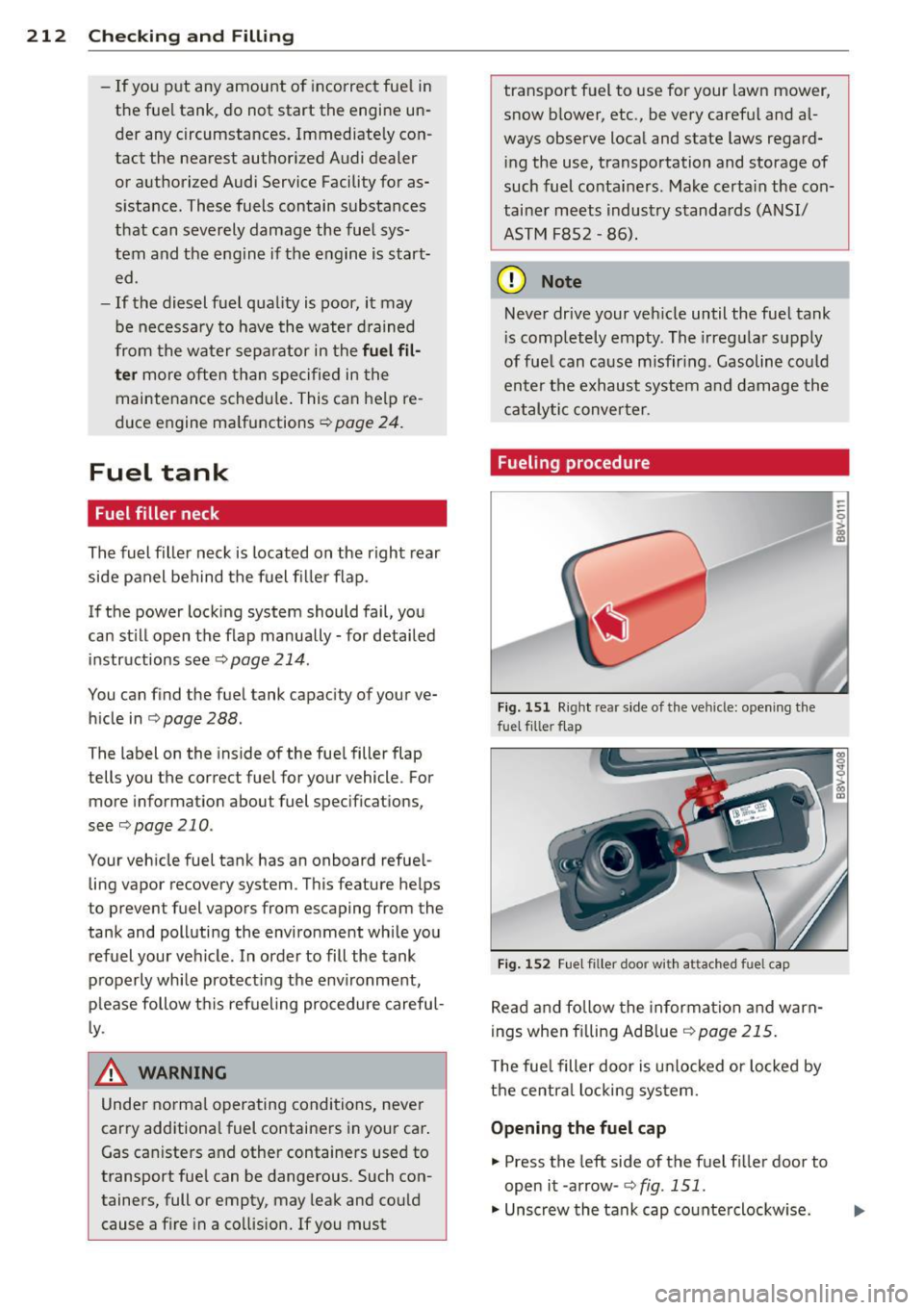
Fueling procedure
F ig. 15 1 Righ t rear side of the vehicle: opening the
fuel filler flap
Fig . 1 52 Fue l filler door w ith attached fuel cap
Read and follow the information and warn
ings when filling Ad B lue
c;, page 215.
T he fue l filler door is u nlocked or locked by
the centra l locking sys tem.
Openin g the fuel c ap
" Press the left side of the fuel f iller door to
open it -arrow-
Q fig. 151.
"Unscrew the tank cap counterclockw ise .
-;:;
> a, a,
Page 215 of 310
M N
0 > co ,...., \!) ..,.,
M ..,., ,....,
~ Place the cap from above on the open fuel
filler door
¢ fig. 152.
Closing the fuel cap
~ Turn the fuel cap clockwise until you hear it
lock.
~ Close fuel filler door until it latches.
Once the pump nozzle switches off, the fuel
tank is "full". Do not fill the tank more. Other
wise the expansion space in the tank will be
filled.
The correct fuel type for your vehicle can be
found on a label located on the inside of the
fuel filler door. For additional information on
fuel, refer to ¢
page 210.
The fuel tank capacity of your vehicle is in the
Technical Data ¢ page 288.
To avoid fuel spilling or evaporating from the
fuel tank always close fuel filler cap properly
and completely. An improperly closed fuel fill
er cap may also cause the MIL lamp ¢
page 30
to come on .
A WARNING
Not paying attention when fueling or han
dling fuel incorrectly can lead to fires, ex
plosions or serious injuries.
- Fuel ignites easily and can cause serious
burns and other injuries.
- If you do not switch the engine off when
fueling and/or do not insert the fuel noz
zle completely into the tank opening,
fuel can leak out or run over. Leaked fuel
can ignite and start a fire.
- Do not use the telephone while fueling.
The electromagnetic rays can cause
sparks, which can ignite fuel vapors and
start a fire .
- Do not sit in your vehicle while fueling. If
you must make an exception and enter
your vehicle again while fueling, close
the door and touch metal to discharge
static electricity before touching the fuel
nozzle. Static electricity can create
sparks, which can ignite vapors when fu
eling.
Checking and Filling 213
- Do not smoke or have an open flame in
the area when fueling your vehicle or fill
ing a fuel container because this increas
es the risk of an explosion .
- For your safety, carrying fuel containers
in your vehicle is recommended. Wheth
er full or empty, the container can leak
and cause a fire in the event of an acci
dent.
- If you must make an exception and
transport a fuel container, note the fol lowing:
- Never fill the fuel container with fuel
while it is in or on the vehicle. Static
electricity is discharged when filling
which can cause the fuel vapors to ig nite and increases the risk of an explo
sion.
- Always place a fuel container on the
ground before filling.
- Always hold the fuel nozzle completely
in the fuel container when filling .
- If the fuel container is made of metal,
the fuel nozzle must always be in con
tact with the container when filling it
with fuel. This prevents static electrici
ty from discharging.
- Never spill fuel in the vehicle or the
luggage compartment. Evaporated fuel
is explosive and increases the risk of
serious injury or death.
- Follow legal requirements when using,
storing and transporting fuel contain
ers.
- Make sure the fuel container conforms
to industry standards (ANSI/ASTM
F8S2-86).
@ Note
- Remove spilled fuel from vehicle paint
immediately, because it can damage
paint.
- Never drive until the fuel tank is com
pletely empty . The irregular supply of
fuel that results from that can cause the
engine to misfire. Uncombusted fuel will
enter the exhaust system and increase
1111-
•
•
Page 216 of 310
214 Checking and Fill in g
the risk of damage to the catalytic con
verter .
- If the fuel tank runs comp letely empty in
a vehicle with a
die sel en gine , the igni
tion must remain switched on for at l east 30 seconds after refueling before
starting the engine.
It may take longer
than usual for the engine to start, even up to a minute . Th is is because the air
must fi rst b leed out of the fuel system
when starting the eng ine.
@) For the s ake of the environment
- If the fuel nozzle is used correctly , it will
indicate that the tank is full the first
time it switches off automatically. Do
not t ry to add more fuel, because it can
spill over. Also , the expansion space in
the tank will fill, which can resu lt in fuel
spilling out when it becomes warm and po lluting the environment .
@ Tips
-If the engine is runn ing whi le fueling, va
pors can escape or the fuel can spi ll over.
Because of this , the fuel nozz le switches
off before the tank is full.
- Do not fuel the vehicle when the ignition
is switched on. Otherwise, the fuel
gauge may not show the correct level af
ter fueling the vehicle.
- Diesel vehicles are equipped with a diesel misfueling guard
ll. It allows the vehicle
to be fueled only with a diese l fuel pump
nozzle.
- A worn or damaged nozzle or a nozz le
that is too small may not be able to open
the d iesel m isfueling protector . If this is
the case, try t urni ng the nozzle before
i nserting it in the f uel filler neck, use a
different fuel p ump or see you r a uthor
i zed Audi dealer or author ized repair fa
cility for assistance .
- The m isf ueli ng guard does not open
when adding fuel from a fuel container .
ll Market-sp ec ifi c
You can bypass it by adding the diesel
fuel s lowly.
- The fuel fi ller door on your vehicle does
not lock when you lock the vehicle from
the inside.
· Fuel filler door emergency release
If the central locking system is faulty, the
fuel filler door can be unlocked manually.
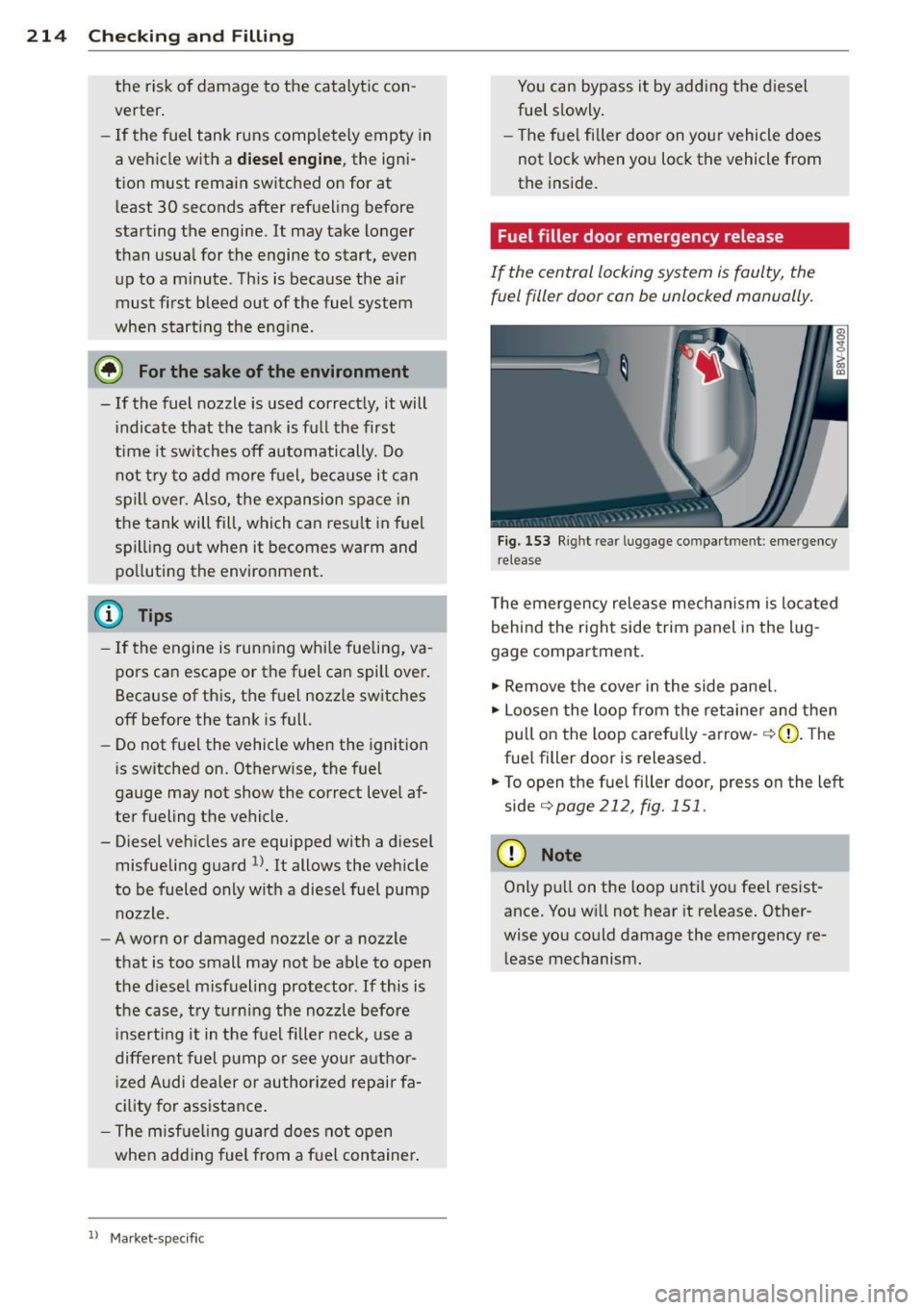
Fig. 153 Right re ar lugg age compa rtm ent : eme rgency
re lease
T he emergency release mechanism is located
behind the right side trim panel in the lug
gage compartment .
" Remove the cover i n the side pane l.
" Loosen the loop from the retaine r and then
pull on the loop carefu lly-arrow-
¢ (D . The
fue l filler door is released .
" To open the fue l filler door, press on the left
side
r=> page 212, fig. 151 .
(D Note
Only pull on the loop until yo u feel resist
ance. You w ill not hear it re lease. Other
wise you could damage the emergency re
lease mechanism.
Page 217 of 310
....,
N
0 > co
rl I.O
"' ....,
"' rl
Selective catalytic reduction
General information
Applies to vehicles: with diesel e ngine
In vehicles with se lective cata lytic reduction, a
urea solut ion (Ad Blue) is injected into the ex
haust system before a nitrogen oxide catalytic
converter to reduce nitrogen -emissions .
Ad Blue is the marketing name for Diese l Ex
ha ust Fluid (DEF) .
The AdBlue is carried in a separa te tank in t he
vehicle . The AdBl ue usage accounts for ap
proximately 0.5% to 1.2% of the diese l fuel
that is used .
When a message abo ut refil ling the Ad Blue
appears in the inst rume nt cl uste r dis play, you
must refi ll the Ad B lue yourse lf or have it refil
l ed by an authorized Audi dealer or aut horized
Aud i Service Facility
Q page 216.
A WARNING
Failure to heed Ad Blue refill information in
the inst rume nt cluste r can p revent the
ve
hicle from being started and driven . If the
veh icle cannot be driven and an eme rgency
ar ises, perso na l inju ry can occur.
- Always have the Ad Blue tank refilled well
before the tank r uns d ry.
(!) Tips
- The instrument cluster display indicates
the d istance remaining that ca n be dr iv
en
Q page 215. If the AdBlue tank is
complete ly empty, the engi ne will not
sta rt again after the ign ition is switched
o ff.
- Ad B lue is requ ired by law to operate this
vehicle.
Che cking and Fillin g 215
Indicators in the instrument cluster
d isplay
Appl ies to vehicles: with diesel engine
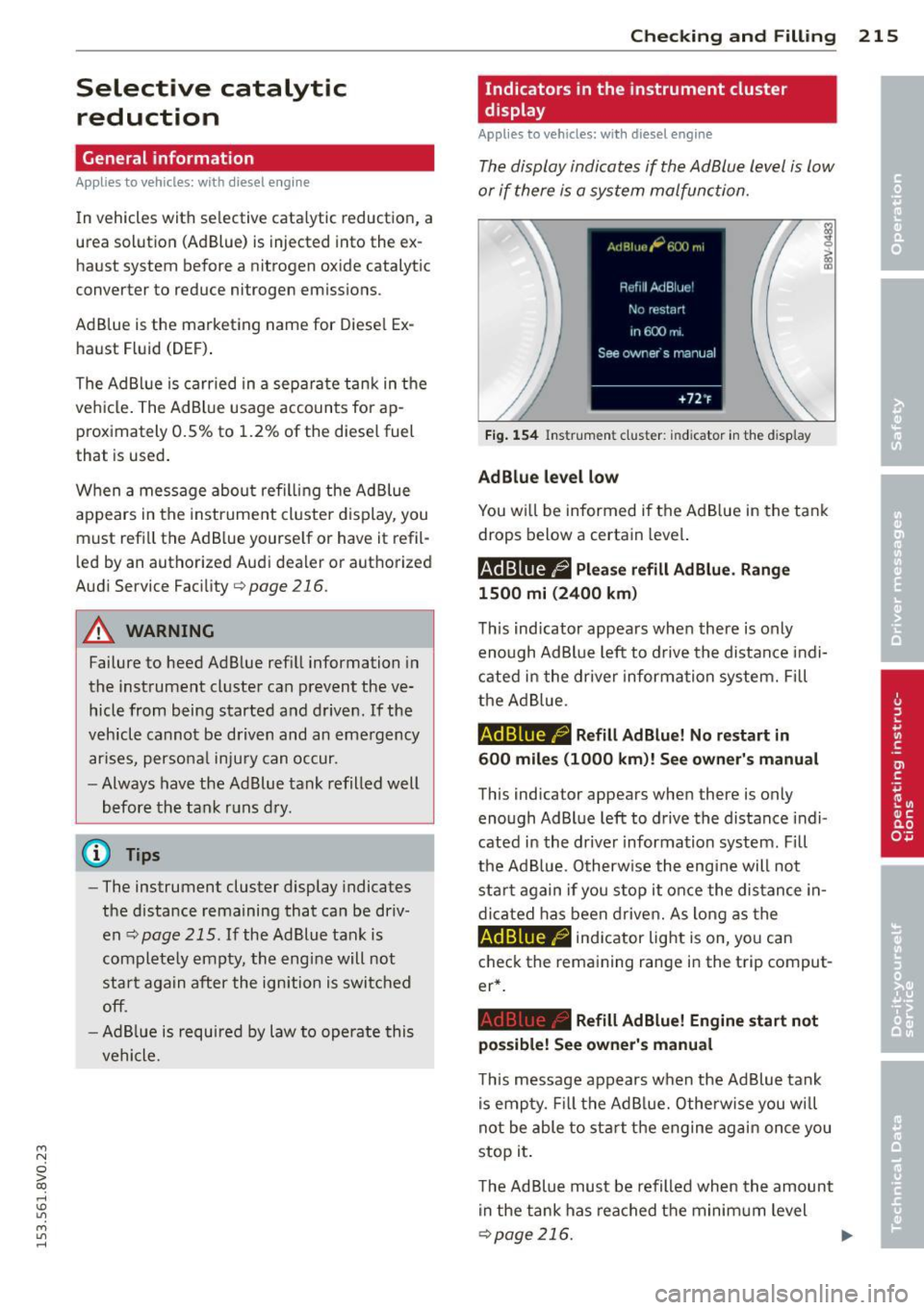
Th e display indicates if th e Ad Blue lev el is low
or if there is a system malfunction.
Fi g. 1 54 Ins trum ent cluster : indicator in the display
AdBlue level low
You w ill be informed if t he AdBlue in the ta nk
drops below a certain leve l.
Ad Blue /9 Please refill Ad B lu e. Range
1500 mi (2400 km)
T his ind icator appea rs whe n there is only
eno ugh Ad Bl ue left to d rive the distance i ndi
cated in the driver information system. F ill
the Ad Blue .
AdBlue /9 Refill AdBlue! No re start in
600 mile s (1000 km )! See owner' s manual
This indicator appears when there is only
enough AdBlue left to drive the distance indi
cated in the dr iver information syst em. F ill
the Ad Blue. Otherwise the eng ine will not
star t again if you s top it o nce the dis tance in
dicated has been drive n. As long as the
AdBlue /9 ind icator light is on, yo u can
check the remaining range in the trip comput
er* .
Refill AdBlue! Engine start not
po ssible! See owner' s manual
This message appears w hen the Ad Blue tank
i s emp ty. Fill the AdB lue. Othe rw ise you w ill
not be able to sta rt the engine ag ain on ce you
stop it .
T he Ad Blu e mu st be refilled when the amount
i n the tank has rea ched t he minim um level
Q poge 216.