engine AUDI S3 2015 Workshop Manual
[x] Cancel search | Manufacturer: AUDI, Model Year: 2015, Model line: S3, Model: AUDI S3 2015Pages: 310, PDF Size: 76.15 MB
Page 139 of 310
....,
N
0 > co
rl I.O
"' ....,
"' rl
occupant will slam violently into the steering
wheel, instrument panel, w indshield , or what
ever else is in the way
c::> fig. 120. This impact
with the vehicle interior has all the energy
they had just before the crash.
Never rely on airbags alone for protection.
Even when they deploy, airbags provide only
additional protection. Airbags are not sup
posed to deploy in all kinds of accidents. Al
though your Audi is equipped with airbags, all
vehicle occupants, including the driver, must
wear safety belts correctly in order to mini mize the risk of severe injury or death in a
crash.
Remember too, that airbags will deploy only
once and that your safety belts are always
there to offer protection in those accidents in
which airbags are not supposed to deploy or
when they have already deployed. Unbelted
occupants can also be thrown out of the vehi
cle where even more severe or fatal injur ies
can occur.
It is also important for the rear passengers to
wear safety belts correctly. Unbelted passen
gers in the rear seats endanger not only them
selves but also the driver and other passen
gers
c::> fig. 121. In a frontal collision they will
be thrown forward violently, where they can
hit and injure the driver and/or front seat pas
senger.
Safety belts protect
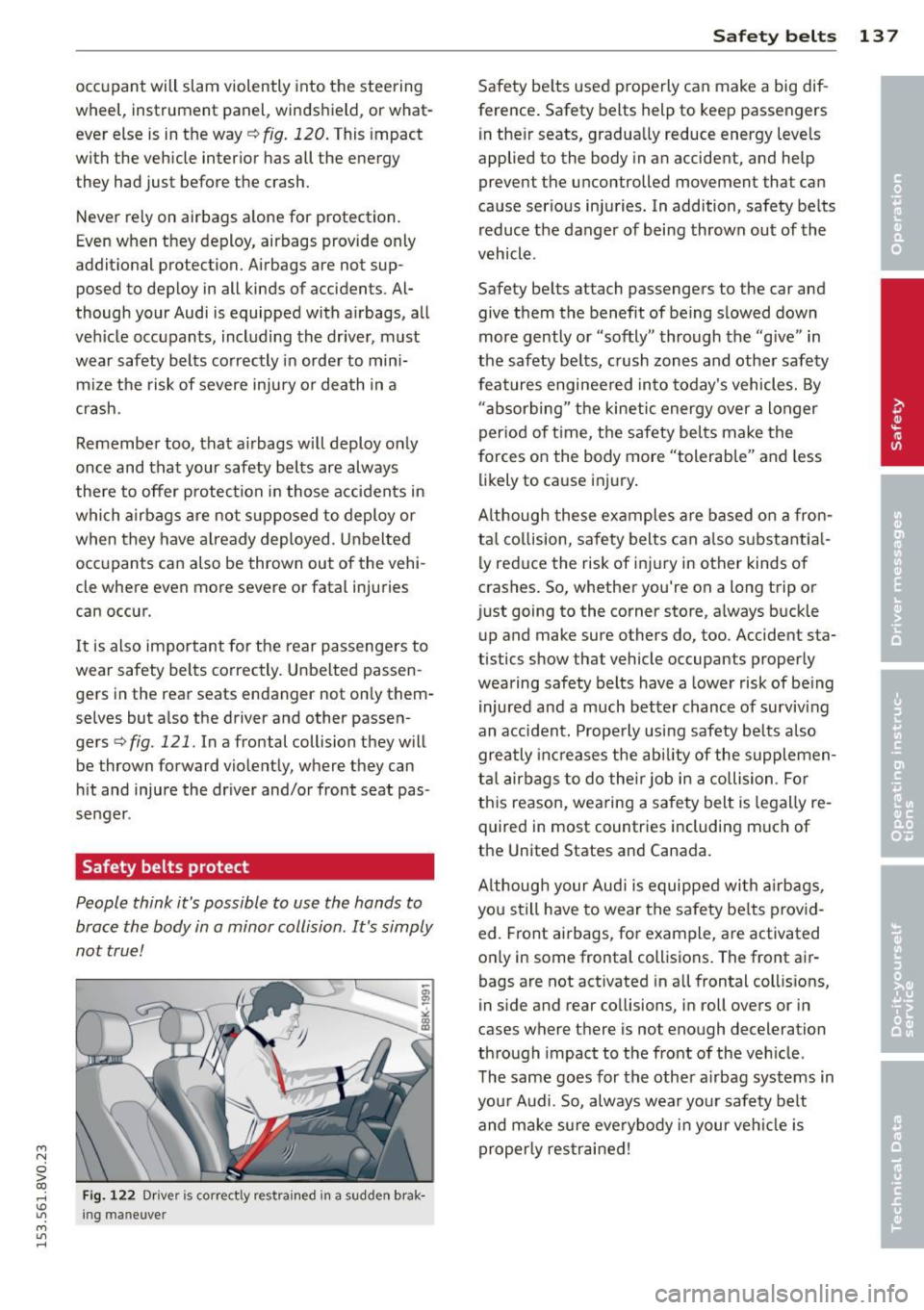
People think it's possible to use the hands to
brace the body in a minor collision . It's simply
not true!
Fig. 122 Driver is cor rect ly r est rain ed in a sudd en brak
ing man euve r
Safety belts 13 7
Safety belts used properly can make a big dif
ference. Safety belts help to keep passengers
in their seats, gradually reduce energy levels
applied to the body in an accident, and help
prevent the uncontrolled movement that can
cause serious injuries . In addition, safety belts
reduce the danger of being thrown out of the
vehicle .
Safety belts attach passengers to the car and
give them the benefit of being slowed down more gently or "softly" through the "give" in
the safety belts, crush zones and other safety
features engineered into today's vehicles. By
"absorbing" the kinetic energy over a longer
period of time, the safety belts make the
forces on the body more "tolerable" and less
likely to cause injury.
Although these examples are based on a fron
tal collision, safety belts can also su bsta ntia l
ly reduce the risk of injury in other kinds of
crashes. So, whether you're on a long trip or
just going to the corner store, always buckle
up and make sure others do, too. Accident sta
tistics show that vehicle occupants properly
wearing safety belts have a lower risk of being
injured and a much better chance of surviving
an accident. Properly using safety belts also
greatly increases the ability of the supplemen
tal airbags to do their job in a collision . For
this reason, wearing a safety belt is legally re
quired in most countries including much of
the United States and Canada.
Although your Audi is equipped with airbags,
you still have to wear the safety belts provid
ed. Front airbags, for example, are activated
only in some frontal collisions. The front air
bags are not activated in all frontal collisions,
in side and rear collisions, in roll overs or in
cases where there is not enough deceleration
through impact to the front of the vehicle.
The same goes for the other airbag systems in
your Audi. So, always wear your safety belt
and make sure everybody in your vehicle is
properly restrained!
Page 191 of 310
M N
0 > co ,...., \!) 1.1'1
M 1.1'1 ,....,
Smart Technology
Information about
data recorded by
vehicle control
modules
Your vehicle is not equipped with a crash data
recorder. This device is installed by some vehi
cle manufacturers to record data about crash
es so that it can be analy zed later . Crash data
recorders are also called "Event Data Record
ers ( EDR)" .
In some legal jurisdictions, it is not permitted
to access or download data recorded by pre
installed crash data recorders in order to eval
uate a crash without clear consent of the vehi
cle owner .
Your vehicle is not equipped with a crash data recorder. However it does contain a variety of
electronic control modules for various vehicle
systems such as engine function, exhaust
treatment or airbags and safety belts .
These electronic control modules record vehi cle data during normal driving for diagnosis
and repair purposes . The recording capability
of the electronic control modules is limited to
data only- no sound is recorded.
If the control
module detects a system ma lfunction or other
change in status, a very limited amount of da
ta is recorded for an extremely small period of
time . Data that is recorded in such a case may
include vehicle speed, d riving direction, the
load on the brakes and head restraints and
performance in the event of an acciden t or
other change in status . The stored data can
only be read or downloaded with special devi
ces.
Electronic stabilization
control (ESC)
Description
The Electronic Stabilization Control (ESC) con
tr ibutes to driver safety. It reduces the risk of
slipp ing and improves driving stability. ESC
Smart Technolog y 189
detects critical situations such as the vehicle
oversteering and understeering or the wheels
are spinning . The vehicle is stabilized by ap
plying the brakes or reducing engine torque.
Once the ESC is activated, the indicator light
m blinks in the instrument cluster .
The following systems are integrated in the
ESC:
Anti-lock braking system (ABS )
ABS prevents the whee ls from locking when
braking. The vehicle can still be steered even
during hard braking. Apply steady pressure to
the brake pedal. Do not pump the pedal. A
pulsing in the brake peda l indicates that the
system is acting to stabilize the vehicle.
Brake assi st sys tem
The brake assist system can decrease braking
distance. It increases braking power when the
driver presses the brake pedal quickly in emer
gency situations. You must press and hold the brake pedal until the dangerous situation is
over . In vehicles with adaptive cruise control*,
the brake assist system is more sensit ive if the
distance detected to the vehicle ahead is too
small.
Anti-slip regulation (ASR)
ASR reduces engine power when the drive
wheels begin spinning and adapts the force to
the road conditions . This makes it easier to
start , accelerate and dr ive up inclines .
Electronic differential lock (EDL)
The EDL brakes wheels that are spinning and
transfers the drive power to the other drive
wheel or wheels if the vehicle is equ ipped with
all wheel drive*). This function is not available
at higher speeds .
In extreme cases, EDL automatically switches
off to keep the brake on the braked wheel
from overheating . The vehicle is still working
correctly. EDL will switch on aga in automat i
cally when cond itions have returned to nor-
mal. .,..
•
•
•
Page 192 of 310
190 Smart Technology
Steering r ecommendat ion
The ESC helps to stabilize the vehi cle by
changing the steering torque.
Select ive wh eel torqu e co ntrol
Select ive wheel torque control is used when
driving on curves . The front wheel on the in
side of the curve or both wheels on the inside
of the curve are braked selective ly as needed.
Th is a llows more precise driv ing in c urves.
Automatic post -collision braking system
The "Automatic post-collision braking system"
can he lp to reduce the risk of sliding and of
other coll is ions after an acc ident. If the airbag
control mod ule detects a collision above acer
tain vehicle speed, the vehicle is braked by the
ESC.
The vehicle does not brake automatically if:
- the driver presses the accelerator pedal , or
- the braking fo rce genera ted by the pressed
brake pedal is greater than the braking force
that would be initiated by the system, or
- the ESC, the brake system or the vehicle
electrical system are not functioning .
A WARNING ,.
- The ESC and its integrated systems can
not overcome the lim its posed by natural
physical laws. This is especia lly impor
tant on s lippery or wet roads. If the sys-
Switching on /off
terns begin acting to stabilize your vehi
cle, you should immediately a lter your
speed to match the road and traffic con
ditions . Do not let the increased safety
provided tempt you into taking r isks .
This could increase your risk of a co lli
sion .
- Please note the r isk of a coll is ion increas
es when driving fast, especially through
curves and o n slippe ry or wet roads, and
when dr iv ing too close to objects ahead.
The ESC and i ts integrated systems can
not a lways p revent collisions -there is
still a risk of accidents!
- Press the acce lerator pedal caref ully
when acce lerating on even, slippery sur
faces such as ice and snow. The drive wheels can spin even when these control
systems are installed and this can affect
driving stability and increase the risk of a
coll is io n.
(D Tips
- ABS and ASR only function correctly
when all four wheels are equ ipped w ith
identical t ires . Different t ire sizes can
lead to a reduction in engine power.
- You may hear noises when the systems
descr ibed are working .
- If the
DJ or [IJ indicator light appears,
there may be a malfunction¢
page 22.
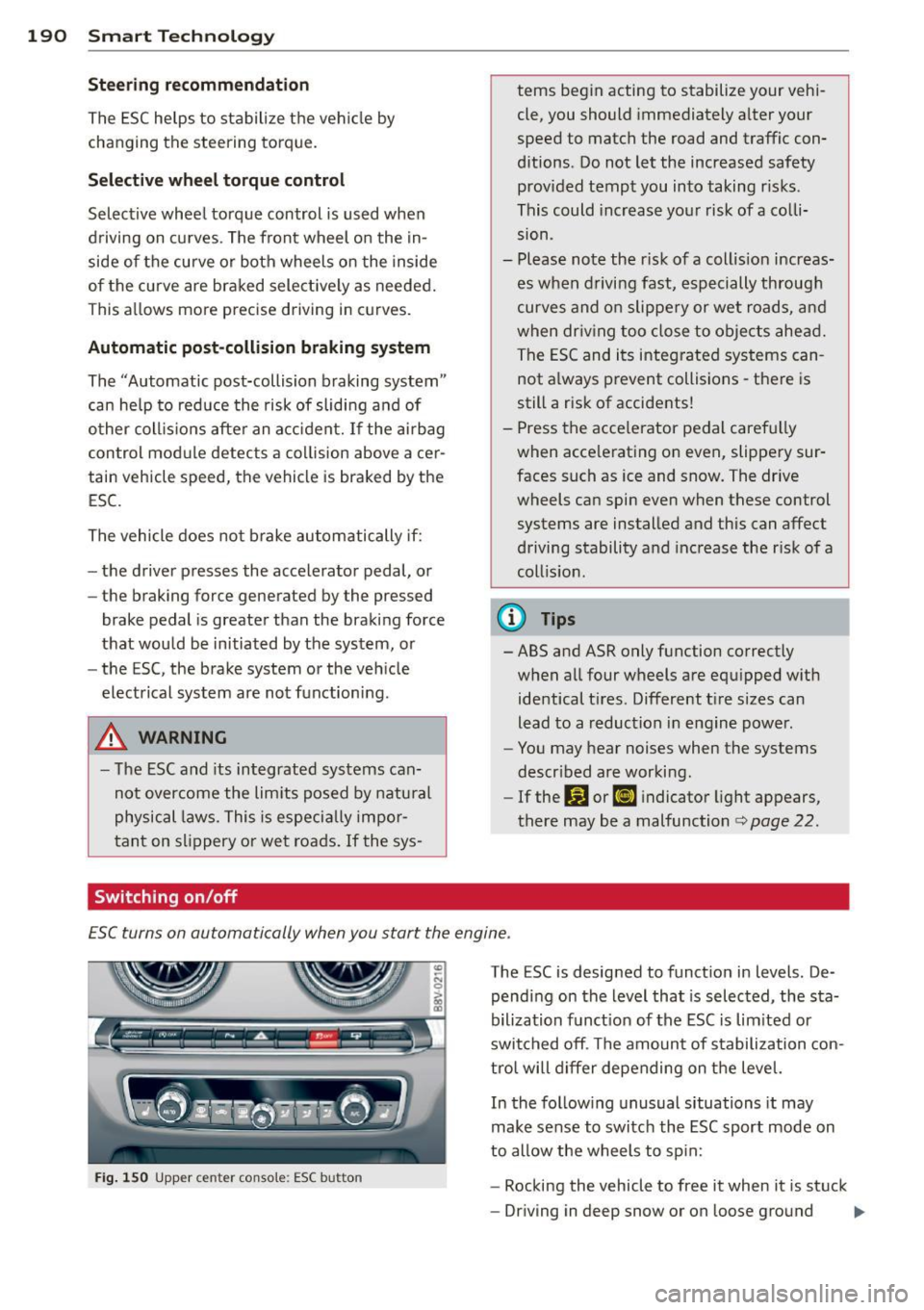
E SC turns on automatically when you start the engine .
Fig. 1 50 Upper c ente r conso le : ESC but to n
The ESC is designed to funct ion in levels . De
pending on the level that is selected, the sta
bilization funct io n of the ESC is lim ited or
swit ched off . The amoun t of stabilization con
tro l will differ depending on t he level.
In the follow ing unusual situations it may
make sense to switch the ESC sport mode on
to allow the wheels to sp in:
- Rocking the vehicle to free it when it is stuck
- Driving in deep snow or on loose ground
ll>
Page 194 of 310
192 Smart T echnol ogy
Corro sion
Leaving the vehicle parked for long periods o f
time, low mi leage and avoiding heavy braking
can contribute to corrosion on the brake ro
tors and di rty brake pads.
I f you usually avoid heavy brak ing or if there is
corrosion present, occasiona l heavy braking at
high speeds is recommended to clean the
brake rotors and pads¢,& .
Brake system malfunction
if you notice that the brake pedal t ravel has
suddenly gotten larger, then a brake circuit
may have failed. Drive to your authorized Audi
dealer or qualified repair facility immediately
to hav e the problem corrected . On the way
there, drive with reduced speed and keep in
mind that a long braking distance and in
creased pressure on the brake pedal will be
necessary .
Lo w brake fluid level
When the brake fluid level is low, ma lfunc
tions in the brake system may occur. The
brake fluid level is electronically mon itored.
B rake bo ost er
The brake booster amplifies the pressure you
apply to the brake pedal. It only works when
the engine is running.
A WARNING ,~ ·
- You should only perform braking maneu
vers to clean the brakes when the road
condit ions perm it. Never put others on
the road at risk -never forget the risk of
acc idents!
- On steep slopes, reduce the speed and
select a lower gea r or lowe r selector lev
er position. Drive as litt le as poss ible
w hil e pressing the bra ke peda l and avoid
putt ing you r left foot on the brake pedal
whi le driving . This could cause the brakes
to overheat and impair the efficiency of
the brakes .
- Do not let the brakes "grind" by always
keeping yo ur foot on the brake peda l. This can cause the brakes to overheat
in-
,
crease wear and increase braking dis
tance unnecessarily.
- Certain weather and operating condi
tions such as driving through water, driv
ing in heavy rain or driving after washing
your veh icle can impa ir the effectiveness
of the brakes . In the winter, ice may
bu ild up on the bra ke pads, rotors and
d rums. Che ck these components by b rak
ing caref ully. App lyi ng the br akes care
fu lly several times dries the brakes and
removes ice bui ld-up .
- The eff ic iency of the brakes can also be
impaired by driving for long stretches on roads covered with salt without using the
brakes. Yo u can remove salt deposits
from the brake rotors and pads by care
fully applying the brakes several times.
- If the front spoiler is damaged or you in
stall another spoiler, make sure the front
wheel brakes are ventilated properly.
Otherwise , the brake system could over
heat, wh ic h red uces their effectiveness .
- Failure of a brake circuit impa irs braking
performance, wh ic h increases bra king
d istance . Avoid driving the vehicle and
have it towed it to the nearest author
i z ed A udi dealer or au thorized Aud i Serv
ice Facility .
- Do not let your ve hicle roll w it h the en
g ine switched off unde r any circumstan
ces .
- If the b rake booste r is no t working, you
will have to press much harder on the b rake peda l to compensate for the lack
of the booster.
(D Note
- N ever le t the bra kes "rub" by pressing
t he pedal ligh tly when braking is not
really necessary . This causes the brakes
to overheat and increases braking dis
tance and causes wear .
- Before dr iv ing on a long stretch with
steep s lopes, reduce your speed and shift
to the next lower gear This makes use of
the engine brak ing effect and relieves .,.
Page 196 of 310
194 Smart Technology
Winter tires By using all wheel drive, your vehicle has good
forward motion with standard tires in winter
cond itions. However, in winter we recommend
using winter or all season tires on
all four
wheels, because this will improve the braking
effect .
Snow chains
If there are snow chain laws, snow chains
must also be used on vehicles with all whee l
drive ¢
page 262, Snow chains .
Replacing tires
Fo r vehicles w ith all whee l dr ive , only wheels
with the same rolling circumference should be
used . Avoid whee ls with different tread
depths ¢
page 254.
Offroad vehicle?
Your Aud i is not an offroad vehicle -there is
not enough ground clearance. For this reason,
avoid difficult terrain. Refer to¢
page 287.
&_ WARNING
- Also, in vehicles with all whee l dr ive,
adapt yo ur driving style to the current
road and traffic conditions. Do not let
the increased safety provided tempt you
into taking risks.
- The braking ability of your vehicle is lim
ited to the traction of the wheels . In this
way, it is not different from a two wheel
dr ive vehicle. Do not be tempted to ac
celerate to a high speed when the road is
slippery this increases the risk of an acci
dent .
- Note that on wet streets, the front
wheels can "hydroplane" if driving at
speeds that are too high. Unlike front
wheel drive vehicles, the engine does not
rev higher suddenly when the vehicle be
gins hydroplan ing. For this reason, pay
attention to the road conditions regard
less of your speed.
Energy management
The starting ability is optimized
The energy management system manages
the electrical energy distribution and optimiz
es the availability of electrical energy for
starting the engine.
When a vehicle with a conventional energy
system is not driven for a long time , the bat
tery is drained by equ ipment (for example the
immobilizer). In certain circumstances, there
could may not be enough energy to start the
engine .
Your vehicle is equipped with an intel ligent
energy management system for d istr ibut ing
electricity. This s ignificantly improves the
sta rting ability and increases the battery life.
The energy management sy stem Is made up
of
battery diagnosis , idling current manage·
ment
and dynamic energy management .
Battery diagnosis
The battery d iagnosis determ ines the battery
charge leve l. The sensors determine the bat
tery voltage, the battery current, and the bat
tery temperature. The curren t cha rge leve l
and the performance of the battery are deter
mined based on this.
Idling current management
The idling current management decreases the
energy used wh ile parked. With the engine
switched off, it manages the energy distribu
tion to the different elect rical componen ts.
Date from battery diagnosis is taken into ac
count for this.
Depending on the battery charge level, elec
trical equip ment is switched off one item after
the o ther, to prevent the battery from drain
ing and to retain the starting ability.
Dynamic energy management
While driving, dynamic energy management
distributes the appropriate amount of energy
to the e lectr ica l equipment.
It controls the
battery charge level so that more energy is ..,.
Page 197 of 310
not used then is being generated in o rder to
maintain an optimal battery charge level.
@ Tips
- Energy management cannot overcome
the laws of physics. Note that the charge l evel and length of the battery life are
limited .
- When the start ing ability is endangered,
the (•) indicator light turns on
c!:>page20.
What you should know
Maintaining the starting ability is the highest
priority.
A lot of stress is p laced on the battery when
driving short distances, in traffic , and at co ld
times of the year. A lot of energy is used but litt le is generated. It is also critical when the
engine is not running but electrical equip ment is switched on . In this case, energy is
used but none is generated .
In situations like this, energy management
will actively regulated the distribution of en ergy.
Long periods without use
I f you do not drive your vehicle for several
days or weeks, e lectrica l equipment is gradu
ally sca led back or switched off . This reduces
energy use and ensures the vehicle will be
able to start after long periods of time. Some
conven ience functions such as opening with
the remote contro l key may not be ava ilab le.
These convenience functions will be available
again once you switch the ign ition on and
start the engine.
With the engine switched off For example, if you listen to the radio when
the engine is switched off, the batte ry w ill
drain .
~ A warning text will appear if energy consump-
~ tion could impair starting ab ility . co ,....,
~ The message shows that you need to start the
~ engine in order to charge the battery. ,....,
Smart Technolog y 195
With the engine running
Although electrical energy is generated while driving, the battery can drain. This can happen
when litt le energy is generated, and much is
used and the charge leve l of the battery is not
optimal.
To restore the ba lance of energy, components
that require large amounts of energy are tem
porari ly scaled back or switched off. Heating
systems in particular require a great deal of energy. If you notice, for example, that the
seat heating* or rear window defroster is not
working, then it has been temporar ily reduced
or switched off . These systems are availab le
again as soon as the energy balance has been
restored.
In add ition, you may notice that the idle
speed has slight ly increased . That is normal
and no cause for concern. Due to the in
creased idling speed, the additional required
energy w ill be gene rated and the battery will
be charged.
Notice about data
recorded by the Event
Data Recorder and
vehicle control
modules
Event Data Recorder
This vehicle is equipped with an Event Data Recorder ( EDR). The main purpose of an EDR
is to record, in certain crash or near crash-like
situations, such as an airbag deployment or hitting a road obstacle, data that w ill assist in
understanding how a vehicle's systems per
formed . Th e EDR is designed to record data
related to vehicle dynam ics and safety sys
tems for a short pe riod of time, typically
30 seconds or less . The EDR in this vehicle is
designed to record such data as:
- How various systems in your veh icle were
operating;
- Whether or not the driver and passenger
safety belts were buckled/fastened;
•
•
Page 198 of 310
196 Smart Technology
- How far (if at all) the driver was depress ing
the accelerator and/or brake pedal; and,
- How fast the vehicle was traveling.
These data can he lp provide a better under
stand ing of the circumstances in which crash
es and injuries occur. NOTE: EDR data are re
corded by your vehicle only if a non-trivial
crash situation occ urs; no data are recorded by
the EDR under normal driving conditions and
no personal data (e.g., name, gender, age,
and crash location) are recorded. However,
other parties, such as law enforcement, could
comb ine the EDR data with the type of per
sonally identify ing data routine ly acquired
du ring a crash invest igation.
To read data recorded by an EDR, special
equipment is required, and access to the veh i
cle or the EDR is needed . In add ition to the ve
hicle manufactu rer, othe r parties, such as law
enforcement, that have the special equip
men t, can read the information if they have
access to the vehicle or the EDR.
Some state laws restrict the retrieval or down
loading of data stored by EDRs installed in a
vehicle for the express purpose of retrieving
data after an accident or crash event without
the owner's consent.
Aud i will not access the EDR and/or similar
data or give it to others -
- unless the veh icle owner (or lessee if the ve
hicle has been leased) ag rees; or
- upon th e official request by the police; or
- upon the order of a court of law or a govern-
ment agency; or
- for the defense of a lawsuit through the ju
dicial discovery process.
- Audi may also use the data for research
about veh icle operation and safety perform
ance or provide the data to a third party for
research purposes without identifying the
spec ific vehicle or information about the
identity of its owner or lessee and o nly after
the recorded vehicle data has been ac
cessed.
Vehicle control modules
Your vehicle is also equipped with a number of
electronic control modules for various vehicle
systems, such as engine management, emis
sion control, airbags, and safety belts.
T hese electronic control mod ules record data
during norma l vehicle operation that may be
needed by trained technicians for diagnostic
and repair purposes. The recording capability
of these modu les is limited to data (no sound
is recorded). Only a small amount of data is
actually recorded over a very limited period of
t ime, or stored when a system fault is detect
ed by a contro l module . Some of the data
stored may relate to vehicle speed, direction,
or braking, as well as restraint system use and
performance in the event of a crash. Stored
data can also on ly be read and down loaded
with special eq uipment that is directly con
nected to the vehicle .
(D Tips
Your vehicle may be equipped with Audi
connect. Your use of certain A udi connect
features requires wireless services that are
provided by a third party wire less telecom
munications provider. For details regard
in g how information obtained through
Audi connect is collected, processed,
transmitted, used, and shared, please see
your contract with the wireless telecom
munications provider and the" About Audi
connect" tab in your vehicle's
MMI: I MENU I
button > Audi connect > About Audi con
nect.
Page 199 of 310
M N
0 > co ,...., \!) 1.1'1
M 1.1'1 ,....,
Driving and the
environment
The first 1,000 miles (1,500 km) and
afterwards
New engine
The engine needs to be run-in during the first
1,000 miles (1 ,500 km) .
For the fir st 600 mil es
(1,000 kilometers):
.,. Do not use full throttle.
.,. Do not drive at engine speeds tha t are more
than 2/3 of the max imum permitted RPM .
.. Avoid high engine sp eeds .
From 600 to 1,000 mile s (1,000 to
1,500 kilometers):
.. Speeds can gradually be increased to the
max imum pe rm iss ib le road or eng ine speed .
During and after break-in per iod
.,. Do not rev the engine up to high speeds
when it is cold. Th is app lies whether the
transmission is i n N (Ne utra l) or in gear.
After the break- in period
.. Do not exceed maximum engine speed un
der any circumstances.
.,. Upshift into the next higher gear
before
reaching the red area at the end of the tach
ome ter scale
¢ page 10.
During the first few hours of driving, the en
g ine's interna l friction is higher than later
when all the moving parts have been broken
i n. How well this break-i n process is done de
pends to a conside rable extent on the way the
ve hicl e is driven d uring the first 1,0 00 miles
(1, 500 k ilome ters).
(D Note
Extremely h igh engine speeds a re auto
ma tica lly reduced. However, t he se RPM
lim its are pr ogr amme d for an eng ine t hat
is broken in, no t a new engine .
Driving and the environment 197
@) For the sake of the environment
Do not drive with unnecessar ily hi gh en
g ine speeds -upsh ifting ear ly saves f uel,
r educes noise and protects the environ
ment.
New tires
If your vehicle is running on new tires, drive
particularly caref ul for the first 350 miles
(500 kilomete rs) afte r fitt ing.
.&, WARNING
N ew tires tend to be slippery and mus t al
so be "b roken -in" . Be s ure to remember
this dur ing t he f irst 350 m iles (500 kilo
meters) . Bra ke gently . Avoid fo llow ing
closely behind other vehicles or other sit
uations that m ight require sudden, hard
b raking .
New brake pads
Remember that new brake pads do not have a
full brak ing effect dur ing the first 250 m iles
(400 kilomete rs) afte r they a re install ed.
New brake pads have to be "burnished in" be
fo re they have optima l grab¢ .&. .
D uring the brea k-in pe riod, you should avo id
putting severe loads on the brakes. Severe
l oads include , for example, sudden hard brak
i ng, in particular at very h igh speeds or, for
example, on mounta in passes .
.&, WARNING
New b rake pa ds don't have the best stop
p in g p ower a nd must be "b ro ken -in " dur
ing the ini tial 1 00 t o 150 miles (15 0 to
2 00 kilometers) o f no rma l cit y driving . You
can compensate for this by pressing t he
b rake peda l more fi rm ly . This also applies
l ater when new pads are installed.
•
•
•
Page 200 of 310
198 Driving and the environment
Driving through water
on roads
Note the following to avoid vehicle damage
when driving through water, for example on
flooded roads:
- The water must not be any higher than the
bottom of the vehicle body.
- Do not drive faster than wa lking speed.
A WARNING
After driving through water or mud, the
braking effect can be reduced due to mois
ture on the brake discs and brake pads. A
few careful brake applications should dry off the brakes.
@) Note
Vehicle components such as the engine, transmiss ion, suspension or electrical sys
tem can be severely damaged by driving
through water.
- Determ ine the depth before driving
through water.
- Do not stop the vehicle, drive in reverse
or switch the engine off when driving
through water .
- Keep in mind that oncoming vehicles may create waves that raise the water
level and make it too deep for your vehi
cle to drive through safely.
- Avoid dr iving through salt water (corro
s ion).
Catalytic converter
App lies to vehicles: with gasoline engine
It is very important that your emission con
trol system (catalytic converter) is function
ing properly to ensure that your vehicle is run
ning in an environmentally sound manner.
> Always use lead-free gaso line r=;, page 210,
Fuel supply .
> Never run the tank down all the way to emp-
ty.
> Never put too much motor o il in your engine
r=;, page 223, Adding engine oil
The catalytic converter is an efficient "clean
up" device built into the exhaust system of
the vehicle . The cata lytic converter burns
many of the pollutants in the exhaust gas be
fore they are released into the atmosphere.
The exclusive use of unleaded fuel is critica lly
important for the life of the catalytic convert
er and proper functioning of the engine.
A WARNING
-
The temperature of the exhaust system is high, both when driv ing and after stopping
the eng ine .
- Never touch the exhaust tail pipes once
they have become hot . This could result
in burns.
- Do not park or operate the vehicle in
areas where the hot exhaust system may
come in contact with dry grass, brush,
fue l spill or other material wh ich can
cause a fire.
- Do not app ly additional undercoating or
rustproofing on or near the exhaust manifold, exhaust pipes, catalytic con
verter or heat shields . Dur ing driving, the
substance used for undercoating could
overheat and cause a fire.
(D Note
- Be aware that just one tank filling with
leaded fuel will already seriously de
grade the performance of the catalytic
converter.
- Do not exceed the correct engine oil level
r=;, page 223.
-Do not drive until the fuel tank becomes
completely empty. The engine could mis
fire . Unburned fuel could also get into
the exhaust system and this cou ld cause
the catalytic converter to overheat.
- Do not switch off the ignition while the
vehicle is moving.
- Do not continue to operate your vehicle
under these conditions, as otherwise fuel
IIJ,,
Page 202 of 310
200 Driving and the environment
Vehicles use the most fuel when they are ac
celerati ng. If you anticipate what is going to
happen next, you will need to brake less and,
thus, accelerate less. let the vehicle coast
whenever poss ible -for example when you see
that the next traffic light is red.
Avoid full throttle
Driving at moderate speeds saves fuel and
improves your mileage.
.. Try and keep well be low your car's max imum
speed.
Accelerating gently reduces fuel consump
tion, engine wear, and does not disturb the
environment. F ue l consumption, exhaust emissions and en
gine noise increase disproportionately at hig h
speeds . If you drive at approximately three
quarters of top speed, fue l consumption will
be reduced by one half. Never dr ive faster
tha n the posted speed limit and weather con
d itions permit.
Reducing unnecessary idling
Even when your car is just idling it burns up
fuel.
.. Sh ut the engine off when you are not dr iving
the vehicle.
.. Do not warm up the vehicle by letting the
engine run at idle.
It is efficient to switc h off the engine when
stopped at railroad crossings and long red
lights. Turning the engine off for just 30-40
seconds saves mo re fuel than is burned by
start ing the eng in e again.
It takes a long time for the engine to warm up
fu lly when it is running at idle. However, wear
and nox ious em issions are especially high
when the engine is warming up. So you should
d rive away as soon as you sta rt the eng ine and
avoid ru nning a t high RPM wh ile the engine is
still warming up .
(D Note
Do not leave engine i dling unattended af
ter start ing. If wa rning lights sho uld come
on to indicate improper operation, they
would go unheeded. Extended idling also
produces heat , w hich could result in over
hea ting o r othe r damage to the veh icle or
othe r property.
Regular maintenance
A badly tuned engine unnecessarily wastes a
lot of fuel.
.. Have your ve hicle serviced at regu lar inter-
vals.
Having your veh icle regu larly serviced by an
authorized Aud i dealer helps to ensure that it
runs properly and econom ica lly. The cond it io n
of your veh icle not on ly affects its safety and
ability to ho ld its va lue, i t also affects
fuel
c onsumption .
Check your oil each t ime you fill your tank.
The amount of oi l used is re lated to engine
l oad and speed.
It is normal for the oil consump tion of a new
engine to reach its lowest value after a certain
mileage has been driven .
You m ust drive your ve hicle abou t 3,000 m iles
(5,000 kilometers) before you can properly
assess oil consumpt ion .
T his also ap plies to fue l consumption and en
gine o utp ut.
(D Note
- Have your veh icle ma inta in ed properly
and i n acco rdance with the service rec
ommendations in you r W arranty
& Main
t enance boo klet. l ack of proper ma inte
nance as well as im proper use of the ve
hicle will impair the function of the
em iss ion cont ro l system and cou ld lead
to damage.