warning AUDI S3 2015 Owners Manual
[x] Cancel search | Manufacturer: AUDI, Model Year: 2015, Model line: S3, Model: AUDI S3 2015Pages: 310, PDF Size: 76.15 MB
Page 234 of 310
232 Check ing and F illin g
the time your vehicle was delivered) . Specifi
cations are listed on the battery housing. Yo ur
author ized dealer must code the battery in
the energy management system to enable you
to use the energy management functions cor rectly after replac ing the battery .
The new battery must have the same capacity,
voltage (12-volts), amperage, construct ion
and plug sealing.
When insta lling the battery, make sure the ig
n ition and all e lectr ica l consumers are sw itch
ed off.
Make sure the venti lation hose on the side
of the battery is connected, otherwise
fumes or battery ac id can leak out.
@ For the sake of the environment
Because of the problem of proper disposa l
of a battery, we recommend your author
ized Audi dealer change the battery for
you. Batter ies contain su lfuric ac id and
lead and must always be disposed of prop
erly i n compliance w ith all environmental
regu lations . D ispos ing of vehicle batteries
improper ly is very dangerous to t he envi
ronmen t.
Windshield washer
container
M N ~ N
"' co
co
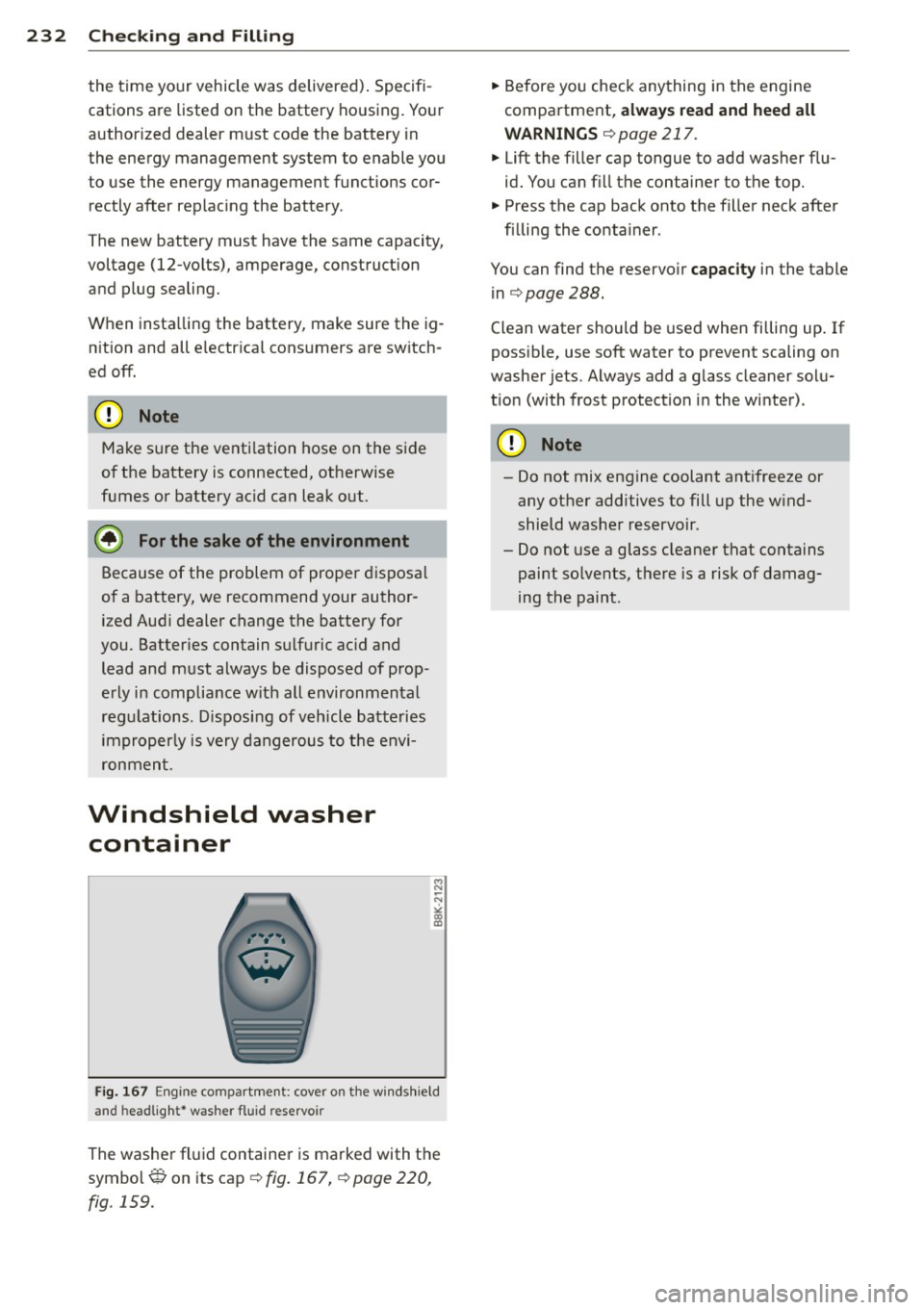
F ig . 167 Eng ine compa rt m ent: cove r on the w indshi eld
an d h ead ligh t* washer f lu id re servo ir
The washer f luid container is marked with the
symbo l won its cap ¢
fig. 167, ¢ page 220,
fig. 159.
.. Before you check anything in the engine
compartment,
always read and heed all
WARNINGS ¢ page 217 .
.. Lift the fi ller cap tongue to add washer flu
id. You can f ill the container to the top.
.. Press the cap back onto the filler neck afte r
filling the conta iner .
You can find the reservo ir
capacit y in the table
in c:>
page 288.
Clean water should be used when filling up . If
poss ib le, use soft water to prevent scaling on
washer jets . Always add a g lass cleaner solu
t ion (with frost protection in the w inter) .
(D Note
- Do not mix engine coolant ant ifreeze or
any other additives to fill up the w ind
shield washer reservoir .
- Do not use a glass cleaner that contains
paint so lvents, there is a risk of damag
ing the paint.
Page 236 of 310
234 Tires and wheels
and make of tire and the tread
pattern.
Hidden damage
Damage to tires and rims is of
ten not readily visible. If you
notice unusual vibration or the
vehicle pulls to one side, this may indicate that one of the
tires has been damaged . The
tires must be checked immedi
ately by an authorized Audi
dealer or qualified workshop.
Unidirectional tires
A unidirectional tire can be identified by arrows on the
sidewall, that point in the direc
tion the tire is designed to ro
tate. You must follow the speci
fied direction of rotation. This is
necessary so that these tires
can develop their optimum
characteristics regarding grip,
road noise, wear and hydro
planing resistance. For more in
formation
¢page 274.
&_ WARNING
New tires or tires that are
old, worn or damaged cannot provide maximum control
and braking ability. -New
tires tend to be slip
pery and must also be bro
ken-in. To reduce the risk of
losing control, a collision
and serious personal inju
ries, drive with special care
for the first 350 miles (560 km).
-Driving with worn or dam aged tires can lead to loss of
control, sudden tire failure,
including a blowout and
sudden deflation, crashes
and serious personal injuries. Have worn or damaged
tires replaced immediately.
-Tires age even if they are
not being used and can fail
suddenly, especially at high
speeds. Tires that are more
than 6 years old can only be
used in an emergency and
then with special care and at low speed.
-Never mount used tires on your vehicle if you are not sure of their "previous histo
ry." Old used tires may have
been damaged even though
the damage cannot be seen
that can lead to sudden tire
failure and loss of vehicle
control.
...
Page 246 of 310
244 Tires and wheels
The correct tire pressure for the
spare wheel is located on a la
bel on the driver's side 8-pillar .
Because technical changes may
be made to vehicle equipment
during the model year, always
compare the tire size designa
tion on the tire pressure label
on your vehicle with the tires on
your vehicle. Make sure that the
tire size information on the ve
hicle label is the same as the
size of the tires on the vehicle.
This is especially important if
the vehicle belongs to someone else or you bought the vehicle
with different rims/tires or you bought the vehicle as a previ
ously owned vehicle.
Remember, your safety and
that of your passengers also de
pends on making sure that load
limits are not exceeded. Vehicle
load includes everybody and ev
erything in and on the vehicle.
These load limits are technical
ly referred to as the vehicle's
Gross Vehicle Weight Rating
("GVWR"). The Gross Axle
Weight Rating ("GAWR") is the maximum load that can be ap
plied at each of the vehicle's
two axles. The Gross Vehicle Weight Rating and the Gross
Axle Weight Rating are listed
on the safety compliance stick
er label located on the driver's
side 8-pillar.
The tire pressure
label on your Audi lists the
maximum combined weight of
all of the occupants and lug gage or other cargo that the ve
hicle can carry. For the location
of the tire pressure label
~fig. 168.
A WARNING -
Overloading a vehicle can
cause loss of vehicle control,
a crash or other accident, se
rious personal injury, and
even death.
-Carrying more weight than your vehicle was designed to carry will prevent the ve
hicle from handling properly
and increase the risk of a
loss of vehicle control.
-The brakes on a vehicle that has been overloaded may not be able to stop the vehi
cle within a safe distance.
-Tires on a vehicle that has been overloaded can fail
suddenly causing loss of
control and a crash.
Page 247 of 310
M N
0 > co ...... \!) 1.1'1
M 1.1'1 ......
-Always make sure that the total load being transported - including the weight of a
trailer hitch and the tongue
weight of a loaded trailer - does not make the vehicle heavier than the vehicles
Gross Vehicle Weight Rat
ing.
_& WARNING
- Incorrect tire pressures
and/or underinflation can
lead to a serious or fatal ac
cident.
- Incorrect tire pressures
and/or underinflation cause
increased tire wear and can
affect the handling of the
vehicle.
-Incorrect tire pressures and/or underinflation can
also lead to sudden tire failure, including a blowout
and sudden deflation, caus ing loss of vehicle control.
Tires and wheels 245
Checking tire pressure
The correct tire pressure for the
tires originally installed on
your vehicle is listed on the tire pressure label located on driv er's side 8-pillar.
The recommended tire pres
sures are on the tire pressure label and in the table
¢ page 240~ Cold tire inflation
pressure.
This means that the
pressure must be checked and
adjusted when the tire has not
been driven for more than a
couple of miles (kilometers) at
low speeds during the previous
three hours. Air in the tires ex pands when the tire heats up as
a result of internal friction as it
flexes in use. The tire pressure is higher when the tire has
warmed up than when it is "cold ."
It is the inflation pressure in a
"cold" tire that counts. There
fore, you should never let air
out of a warm tire to match
"Cold tire inflation pressure" recommendations ¢
page 240.
The tires would then be under
inflated and could fail sudden
ly .
...
' •
•
' •
Page 249 of 310
Tires and wheels 24 7
It is important to check the tire sure for the spare wheel
pressure when the tires are
¢page 268.
cold.
When should I adjust the
-Read the required tire pres-tire pressures?
'
sure from the tire pressure la-
Adjust the tire pressure to the •
•
bel. The tire pressure label is load you are carrying. After
located on the driver's side B- changing a wheel
or replacing
pillar. wheels you have to adjust the
-Turn the valve stem cap coun- tire pressures on all wheels. In
ter-clockwise to remove it addition, you must then store
from the tire valve. the new tire pressures in the
-Place the air pressure gauge tire pressure monitoring sys-
on the valve. tern
¢ page 264.
-The tire pressures should only
A WARNING
be checked and adjusted when
Incorrect tire pressures and/
the tires are cold . The slightly
or underinflation can lead
raised pressures of warm tires
sudden tire failure, loss of
must not be reduced.
control, collision, serious per-
-Adjust the tire pressure to the
sonal injury or even death.
load you are carrying.
-When the warning symbol
-Reinstall the valve stem cap
RI] appears in the instru-
on the valve.
ment cluster, stop and in-
When should I check the tire spect the tires.
pressure? -Incorrect tire pressure and/
The correct tire pressure is es- or underinflation can cause
pecially important at high increased tire wear and can
speeds. The pressure should affect the handling of the
therefore be checked at least vehicle and stopping ability.
once a month and always be- -Incorrect tire pressures
fore start ing a journey. Do not
and/or underinflation can
' • M N
forget to check the tire pres-0 > co .... \!) 1.1'1
M 1.1'1 ....
Page 252 of 310
250 Tires and wheels
hitch and the tongue weight of
the loaded trailer) is limited.
The more passengers in the ve hicle or passengers who are
heavier than the standard
weights assumed mean that
less weight can be carried as
luggage .
The tire pressure label on your
Audi also lists the maximum combined weight of all of the
occupants and luggage or other
cargo that the vehicle can carry.
For the location of the label
q page 240, fig. 168 .
_& WARNING
~ -
Overloading a vehicle can
cause loss of vehicle control,
a crash or other accident, se
rious personal injury, and
even death.
-Carrying more weight than
your vehicle was designed to carry will prevent the vehicle from handling properly
and increase the risk of the
loss of vehicle control.
-The brakes on a vehicle that
has been overloaded may
not be able to stop the vehi
cle within a safe distance . -Tires
on a vehicle that has
been overloaded can fail
suddenly, including a blow
out and sudden deflation,
causing loss of control and a
crash.
-Always make sure that the
total load being transported
- including the weight of a
trailer hitch and the tongue
weight of a loaded trailer -
does not make the vehicle
heavier than the vehicles
Gross Vehicle Weight Rat
ing .
Determining correct load
limit
Use the example below to cal
culate the total weight of the
passengers and luggage or oth
er things that you plan to trans port so that you can make sure
that your vehicle will not be
overloaded.
Steps for Determining
Correct Load Limit
1. Locate the statement "THE
COMBINED WEIGHT OF OC
CUPANTS AND CARGO
SHOULD NEVER EXCEED XXX .,..
Page 255 of 310
-The longer one tire is used in one location on the vehicle,
the more it wears at certain points; therefore, we recom
mend that you follow the tire
manufacturer's suggested tire
rotation intervals.
-Vehicles with front-wheel drive experience more tread
wear on the front wheels com pared to all-wheel drive (quat
tro).
-Please rotate tires as shown
¢ fig. 171.
-Extra care must be taken when
rotating direction-specific
tires
Q page 2 74.
Wheel balancing
The wheels on new vehicles are balanced. However, various sit
uations during everyday driving
can cause them to become un
balanced, resulting in vibra
tions you can usually feel
through the steering wheel.
Unbalanced wheels must be re
balanced to avoid excessive
wear on steering, suspension
and tires. A wheel must also be
rebalanced when a new tire is
M N
~ installed. co ,...., \!) 1.1"1
M 1.1"1 ,....,
Tires and wheels 253
Incorrect wheel alignment
Incorrect wheel alignment can
cause excessive tire wear, impairing the safety of the vehi
cle. If tires show excessive
wear, have the wheel alignment checked by an authorized Audi
dealer or qualified workshop.
All-wheel drive
Vehicles with quattro must al
ways have tires of the same size, construction and tread
type. For details see
¢ page 193 .
.8, WARNING
Sudden tire failure can lead
to loss of control, a crash and serious personal injury!
-Never drive a vehicle when the tread on any tire is worn down to the wear indica
tors.
-Worn tires are a safety haz ard, they do not grip well on
wet roads and increase your risk of "hydroplaning" and
loss of control.
-Always keep chemicals that can cause tire damage, such
-
as grease, oil, gasoline and
brake fluid away from tires.
~
' •
•
' •
Page 260 of 310
258 Tires an d whee ls
tires because they meet the
h ighest standards regarding
safety and driving characteris
tics when used correctly. Your
authorized Audi dealer w ill
g ladly provide you with more
information.
Tire ply composition and materials used
T he number of plies indicates
the number of layers of rubber
coated fabric in the tire. In gen
eral, the greater the number of
plies , the more weight a tire
can support . Tire manufactur
ers also must indicate the ma
ter ia ls in the tire, wh ich include
steel, nylon, polyester, and oth
ers .
Maximum Load Rating
This number indicates the max
imum load in kilograms and
pounds that can be carried by
the tire.
Tire quality grading for
treadwear, traction, and
temperature resistance
Tread wear, trac tion and tem
perature grades
¢ page 260.
Maximum Permissible
Inflation Pressure
T his number is the g reatest
amount of air pressure that should ever be put in the tire
under normal driv ing condi
tions.
A WARNING
-Using incorrect or unmatch ed tires and/or wheels or
improper t ire and wheel
combinations can lead to loss of control , collision and
ser ious personal injury.
-Always use tires, rims and
wheel bolts that meet the
specifications of original
factory-installed tires o r
other combinations that
have been specifically ap
proved by the vehicle manu
facturer.
- Tires age even if they a re
not being used and can fail
sudden ly, especially at high
speeds. Tires that a re more
than 6 years old can on ly be
used in an eme rgency and
then with special care and
at lower speeds.
-Never mount used tires on
your vehicle if you are no t
Page 263 of 310
M N
0 > co ,...., \!) 1.1"1
M 1.1"1 ,....,
Sustained high tem perature can cause the
materia l of the tire to degenerate and reduce
tire life, and excessive temperature can lead
to su dden ti re fa ilure <=>,& .
The grade C corresponds to a level of per form
a nce which a ll passenger car tires must meet
under the Federa l Motor Veh icle Safety Stand
ard No. 109. Grades Band A represent higher levels of performance on the laboratory test
wheel than the m inimum required by law.
_&. WARNING
The traction grade assigned to this t ire is
based on stra ight-ahead b raking t raction
tests, and does not include acceleration,
cornering, hydrop lan ing o r peak traction
character istics .
_&. WARNING
The temperature grade for this t ire is es
tablished for a ti re that is properly inflated
and not overloaded . Excessive speed, un
derinflation, or excessive loading, either
separately or in combination, can cause
heat buildup and possible tire fa ilure.
Winter tires
Winter tires can improve vehicle handling on
snow and ice. At temperatures below 45 °F
(7 °C) we recommend changing to winter
tires .
In some heavy snow areas, loca l governments
may require true winter or "snow" tires, those
with very deeply cut tread. These tires shou ld
only be used in pa irs and be installed on all
four wheels. Make sure you pu rchase snow
tires that are the same size and const ruct ion
type as t he other tires on your ve hicle.
If your vehicle is equipped with all-wheel
d rive*, this will improve tract ion during winte r
d riving, eve n w it h the standard t ires. Howev
e r, we strong ly recommend t hat you a lways
eq uip a ll four wheels on yo ur vehicle wi th cor
rectly fitted win ter t ires or a ll-season tires,
when winter road conditions are expected .
Tires an d wheel s 261
This also improves the veh icle's b rak ing per
formance and reduces stopping distances.
Summe r ti res prov ide les s gr ip on i ce and
snow.
Winter tires (snow tires) must always be fitted
o n all fo ur whee ls.
Ask your authorized Audi dealer or qualified
workshop for permitted winter tire sizes. Use
o nl y rad ial winter t ires.
Winter tires lose their effectiveness whe n the
tread is worn down to a depth of0 .157 inch
(4 mm) .
Only drive w ith w inter t ires under w inter con
dit ions. Summer t ires handle better when
there is no snow or ice on the roads and the
temperature is above 45 °F (7 °() .
If you have a flat tire, see notes on spare
whee l
r=;,page 254.
Please a lways remember that winter tires may
have a lower speed rating t han the tires o rigi
nally installed on your vehicle at the time it
was manufactured. P lease seer=;,
page 257,
Speed rating (letter code)
for a listing of the
speed rating le tter codes and the max imum
speed at which the tires can be d rive n.
The speed rating letter code(¢
page 238) is
o n the side wall of the t ire r=;,
page 254.
_&. WARNING
Winter t ires have maximum speed limits
that may b e lower than yo ur vehicle's max
imum speed. Always know the max imum
speed before dr iv ing off. Never dr ive faster
than the speed permitted for yo ur spe cific
win ter tires . This wi ll ca use damage to the
tires leading to an accident and ser ious
personal injury to you and your passen
gers.
_&. WARNING
Driving faster than the maximum speed
for which the winter tires on your ve hicle
were designed can cause t ire failure in
cluding a blowout and sudden d eflation,
-
•
•
•
Page 264 of 310
26 2 T ire s and wheel s
loss of control, crashes and serious per
sona l injuries. Have worn or damaged tires
replaced immediate ly.
- Winter tires have maximum speed rat ing
that may be lower than your veh icle's
maximum speed .
- Never drive faster than the speed for
wh ich the winter or other tires installed
on your vehicle are rated.
A WARNING
Always adjust your driving to the road and traffic conditions. Never let the good ac
celeration of the winter tires and all-wheel
drive tempt you into taking extra r is ks. A l
ways remember:
- When brak ing, an a ll-wheel d rive vehicle
hand les in the same way as a front drive
vehicle .
- Drive carefu lly and reduce your speed on
icy and slippery roads, even winter tires
canno t he lp under blac k ice condit ions.
@) For the sake of the environment
Use summe r tires when weathe r cond i
tions perm it. They are quieter, do not wea r
as quickly and red uce f ue l cons umption.
Snow chains
Snow chains may be fitted on ly to the front
wheels, and only to certain tire sizes . Ask you r
authorized Audi dealer on which tire sizes
snow chains can be used.
I f you are going to use snow chains, then you
must install them on the front wheels at
l east.
The snow chains must h ave low-profi le links
and must not be thicker than 0 .53 inch
(13 .5 mm), including the lock.
Remove wheel ce nte r covers a nd tr im dis cs
be fore putting snow chains on yo ur vehicle
q0 . For sa fety reasons cover caps must then
be fitted over the whee l bolts. These are avai l
ab le from authorized Audi dea lers.
A WARNING
Using the wrong snow chains for your veh i
cle o r instal ling them incorrect ly can in
crease the risk of loss of cont ro l leading to
se rious pe rsonal injury .
- Snow chains are available in different
sizes . Always make sure to follow the in
structions p rov ided by t he snow cha in
manufac turer.
- When driving with snow cha ins never
d rive faster than the speed permitted for
your specific snow chains.
- Always observe local regulations.
@ Note
- Remove snow chains before dr iv ing o n
roads not covered with snow to avoid
damaging tires and wea ring the snow
chains dow n un necessa rily .
- Snow chains, which come into direc t con
tact with the whee l rim, can scrat ch or
damage it. Therefo re, make sure that the
s now chains are s uitably covered. Check
t he pos ition of t he snow chains after
driving a few yards and correct if neces
sary. Follow the inst ructions from the
snow chain man ufacturer when do ing so.
@ Tips
Where snow chains are mandatory on cer
tain roads, th is normally a lso applies to
vehicles with a ll-wheel drive .
Wheel bolts
Wheel bolts must always be tightened to the
correct torque .
The design of w heel bol ts is matched to the
f ac tory installed rims. If different rims are fit
ted, the co rrect wheel bo lts with the right
l ength and correctly shaped bolt heads must
be used. Th is ensures that wheels are fitted
securely and that the brake system functions
correct ly . .,..