battery AUDI S3 2015 User Guide
[x] Cancel search | Manufacturer: AUDI, Model Year: 2015, Model line: S3, Model: AUDI S3 2015Pages: 310, PDF Size: 76.15 MB
Page 78 of 310
76 Driving
(D Tips
-If it is difficult to turn the key to position
(D , turn the steering wheel back and
forth slightly to release the steering
wheel lock .
- After starting a cold engine, there may
be a brief period of increased noise be
cause the oil pressure must first build up
in the hydraulic valve adjusters. This is
normal and not a cause for concern .
- If the battery is disconnected and recon
nected, you have to hold the ignition key
in position
(D for five seconds for the en
gine to start .
- After switching the ignition off, you can
only remove the key when the selector
lever is in the "P" (Park) position. After
that the selector lever is locked.
,
Stopping the engine with the key
App lies to vehicles: with mechanical ig niti on lock
Stopping the engine
.,,. Br ing the vehicle to a full stop.
.,,. Turn the key to position @.
Releasing the steering lock
Requirement : The selector lever must be in
the P position.
.,,. Remove the ignition key in position @
Qpage 77, fig . 71 Q &-
.,,. Turn the steering wheel until you hear the
steering wheel lock.
The locked steering helps prevent vehicle
theft .
_& WARNING
-Never turn off the engine before the ve
hicle has come to a complete stop. The
full function of the brake booster and the
power steering is not guaranteed. You
must use more force to turn or brake, if
necessary. Because you cannot steer and
brake as you usually would, this could
lead to accidents and serious injuries . -
Never remove the ignition key from the
ignition look while the vehicle is moving .
Otherwise, the steering lock could sud
denly engage and you would not be able
to steer the vehicle .
- Please note that the brake booster and
power steering only work when the en
gine is running. When the engine off, you
must use more force to steer or brake
the vehicle . Because the usual steering
and braking capability is not available,
the risk of accidents or injuries increases.
- Always take the vehicle key with you
when leaving the vehicle, even for a
short period of time. This applies partic
ularly when children remain in the vehi
cle. Otherwise the children could start
the engine or operate electrical equip
ment such as power windows.
- For safety reasons, always park the vehi
cle with the selector lever in the P posi
tion . Otherwise, there is the risk that the
vehicle could roll.
- After the engine has been switched off,
the radiator fan can continue to run for
up to 10 minutes - even with the ignition
switched off. It can also switch on again
after some time if the coolant tempera
ture rises as a result of heat buildup or if
the engine compartment is heated by
sunlight and the engine is hot .
(D Note
-If the engine has been under heavy load
for an extended period of time, heat
builds up in the engine compartment af
ter the engine is switched off -there is a
risk of damaging the engine. For this
reason, let the engine run for at idle for
approximately two minutes before shut
ting it off.
Page 81 of 310
....,
N
ci > co
rl I.O
"' ....,
"' rl
-After the engine has been switched off ,
the radiator fan can continue to run for
up to 10 minutes -even with the ignition
switched off . It can also switch on again
after some time if the coolant tempera
ture rises as the result of heat buildup or
if the engine compartment is heated by
the sun's rays and the engine is hot.
(D Note
If the engine has been under heavy load
for an extended period of time, heat builds
up in the engine compartment after the
engine is sw itched off -there is a ris k of
damaging the engine. For this reason, let
the engine run for at idle for approx imate
ly two minutes before shutting it off.
Starting the engine if there is a
malfunction
App lies to vehicles: with conve nience key
It may not b e possibl e to start the engine un
der cer tain circumstances , for example if the
battery in the vehicle key is drained , if inter
ference is affected the key or if there is o sys
tem mo/function.
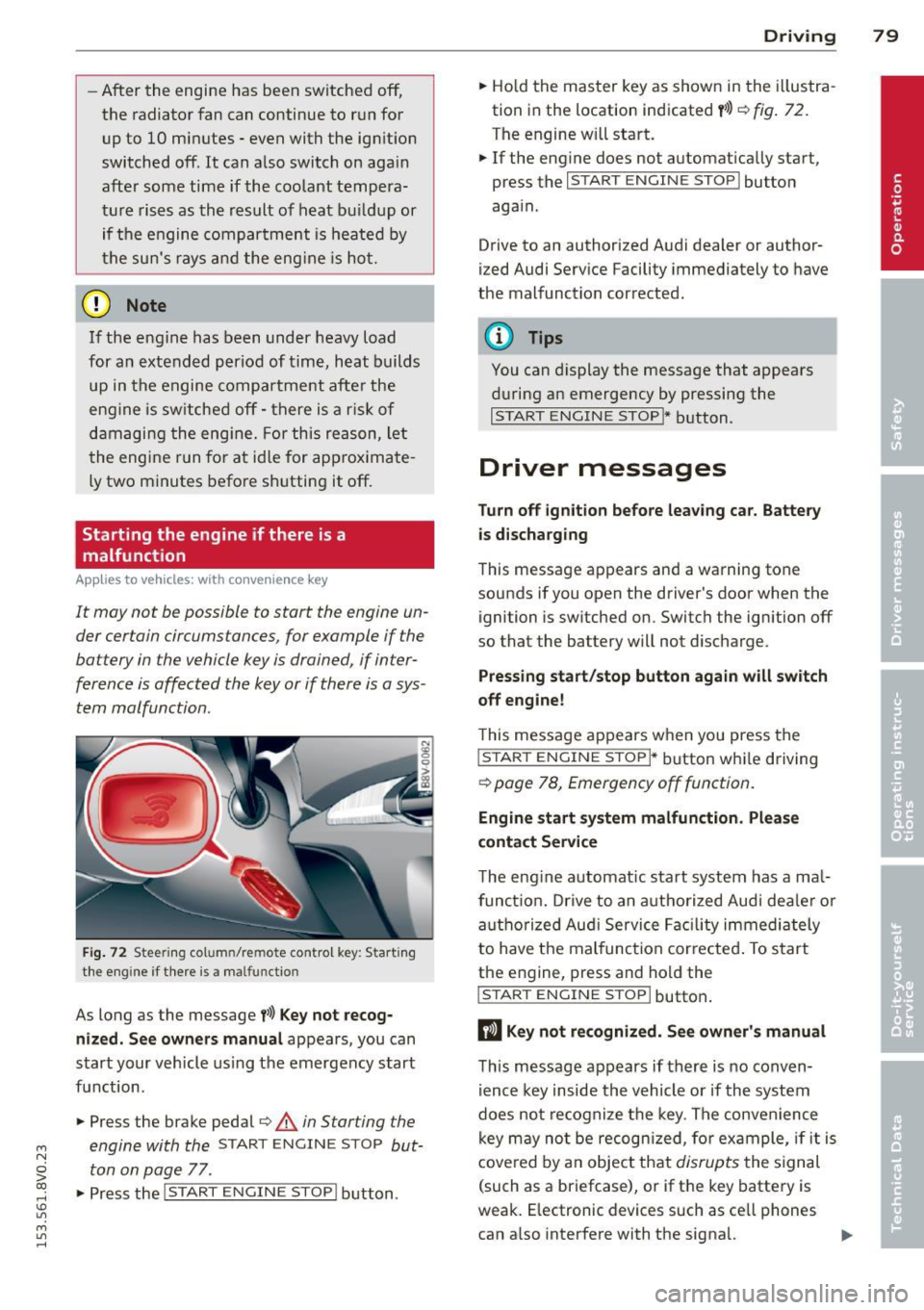
Fig. 72 Steering co lu m n/re mote control key : Start ing
the engine if there is a ma lfunctio n
As long as the message f>l) Key not recog
nized. See owners manual
appears, you can
start your vehicle using the emergency start
function .
"" Press the brake pedal¢.&.
in Starting the
engine with the
START ENGINE STOP but
ton on page
77 .
.,. Press the
j;..,, s=T~A~R=T~-EN~G-I_N_E--ST--OP I button.
Driving 79
""Ho ld the master key as shown in the illustra
tion in the location indicated
y>>) r=) fig. 72.
The engine w ill start.
"" If the engine does not automatically start,
press the
I START ENGINE STOP I button
again .
Drive to an authorized Audi dealer or author
ized Audi Service Facility immediately to have
the malfunction corrected.
(D Tips
You can display the message that appears
during an emergency by pressing the
I START ENGINE STOP!* button.
Driver messages
Turn off ignition before leav ing car. Battery
is discharging
This message appears and a warning tone
sounds if you open the driver's door when the ignition is switched on. Switch the ignition off
so that the battery will not discharge.
Pressing start/stop button again will switch
off engine!
T his message appears when you press the
I STAR T ENGINE S TOPI* button while driving
¢ page 78, Emergency off function .
Engine start system malfunction. Please
contact Service
The engine automat ic start system has a ma l
funct ion. Drive to an authorized Audi deale r or
authorized Aud i Service Facility immediately
to have the malfunction corrected . To start
the engine, press and hold the
I STAR T ENGINE S TOP I button.
DJ Key not recognized. See owner's manual
This message appears if there is no conven
ience key inside the vehicle or if the system
does not recognize the key. The convenience
key may no t be recogn ized, for example, if it is
covered by an object that
disrupts the signal
(such as a briefcase), or if the key battery is
weak. E lectronic devices such as ce ll phones
can a lso interfere with the signal. ..,.
Page 107 of 310
M N
0 > co ,...., \!) 1.1'1
M 1.1'1 ,....,
@ Tips
-Side assist is not active wh ile you are
making the adjustment.
- Your settings are automati cally stored
and ass igned to the remote control key
being used.
Driver messages
App lies to vehicles: with Audi side assist
If t h e side assist switc hes off automatically, a
message appea rs in the instrument cluster
d is p lay.
@j Audi side assist: currently unavailable
No sensor vision
The radar sensors' vision is affected . Do not
cover the area in front of the senso rs with bike
wheels, s tickers, dirt or other obj ects . Clean
the area in front of the senso rs, if necessa ry
~p age 103, fig. 93.
@j Audi side assist: currently unavailable
Side assist can not be switched o n tempo rar ily
beca use there is a mal func tion (for exam ple,
the battery charge leve l may be too low) .
@j Audi side assist: System fault!
The system cannot guara ntee that it w ill de
tect ve hicles correctly and it is switched
off.
The senso rs have been displaced o r are faulty.
H ave the sys tem check ed by a n authorized
Aud i dea le r or autho rized Aud i S ervic e Facility
soon.
Audi side assist 105
•
Page 119 of 310
M N
0 > co ,...., \!) ..,.,
M ..,., ,....,
Selector lever emergency release
"'Press and hold the yellow release button
with the screwdr iver
¢ fig. 102.
"' Press the release button in the selector lever
@ and move the lever into the N position.
"' Clip the shift cover back into the shift gate
after using the emergency release.
If the ve hicle must be pushed or towed due to
a power failure (for example, the battery is
dead), the selector lever must f irst be moved
to the N position using the emergency release
mechanism.
A WARNING
Only move the selector lever out of the P
position when the parking brake is set. If
that does not work, secure the vehicle with
the brake pedal. Otherwise, the vehicle
could start to move unintentiona lly when
the selector lever is moved out of the P po
sition .
Automatic transmission 11 7
•
Page 162 of 310
160 Airbag system
Repair, care and disposal of the airbags
Parts of the airbag system are installed at
many different places on your Audi. Installing,
removing, servicing or repairing a part in an
area of the vehicle can damage a part of an
airbag system and prevent that system from
working properly in a collision.
There are some important things you have to know to make sure that the effectiveness of
the system will not be impaired and that dis
carded components do not cause injury or pol lute the environment.
A WARNING
Improper care, servicing and repair proce
dures can increase the risk of personal in
jury and death by preventing an airbag from deploying when needed or deploying
an airbag unexpectedly:
- Never cover, obstruct, or change the
steering wheel horn pad or airbag cover
or the instrument panel or modify them
in any way.
- Never attach any objects such as cup
holders or telephone mountings to the
surfaces covering the airbag units.
- For cleaning the horn pad or instrument
panel, use only a soft, dry cloth or one
moistened with plain water. Solvents or
cleaners could damage the airbag cover
or change the stiffness or strength of the material so that the airbag cannot de
ploy and protect properly.
- Never repair, adjust, or change any parts
of the airbag system.
- All work on the steering wheel, instru
ment panel, front seats or electrical sys
tem (including the installation of audio
equipment, cellular telephones and CB
radios, etc .) must be performed by a
qualified technician who has the training
and special equipment necessary.
- For any work on the airbag system, we
strongly recommend that you see your
authorized Audi dealer or qualified work
shop. -
Never modify the front bumper or parts
of the vehicle body.
- Always make sure that the side airbag
can inflate without interference:
- Never install seat covers or replace
ment upholstery over the front seat
backs that have not been specifically
approved by Audi.
- Never use additional seat cushions that
cover the areas where the side airbags
inflate.
- Damage to the original seat covers or
to the seam in the area of the side air
bag module must always be repaired
immediately by an authorized Audi
dealer.
- The airbag system can deploy only once.
After an airbag has been deployed, it must be replaced with new replacement
parts designed and approved especially
for your Audi model version. Replace
ment of complete airbag systems or air
bag components must be performed by
qualified workshops only . Make sure that
any airbag service action is entered in
your Audi Warranty
& Maintenance book
let under
AIRBAG REPLACEMENT RE
CORD.
- For safety reasons in severe accidents,
the alternator and starter are separated
from the vehicle battery with a pyrotech nic circuit interrupter.
- Work on the pyrotechnic circuit inter
rupter must only be performed by a
qualified technicians who have the ex perience, information and special tools
necessary to perform the work safely.
- If the vehicle or the circuit interrupter
is scrapped, all applicable safety pre
cautions must be followed.
@) For the sake of the environment
Undeployed airbag modules and preten
sioners might be classified as Perchlorate
Material -special handling may apply, see
Page 196 of 310
194 Smart Technology
Winter tires By using all wheel drive, your vehicle has good
forward motion with standard tires in winter
cond itions. However, in winter we recommend
using winter or all season tires on
all four
wheels, because this will improve the braking
effect .
Snow chains
If there are snow chain laws, snow chains
must also be used on vehicles with all whee l
drive ¢
page 262, Snow chains .
Replacing tires
Fo r vehicles w ith all whee l dr ive , only wheels
with the same rolling circumference should be
used . Avoid whee ls with different tread
depths ¢
page 254.
Offroad vehicle?
Your Aud i is not an offroad vehicle -there is
not enough ground clearance. For this reason,
avoid difficult terrain. Refer to¢
page 287.
&_ WARNING
- Also, in vehicles with all whee l dr ive,
adapt yo ur driving style to the current
road and traffic conditions. Do not let
the increased safety provided tempt you
into taking risks.
- The braking ability of your vehicle is lim
ited to the traction of the wheels . In this
way, it is not different from a two wheel
dr ive vehicle. Do not be tempted to ac
celerate to a high speed when the road is
slippery this increases the risk of an acci
dent .
- Note that on wet streets, the front
wheels can "hydroplane" if driving at
speeds that are too high. Unlike front
wheel drive vehicles, the engine does not
rev higher suddenly when the vehicle be
gins hydroplan ing. For this reason, pay
attention to the road conditions regard
less of your speed.
Energy management
The starting ability is optimized
The energy management system manages
the electrical energy distribution and optimiz
es the availability of electrical energy for
starting the engine.
When a vehicle with a conventional energy
system is not driven for a long time , the bat
tery is drained by equ ipment (for example the
immobilizer). In certain circumstances, there
could may not be enough energy to start the
engine .
Your vehicle is equipped with an intel ligent
energy management system for d istr ibut ing
electricity. This s ignificantly improves the
sta rting ability and increases the battery life.
The energy management sy stem Is made up
of
battery diagnosis , idling current manage·
ment
and dynamic energy management .
Battery diagnosis
The battery d iagnosis determ ines the battery
charge leve l. The sensors determine the bat
tery voltage, the battery current, and the bat
tery temperature. The curren t cha rge leve l
and the performance of the battery are deter
mined based on this.
Idling current management
The idling current management decreases the
energy used wh ile parked. With the engine
switched off, it manages the energy distribu
tion to the different elect rical componen ts.
Date from battery diagnosis is taken into ac
count for this.
Depending on the battery charge level, elec
trical equip ment is switched off one item after
the o ther, to prevent the battery from drain
ing and to retain the starting ability.
Dynamic energy management
While driving, dynamic energy management
distributes the appropriate amount of energy
to the e lectr ica l equipment.
It controls the
battery charge level so that more energy is ..,.
Page 197 of 310
not used then is being generated in o rder to
maintain an optimal battery charge level.
@ Tips
- Energy management cannot overcome
the laws of physics. Note that the charge l evel and length of the battery life are
limited .
- When the start ing ability is endangered,
the (•) indicator light turns on
c!:>page20.
What you should know
Maintaining the starting ability is the highest
priority.
A lot of stress is p laced on the battery when
driving short distances, in traffic , and at co ld
times of the year. A lot of energy is used but litt le is generated. It is also critical when the
engine is not running but electrical equip ment is switched on . In this case, energy is
used but none is generated .
In situations like this, energy management
will actively regulated the distribution of en ergy.
Long periods without use
I f you do not drive your vehicle for several
days or weeks, e lectrica l equipment is gradu
ally sca led back or switched off . This reduces
energy use and ensures the vehicle will be
able to start after long periods of time. Some
conven ience functions such as opening with
the remote contro l key may not be ava ilab le.
These convenience functions will be available
again once you switch the ign ition on and
start the engine.
With the engine switched off For example, if you listen to the radio when
the engine is switched off, the batte ry w ill
drain .
~ A warning text will appear if energy consump-
~ tion could impair starting ab ility . co ,....,
~ The message shows that you need to start the
~ engine in order to charge the battery. ,....,
Smart Technolog y 195
With the engine running
Although electrical energy is generated while driving, the battery can drain. This can happen
when litt le energy is generated, and much is
used and the charge leve l of the battery is not
optimal.
To restore the ba lance of energy, components
that require large amounts of energy are tem
porari ly scaled back or switched off. Heating
systems in particular require a great deal of energy. If you notice, for example, that the
seat heating* or rear window defroster is not
working, then it has been temporar ily reduced
or switched off . These systems are availab le
again as soon as the energy balance has been
restored.
In add ition, you may notice that the idle
speed has slight ly increased . That is normal
and no cause for concern. Due to the in
creased idling speed, the additional required
energy w ill be gene rated and the battery will
be charged.
Notice about data
recorded by the Event
Data Recorder and
vehicle control
modules
Event Data Recorder
This vehicle is equipped with an Event Data Recorder ( EDR). The main purpose of an EDR
is to record, in certain crash or near crash-like
situations, such as an airbag deployment or hitting a road obstacle, data that w ill assist in
understanding how a vehicle's systems per
formed . Th e EDR is designed to record data
related to vehicle dynam ics and safety sys
tems for a short pe riod of time, typically
30 seconds or less . The EDR in this vehicle is
designed to record such data as:
- How various systems in your veh icle were
operating;
- Whether or not the driver and passenger
safety belts were buckled/fastened;
•
•
Page 201 of 310
M N
0 > co ,...., \!) 1.1"1
M 1.1"1 ,....,
can reach the catalytic converter . This
could result in overheating of the con
verter, requ iring its replacement.
- To assure efficient operation of the Emis
sion Control System :
- Have your veh icle ma inta ined properly
and in accordance with the service rec
ommendations in your Wa rranty
&
Ma intenance booklet.
- Lac k of proper maintenance as well as
improper use of the vehicle will impa ir
t he funct ion of the emission control
system and cou ld lead to damage.
@) For the sake of the environment
Even when the Emission Cont ro l System is
operating properly, t he exhaus t gas can
have a s ulfu r-like exhaust gas smell unde r
some operating states. This depends on
the s ulfur content of the fue l being used .
Using a different brand of fuel may help,
or filling the tank w ith lead-free super
grade gasoline.
Diesel particulate filter
Applies to vehicles: with d iesel eng ine
The diesel particulate filter fi lters nearly a ll of
the soot part icles out of the exhaust. The fil
ter cleans itse lf automatically under normal
driving conditions. If the filter cannot clea n it
self (for examp le, because you are only driving
short d istances) , the fil ter becomes clogged
with soot and the
II symbo l for the diesel
particulate f ilter illum inates ~ page 23.
A WARNING
- Do not park yo ur vehicle ove r flammable
materials such as g rass or leaves because
the high temperature of the diesel par
t icu late filter could start a fire .
- Do not apply an underbody protectant in
the exhaust system area or a fire could
start.
Dri ving and the en vironm ent 199
Placing your vehicle
out of service
If you would like to take your vehicle out of
se rv ice for a longer time, contact your author
ized Audi dealer or qualified repair fac ility .
They w ill advise yo u of impo rtant measures,
such as corrosion p rotection , maintenance
and storage p roced ures. Also follow the infor
ma tion about the battery ~ page 228 .
Operate your vehicle
economically and
minimize pollution
General
Your personal style of driving will determine
the economy of your vehicle, as well as ex
haust and noise levels .
Fuel economy, env ironme ntal impact, and
wea r on your eng ine, b rakes and tires la rgely
depend on three factors:
- your personal d riving s tyle
- operating conditions
- technical limitat ions
If you ant ic ipate what you need to do next and
drive economically, you can easily cut your
fuel consumpt ion by 10-15 percent. This sec
tion w ill give you some tips on how you can
help t he env ironment and your pocketbook.
@ Tips
The consumption estimates as published
by ENVIRONME NTAL PROTECTION AGENCY
(EPA) and Transpo rt Canada may not corre
spond to your actual consumption on the r oad, which will va ry depending upon vehi
cle load and speed, ro ad and weather con
ditions, trip leng th, etc.
Drive smoothly and keep a lookout
ahead
Vehicles use the most fuel when they are ac
celerating .
.,. Avo id unne cessary acceler ating and bra ki ng . .,..
•
•
•
Page 219 of 310
M N
0 > co ,...., \!) 1.1"1
M 1.1"1 ,....,
~ If there was no Ad Blue left in the tank and a
range of
O mi (0 km) was displayed in the
instrument cluster, switch the ignition on
for about 15 seconds before starting the en gine.
_& WARNING
Ad Blue can irritate the skin, eyes and respiratory system. If there is contact with
the fluid, flush immediately with plenty of
water. Consult a physician if necessary.
(D Note
- Only use Ad Blue that conforms to the standard ISO 22241-1. Do not mix any
additives with the Ad Blue and do not dilute it with water .
- Do not add Ad Blue to the diesel tank or
add diesel fuel to the Ad Blue tank. Mix
ing can lead to damage to the engine
and the Ad Blue tank system. Warranty
does not cover damage caused by this.
- AdBlue attacks surfaces such as painted
vehicle components, plastic and carpet.
Remove the fluid as quickly as possible
with a damp cloth and plenty of cold wa
ter. If the Ad Blue has already crystal lized, use warm water and a sponge .
AdBlue residue that is not removed will
crystallize and can damage the affected
surface .
- Do not store the refill bottle in the vehi cle. If it leaks, the escaping Ad Blue could
damage the vehicle interior.
- Do not allow AdBlue to come into con
tact with clothing . If there is contact
with the fluid, flush immediately with
plenty of water.
@ Tips
- You can obtain refill bottles from an au
thorized Audi dealer or authorized Audi
Service Facility.
- Follow the AdBlue manufacturer's in
structions for use and storage.
Checking and Filling 217
Hood
Working in the engine compartment
Special care is required if you are working in
the engine compartment
For work in the engine compartment such as
checking and filling fluids, there is a risk of
injury, scalding, accidents, and burns. For
this reason, follow all the following listed
warnings and general safety precautions.
The engine compartment is a dangerous
area.
c::> .&. .
_8 WARNING
To reduce the risk of injuries, complete the
following steps before opening the hood:
- Turn the engine off.
- Switch the ignition off.
- Set the parking brake.
- Place the selector lever in the P position.
- Let the engine cool down.
- Never open the hood when you see that
steam or coolant drips from the engine
compartment- there is a danger of burns! Wait until no steam or coolant
flows out .
- Keep children away from the engine com
partment.
- Never spill fluids on a hot engine . These
fluids (such as the freeze protection con
tained in the coolant) can catch fire .
- Avoid short circuits in the electrical sys
tem, especially the battery .
- When working in the engine compart
ment, remember that the radiator fan
can switch on even if the ignition is
switched off, which increases the risk of
personal injury.
- Never open the cap on the coolant ex
pansion tank when the engine is warm.
The cooling system is under pressure.
- To protect your face, hands, and arms
from hot steam or coolant, cover the cap
with a large cloth when opening.
II>-
•
•
•
Page 220 of 310
218 Check ing and F illin g
- Do not remove the engine cover under
any circumstances. Th is increases the
risk of burns.
- If tests need to be performed with the
engine running, there is additional dan
ger due to moving components (such as
the ribbed belt, generator and radiator
fan) and from the high voltage ign ition
system .
- Never reach into the rad iator fan . The
electric auxiliary fan is controlled by
tempe ratu re and can sw itch on suddenly.
- Pay attention to the following warn ings
listed wh en work on the fue l system or
on the electrical equipment is required.
- Always disconnect the vehicle battery
from the vehicle electrical system
- Do not smoke
- Never work near open flames
- Always have a working fire extinguisher
nearby
- To reduce the r isk of electric sho ck a nd
injury, never touch the following compo
nents when the engine is running or is
being started:
- Ignition cable
- Other components in the electronic
h igh voltage ignition system
- If you must check or perform work on
the engine while it is running:
- Set the parking brake and place these
lector lever in the P (park) posit ion
first.
- Always proceed with ext reme caut ion
so that clothing, jewelry or long hair do not become ca ugh t in the radiator fan,
fan belt o r other moving components
or do not come into contact with hot
components . Tie back long hair before
beginning work and do not wear cloth
ing that can hang down into the en
g ine.
- Limit your exposure to exhaust and
chemica ls to as short a time as poss ible
~ .&. -
A WARNING
Ca lifornia Proposition 6S Warning:
- Engine exhaust, some of its constituents,
and certain vehicle components contain
or emit chemicals known to the State of
California to cause cancer and birth de
fects and reproductive harm. In addition,
certa in flu ids contained i n veh icles and
certain products o f componen t wear con
tain or emit chemic als known to t he
State of California to ca use cancer and
birth defects or other reproductive ha rm .
- Battery posts, terminals and related ac
cessories contain lead and lead com
pounds, chemicals known to the State of
California to cause cancer and reproduc
tive harms. Wash hands after handling.
(D Note
When filling fluids, be sure not to mix the
fl ui ds up . Otherwise severe ma lf u nctions
and engine damage w ill occur.
@ For the sake of the environment
You sho uld reg ularly chec k the ground un
der your vehicle in order to detect leaks
quick ly. If there are visib le spots from oil
or other fluids, br ing your vehicle to an au
thorized Audi dealer or qua lified repair fa
cility to be checked .