battery AUDI S3 2015 Owner's Manual
[x] Cancel search | Manufacturer: AUDI, Model Year: 2015, Model line: S3, Model: AUDI S3 2015Pages: 310, PDF Size: 76.15 MB
Page 222 of 310
220 Checking and Filling
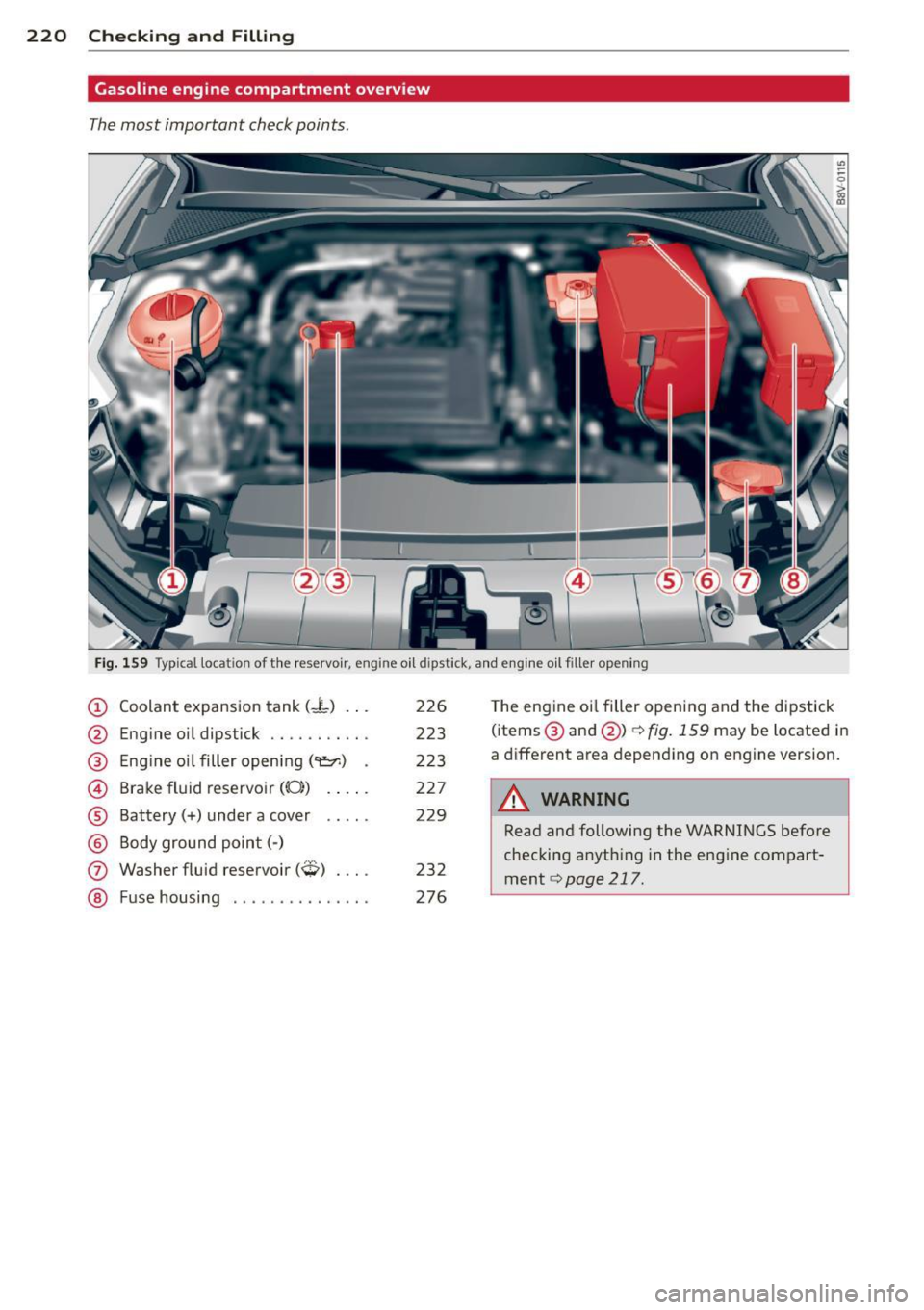
Gasoline engine compartment overview
The most important check points.
Fig. 159 Typical locat ion of th e reservo ir, engine oi l d ipstick, and engine oil filler opening
CD Coolant expansion tank ( ... L) ... 226 The eng ine oi l filler opening and the d ipstick
@ Engine oil dipstick
...........
223 (items® and @)¢ fig. 159 may be located in
® E
ngine oi l filler open ing
('t=r.) 223 a different area depending on engine version.
© Brake fluid reservoir ((0) .. .. . 227 A WARNING
® Battery(+) under a cover 229 .. ... -
® Body ground point(-) Read
and following the WARNINGS before
checking anyth ing in the eng ine com part-
(j) Washer fluid reservoir(<$) . ... 232 ment ¢ page 217.
® Fuse housing ............. .. 276
Page 223 of 310
....,
N
0 > co
rl I.O
"' ....,
"' rl
Checking and Fillin g 221
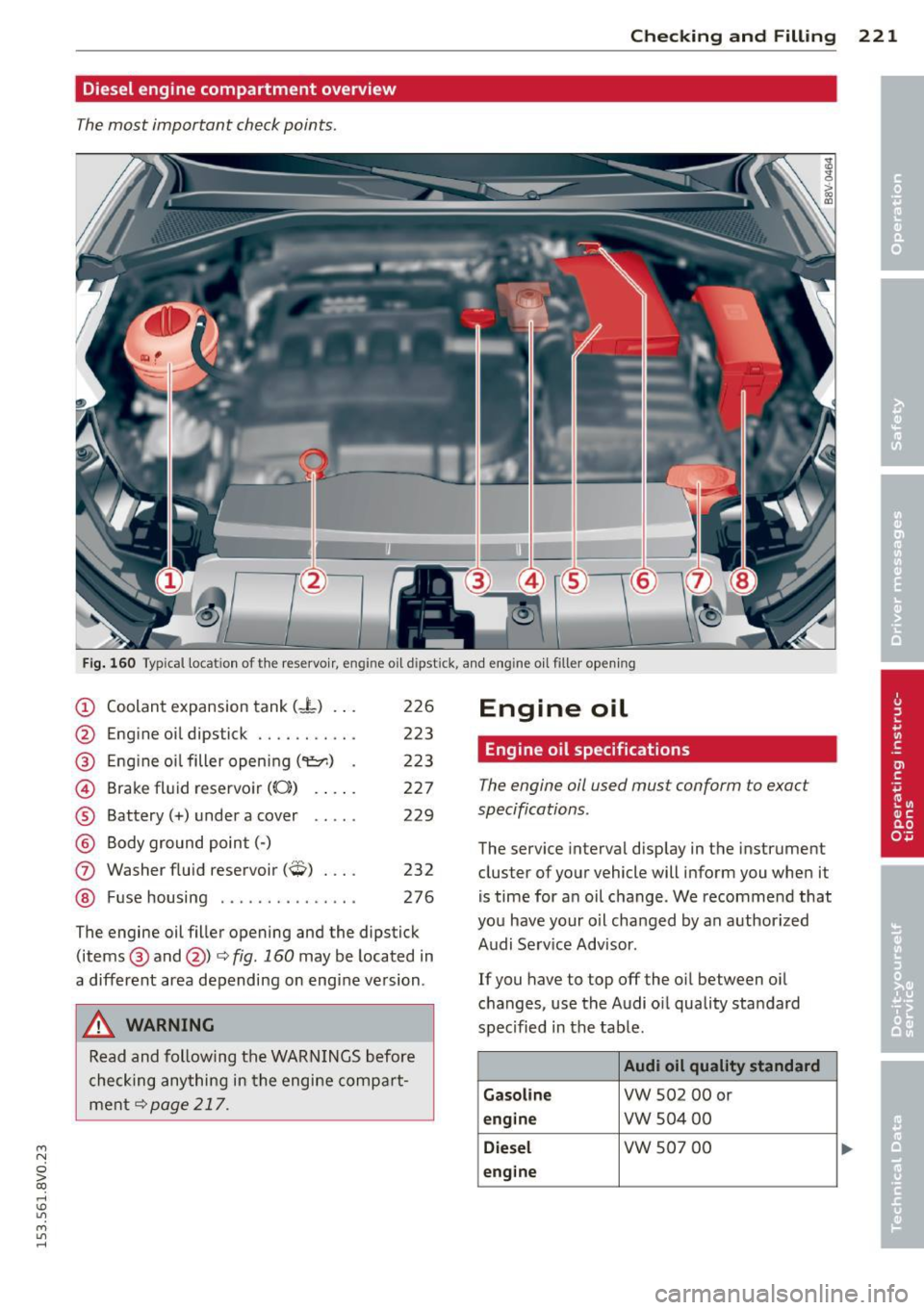
Diesel engine compartment overview
The most important check points .
Fig. 160 Typical locat ion of th e reservo ir, engine oil dip stick, and engine oil filler opening
(D Coolant expansion tank (J-) .. .
@
®
©
®
®
0
®
Eng ine oi l dipstick .......... .
E ng ine o il filler opening
('!=r.) .
Brake fluid reservoir ((0))
Battery(+) under a cover .....
B ody ground point(-)
Washer f luid reservoir(~)
F use housing .............. .
226
223
223
227
229
232
276
The engine oil filler opening and the dipstick
(items @ and @)¢
fig. 160 may be located in
a different area depending on eng ine ve rsion .
A WARNING
Read and following the WARN INGS before
checking anything in the engine compa rt
ment
¢page 217.
Engine oil
Engine oil specifications
The engine oil used must conform to exact
specifications .
The service interva l disp lay in the instrument
cluster of yo ur vehicle will inform you when it
is time for a n oil change . We recomme nd that
you have your oil changed by an author ized
Audi Se rv ice Advisor .
If you have to top off the o il between oi l
c hanges, use the Audi o il quality sta ndard
spec ified in the tab le .
Audi oil quality standard
Gasoline
VW 502 00 or
engine vw 504 00
Diesel vw 507 00
eng ine
...
Page 230 of 310
228 Check ing and F illin g
8_ WARNING
-Brake fluid is poiso nous. It must be sto r
ed only in th e closed original container
out o f the reach of children!
- Brake fa ilure can result from old or inap
propriate brake fluid. Observe these pre
caut ions:
- Use only brake fluid that meets SAE specification
J 1703 and conforms to
Federal Motor Vehicle Standard 116.
Always check with your authorized Audi
dealer to make sure you are using the
correct brake flu id. The correct type of
brake fluid is also indicated on the
b rake fluid reservoir.
- The brake fluid must be new. Heavy use
of the brakes can cause a vapor lock if
the brake fluid is left in the system too
l ong. This can serious ly affect the effi
ciency of the bra kes as well as yo ur
safety . This could result in an acc ident.
@ Note
Brake flu id will damage the paint of your
veh icle.
@i For the sake of the environment
Because of the problem of proper d isposa l
of brake flu id as we ll as the special tools
requ ired and the ne cessary expert ise, we
recommend that you have the brake fluid
changed by your author ized Audi dealer .
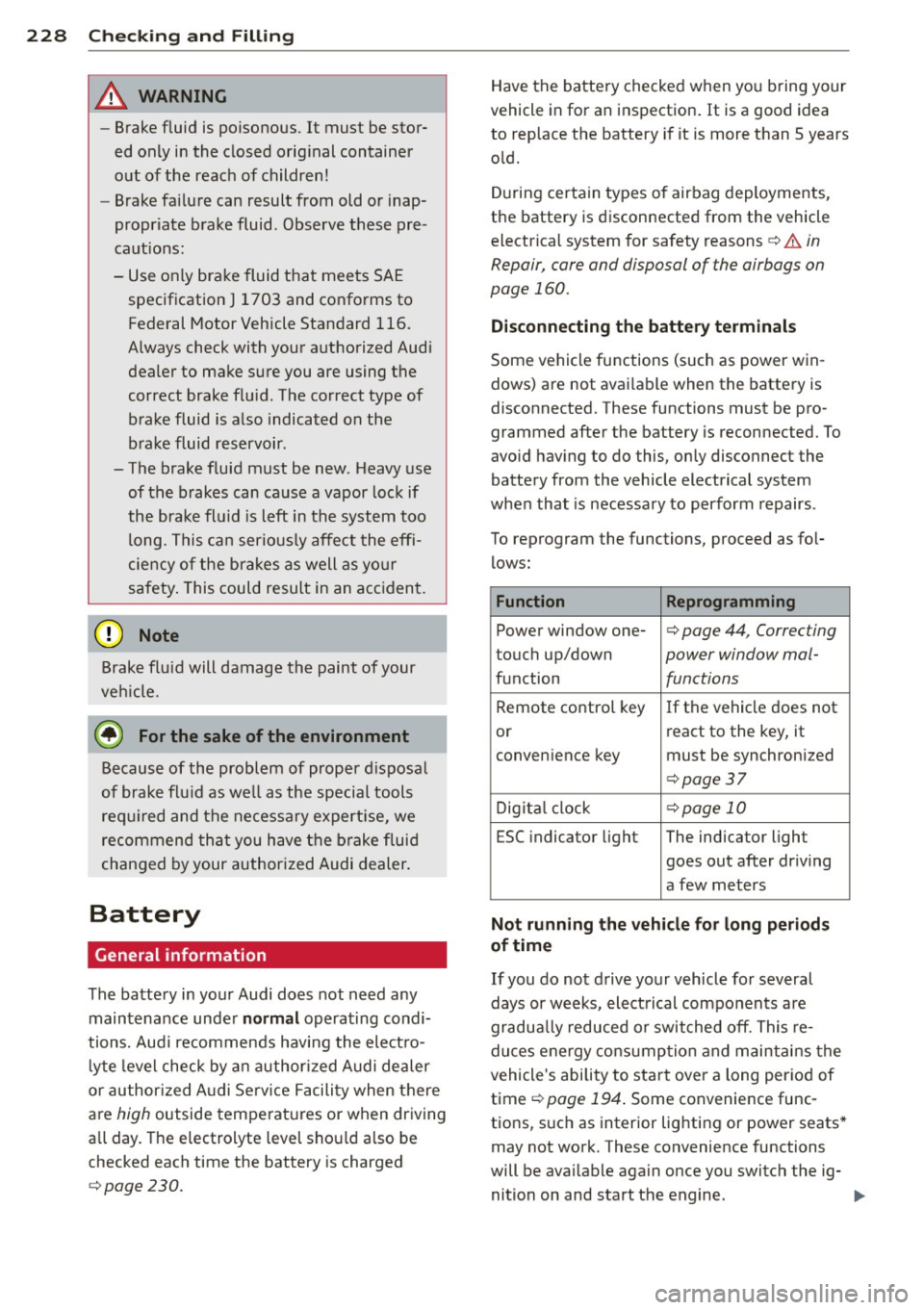
Battery
General information
The battery in your Audi does not need any
maintena nce under
normal operating condi
tions. Aud i recommends having the elect ro
l yte level check by a n author ized Audi dealer
or author ized Audi Se rv ice Facili ty when there
are
high outside temperat ures or when driving
all day. The e lectrolyte level shou ld a lso be
checked each time the battery is charged
¢ page 230.
Have the batte ry checked when yo u bring your
vehicle in for an inspection . It is a good idea
to replace the battery if it is more than 5 years
o ld.
D uring certain types of airbag deployments,
the battery is disconnected from the vehicle electrical system for safety reasons¢
& in
Repair, care and disposal of the airbags on
page 160.
Di sconnecting the battery te rminals
Some vehicle functions (such as power win
dows) are not avai lable when the battery is
disconnected. These functions must be pro
grammed after the battery is reconnected. To
avo id hav ing to do this, only disconnect the
battery from the vehicle electrical system
when that is necessary to perform repairs .
To reprogram the functions, proceed as fol
lows:
Function Reprogramming
Power window one-¢ page 44, Correcting
touch up/down power window ma/-
function functions
Remote control key
If the vehicle does not
or r
eact to the key, it
convenience key must be synchronized
¢ page37
Dig ita l cl ock ¢page 10
ESC indicator light The indicator light
goes out after driving
a few meters
Not running the vehicle for long periods
of time
If you do not drive your vehicle fo r several
days or weeks, electrical components are
gradua lly reduced or switched off. This re
duces e nergy consumption and maintains the
vehicle's ability to start over a long per iod of
time
¢ page 194. Some convenie nce func
tions, such as interior lig hting or power seats *
may not work. These convenience functions
will be ava ilable again once you switch the ig-
nition on and start the engine. .,.
Page 231 of 310
Winter operati on
During the winter months, it is common for
the battery capacity to decrease as the tem
peratures become lower. This is because more
pow er is n eeded to start the vehicle and com
ponents such as the headlights and the rear
window defogger are used more frequently.
Avoid using power unnecessarily, especially in
city driving or on short trips . Have your a u
thorized Audi dealer or authorized Audi Serv
ice Facility check the battery capac ity before
the start of winter ¢
page 230 . A well-charg
ed battery will not only reduce starting prob
l ems in cold weather, but it wi ll also last lon
ge r.
A WARNING
- Wor k on the battery requires expert
knowledge. Con tact your au thori zed Audi
dealer q ua lified repai r fac ility for infor
mation regarding the vehicle battery.
The re is a risk for chemical burns or ex
plos ions.
- Never open the vehicle battery. Do not
try to change the battery e lectrolyte lev
el. Otherwise explosive gas will escape
from the battery and increase the risk of an exp losion .
@ Tips
If your vehicle is not driven for severa l
weeks in very cold temperatures, remove
the battery and store it in a place where it
w ill no t freeze . This prevents the battery
from being damaged and need ing to be re
placed.
Working on the battery
Be especially careful when working on or near the battery .
The battery is located in the lugg age compart
ment under the floor. Before you check any -
"' N thing in the luggage compartment, read and 0
iii heed all WARNINGS ¢ _&.
Checking and Fillin g 229
Always heed the safety warning s, when work
ing on the vehicle battery or the vehicle e lec
trical system to prevent in jury.
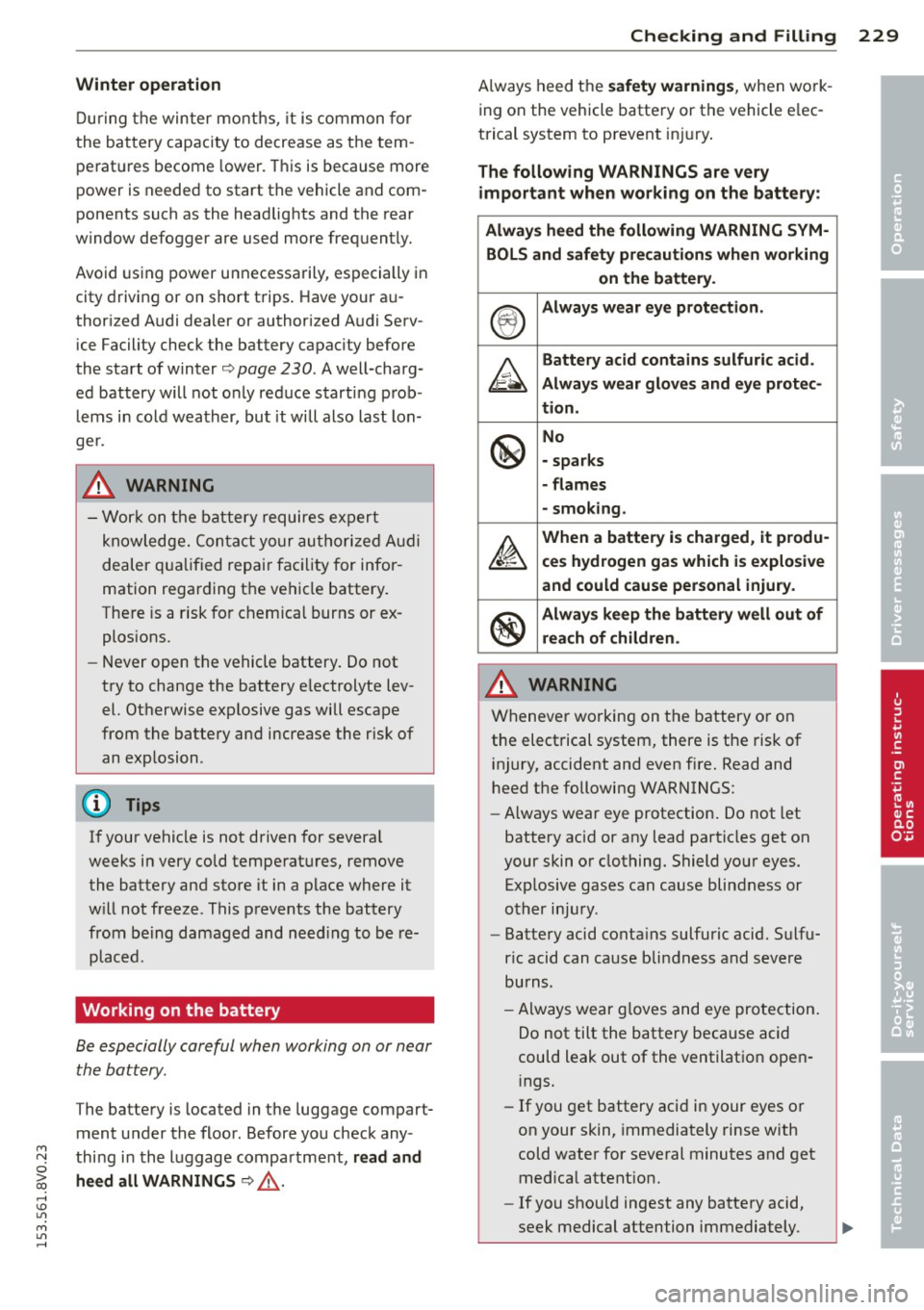
The following WARNINGS are very
important wh en working on the batte ry :
Alway s heed th e following WARNING SYM -
BOLS and safety pre caution s when working
on the battery .
®
Always wear eye p rotection .
A
Battery acid contain s sulfuric acid .
Always wear glov es and eye protec -
tion .
@
No
- sparks
- flames
- smoking .
~
When a battery is charged, it produ-
ce s hydrogen g as wh ich i s ex plo sive
and could c au se per sonal injury .
®
Always keep the battery well out of
re ac h of children .
A WARNING
Whenever working on the battery o r on
the elect rical system, there is the risk of
injury, accident and even fire. Read and
heed the following WARNINGS :
- Always wear eye protection. Do not let
-
battery ac id or any lead particles get on
your skin or clothing. Shield your eyes.
Exp losive gases can cause blindness or
other inju ry.
- Battery acid conta ins sulfuric acid. Sulfu
ric acid can cause blindness and severe
bu rns.
- Always wear g loves and eye protection.
Do not tilt the battery because acid
could leak out of the ventilat ion open
i ngs.
- If you get battery aci d in your eyes or
on your skin, immediately rinse with
cold water for several minutes and get med ica l attent ion.
- If you should ingest any battery acid,
seek medical attention immediately . •
•
•
Page 232 of 310
230 Checking and Filling
-Do not expose the battery to an open
flame, electric sparks or an open light.
- Do not smoke.
- Do not interchange the positive and neg-
ative cables.
- When working on the battery, be sure
not to short-circuit the terminals with
tools or other metal objects. This would
cause the battery to heat up very quickly,
which could lead to damage or explosion
and personal injury.
- When a battery is charged, it produces
hydrogen gas which is explosive and
could cause personal injury.
- Always keep the battery well out of the
reach of children.
- Before work is done on the electrical sys
tem, disconnect the negative ground ca ble.
- Before performing any work on the elec
trical system, switch off the engine and ignition as well as any electrical equip
ment . The negative cable on the battery
must be disconnected . If you are just go
ing to replace a light bulb, then it is
enough to switch off the lights.
- Before disconnecting the battery, switch
off the anti-theft alarm system! Other
wise you will set off the alarm.
- When disconnecting the battery, first
disconnect the negative cable and then
the positive cable .
- Before reconnecting the battery, make
sure all electrical consumers are switch
ed off. Reconnect the positive cable first
and then the negative cable. Never inter
change the cables -this could start a fire!
- Never charge a frozen or a thawed-out
battery. It could explode! If a battery has
frozen, then it must be replaced. A dead battery can free ze over at 32°F (O°C).
- Make sure the vent hose is always attach
ed to the opening on the side of the bat
tery.
- Never use batteries which are damaged.
There is the danger of an explosion! Al
ways replace a damaged battery . A WARNING
-California Proposition 65 Warning:
- Battery posts, terminals and related ac
cessories contain lead and lead com
pounds, chemicals known to the State of
California to cause cancer and reproduc
tive problems . Wash hands after han
dling.
(D Note
- Do not disconnect the vehicle battery
when the ignition is on or when the en
gine is running, otherwise, you will dam
age electronic components in the electri
cal system.
- If your vehicle is going to stand for a
long period of time without being driven,
protect the battery from "freezing", oth
erwise it will be damaged and will then
have to be replaced.
Battery charging
Starting the engine requires a well charged
battery.
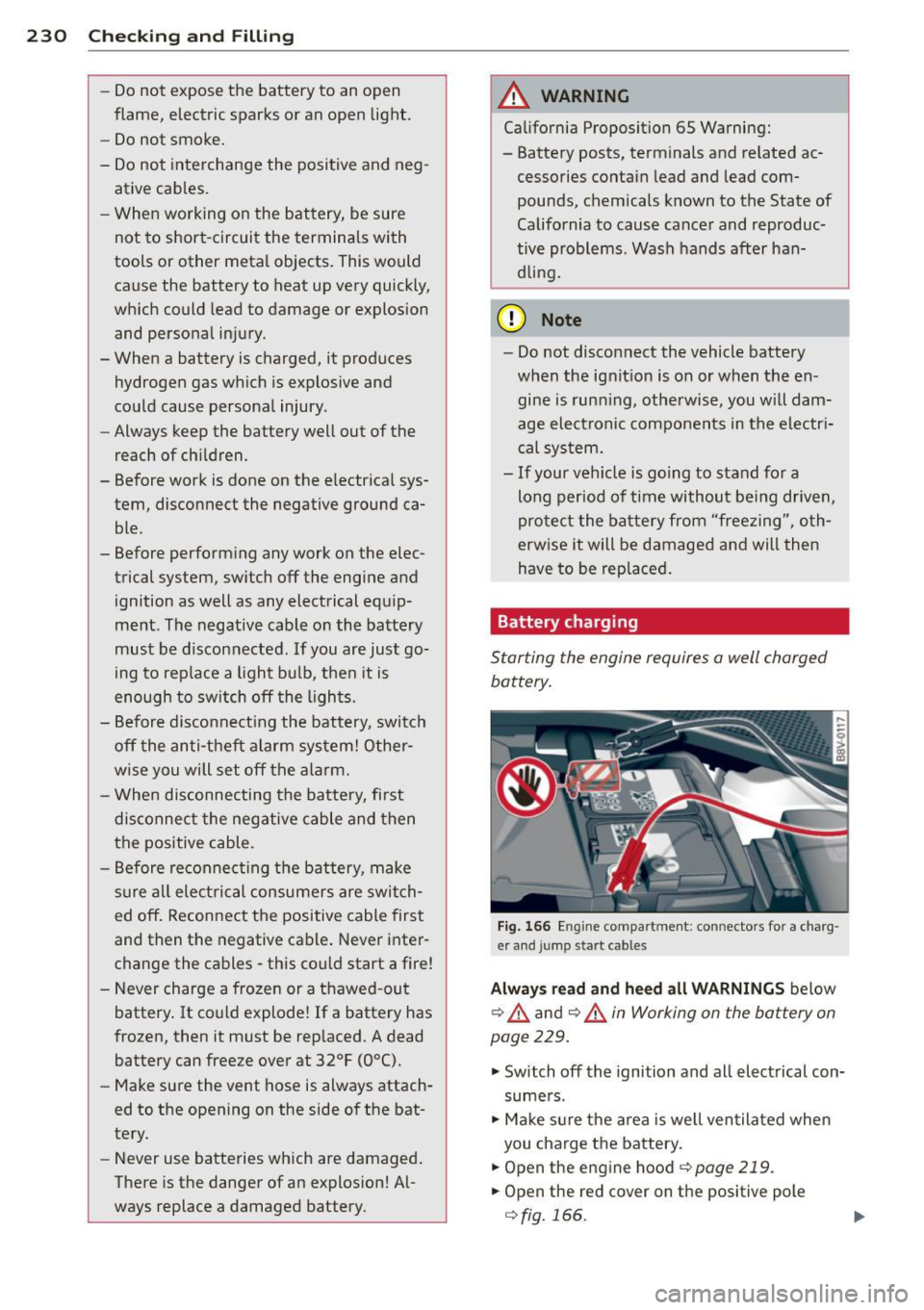
Fig. 166 E ngin e compart men t: co nnecto rs for a charg
e r and jump st art ca bles
Always read and heed all WARNINGS below
~ .&_ and q .&_ in Working on the battery on
page 229.
~ Switch off the ignition and all electrical con
sumers.
~ Make sure the area is well ventilated when
you charge the battery.
~ Open the engine hood q page 219 .
~ Open the red cover on the positive pole
qfig. 166 .
Page 233 of 310
M N
0 > co ,...., \!) ..,.,
M ..,., ,....,
~ Clamp the charger terminal clamps as in
structed on the
b atter y ter min al (+ ) and on
ly on the
body ground point (·).
~ Only now plug the mains lead for the charg
ing equipment into the wall outlet and turn
it on
c:> ,.&. .
~ Mak e sure the charging rate i s not o ver
30 amp s / 14.8 Volt .
~ When the batte ry is fully charged: Turn the
c harging equ ipment off a nd remove the
mains lead from the wall outle t.
~ Now remove the clamps for the charging
equipment.
~ Close the red cover on the positive po le.
~ Close the hood <=> page 219.
A discharged battery can freeze at tempera
tures of on ly 32 F
0 (0 °C). A llow a frozen bat
tery to thaw completely before attempt ing to
charge it
c:> &. . However, we recommend not
using a thawed battery again because the bat
tery cas ing can be cracked due to ice forma
tion and can leak battery acid.
B atter y ch arging (Ma ximum charging rate
of
30 amps / 14.8 Volt)
When cha rging at low voltages (e .g. w ith a
tric kle charger ), the battery cables do not
have to be d isconnected first. The batte ry
caps sho uld
not be opened when charging a
battery .
It is not necessary to remove the batte ry from
the luggage compa rtment, and it is also not
necessa ry to disconnec t the cables.
Fa st charging the b attery (charging rate
above
14.8 Volts )
For technica l reasons do not use a battery
charger that uses voltage g reate r than
14.8 Volts to charge your veh icle's battery.
WARNING
Charging a battery can be dangerous.
- Always fo llow the oper ating instructions
provided by the battery charge r manu
fact urer when charging your battery.
Checking and Fillin g 231
-Never charge a frozen battery. It may ex
plode because of gas trapped in the ice .
Allow a frozen battery to thaw out first.
- Do not reuse batteries wh ich were fro
zen. The battery housing may have
cracked and weakened when the battery
froze.
- Charge the battery in a well ventilated
area. Keep away from open flame or elec
trical spark. Do not smoke. Hydrogen gas
generated by the battery is explos ive.
- To reduce the danger of explosion, never connect or d isconnect charger cab les
while the charger is ope rat ing.
- Fast charging a batte ry is dangerous and
should only be attempted by a compe
tent techn ic ian with the prope r equip
ment.
- Battery acid that may spi ll dur ing cha rg
ing should be washed off wi th a solut io n
of wa rm w ater and baking soda to neu
trali ze the ac id.
(D Note
Neve r use a fast cha rger as a boost er to
star t the engine. This w ill ser iously dam
age sens it ive e lectronic componen ts, su ch
as cont ro l units, re lays, radio, etc., as well
as the battery charger.
Battery replacement
The new battery must have the same specifi
cations and dimensions as the original equip
ment battery.
Inte lligent energy management in your vehi
cl e is responsible for dist ributing the elect ri
ca l energy throughout yo ur vehicle
<=> page 194 . The intelligent energy manage
ment system will keep the engine battery
charged better than vehicles without this sys
tem . To make sure the additional electrical en
ergy is ava ilab le once again after you have
changed the batte ry, we recommend that you
insta ll batteries of the same type and manu-
factu re on ly (the same as those installed at
IJI,,
•
•
•
Page 234 of 310
232 Check ing and F illin g
the time your vehicle was delivered) . Specifi
cations are listed on the battery housing. Yo ur
author ized dealer must code the battery in
the energy management system to enable you
to use the energy management functions cor rectly after replac ing the battery .
The new battery must have the same capacity,
voltage (12-volts), amperage, construct ion
and plug sealing.
When insta lling the battery, make sure the ig
n ition and all e lectr ica l consumers are sw itch
ed off.
Make sure the venti lation hose on the side
of the battery is connected, otherwise
fumes or battery ac id can leak out.
@ For the sake of the environment
Because of the problem of proper disposa l
of a battery, we recommend your author
ized Audi dealer change the battery for
you. Batter ies contain su lfuric ac id and
lead and must always be disposed of prop
erly i n compliance w ith all environmental
regu lations . D ispos ing of vehicle batteries
improper ly is very dangerous to t he envi
ronmen t.
Windshield washer
container
M N ~ N
"' co
co
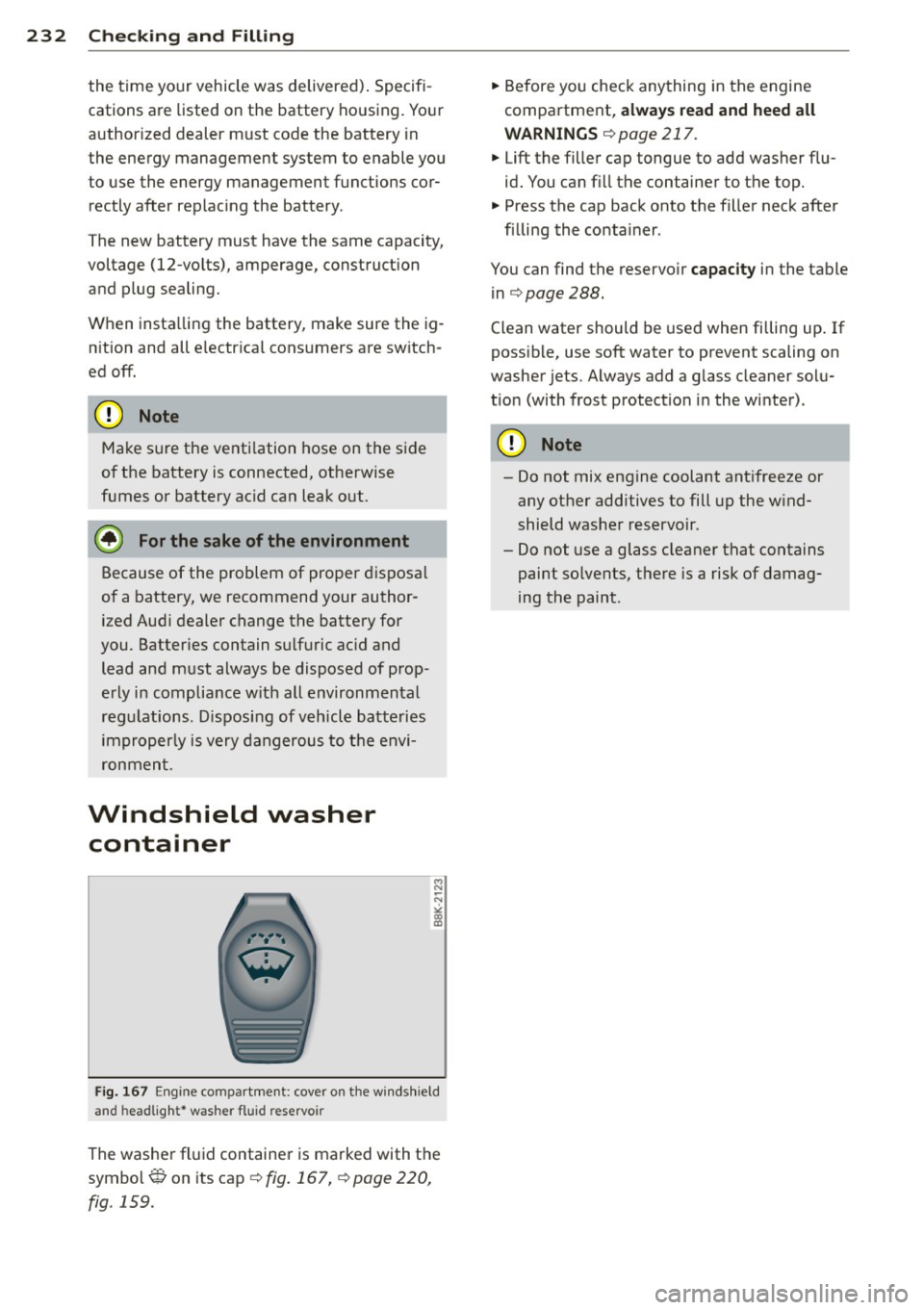
F ig . 167 Eng ine compa rt m ent: cove r on the w indshi eld
an d h ead ligh t* washer f lu id re servo ir
The washer f luid container is marked with the
symbo l won its cap ¢
fig. 167, ¢ page 220,
fig. 159.
.. Before you check anything in the engine
compartment,
always read and heed all
WARNINGS ¢ page 217 .
.. Lift the fi ller cap tongue to add washer flu
id. You can f ill the container to the top.
.. Press the cap back onto the filler neck afte r
filling the conta iner .
You can find the reservo ir
capacit y in the table
in c:>
page 288.
Clean water should be used when filling up . If
poss ib le, use soft water to prevent scaling on
washer jets . Always add a g lass cleaner solu
t ion (with frost protection in the w inter) .
(D Note
- Do not mix engine coolant ant ifreeze or
any other additives to fill up the w ind
shield washer reservoir .
- Do not use a glass cleaner that contains
paint so lvents, there is a risk of damag
ing the paint.
Page 239 of 310
M N
0 > co ,...., \!) 1.1'1
M 1.1'1 ,....,
Maximum load rating
means the load rating for a tire
at the maximum permissible in
flation pressure for that tire.
Maximum loaded vehicle
weight
means the sum of:
(a) Curb weight
(b) Accessory weight
(c) Vehicle capacity weight, and
(d) Production options weight
Maximum (permissible)
inflation pressure
means the maximum cold infla
tion pressure to which a tire
may be inflated. Also called
"maximum inflation pressure."
Normal occupant weight
means 150 lbs. (68 kilograms)
times the number of occupants seated in the vehicle up to the
total seating capacity of your
vehicle.
Occupant distribution
means distribution of occu pants in a vehicle.
Outer diameter
means the overall diameter of
an inflated new tire.
Tires and wheels 237
Overall width
means the linear distance be
tween the exteriors of the side
walls of an inflated tire, includ ing elevations due to labeling,
decorations, or protective bands or ribs.
Ply
means a layer of rubber-coated
parallel cords.
Production options weight
means the combined weight of
those installed regular produc
tion options weighing over 5 lbs. (2 . 3 kg) in excess of those
standard items which they re place, not previously consid
ered in curb weight or accessory
weight, including heavy duty
brakes, ride levelers, roof rack,
heavy duty battery, and special
trim.
Radial ply tire
means a pneumatic tire in
which the ply cords that extend
to the beads are laid at sub stantially 90 degrees to the
centerline of the tread.
' •
•
' •
Page 282 of 310
280 Emergency situations
Emergency situations
General
This chapter is intended for trained emer
gency crews and working personnel who
have the necessary tools and equipment to
perform these ope rations.
Starting by pushing or
towing
Q;) Note
Vehicles w ith an automatic transmission
cannot be started by pus hing o r tow ing.
Starting with jumper
cables
If necessary, the engine can be started by
connecting it to the battery of another vehi
cle.
If the engine should fail to start because of a
discharged or weak battery, the battery can be
connected to the battery of
another vehicle,
using a
pair of jumpe r cables to start the en
g ine .
Jumper cables
Use only jumper cables of sufficiently large
cross section to carry the starter current safe
ly. Refer to the manufacturer's specif ications.
Use only jumper cables with
insulated termi
na l clamps which are distinctly marked:
plus(+) cable in most cases colored red
minu s(-) cable
in most cases colored black .
A WARNING
Batteries contain electricity, acid, and gas.
Any of these can cause very serious or fatal
inju ry. Follow the instructions below for
safe handling of your veh icle's battery.
- Always shield you r eyes and avoid lean
ing over the battery whenever possible.
- A discharged battery can freeze at tem
peratures just be low 32 °F (0 °C). Before connecting a
jumper cable, you must
thaw the frozen battery complete ly, oth
erwise it could explode.
- Do not allow battery acid to contact eyes
or skin . Flush any contacted area with
water immediately .
- Improper use of a booster battery to start a vehicle may cause an explosion.
- Vehicle batteries generate explosive gas
es. Keep sparks, flame and lighted ciga
rettes away from batteries.
- Do not try to jump start any vehicle with a low acid level in the battery.
- The vo ltage of the booster battery must
also have a 12-volt rating. The capacity
(Ah) of the booster battery should not be
lower than that of the discharged bat
tery . Use of batteries of d ifferent voltage
or substantially different "Ah" rating
may cause an exp losion and personal in
jury.
- Never charge a frozen batte ry. Gas trap
ped in the ice may cause an explosion.
- Never charge or use a battery that has
been frozen. The battery case may have
be weakened.
- Use of batter ies of different voltage or
substantially different capacity (Ah) rat
ing may cause an exp losion and injury.
The capacity (Ah) of the booster battery
should not be lower than that of the dis
charged battery.
- Before you check anything in the engine
compartment, always read and heed a ll
WARNINGS
¢page 217.
(D Note
-App lying a higher voltage booster bat
tery will cause expensive damage to sen
sitive electronic components, such as
contro l units, relays, radio, etc .
- Th ere must be no electrical contact be
tween the vehicles as otherwise current cou ld already start to f low as soon as the
positive(+) terminals are connected. .,.
Page 283 of 310
....,
N
0 > co
rl I.O
"'
@ Tips
The discharged battery must be pr operly
connected to the vehicle's electrical sys
tem. When jump starting or charg ing the
battery, never connect the negative
ground cable to the batte ry negative post
because the ba ttery manager system must
be able to detect the battery's state of
charge. Always connec t the negative
g roun d cab le to t he negative ground pos t
of t he battery manager cont ro l unit.
Using jump start cables
Connect the jump start cables in the e xact or
der described below .
Fig . 190 Eng ine co mpar tment : connecto rs for jum p
star t cab le s an d a charger
Fig. 1 91 Jump start in g the batte ry w ith anot her ve hi
cle: @-dra ined battery ,@ -starte r bat tery
The batte ry is located to the left in the eng ine
compartment.
Do not jump start a frozen or
thawed battery
¢ A in Starting with jumper
cables on page
280 ! Replace the battery. The
p rocedu re for connecting jump start cab les
that is descr ibed next is designed to he lp
jump sta rt your ve hicl e.
Vehicle with drained battery:
~ .. Read the following carefully ¢ page 280 rl
Emergency situ ation s 281
.. Set the parking brake and p lace the selector
lever in the P position.
.. Turn the ignition and e lectr ica l equ ipment
off in both vehicles.
Connecting the negati ve terminal (-) to
the negat ive terminal (- ) ( black )
.. To r each the battery term inals, flip the bat
tery cover cap to the side ¢
fig. 190.
1. Clamp the end of the red jump start cable
to the terminal (!)¢
fig. 191 on the dead
battery @ ¢CI)
in Starting with jumper
cables on page 280 .
2. Clamp the othe r end of the red jump star t
c able to the termin al@ on t he charging
battery @.
Connect NEGATIVE (-) to NEGATIVE (-)
(black )
3. Clamp the blac k end of t he j ump sta rt ca
ble
preferably at the ground point , or on
the nega tive terminal @ on the charging
batte ry @ .
4. Clamp the other black end of the jump start cab le
onl y on the ground point@
on your vehicle @ ¢CI).
S. Route the jump start cab les so they can
not get ca ugh t in the moving parts in the
engine compa rtment.
St arting the engine
6. Start the engine in the vehicle giving the
charge and let it run at idle.
7 . Start the eng ine in the vehicle with the
dead battery and wait two to three m i
nu tes unti l it "runs smoothly".
8.
If t he engine does not s tart: Stop the
st art ing procedure afte r 10 seco nds and
then repeat it afte r approximately 30 sec
onds.
9 . In the vehicle that is be ing jump started,
switch the heater fan and rear window de
froster on to reduce any voltage peaks
t hat may occur when disconnecting the
j u mper cables . The headlights must be
switched off .
10 . Wi th the e ngin es runn ing , remov e th e ca
bles in
rever se orde r of the way t hey were ..,.