engine oil AUDI S3 2015 User Guide
[x] Cancel search | Manufacturer: AUDI, Model Year: 2015, Model line: S3, Model: AUDI S3 2015Pages: 310, PDF Size: 76.15 MB
Page 78 of 310
76 Driving
(D Tips
-If it is difficult to turn the key to position
(D , turn the steering wheel back and
forth slightly to release the steering
wheel lock .
- After starting a cold engine, there may
be a brief period of increased noise be
cause the oil pressure must first build up
in the hydraulic valve adjusters. This is
normal and not a cause for concern .
- If the battery is disconnected and recon
nected, you have to hold the ignition key
in position
(D for five seconds for the en
gine to start .
- After switching the ignition off, you can
only remove the key when the selector
lever is in the "P" (Park) position. After
that the selector lever is locked.
,
Stopping the engine with the key
App lies to vehicles: with mechanical ig niti on lock
Stopping the engine
.,,. Br ing the vehicle to a full stop.
.,,. Turn the key to position @.
Releasing the steering lock
Requirement : The selector lever must be in
the P position.
.,,. Remove the ignition key in position @
Qpage 77, fig . 71 Q &-
.,,. Turn the steering wheel until you hear the
steering wheel lock.
The locked steering helps prevent vehicle
theft .
_& WARNING
-Never turn off the engine before the ve
hicle has come to a complete stop. The
full function of the brake booster and the
power steering is not guaranteed. You
must use more force to turn or brake, if
necessary. Because you cannot steer and
brake as you usually would, this could
lead to accidents and serious injuries . -
Never remove the ignition key from the
ignition look while the vehicle is moving .
Otherwise, the steering lock could sud
denly engage and you would not be able
to steer the vehicle .
- Please note that the brake booster and
power steering only work when the en
gine is running. When the engine off, you
must use more force to steer or brake
the vehicle . Because the usual steering
and braking capability is not available,
the risk of accidents or injuries increases.
- Always take the vehicle key with you
when leaving the vehicle, even for a
short period of time. This applies partic
ularly when children remain in the vehi
cle. Otherwise the children could start
the engine or operate electrical equip
ment such as power windows.
- For safety reasons, always park the vehi
cle with the selector lever in the P posi
tion . Otherwise, there is the risk that the
vehicle could roll.
- After the engine has been switched off,
the radiator fan can continue to run for
up to 10 minutes - even with the ignition
switched off. It can also switch on again
after some time if the coolant tempera
ture rises as a result of heat buildup or if
the engine compartment is heated by
sunlight and the engine is hot .
(D Note
-If the engine has been under heavy load
for an extended period of time, heat
builds up in the engine compartment af
ter the engine is switched off -there is a
risk of damaging the engine. For this
reason, let the engine run for at idle for
approximately two minutes before shut
ting it off.
Page 80 of 310
78 Driving
must use more force to steer or brake
the vehicle. Because the usual steering
and braking capability is not available,
the risk of accidents or injuries increases .
- Avoid high engine speed, full throttle,
and heavy engine load as long as the en
gine has not reached operating tempera
ture yet. You could damage the engine .
- The engine cannot be started by pushing
or towing.
@ For the sake of the environment
Do not let the engine run while parked to
warm up. Begin driving immediately. This
reduces unnecessary emissions.
{D) Tips
- After starting a cold engine, there may
be a brief period of increased noise be
cause the oil pressure must first build up in the hydraulic valve adjusters. This is
normal and not a cause for concern .
- If the . indicator light blinks in the in
strument cluster before switching the ig
nition off, the ignition will not switch on
again.
9 page 193
- If you leave your vehicle with the ignition
switched on, the ignition will switch off
after a certain amount of time. Make
sure that electrical equipment such as
the exterior lights are switched off.
Turning the engine off using the button
Applies to vehicles: with conven ience key
• Bring the vehicle to a full stop.
• Move the selector lever into the P position .
• Press the
I START ENGIN E STOPI button
9page 77, fig. 71 .
Steering lockll
The steering locks when you turn the engine
off using the
I START E NGIN E STOP t* button,
l) Thi s fun ction is not available in all c oun tries.
move the selector lever into the P position
and open the driver's door.
The locked steering helps prevent vehicle
theft .
Emergency off function
If it is absolutely necessary, the engine can al
so be turned off while driving at speeds lower
than 6 mph (10 km/h). If you press the
I STAR T ENGINE ST OPI* button while driving,
the message
Pressing start/stop button
again will switch off engine!
appears. To
switch the engine off, press the
I S TAR T ENGINE ST OPI* button twice in a row
briefly or press and hold for longer than two
seconds.
A WARNING ~
- Never turn off the engine before the ve- hicle has come to a complete stop . The
full function of the brake booster and the
power steering is not guaranteed . You
must use more force to turn or brake if
necessary. Because you cannot steer and
brake as you usually would, this could
lead to crashes and serious injuries.
- Please note that the brake booster and
power steering only work when the en
gine is running. When the engine off, you
must use more force to steer or brake
the vehicle. Because the usual steering
and braking capability is not available,
the risk of accidents or injuries increases.
- Always take the vehicle key with you
when leaving the vehicle, even for a
short period of time. This applies partic
ularly when children remain in the vehi
cle . Otherwise the children could start
the engine or operate electrical equip
ment such as power windows.
- For safety reasons, always park the vehi
cle with the selector lever in the P posi
tion. Otherwise, there is the risk that the
vehicle could roll.
Page 194 of 310
192 Smart T echnol ogy
Corro sion
Leaving the vehicle parked for long periods o f
time, low mi leage and avoiding heavy braking
can contribute to corrosion on the brake ro
tors and di rty brake pads.
I f you usually avoid heavy brak ing or if there is
corrosion present, occasiona l heavy braking at
high speeds is recommended to clean the
brake rotors and pads¢,& .
Brake system malfunction
if you notice that the brake pedal t ravel has
suddenly gotten larger, then a brake circuit
may have failed. Drive to your authorized Audi
dealer or qualified repair facility immediately
to hav e the problem corrected . On the way
there, drive with reduced speed and keep in
mind that a long braking distance and in
creased pressure on the brake pedal will be
necessary .
Lo w brake fluid level
When the brake fluid level is low, ma lfunc
tions in the brake system may occur. The
brake fluid level is electronically mon itored.
B rake bo ost er
The brake booster amplifies the pressure you
apply to the brake pedal. It only works when
the engine is running.
A WARNING ,~ ·
- You should only perform braking maneu
vers to clean the brakes when the road
condit ions perm it. Never put others on
the road at risk -never forget the risk of
acc idents!
- On steep slopes, reduce the speed and
select a lower gea r or lowe r selector lev
er position. Drive as litt le as poss ible
w hil e pressing the bra ke peda l and avoid
putt ing you r left foot on the brake pedal
whi le driving . This could cause the brakes
to overheat and impair the efficiency of
the brakes .
- Do not let the brakes "grind" by always
keeping yo ur foot on the brake peda l. This can cause the brakes to overheat
in-
,
crease wear and increase braking dis
tance unnecessarily.
- Certain weather and operating condi
tions such as driving through water, driv
ing in heavy rain or driving after washing
your veh icle can impa ir the effectiveness
of the brakes . In the winter, ice may
bu ild up on the bra ke pads, rotors and
d rums. Che ck these components by b rak
ing caref ully. App lyi ng the br akes care
fu lly several times dries the brakes and
removes ice bui ld-up .
- The eff ic iency of the brakes can also be
impaired by driving for long stretches on roads covered with salt without using the
brakes. Yo u can remove salt deposits
from the brake rotors and pads by care
fully applying the brakes several times.
- If the front spoiler is damaged or you in
stall another spoiler, make sure the front
wheel brakes are ventilated properly.
Otherwise , the brake system could over
heat, wh ic h red uces their effectiveness .
- Failure of a brake circuit impa irs braking
performance, wh ic h increases bra king
d istance . Avoid driving the vehicle and
have it towed it to the nearest author
i z ed A udi dealer or au thorized Aud i Serv
ice Facility .
- Do not let your ve hicle roll w it h the en
g ine switched off unde r any circumstan
ces .
- If the b rake booste r is no t working, you
will have to press much harder on the b rake peda l to compensate for the lack
of the booster.
(D Note
- N ever le t the bra kes "rub" by pressing
t he pedal ligh tly when braking is not
really necessary . This causes the brakes
to overheat and increases braking dis
tance and causes wear .
- Before dr iv ing on a long stretch with
steep s lopes, reduce your speed and shift
to the next lower gear This makes use of
the engine brak ing effect and relieves .,.
Page 200 of 310
198 Driving and the environment
Driving through water
on roads
Note the following to avoid vehicle damage
when driving through water, for example on
flooded roads:
- The water must not be any higher than the
bottom of the vehicle body.
- Do not drive faster than wa lking speed.
A WARNING
After driving through water or mud, the
braking effect can be reduced due to mois
ture on the brake discs and brake pads. A
few careful brake applications should dry off the brakes.
@) Note
Vehicle components such as the engine, transmiss ion, suspension or electrical sys
tem can be severely damaged by driving
through water.
- Determ ine the depth before driving
through water.
- Do not stop the vehicle, drive in reverse
or switch the engine off when driving
through water .
- Keep in mind that oncoming vehicles may create waves that raise the water
level and make it too deep for your vehi
cle to drive through safely.
- Avoid dr iving through salt water (corro
s ion).
Catalytic converter
App lies to vehicles: with gasoline engine
It is very important that your emission con
trol system (catalytic converter) is function
ing properly to ensure that your vehicle is run
ning in an environmentally sound manner.
> Always use lead-free gaso line r=;, page 210,
Fuel supply .
> Never run the tank down all the way to emp-
ty.
> Never put too much motor o il in your engine
r=;, page 223, Adding engine oil
The catalytic converter is an efficient "clean
up" device built into the exhaust system of
the vehicle . The cata lytic converter burns
many of the pollutants in the exhaust gas be
fore they are released into the atmosphere.
The exclusive use of unleaded fuel is critica lly
important for the life of the catalytic convert
er and proper functioning of the engine.
A WARNING
-
The temperature of the exhaust system is high, both when driv ing and after stopping
the eng ine .
- Never touch the exhaust tail pipes once
they have become hot . This could result
in burns.
- Do not park or operate the vehicle in
areas where the hot exhaust system may
come in contact with dry grass, brush,
fue l spill or other material wh ich can
cause a fire.
- Do not app ly additional undercoating or
rustproofing on or near the exhaust manifold, exhaust pipes, catalytic con
verter or heat shields . Dur ing driving, the
substance used for undercoating could
overheat and cause a fire.
(D Note
- Be aware that just one tank filling with
leaded fuel will already seriously de
grade the performance of the catalytic
converter.
- Do not exceed the correct engine oil level
r=;, page 223.
-Do not drive until the fuel tank becomes
completely empty. The engine could mis
fire . Unburned fuel could also get into
the exhaust system and this cou ld cause
the catalytic converter to overheat.
- Do not switch off the ignition while the
vehicle is moving.
- Do not continue to operate your vehicle
under these conditions, as otherwise fuel
IIJ,,
Page 202 of 310
200 Driving and the environment
Vehicles use the most fuel when they are ac
celerati ng. If you anticipate what is going to
happen next, you will need to brake less and,
thus, accelerate less. let the vehicle coast
whenever poss ible -for example when you see
that the next traffic light is red.
Avoid full throttle
Driving at moderate speeds saves fuel and
improves your mileage.
.. Try and keep well be low your car's max imum
speed.
Accelerating gently reduces fuel consump
tion, engine wear, and does not disturb the
environment. F ue l consumption, exhaust emissions and en
gine noise increase disproportionately at hig h
speeds . If you drive at approximately three
quarters of top speed, fue l consumption will
be reduced by one half. Never dr ive faster
tha n the posted speed limit and weather con
d itions permit.
Reducing unnecessary idling
Even when your car is just idling it burns up
fuel.
.. Sh ut the engine off when you are not dr iving
the vehicle.
.. Do not warm up the vehicle by letting the
engine run at idle.
It is efficient to switc h off the engine when
stopped at railroad crossings and long red
lights. Turning the engine off for just 30-40
seconds saves mo re fuel than is burned by
start ing the eng in e again.
It takes a long time for the engine to warm up
fu lly when it is running at idle. However, wear
and nox ious em issions are especially high
when the engine is warming up. So you should
d rive away as soon as you sta rt the eng ine and
avoid ru nning a t high RPM wh ile the engine is
still warming up .
(D Note
Do not leave engine i dling unattended af
ter start ing. If wa rning lights sho uld come
on to indicate improper operation, they
would go unheeded. Extended idling also
produces heat , w hich could result in over
hea ting o r othe r damage to the veh icle or
othe r property.
Regular maintenance
A badly tuned engine unnecessarily wastes a
lot of fuel.
.. Have your ve hicle serviced at regu lar inter-
vals.
Having your veh icle regu larly serviced by an
authorized Aud i dealer helps to ensure that it
runs properly and econom ica lly. The cond it io n
of your veh icle not on ly affects its safety and
ability to ho ld its va lue, i t also affects
fuel
c onsumption .
Check your oil each t ime you fill your tank.
The amount of oi l used is re lated to engine
l oad and speed.
It is normal for the oil consump tion of a new
engine to reach its lowest value after a certain
mileage has been driven .
You m ust drive your ve hicle abou t 3,000 m iles
(5,000 kilometers) before you can properly
assess oil consumpt ion .
T his also ap plies to fue l consumption and en
gine o utp ut.
(D Note
- Have your veh icle ma inta in ed properly
and i n acco rdance with the service rec
ommendations in you r W arranty
& Main
t enance boo klet. l ack of proper ma inte
nance as well as im proper use of the ve
hicle will impair the function of the
em iss ion cont ro l system and cou ld lead
to damage.
Page 213 of 310
Many gasoline grades are blended to perform
especially well for winter or summer driving. During seasonal change-over, we suggest that
you fill up at busy gas stations where the sea sonal adjustment is more likely to be made in
time.
Q;) Note
- Methanol fuels which do not meet these requirements may cause corrosion and
damage to plastic and rubber compo nents in the fuel system .
- Do not use fuels that fail to meet the
specified criteria in this chapter .
- If you are unable to determine whether
or not a particular fuel blend meets the
specificat ions, ask your service station or
i ts fuel supp lier.
- Do not use fuel for which the contents cannot be identified.
- Fuel system damage and performance
problems resulting from the use of fuels
different from those specified are not
the responsibility of Audi and are not
covered under the New Vehicle or the
Emission Control System Warranties.
- If you experience a loss of fuel economy
or driveability and performance prob
lems due to the use of one of these fuel
blends, we recommend that you switch
to unblended fuel.
Gasoline additives
A major concern among many auto manufac
turers is carbon deposit build-up caused by
the type of gasoline you use .
Although gasoline grades differ from one manufacturer to another, they have certain
things in common. All gasoline grades contain substances that can cause deposits to collect
on vital engine parts, such as fuel injectors
and intake valves. Although most gasoline
brands include additives to keep engine and
M
N fuel systems clean, they are not equally effec-o
iii tive. ,...., \!) ..,.,
M ..,., ,....,
Checking and Filling 211
Audi recommends using TOP TIER Detergent
Gasoline . For more information on TOP TIER
Detergent Gasoline, please go to the official
website (www.toptiergas .com).
After an extended period of using inadequate
fuels, carbon deposit build-ups can rob your engine of peak performance.
CJ) Note
Damage or malfunction due to poor fuel
quality is not covered by the Audi New Ve
hicle Limited Warranty.
Diesel fuel
App lies to vehicles : wit h diese l eng ine
Always use ULSD (Ultra Low Sulfur Diesel)
No. 2 . The ULSD No. 2 meets the ASTM D975.
Diesel fuel with concentrations of biodiesel
higher than 5
% such as B11, B2O or B1OO are
strictly prohibited.
Service station fuel pumps are labeled with
the correct fuel information for easy recogni
tion by the user.
If the diesel fuel pump is not
labeled ask the station operator what fuel is
being dispensed before filling up your vehicle.
ULSD No. 2 may not be available outside the
USA and Canada. Be sure to check before trav
eling to other countries.
ULSD No. 2 can become thicker in very cold
temperatures, and this can impair the en
gine's starting and running. Depending on the
season, gas stations provide ULSD No . 2 that
flows better in cold temperatures so that you
can continue operating your vehicle as usual.
(D Note
- Your vehicle's diesel engine was de
signed solely for use with ULSD No. 2.
Therefore, never use gasoline, heating
oil, other fuels or flow improvers. These
contain substances that will severely
damage the fuel system and the engine.
Such damage will not be covered by your
New Vehicle Limited Warranty.
ll>
•
•
•
Page 220 of 310
218 Check ing and F illin g
- Do not remove the engine cover under
any circumstances. Th is increases the
risk of burns.
- If tests need to be performed with the
engine running, there is additional dan
ger due to moving components (such as
the ribbed belt, generator and radiator
fan) and from the high voltage ign ition
system .
- Never reach into the rad iator fan . The
electric auxiliary fan is controlled by
tempe ratu re and can sw itch on suddenly.
- Pay attention to the following warn ings
listed wh en work on the fue l system or
on the electrical equipment is required.
- Always disconnect the vehicle battery
from the vehicle electrical system
- Do not smoke
- Never work near open flames
- Always have a working fire extinguisher
nearby
- To reduce the r isk of electric sho ck a nd
injury, never touch the following compo
nents when the engine is running or is
being started:
- Ignition cable
- Other components in the electronic
h igh voltage ignition system
- If you must check or perform work on
the engine while it is running:
- Set the parking brake and place these
lector lever in the P (park) posit ion
first.
- Always proceed with ext reme caut ion
so that clothing, jewelry or long hair do not become ca ugh t in the radiator fan,
fan belt o r other moving components
or do not come into contact with hot
components . Tie back long hair before
beginning work and do not wear cloth
ing that can hang down into the en
g ine.
- Limit your exposure to exhaust and
chemica ls to as short a time as poss ible
~ .&. -
A WARNING
Ca lifornia Proposition 6S Warning:
- Engine exhaust, some of its constituents,
and certain vehicle components contain
or emit chemicals known to the State of
California to cause cancer and birth de
fects and reproductive harm. In addition,
certa in flu ids contained i n veh icles and
certain products o f componen t wear con
tain or emit chemic als known to t he
State of California to ca use cancer and
birth defects or other reproductive ha rm .
- Battery posts, terminals and related ac
cessories contain lead and lead com
pounds, chemicals known to the State of
California to cause cancer and reproduc
tive harms. Wash hands after handling.
(D Note
When filling fluids, be sure not to mix the
fl ui ds up . Otherwise severe ma lf u nctions
and engine damage w ill occur.
@ For the sake of the environment
You sho uld reg ularly chec k the ground un
der your vehicle in order to detect leaks
quick ly. If there are visib le spots from oil
or other fluids, br ing your vehicle to an au
thorized Audi dealer or qua lified repair fa
cility to be checked .
Page 222 of 310
220 Checking and Filling
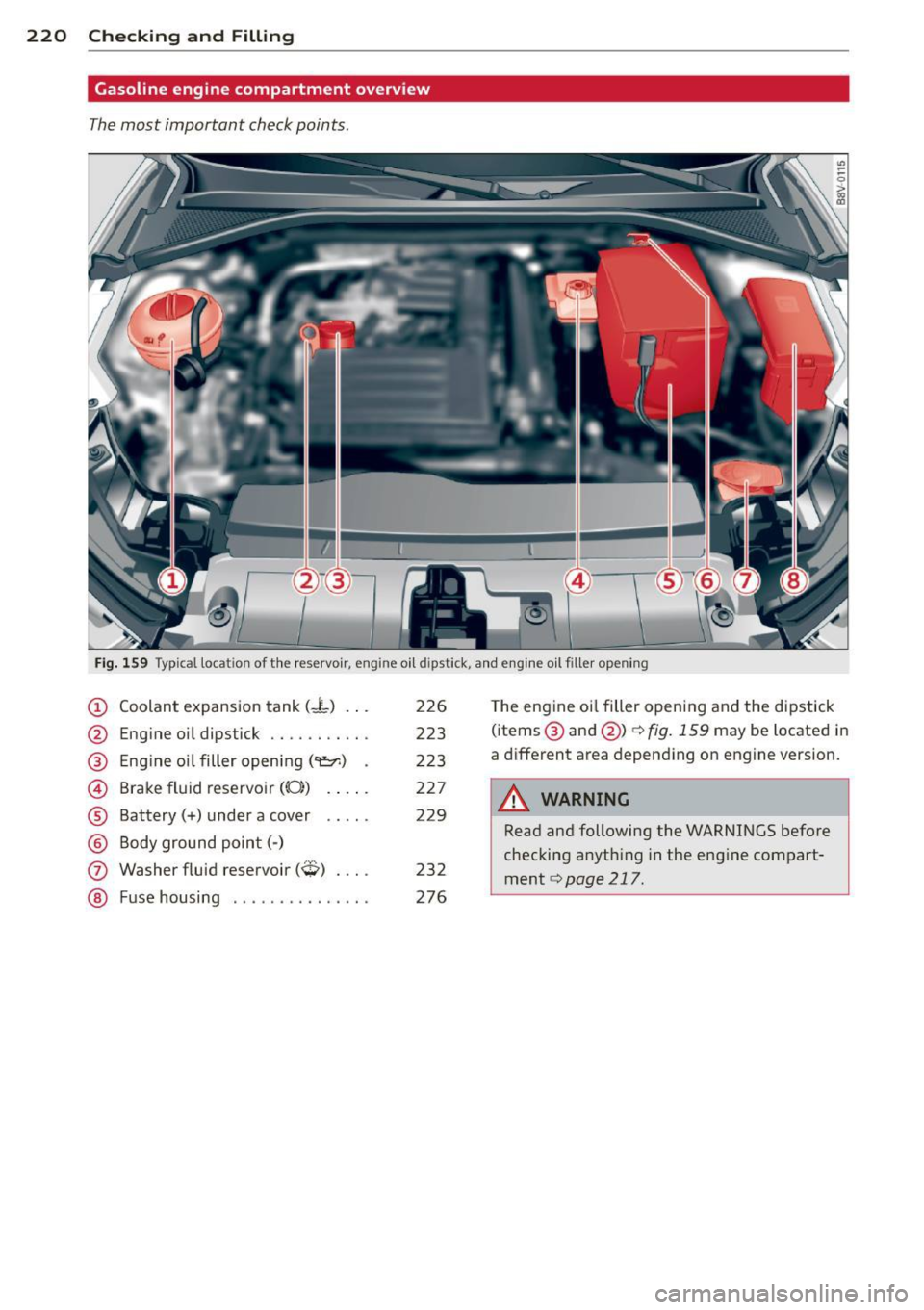
Gasoline engine compartment overview
The most important check points.
Fig. 159 Typical locat ion of th e reservo ir, engine oi l d ipstick, and engine oil filler opening
CD Coolant expansion tank ( ... L) ... 226 The eng ine oi l filler opening and the d ipstick
@ Engine oil dipstick
...........
223 (items® and @)¢ fig. 159 may be located in
® E
ngine oi l filler open ing
('t=r.) 223 a different area depending on engine version.
© Brake fluid reservoir ((0) .. .. . 227 A WARNING
® Battery(+) under a cover 229 .. ... -
® Body ground point(-) Read
and following the WARNINGS before
checking anyth ing in the eng ine com part-
(j) Washer fluid reservoir(<$) . ... 232 ment ¢ page 217.
® Fuse housing ............. .. 276
Page 223 of 310
....,
N
0 > co
rl I.O
"' ....,
"' rl
Checking and Fillin g 221
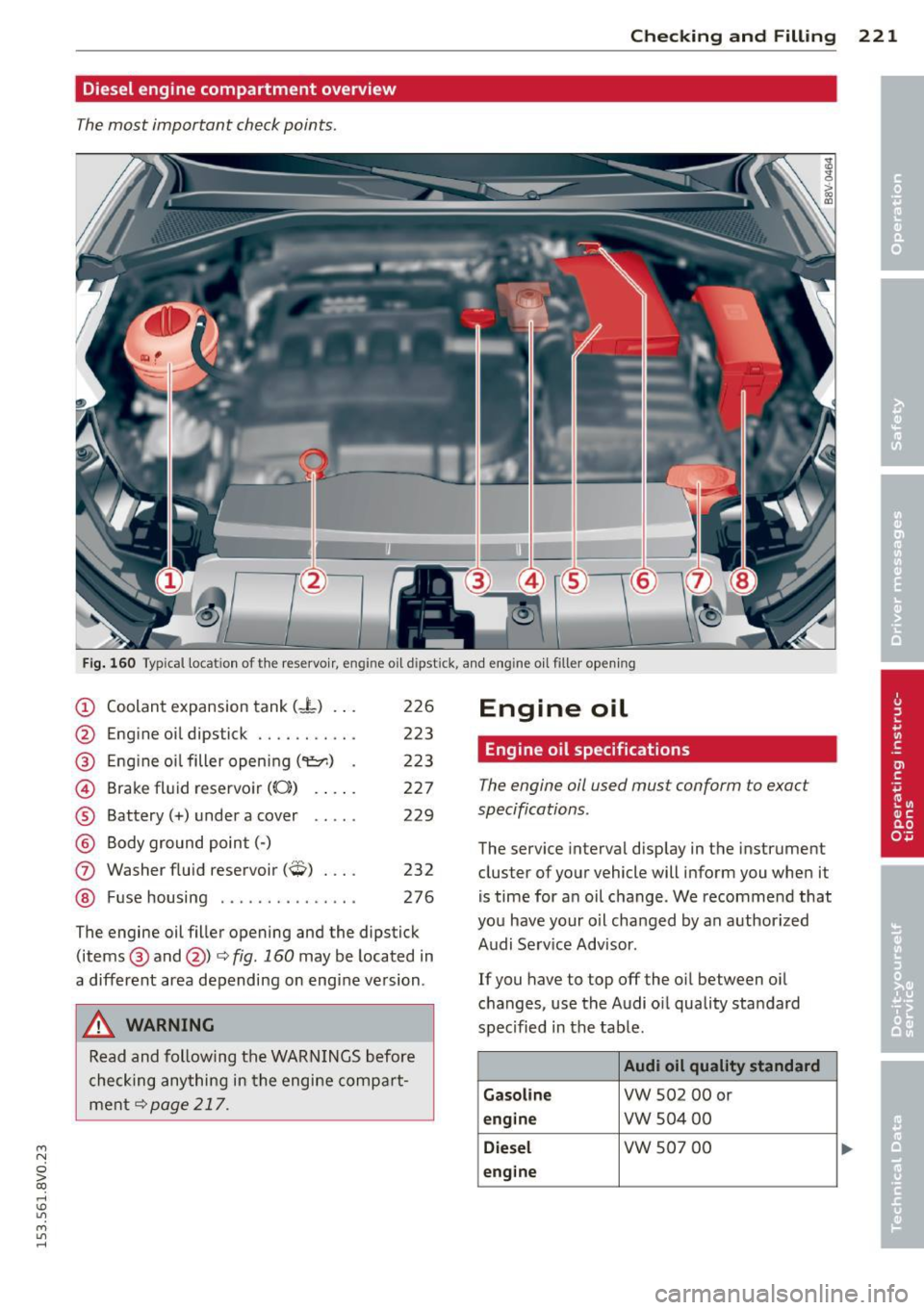
Diesel engine compartment overview
The most important check points .
Fig. 160 Typical locat ion of th e reservo ir, engine oil dip stick, and engine oil filler opening
(D Coolant expansion tank (J-) .. .
@
®
©
®
®
0
®
Eng ine oi l dipstick .......... .
E ng ine o il filler opening
('!=r.) .
Brake fluid reservoir ((0))
Battery(+) under a cover .....
B ody ground point(-)
Washer f luid reservoir(~)
F use housing .............. .
226
223
223
227
229
232
276
The engine oil filler opening and the dipstick
(items @ and @)¢
fig. 160 may be located in
a different area depending on eng ine ve rsion .
A WARNING
Read and following the WARN INGS before
checking anything in the engine compa rt
ment
¢page 217.
Engine oil
Engine oil specifications
The engine oil used must conform to exact
specifications .
The service interva l disp lay in the instrument
cluster of yo ur vehicle will inform you when it
is time for a n oil change . We recomme nd that
you have your oil changed by an author ized
Audi Se rv ice Advisor .
If you have to top off the o il between oi l
c hanges, use the Audi o il quality sta ndard
spec ified in the tab le .
Audi oil quality standard
Gasoline
VW 502 00 or
engine vw 504 00
Diesel vw 507 00
eng ine
...
Page 224 of 310
222 Check ing and F illin g
Using the proper engine o il is important for
the functionality and service life of the en
g ine. Your engine was factory-filled with a
high-quality oil which can usua lly be used
throughout the entire year.
0 Note
Your L imited New Vehicle Warranty does
not cover damage or ma lfunctions due to
fai lure to follow recommended mainte
nance and use requ irements as set forth in
the Audi Owner's Manual and Warranty
&
Ma intenance booklet.
- Use only a high quality eng ine oil that ex
pressly complies w ith the Audi o il quality
standard spec ified for your veh icle's en
gine. Using any other oil can cause seri
ous eng ine damage.
- Do not mix any lubricants o r othe r addi
tives into the eng ine o il. Doing so can
ca use engine damage.
If you need to add oi l and there is no ne
availab le tha t mee ts the Audi oil qua lity
s tandard your engine requires, yo u may
add a tota l of no more than 0 .5 quart/liter
of a high-quality "synthetic"oil that meets
the following specifications.
- Vehicles with gaso line engine: ACEA A3
or API SM with a viscosity grade of
SAE 0W-30, SAE SW-30 or SAE SW-40.
- Vehicles with diesel engine: ACEA C3 or
API CF with a v iscosity grade of
SAE 0W-30 or SAE SW-30.
- For more information abo ut eng ine oil
that has been approved for your vehicle, please contact either your a uthorized
Audi dealer or Audi Customer Relations
at 1 (800) 822-2834 or visit our web site
at www.audiusa .com or
www.aud icanada.ca.
Engine oil consumption
The engine in your vehicle depends on on ade
quate amount of oil to lubricate and cool all
of its moving ports .
In order to provide effective lubricat ion and
cooling of interna l eng ine components, all in
ternal combust ion e ngines consume a certain
amount of oil. Oil consumpt ion va ries from
engi ne to engine and may change sig nifican tly
over the life of the engine. Typically, engines
with a spec ified break -in period (see
¢ page 197) consume more oil during the
break-in period than they cons ume after oi l
consumption has stabilized.
U nder normal cond itions, the rate o f oi l con
s u mption depends on the q uality and viscos ity
of the oil, the RPM (revolutions per minute) at
which the engine is operated, the ambient
temperature and road conditions. Further fac
tors are the amount of oil dilut ion from water
condensation or fue l residue a nd the oxida
t ion level of the oil. As any eng ine is subject to
wea r as m ileage builds up, t he oil co nsump
t ion may increase over time until replacemen t
of worn components may be come necessary.
With a ll these variab les coming into play, no
standard rate of oil consumpt io n can be es
tabl ished o r spe cified . There i s no alte rnative
to regu lar and frequent che ck ing of the o il lev
el , see
Note.
If the yellow engine oil leve l wa rning symbo l
Ill in the inst rument cl uste r lights up, you
sho uld check the oil leve l as soon as possib le
i=> page 223 . Top off the oil at your earliest
convenience
i=> page 223 .
A WARNING
--
Before you check anything in the engine
compartment, always read and heed a ll
WARNINGS¢ page 217.
(D Note
Driving wit h an insufficient o il level is like -
l y to cause severe damage to the engine.
liJJ,