ECO mode AUDI S3 2015 Owner's Manual
[x] Cancel search | Manufacturer: AUDI, Model Year: 2015, Model line: S3, Model: AUDI S3 2015Pages: 310, PDF Size: 76.15 MB
Page 192 of 310
190 Smart Technology
Steering r ecommendat ion
The ESC helps to stabilize the vehi cle by
changing the steering torque.
Select ive wh eel torqu e co ntrol
Select ive wheel torque control is used when
driving on curves . The front wheel on the in
side of the curve or both wheels on the inside
of the curve are braked selective ly as needed.
Th is a llows more precise driv ing in c urves.
Automatic post -collision braking system
The "Automatic post-collision braking system"
can he lp to reduce the risk of sliding and of
other coll is ions after an acc ident. If the airbag
control mod ule detects a collision above acer
tain vehicle speed, the vehicle is braked by the
ESC.
The vehicle does not brake automatically if:
- the driver presses the accelerator pedal , or
- the braking fo rce genera ted by the pressed
brake pedal is greater than the braking force
that would be initiated by the system, or
- the ESC, the brake system or the vehicle
electrical system are not functioning .
A WARNING ,.
- The ESC and its integrated systems can
not overcome the lim its posed by natural
physical laws. This is especia lly impor
tant on s lippery or wet roads. If the sys-
Switching on /off
terns begin acting to stabilize your vehi
cle, you should immediately a lter your
speed to match the road and traffic con
ditions . Do not let the increased safety
provided tempt you into taking r isks .
This could increase your risk of a co lli
sion .
- Please note the r isk of a coll is ion increas
es when driving fast, especially through
curves and o n slippe ry or wet roads, and
when dr iv ing too close to objects ahead.
The ESC and i ts integrated systems can
not a lways p revent collisions -there is
still a risk of accidents!
- Press the acce lerator pedal caref ully
when acce lerating on even, slippery sur
faces such as ice and snow. The drive wheels can spin even when these control
systems are installed and this can affect
driving stability and increase the risk of a
coll is io n.
(D Tips
- ABS and ASR only function correctly
when all four wheels are equ ipped w ith
identical t ires . Different t ire sizes can
lead to a reduction in engine power.
- You may hear noises when the systems
descr ibed are working .
- If the
DJ or [IJ indicator light appears,
there may be a malfunction¢
page 22.
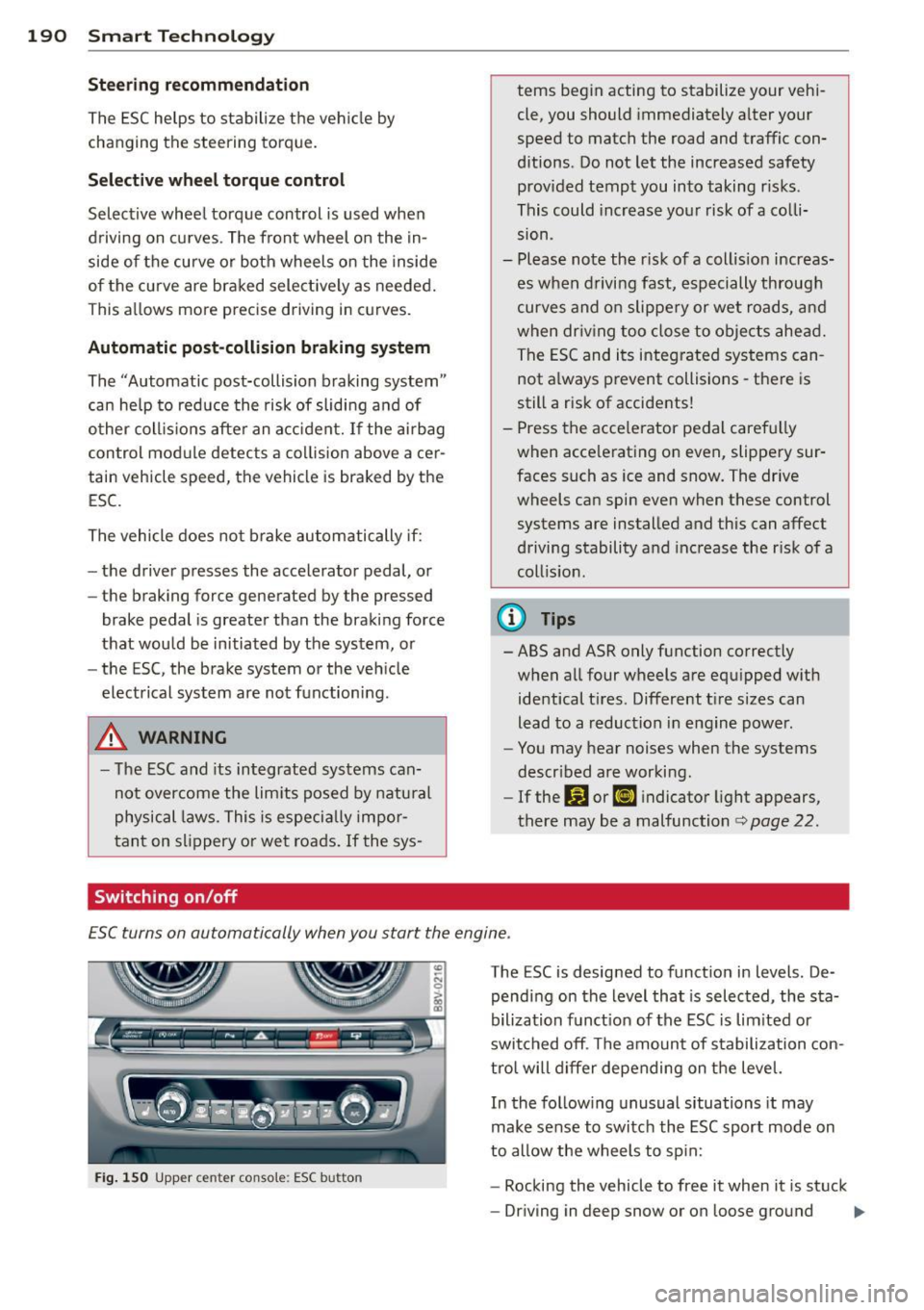
E SC turns on automatically when you start the engine .
Fig. 1 50 Upper c ente r conso le : ESC but to n
The ESC is designed to funct ion in levels . De
pending on the level that is selected, the sta
bilization funct io n of the ESC is lim ited or
swit ched off . The amoun t of stabilization con
tro l will differ depending on t he level.
In the follow ing unusual situations it may
make sense to switch the ESC sport mode on
to allow the wheels to sp in:
- Rocking the vehicle to free it when it is stuck
- Driving in deep snow or on loose ground
ll>
Page 202 of 310
200 Driving and the environment
Vehicles use the most fuel when they are ac
celerati ng. If you anticipate what is going to
happen next, you will need to brake less and,
thus, accelerate less. let the vehicle coast
whenever poss ible -for example when you see
that the next traffic light is red.
Avoid full throttle
Driving at moderate speeds saves fuel and
improves your mileage.
.. Try and keep well be low your car's max imum
speed.
Accelerating gently reduces fuel consump
tion, engine wear, and does not disturb the
environment. F ue l consumption, exhaust emissions and en
gine noise increase disproportionately at hig h
speeds . If you drive at approximately three
quarters of top speed, fue l consumption will
be reduced by one half. Never dr ive faster
tha n the posted speed limit and weather con
d itions permit.
Reducing unnecessary idling
Even when your car is just idling it burns up
fuel.
.. Sh ut the engine off when you are not dr iving
the vehicle.
.. Do not warm up the vehicle by letting the
engine run at idle.
It is efficient to switc h off the engine when
stopped at railroad crossings and long red
lights. Turning the engine off for just 30-40
seconds saves mo re fuel than is burned by
start ing the eng in e again.
It takes a long time for the engine to warm up
fu lly when it is running at idle. However, wear
and nox ious em issions are especially high
when the engine is warming up. So you should
d rive away as soon as you sta rt the eng ine and
avoid ru nning a t high RPM wh ile the engine is
still warming up .
(D Note
Do not leave engine i dling unattended af
ter start ing. If wa rning lights sho uld come
on to indicate improper operation, they
would go unheeded. Extended idling also
produces heat , w hich could result in over
hea ting o r othe r damage to the veh icle or
othe r property.
Regular maintenance
A badly tuned engine unnecessarily wastes a
lot of fuel.
.. Have your ve hicle serviced at regu lar inter-
vals.
Having your veh icle regu larly serviced by an
authorized Aud i dealer helps to ensure that it
runs properly and econom ica lly. The cond it io n
of your veh icle not on ly affects its safety and
ability to ho ld its va lue, i t also affects
fuel
c onsumption .
Check your oil each t ime you fill your tank.
The amount of oi l used is re lated to engine
l oad and speed.
It is normal for the oil consump tion of a new
engine to reach its lowest value after a certain
mileage has been driven .
You m ust drive your ve hicle abou t 3,000 m iles
(5,000 kilometers) before you can properly
assess oil consumpt ion .
T his also ap plies to fue l consumption and en
gine o utp ut.
(D Note
- Have your veh icle ma inta in ed properly
and i n acco rdance with the service rec
ommendations in you r W arranty
& Main
t enance boo klet. l ack of proper ma inte
nance as well as im proper use of the ve
hicle will impair the function of the
em iss ion cont ro l system and cou ld lead
to damage.
Page 227 of 310
M N
0 > co ,...., \!) 1.1"1
M 1.1"1 ,....,
Always keep your forearm parallel to the
ground to help prevent hot oil from run
ning down your arm.
- Drain the oi l into a conta iner designed
for this p urpose, one large eno ugh to
hold at least the total amount of oil in
your engi ne.
- Engine oil is poisono us. Keep it well out
of the reach of c hildren .
- Cont inuo us contact with used engine oil
is harmful to your skin. Always protect
you r sk in by washing oil off thoroug hly
with soap and water .
(D Note
Never mix oil addit ives with your engine
oil. These additives can damage your en
gine and adversely affect y our Aud i Limit
ed New Vehicle Wa rra nty .
@ For the sake of the environment
- Before changing your oi l, f irst make sure
you know whe re you can proper ly dispose
of the used o il.
- Always d ispose of used engine oil proper
l y. Do not dum p it o n ga rden so il, wood
ed a reas, into open streams or down
sewage dra ins.
- Recycle used engine o il by taking it to a
u se d engine oil collection facility in your
a rea, or contact a servi ce station .
Cooling system
Coolant
The engine coolant performs two functions: it
keeps the engine from overheating and it pro
tects the engine from freezing in the winter.
The cooling system is sea led an d generally re
q uir es little attention.
The cooling system has been filled at the f ac
tory with a pe rm anen t coo lan t which does no t
n eed to be changed. The coolant consists of a
mixture of specia lly conditioned water and the
manufacturer's glyco l-based coo lant add i-
tive Gl3 antifree ze with ant icorros ion addi-
Checking and Fillin g 225
tives (50% for USA mode ls; 60% fo r Canadian
models) . This mixture both ass ures the neces
sary frost protection and protects metal com
ponents in the eng ine's cooling system from
corros io n and scaling. It also raises the bo il
ing point of the coolant .
Do not reduce the concentration of the cool
ant in the s ummer by adding p lain water.
The
proportion of coolant additive must be at
least 50°/o but not more than 60 %
to main
ta in antifreeze protect io n and cool ing eff ic ien
cy . If the coo lant frost p rotection is too low ,
t he coo lan t could freeze and damage the vehi
cl e heating and engine cooling sys tem.
Fo r year- round drivi ng, a ntifreeze is added at
the factory fo r temperatures down to:
- -31 °F
< -3s0c) u sA
- -40°F ( - 40°C) Canada.
If you must ad d coo lant, use a mixture o f wa
te r and coolant additive. Mixing the coo lant
additive with dist illed water is recommended.
A WARNING
Before you chec k anything in the engine
compartment, always read and heed all
WARNI NGS
c:> page 217.
-
(D Note
- Before winter sets in, have the coo lant
checked to see if the coolant additive in
your vehicle is sufficient to meet the cli mate condit ions. This is especially impor
t ant if you l ive i n a region where the win-
t er is extremely cold. If necessary, in-
c rea se t he p ropo rtion of coo lant add itive
t o 6 0% .
- Whe n ad d ing coolant addi tiv e to yo ur
c ooling sys te m , reme mbe r:
- We recommend using on ly coo lant ad
d itive Gl2 ++ or Gl3 (check the labe l)
for your vehicle. This coolant additive is ava ila ble at autho rized Aud i dea le rs .
Othe r ty pes of antifreeze ca n sig nifi
cantly reduce cor ros io n protec tion . The
r esu lting co rrosion can cause a lo ss of
c o o lant a nd serio us e ng ine da mage.
IJI,,
•
•
•
Page 229 of 310
....,
N
0 > co
rl I.O
"' ....,
"' rl
Radiator fan
The radiator fan switches on automatically by
itself
An auxiliary electric radiator fan switches on
and off depending on coolan t temperature
and other vehicle operating conditions .
After you switch the engine off, the auxiliary
fan can continue running for up to 10 minutes
- even with the ignition off. It can even switch
on again later by itself<=>.& , if
- the temperature of the engine coolant rises
due to the heat build-up from the engine in
the engine compartment, or
- the engine compartment heats up because
the vehicle is parked in intense sunlight.
A WARNING
-To reduce the risk of personal injury nev
er touch the radiator fan.
- The auxiliary electric fan is temperature
controlled and can switch on suddenly
even when the engine is not running.
- The auxiliary radiator fan switches on au
tomatically when the engine coolant
reaches a certain temperature and will
continue to run until the coolant temper
ature drops.
Brake fluid
Checking brake fluid level
N
N
N
>< ~
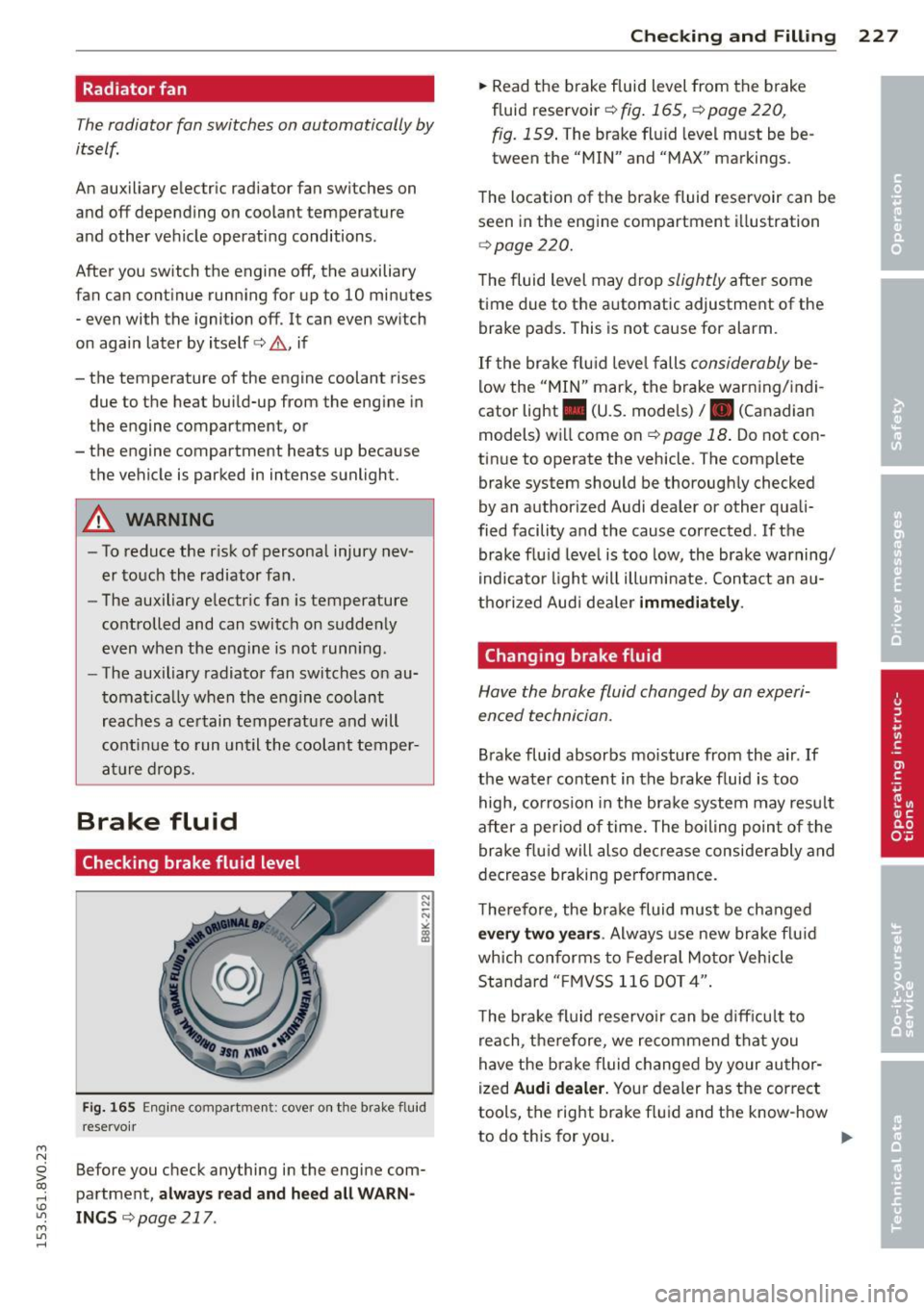
Fig. 165 Engine compa rtment: cove r on the brake fluid
rese rvoir
Before you check anything in the engine com
partment,
always read and heed all WARN
INGS r::;, page 217 .
Checking and Filling 22 7
.. Read the brake fluid level from the brake
fluid reservoir <=>
fig. 165, <=> page 220,
fig. 159.
T he brake fluid level must be be
tween the "MIN" and "MAX" markings.
The location of the brake fluid reservoir can be seen in the engine compartment illustration
<=>page 220.
The fluid level may drop slightly after some
time due to the automatic adjustment of the
brake pads. This is not cause for alarm.
If the brake fluid level falls considerably be
low the "MIN" mark, the brake warning/indi
cator light . (U.S. models)
I. (Canadian
models) will come on
c:> page 18 . Do not con
tinue to operate the vehicle. The complete
brake system should be thoroughly checked
by an authorized Audi dealer or other quali
fied facility and the cause corrected . If the
brake fluid level is too low, the brake warning/
indicator light will illuminate. Contact an au
thorized Audi dealer
immediately.
Changing brake fluid
Have the brake fluid changed by an experi
enced technician.
Brake fluid absorbs moisture from the air . If
the water content in the brake fluid is too
high, corrosion in the brake system may result
after a period of time. The boiling point of the
brake fluid will also decrease considerably and
decrease braking performance.
Therefore, the brake fluid must be changed
every two years . Always use new brake fluid
which conforms to Federal Motor Vehicle
Standard "FMVSS 116 DOT 4".
The brake fluid reservoir can be difficult to
reach, therefore, we recommend that you
have the brake fluid changed by your author
ized
Audi dealer. Your dealer has the correct
tools, the right brake fluid and the know-how
to do this for you.
II>-
Page 244 of 310
242 Tires and wheel s
If you wish to improve comfort See the illustration c::;, fig. 168
when operating the vehicle at for the locati on of the labe l on
normal load (up to 3 occu -driver's side B-pillar (color of
pants), you can adjust tire the actual label and exact loca-
pressures to those specified tion on the vehic le will vary
for normal vehicle load. Before slight ly) .
operat ing the vehicle at maxi -Note that the following table is
mum load , you must increase accurate at the time of going to
the ti re pressu res to those press and is subject to change .
specified for maximum vehicle In the event of discrepancies,
load c::;, &. the tire pressure labe l is locat-
Bear in mind that the tire pres- ed on the driver's side 8-pi llar
sure monitoring system can on -always takes precedence .
ly monitor the tire pressures The table below lists the rec-
you have stored . The system
ommended cold tire inflation
does not recogn ize the load
pressures for the Audi model
condition of your vehic le.
covered by your Owner's Litera-
T he effectiveness of the tire ture at the vehicle's capacity
pressure monitoring system weight and the tire sizes instal -
will be impaired if you store led on the respective mode ls as
normal load pressures but then original equipment, or as a fac-
operate the vehicle at its maxi- tory option.
...
mum load c::;, & .
Page 265 of 310
M N
0 > co ,...., \!) 1.1'1
M 1.1'1 ,....,
In certain circumstances, you may not use
wheel bo lts from a different vehicle -
even if it
i s the same mode l
Q page 291.
A WARNING
Improperly tightened or maintained wheel
bolts can become loose caus ing loss of
control, a collision and ser ious personal in
jury .
- Always keep the wheel bolts and the
threads in the wheel hubs clean so the
wheel bolts can turn easily and be prop
erly t ightened.
- Never grease or oil the wheel bolts and
the threads in the wheel hubs. They can
become loose w hile d riving if greased or
o iled,
even if tightened to the spec ified
torq ue.
- Only use wheel bo lts that belong to the
rim being ins talled.
- Never use different whee ls bolts on your
vehicle .
- Always maintain the correct tightening
torque fo r the wheel bolts to reduce the
risk of a wheel loss. If the tigh teni ng tor
que of the wheel bolts is too low, they
can loosen and come out when the vehi
cle is moving . If the tightening torque is
too high, the whee l bolts and threads
can be damaged and the wheel ca n be
come loose .
(D Note
The specified torque for the wheel bo lts is
90 ft lb (120 Nm) w ith a tolerance of
± 7,4 ft lb(± 10 Nm). Torque whee l bolts
diagonally. After changing a wheel, the
torque must be checked as soon as possi
b le with a torque wrench -prefe rably by an
author ized Audi dealer or qualified wo rk
shop.
Low aspect ratio tires
Your Audi is factory-equipped with low aspect
ratio tires . These tires have been thorough ly
tested and been selected spec ifically for your
model for the ir superb performance, road feel
Tire s an d wheel s 263
and handling under a variety o f driving condi
tions. Ask your authorized A udi dealer for
more details .
T he low aspec t ratio of these tires is ind icate d
by a numera l of
55 or le ss in the tire's size
designation. The numera l represents the ratio
of the t ire's sidewa ll height in relation to its
tread width expressed in percentage.
Conven
tiona l tires have a he ight/w idth rat io of 60 or
more .
The performance of low-a spect-ratio tire s is
particularl y sens it iv e to improper inflation
pressure. It is therefore important that low
a spect ratio tir es are inflated to the specified
pre ssure and that the inflation pr essure i s
regularly checked and ma intain ed . Tire pr es
s ure s should be checked at lea st on ce a
month and alway s bef ore a long trip
~ page 245 , Checking tire pressure .
A Word about Low Aspect Ratio and High
Performance Ti res
Hig h pe rformance tires are des igned for bet
ter performance and handling in warm cli
mates. When driving in cold, snowy or icy
weather, you sho uld equ ip your vehicle w it h
four all-season or winter tires, which
offer
better traction under those condit ions. We
suggest you use the Audi recommended win
te r or a ll-season tires specified for you r Audi.
High performance tires a lso have a lower as
pect ratio that aids performance and han
dling . Driving over rough or damaged road
surfaces, as well as debr is, cu rbs and other
obstacles can cause serious damage to
whee ls, tires, vehicle body, and suspens ion
parts . B e carefu l to avo id road hazards and re
du ce your speed , espec ia lly if your vehicle is
equipped wi th low prof ile tires .
Please a lso remember when making your se
lection that, wh ile these tires deliver respon
s ive handling, t hey m ay ride less comfo rtably
and make more noise than o thers . Finally,
these tires may wear more quickly than other
c h oices.
IJJ>
•
•
•
Page 291 of 310
M N
0 > co ,...., \!) 1.1"1
M 1.1"1 ,....,
Consumer Information
Warranty coverages
Your Audi is covered by the following war
ranties :
-New Vehicle Limited Warranty
- Limited Warranty Against Corrosion Perfo-
ration
- Emissions Control System Warranty
- Emissions Performance Warranty
- California Emissions Control Warranty (USA
vehicles only)
- California Emissions Performance Warranty
(USA vehicles only)
Detailed information regarding your warran
ties can be found in your
Warranty & Mainte
nance booklet .
Operating your vehicle
outside the U.S.A. or
Canada
Government regulations in the United States
and Canada require that automobiles meet
specific emission regulations and safety
standards. Therefore, veh icles built for the
U.S.A. and Canada differ from vehicles sold in
other countries .
If you p lan to take your vehicle outside the
continental limits of the United States or Can
ada, there is the possibility that:
- unleaded fuels for vehicles with catalytic
converter may not be available;
- fuel may have a considerably lower octane
rating . Improper fuel may cause engine
damage;
- service may be inadequate due to lack of
proper service facilities, tools or testing
equipment;
- replacement parts may not be readily availa
ble.
- Navigation systems for vehicles built for the
U.S.A. and Canada will not necessari ly work
in Europe, and may not work in other coun
tries outside North America .
Consumer Information 289
@ Note
Audi cannot be responsible for mechanical
damage that could result from inadequate
fuel, service or parts availab ility.
Audi Service Repair
Manuals and Literature
Audi Offic ial Factory Service Manuals and Lit
erature are published as soon as possible after
model introduction. Service manuals and lit
erat ure are available to order from the Audi
T echnical Literature Ordering Center at:
www.audi.techliterature.com
Maintenance
' General
Your vehicle has been designed to help keep
maintenance requirements to a minimum.
However, a certain amount of regular mainte
nance is still necessary to assure your vehicle's
safety, economy and reliability . For detailed
vehicle maintenance consult your Warranty &
Maintenance booklet.
Under difficult operating conditions , for ex
ample at extremely low outside temperatures,
in very dusty regions, when towing a tra iler
very frequently, etc., some serv ice work
shou ld be pe rformed between the intervals
specified. This applies particularly to:
- oil changes, and
- cleaning or replacing the air filter.
® For the sake of the environment
By regularly maintaining your vehicle, you
help make sure that emission standards
are maintained, thus min imizi ng adverse
effects on the environment .
Important considerations for you and
your vehicle
The increasing use of electronics, sophisticat
ed fuel injection and emission contro l sys-
tems, and the genera lly increasing technica l ..,_
•
•
Page 297 of 310
M N
0 > co ,...., \!) er,
M er, ,....,
Cargo area ... .................. .... 131
Cargo net ...... .............. ... ... . 65
Catalytic converter ......... .... .. .. . 198
CD-ROM player (navigation) .. .. .. .. .. .. 61
CD changer 61
Central indicator light ......... ... .. .. 14
Central locking ............ .... .. .. .. 35
Central locking switch ..... .. .. .. .. .. 39
Convenience key . . . . . . . . . . . . . . . . . . . . 38
Emergency locking .............. .. .. 41
Folding the exterior mirrors . ... .. .. .. 40
Luggage compartment lid ..... ... .. .. 42
Panorama sunroof ........ .... .. .. .. 43
Power windows .......... .... .. .. .. 43
Remote control key . . . . . . . . . . . . . . . . . 3 7
Safety central locking ....... .. .. .. . .
Setting
Certification . ............. .... .. .. .
Changing a wheel .......... .... .. .. .
41
40
292
269
Changing engine oil ............. .... 224
Checking Tire pressure .. ........... .. .. .. .. . 245
Child restraints
Danger of using child restraints in the
front seat . . . . . . . . . . . . . . . . . . . . . . . .
146
Where can I get additional information
about child restraints and their use? . .
188
Child restraint system anchors . .. .. .. . 184
Child safety .. .. ... ... ... .... .. .. ... 170
Convertible locking retractor .. .. ... .. 181
Important safety instructions for using
child safety seats . . . . . . . . . . . . . . . . . .
17 4
I mportant things to know when driving
with chi ldren ............ .. .. .. .. .
170
Tether anchors .............. ... .. . 187
Tether straps .................. .. . 187
Child safety lock
Power windows .......... .. .. .. .. .. 43
Rear doors . ............. .... .. .. .. 42
Child safety seats ............... ....
176
Booster seats . . . . . . . . . . . . . . . . . . . . . 179
Convertible ch ild seats .... .. .. .. .. . 177
Convertible locking retractor .. .. .. .. .
How do I properly install a child safety
. h' l 7 seat in my ve 1c e ................. .
Infant seats ................ ... .. .
Installing .. .. .............. ... .. .
181
174
176
181
Index 295
Installing a child restraint using the
LATCH system .. .. .. ...............
186
LATCH system . . . . . . . . . . . . . . . . . . . . . 186
Lower anchorages ................. 185
Mounting and releasing the anchorage
hook ........ ... .. ...............
186
Safety instructions . . . . . . . . . . . . . . . . . 17 4
Unused safety belts on the rear seat ..
176
Cleaning ... .. .. .. .. .. ........... .. 205
Cleaning/removing ice from windows . .. 207
Cleaning Alcantara ........ .......... 208
Cleaning artificial leather ............ . 208
Cleaning carbon parts . . . . . . . . . . 207, 208
Cleaning controls .. ................. 207
Cleaning decorative parts/trim ....... . 207
Cleaning displays ......... .......... 207
Cleaning exhaust tail pipes ........... 206
Cleaning plastic parts ............ .. .. 207
Cleaning rims ...... ...... .......... 206
Cleaning seat covers . ................ 208
Cleaning textiles . .. .... ........... .. 208
Cleaning the tail lights ............... 206
Climate control system
Key recognition . . . . . . . . . . . . . . . . . . . .
68
Climate control system (automatic)
Adjusting air vents . . . . . . . . . . . . . .
71 , 72
Air distribution, air vents ........ .... . 71
Audi drive select . ... ............... 106
AUTO (climate control system) . . . . . . . . 70
Blower ...... ' .. ................. . 71
Controls . . . . . . . . . . . . . . . . . . . . . . . . . . 70
Defrosting the windshield ....... .. .. . 71
Rear window defogger . . . . . . . . . . . . . . . 72
Recirculation mode ................. 71
Setting the temperature .... .... .... . 71
synchronizing .. ... ................. 71
Climate control system (manual)
Adjusting air vents . . . . . . . . . . . . . .
69, 72
Adjusting the temperature . . . . . . . . . . . 69
Air distribution, air vents . . . . . . . . . . . . . 69
Blower ......... .. ................ 69
Defrosting windows ............ .. .. . 69
Operation . . . . . . . . . . . . . . . . . . . . . . . . . 69
Rear window defogger . . . . . . . . . . . . . . . 72
Recirculation mode ................. 70
Clock ............ .. ..... ........... 10
•
•
Page 298 of 310
296 ~l :..:.: nd ~e ~x :._ ______________________________ _
Closing
Hood . ..... ... . ...... ... .. .. .... . 219
Panorama s unroof ..... ... .. .. .... .. 44
W indows ............... .... ...... 43
C losing/open ing
by remote con tro l . . . . . . . . . . . . . . . . . . 3 7
with the central locking switch ...... . . 39
with the convenience key . . . . . . . . . . . . . 38
with the door lock ........ .. .. .... .. 39
Cockpi t (ove rview) . . . . . . . . . . . . . . . . . . . . 8
Cold ti re i nflat ion pressure ....... .. .. . 240
Com ing home . .. .. ..... ... .. .. .... .. 48
Compartmen ts .......... .. .... .. .. .. 6 1
Compass in the mirror .......... .. .. .. 54
Comp liance .. ... .. ..... ... .. .. .... . 292
Consumer Info rmation . . . . . . . . . . 133, 289
Consumpt ion (fue l) . . . . . . . . . . . . . . . . . . 28
Cont acting NH TSA ......... .. .. .... . 133
Conve nience key
Eme rgency operation . . . . . . . . . . . . . . . . 79
I nd icator light . . . . . . . . . . . . . . . . . . . . . 79
St arti ng the eng ine (START ENG INE ST OP
b utton) .. .. ............. .. .. .. .. .. 77
S topping the engine (S TAR T EN GIN E
STO P button) .. . ...... ... .. .. .... .. 78
Switching the ign ition on . ... .. .... . . 77
un locking/locking ........ .. .. .. .. .. 38
Conve nien ce opening/closing .. .. .. .. . . 43
Convertible c hild safety seats .. .. .... . 177
Conve rtible locking retracto r
Activating .. ... .. ..... ... .. .. .... . 183
Deactivating . . . . . . . . . . . . . . . . . . . . . . 184
Using to secure a c hild safety seat l81, 183
Coolant
refer to Engine coo la nt . ... .. .. .... . 225
Cooling mode (automatic climate control
sys tem) . .. .... ............. .. .... .. 70
Cooling mode (manua l cl imate control sys-
tem) ........ .......... ...... ... .. .. 69
Cooling system Adding coolant . ... .... ... .. .. .. .. . 226
Coolant leve l check ing ....... .. .... . 226
Coolant temperature indicator .. .. .... 12
Ind icator light . . . . . . . . . . . . . . . . . . . . . 20
Cornering light .. .. ..... ... .. .. .... .. 4 7
C rash data recorde r (ED R) ... .. .. .. .. . 189 Cruise cont
ro l system
Changing speed . ... ... ..... ... .. .. . 84
Desc ription . ... .. ... .. ..... ... .. .. . 83
Preselect ing speed ............. .... . 84
Switching off .. .. ............. .... . 85
switching on . . . . . . . . . . . . . . . . . . . . . . . 84
C u p ho lde rs ..... .. ... .. ..... ... .. .. . 61
C ur rent co nsu mption . . . . . . . . . . . . . 27, 28
D
Data recorde r . . . . . . . . . . . . . . . . . 189, 195
Date disp lay . ..... .. ... ..... ... .. .. . 10
D ayt ime run ning lights ........... .... . 46
Declarat ion of compliance
Adaptive cruise control ............. 292
Audi s ide ass ist .. ... .. .. ... ..... .. 292
Cell phone package ... ...... ... .. .. 292
C onvenience key ... .......... .... .. 29 2
El ec tronic immob ilizer ...... .... .. .. 292
Homelin k unive rsal remo te con trol ... 2 92
Remote contro l key .. .. ..... ... .. .. 292
Defect ive light bu lb wa rni ng
I n di cator lig ht . .. ............. .... . 25
Defrost ing (windshie ld)
automatic climate control system . . . . . 71
ma nual cl imate co ntrol system ....... . 69
DEF (instr ument cluster) . ..... ... .. .. . 11
Del uxe a utomat ic cli mate control
refer to Clima te con trol sys tem ( auto -
matic) . ... .... .. ... .. .. ..... ... .. . 70
Dete rm ining co rrect load limit .. .. .. .. 250
Diesel Indicato r light . .. ... ...... .... .... . 23
Prewarm ing (bu tton) ......... .... .. . 77
P rewarm ing (key) . .......... ...... .. 74
Diesel f uel .. .... .. .. .... .... ... .. .. 211
D iesel pa rticula te filter ... ... .... .. .. 1 99
Digital compass . . . . . . . . . . . . . . . . . . . . . 54
D imens ions ..... .. .. .... .... ... .. .. 287
D im ming the rearview m irror ... .. .. .. . 53
Distance ... .. .. .. ............. .... . 28
D oor/re ar lid w arning ............ .. .. . 27
Door contact sw itch . . . . . . . . . . . . . . . . . . 49
Doors Child safety lock (mechanical) . ... .. .. . 42
Page 299 of 310
M N
0 > co ,...., \!) 1.1'1
M 1.1'1 ,....,
Driver information system ... .. .. .. .. .. 27
Boost ..... .. .. .. .. .... ... .. .. .... 29
CD/radio display ....... ... .. .. .. .. .. 27
Door/rear lid warning ..... .. .. .. .. .. 27
Driver messages . . . . . . . . . . . . . . . . . . . . 14
Efficiency program . . . . . . . . . . . . . . . . . . 29
E ng ine o il temperature indicator .. .. .. 32
I ndicator lights . . . . . . . . . . . . . . . . . . . . 14
L ap time r .. ............... .. .. .. .. 3 2
On- boa rd comp ute r . . . . . . . . . . . . . . . . . 28
Outside tempera ture display . ... .. .. .. 27
Service interval disp lay . ... .. .. .. .. .. 13
Using the multifunction steer ing whee l . 27
Dr iver sea ting posi tion ...... .. .. .. .. . 126
Drive se lect
refer to Audi dr ive se lect . ...... ... .. 106
D riving safe ly . .. .. ..... ... .. .. .. .. . 125
D riving through water . . . . . . . . . . . . . . . 198
Driving time . . . . . . . . . . . . . . . . . . . . . . . . 28
D ust filter
refer to Po llutant filte r . . . . . . . . . . . . . . 68
E
EC O mode ( autom atic clima te control sys -
tem) . ..... .. .. ... .. ..... ... .. .. .... 70
E fficiency program . . . . . . . . . . . . . . . . . . . 29
D escr ipt io n ................. ... ... . 29
Fu el economy messages . . . . . . . . . . . . . 30
O the r equipmen t . . . . . . . . . . . . . . . . . . . 30
Elect rical accessories
refer to Socket . . . . . . . . . . . . . . . . . . . . . 60
Elect romechanical par king brake
refer to Parking brake ..... .. .. .. .. .. 80
E lect romechan ic a l steering .. .. .. .. .. . 193
I ndica tor ligh ts .. ..... ... .. .. .. .. . 193
E lect ron ic diffe rent ial loc k ... .. .. .. .. . 189
I ndicator light . . . . . . . . . . . . . . . . . . . . . 2 2
Electronic immobili zer ...... .. .. .. .. .. 40
also refer to Immobilizer .. .. .. .. .. .. 35
E lect ro nic spee d limiter .. ... .. .. .. .. .. 31
E lect ronic stabilization control (ESC)
I ndicator light . . . . . . . . . . . . . . . . . . . . . 2 2
Sport mode .. ........... .. .. .. .. . 190
Electro nic Stabilization Control (ESC) .. . 189
Eme rgency ass istance ... ... .. .. .. .. . 26 7
E mergency flasher ...... ... .... .. .. .. 47
Inde x 297
Emergency flashe rs
Indicator light ... .. . ... ...... ... .. . 26
Emergency operation Emergen cy bra king f unct ion ..... .. .. . 82
F ron t passenger's door/rear doors .. .. . 41
L uggage compartment lid .... ... .. .. 2 67
Pano rama sunroof . .. .. ..... ... .. .. . 4S
with convenience key . . . . . . . . . . . . . . . . 79
E mergency re lease
F uel fi ller doo r ... .. . .............. 214
S e lector lever . . . . . . . . . . . . . . . . . . . . . 116
Emergency starting ................. 280
Emergency towing . ................. 282
E nergy m anagement ............ .. .. 19 4
Ind icator lig ht ... .. .. .. ...... ... .. . 2 0
E ngine
Coolant ......... .. ............... 225
Pr ewa rm ing (butto n) ............... . 77
P rewarm ing ( key) . .... ........... .. . 74
Star ting with jumper cables .. ... .. .. 2 80
S tar ting (driver messages with conven -
ience key) . . . . . . . . . . . . . . . . . . . . . . . . . 79
Starting (eng ine) . .. ............... . 77
Starting
(key) . . . . . . . . . . . . . . . . . . . . . . 7 4
stopp ing (button) .................. 78
stopp ing (key) . ......... ........... 76
Engine compartment Closing the hood ..... ............. 219
Open ing the ho od ............. .. .. 219
Overview.. .. .. .. ............ 220,221
Safety precautions ... . .. ...... .... . 217
Engine co ntrol (indicato r light) . . . . . . . . . 23
En gine coolant .. .. ................. 225
Radiator fan . .. .. .... ............. 227
Engine o il .. .. .. .. .. . .. .. ..... ... .. 221
adding ......... .. ............... 223
Changi ng ... .. .. .. . .. .... .... .. .. 224
Checking the oi l level ............. .. 22 3
Dip stic k ... .... .. .. . ..... 2 20, 22 1,22 3
Ind icator lig ht . .. .... ........... .. . 20
Oil consumpt ion . ... . .. .. ..... ... .. 2 22
Specificatio n and viscosity .... ... .. .. 221
T emperature indicato r ... .... ... .. .. . 32
U se ...... .. .. .. ................. 223
Engine speed lim itation ( indica to r li gh t) . 24
•
•
•