air condition AUDI S3 2015 Owner's Manual
[x] Cancel search | Manufacturer: AUDI, Model Year: 2015, Model line: S3, Model: AUDI S3 2015Pages: 310, PDF Size: 76.15 MB
Page 210 of 310
208 Care and cleaning
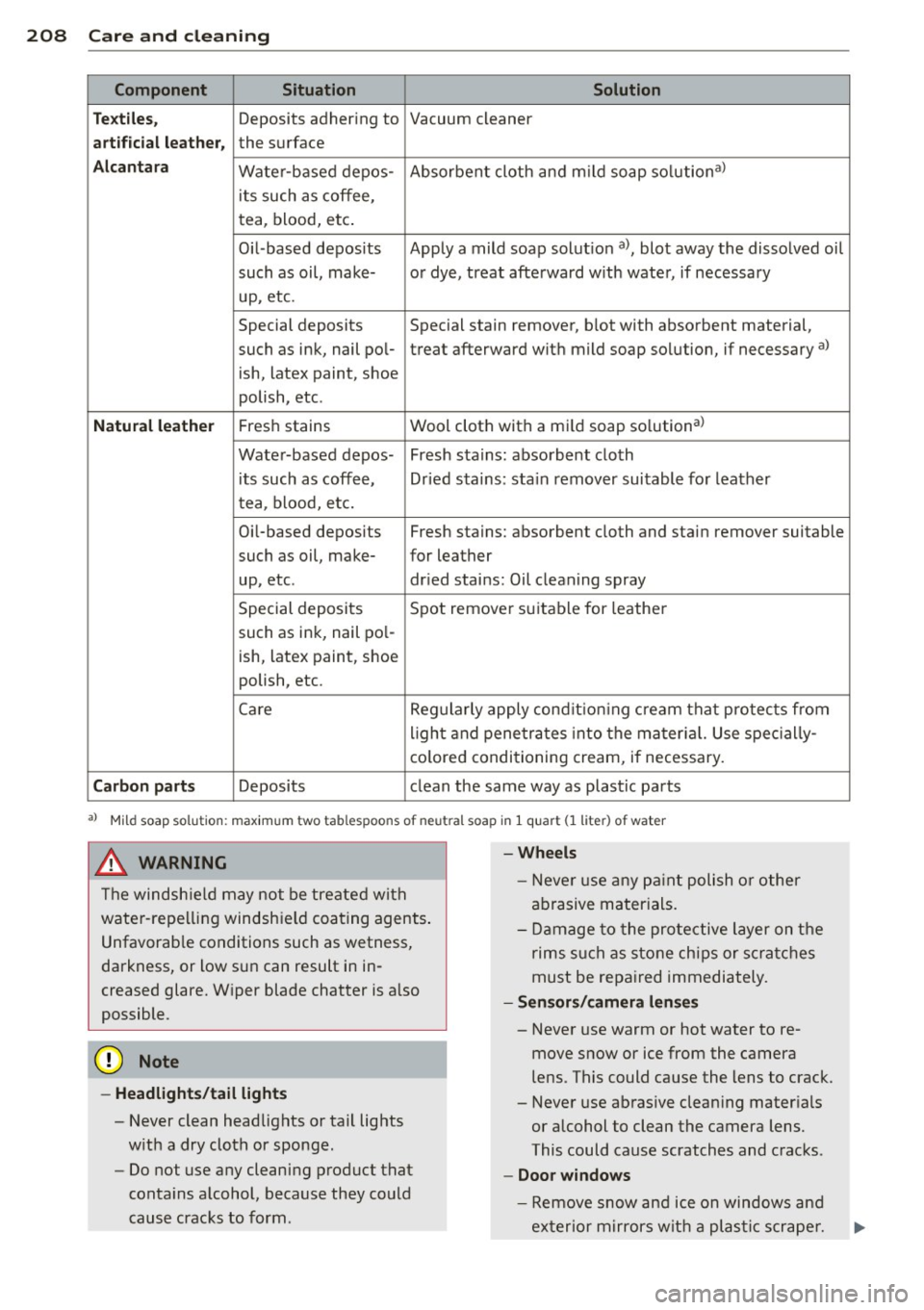
Component Situ ation Solution
Tex tile s,
Deposits adhering to Vacuum cleaner
art ifi cial l eather , the surface
Alcan ta ra Water-based depos- Absorbent cloth and m
ild soap so lution a>
its such as coffee,
tea, blood, etc.
Oil-based deposits Apply
a mild soap solut ion a>, blot away the dissolved oil
such as oil, make- or dye, treat afterward w ith water, if necessary
up, etc.
Special deposits Special stain remover, blot with absorbent material,
such as ink, nail pol-treat afterward with mild soap so lution, if necessary a)
ish, latex paint, shoe
polish, etc.
Natu ral leathe r Fresh stains Wool
cloth with a mi ld soap so lutiona >
Water-based depos- Fresh stains: absorbent cloth its such as coffee, Dr ied stains: stain remover suitable for leather
tea, blood, etc.
Oi l-based deposits Fresh stains: absorbent cloth and stain remover suitable
such as oil, make- for leather
up, etc . dried stains: Oil clean ing spray
Special deposits Spot remover suitable for leathe r
such as ink, nail po l-
ish, latex paint, shoe
polish, etc.
Ca re Regularly apply cond it io ni ng cream that protects from
light and penetrates into the mater ia l. Use spec ially-
co lored! conditioning cream, if necessary.
Carb on p art s Deposits clean th e same way as plastic parts
a) Mi ld soap solution: maximu m two tablespoons of neutral soap in 1 quart (l liter) of water
_& WARNING
The windsh ie ld may not be treated with
water-repelling windshield coating agents .
Unfavorab le conditions such as wetness,
darkness, or low sun can result in in
creased glare. Wiper blade chatter is also
possible .
([) Note
-Headlight s/tail li ght s
-Never clean headlights or tail lights
w ith a dry cloth or sponge.
- Do not use any cleaning product that
conta ins alcohol, because they could
cause cracks to form.
-
- Whee ls
- Never use any pa int polish or other
abrasive materials.
- Damage to the protective layer on the
rims s uch as stone chips or scratches
must be repaired immediately.
- Sen sors/ cam era len ses
-Never use warm or hot water to re-
move snow or ice from the camera
lens. This could cause the lens to crack.
- Never use abrasive cleaning mater ials
or alcohol to clean the camera lens.
This could cause scratches and cracks.
-Door windo ws
-Remove snow and ice on windows and
exter ior mirrors with a plastic scrape r.
Page 229 of 310
....,
N
0 > co
rl I.O
"' ....,
"' rl
Radiator fan
The radiator fan switches on automatically by
itself
An auxiliary electric radiator fan switches on
and off depending on coolan t temperature
and other vehicle operating conditions .
After you switch the engine off, the auxiliary
fan can continue running for up to 10 minutes
- even with the ignition off. It can even switch
on again later by itself<=>.& , if
- the temperature of the engine coolant rises
due to the heat build-up from the engine in
the engine compartment, or
- the engine compartment heats up because
the vehicle is parked in intense sunlight.
A WARNING
-To reduce the risk of personal injury nev
er touch the radiator fan.
- The auxiliary electric fan is temperature
controlled and can switch on suddenly
even when the engine is not running.
- The auxiliary radiator fan switches on au
tomatically when the engine coolant
reaches a certain temperature and will
continue to run until the coolant temper
ature drops.
Brake fluid
Checking brake fluid level
N
N
N
>< ~
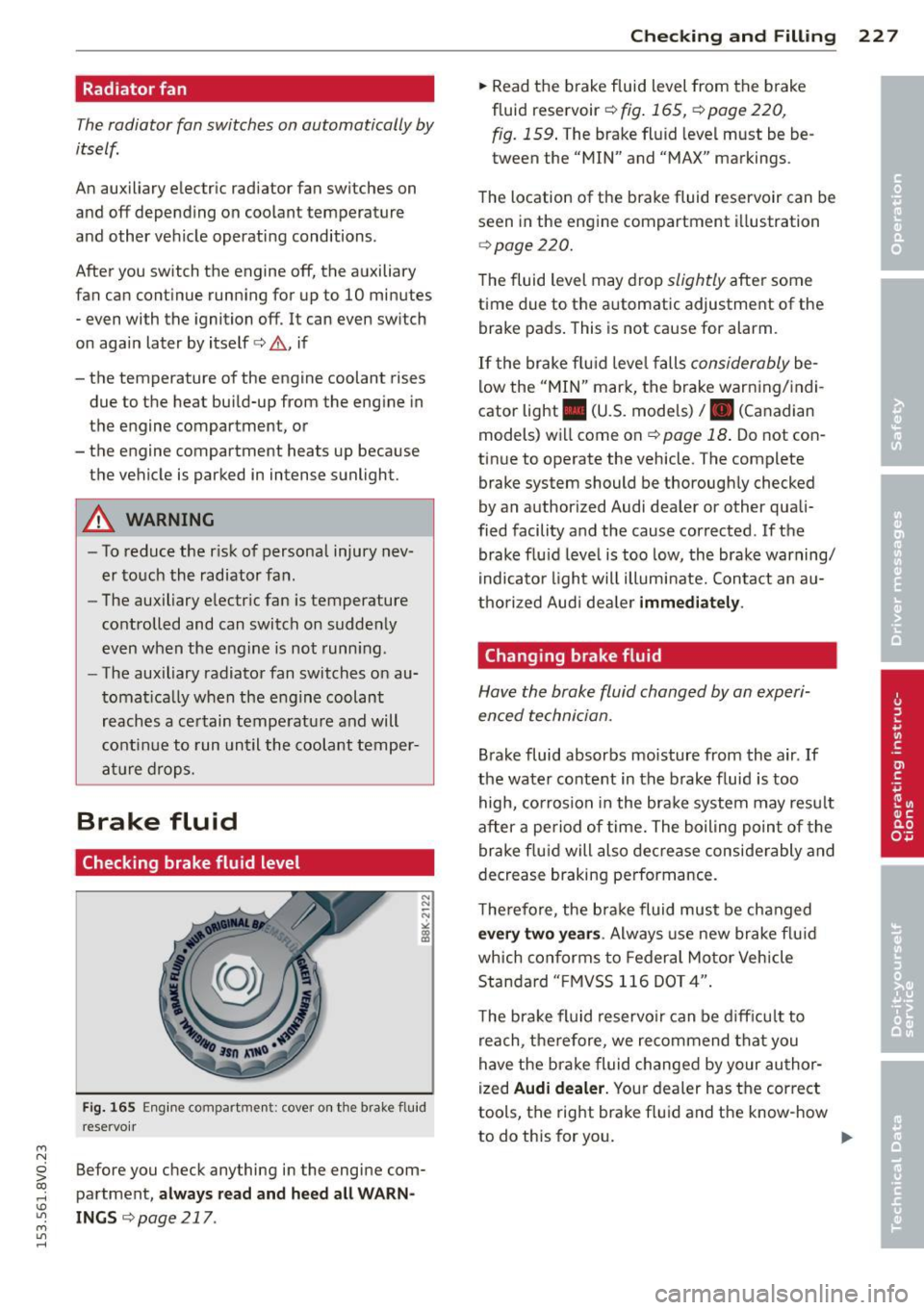
Fig. 165 Engine compa rtment: cove r on the brake fluid
rese rvoir
Before you check anything in the engine com
partment,
always read and heed all WARN
INGS r::;, page 217 .
Checking and Filling 22 7
.. Read the brake fluid level from the brake
fluid reservoir <=>
fig. 165, <=> page 220,
fig. 159.
T he brake fluid level must be be
tween the "MIN" and "MAX" markings.
The location of the brake fluid reservoir can be seen in the engine compartment illustration
<=>page 220.
The fluid level may drop slightly after some
time due to the automatic adjustment of the
brake pads. This is not cause for alarm.
If the brake fluid level falls considerably be
low the "MIN" mark, the brake warning/indi
cator light . (U.S. models)
I. (Canadian
models) will come on
c:> page 18 . Do not con
tinue to operate the vehicle. The complete
brake system should be thoroughly checked
by an authorized Audi dealer or other quali
fied facility and the cause corrected . If the
brake fluid level is too low, the brake warning/
indicator light will illuminate. Contact an au
thorized Audi dealer
immediately.
Changing brake fluid
Have the brake fluid changed by an experi
enced technician.
Brake fluid absorbs moisture from the air . If
the water content in the brake fluid is too
high, corrosion in the brake system may result
after a period of time. The boiling point of the
brake fluid will also decrease considerably and
decrease braking performance.
Therefore, the brake fluid must be changed
every two years . Always use new brake fluid
which conforms to Federal Motor Vehicle
Standard "FMVSS 116 DOT 4".
The brake fluid reservoir can be difficult to
reach, therefore, we recommend that you
have the brake fluid changed by your author
ized
Audi dealer. Your dealer has the correct
tools, the right brake fluid and the know-how
to do this for you.
II>-
Page 244 of 310
242 Tires and wheel s
If you wish to improve comfort See the illustration c::;, fig. 168
when operating the vehicle at for the locati on of the labe l on
normal load (up to 3 occu -driver's side B-pillar (color of
pants), you can adjust tire the actual label and exact loca-
pressures to those specified tion on the vehic le will vary
for normal vehicle load. Before slight ly) .
operat ing the vehicle at maxi -Note that the following table is
mum load , you must increase accurate at the time of going to
the ti re pressu res to those press and is subject to change .
specified for maximum vehicle In the event of discrepancies,
load c::;, &. the tire pressure labe l is locat-
Bear in mind that the tire pres- ed on the driver's side 8-pi llar
sure monitoring system can on -always takes precedence .
ly monitor the tire pressures The table below lists the rec-
you have stored . The system
ommended cold tire inflation
does not recogn ize the load
pressures for the Audi model
condition of your vehic le.
covered by your Owner's Litera-
T he effectiveness of the tire ture at the vehicle's capacity
pressure monitoring system weight and the tire sizes instal -
will be impaired if you store led on the respective mode ls as
normal load pressures but then original equipment, or as a fac-
operate the vehicle at its maxi- tory option.
...
mum load c::;, & .
Page 257 of 310
M N
0 > co ,...., \!) 1.1'1
M 1.1'1 ,....,
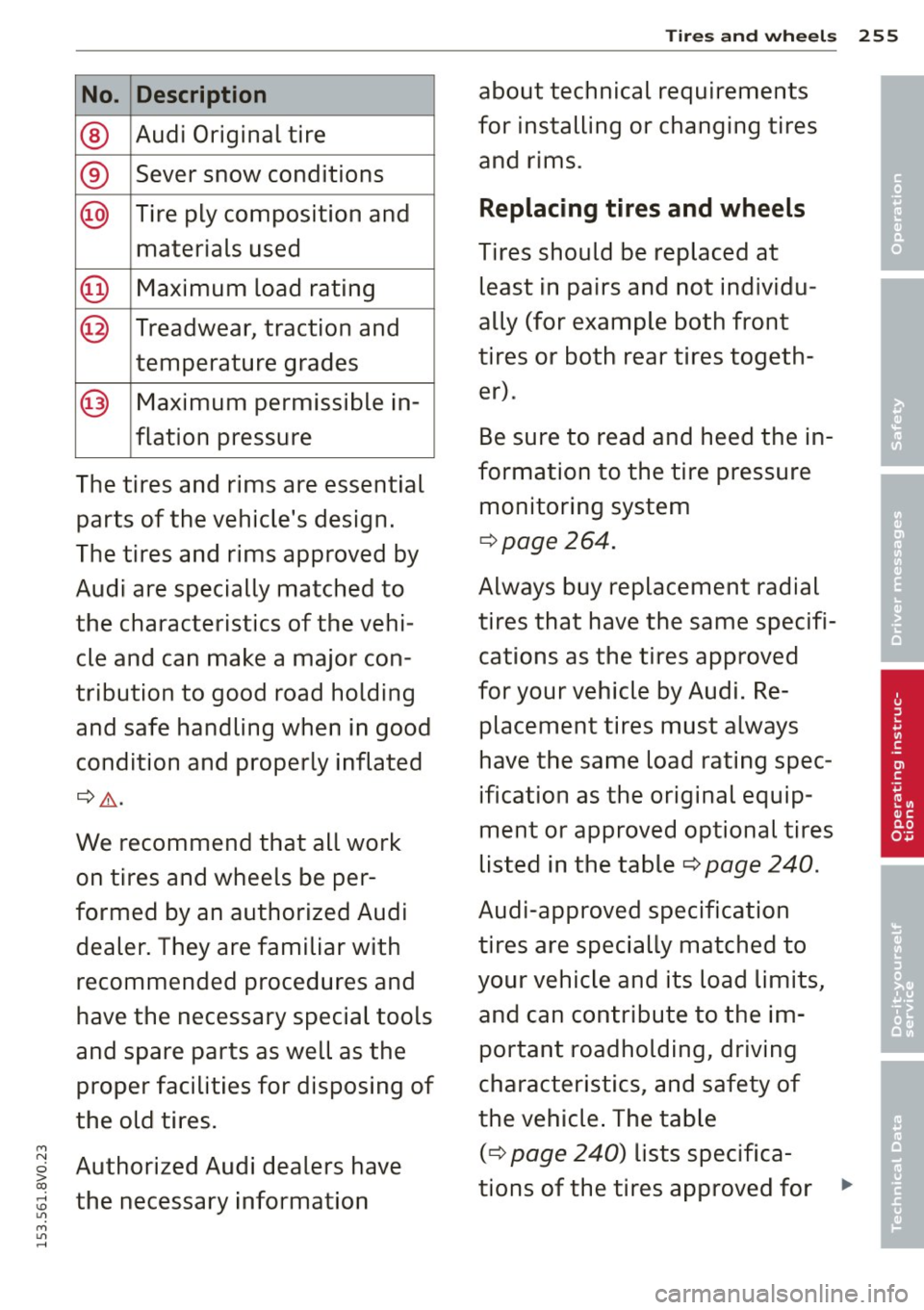
No. Description
® Audi Original tire
® Sever snow conditions
@ Tire ply composition and materials used
@ Maximum load rating
@ Treadwear, traction and
temperature grades
@ Maximum permissible in-
flation pressure
The tires and rims are essential parts of the vehicle's design.
The tires and rims approved by
Audi are specially matched to
the characteristics of the vehi
cle and can make a major con
tribution to good road holding
and safe handling when in good
condition and properly inflated
¢ ,&.
We recommend that all work
on tires and wheels be per
formed by an authorized Audi dealer. They are familiar with
recommended procedures and
have the necessary special tools
and spare parts as well as the
proper facilities for disposing of
the old tires.
Authorized Audi dealers have
the necessary information
Tires and wheels 255
about technical requirements
for installing or changing tires and rims.
Replacing tires and wheels
Tires should be replaced at least in pairs and not individu
ally (for example both front
tires or both rear tires togeth er).
Be sure to read and heed the in
formation to the tire pressure monitoring system
i=> page 264.
Always buy replacement radial
tires that have the same specifi
cations as the tires approved
for your vehicle by Audi. Re
placement tires must always
have the same load rating spec
ification as the original equip
ment or approved optional tires
listed in the table
c> page 240.
Audi-approved specification
tires are specially matched to
your vehicle and its load limits, and can contribute to the important roadholding, driving
characteristics, and safety of
the vehicle. The table
{ c> page 240) lists specifica
tions of the tires approved for
' •
•
' •
Page 266 of 310
264 Tire s and wheel s
It is important that the inflation pressu re is
regularly checked and maintained at recom
mended levels .
F or more informat ion p lease ask your A udi
deale r for more details .
What you can do to avoid tire and rim
damage
Low aspect ratio t ires can be damaged more
easi ly by impact with potho les, curbs, gu llies
or ridges on the road, part icularly if the t ire is
underinflated .
I n o rder to m inim ize the o ccu rrence of impact
damage to the tires of your vehicle, we recom
mend that you observe the following precau
tions:
- Always mainta in recommended inflat ion
pressures. Check your tire pressure every
2,000 miles (3,000 km) and add air if neces
sary .
- Drive carefu lly on roads with potholes, deep
gullies or ridges. The impact from driving
thro ugh or over such obstacles can damage
your t ires. Impact with a curb may also
cause damage to your tires.
- After any impact, immediately inspect your
t ires or have them inspected by the neares t
authorized Aud i dealer . Replace a damaged
t ire as soon as possible .
- Inspect your t ires every 2,000 miles (3,000
km) for damage and wear . Damage is not al
ways easy to see . Damage can lead to loss of
air and unde rinflat ion, wh ich could eventu
ally cause t ire fail ure.
If you be lieve that a
t ire may have been damaged, replace the
tire as soon as possible.
- T hese tires may wea r more quick ly than oth
ers.
- Please a lso remember that, whi le these t ires
deliver respons ive handling, they may ride
less comfortably and make mo re noise than
other c hoices.
Reduced performance in winter /cold
s eason condition s
All tires are designed for certain pu rposes .
The low aspect ratio, u ltra hig h performance t
ir es or iginally insta lled on yo ur vehicle a re in
tended for maximum dry and wet road per
formance and handling . They are not suitable
for cold, snowy or icy weather conditions. If
you drive under those c ircumstances, you
shou ld equ ip your vehicle w ith all -season or
winter tires, which offer bette r traction unde r
those conditions . We suggest you use the rec
ommended snow o r all-season t ires specified
for yo ur vehicle , or thei r equivalent .
Refer to~ page
261 for more detailed infor
mation regard ing winter tires .
Tire pressure
monitoring system
ill General notes
E ach tire, including the spare ( if provided),
shou ld be checked monthly wh en co ld and in
flated to t he inflat io n pressure recommended
by the veh icle man ufact urer on t he veh icle
placard or tire inf lation pressure labe l. (If your
vehicle has tires of a different size than the
size indicated on the vehicle placard or tire in
flat ion pressure labe l, you should determine
the proper t ire inflation press ure for those
t i res).
As an added safety feature, your ve hicle has
been equipped with a tire pressure monitoring
system (TPMS) that illum inates a low tire
pressure tell tale when one or more of your
t ires is s ignificantly under-inflated . According
ly, when the low tire pressure telltale illumi
nates, you shou ld stop and check you r tires as
soon as possib le, and inflate them to the
proper p ress ure. Driving on a sig nifican tly u n
der -inflated t ire causes the tire to overhea t
and can lead to tire fa ilure . Under-inflation al
so reduces fuel eff iciency and tire tread life,
and may affect the vehicle's hand ling and
stopp ing ability.
Please note that the TPMS is not a substit ute
for proper tire maintenance, and it is the driv
er 's respons ibility to maintain correct tire
pressure, even if under-inflation has not
Page 291 of 310
M N
0 > co ,...., \!) 1.1"1
M 1.1"1 ,....,
Consumer Information
Warranty coverages
Your Audi is covered by the following war
ranties :
-New Vehicle Limited Warranty
- Limited Warranty Against Corrosion Perfo-
ration
- Emissions Control System Warranty
- Emissions Performance Warranty
- California Emissions Control Warranty (USA
vehicles only)
- California Emissions Performance Warranty
(USA vehicles only)
Detailed information regarding your warran
ties can be found in your
Warranty & Mainte
nance booklet .
Operating your vehicle
outside the U.S.A. or
Canada
Government regulations in the United States
and Canada require that automobiles meet
specific emission regulations and safety
standards. Therefore, veh icles built for the
U.S.A. and Canada differ from vehicles sold in
other countries .
If you p lan to take your vehicle outside the
continental limits of the United States or Can
ada, there is the possibility that:
- unleaded fuels for vehicles with catalytic
converter may not be available;
- fuel may have a considerably lower octane
rating . Improper fuel may cause engine
damage;
- service may be inadequate due to lack of
proper service facilities, tools or testing
equipment;
- replacement parts may not be readily availa
ble.
- Navigation systems for vehicles built for the
U.S.A. and Canada will not necessari ly work
in Europe, and may not work in other coun
tries outside North America .
Consumer Information 289
@ Note
Audi cannot be responsible for mechanical
damage that could result from inadequate
fuel, service or parts availab ility.
Audi Service Repair
Manuals and Literature
Audi Offic ial Factory Service Manuals and Lit
erature are published as soon as possible after
model introduction. Service manuals and lit
erat ure are available to order from the Audi
T echnical Literature Ordering Center at:
www.audi.techliterature.com
Maintenance
' General
Your vehicle has been designed to help keep
maintenance requirements to a minimum.
However, a certain amount of regular mainte
nance is still necessary to assure your vehicle's
safety, economy and reliability . For detailed
vehicle maintenance consult your Warranty &
Maintenance booklet.
Under difficult operating conditions , for ex
ample at extremely low outside temperatures,
in very dusty regions, when towing a tra iler
very frequently, etc., some serv ice work
shou ld be pe rformed between the intervals
specified. This applies particularly to:
- oil changes, and
- cleaning or replacing the air filter.
® For the sake of the environment
By regularly maintaining your vehicle, you
help make sure that emission standards
are maintained, thus min imizi ng adverse
effects on the environment .
Important considerations for you and
your vehicle
The increasing use of electronics, sophisticat
ed fuel injection and emission contro l sys-
tems, and the genera lly increasing technica l ..,_
•
•
Page 292 of 310
29 0 Con sum er Inf ormation
comp lexity of today's automobi les, have
steadi ly reduced the scope of maintenance
and repairs which can be carried out by vehicle
owners.
Also, s afety an d e nvir onm ent al con
cerns place very strict limits on the nature of
repairs and adjustments to engine and trans
miss ion pa rts which an owner can perform .
Maintenance, adjustments and repa irs usua lly
require special tools, testing devices and oth
er equipment avai lab le to specially trained
workshop personnel in order to assure proper
performance, reliab ility and safety of the vehi
cle and its many systems .
Improper ma intenance, adjustments and re
pa irs can impair the operation and reliab ility
of your vehicle and even void your vehicle war ranty. Therefo re , proof of servic ing in accord
ance w it h the ma intenance sched ule may be a
condition for upholding a poss ible warranty
claim made within the warran ty period.
Above all, operational safety can be adve rsely
affected, creating unnecessary risks for you
and your passengers.
If in doubt about any serv icing, have it done
by your author ized Audi dealer or any other
p roperly equipped and qualified workshop .
We strong ly urge you to give your authorized
Audi dealer the opportunity to perform all
schedu led maintenance and necessary repairs .
Your dea ler has the facilities, or iginal parts
and tra ined spec ialists to keep your vehicle
running properly .
Performing lim it e d m aint en anc e y ourself
The fo llowing pages describe a limited num
ber of procedures which can be performed on
you r vehicle with ordinary too ls, shou ld the
need arise and trained personnel be unavaila
ble. Before performing any of these proce
dures, always thoroughly read all of the app li
cable text and ca refully follow the instruc
tions given. Always rigorously obse rve the
WARNINGS p rovided .
Before you ch eck anything in th e engin e
compartme nt, alway s read an d heed all
WARNINGS ~
& and ~page 217 .
_& WARNING
-Ser ious personal injury may occur as a re
sult of improperly performed mainte
nance, adjustments or repa irs .
- Always be extremely careful when work
ing on the vehicle . Always follow com
monly accepted safety pract ices and gen
eral common sense. Never r is k personal
in ju ry.
- Do not attempt any of the maintenance ,
checks or repairs descr ibed on the fol
lowing pages if you are not fu lly fam iliar
with these or other procedures with re
spect to the vehicle, or are uncertain how
to proceed .
- Do not do any work without the proper
too ls and equipment. Have the necessa ry
work done by your author ized A udi deal
er or another proper ly equipped and
qualified workshop.
- The engine compartment of any motor
veh icle is a potentially hazardous area.
Never reach into the area around or
touch the rad iator fan. It is temperature
controlled and can sw itch on suddenly -
even when the engine is off . The radiator
fan switches on automatical ly when the
coo lant re aches a certain temperature
and will cont inue to run until the coo lant
temperature drops .
- Always sw itch off the ignition before any
one gets under the vehicle.
- Always support your veh icle with safety
stands if it is necessary to work under
neath the vehicle. The jack s upplied with
the vehicle is not adequate for this pu r
pose and cou ld collapse causing serious
personal injury.
- If you must work underneath the vehicle
with the wheels on the ground, a lways
make sure the vehicle is on level ground,
that the wheels are a lways securely
b locked and that the engine cannot be
started .
- Always make sure the transmission se
lecto r lever (automatic transmission) is
Page 294 of 310

292 Consumer Information
This will help ensure that vehicle function, performance and safety are not impaired
c:::> &. .
Attempting to work on electronic components
and the software used with them can cause
malfunctions. Because of the way electronic
components are interconnected with each
other, such malfunctions can also have an ad
verse affect on other systems that are not di rectly involved . Th is means that you risk both
a substantial reduction in the operational
safety of your vehicle and an increased wear of
vehicle pa rts
c:::> &. .
Author ized Audi dealers will perform this
work in a p rofessional and competent manner
or, in special cases, refer you to a professional
company that specializes in such modifica
tions.
& WARNING
Improper repairs and modifications can
change the way vehicle systems work and
cause damage to the vehicle and serious
personal injury.
-
(D Note
If emergency repairs must be performed
elsewhere, have the vehicle examined by
an authorized Audi dealer as soon as possi
ble.
Declaration of
Compliance, Telecom
munication and
Electronic Systems
Radio Frequency Devices and Radiocommuni
cation Equipmen t User Manual Notice.
The manufacturer is not responsible for any
radio or TV interference caused by unauthor
ized modifications to this equipment.
Devices
The following devices each comp ly with FCC
Part 15.19, FCC 15.21 and RSS-Gen Issue 1:
- Adaptive cruise control* -
Audi side assist*
- Cell phone package*
- Convenience key*
- Electron ic immobilizer
- Homelink un iversal remote control*
- Remote control key
FCC Part 15.19
This device complies with part 15 of the FCC
Rules. Operation is subject to the following
two conditions :
(1) This device may not cause harmful inter
f erence, and
(2) this device must accept any interference
received, including interference that may
cause undesired opera tion .
FCC Part 15.21
CAUTION:
Changes or modifications not expressly ap
proved by the party responsible for compli
ance could void the user's authority to operate
the equipment.
RSS-Gen Issue 1
Operation is subject to the following two con
ditions:
(1) this device may not cause interference ,
and
(2) this device must accept any interfe rence ,
i ncl uding interference that may cause unde
sired operation of the device.