airbag AUDI S3 2015 Repair Manual
[x] Cancel search | Manufacturer: AUDI, Model Year: 2015, Model line: S3, Model: AUDI S3 2015Pages: 310, PDF Size: 76.15 MB
Page 191 of 310
M N
0 > co ,...., \!) 1.1'1
M 1.1'1 ,....,
Smart Technology
Information about
data recorded by
vehicle control
modules
Your vehicle is not equipped with a crash data
recorder. This device is installed by some vehi
cle manufacturers to record data about crash
es so that it can be analy zed later . Crash data
recorders are also called "Event Data Record
ers ( EDR)" .
In some legal jurisdictions, it is not permitted
to access or download data recorded by pre
installed crash data recorders in order to eval
uate a crash without clear consent of the vehi
cle owner .
Your vehicle is not equipped with a crash data recorder. However it does contain a variety of
electronic control modules for various vehicle
systems such as engine function, exhaust
treatment or airbags and safety belts .
These electronic control modules record vehi cle data during normal driving for diagnosis
and repair purposes . The recording capability
of the electronic control modules is limited to
data only- no sound is recorded.
If the control
module detects a system ma lfunction or other
change in status, a very limited amount of da
ta is recorded for an extremely small period of
time . Data that is recorded in such a case may
include vehicle speed, d riving direction, the
load on the brakes and head restraints and
performance in the event of an acciden t or
other change in status . The stored data can
only be read or downloaded with special devi
ces.
Electronic stabilization
control (ESC)
Description
The Electronic Stabilization Control (ESC) con
tr ibutes to driver safety. It reduces the risk of
slipp ing and improves driving stability. ESC
Smart Technolog y 189
detects critical situations such as the vehicle
oversteering and understeering or the wheels
are spinning . The vehicle is stabilized by ap
plying the brakes or reducing engine torque.
Once the ESC is activated, the indicator light
m blinks in the instrument cluster .
The following systems are integrated in the
ESC:
Anti-lock braking system (ABS )
ABS prevents the whee ls from locking when
braking. The vehicle can still be steered even
during hard braking. Apply steady pressure to
the brake pedal. Do not pump the pedal. A
pulsing in the brake peda l indicates that the
system is acting to stabilize the vehicle.
Brake assi st sys tem
The brake assist system can decrease braking
distance. It increases braking power when the
driver presses the brake pedal quickly in emer
gency situations. You must press and hold the brake pedal until the dangerous situation is
over . In vehicles with adaptive cruise control*,
the brake assist system is more sensit ive if the
distance detected to the vehicle ahead is too
small.
Anti-slip regulation (ASR)
ASR reduces engine power when the drive
wheels begin spinning and adapts the force to
the road conditions . This makes it easier to
start , accelerate and dr ive up inclines .
Electronic differential lock (EDL)
The EDL brakes wheels that are spinning and
transfers the drive power to the other drive
wheel or wheels if the vehicle is equ ipped with
all wheel drive*). This function is not available
at higher speeds .
In extreme cases, EDL automatically switches
off to keep the brake on the braked wheel
from overheating . The vehicle is still working
correctly. EDL will switch on aga in automat i
cally when cond itions have returned to nor-
mal. .,..
•
•
•
Page 192 of 310
190 Smart Technology
Steering r ecommendat ion
The ESC helps to stabilize the vehi cle by
changing the steering torque.
Select ive wh eel torqu e co ntrol
Select ive wheel torque control is used when
driving on curves . The front wheel on the in
side of the curve or both wheels on the inside
of the curve are braked selective ly as needed.
Th is a llows more precise driv ing in c urves.
Automatic post -collision braking system
The "Automatic post-collision braking system"
can he lp to reduce the risk of sliding and of
other coll is ions after an acc ident. If the airbag
control mod ule detects a collision above acer
tain vehicle speed, the vehicle is braked by the
ESC.
The vehicle does not brake automatically if:
- the driver presses the accelerator pedal , or
- the braking fo rce genera ted by the pressed
brake pedal is greater than the braking force
that would be initiated by the system, or
- the ESC, the brake system or the vehicle
electrical system are not functioning .
A WARNING ,.
- The ESC and its integrated systems can
not overcome the lim its posed by natural
physical laws. This is especia lly impor
tant on s lippery or wet roads. If the sys-
Switching on /off
terns begin acting to stabilize your vehi
cle, you should immediately a lter your
speed to match the road and traffic con
ditions . Do not let the increased safety
provided tempt you into taking r isks .
This could increase your risk of a co lli
sion .
- Please note the r isk of a coll is ion increas
es when driving fast, especially through
curves and o n slippe ry or wet roads, and
when dr iv ing too close to objects ahead.
The ESC and i ts integrated systems can
not a lways p revent collisions -there is
still a risk of accidents!
- Press the acce lerator pedal caref ully
when acce lerating on even, slippery sur
faces such as ice and snow. The drive wheels can spin even when these control
systems are installed and this can affect
driving stability and increase the risk of a
coll is io n.
(D Tips
- ABS and ASR only function correctly
when all four wheels are equ ipped w ith
identical t ires . Different t ire sizes can
lead to a reduction in engine power.
- You may hear noises when the systems
descr ibed are working .
- If the
DJ or [IJ indicator light appears,
there may be a malfunction¢
page 22.
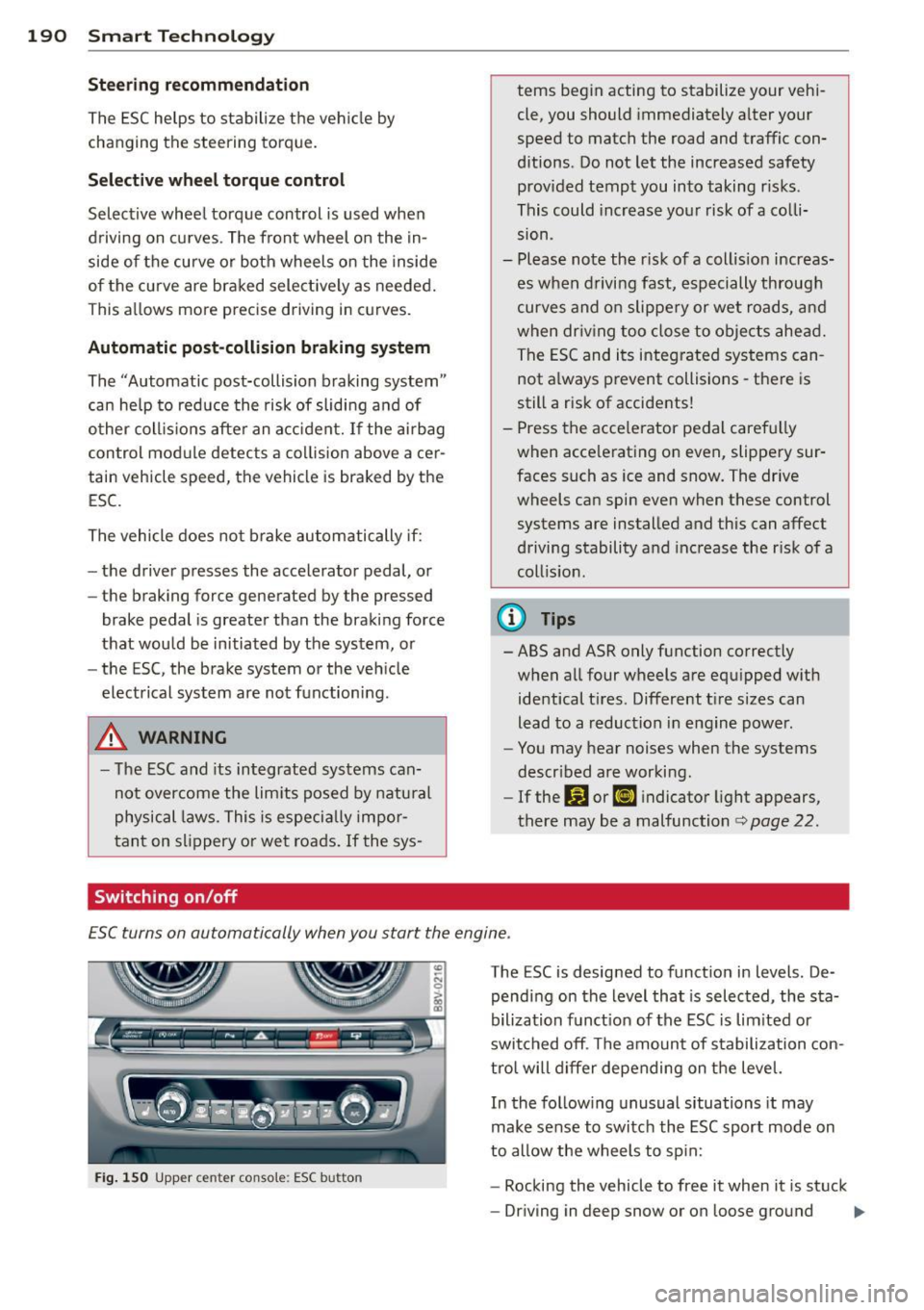
E SC turns on automatically when you start the engine .
Fig. 1 50 Upper c ente r conso le : ESC but to n
The ESC is designed to funct ion in levels . De
pending on the level that is selected, the sta
bilization funct io n of the ESC is lim ited or
swit ched off . The amoun t of stabilization con
tro l will differ depending on t he level.
In the follow ing unusual situations it may
make sense to switch the ESC sport mode on
to allow the wheels to sp in:
- Rocking the vehicle to free it when it is stuck
- Driving in deep snow or on loose ground
ll>
Page 197 of 310
not used then is being generated in o rder to
maintain an optimal battery charge level.
@ Tips
- Energy management cannot overcome
the laws of physics. Note that the charge l evel and length of the battery life are
limited .
- When the start ing ability is endangered,
the (•) indicator light turns on
c!:>page20.
What you should know
Maintaining the starting ability is the highest
priority.
A lot of stress is p laced on the battery when
driving short distances, in traffic , and at co ld
times of the year. A lot of energy is used but litt le is generated. It is also critical when the
engine is not running but electrical equip ment is switched on . In this case, energy is
used but none is generated .
In situations like this, energy management
will actively regulated the distribution of en ergy.
Long periods without use
I f you do not drive your vehicle for several
days or weeks, e lectrica l equipment is gradu
ally sca led back or switched off . This reduces
energy use and ensures the vehicle will be
able to start after long periods of time. Some
conven ience functions such as opening with
the remote contro l key may not be ava ilab le.
These convenience functions will be available
again once you switch the ign ition on and
start the engine.
With the engine switched off For example, if you listen to the radio when
the engine is switched off, the batte ry w ill
drain .
~ A warning text will appear if energy consump-
~ tion could impair starting ab ility . co ,....,
~ The message shows that you need to start the
~ engine in order to charge the battery. ,....,
Smart Technolog y 195
With the engine running
Although electrical energy is generated while driving, the battery can drain. This can happen
when litt le energy is generated, and much is
used and the charge leve l of the battery is not
optimal.
To restore the ba lance of energy, components
that require large amounts of energy are tem
porari ly scaled back or switched off. Heating
systems in particular require a great deal of energy. If you notice, for example, that the
seat heating* or rear window defroster is not
working, then it has been temporar ily reduced
or switched off . These systems are availab le
again as soon as the energy balance has been
restored.
In add ition, you may notice that the idle
speed has slight ly increased . That is normal
and no cause for concern. Due to the in
creased idling speed, the additional required
energy w ill be gene rated and the battery will
be charged.
Notice about data
recorded by the Event
Data Recorder and
vehicle control
modules
Event Data Recorder
This vehicle is equipped with an Event Data Recorder ( EDR). The main purpose of an EDR
is to record, in certain crash or near crash-like
situations, such as an airbag deployment or hitting a road obstacle, data that w ill assist in
understanding how a vehicle's systems per
formed . Th e EDR is designed to record data
related to vehicle dynam ics and safety sys
tems for a short pe riod of time, typically
30 seconds or less . The EDR in this vehicle is
designed to record such data as:
- How various systems in your veh icle were
operating;
- Whether or not the driver and passenger
safety belts were buckled/fastened;
•
•
Page 198 of 310
196 Smart Technology
- How far (if at all) the driver was depress ing
the accelerator and/or brake pedal; and,
- How fast the vehicle was traveling.
These data can he lp provide a better under
stand ing of the circumstances in which crash
es and injuries occur. NOTE: EDR data are re
corded by your vehicle only if a non-trivial
crash situation occ urs; no data are recorded by
the EDR under normal driving conditions and
no personal data (e.g., name, gender, age,
and crash location) are recorded. However,
other parties, such as law enforcement, could
comb ine the EDR data with the type of per
sonally identify ing data routine ly acquired
du ring a crash invest igation.
To read data recorded by an EDR, special
equipment is required, and access to the veh i
cle or the EDR is needed . In add ition to the ve
hicle manufactu rer, othe r parties, such as law
enforcement, that have the special equip
men t, can read the information if they have
access to the vehicle or the EDR.
Some state laws restrict the retrieval or down
loading of data stored by EDRs installed in a
vehicle for the express purpose of retrieving
data after an accident or crash event without
the owner's consent.
Aud i will not access the EDR and/or similar
data or give it to others -
- unless the veh icle owner (or lessee if the ve
hicle has been leased) ag rees; or
- upon th e official request by the police; or
- upon the order of a court of law or a govern-
ment agency; or
- for the defense of a lawsuit through the ju
dicial discovery process.
- Audi may also use the data for research
about veh icle operation and safety perform
ance or provide the data to a third party for
research purposes without identifying the
spec ific vehicle or information about the
identity of its owner or lessee and o nly after
the recorded vehicle data has been ac
cessed.
Vehicle control modules
Your vehicle is also equipped with a number of
electronic control modules for various vehicle
systems, such as engine management, emis
sion control, airbags, and safety belts.
T hese electronic control mod ules record data
during norma l vehicle operation that may be
needed by trained technicians for diagnostic
and repair purposes. The recording capability
of these modu les is limited to data (no sound
is recorded). Only a small amount of data is
actually recorded over a very limited period of
t ime, or stored when a system fault is detect
ed by a contro l module . Some of the data
stored may relate to vehicle speed, direction,
or braking, as well as restraint system use and
performance in the event of a crash. Stored
data can also on ly be read and down loaded
with special eq uipment that is directly con
nected to the vehicle .
(D Tips
Your vehicle may be equipped with Audi
connect. Your use of certain A udi connect
features requires wireless services that are
provided by a third party wire less telecom
munications provider. For details regard
in g how information obtained through
Audi connect is collected, processed,
transmitted, used, and shared, please see
your contract with the wireless telecom
munications provider and the" About Audi
connect" tab in your vehicle's
MMI: I MENU I
button > Audi connect > About Audi con
nect.
Page 230 of 310
228 Check ing and F illin g
8_ WARNING
-Brake fluid is poiso nous. It must be sto r
ed only in th e closed original container
out o f the reach of children!
- Brake fa ilure can result from old or inap
propriate brake fluid. Observe these pre
caut ions:
- Use only brake fluid that meets SAE specification
J 1703 and conforms to
Federal Motor Vehicle Standard 116.
Always check with your authorized Audi
dealer to make sure you are using the
correct brake flu id. The correct type of
brake fluid is also indicated on the
b rake fluid reservoir.
- The brake fluid must be new. Heavy use
of the brakes can cause a vapor lock if
the brake fluid is left in the system too
l ong. This can serious ly affect the effi
ciency of the bra kes as well as yo ur
safety . This could result in an acc ident.
@ Note
Brake flu id will damage the paint of your
veh icle.
@i For the sake of the environment
Because of the problem of proper d isposa l
of brake flu id as we ll as the special tools
requ ired and the ne cessary expert ise, we
recommend that you have the brake fluid
changed by your author ized Audi dealer .
Battery
General information
The battery in your Audi does not need any
maintena nce under
normal operating condi
tions. Aud i recommends having the elect ro
l yte level check by a n author ized Audi dealer
or author ized Audi Se rv ice Facili ty when there
are
high outside temperat ures or when driving
all day. The e lectrolyte level shou ld a lso be
checked each time the battery is charged
¢ page 230.
Have the batte ry checked when yo u bring your
vehicle in for an inspection . It is a good idea
to replace the battery if it is more than 5 years
o ld.
D uring certain types of airbag deployments,
the battery is disconnected from the vehicle electrical system for safety reasons¢
& in
Repair, care and disposal of the airbags on
page 160.
Di sconnecting the battery te rminals
Some vehicle functions (such as power win
dows) are not avai lable when the battery is
disconnected. These functions must be pro
grammed after the battery is reconnected. To
avo id hav ing to do this, only disconnect the
battery from the vehicle electrical system
when that is necessary to perform repairs .
To reprogram the functions, proceed as fol
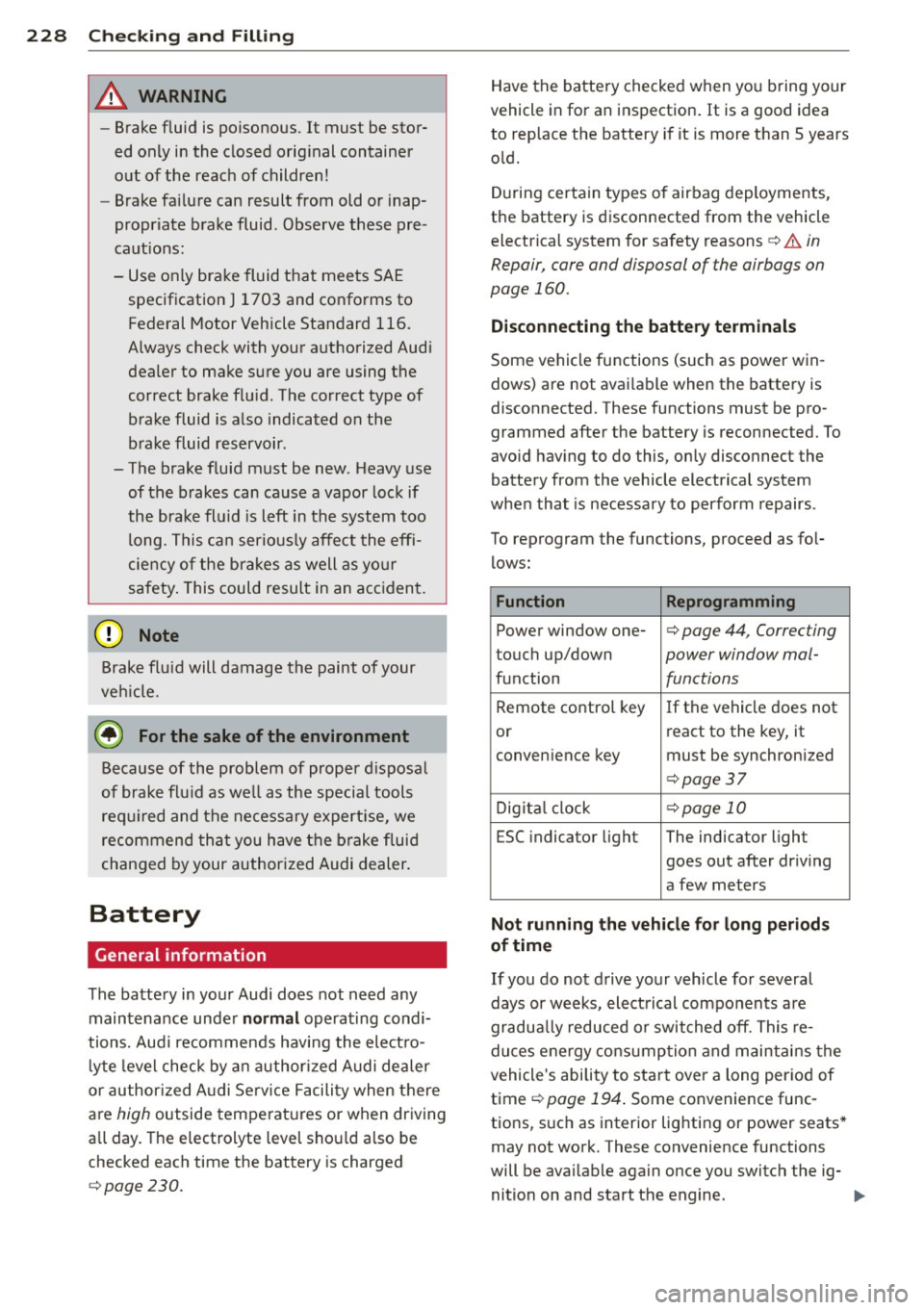
lows:
Function Reprogramming
Power window one-¢ page 44, Correcting
touch up/down power window ma/-
function functions
Remote control key
If the vehicle does not
or r
eact to the key, it
convenience key must be synchronized
¢ page37
Dig ita l cl ock ¢page 10
ESC indicator light The indicator light
goes out after driving
a few meters
Not running the vehicle for long periods
of time
If you do not drive your vehicle fo r several
days or weeks, electrical components are
gradua lly reduced or switched off. This re
duces e nergy consumption and maintains the
vehicle's ability to start over a long per iod of
time
¢ page 194. Some convenie nce func
tions, such as interior lig hting or power seats *
may not work. These convenience functions
will be ava ilable again once you switch the ig-
nition on and start the engine. .,.
Page 278 of 310
2 76 Fuses and bulbs
Fuses and bulbs
Electrical fuses
Replacing fuses
Fuses that have blown will have metal strips
that have burned through.
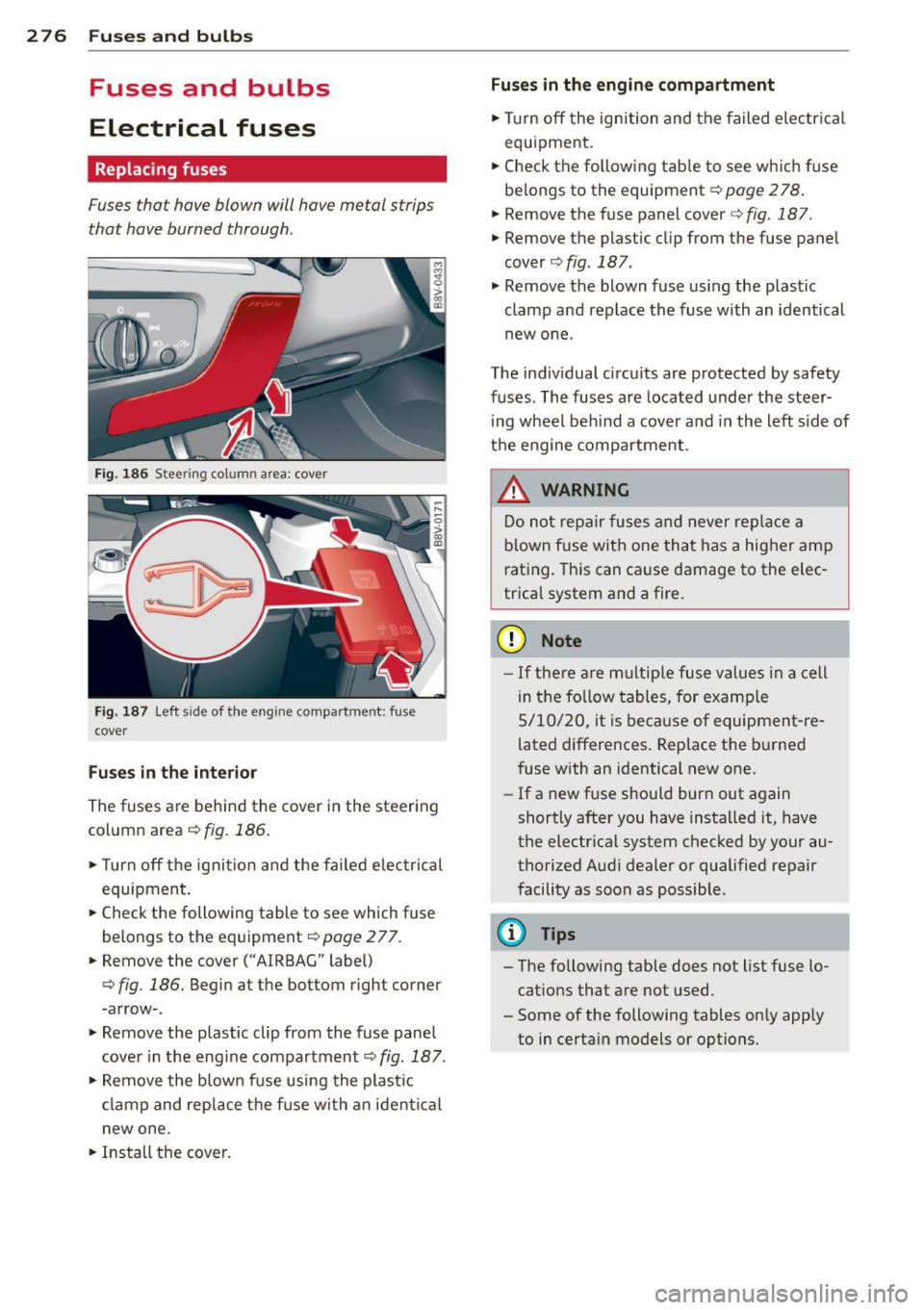
Fig. 186 Steering column area: cover
Fig. 187 Left side of the engi ne co mpar tmen t: fuse
cover
Fuses in the interior
The fuses are behind the cover in the steering
column area
¢ fig. 186.
"'Turn off the ignition and the failed electrical
equipment.
"'Check the following table to see which fuse
belongs to the equipmen t
¢page 277.
"'Remove the cover ("AIRBAG" label)
c:> fig. 186. Begin at the bottom right corner
-arrow- .
"' Remove the plastic clip from the fuse panel
cover in the eng ine compartment
c:> fig. 187.
"' Remove the blown fuse using the plast ic
clamp and replace the f use with an ident ica l
new one.
"'Install the cover.
Fuses in the engine compartment
"'Turn off the ignition and the failed electrical
equipment.
"' Check the following table to see which fuse
belongs to the equipment
c::;, page 2 78.
"'Remove the fuse panel cover ¢fig. 187 .
"'Remove the plastic clip from the fuse panel
cover
c:> fig. 187.
"' Remove the blown fuse using the plastic
clamp and replace the fuse with an identical
new one.
The indiv idual circuits are protected by safety
fuses. The fuses are located under the steer
ing wheel beh ind a cover and in the left side of
the engine compartment .
_&. WARNING
-
Do not repa ir fuses and never replace a
blown fuse with one that has a higher amp
rating. This can cause damage to the elec
trica l system and a fire.
(D Note
- If there are multip le fuse values in a cell
in the follow tables, for examp le
5/10/20, it is because of equipment-re
lated differences. Replace the burned
fuse with an identical new one .
-If a new fuse should burn out again
shortly after you have installed it, have
the electrical system checked by your au
thorized Audi dealer or qualified repair
facility as soon as possible .
(D Tips
- The following table does not list fuse lo
cations that are not used.
- Some of the following tables on ly apply
to in certain models or options.
Page 279 of 310
....,
N
0 > co
rl I.O
"' ....,
"' rl
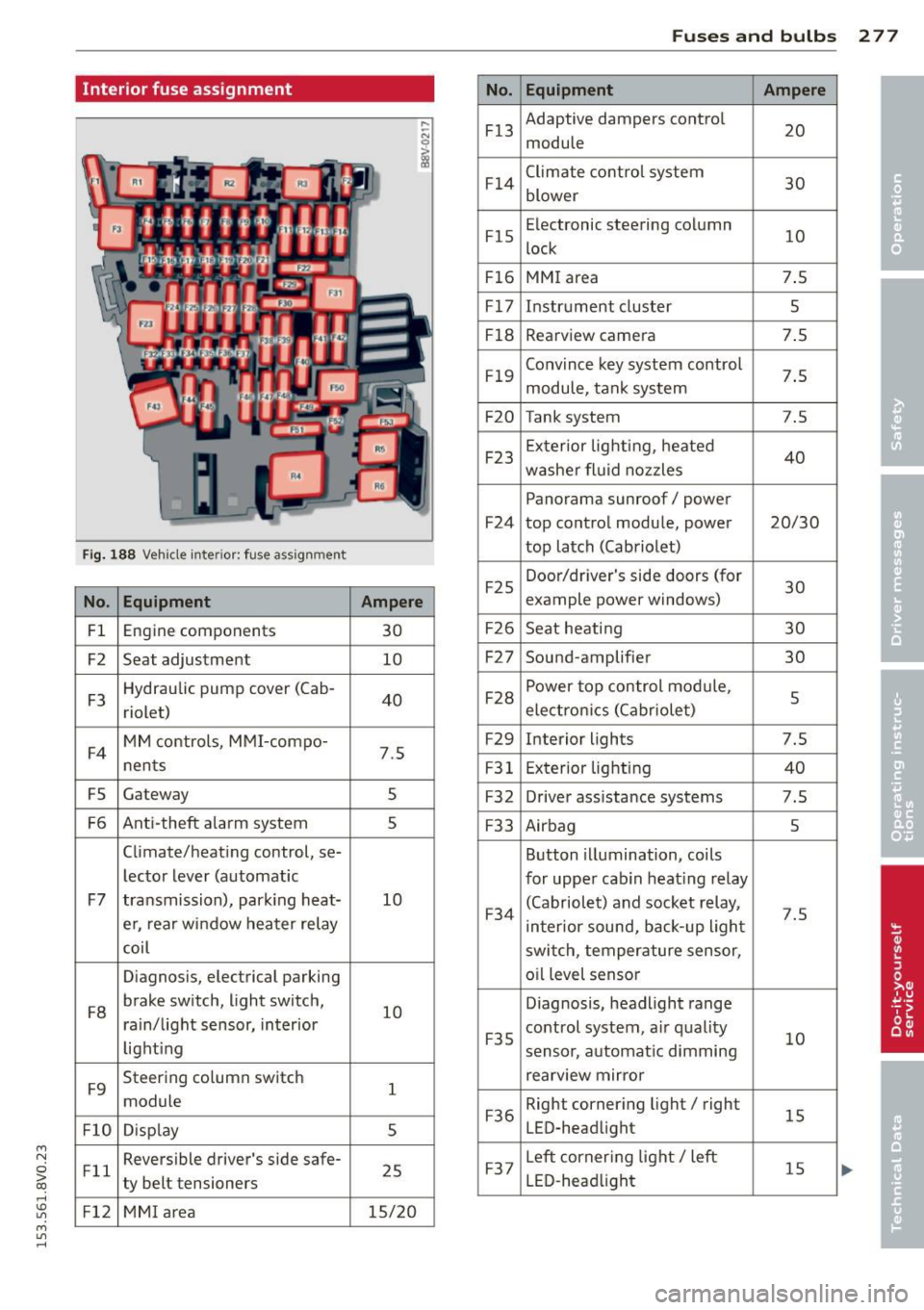
Interior fuse assignment
Fig. 188 Vehicle inter ior: fuse assignment
No . Equ ipment
Fl Engine components
F2 Seat adjustment
F 3 Hydraulic pump
cover (Cab-
riolet)
F4 MM controls, MMI-compo-
nents
FS Gateway
F 6 Anti-theft alarm system
Climate/heating control,
se-
lector lever (automatic
F7 transmission), park ing heat-
e r, rear window heater relay
coil
Diagnosis, electrical parking
F 8 brake
switch, light switch,
rain/light sensor, interior
light ing
F9 Steering
column switch
module
Fl0 Disp lay
Fll Reversible driver's
side safe-
ty belt tensioners
Fl2 MMI a rea
No .
Fl 3
Fl4
Fl5
Fl6
Fl7
Fl8
Fl9
F20
F23
F24
F25
Ampere
30 F26
10 F27
40 F28
F29
7.5
F31
s F32
5 F33
10 F34
10 F35
1 F36
5
25 F37
15/20
Fu se s and bulb s 2 77
Equipment Ampere
Adaptive dampers control
20
module
Climate control system 30
blower
Electronic steering column
10
lock
MM I area 7.5
Instrument cluster 5
Rearview camera 7.5
Conv ince key system control
7.5
module, tank system
Tank system 7.5
Ex terior lighting, heated
40
washer fluid nozzles
Panorama sunroof/ power
top control modu le, power 20/30
top latch (Cabriolet)
Door/dr iver's side doors (for
30
example power windows)
Seat heati ng 30
Sound-amplifier 30
Power top con trol module,
5
electron ics (Cabriolet)
Interior lights 7.5
Ex terior lighting
40
Driver assistance systems 7.5
Airbag 5
Button illumination, coils
for upper cab in heat ing relay
(Cabriolet) and socket relay,
7.5
interior sound, back-up ligh t
switch, temperature sensor, o il level sensor
Diagnosis, headlight range
control system, air quality
10
senso r, a utomat ic dimming
rearview mir ror
Right corner ing light/ right
15
LED-headlight
Left corner ing light/ left
15
LED -head light
Page 293 of 310
M N
0 > co ,...., \!) ..,.,
M ..,., ,....,
in P (Park position) and the park brake is
applied.
@ For the sake of the environment
-Changing the engine settings wi ll ad
versely affect emission levels . This is det
rimenta l to the environment and increas
es fue l cons umption .
- Always observe env ironmental regula
tions when dispos ing of old engine oil,
used brake fluid, dirty engine coolant,
spent batter ies or worn out tires.
- Undeployed airbag modules and preten
s ioners might be classified as Perchlo
rate Material -spec ial handling may ap
ply, see www .dtsc .ca .gov/hazardous
waste/perch lorate . When the veh icle or
parts of the restraint system includ ing
airb ag mod ules safety be lts wit h preten
s ioners are scrapped, all applic able laws
and regulations must be observed. Your
a utho rized Audi dea le r is familiar with
these req uirements and we recommend
that you have your dealer perform this
serv ice for you .
Additional accessories,
modifications and
parts replacement
Additional accessories and parts
replacement
Always consult an authorized Audi dealer be
fore purchasing accessories .
Your vehicle incorporates the latest safety de
sig n features ensuring a high standard of ac
tive and passive safety .
This sa fe ty could be compromised by non-ap
proved changes to the veh icle . For this reason ,
if pa rts have to be replaced, p lease observe
the following points when install ing addition
a l acc essories:
Approved Audi accessor ies and genuine Audi
pa rts are ava ilable from authorized Aud i deal
ers .
Con sumer In formation 29 1
These dea le rs a lso have the necessary facili
ties, tools a nd trained specialists to install the
parts and accessories properly .
_& WARNING
Using the wrong spare parts or using non
approved accessories can cause damage to
the vehicle and ser ious persona l injury .
- Use on ly accessories express ly approved
by Audi and ge nuine Audi spare parts
- These parts and accessories have been
specially designed to be used on your ve
hicle .
- Never install accessor ies such as tele
phone crad les or beverage ho lders on air
bag covers or w ithi n the airbag deploy
ment zones. Do ing so wi ll increas e the
ris k of injury if a irbags are triggered in an
accide nt!
- Before you check anything in the engine
compa rtment, always read and heed a ll
WARNIN GS
<:!) page 217.
(D Note
-If items other than ge nuine Audi spare
parts, add-on equipment and accessory
items are used o r if repair wo rk is no t
perf ormed ac cord ing to spe cified meth
ods, this ca n resu lt in seve re dam age to
your vehicle's engine and bo dy (such as
co rrosion) an d adve rsely affect yo ur vehi
cle 's warranty .
- If emergency repairs must be performe d
elsewhere , have the vehicle examine d by
an authorized A udi dealer as soon as
possible.
- The manufacturer cannot be held liable
for damage wh ich occ urs due to failure
to comply with these stipu lations.
Technical Modifications
Our guidelines must be complied with when
technical modifications are made.
A lways consult an authorized Audi dealer be-
-
fore start ing work on any modifications. ..,_
•
•
Page 295 of 310
M N
0 > co ,...., \!) 1.1'1
M 1.1'1 ,....,
A
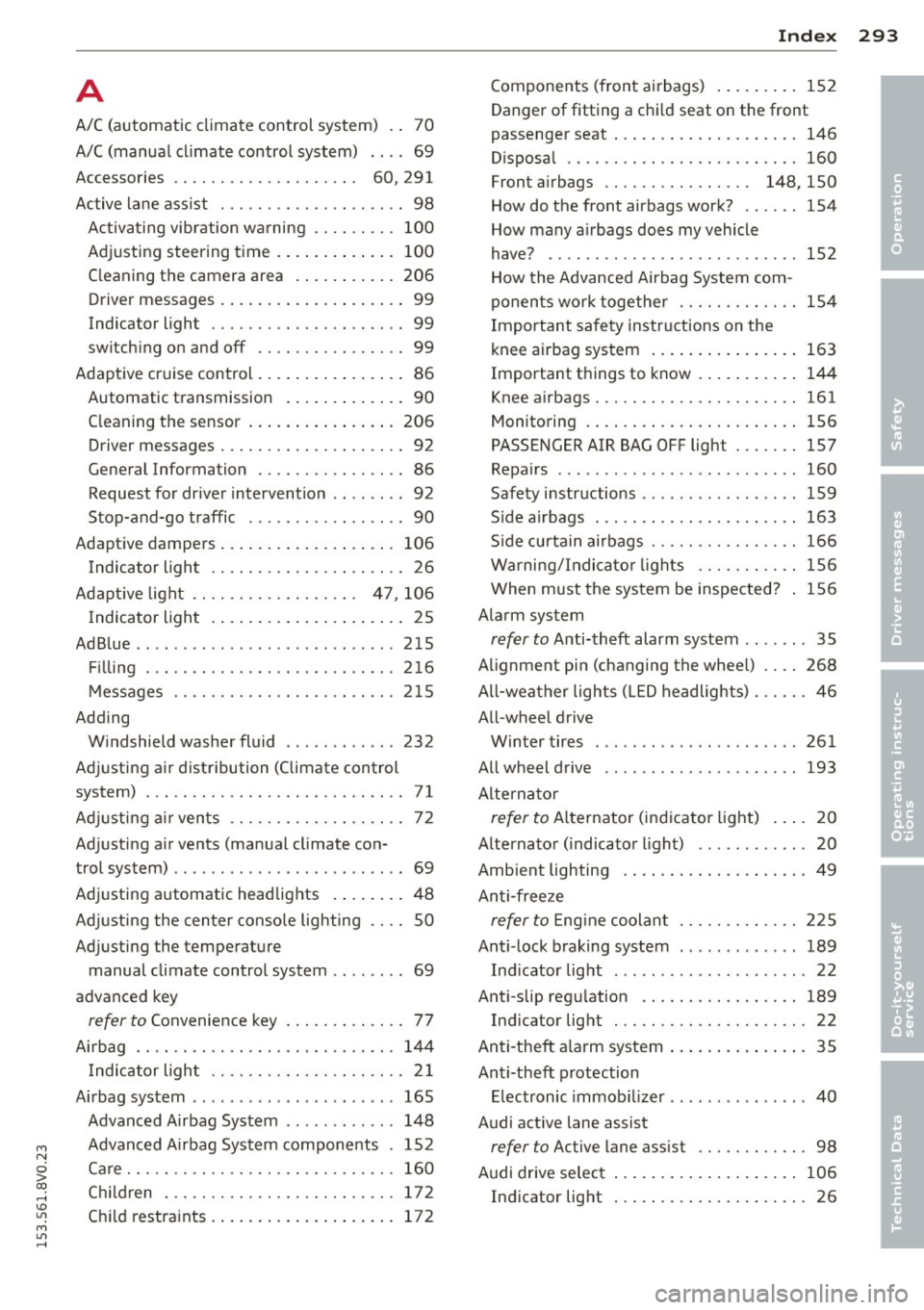
A/C (automatic climate control system) .. 70
A/C (manual cl imate control system) .. .. 69
Accessories . . . . . . . . . . . . . . . . . . . . 60, 291
Active lane ass ist . . . . . . . . . . . . . . . . . . . . 98
Ac tiva ting vibration warning .. .. .. .. . 100
Adj usting steering time . ... .. .. .. .. . 100
C leaning the camera area . ... .. .. .. . 206
Driver messages . . . . . . . . . . . . . . . . . . . . 99
Indicator light . . . . . . . . . . . . . . . . . . . . . 99
switch ing on and
off ...... .. .. .. .. .. 99
Adapt ive cruise control . . . . . . . . . . . . . . . . 86
Automatic transmission . . . . . . . . . . . . . 90
C lean ing the sensor .... ... .. .. .... . 206
Driver messages .......... .... .. .... 92
General Informa tion . . . . . . . . . . . . . . . . 86
Request fo r driver intervention . . . . . . . . 92
Stop-and-go traffic .......... .... ... 90
Adaptive dampe rs . . . . . . . . . . . . . . . . . . . 106
Indicator light . . . . . . . . . . . . . . . . . . . . . 26
Adapt ive light . . . . . . . . . . . . . . . . . . 47, 106
I ndicator light . . . . . . . . . . . . . . . . . . . . . 25
AdBlue .. .. .. .. ........ ... .. ... ... . 215
F il ling . .. .. .......... ... .... .. .. . 216
M essages .. ............. .. .. .. .. . 215
Adding W indshield washer fluid ....... ... .. 232
Adj usting a ir distribution (Climate control
system) ... .. ................. .. .... 71
Ad justing air vents ......... .. .. .. .. .. 7 2
Adjusting a ir vents (manual climate con-
trol system) . . . . . . . . . . . . . . . . . . . . . . . . . 69
Ad justing a utomatic headlights . ... .. .. 48
Ad justing the cen ter conso le lighting .. .. 50
Ad justing the temperat ure
manual climate control system . . . . . . . . 69
advanced key
refer to Convenience key . . . . . . . . . . . . . 77
A irbag .... .. ................. .. ... 1 44
I ndica tor ligh t . . . . . . . . . . . . . . . . . . . . . 21
Ai rbag system ................ .... .. 165
Advanced Airbag System ... .. .. .. .. . 148
Advanced Airbag System compone nts . 15 2
Ca re ..... .. .... ........... .. .. .. . 160
C hi ld ren . .. ............. .... .. ... 17 2
C hi ld restra ints . .. ..... ... .. .. .. ... 172
Inde x 293
Components (front airbags) .. ... .. .. 152
Danger of fitting a ch ild seat o n the front
passenger seat ... .. . .. ... .... ... .. 146
Disposa l .. .. .. .. ................. 160
Front a irbags . . . . . . . . . . . . . . . . 148, 150
How do the front airbags work? ...... 154
How many a irbags does my vehicle
have? ....... ... .. ..... .......... 152
How the Advanced Airbag System com-
ponent s work togethe r ......... .. .. 15 4
Im portant sa fe ty instructions on the
knee airbag system .. .. ..... ... .. .. 163
Impo rtant t hings to know .... ... .. .. 144
Knee a irbags . .. .. ................. 161
Monitoring .. .. .. ................. 156
PASSENGER AIR BAG OFF light ..... .. 157
Repairs ......... .. ............... 160
Safety i nstr uctions .. . .. .. .. ... ... .. 159
S ide a irbags . .. .... ... .. ..... ..... 163
S ide cur tain airbags . ........... .... 166
Wa rning/Indicato r lights ....... .. .. 156
When must the system be inspected? . 156
Ala rm system
re fer to Anti-theft alarm system ....... 35
A lignment pin (changing the whee l) .. .. 268
A ll- wea ther lights ( LED headlights) ... .. . 46
A ll-wheel d rive
Winter tires . .. .. .. .......... ..... 261
A ll wheel drive .. .. ................. 193
Altern ator
refer to Alternator (indicator light) 20
Alternato r (indicato r light) ...... .... .. 20
Amb ient lighting . ... .. .. .. .... ... .. . 49
A nti- freeze
refer to Eng ine coolan t ......... .. .. 225
Anti -lock braking system ............. 189
Ind icator light ... .. . .. .... .... .. .. . 22
Anti-slip regu lation .. ........... .... 189
Ind icator light . .. .... ........... .. . 22
An ti-theft a larm system ....... ... .. .. . 35
Anti-theft protection Electronic immob ilizer ............. .. 40
Audi active lane assist
refer to Active lane ass ist ......... .. . 98
Audi drive selec t ..... . .. .. ..... ... .. 106
Ind icator light ..... . .. .. ..... ... .. . 26
•
•
•
Page 300 of 310
298 Index
Environment
Break-in period . ....... ... .. .. .... . 197
Cata lytic converter ....... ... .. .... . 198
Diese l partic ulate filter ............. 199
Disposing of your vehicle battery .... . 231
Driving at h igh speeds ......... .. ... 200
Driving to m inim ize pollution and no ise 199
Fue l economy . . . . . . . . . . . . . . . . . . . . . 199
L ett ing the ve hicle s tand and wa rm up . 200
P roper disposal of dra ined brake flu id . 227
Pr oper disposal of dra ined engine oil .. 224
Un leaded fu el .. .. ..... ... .. .. .... . 210
What should I do with an old battery? . 231
E PC (eng ine control) .......... .. .... .. 23
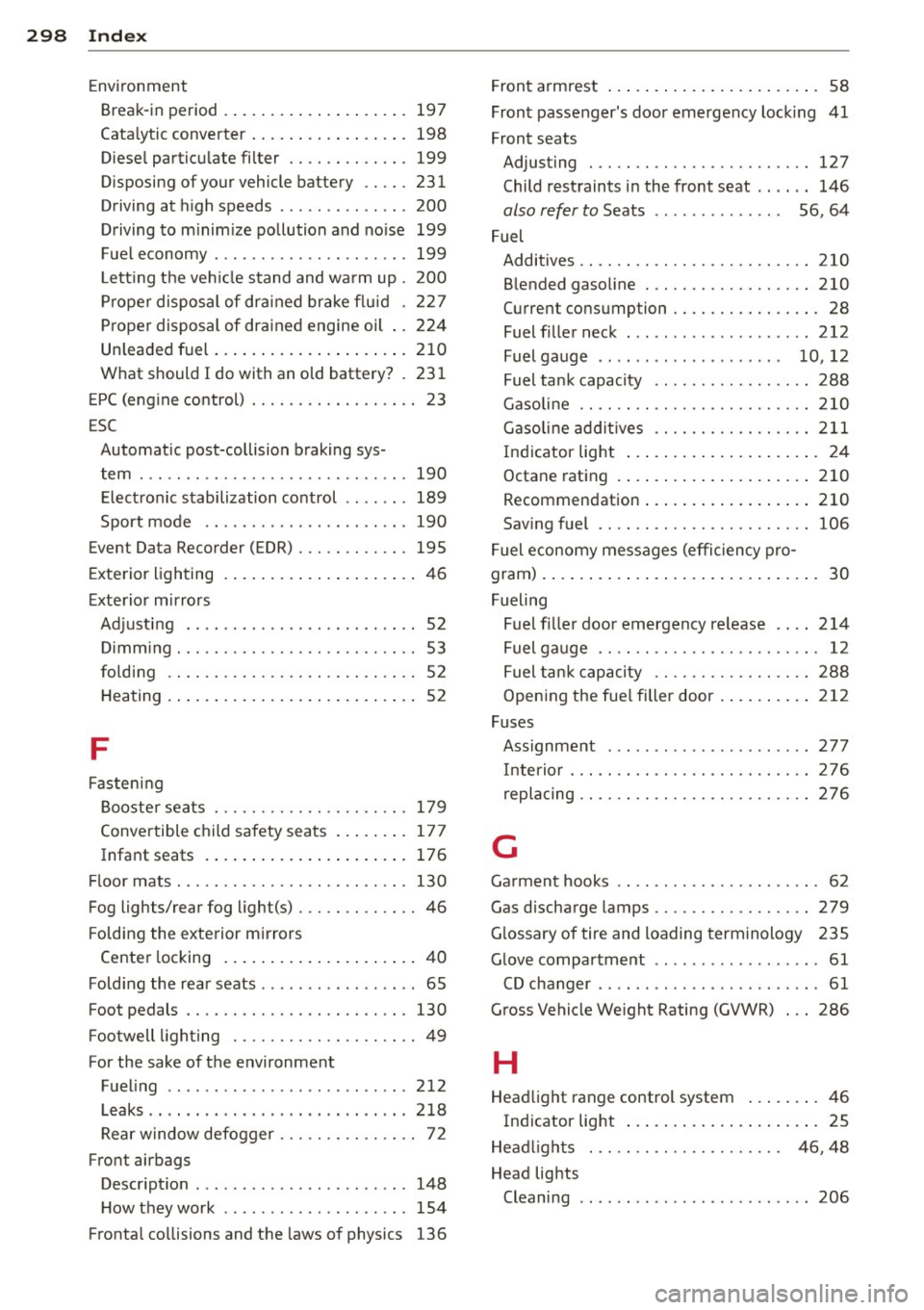
ESC Automatic post-collision braking sys-
tem ...... ................... ... . 190
Electron ic stabilization control . . . . . . . 189
Sport mode ...................... 190
Event Data Recorder ( EDR) ... .. .. .. .. . 195
E xterior lighting . .. ..... ... .. .. .... .. 46
E xterio r m irrors
Ad just ing .. .......... ...... ... .. .. 52
D imm ing ... ................ .... ... 53
fo ld in g .. .. .. ... ..... ..... .. .. .. .. 5 2
H ea ting .... .. . .. ..... ... .. .. .... .. 52
F
Fasten ing
Booste r seats . ........ ..... .. .. .. . 179
Convertible chi ld safety seats ..... .. . 17 7
Infant seats . .. .. ..... ... .. .. .... . 176
Fl oor mats . .. ............. .. .. .. .. . 130
Fog lights/rear fog light(s) ..... .. .. .. . . 46
F olding the exte rior mirrors
Cente r locking . ....... ... .. .. .... .. 40
Folding the rear seats . . . . . . . . . . . . . . . . . 65
Foot pedals ................. .. .... . 130
F oo twell ligh ting .......... .. .. .... .. 49
For the sake of the environment
Fueling ...................... ... . 212
L eaks .. .. ... ....... ........ ..... . 218
Rear w indow defogger . . . . . . . . . . . . . . . 7 2
Front airbags
Descr ipt ion .... ... .... ... ... ... .. . 148
H ow they work ................ ... . 154
Fronta l co llisions and the laws of physics 136 F
ront a rmrest ..... ... .. ..... ... .. .. . 58
Front passenger's door emergency locking 41
Front seats Adjusting . .... .. ............. .... 127
Child restraints in the front seat ...... 146
also refer to Seats . . . . . . . . . . . . . . 56, 64
Fuel Additives .. .... .. ............. .... 210
Blended gasoline .............. .. .. 210
Current consumption ........... .. .. . 28
Fuel filler neck . ................... 212
Fuel gauge . . . . . . . . . . . . . . . . . . . . 10, 12
Fuel ta nk capacity ... .......... .. .. 288
Gasoli ne .. .. .. .. .. ........... .. .. 210
Gaso lin e ad dit ives ................. 211
Indicator light ... .. ... ..... ... .. .. . 24
Octane rat ing .... ... .. ..... ... .. .. 210
Recommendation ... ... ..... ... .. .. 210
Sav ing fuel .... .. ............. .... 106
F uel economy messages (effic iency p ro -
gram) . ... .. .... .. ... .. .. ..... ... .. . 30
Fueling Fuel fi lle r door emergency re lease .. .. 214
Fuel gauge . . . . . . . . . . . . . . . . . . . . . . . . 12
F uel ta nk capaci ty ... .......... .. .. 288
Open ing the fue l filler door . ... .. .. .. 212
Fuses Ass ignment ..... ................ . 277
I n te rio r ... .... .. ............. .... 276
replacing .. .... .. ............. .... 276
G
Ga rment hooks .. .. ............. .. .. . 62
Gas discharge lamps ................. 279
G lossary of tire and loading term inology 235
G love compar tment ................ .. 61
CD changer ...................... .. 61
Gross Vehicle Weight Rating (GVWR) ... 286
H
Headlight range control system ... .. .. . 46
Indicator light ... .. ... ..... ... .. .. . 25
Head lights . . . . . . . . . . . . . . . . . . . . . 46, 48
Head lig hts
Cleaning ........................ . 206