ESP AUDI S3 2015 Manual PDF
[x] Cancel search | Manufacturer: AUDI, Model Year: 2015, Model line: S3, Model: AUDI S3 2015Pages: 310, PDF Size: 76.15 MB
Page 244 of 310
242 Tires and wheel s
If you wish to improve comfort See the illustration c::;, fig. 168
when operating the vehicle at for the locati on of the labe l on
normal load (up to 3 occu -driver's side B-pillar (color of
pants), you can adjust tire the actual label and exact loca-
pressures to those specified tion on the vehic le will vary
for normal vehicle load. Before slight ly) .
operat ing the vehicle at maxi -Note that the following table is
mum load , you must increase accurate at the time of going to
the ti re pressu res to those press and is subject to change .
specified for maximum vehicle In the event of discrepancies,
load c::;, &. the tire pressure labe l is locat-
Bear in mind that the tire pres- ed on the driver's side 8-pi llar
sure monitoring system can on -always takes precedence .
ly monitor the tire pressures The table below lists the rec-
you have stored . The system
ommended cold tire inflation
does not recogn ize the load
pressures for the Audi model
condition of your vehic le.
covered by your Owner's Litera-
T he effectiveness of the tire ture at the vehicle's capacity
pressure monitoring system weight and the tire sizes instal -
will be impaired if you store led on the respective mode ls as
normal load pressures but then original equipment, or as a fac-
operate the vehicle at its maxi- tory option.
...
mum load c::;, & .
Page 246 of 310
244 Tires and wheels
The correct tire pressure for the
spare wheel is located on a la
bel on the driver's side 8-pillar .
Because technical changes may
be made to vehicle equipment
during the model year, always
compare the tire size designa
tion on the tire pressure label
on your vehicle with the tires on
your vehicle. Make sure that the
tire size information on the ve
hicle label is the same as the
size of the tires on the vehicle.
This is especially important if
the vehicle belongs to someone else or you bought the vehicle
with different rims/tires or you bought the vehicle as a previ
ously owned vehicle.
Remember, your safety and
that of your passengers also de
pends on making sure that load
limits are not exceeded. Vehicle
load includes everybody and ev
erything in and on the vehicle.
These load limits are technical
ly referred to as the vehicle's
Gross Vehicle Weight Rating
("GVWR"). The Gross Axle
Weight Rating ("GAWR") is the maximum load that can be ap
plied at each of the vehicle's
two axles. The Gross Vehicle Weight Rating and the Gross
Axle Weight Rating are listed
on the safety compliance stick
er label located on the driver's
side 8-pillar.
The tire pressure
label on your Audi lists the
maximum combined weight of
all of the occupants and lug gage or other cargo that the ve
hicle can carry. For the location
of the tire pressure label
~fig. 168.
A WARNING -
Overloading a vehicle can
cause loss of vehicle control,
a crash or other accident, se
rious personal injury, and
even death.
-Carrying more weight than your vehicle was designed to carry will prevent the ve
hicle from handling properly
and increase the risk of a
loss of vehicle control.
-The brakes on a vehicle that has been overloaded may not be able to stop the vehi
cle within a safe distance.
-Tires on a vehicle that has been overloaded can fail
suddenly causing loss of
control and a crash.
Page 250 of 310
248 Tires and wheels
also lead to sudden tire failure, including a blowout
and sudden deflation, caus ing loss of vehicle control.
-The driver is responsible for the correct tire pressures for
all tires on the vehicle. The
applicable pressure values
are located on a sticker on
the driver's side B-pillar.
-Only when all tires on the vehicle are filled to the cor
rect pressure, the tire pres
sure monitoring system can
work correctly.
-The use of incorrect tire
pressure values can lead to
accidents or other damage.
Therefore it is essential that
the driver observe the speci
fied tire pressure values for
the tires and the correct
pressures for the function of
the tire pressure monitoring
system.
-Always inflate tires to the recommended and correct
tire pressure before driving off.
- Driving with underinflated
tires bend more, letting
them get too hot resulting
in tread separation, sudden tire failure and loss of con
trol.
-Excessive speed and/over
loading can cause heat
build-up, sudden tire failure
and loss of control.
-If the tire pressure is too
low or too high, the tires
will wear prematurely and the vehicle will not handle
well.
-If the tire is not flat and you
do not have to change a
wheel immediately, drive at
reduced speed to the near
est service station to check
the tire pressure and add air
as required.
(D Note
Driving without valve stem
caps can cause damage to
the tire valves . To prevent
this, always make sure that
factory installed valve stem caps on all wheels are securely mounted on the valve.
@ For the sake of the environment
Underinflated tires will also
increase the fuel consump
tion .
Page 256 of 310
254 Tires and wheels
-Tires age even if they are
not being used and can fail
suddenly, especially at high
speeds. Tires that are more
than 6 years old can only be
used in an emergency and
then with special care and at lower speeds.
-Never mount used tires on your vehicle if you are not sure of their "previous histo
ry." Old used tires may have
been damaged even though
the damage cannot be seen
that can lead to sudden tire
fa ilure and loss of vehicle
control. New tires and replacing
tires and wheels
New tires and wheels have to
be broken in.
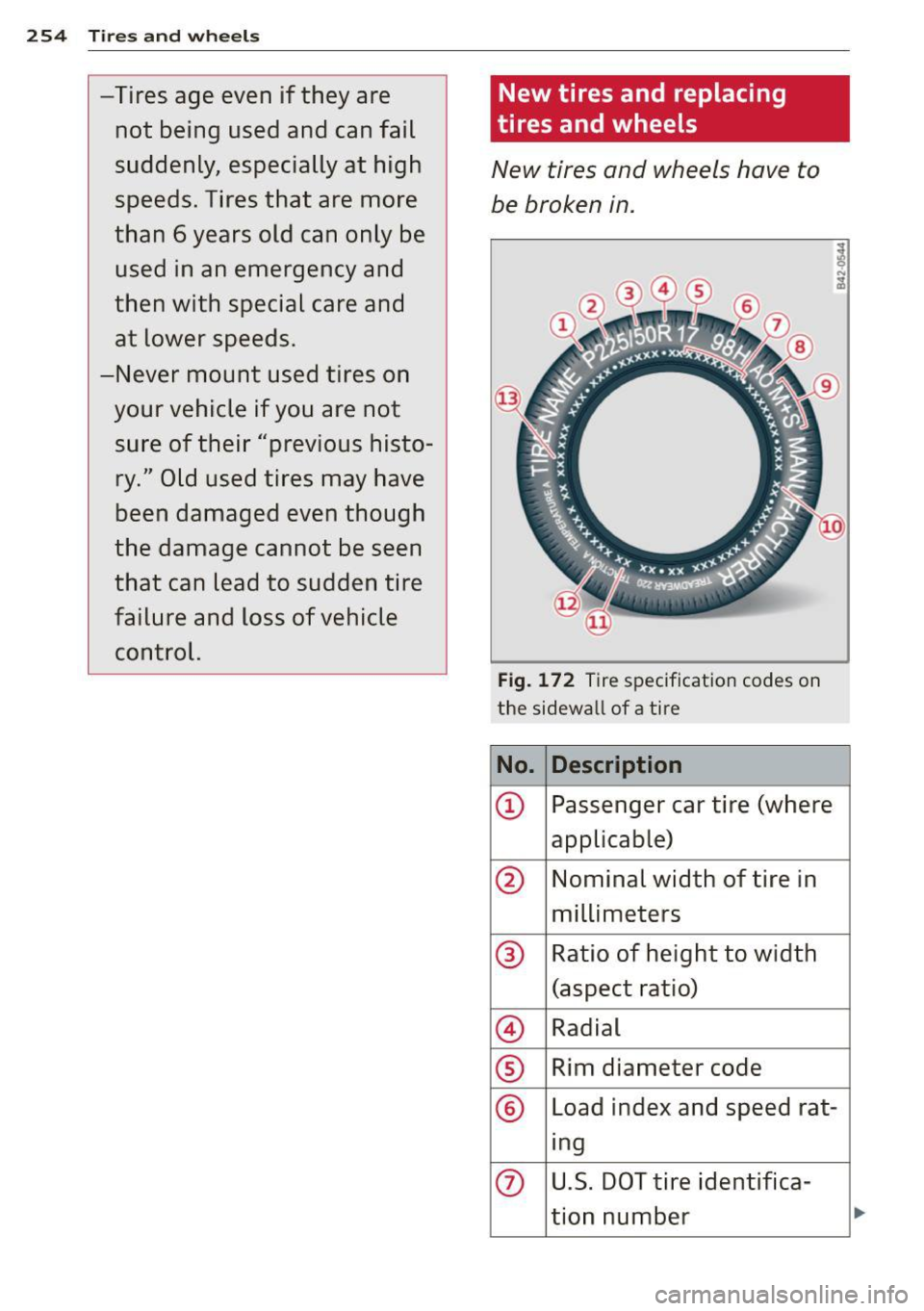
Fig. 172 Tire specification codes on
the sidewall of a tire
No. Description
CD Passenger car tire (where
applicable)
@ Nominal width of tire in
millimeters
@ Ratio of height to width
(aspect ratio)
@) Radial
® Rim diameter code
® Load index and speed rat -
1ng
0 U .S . DOT tire identifica-
tion number
Page 260 of 310
258 Tires an d whee ls
tires because they meet the
h ighest standards regarding
safety and driving characteris
tics when used correctly. Your
authorized Audi dealer w ill
g ladly provide you with more
information.
Tire ply composition and materials used
T he number of plies indicates
the number of layers of rubber
coated fabric in the tire. In gen
eral, the greater the number of
plies , the more weight a tire
can support . Tire manufactur
ers also must indicate the ma
ter ia ls in the tire, wh ich include
steel, nylon, polyester, and oth
ers .
Maximum Load Rating
This number indicates the max
imum load in kilograms and
pounds that can be carried by
the tire.
Tire quality grading for
treadwear, traction, and
temperature resistance
Tread wear, trac tion and tem
perature grades
¢ page 260.
Maximum Permissible
Inflation Pressure
T his number is the g reatest
amount of air pressure that should ever be put in the tire
under normal driv ing condi
tions.
A WARNING
-Using incorrect or unmatch ed tires and/or wheels or
improper t ire and wheel
combinations can lead to loss of control , collision and
ser ious personal injury.
-Always use tires, rims and
wheel bolts that meet the
specifications of original
factory-installed tires o r
other combinations that
have been specifically ap
proved by the vehicle manu
facturer.
- Tires age even if they a re
not being used and can fail
sudden ly, especially at high
speeds. Tires that a re more
than 6 years old can on ly be
used in an eme rgency and
then with special care and
at lower speeds.
-Never mount used tires on
your vehicle if you are no t
Page 263 of 310
M N
0 > co ,...., \!) 1.1"1
M 1.1"1 ,....,
Sustained high tem perature can cause the
materia l of the tire to degenerate and reduce
tire life, and excessive temperature can lead
to su dden ti re fa ilure <=>,& .
The grade C corresponds to a level of per form
a nce which a ll passenger car tires must meet
under the Federa l Motor Veh icle Safety Stand
ard No. 109. Grades Band A represent higher levels of performance on the laboratory test
wheel than the m inimum required by law.
_&. WARNING
The traction grade assigned to this t ire is
based on stra ight-ahead b raking t raction
tests, and does not include acceleration,
cornering, hydrop lan ing o r peak traction
character istics .
_&. WARNING
The temperature grade for this t ire is es
tablished for a ti re that is properly inflated
and not overloaded . Excessive speed, un
derinflation, or excessive loading, either
separately or in combination, can cause
heat buildup and possible tire fa ilure.
Winter tires
Winter tires can improve vehicle handling on
snow and ice. At temperatures below 45 °F
(7 °C) we recommend changing to winter
tires .
In some heavy snow areas, loca l governments
may require true winter or "snow" tires, those
with very deeply cut tread. These tires shou ld
only be used in pa irs and be installed on all
four wheels. Make sure you pu rchase snow
tires that are the same size and const ruct ion
type as t he other tires on your ve hicle.
If your vehicle is equipped with all-wheel
d rive*, this will improve tract ion during winte r
d riving, eve n w it h the standard t ires. Howev
e r, we strong ly recommend t hat you a lways
eq uip a ll four wheels on yo ur vehicle wi th cor
rectly fitted win ter t ires or a ll-season tires,
when winter road conditions are expected .
Tires an d wheel s 261
This also improves the veh icle's b rak ing per
formance and reduces stopping distances.
Summe r ti res prov ide les s gr ip on i ce and
snow.
Winter tires (snow tires) must always be fitted
o n all fo ur whee ls.
Ask your authorized Audi dealer or qualified
workshop for permitted winter tire sizes. Use
o nl y rad ial winter t ires.
Winter tires lose their effectiveness whe n the
tread is worn down to a depth of0 .157 inch
(4 mm) .
Only drive w ith w inter t ires under w inter con
dit ions. Summer t ires handle better when
there is no snow or ice on the roads and the
temperature is above 45 °F (7 °() .
If you have a flat tire, see notes on spare
whee l
r=;,page 254.
Please a lways remember that winter tires may
have a lower speed rating t han the tires o rigi
nally installed on your vehicle at the time it
was manufactured. P lease seer=;,
page 257,
Speed rating (letter code)
for a listing of the
speed rating le tter codes and the max imum
speed at which the tires can be d rive n.
The speed rating letter code(¢
page 238) is
o n the side wall of the t ire r=;,
page 254.
_&. WARNING
Winter t ires have maximum speed limits
that may b e lower than yo ur vehicle's max
imum speed. Always know the max imum
speed before dr iv ing off. Never dr ive faster
than the speed permitted for yo ur spe cific
win ter tires . This wi ll ca use damage to the
tires leading to an accident and ser ious
personal injury to you and your passen
gers.
_&. WARNING
Driving faster than the maximum speed
for which the winter tires on your ve hicle
were designed can cause t ire failure in
cluding a blowout and sudden d eflation,
-
•
•
•
Page 265 of 310
M N
0 > co ,...., \!) 1.1'1
M 1.1'1 ,....,
In certain circumstances, you may not use
wheel bo lts from a different vehicle -
even if it
i s the same mode l
Q page 291.
A WARNING
Improperly tightened or maintained wheel
bolts can become loose caus ing loss of
control, a collision and ser ious personal in
jury .
- Always keep the wheel bolts and the
threads in the wheel hubs clean so the
wheel bolts can turn easily and be prop
erly t ightened.
- Never grease or oil the wheel bolts and
the threads in the wheel hubs. They can
become loose w hile d riving if greased or
o iled,
even if tightened to the spec ified
torq ue.
- Only use wheel bo lts that belong to the
rim being ins talled.
- Never use different whee ls bolts on your
vehicle .
- Always maintain the correct tightening
torque fo r the wheel bolts to reduce the
risk of a wheel loss. If the tigh teni ng tor
que of the wheel bolts is too low, they
can loosen and come out when the vehi
cle is moving . If the tightening torque is
too high, the whee l bolts and threads
can be damaged and the wheel ca n be
come loose .
(D Note
The specified torque for the wheel bo lts is
90 ft lb (120 Nm) w ith a tolerance of
± 7,4 ft lb(± 10 Nm). Torque whee l bolts
diagonally. After changing a wheel, the
torque must be checked as soon as possi
b le with a torque wrench -prefe rably by an
author ized Audi dealer or qualified wo rk
shop.
Low aspect ratio tires
Your Audi is factory-equipped with low aspect
ratio tires . These tires have been thorough ly
tested and been selected spec ifically for your
model for the ir superb performance, road feel
Tire s an d wheel s 263
and handling under a variety o f driving condi
tions. Ask your authorized A udi dealer for
more details .
T he low aspec t ratio of these tires is ind icate d
by a numera l of
55 or le ss in the tire's size
designation. The numera l represents the ratio
of the t ire's sidewa ll height in relation to its
tread width expressed in percentage.
Conven
tiona l tires have a he ight/w idth rat io of 60 or
more .
The performance of low-a spect-ratio tire s is
particularl y sens it iv e to improper inflation
pressure. It is therefore important that low
a spect ratio tir es are inflated to the specified
pre ssure and that the inflation pr essure i s
regularly checked and ma intain ed . Tire pr es
s ure s should be checked at lea st on ce a
month and alway s bef ore a long trip
~ page 245 , Checking tire pressure .
A Word about Low Aspect Ratio and High
Performance Ti res
Hig h pe rformance tires are des igned for bet
ter performance and handling in warm cli
mates. When driving in cold, snowy or icy
weather, you sho uld equ ip your vehicle w it h
four all-season or winter tires, which
offer
better traction under those condit ions. We
suggest you use the Audi recommended win
te r or a ll-season tires specified for you r Audi.
High performance tires a lso have a lower as
pect ratio that aids performance and han
dling . Driving over rough or damaged road
surfaces, as well as debr is, cu rbs and other
obstacles can cause serious damage to
whee ls, tires, vehicle body, and suspens ion
parts . B e carefu l to avo id road hazards and re
du ce your speed , espec ia lly if your vehicle is
equipped wi th low prof ile tires .
Please a lso remember when making your se
lection that, wh ile these tires deliver respon
s ive handling, t hey m ay ride less comfo rtably
and make more noise than o thers . Finally,
these tires may wear more quickly than other
c h oices.
IJJ>
•
•
•
Page 266 of 310
264 Tire s and wheel s
It is important that the inflation pressu re is
regularly checked and maintained at recom
mended levels .
F or more informat ion p lease ask your A udi
deale r for more details .
What you can do to avoid tire and rim
damage
Low aspect ratio t ires can be damaged more
easi ly by impact with potho les, curbs, gu llies
or ridges on the road, part icularly if the t ire is
underinflated .
I n o rder to m inim ize the o ccu rrence of impact
damage to the tires of your vehicle, we recom
mend that you observe the following precau
tions:
- Always mainta in recommended inflat ion
pressures. Check your tire pressure every
2,000 miles (3,000 km) and add air if neces
sary .
- Drive carefu lly on roads with potholes, deep
gullies or ridges. The impact from driving
thro ugh or over such obstacles can damage
your t ires. Impact with a curb may also
cause damage to your tires.
- After any impact, immediately inspect your
t ires or have them inspected by the neares t
authorized Aud i dealer . Replace a damaged
t ire as soon as possible .
- Inspect your t ires every 2,000 miles (3,000
km) for damage and wear . Damage is not al
ways easy to see . Damage can lead to loss of
air and unde rinflat ion, wh ich could eventu
ally cause t ire fail ure.
If you be lieve that a
t ire may have been damaged, replace the
tire as soon as possible.
- T hese tires may wea r more quick ly than oth
ers.
- Please a lso remember that, whi le these t ires
deliver respons ive handling, they may ride
less comfortably and make mo re noise than
other c hoices.
Reduced performance in winter /cold
s eason condition s
All tires are designed for certain pu rposes .
The low aspect ratio, u ltra hig h performance t
ir es or iginally insta lled on yo ur vehicle a re in
tended for maximum dry and wet road per
formance and handling . They are not suitable
for cold, snowy or icy weather conditions. If
you drive under those c ircumstances, you
shou ld equ ip your vehicle w ith all -season or
winter tires, which offer bette r traction unde r
those conditions . We suggest you use the rec
ommended snow o r all-season t ires specified
for yo ur vehicle , or thei r equivalent .
Refer to~ page
261 for more detailed infor
mation regard ing winter tires .
Tire pressure
monitoring system
ill General notes
E ach tire, including the spare ( if provided),
shou ld be checked monthly wh en co ld and in
flated to t he inflat io n pressure recommended
by the veh icle man ufact urer on t he veh icle
placard or tire inf lation pressure labe l. (If your
vehicle has tires of a different size than the
size indicated on the vehicle placard or tire in
flat ion pressure labe l, you should determine
the proper t ire inflation press ure for those
t i res).
As an added safety feature, your ve hicle has
been equipped with a tire pressure monitoring
system (TPMS) that illum inates a low tire
pressure tell tale when one or more of your
t ires is s ignificantly under-inflated . According
ly, when the low tire pressure telltale illumi
nates, you shou ld stop and check you r tires as
soon as possib le, and inflate them to the
proper p ress ure. Driving on a sig nifican tly u n
der -inflated t ire causes the tire to overhea t
and can lead to tire fa ilure . Under-inflation al
so reduces fuel eff iciency and tire tread life,
and may affect the vehicle's hand ling and
stopp ing ability.
Please note that the TPMS is not a substit ute
for proper tire maintenance, and it is the driv
er 's respons ibility to maintain correct tire
pressure, even if under-inflation has not
Page 268 of 310
![AUDI S3 2015 Manual PDF 266 Tire s and wheels
& WARNING
-If the tire pressure warning light ti] in
the instrument cluster turns on, the
pressure in one or more tires is too low.
Reduce the vehicle speed](/img/6/57541/w960_57541-267.png "AUDI S3 2015 Manual PDF 266 Tire s and wheels
& WARNING
-If the tire pressure warning light ti] in
the instrument cluster turns on, the
pressure in one or more tires is too low.
Reduce the vehicle speed")
266 Tire s and wheels
& WARNING
-If the tire pressure warning light ti] in
the instrument cluster turns on, the
pressure in one or more tires is too low.
Reduce the vehicle speed immediately
and avoid any hard steering or braking
maneuvers . Stop as soon as possible,
check the t ire and inflate the tire to the
correct pressure, which is specified on
the tire pressu re label on the veh icle
¢ page 240. Driving with a t ire with low
pressure causes the tire to overheat and
can result in failure of the tire . Low pres
sure can a lso have a negative effect on
the driving and braking behavior of the
vehicle.
- The driver is responsible for maintaining
the correct tire pressures. You must
check the t ire pressures regularly.
- Under certain conditions (such as a spor
ty driving style, winter conditions or un
paved roads), the pressure monitor ind i
cator may be delayed .
- Ask your author ized dealer if run-flat
t ires may be used on your vehicle.
- The tire pressure monitoring system can
also stop work ing when there is an ESC
malfunction.
- Using snow chains may result in a system
malfunction.
- The tires with the identification "AO" or
"RO" ¢ page 254 have been matched
with your Audi tire pressure monitoring
system. We recommend that you use
these tires.
- The tire pressure monitoring system can
only mon itor the t ire pressure of the
driving tires . Check the tire pressure of
the spare wheel in the luggage compart ment so that if necessary it is ready for
us e.
-
Storing tire pressures
Applies to vehicles: wit h tire press ure mo nitor ing system
A change in tire pressure or a change in tires
must be stored in the system.
The tire pressure is stored in the MMI.
.. Make sure before storing that the tire pres
sures of a ll four tires meet the specified va l
ues and are adapted to the load. Otherwise
the system could malfunction
¢ page 240.
.. Switch on the ignition.
.. Select: the
I MENU I button >Car > Systems*
control button > Service & control > Tire
pressure monitor > Store tire pre ssure >
Yes, store now.
(D Tips
Do not store the tire pressures if snow
chains are installed. Otherwise the system
could malfunction.
Page 269 of 310
....,
N
0 > co
rl I.O
"' ....,
"' rl
What do I do now? Luggage compartment
lid emergency release
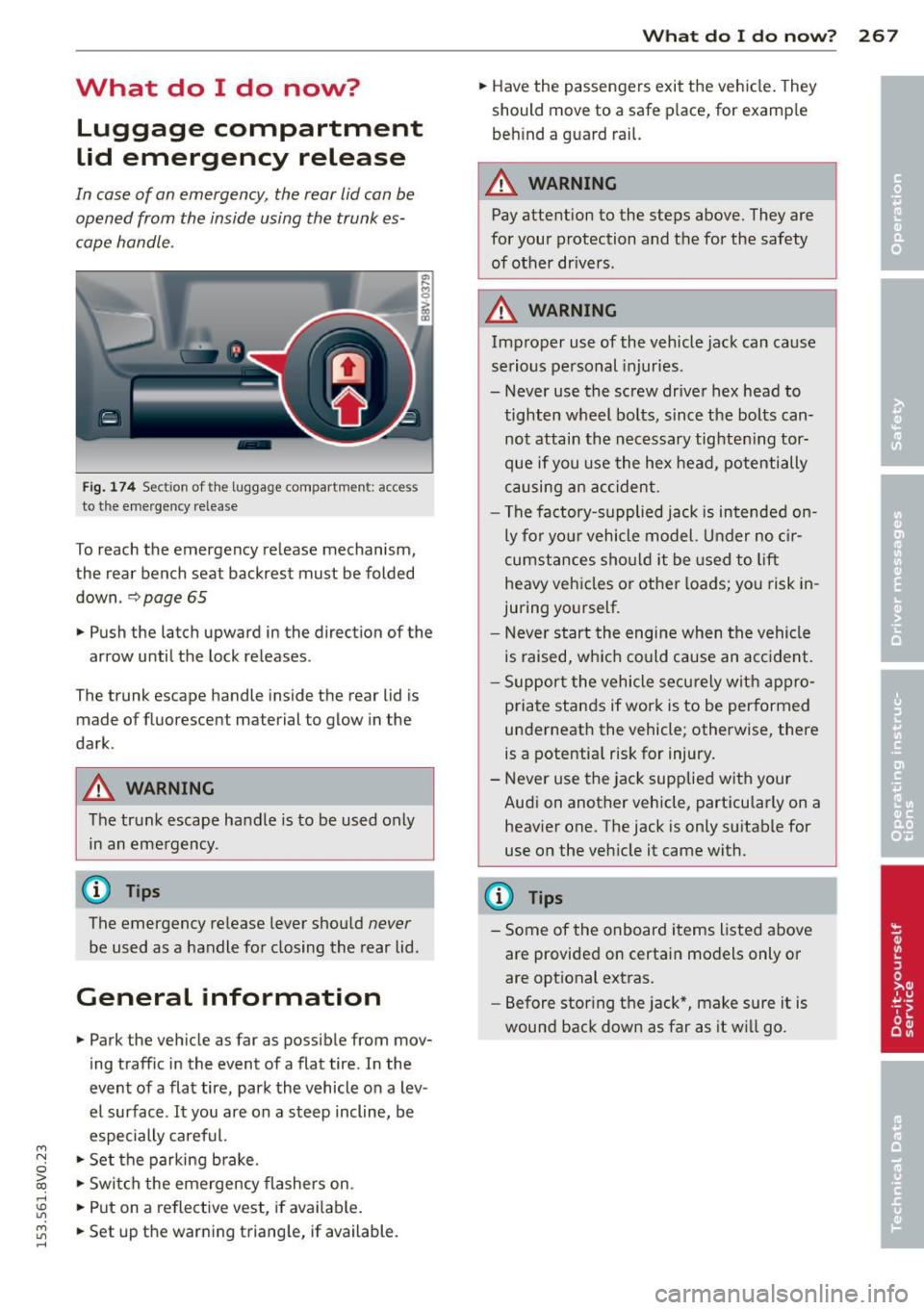
In case of an emergency, the rear lid can be
opened from the inside using the trunk es
cape handle .
Fig. 174 Section of the luggage compartm en t: access
to the emergency release
To reach the emergency release mechanism,
the rear bench seat backrest must be folded
down .
~ page 65
.,. Push the latch upward in the direction of the
arrow until the lock releases .
The trunk escape handle inside the rear lid is
made of fluorescent material to glow in the
dark.
A WARNING
The trunk escape handle is to be used only in an emergency .
@ Tips
The emergency release lever should never
be used as a handle for closing the rear lid .
General information
.,. Park the vehicle as far as possible from mov
ing traff ic in the event of a flat tire. In the
event of a flat tire, park the vehicle on a lev
el surface .
It you are on a steep incline, be
especially careful.
.,. Set the parking b rake.
.,. Swi tch the emergency flashers on .
.,. Put on a reflective vest, if avai lable .
.,. Set up the warning triangle, if available .
What do I d o now ? 267
.,. Have the passengers exit the vehicle . They
should move to a safe place, for examp le
beh ind a guard rail.
A WARNING
Pay attention to the steps above. They are
for your p rotection and t he for the safety
of other dr ivers.
A WARNING ...
Imp roper use of the vehicle jack can cause
se rious pe rsonal injuries .
- Never use the screw driver hex head to
tighten w heel bolts, s ince the bolts can
not attain the necessary tighten ing tor
que if you use the hex head, potentially
causing an ac cident .
- The fac tory-supplied jack is intended on
ly fo r yo ur vehicle model. U nder no c ir
cumstances sho uld it be used to
li ft
heavy vehicles o r other loads; you risk in
juring yo urself .
- Never s tart the engine when the vehicle
is raised, w hich co uld cause an acc ident.
- Support the vehicle secu rely wit h appro
priate stands if wor k is to be performed
underneath the vehicle ; otherwise, there
is a pote ntia l risk for injury.
- Never use the jac k supplied wit h your
Aud i on another vehicle, particularly on a
heav ier one. The jack is only su itable for
use on the vehicle it came with.
@ Tips
- Some of the on board items listed above
are provided on certain mo dels only or
are opt ional extras.
- Before stor ing the jack*, make sure it is
wound back down as far as it w ill go .