instrument panel AUDI S3 2015 Owners Manual
[x] Cancel search | Manufacturer: AUDI, Model Year: 2015, Model line: S3, Model: AUDI S3 2015Pages: 310, PDF Size: 76.15 MB
Page 11 of 310
M N
0 > co ...... \!) ..,.,
M ..,., ......
CD
@
®
©
®
®
(J)
®
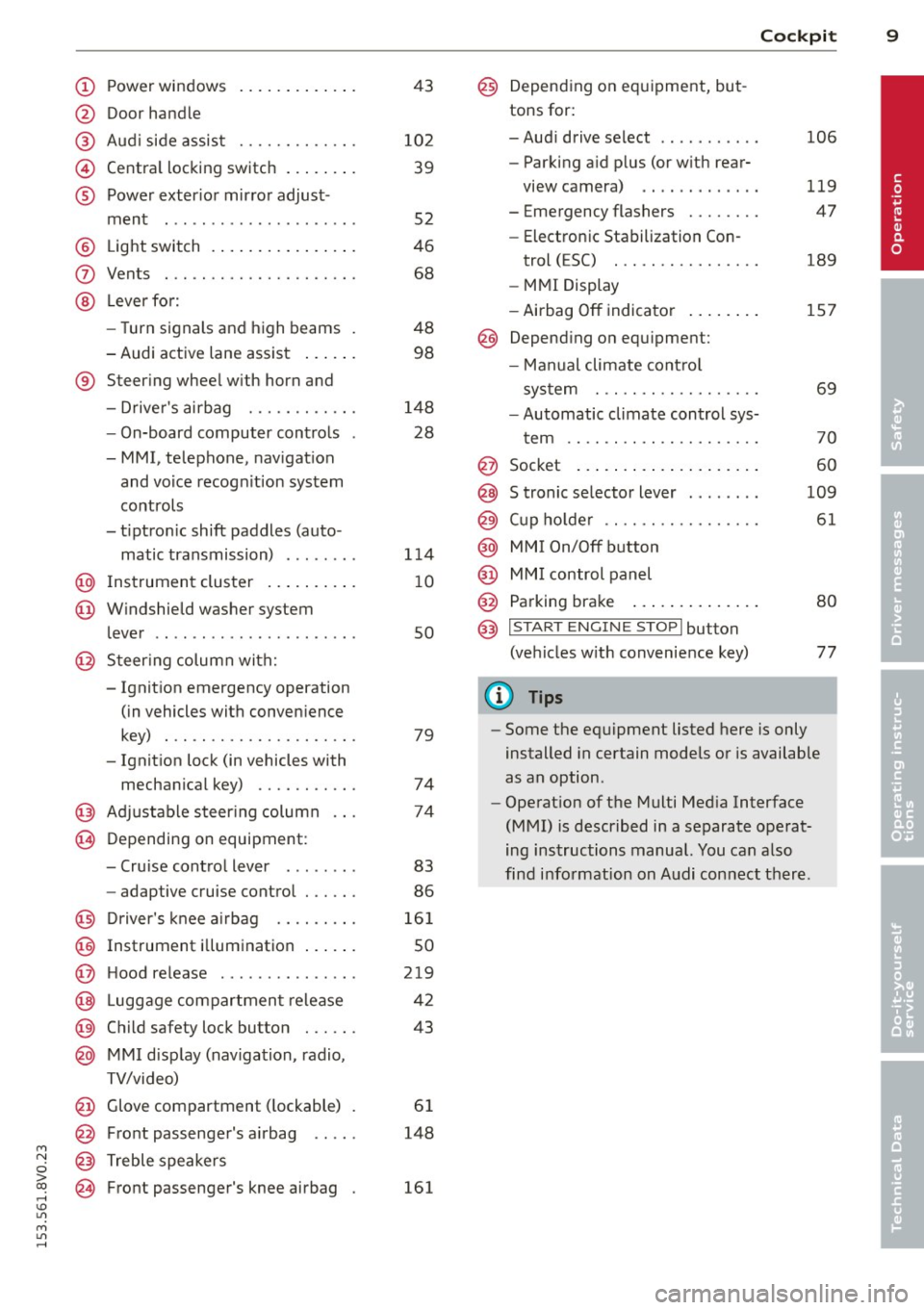
Power windows
Door handle
Aud i side assist
........ .... .
Centra l locking switch ... .. .. .
Powe r exter ior mirror adjust
ment
.. ... .............. ..
Light switch
Vents
L ever fo r:
- Turn signals and high beams
- Audi active lane assist ... .. .
® Steer ing wheel w ith horn and
- Drive r's airbag ....... .. .. .
- On-board computer controls
- MMI, telephone, nav igat ion
and voice recogn it ion system
controls
- tiptron ic shift paddles (auto-
matic transmission) ....... .
@ Instrument cluster .. ... .. .. .
@ W indshield washer system
l ever
' .. ... .............. . .
@ S teer ing column with:
- Ignit ion emergency operation
(in vehicles with conven ience
key) . .. ................. .
- Ignit ion lock (in vehicles with
mechanical key) ...... .. .. .
@ Adjustable s teer ing column
@ Depending on equipment :
- Cruise contro l lever . ...... .
- adaptive cruise contro l ... .. . 4
3
10 2
39
52
46
68
48 98
148 28
1 14
1 0
so
79
74
74
83
86
@ D river's knee a irbag . . . . . . . . . 161
@ Instrument i llumination . . . . . . 50
@ H ood re lease . . . . . . . . . . . . . . . 219
@ Lugg age compartmen t release 42
@ Child safety lock button . . . . . . 43
@ MMI d isp lay (navigation , radio,
TV/video)
@ Glove compartment ( lockable)
@ Front passenger's airbag .. .. .
@ Treble speakers
@ Front passenger's knee airbag 61
148
161
Cockpi t 9
@) Depending on eq uipment, but
tons for:
- Aud i drive select
- Parking a id p lus (or w ith rear-
view camera) .. . ... ...... .
- Emergency flashers ....... .
- Electron ic Stabilization Con-
trol ( ESC) . .. .... ........ .
- MMI Display
- Airbag
Off indicator ..... .. .
@ Depend ing on equ ipment:
- Manual climate cont ro l
system
- Automatic climate contro l sys
t em
. . .. .. .. .... .........
@ Socket
@ S tronic se lector lever ....... .
@ Cup ho lder .. .. .. . ......... .
@ MMI On/Off button
@ MM I control panel
@ Parking brake ... . ... ...... .
@ I START ENGI NE STOPI button
(ve hicles w ith convenience key)
(D Tips
106
119
47
189
157
69
70
60
109
61
80
77
- Some the eq uipment listed here is only
installed in certain models or is available
as an option.
- Operat ion of the Multi Med ia Interface
(MMI) is described in a separate operat
ing instructions manual. You can a lso
find info rmation on A udi con nect ther e.
•
Page 15 of 310
....,
N
0 > co
rl I.O
"' ....,
"' rl
@ Tips
Diesel engines: Due to the high efficiency
o f t hese engines, the eng ine may not al
ways reach operating temperature in cold
outs ide temperatur es. T his is normal a nd
not a cause for co nce rn.
Service interval display
The service interval display detects when your
vehicle is due for service.
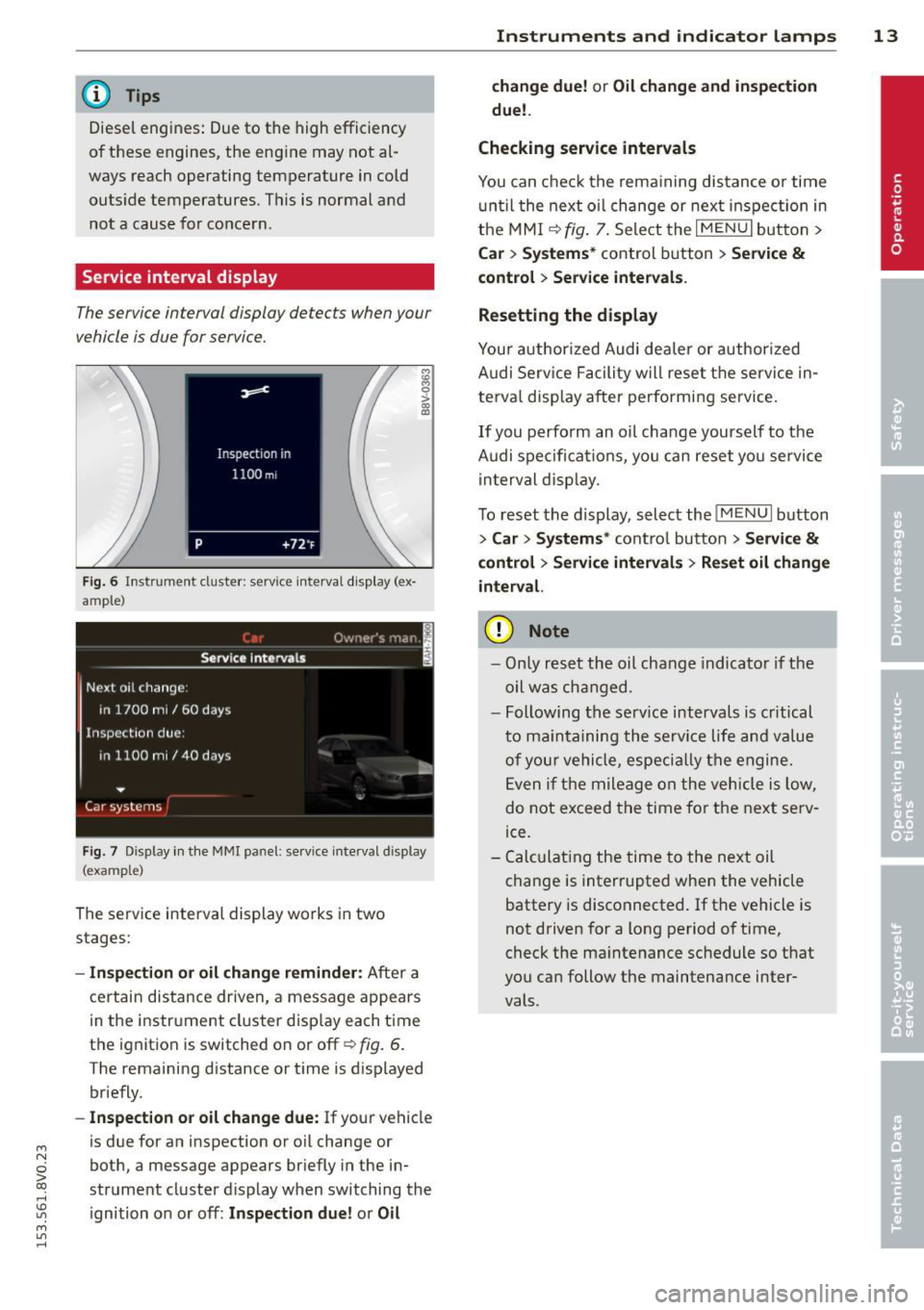
F ig . 6 In stru ment cluste r: serv ice inte rval d isp lay (ex
ample)
F ig . 7 Display in the MMI panel: service interva l display
(example)
The se rv ice interva l display wo rks in two
stages:
- In spection or oil change reminder: A ft er a
c e rt a in dis tance dr iven, a message a ppears
in t he i nstr ument cluster d isp lay each t ime
t h e i gnition is switched on or off~
fig. 6.
The remaining distance or t im e is d isplayed
br iefly.
- Inspection or oil change due : If your vehicle
is due for an inspection or o il change or
bot h, a message appears br iefly in the in
strument cluster display when switching the
ignition o n or off:
Inspection due! or Oil
Instruments and indicator lamps 13
change due! or Oil change and inspection
due!.
Checking service intervals
You can check th e rema ining dis tance o r time
u nti l the next o il change or nex t inspec tion in
t h e MM I
~ fig. 7. Sele ct the I M ENU I but to n >
Ca r > Systems * control button > Service &
control > Ser vice intervals .
Resetting the display
Y ou r auth or ized Audi dea ler or author ized
A udi Se rv ice F acili ty w ill reset the service in
te rva l display a fter performi ng service.
If you perfo rm an oil ch ange yourself to the
A udi spe cifica tions , yo u can reset you servi ce
i n terval disp lay.
T o reset t he di splay, select the
I ME NU I bu tton
> Car > System s* cont ro l button > Service &
control > Service intervals > Re set oil change
interval.
(D Note
- On ly r eset t he oil cha nge i ndicat or if th e
oi l was cha nged.
- Following t he serv ice intervals is critical
t o m ain ta ining the se rv ic e life a nd value
of your v ehicle, especi ally th e e ngine.
E ven i f the mileage on the vehicle is low,
do n ot exceed t he time fo r th e nex t serv
ice.
- C alcula ting the time to the next oil
ch ange is inter rupted whe n the vehicle
battery is disconnected. If t he vehicle is
n ot d riven for a long pe riod o f time,
check the ma intenance sc hedule so t hat
yo u ca n follow the maintena nce inter
vals.
Page 58 of 310
56 Seat s a nd s tor ag e
Seats and storage
General information
Important information
& WARNING
Refer to the chapter Driving Safely
r::!>poge 125, Driving safety for important
information, t ips, suggestions and warn
ings that you should read and follow for
your own safety and the safety of your pas sengers.
Why is your seat adjustment so important?
The safety belts and the airbag system con
only provide maximum protection if the front
seats ore correctly adjusted.
There are various ways of adjusting the front
seats to provide safe and comfortable support
for the driver and the front passenger. Adjust
your seat properly so that :
- you can easily and quickly reach all the
switches and controls in the instrument
panel
- your body is properly supported thus reduc
ing physical stress and fatigue
- the safety belts and airbag system can offer
maximum protection
r::!> page 144 .
In the following sections, you will see exactly
how you can best adjust your seats .
There are special regulations and instructions
for insta lling a child seat on the front pas
senger's seat. Always follow the information regarding child safety provided in
r::!> page 170, Child Safety .
& WARNING
Incorrect seating position of the dr iver and
all other passengers can result in serious
personal in jury.
- Always keep your feet on the f loor when
the vehicle is in motion - never p ut your
feet on top of the instrumen t panel, out of the window or on top of the seat c
ush
ion. This applies espec ially to the passen
gers. If your seating position is incorrect,
you increase the risk of injury in the case
of sudden braking or an accident .
If the
airbag inflates and the seating position is incorrect, this could result in pe rsonal
inj ury or even death.
- It is important for both the drive r and
front passenger to keep a distance of at least 10 inches ( 25 cm) between them
selves and the steering wheel and/or in
strument panel. If you're sitting any
closer than this, the airbag system can not protect you properly. In addition, the
front seats and head restraints must be
adjusted to your body height so that they
can give you max imum protect ion.
- Always try to keep as much distance as
possible between yourself and the steer
ing wheel o r instrument panel.
- Do not adjust the driver's or front pas
senger's seat whi le the vehicle is moving.
Your seat may move unexpectedly, caus
ing sudden loss of veh icle cont ro l and
pe rsonal injury. If you adjust yo ur seat
while the veh icle is moving, yo u are ou t
of posit ion .
Driver's seat
The correct seat position is important for safe
and relaxed driving.
We recommend that you adjust the dr iver's
seat in the fo llow ing manne r:
.. Adjust the seat in fore and aft direction so
that you can easily push the peda ls to the
floor wh ile keeping your knees sl ightly bent
c::> &. in Why is your seat adjustment so im
portant? on page 56.
.. Ad just the bac krest so tha t when you sit
w ith your back against the backrest, you can
still grasp the top of the steering wheel.
.. For adjustab le head restraints: adjust the
head restra int so the upper edge is as even
as poss ible with the top of your head. If that
is not possible, try to adjust the head ..,.
Page 129 of 310
M N
0 > co ,...., \!) 1.1'1
M 1.1'1 ,....,
is not possible, try to adjust the head re
straint so that it is as close to this position
as possible. Move the head restraint so that
it is as close to the back of the head as pos
sible.
.. Fasten and wear safety belts correctly
Q page 138.
.. Always keep both feet in the footwell so
that you are in control of the vehicle at all
times.
For detailed information on how to adjust the
driver's seat, see
Q page 58.
.&, WARNING
Drivers who are unbelted, out of position
or too close to the airbag can be seriously
injured by an airbag as it unfolds. To help
reduce the risk of serious personal injury:
- Always adjust the driver's seat and the
steering wheel so that there are at least
10 inches (25 cm) between your breast
bone and the steering wheel.
- Always adjust the driver 's seat and the
steering wheel so that there are at least
4 inches (10 cm) between the knees and
the lower part of the instrument panel.
- Always hold the steering wheel on the
outside of the steering wheel rim with
your hands at the 9 o'clock and 3 o'clock positions to help reduce the risk of per
sonal injury if the driver's airbag inflates.
- Never hold the steering wheel at the
12 o'clock position or with your hands at
other positions inside the steering wheel
rim or on the steering wheel hub. Hold
ing the steering wheel the wrong way
can cause serious injuries to the hands,
arms and head if the driver's airbag in
flates.
- Pointing the steering wheel toward your
face decreases the ability of the supple
mental driver's airbag to protect you in a
collision.
- Always sit in an upright position and nev
er lean against or place any part of your
body too close to the area where the air
bags are located.
-
Driving safety 127
-Before driving, always adjust the front
seats properly and make sure that all passengers are properly restrained .
- For adjustable head restraints: before
driving, always also adjust the head re
straints properly.
- Never adjust the seats while the vehicle is moving. Your seat may move unexpect
edly and you could lose control of the ve hicle .
- Never drive with the backrest reclined or
tilted far back! The farther the backrests are tilted back, the greater the risk of in
jury due to incorrect positioning of the safety belt and improper seating posi
tion .
- Children must always ride in child seats
Q page 170 . Special precautions apply
when installing a child seat on the front
passenger seat ¢
page 144.
Proper seating position for the front
passenger
The proper front passenger seating position
is important for safe, relaxed driving.
For your own safety and to reduce the risk of
injury in the event of an accident, we recom
mend that you adjust the seat for the front
pass enger to the following position :
.. Adjust the angle of the seatback so that it is
in an upright position and your back comes
in full contact with it whenever the vehicle is
moving.
.. Fo r adjustable head restraints: adjust the
head restraint so the upper edge is as even
as possible with the top of your head. If that
is not possible, try to adjust the head re
straint so that it is as close to this position
as possible
¢ page 129. Move the head re
straint so that it is as close to the back of
the head as possible .
.. Keep both feet flat on the floor in front of
the front passenger seat.
.. Fasten and wear safety belts corr ectly
¢ page 138.
•
•
•
Page 130 of 310
128 Driving safety
For detailed information on how to adjust the
front passenger's seat, see ¢
page 5 7.
A WARNING
Front seat passengers who are unbelted,
out of position or too close to the airbag
can be seriously injured or killed by the air
bag as it unfolds. To help reduce the risk of
serious personal injury:
- Passengers must always sit in an upright
position and never lean against or place
any part of their body too close to the
area where the airbags are located.
- Passengers who are unbelted, out of po
sition or too close to the airbag can be
seriously injured by an airbag as it un
folds with great force in the blink of an
eye.
- Always make sure that there are at least
10 inches (25 cm) between the front
passenger's breastbone and the instru
ment panel.
- Always make sure that there are at least
4 inches (10 cm) between the front pas
senger's knees and the lower part of the
instrument panel.
- Each passenger must always sit on a seat
of their own and properly fasten and
wear the safety belt belonging to that
seat.
- Before driving, always adjust the front
passenger seat properly .
- For adjustable head restraints: before
driving, always also adjust the head re
straints properly.
- Always keep your feet on the floor in
front of the seat. Never rest them on the
seat, instrument panel, out of the win
dow, etc. The airbag system and safety
belt will not be able to protect you prop
erly and can even increase the risk of in
jury in a crash .
- Never drive with the backrest reclined or
tilted far back! The farther the backrests are tilted back, the greater the risk of in
jury due to incorrect positioning of the
safety belt and improper seating posi
tion. -
Children must always ride in child seats
¢
page 170. Special precautions apply
when installing a child seat on the front passenger seat
c> page 144.
Proper seating positions for passengers
in rear seats
Rear seat passengers must sit upright with
both feet on the floor consistent with their
physical size and be properly restrained whenever the vehicle is in use.
To reduce the risk of injury caused by an incor
rect seating position in the event of a sudden
braking maneuver or an accident, your pas
sengers on the rear bench seat must always
observe the following:
"" For adjustable head restraints: adjust the
head restraint so the upper edge is as even
as possible with the top of your head. If that
is not possible, try to adjust the head re
straint so that it is as close to this position
as possible
¢ page 129.
.,. Keep both feet flat in the footwell in front of
the rear seat.
.,. Fasten and wear safety belts properly
¢page 138.
.,. Make sure that children are always properly
restrained in a child restraint that is appro
priate for their size and age¢
page 170.
A WARNING
Passengers who are improperly seated on
the rear seat can be seriously injured in a
crash.
- Each passenger must always sit on a seat
of their own and properly fasten and
wear the safety belt belonging to that
seat.
- Safety belts only offer maximum protec
tion when the safety belts are properly positioned on the body and securely
latched. By not sitting upright, a rear
seat passenger increases the risk of per
sonal injury from improperly positioned
safety belts!
Page 132 of 310
130 Driving saf ety
Th ere fo re, wh enever th e vehicle i s
mo ving :
-never stand up in the vehicle
- never stand on the seats
- never knee l on the seats
- never ride with the seatback reclined
- never lie down on the rear seat
- never lean up aga inst the instrument panel
- never sit on the edge of the seat
- never sit sideways
- never lean out the w indow
- never put your feet out the window
- never put your feet on the instrument panel
- never rest your feet on the seat cushion o r
back of the seat
- never ride in the footwell
- never ride in the cargo area
A WARNING
Improper seat ing positions increase the
r isk of serious personal injury and death
whenever a veh icle is being used .
- Always make sure that all vehicle occu pants stay in a proper seating pos it ion
and are properly restra ined whenever the
vehicle is be ing used.
Driver and passenger
side footwell
Important safety instructions
App lies to vehicles: with knee a irbags
A WARNING
Always make s ure that the knee airbag can
inflate without interference. Objects be
tween yourse lf and the airbag can inc rease
the risk of in jury in an acc ident by interfer
ing w ith the way the a irbag deploys or by
being pushed into you as the airbag de
ploys.
- No persons (ch ildren) or animals should
ride in the footwell in front of the pas
senger seat. If the airbag deploys, this
can result in se rious or fata l injuries.
- No objects of any kind should be carried in the footwe ll area in front of the driv- er's or passenger's seat
. Bulky objects
(shopping bags, for example) can ham
per or prevent proper deployment of the
ai rbag. Small objects can be thrown
through the vehicle if the airbag deploys
and i njure you or your passenge rs .
Pedal area
Pedals
The pedals must always be free to move and
must never be interfered with by a floor mat
or any other object.
Make su re that a ll peda ls move free ly without
i nterference and that no thing preven ts them
from return ing to their or ig inal positions .
Only use f loor mats that leave the pedal a rea
free and can be secu red with floor mat fasten
ers.
If a brake c ircu it fa ils, inc reased brake pedal
t ravel is required to bring the vehicle to a full
stop.
A WARNING
P edals that cannot move free ly can ca use
l oss of vehicle contro l and increase the risk
of serious injury.
- Never p lace any objects in the driver's
footwell. An object co uld get into the
pedal area and interfere with pedal func
tion. In case of sudden braking or an ac
cident, you wou ld not be able to brake or
accelerate!
-Always make sure that nothing can fall
or move into the driver's footwell.
Floor mats on the driver side
Always use floor mats that can be securely attached to the floor mat fasteners and do
not interfere with the free movement of the
pedals.
.,. Make sure that the floor mats are properly
secured and cannot move and interfere with
the pedals
¢ A . ..,_
Page 134 of 310
132 Driving saf ety
A WARNING
Heavy loads will influence the way your ve
hicle handles. To help reduce the risk of a
loss of control leading to ser ious personal
injury:
-Always keep in m ind when transporting
heavy objects, that a change in the cen
ter of gravity can also cause changes in
vehicle handling:
- Always distribute the load as evenly as
possible.
- Place heavy objects as far forward in
the luggage compartment as possible.
- Never exceed the Gross Ax le Weight Rat
ing or the Gross Vehicle Weight Rating
specified on the safety compliance stick
er on the left door jamb. Exceeding per
missible we ight standards can cause the
vehicle to slide and handle differently.
- Please observe information on safe driv
ing
opoge 125.
A WARNING
To help prevent poisonous exhaust gas
from be ing drawn into the veh icle, always
keep the rea r lid closed while dr iving.
- Never transport objects larger than those fitting completely into the luggage
area because the rear lid cannot be fully
cl osed.
- If you absolutely must drive w ith the rear
lid open, observe the follow ing notes to
reduce the risk of poisoning:
- Close all w indows,
- Close the power roof *,
- Open all air outlets in the instrument
panel,
- Sw itch off the air recircu lation,
- Set the fresh a ir fan to the highes t
speed.
A WARNING
Always ma ke s ure th at the doors, all win
dows, the power roo f* and the rear lid are
securely closed and locked to reduce the risk of injury when the vehicle is not being
used.
- After closing the rear lid, always make
sure that it is properly closed and locked.
- Never leave your vehicle unattended es
pecially with the rear lid left open. A
child cou ld craw l into the vehicle thro ugh
the luggage compartment and close the rea r lid becoming trapped and unable to
get out. Being t rapped in a vehicle can
lead to serious pe rsonal in jury.
- Never let children play in or around the veh icle.
- Never let passengers ride in the luggage
compa rtment. Vehicle occupants must
always be prope rly restra ined in one of
the vehicle's seating posit ions.
(D Tips
- Air circulation helps to reduce window
fogging. Stale a ir escapes to the outside
through vents in the t rim panel. Be sure
to keep these slots free and open.
- The tire pressure m ust correspond to the
load. The tire pressure is shown on the
t ire pressure label. The tire pressure la
bel is located on the drive r's side B-pilla r.
The tire pressure label lists the recom
mended co ld tire inflation pressures for
the vehicle at its maxim um capacity
we ight and the tires that we re on your
vehicle at the t ime it was manufactured.
For recommended tire pressures for nor
ma l load cond itions, please see chapter
opoge240.
Tie -downs
The luggage comportment is equipped with
four tie-downs to secure luggage and other
items.
Use the t ie-downs to secure your cargo prop
erly
o page 131, Loading the luggage com
portment .
In a collision, the laws of physics mean that
even smaller items that are loose in the vehi-
cle w ill become heavy missiles t hat can cause .,..
Page 139 of 310
....,
N
0 > co
rl I.O
"' ....,
"' rl
occupant will slam violently into the steering
wheel, instrument panel, w indshield , or what
ever else is in the way
c::> fig. 120. This impact
with the vehicle interior has all the energy
they had just before the crash.
Never rely on airbags alone for protection.
Even when they deploy, airbags provide only
additional protection. Airbags are not sup
posed to deploy in all kinds of accidents. Al
though your Audi is equipped with airbags, all
vehicle occupants, including the driver, must
wear safety belts correctly in order to mini mize the risk of severe injury or death in a
crash.
Remember too, that airbags will deploy only
once and that your safety belts are always
there to offer protection in those accidents in
which airbags are not supposed to deploy or
when they have already deployed. Unbelted
occupants can also be thrown out of the vehi
cle where even more severe or fatal injur ies
can occur.
It is also important for the rear passengers to
wear safety belts correctly. Unbelted passen
gers in the rear seats endanger not only them
selves but also the driver and other passen
gers
c::> fig. 121. In a frontal collision they will
be thrown forward violently, where they can
hit and injure the driver and/or front seat pas
senger.
Safety belts protect
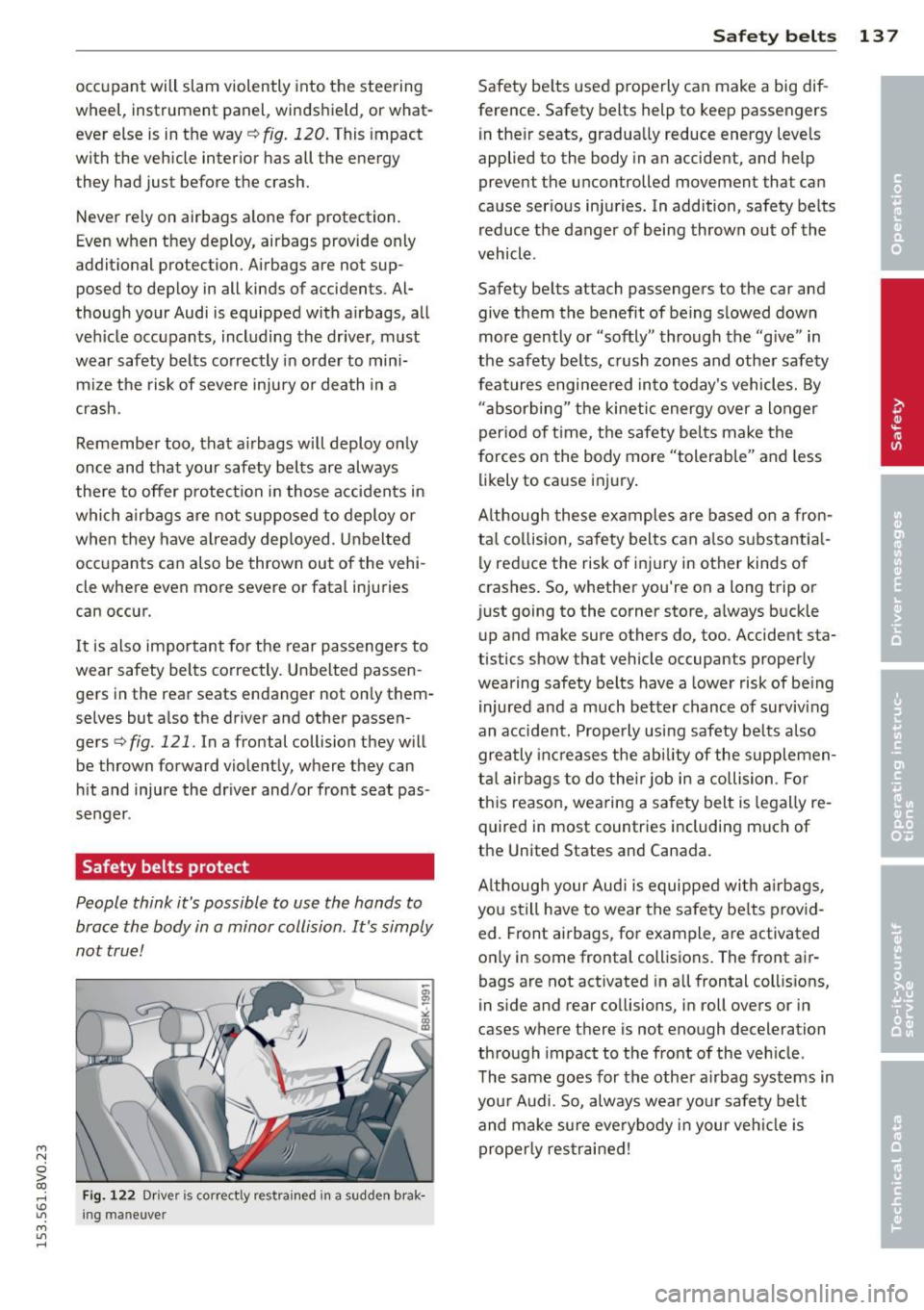
People think it's possible to use the hands to
brace the body in a minor collision . It's simply
not true!
Fig. 122 Driver is cor rect ly r est rain ed in a sudd en brak
ing man euve r
Safety belts 13 7
Safety belts used properly can make a big dif
ference. Safety belts help to keep passengers
in their seats, gradually reduce energy levels
applied to the body in an accident, and help
prevent the uncontrolled movement that can
cause serious injuries . In addition, safety belts
reduce the danger of being thrown out of the
vehicle .
Safety belts attach passengers to the car and
give them the benefit of being slowed down more gently or "softly" through the "give" in
the safety belts, crush zones and other safety
features engineered into today's vehicles. By
"absorbing" the kinetic energy over a longer
period of time, the safety belts make the
forces on the body more "tolerable" and less
likely to cause injury.
Although these examples are based on a fron
tal collision, safety belts can also su bsta ntia l
ly reduce the risk of injury in other kinds of
crashes. So, whether you're on a long trip or
just going to the corner store, always buckle
up and make sure others do, too. Accident sta
tistics show that vehicle occupants properly
wearing safety belts have a lower risk of being
injured and a much better chance of surviving
an accident. Properly using safety belts also
greatly increases the ability of the supplemen
tal airbags to do their job in a collision . For
this reason, wearing a safety belt is legally re
quired in most countries including much of
the United States and Canada.
Although your Audi is equipped with airbags,
you still have to wear the safety belts provid
ed. Front airbags, for example, are activated
only in some frontal collisions. The front air
bags are not activated in all frontal collisions,
in side and rear collisions, in roll overs or in
cases where there is not enough deceleration
through impact to the front of the vehicle.
The same goes for the other airbag systems in
your Audi. So, always wear your safety belt
and make sure everybody in your vehicle is
properly restrained!
Page 140 of 310
138 Safety belts
Important safety instructions about
safety belts
Safety belts must always be correctly posi
tioned across the strongest bones of your
body.
,.. Always wear safety belts as illustrated and
described in this chapter.
,.. Make sure that your safety belts are always
ready for use and are not damaged.
A WARNING
Not wearing safety belts or wearing them
improperly increases the risk of serious
personal injury and death. Safety belts can
work only when used correctly .
- Always fasten your safety belts correctly
before driving
off and make sure all pas
sengers are correctly restrained.
- For maximum protection, safety belts must always be positioned properly on
the body .
- Never strap more than one person , in
cluding small children, into any belt.
- Never place a safety belt over a child sit ting on your lap.
- Always keep feet in the footwell in front
of the seat while the vehicle is being driv
en .
- Never let any person ride with their feet on the instrument panel or sticking out
the window or on the seat.
- Never remove a safety belt while the ve
hicle is moving. Doing so will increase
your risk of be ing injured or killed.
- Never wear belts twisted.
- Never wear belts over rigid or breakable
objects in or on your clothing, such as
eye glasses, pens, keys, etc., as these
may cause injury.
- Never allow safety belts to become dam
aged by being caught in door or seat
hardware .
- Do not wear the shoulder pa rt of the belt
under your arm or otherwise out of pos i
tion . -
Several layers of heavy clothing may in
terfere with correct positioning of belts
and reduce the overall effectiveness of
the system .
- Always keep belt buckles free of anything
that may prevent the buckle from latch
ing securely .
- Never use comfort clips or devices that
create slack in the shoulder belt . Howev
er, special clips may be required for the
proper use of some child restraint sys
tems .
- Torn or frayed safety belts can tear, and
damaged belt hardware can break in an
accident. Inspect belts regularly .
If web
bing, bindings, buck les, or retractors are
damaged, have belts replaced by an au
thorized Audi dealer or qualified work
shop.
- Safety belts that have been worn and
loaded in an accident must be replaced
with the correct replacement safety belt
by an authorized Audi dealer . Replace
ment may be necessary even if damage
cannot be clearly seen . Anchorages that
were loaded must also be inspected.
- Never remove, modify, disassemble, or
try to repair the safety belts yourself.
- Always keep the belts clean. Dirty belts
may not work properly and can impair
the function of the inert ia reel
c::> ta
ble Internal cleaning on page 207.
Safety belts
Fastening safety belts
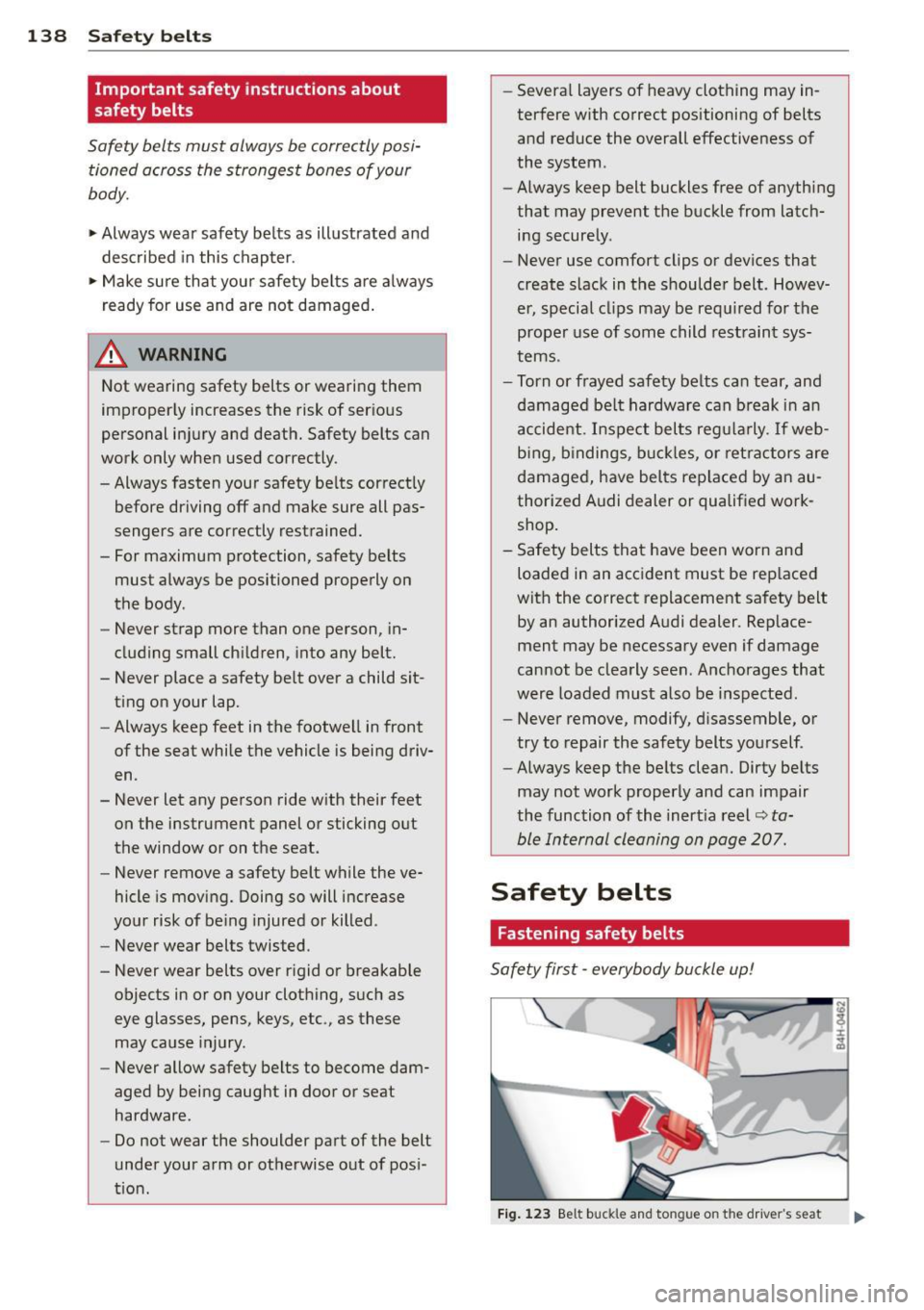
Safety first -everybody buckle up!
Fig. 123 B elt buck le and to ngue o n th e drive r's se at
Page 147 of 310
Airbag system 145
Since the circumstances will vary considerab ly
also at greater risk of injury or death
between on e collision and another , it is not
through contact with an inflating airbag .
possible to define a range of veh icle speeds
-If you are unrestrained, leaning forward,
that will cover every possible k ind and angle
sitting sideways or out of position in any
of impact that will always trigger the a irbags .
way, your risk of injury is much higher.
Important factors include, for example, the -You will a lso receive serious injuries and
nature (hard or soft) of the object which the could even be killed if you are up against
•
car h its, the ang le of impact, vehicle speed ,
• the airbag or too close to it when it in-
etc. The front airbags will a lso not inflate in
flates - even with an Advanced A irbag.
side or rea r collisions, or in ro ll-overs .
-To reduce the risk of injury when an air-
Alwa ys re memb er: Airbags will deploy only bag inflates, always wear safety belts
once, and only in certa in kinds of co llisions. properly
c::;, page 138, Safety belts
.
Your safety belts are always there to offe r pro- -
Always make certain that ch ildren age 12
tection in those s ituations in which airbags or younger always ride in the rear seat. If
are not s upposed to deploy , or when they have children a
re not properly restrained , they
already deployed ; for example , when your ve- may be severe
ly inju red or killed when an
hide strikes or is struck by another vehicle af- airbag inf
lates.
ter the first collision . -
Never let ch ildren ride un restra ined o r
This is just one of the reasons why an a irbag is improperly restrained
in the vehicle . Ad-
just the front sea ts prope rly.
a supp lementary restraint and is not a s ubsti -
-Never ride with the back rest reclined .
tute for a safety belt . The airbag system
-Always sit as far as possible from the
works most effect ively when used with the
steering whee l or the instrument panel
safety belts. Therefore, always properly wear
c::;, page 126 . your safety belts c::;, page 135 .
- Always sit upright with your back against
A WARNING the backrest of yo ur seat.
- Never p lace your feet on the instrument
Sitting too close to the steer ing whee l or
panel or on the seat . Always keep both
instrument panel will dec rease the effec-
feet on the floor in front of the seat to
tiveness of the airbags and will inc rease
help prevent serious in ju ries to the legs
the risk of pe rsonal injury in a co llision.
and hips if the airbag deploys.
- Never si t closer than 10 inches (2S cm)
-Never recline the front passenger's sea t
to the stee ring wheel or instr ument pan-
to transport objects. Items can a lso
el. move into the area of the s ide a irb ag or
- If you cannot si t mo re than 10 inches
the front airbag during bra king or in a
( 2 5 cm) from the steer ing whee l, investi-
sudden maneuver. Objects near the air-
ga te whethe r adap tive equipmen t may
bags can become projectiles and cause
be available to help you reach the pedals injury when an airbag inflates.
and increase your seating distance from
the steering wheel.
A WARNING
- All veh icle occupants and especia lly chil -
dren m ust be restrained properly when- A
irbags that have deployed in a crash must
ever riding in a vehicle . An unrestra ined be replaced.
or improperly restrained child could be -
Use on ly orig inal equipment airbags ap-
M injured by striking the inter ior or by be- proved by Audi and installed by a trained • N technician who has the necessary too
ls ~ 0 ing ejected from the vehicle during a > co sudden maneuver or impact . An unre-,...., \!) ..,., strained or imp roperly rest rained child is M ..,., ,....,