weight AUDI S3 2015 Owners Manual
[x] Cancel search | Manufacturer: AUDI, Model Year: 2015, Model line: S3, Model: AUDI S3 2015Pages: 310, PDF Size: 76.15 MB
Page 6 of 310
4 Table of contents
Fuses and bulbs . . . . . . . . . . . . . . .
27 6
Elect rical fuses . . . . . . . . . . . . . . . . . . . 276
Bulbs . . . . . . . . . . . . . . . . . . . . . . . . . . . 279
Emergency situations . . . . . . . . . 280
General . . . . . . . . . . . . . . . . . . . . . . . . . 280
Starting by push ing or tow ing . . . . . . . 280
Starting with jumper cab les . . . . . . . . 280
Using jump start cables . . . . . . . . . . . . 281
Eme rgency towing with commercial
tow truck . . . . . . . . . . . . . . . . . . . . . . . 282
Lift ing vehicle . . . . . . . . . . . . . . . . . . . . 28 4
Technical Data . . . . . . . . . . . . . . . . . 286
Technical data . . . . . . . . . . . . . . . . . 286
Vehicle ident ifica tion . . . . . . . . . . . . . . 286
Weights . . . . . . . . . . . . . . . . . . . . . . . . 286
D imensions . . . . . . . . . . . . . . . . . . . . . . 287
Capacities . . . . . . . . . . . . . . . . . . . . . . . 288
Gasoline engines . . . . . . . . . . . . . . . . . 288
Diese l eng ine . . . . . . . . . . . . . . . . . . . . 288
Consumer Information . . . . . . . 289
Warranty coverages . . . . . . . . . . . . . . . 289
Operating your vehicle outside the U.S.A. or Canada . . . . . . . . . . . . . . . . . 289
Audi Service Repair Manuals and Literature . . . . . . . . . . . . . . . . . . . . . . . 289
M aintenance . . . . . . . . . . . . . . . . . . . . . 289
Addit ional accesso ries, modifica tions
and parts replacement . . . . . . . . . . . . 29 1
D eclaration o f Compliance,
Te lecommunication and E lectronic
Systems . . . . . . . . . . . . . . . . . . . . . . . . 292
Inde x . . . . . . . . . . . . . . . . . . . . . . . . . . 293
Page 64 of 310
62 Seats and storage
The glove compartment can be locked using
the vehicle key.
.&_ WARNING
Always leave the lid on the glove compart ment cover closed while driving to reduce
the risk of injury.
Additional storage compartments
There are additional storage compartments,
compartments and holders at other locations
in the vehicle :
- In the upper part of the glove compart
ment .
- In the center console under the center arm
rest* .
- On the back of the right front seat. The com
partment* can hold a maximum weight of
2 lbs (1 kg).
- Garment hooks on the 8-pillar
c:> &, .
.&_ WARNING
-Do not place any objects on the instru
ment panel. Objects that are not stored
securely can slide around in the vehicle
while driving, when accelerating or brak ing or when turning.
- Make sure that objects cannot fall out of
the center console storage compartment
or other compartments and into the
footwell while driving. These objects
could prevent you from braking or accel
erating during sudden braking maneu
vers.
- Garments hung on the hooks must not obstruct the driver's view. The garment
hooks are only designed for light objects.
Do not hang any garments with hard,
sharp or heavy objects in the pockets on
the garment hooks. These objects could
injure vehicle occupants during sudden
braking or in a collision - especially if the
airbags deploy.
-Always keep the glove compartment
closed while driving to reduce the risk of
injury during a collision or heavy braking. -
Read and following the WARNINGS in
c:> page 165, Important safety instruc
tions on the side airbag system .
- Hang garments so that they do not ob
struct the driver's view.
- The garment hooks should only be used
for light articles of clothing. Do not leave
any heavy or sharp-edged objects in the
pockets that could interfere with the side
airbags unfolding and cause injuries in
the event of a collision.
- Do not use coat hangers to hang gar ments, because this could reduce the ef
fectiveness of the side curtain airbags .
- Do not hang any heavy objects on the garment hooks, because they could
cause injury during heavy braking.
- Because of their load capacity, the hooks
should only be used to secure objects
that weigh a maximum of 10 lb (5 kg).
Heavy objects will not be secured suffi
ciently, and this increases the risk of in
jury.
Roof rack
Description and mounting locations
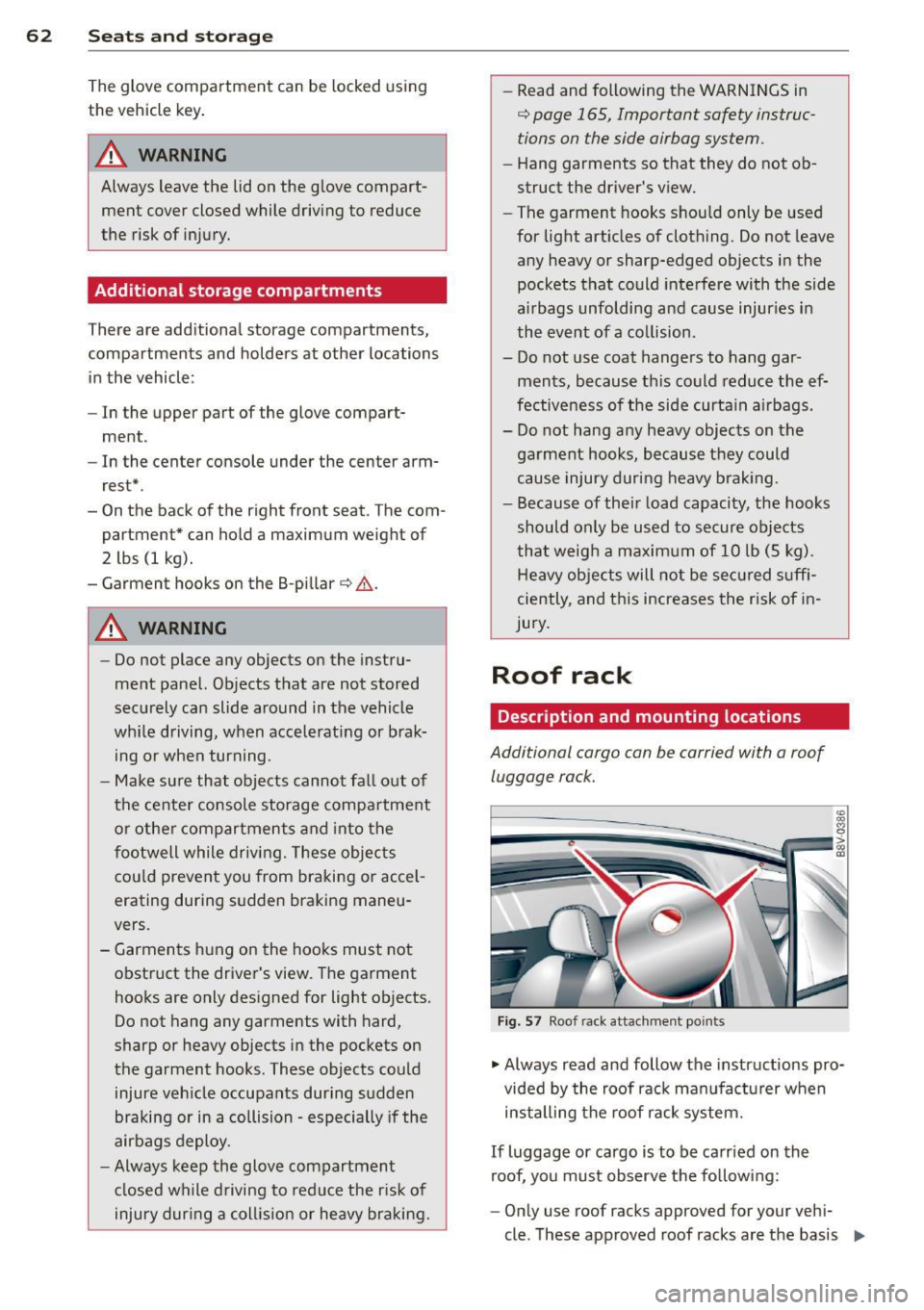
Additional cargo can be carried with a roof
luggage rack.
Fig. 57 Roof rack attachment po ints
• Always read and follow the instructions pro
vided by the roof rack manufacturer when
installing the roof rack system.
If luggage or cargo is to be carried on the
roof, you must observe the following:
- Only use roof racks approved for your vehi-
cle. These approved roof racks are the basis ..,
Page 65 of 310
M N
0 > co ,...., \!) 1.1'1
M 1.1'1 ,....,
for a complete roof rack system. Additiona l
attachments or carrier systems are needed
to transport luggage and sports equipment.
We recommend using roof racks from the
Audi original accessories program.
- When installing the roof rack, make sure it
is only mounted on the designated locations
on the roof¢
fig. 57.
-We recommend that you keep the installa
tion instructions for your roof rack system
together with your Owner's literature in the
vehicle .
When should the roof rack be remo ved ?
-Before going through an automatic car wash
(it is best to ask the car wash operator for
advice).
- When not in use, to reduce fuel consump
t ion, w ind no ise and to guard against theft .
A WARNING
-Use of an unapproved roof rack or incor
rect mount ing of an approved roof rack
can cause the roof rack or the items at
tached to it to fa ll off the roof onto the
road.
- Objects fall ing from the roof of a veh icle
can cause a c rash and persona l injury.
- Only mount the roof rack on the desig
nated locations on the roof¢
fig. 57.
-The roof rack system must be installed
exactly according to the instructions pro
vided.
- When driving w ith a roof rack system,
changes to the center of g ravity and wind
resistance can change the veh icle han
dling and lead to a collision. A lways
adapt your driving and your speed to the
c u rrent conditions.
(D Note
- Your veh icle warranty does not cover any
damages to the veh icle caused by using
r oof racks or mo unting structures not
approved by Audi for your vehicle. The
same applies to damage resulting from i ncorrect roof rack installation.
S eat s an d sto rage 63
- Always check the roof rack mountings
and hardware before each trip and dur
ing a trip to make s ure everyth ing is se
curely tightened. If necessary, ret ighten
the mountings and check the entire sys
tem from time to time.
- After mount ing a roof rack system, or
when you transport objects on the roof
of your vehicle, the height of the veh icle
is naturally increased . Be careful when
dr iving unde r low bridges or in parki ng
garages for example. This cou ld cause
damage to the load and even the vehicle
itself .
- Make sure the open rear lid and the sun
roo f* do not come in to contact with the
roo f rac k.
Loading the roof rack
Always distribute loads evenly. Make sure
anything on the roof rack is securely tied
down .
.,. Always dis tribute the loads on the roof rack
even ly .
.,. Always attach items to the roof rack securely
before you drive off .
T he maxim um permissible roof we ight is
1 6 5 lb (75 kg ). The roof weight is the total of
the weight of the roof rack, the attachments
and the cargo you are carrying. You must a lso
not exceed the maximum load weight for the
roof rack you are using.
When using a roof rack system which has a
lower load carrying capacity, you must not use
up the tota l maximum permissible load carry
ing capacity specified above. Instead, you
should load the roof rack system only to the
max imum capacity specified by the manufac
ture r of the roof rack system .
A WARNING
Weak, damaged or imprope r straps used
to secure items to the roof rack can fail
during ha rd braking o r in a coll is ion and
cause ser ious persona l injury .
.
•
Page 66 of 310
64 Seats and storage
-Make sure the roof rack is installed exact
ly as specified above
r::;, page 62.
- Always use suitable mounting straps for
securing items to the roof rack to help
prevent items from shifting or flying for
ward.
- Items on the roof rack must always be
securely mounted.
- The use of a roof rack can negatively af
fect the way a vehicle handles. Cargo
that is large, heavy, bulky, long or flat
will have a greater negative influence on
the vehicle's aerodynamics, center of gravity and overall handling. Always
drive slowly, avoid sudden braking and
maneuvers when transporting cargo on
the roof of your vehicle.
- Never exceed the maximum permissible
load carrying capacity of the roof of your
vehicle, the permissible axle weights and
the permissible total weight of your veh i
cle
r::;, page 286, Weights.
@ For the sake of the environment
As a result of the increased wind resist
ance created by a roof rack, your vehicle is
using fuel unnecessarily. So remove the
roof rack after using it .
Luggage compartment
Loading luggage compartment
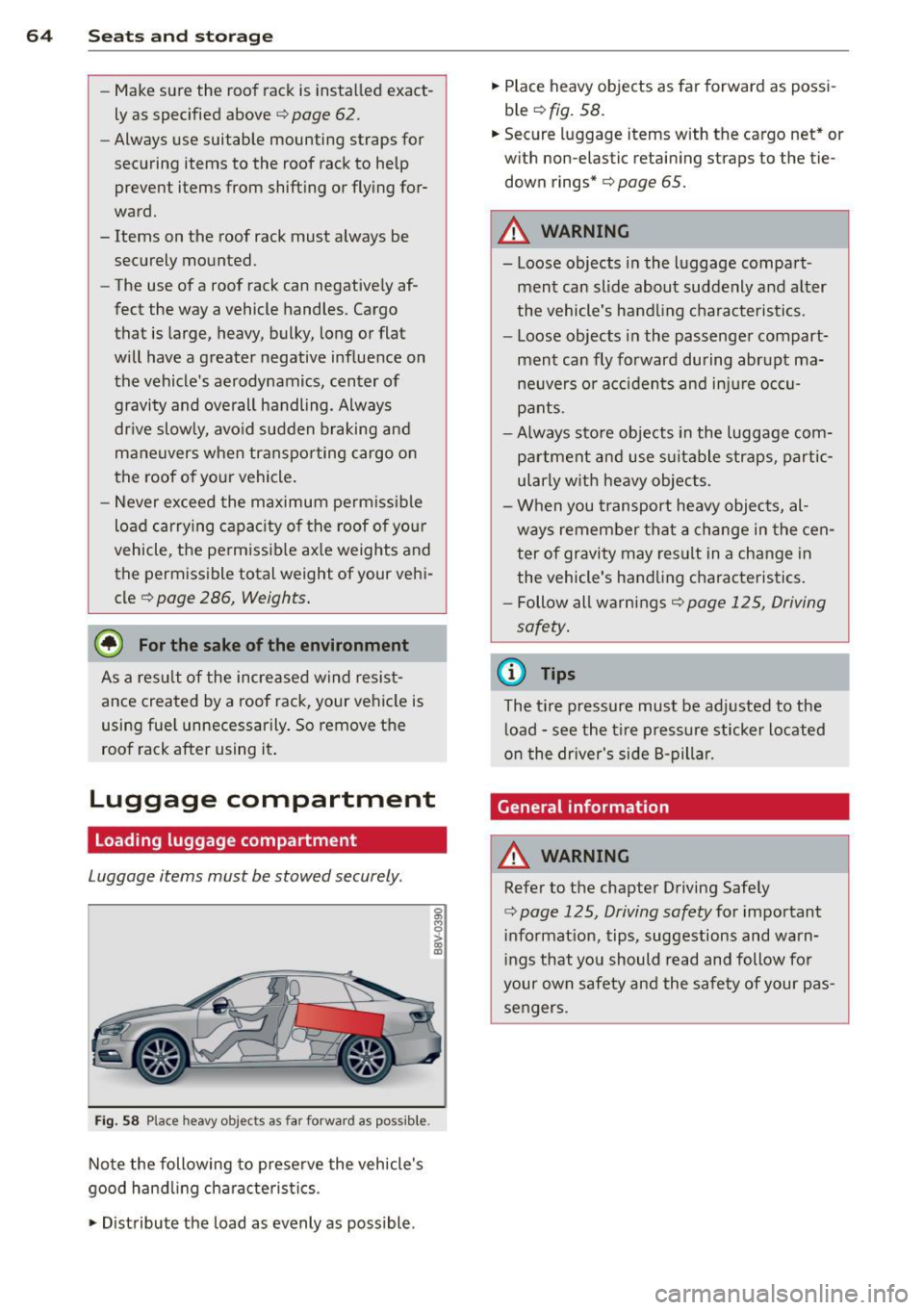
Luggage items must be stowed securely .
Fig. 58 Place heavy objects as far forward as possible.
Note the following to preserve the vehicle's
good handling characteristics .
.,. Distribute the load as evenly as possible .
0
s
> "' m
.,. Place heavy objects as far forward as possi
ble
r::;, fig. 58.
.,. Secure luggage items with the cargo net* or
with non-elastic retaining straps to the tie
down rings*
r::;, page 65.
A WARNING
- Loose objects in the luggage compart
ment can slide about suddenly and alter
the vehicle's handling characteristics.
- Loose objects in the passenger compart
ment can fly forward during abrupt ma
neuvers or accidents and injure occu
pants.
- Always store objects in the luggage com
partment and use suitable straps, partic
ularly w ith heavy objects.
- When you transport heavy objects, al
ways remember that a change in the cen
ter of gravity may result in a change in
the vehicle's handling characteristics.
- Follow all warnings
¢page 125, Driving
safety.
'
(D Tips
The tire pressure must be adjusted to the
load -see the tire pressure sticker located
on the driver's side B-pillar.
General information
A WARNING ,-
Refer to the chapter Driving Safely
r::;, page 125, Driving safety for important
information , tips, suggestions and warn
ings that you should read and follow for
your own safety and the safety of your pas
sengers .
Page 68 of 310
66 Seats and st o rage
• Observe the safety notes q page 132 , Tie-
downs.
Due to the laws of phys ics , even small objects
that are loose in the vehicle can become heavy
p rojectiles and cause serious inj uries during a
collision . Objects in the vehicle inc rease in ki
neti c energy, wh ich varies depend ing on the
vehicle and the we ight of the objec t. The vehi
cle speed is the most important factor in t his.
F or example: In a fronta l impact at a speed of
30 mph (48 km/h). the weight of a 10 lb
(5 kg) object increa ses to approxima tely
20 times its normal weight due to the forces
acting upon it . This means the we ight of the
object is suddenly equ ivalent to approximate
ly 200 lb (90 kg) . It is easy to imagine the
type of injuries a n objec t of that weight could
cause if it slides thro ugh the passenger com
pa rtment unrestrained during a collision at a
re lative ly low speed.
A WARNING
Weak, damaged or faulty straps used to
secure objects to the tie-downs can fa il
during heavy braking or a collision and
lead to serious injuries .
- Always use suitable straps and secure
objects to the t ie-downs in the luggage
compartment to prevent objects from
shifting and slid ing fo rward.
- Never secure a ch ild seat restraint to a
t ie-down .
- Because of their load capacity, the hooks
should only be used to secu re objects
that weigh a max imum of 10 lb (5 kg) .
Heavy objec ts will not be secured suffi
c iently, a nd this increases the risk of in
jury.
Storage hooks
Applies to vehicles: with bag hooks
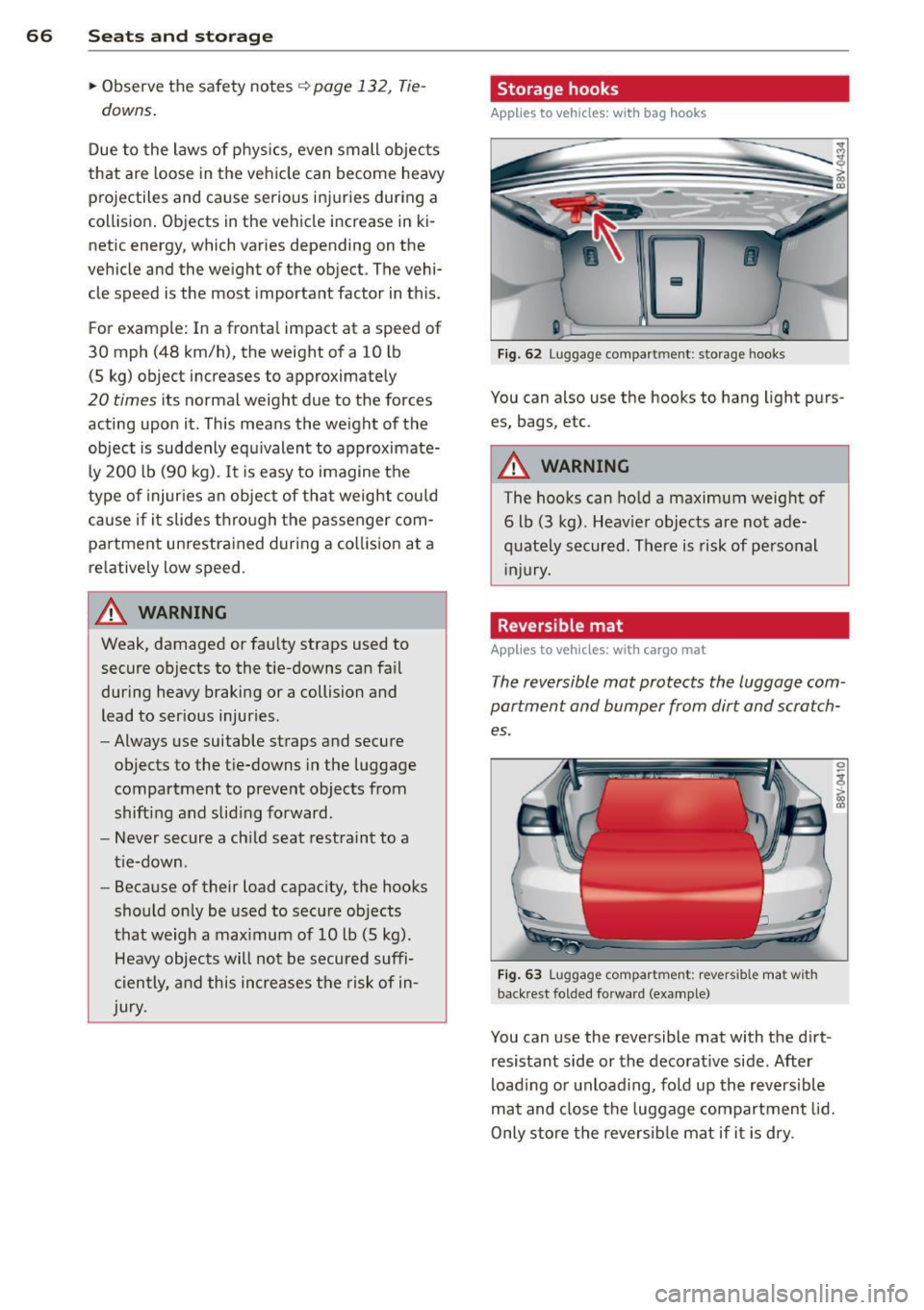
F ig. 62 Lugg age compart men t: s torage hooks
You can also use the hooks to hang light purs
es, bags , etc .
A WARNING
-The hooks can ho ld a maximum weight of
6 lb (3 kg). Heav ier objects are not ade
q uate ly secured . Th ere is risk of personal
Injury.
. Reversible mat
Applies to vehicles: with cargo mat
The reversible mat protects the luggage com
partment and bumper from dirt and scratch
es.
F ig . 63 Lu gg age compar tment: re vers ible mat w it h
back re st fo lded fo rwa rd (example)
You can u se the reversible mat with the d irt
resistant side or the decorat ive side. After
load ing or unload ing, fold up the revers ible
mat and close the luggage compartment lid.
Only store the reversib le mat if it is dry .
Page 134 of 310
132 Driving saf ety
A WARNING
Heavy loads will influence the way your ve
hicle handles. To help reduce the risk of a
loss of control leading to ser ious personal
injury:
-Always keep in m ind when transporting
heavy objects, that a change in the cen
ter of gravity can also cause changes in
vehicle handling:
- Always distribute the load as evenly as
possible.
- Place heavy objects as far forward in
the luggage compartment as possible.
- Never exceed the Gross Ax le Weight Rat
ing or the Gross Vehicle Weight Rating
specified on the safety compliance stick
er on the left door jamb. Exceeding per
missible we ight standards can cause the
vehicle to slide and handle differently.
- Please observe information on safe driv
ing
opoge 125.
A WARNING
To help prevent poisonous exhaust gas
from be ing drawn into the veh icle, always
keep the rea r lid closed while dr iving.
- Never transport objects larger than those fitting completely into the luggage
area because the rear lid cannot be fully
cl osed.
- If you absolutely must drive w ith the rear
lid open, observe the follow ing notes to
reduce the risk of poisoning:
- Close all w indows,
- Close the power roof *,
- Open all air outlets in the instrument
panel,
- Sw itch off the air recircu lation,
- Set the fresh a ir fan to the highes t
speed.
A WARNING
Always ma ke s ure th at the doors, all win
dows, the power roo f* and the rear lid are
securely closed and locked to reduce the risk of injury when the vehicle is not being
used.
- After closing the rear lid, always make
sure that it is properly closed and locked.
- Never leave your vehicle unattended es
pecially with the rear lid left open. A
child cou ld craw l into the vehicle thro ugh
the luggage compartment and close the rea r lid becoming trapped and unable to
get out. Being t rapped in a vehicle can
lead to serious pe rsonal in jury.
- Never let children play in or around the veh icle.
- Never let passengers ride in the luggage
compa rtment. Vehicle occupants must
always be prope rly restra ined in one of
the vehicle's seating posit ions.
(D Tips
- Air circulation helps to reduce window
fogging. Stale a ir escapes to the outside
through vents in the t rim panel. Be sure
to keep these slots free and open.
- The tire pressure m ust correspond to the
load. The tire pressure is shown on the
t ire pressure label. The tire pressure la
bel is located on the drive r's side B-pilla r.
The tire pressure label lists the recom
mended co ld tire inflation pressures for
the vehicle at its maxim um capacity
we ight and the tires that we re on your
vehicle at the t ime it was manufactured.
For recommended tire pressures for nor
ma l load cond itions, please see chapter
opoge240.
Tie -downs
The luggage comportment is equipped with
four tie-downs to secure luggage and other
items.
Use the t ie-downs to secure your cargo prop
erly
o page 131, Loading the luggage com
portment .
In a collision, the laws of physics mean that
even smaller items that are loose in the vehi-
cle w ill become heavy missiles t hat can cause .,..
Page 135 of 310
serious injury. Items in the vehicle possess en
ergy which vary with vehicle speed and the
weight of the item. Vehicle speed is the most
significant factor.
F or example, in a frontal collision at a speed
of 30 mph (48 km/h), the forces acting on a 10- lb (4.5 kg) object are about 20 times the
normal weight of the item. This means that
the we ight of the item would suddenly be
about 200 lbs . (90 kg) . You can imagine the
injuries that a 200 lbs. (90 kg) item flying
freely through the passenger compartment
could cause in a collision like t his.
_& WARNING
Weak, damaged or improper straps used
to secure items to t ie-downs can fail dur
ing hard braking or in a collision and cause
ser ious personal injury .
- Always use suitable mounting straps and
properly secure items to the tie-downs in
the luggage compartment to help pre
vent items from shifting or flying for
ward as dangerous miss iles.
- When the rear seat backrest is folded
down, always use su itab le mounting
straps and properly secure items to the
t ie -downs in the luggage compartment
to help prevent items from flying for
ward as dangerous miss iles into the pas
senger compartment.
- Never attach a child safety seat tether
strap to a tie-dow n.
Reporting Safety
Defects
Applicable to U.S.A.
If yo u beli eve that your vehicl e
h as a def ect w hich co uld cause
a c rash o r could cause injur y or
~ death , yo u should immedi ately
0
iii inform the N atio nal High way
Tr affic S afe ty Admini stration
Dri ving s afe ty 133
(NHT SA) in addi tio n to notif y
ing A udi of A m erica, Inc.
If NHTSA r ecei ves similar com
plaint s, it may open an in ve sti
gation , and if it finds that a
s af ety defe cts exis ts in a gr oup
of vehicle s, it ma y ord er a recall
a nd r em edy campa ign. Ho wev
e r, NHTS A cannot become in
v ol ved in indi vidu al problem s
bet ween y ou, your dealer , or
A udi of America, Inc.
T o conta ct the NHTSA, you m ay
e ither c all :
T e l.: 1-888-32 7-423 6 (TTY :
1-800-4 24-9 153) or
1-800-424-939 3
or you ma y write to:
NHTSA
U .S. Depar tment of Tran sp o rt a
tion 1200 N ew Jersey Av e., S. E.
Wes t Buil ding
W ashington , D C 2 0590
You can als o obtain other infor
mation about m otor vehicl e
s af ety from:
h tt p: //www .sa fe rc ar. gov
•
•
•
Page 138 of 310
136 Safet y belt s
-Failure to pay attention to the warning
light that come on, could lead to person
al injury.
Why safety belts?
Frontal collisions and the law of physics
Frontal crashes create very strong forces for
people riding in vehicles.
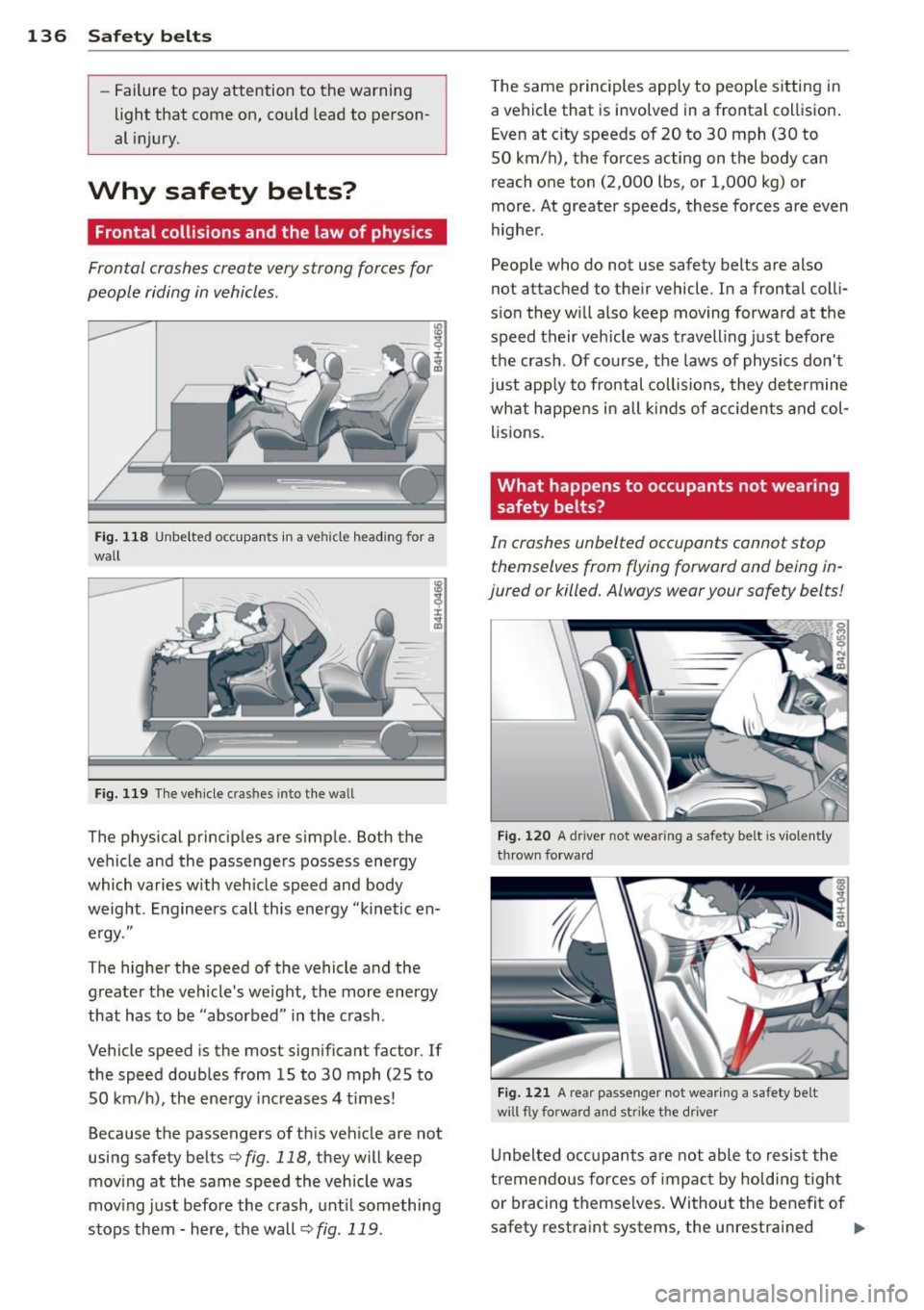
F ig. 11 8 Unbelted occ upants in a ve hicle h eading for a
wall
Fig. 1 19 Th e vehicle c rash es into t he wall
The physical principles are simple. Both the
vehicle and the passengers possess energy
which varies w ith veh icle speed and body
weight . Engineers call this energy "kinetic en
e rgy ."
T he higher the speed of the vehicle and the
g reater the vehicle's we ight, the more energy
that has to be "absorbed" in the crash .
Vehicle speed is the most sign ificant factor.
If
the speed doubles from 15 to 30 mph (25 to
50 km/h), the energy increases 4 t imes!
Because the passengers of this veh icle are not
using safety belts
c::;, fig. 118, they w ill keep
mov ing at the same speed the vehicle was
mov ing just before the c rash, unt il something
stops them - here, the wall ¢
fig. 119 .
The same principles apply to people sitting in
a vehicle that is involved in a frontal collision .
Even at c ity speeds of 20 to 30 mph (30 to
50 km/h), the forces acting on the body can
reach one ton (2,000 lbs , or 1,000 kg) or
more . At greater speeds, these forces are even
highe r.
Peop le who do not use safety belts are also
not attached to their vehicle. In a frontal colli
s io n they will also keep moving forward at the
speed their veh icle was t ravell ing just before
the crash . Of co urse, the laws of physics don't
just app ly to frontal collisions, they determine
what happens i n all kinds of acc idents and col
lisions .
What happens to occupants not wearing
safety belts?
In crashes unbelted occupants cannot stop
themselves from flying forward and being in
jured or killed. Always wear your safety belts!
F ig . 120 A d river not wea ring a safety b elt is viol en tly
thrown fo rwa rd
F ig . 12 1 A rear passe nge r no t wea ring a safety be lt
w ill fl y forward a nd strike the dr iver
Un belted oc cupants a re not able to resist the
t remendous forces o f impac t by ho lding tight
o r bracing themse lves. Withou t the benefit of
safety restraint systems , the unrestrained
ll-
Page 148 of 310
146 Airbag sys te m
and dia gnostic equipmen t to pro perly re
place any a irbag in y our vehicle and
assure system eff ectiveness in a crash.
- Never permit salvaged or recycle d air
bags to be installed in your veh icle.
Child restraints on the front seat - some
important things to know
~ Be sure to read the important informat ion
and heed the WARNINGS for important de
ta ils about ch ild ren and Advanced Airbags
Qpage 170.
Even though your vehicle is equ ipped with an
Advanced Airbag System, make certain that
all c hildren, especially those 12 years and
younger, a lways ride in the back seat properly
restrained for their age and size . The airbag
on the passenger side makes the front seat a potentially dangerous place for a child to ride.
The front seat is not the safest place for a
child in a forward-facing child seat. It can be a
ve ry dangerous place for an infant or a ch ild in
a rearward-facing seat.
The Advanced Airbag System in your veh icle
has been certified to comply with the require
ments of United States Federal Motor Veh icle
Safety Standard 208 as applicable at the time
your ve hicle was manufactured.
The Standard requires the front a irbag on the
passenger side to be turned off ("sup
p ressed") if a ch ild up to about one year of
age restra ined in one of the rear-facing o r fo r
ward-facing infan t restra ints listed in Federal
M otor Vehicle Safety Standard 208 with w hich
the Advanced A irbag System in your vehicle
was certified has been installed on the front
passenger seat. Fo r a listing of the child re
straints that were used to certify compliance
with the US Safety Standard
Q page 172.
The PASSENGER AIR BAG OFF light in the in
strument panel te lls you when the front Ad
vanced Airbag on the passenger side has been turned off by the e lectronic control unit. E
ach time you switch on the ignition, the
PAS
SENGER AIR BAG O FF
light will come on for a
few seconds and :
- w ill stay on if the front passenge r seat is not
occupied,
- w ill stay on if the e lec trica l ca pa citance
meas ured by the capacitive passenger de
tection system for the front passenger seat equa ls the combined capacitance of an in
fant up to about one year of age and one of
the rearward-facing or forward-fac ing ch ild
restraints listed in Federal Motor Vehicle
Safety Standard 208 with wh ich the Ad
vanced Airbag System in your vehicle was
cert ified . For a listing of the chi ld restraints
tha t were used to certify you r vehi cle's com
p lia nce w it h t he U.S. Safety Standard
Q page 172.
-w ill stay on i f there is a small ch ild or child
restraint on the front passenge r seat,
- will go off if the front passenger seat is oc
cupied by an adult as registered by the ca
pacitive passenger de tection system
c::> page 156, Monitoring the Advanced Air·
bag System.
The PASSENGER AIR BAG OFF light comes on
when e lectrica l capacitance registered on the
front passenger seat is eq ua l to or less tha n
the comb ined capacitance of a typica l 1 year
o ld infant and one of the rearward-facing or
forward-facing chi ld restraints listed in Feder
al Motor Vehicle Safety Standard 208 with
wh ich the Advanced Airbag System in your ve
hicle was certified.
If the total electr ica l capacitance registered
on the front passenger seat is more than that
of a typical 1 year -o ld child but less than the
weight of a small adult , the front airbag on
t h e passenger side can deploy (the
PASSEN
GER AIR BAG OFF
light does not come on).
If the
PASSENGER AIR BAG OFF light does
not come on, the front airbag on the passen
ger side has not been turned off by t he e lec
t ro ni c cont ro l unit and can deploy if the con
t ro l uni t se nses an impact tha t mee ts the con-
di tions stored in its memory .
1J1>
Page 152 of 310
150 Airbag sys te m
U.S. Federal Standard if a chi ld with elec
trical capac itance greater than the com
bined capacitance of a typical one-year
old infant restra ined in one of the for
ward fac ing or rearward-fac ing ch ild
seats with which your vehicle was certi
fied is on the front passenger seat and
the other conditions for airbag deploy ment are met.
- Acc ident statist ics have shown that chil
dren are generally safer in the rear seat
area than in the front seating posit ion .
- For their own safety, all chi ldren, espe
ci ally 12 years and younger, sho uld a l
ways ride in the back properly rest rained
for their age and size .
Advanced front airbag system
Your vehicle is equipped with a front Advanced
Airbag System in compliance with United
States Federal Motor Vehicle Safety Standard
208 as applicable at the time your vehicle was manufactured.
The front Advanced Airbag System supple ments the safety belts to provide addit ional
protection for the driver's and front passeng
er's heads and upper bodies in frontal crashes .
The airbags inflate only in frontal impacts
when the vehicle dece le rat io n is high enoug h.
The front Advanced Airbag System for the
fro nt seat occupants is not a substitute for
your safety belts . Rather, it is part of the over
a ll occupa nt restraint system in your veh icle.
A lways remember that the airbag system ca n
on ly help to pro tect you, if you are s itting up
right, wearing yo ur safety belt and wearing it
properly. This is why you and yo ur passengers
must always be properly restrained, not just
beca use the law requires you to be.
The Advanced Airbag System in your veh icle
has been certified to meet the " low risk" re
qu irements for 3 and 6 year-o ld children on
the passenger side and very small adu lts on
the dr iver side. The low risk deployment crite
ria are intended to he lp reduce the risk of in
jury through interaction with the front airbag that can occur, for example, by being too
close to the steering wheel and instr ument
panel when the airbag inflates .
In add ition, the system has been cer tified to
comply with the "s uppression" requirements
of the Safety Standard, to turn off the front
airbag for infants up to 12 months who are re
stra ined on the front passenger seat in child
restraints that are listed in the Standard.
"Suppression" requires the front airbag on the
passenger side to be turned off if:
- a child up to abo ut one year o f age is re
st rained on the front passenger seat in one
of the rear -facing or fo rward -facing infant
restraints listed in Federal Motor Vehicle
Safety Standard 208 with which the Ad
vanced Airbag System in your vehicle was
cert ified . Fo r a listing of the chi ld restraints
that were used to certify you r vehicle's com
plia nce w ith the US Saf ety Standard
r::) page 172,
- When a person is detected on the front pas
senger seat that has an electrical capaci
tance that is more than the tota l elect rical
capacitance o f a child tha t is about 1 year
old rest rained in one of the rear- facing or
forward-facing infant restraints (listed in Federal Motor Vehicle Safety Standard 208
w ith which the Advanced A irbag System in
your veh icle was certified), the front airbag
on the passenger side may or may not de ploy.
The
PASSENGER AIR BAG OFF light comes on
when the electro nic control unit detects a to
ta l electrical capac itance on the front passen
ger seat that requ ires the front airbag to be
tu rned off. If the
PASSENGER AIR BAG OFF
light does not come on, the fro nt airbag o n
t h e passenger side has not been turned off by
the con trol un it and can deploy if the cont ro l
u nit senses an impact that meets the condi
tions stored in its memo ry .
If the total e lectr ic al c apaci tance regis tered
o n t he fron t passenge r se at is more than that
of a typical 1 year -o ld, but less than the
weight of a small adu lt, the front airbag on
ll-