ECU AUDI S3 2016 User Guide
[x] Cancel search | Manufacturer: AUDI, Model Year: 2016, Model line: S3, Model: AUDI S3 2016Pages: 328, PDF Size: 81.78 MB
Page 68 of 328
Sea ts and stor age
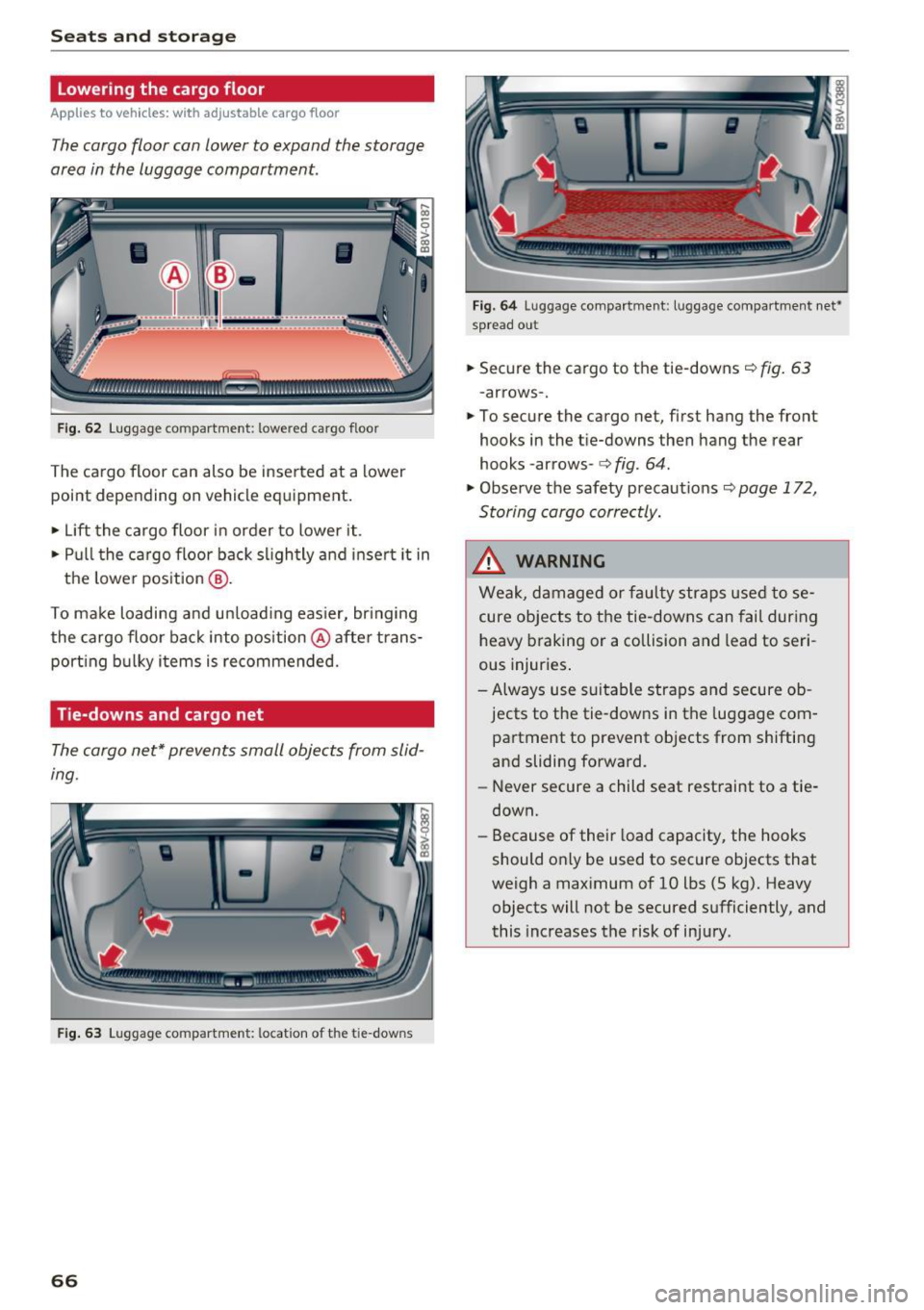
Lowering the cargo floor
Applies to veh icles: w ith adj ustable cargo f loor
The cargo floor can lower to expand the storage
area in the luggage compartment.
F ig. 62 L uggage compartment: lowered cargo floor
The cargo floor can also be inse rted at a lower
point depending on vehicle eq uipment .
., Lift the cargo floor in order to lower it.
., Pull the cargo floor back slightly a nd insert it in
the lowe r pos it ion
@ .
To make loading and un load ing eas ier, br inging
the cargo floo r back into position @ afte r trans
port ing b ulky i tems is recommended.
Tie-downs and cargo net
The cargo net* prevents small objects from slid
ing.
F ig . 63 Luggage compartment: location of the tie -downs
66
F ig. 6 4 Luggage compartment: luggage compartment net•
spread out
., Secure the cargo to the tie-downs c::> fig. 63
-arrows- .
., To secure the cargo net, first hang the front
hooks in the tie-downs then hang the rear
hooks -arrows-
c::> fig. 64.
., Obse rve
the safety precaut ions c::> page 172,
Storing cargo correctly .
.&_ WARNING
Weak, damaged or fau lty straps used to se
cure objects to the tie-downs can fail during
heavy braking or a co llision and lead to seri
ous injur ies .
- Always use s uitable straps and secure ob
jects to the tie-downs in the luggage com
partment to prevent objects from shifting
and sliding forward.
- Never secure a child seat restraint to a tie
down.
- Because of their load capacity, the hooks
should only be used to secure objects that
weigh a maximum of 10 lbs (5 kg). Heavy
objects will not be secured sufficiently, and
this increases the risk of inju ry.
-
Page 69 of 328
.... N
0 > CX)
rl I.Cl U"I
rl I.Cl ....
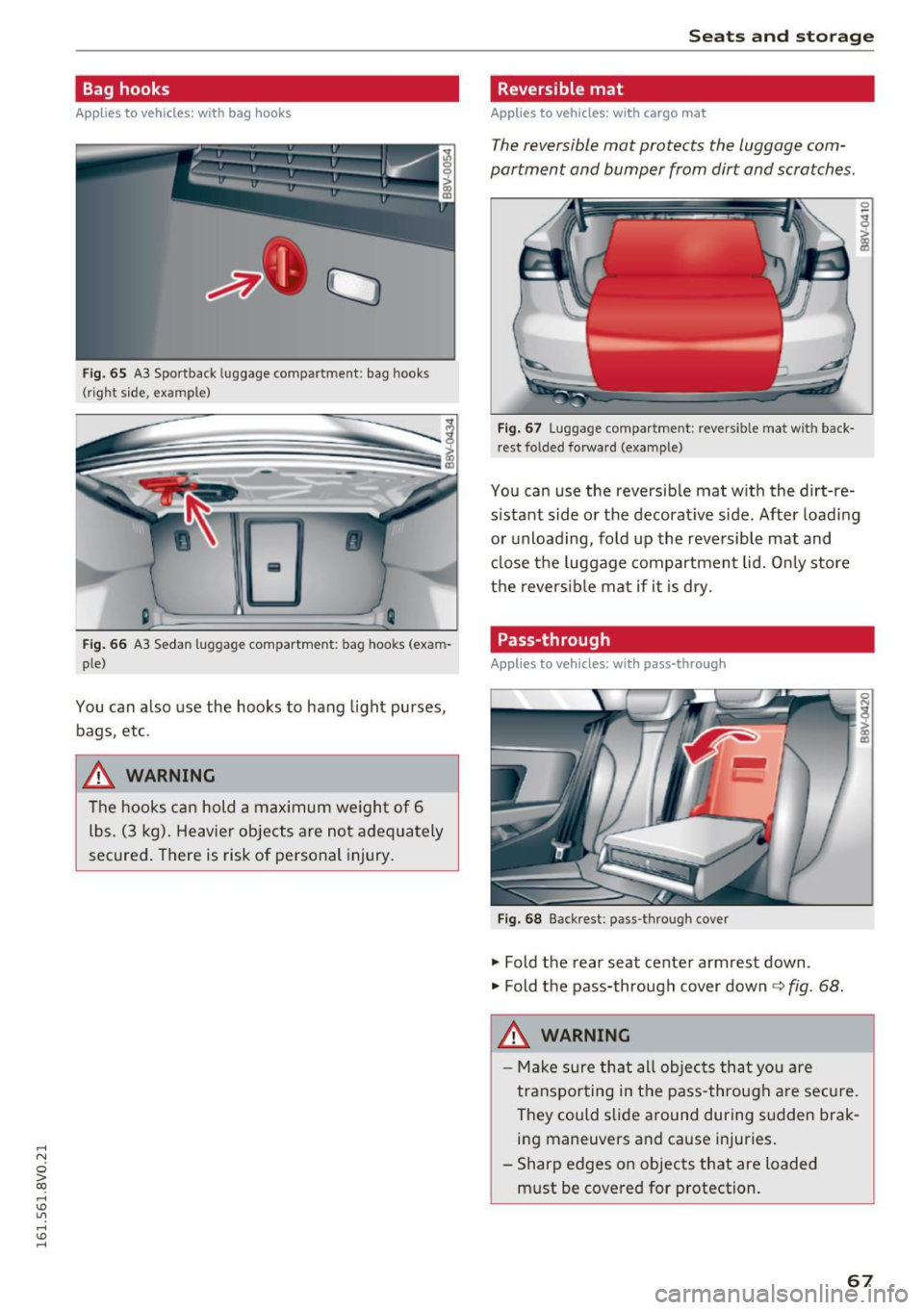
Bag hooks
Applies to vehicles: with bag hooks
Fig. 65 A3 Sportba ck luggage com part men t: bag hook s
( r igh t sid e, e xampl e)
Fig. 66 A3 Sed an luggag e compartmen t: bag hoo ks (exa m
p le )
You can also use the hooks to hang light purses ,
bags , etc.
_&. WARNING
The hooks can hold a maximum weight of 6
lbs. (3 kg). Heavier objects are not adequately
secured. There is risk of personal injury.
Seats and storage
Reversible mat
Applies to vehicles: with cargo mat
The reversible mat protects the luggage com
partment and bumper from dirt and scratches.
Fig. 67 Lugg ag e compar tment: re ve rs ib le ma t w it h back
rest folded forward (example)
You can use the reversible mat with the dirt-re
sistant side or the decorative side. After loading
or unloading, fold up the reversible mat and
close the luggage compartment lid. Only store
the reversible mat if it is dry.
Pass-through
Appl ies to vehicles: with pass-through
Fig. 68 Backrest: pass -thro ugh cover
.,. Fold the rear seat center armrest down .
.,. Fold the pass-through cover down¢
fig. 68.
_&. WARNING
- Make sure that all objects that you are
transporting in the pass-through are secure.
They could slide around during sudden brak ing maneuvers and cause injuries .
- Sharp edges on objects that are loaded must be covered for protection.
67
Page 70 of 328
Sea ts and stor age
Roof rack
Description and mounting locations
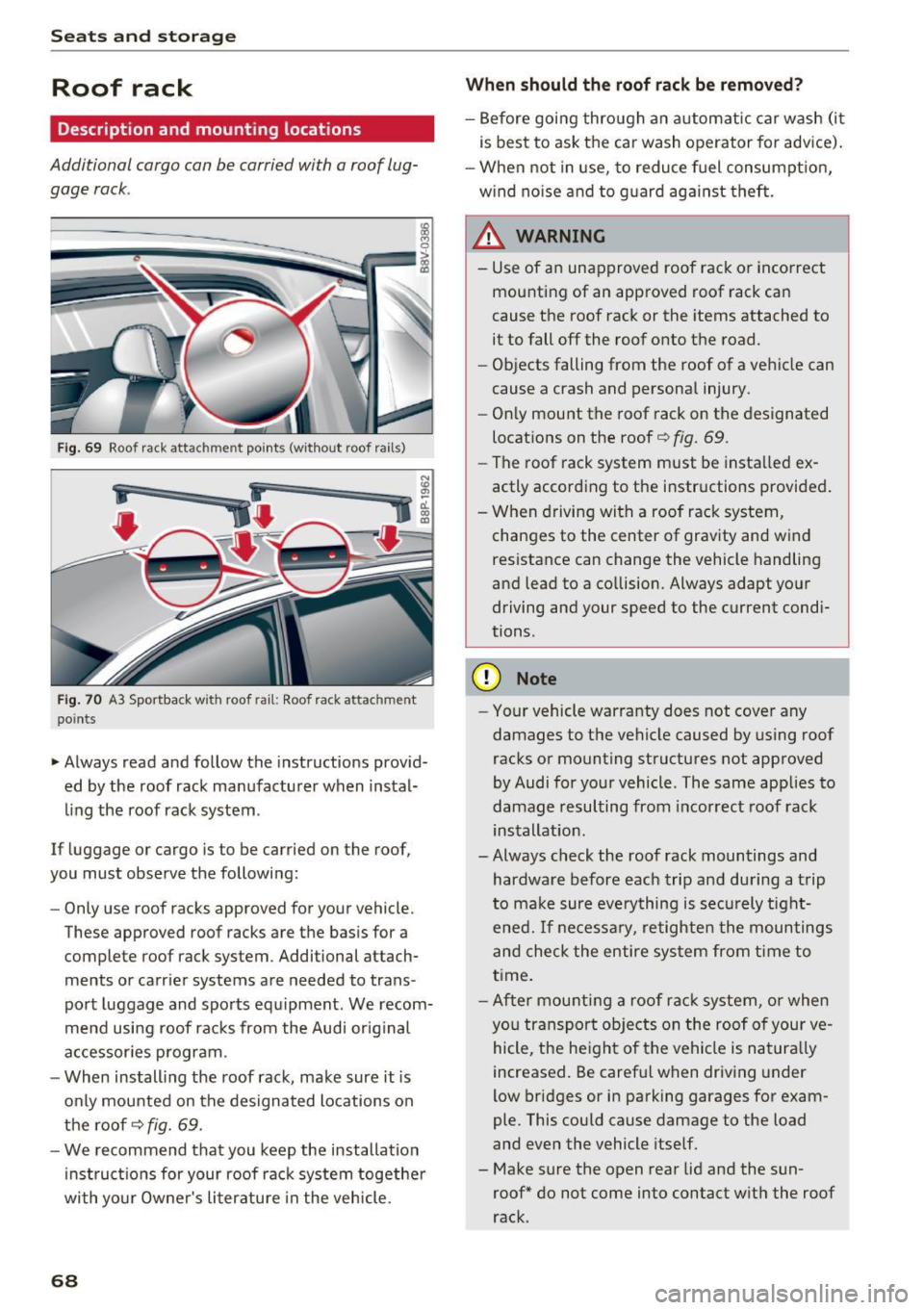
Additional cargo can be carried with a roof lug
gage rack.
Fig. 69 Roof rack attachment points (w it h out roof rails)
Fig. 70 A3 Sportback w ith roof rail: Roof rack attac hment
points
" Always read and follow the instructions prov id
ed by the roof rack manufacturer when instal
ling the roof rack system .
If luggage or cargo is to be carried on the roof,
you must observe the followi ng:
- Only use roof racks approved for your vehicle.
These approved roof racks are the basis for a
complete roof rack system. Additional attach
ments o r carrier systems are needed to trans
po rt luggage and sports equ ipment. We recom
mend using roof racks from the Aud i orig inal
accessor ies program.
- When ins tall ing the roof rack, make sure it is
o nly mounted on the designated locations on
the roof
r=;, fig. 69.
- We recommend that you keep the installation
inst ruct ions for your roof rac k system togethe r
with yo ur Ow ner's li teratu re in the vehicle.
68
When should th e roof rack be removed?
- Before goi ng through an automatic car wash (it
is best to ask the car wash operator for advice).
- When not in use, to reduce fuel consumpt ion,
w ind no ise and to g uard aga inst theft.
_& WARNING
- Use of an unapproved roof rack or incorrect
mounting of an approved roof rack can
cause the roof rack or the items attached to
it to fall off the roof onto the road.
- Objects falling from the roof of a vehicle can
cause a crash and personal injury.
- On ly mount the roof rack on the designated
locations on the roof
r=;, fig. 69.
- The roof rack system must be insta lled ex
actly according to the i nstr uctions provided.
- When drivi ng with a roof rack system,
changes to the center of gravity and wind
resistance can change the vehicle handling
and lead to a co llision. Always adapt yo ur
driving and your speed to the current condi
tions.
(D Note
- Your vehicle warranty does not cove r any
damages to the vehicle caused by using roof
racks or mounting structures not approved
by Audi for yo ur vehicle . The same applies to
damage resulting from incorrect roof rack
ins tallation.
- Always check the roof rack mountings and hardwa re before each trip and du ring a t rip
to ma ke sure eve ry t hing is securely tight
ened. If necessa ry, retighte n the mountings
and che ck the entire sys tem from time to
t ime.
- After mou nting a roof rac k system, o r when
yo u transport ob jects on the roof o f your
ve
hicle, the he ight of the vehicle is natura lly
increased. Be careful when driving under
low bridges or in parking garages for exam
ple. This could cause damage to the load
and
even the vehicle itself.
- Make sure the open rear lid and the sun
roof" do not come into contact w it h the roof
rack.
Page 71 of 328
,....,
N
0 > co ,....,
Always distribute loads evenly. Make sure any
thing on the roof rack is securely tied down .
11-Always distribute the loads on the roof rack
evenly .
11-Always attach items to the roof rack securely
before you drive off.
The maximum permiss ible roof weight is
165 lb
( 7 5 kg ). The roof weight is the total of the
weight of the roof rack, the attachments and the
cargo you are carrying. You must also not exceed
the maximum load weight fo r th e roof rac k you
are using.
When us ing a roof rack system wh ich has a lower
l oad carry ing capacity, you must not use up the
to ta l maximum permissible load car rying capaci
ty specified above. Instead, you s hou ld load the
r oof rack system only to the maximum capac ity
specified by the manufacturer of the roof rack
system .
A WARNING
Weak, damaged or improper straps used to
secure items to the roof rack can fa il during
hard braking or in a collision and cause seri
ous personal injury.
- Make sure the roof rack is installed exactly
as spec ified above
c> page 68.
- Always use su itab le mounting straps for se
curing items to the roof rack to help prevent
items from shifting or fly ing forward .
- Items on the roof rack must always be se
curely mounted.
- The use of a roof rack can negatively affect
the way a vehicle handles. Cargo that is
large, heavy, bulky, long or flat will have a
greate r negative influence on the vehicle's
aerodynamics, cente r of g ravity and ove rall
hand lin g. A lways d rive slowly, avoid sudden
bra king and mane uvers when transpo rting
cargo on the roof of you r vehicle .
- Never exceed the maxim um permissible
load carrying cap aci ty of the roof of you r ve
hicle, the permissib le ax le weigh ts and the
permissible total weight of your vehicle
c> page 301, Weights.
-
Seat s and sto rage
{® For the sake of the environment
As a result of the increased wind resistance
created by a roof rack, your vehicle is using
fuel unnecessarily. So remove the roof rack
after using it.
69
Page 78 of 328
Warm and cold
outlet, regardless of whether it is protected
against a short circuit or not.
- Always disconnect the connector cable and
close the cover
(D before starting the engine.
.&_ WARNING
Using the engine preheater incorrectly can
cause short circuits, electric shocks, fire, seri
ous injuries and death.
- The connector cable must always be con
nected to a grounded 120 Volt socket that
is equipped with a GFI circuit breaker . Al
ways protect the sockets from water, mois
ture and other fluids .
- Never plug the engine preheater into a con
ventional outlet, regardless of whether it is protected against a short circuit or not .
.&_ WARNING
-
Short circuiting, fire, serious injuries and life
threatening or lethal electric shock can result
from using unsuitable or damaged sockets and connector cables/extension cords, using
electrical equipment incorrectly, and/or disre
garding general safety precautions.
- Always plug the extension cord into a 120 V
socket that is properly functioning, ground
ed, equipped with a GFI circuit breaker and
is protected against water, moisture and
other fluids.
- Never connect the engine preheater to a
conventional socket, even if the socket is
protected by a fuse.
- Always check the fuse on the 120 Volt GFI
socket before connecting the connector ca
ble to the engine preheater on the vehicle.
- Only use highly durable extension cords that
are class 12 or better and can be properly grounded to a three-prong wall socket with
a GFI circuit breaker . The extension cord
must not be longer than 100 feet (30 me
ters).
- Never use damaged connector cables, ex
tension cords or sockets . Always check the
connector cable, extension cord and sockets
for damage before using them. Damaged
parts must be replaced. If damaged, replace
76
the engine preheater connector cable at an
authorized Audi dealer or authorized Audi
service facility .
- Only use the connector cable provided to
connect the vehicle socket to a suitable
power source. Use a suitable extension cord
if necessary .
- Always disconnect the connector cable from
the vehicle socket before starting the en
gine. Switch off the power supply to the
connector cable and to the extension cord if necessary, or disconnect the cable or exten
sion cord from the 120 Volt socket equip
ped with a GFI circuit breaker. Never leave
the connector cable or extension cord con
nected to a live power source.
- Never make alterations or repairs to the
connector cables or extension cords that
supply power to the engine preheater or to
any components that affect the engine pre
heater.
- Always protect the connections from water,
moisture and other fluids. Always store the
connector cable and extension cord securely
and in a dry place when they are not being
used, and disconnect them from the power
source before storing .
(D Tips
Test the GFI circuit breaker once a month if
you use the engine preheater occasionally, and test it weekly if you use it regularly.
Page 88 of 328
Driving
brake provides various convenience and safety
functions.
When starting from a stop
- The integral hill start assist helps you when
driving by automatically releasing the parking
brake
c:;, page 87, Starting from a stop.
- When starting on inclines, the hill start assist
prevents the vehicle from unintentionally roll
ing back. The braking force of the parking brake
is not released until the wheels build up
enough driving force.
Emergency brake function
The emergency braking function ensures that the
vehicle can be slowed down even if the
standard
brakes fail c:;, page 87, Emergency braking
function.
A WARNING
- Do not press the accelerator pedal inadver
tently when the vehicle is stationary and the engine is running and a gear is selected.
Otherwise the vehicle will start to move im
mediately and could result in a crash.
- If the power supply fails, the released park
ing brake can no longer engage. In this
case, park the vehicle on level ground and
secure it by placing the selector lever in the
P position . See an authorized Audi dealer or
authorized Audi Service Facility for assis
tance.
(D Note
If the . or .. (USA models) /. (Canada
models) indicator light in the instrument
cluster blinks, there is a malfunction in the
brake system. Refer to the detailed descrip
tion of the indicator lights
c:;, page 18.
-If the - (USA models) /. (Cana-
da models) or
Ill indicator light turns on,
there is a malfunction in the parking brake
c;, page 19.
@ Tips
-If the parking brake is set while the ignition
is switched off, the
¢~jj indicator light in the
button and in the instrument cluster dis-
86
play - (USA models) /. (Canada mod
els) will turn off after a certain amount of
time.
- If driver's door is opened while the ignition
is switched on, the parking brake sets auto
matically. This prevents unintended rolling
of the vehicle.
- Occasional noises when the parking brake is
set and released are normal and are not a
cause for concern.
- When the vehicle is parked, the parking
brake goes through a self-test cycle at regu
lar intervals. Any noises associated with this
are normal.
- If there is a power failure, the parking brake
will not set if it is released, and it will not release if it is set
c:;, I!:::,. . See an authorized
Audi dealer or authorized Audi Service Fa cility for assistance.
· Parking
.,. Press the brake pedal to stop the vehicle.
.,. Pull the switch @
c:;, page 85, fig. 80 to set the
parking brake.
.,. Place the selector lever in the P position.
.,. Turn the engine off
c:;, & -
.,. Turn the steering wheel when parking on in
clines so that the wheels will roll into the curb
if the vehicle starts moving.
A WARNING
- Always take the vehicle key with you when
leaving the vehicle, even for a short period
of time . This applies particularly when chil
dren remain in the vehicle. Otherwise chil
dren could start the engine, release the
parking brake or operate electrical equip
ment such as power windows, which in
creases the risk of an accident.
- When the vehicle is locked, no one -particu
larly not children -should remain in the ve
hicle. Locked doors make it more difficult
for emergency workers to get into the vehi
cle, which puts lives at risk.
Page 97 of 328

,....,
N
0 > co ,....,
Applies to vehicles: with launch control
The Launch Control Program enables maximum
acceleration .
Requirement: the engine must be at operating
temperature and the steering wheel must not be
turned .
.. With the engine running, press the
l~OFF ! but
ton briefly one time
ll .
.. Pull the selector lever back out of the D/S posi
tion briefly to select the S position, or press it
toward the right into the tiptronic pos ition or
select the
D ynami c driving mode in drive se
lect*
~page 148.
.. Press the b rake peda l firmly wi th you r left foot
and hold it all the way down for at least 1 sec
ond.
.. At the same time, press the gas pedal all the
way down with your right foot until the engine
reaches and stays at a high RPM level.
.. Remove your left foot from the brake.
A WARNING
-Always adapt yo ur driv ing to the traffic flow.
- Only use Launch Control when road and traf-
fic cond itions allow it and other dr ivers will
not be endangered or impacted by you r d riv
ing and the vehicle's accele ration.
- Please note that the drive whee ls can sp in
and the vehicle can break away when sport
mode is swit ched o n, especia lly when the
road is s lippery.
- Once t he vehicle has sta rted moving, press
the
I $? OFF ! button briefly to t urn the sport
mode off.
(D Tips
- The transmiss ion temperature may increase
s ignificantly after using the lau nch cont rol
program.
If that happe ns, the program m ay
l) In vehicles w ith a d river information system, an ESC light
in the instrument cluster stays o n continuous ly and the
message
Stabili za tion contro l (E SC ): sport . Warning! Re·
stricted st abi lity
appears temporar ily.
Autom atic tran sm iss ion
not be ava ilab le for a few minutes. It will be
avai lab le again after a cool-down period.
- Whe n accelerating using the launch contro l
program, all vehicle parts a re su bject to
heavy loads. This can lead to increased
wear.
Emergency mode
Applies to vehicles: wit h S tronic transmiss ion
In the event of o system mo/function, there is on
emergency program.
If all of the selector lever positions are hig hlight
ed with a light background in the instrument
cluster disp lay, there is a system malfunction and
the S tronic transmission is running in the emer
gency program. The vehicle can still be driven in
emergency mode, but only with reduced speed
and not in all gears . In some cases, the vehicle
cannot drive in rever se .
(D Note
If the transm ission runs in emergency mode,
drive to an authorized A udi dealer or author
iz ed Audi Se rvice Facility immed iate ly to have
the malfunc tion corrected.
Transmission malfunction
• Tran smi ssion malfunction ! Pl ea se stop the
vehicle and select P
The re is a ma lfunction in the transmission. Park
the vehi cle secure ly and do not cont in u e driv ing.
See a n author ized Audi dealer or au thori zed A udi
Service Facility for assis tance.
• Tran smission overheating! Plea se stop the
vehicle!
The transmiss ion is too hot and can become dam
aged. Stop and let the transmiss ion cool w ith the
engi ne r unning (at idle) in the P se lector lever po
s it ion. Then the ind icator lig ht and the message .,.
95
Page 98 of 328

Automatic transmission
turn off, drive to an authorized Audi dea ler or au
thorized Audi Service Facility immediate ly to have
the malfunction corrected . If the ind icator light
and the driver message do not turn off, do not
continue driving. See an authorized Audi dealer
or authorized Audi Service Facility for assistance .
rm Transmission malfunction: you can continue
driving
Drive to an autho rized Audi dea ler or authorized
Audi Service Facility immediately to have the
malfunct ion corrected .
rm Transmission malfunction: no reverse gear
(you can continue driving)
Drive to an authorized Aud i dea ler or authorized
Aud i Service Facility immediately to have the
malfunct ion corrected.
[O] Transmission malfunction: You can continue
driving in D until engine off
Drive the vehicle away from moving traffic and
park. See an authorized Audi dealer or authorized
Audi Service Facility for assistance .
rm Transmission overheating! Please adapt
driving style
Continue driving moderately. When the indicator
light turns off, you can continue driving normal
ly .
rm Transmission: Press brake pedal and select
gear again.
If the transmission malfunctions because the
temperature is too high, a message appears
when the transmission is cooled.
96
Selector lever emergency release
App lies to vehicles: wit h S tronic transmission
If the vehicle's power supply fails, the selector
lever can be released in an emergency.
Fig. 86 Se lector leve r: remov ing the cover
Fig. 87 Selector lever: us ing the emergency release to
move out of the Pa rk posit ion
The emergency release mechanism is located in
the right area under the selector lever shift gate.
Using the emergency release can be complicated.
We recommend contacting an authorized Audi
dealer or authorized Audi Service Facility for as
sistance, if necessary .
The screwdr iver from the vehicle tool kit located
i n the luggage compartment is needed to for the
eme rgency release¢
page 280 . Use the flat side
of the reversible screwdriver blade.
Removing the selector lever cover
.,. Set the parking brake(®)¢,& to secure your
vehicle from rolling .
.,. Insert the flat side of the screwdriver s ideways
in the slot near the s hift cover and pry the shift
cover up
¢ fig. 86 .
.,. Pull up the corners of the shift cover carefully
with your hands and fo ld it over the shifter
knob
¢ fig . 87. ..,.
Page 101 of 328
,....,
N
0 > co ,....,
mode, the status message
e-"'1 o I r.-.Al"'Y ap
pears briefly in the instrument cluster display
and the needle in the power meter points to
READY ¢page 101.
-Make sure that the selector lever is in the P
position and the ignition is switched off
when leaving the vehicle.
([) Note
-The high-voltage system can be damaged if
the vehicle underbody comes into contact
with the ground. Immediately drive your ve
hicle to an authorized repair facility and
have it inspected.
- The electric drive motor can become very
hot during operation . Do not stop the vehi
cle if there is oil, fuel residue or other flam
mable substances under or next to the vehi
cle.
Special considerations for the high-voltage
battery
Please first read and note the introductory infor
mation and heed the warnings
¢page 98.
All batteries age with use and over time. There
are things you should know about the care of the
high-voltage battery that will help it keep giving
you good service and reliability over time. Please
read and keep the following information in mind
while you enjoy the performance and economy of
your vehicle.
- Be sure to charge the high-voltage battery be
fore leaving the vehicle parked and unused for a
longer period of time. Ideally the high-voltage
battery should have a charge level between
40% and 60% when parked for a long time.
- If the battery charge level is below 3%, never
park the vehicle for more than 21 days without
charging the high-voltage battery. Should you
have to park the vehicle for a long time, make
sure that the charge level is sufficient to help
prevent the battery from aging prematurely.
- Frequent and consecutive charging of the high
voltage battery when the charge level is above
98% can also decrease the capacity of the high-
e-tron
voltage battery. Make sure the charge level is
below 98% when you start the charging proc
ess.
- Should the vehicle be parked for longer than
2 days at temperatures below -13 °F (-25 °(),
the high-voltage battery could freeze and not
be able to provide energy to the electric motor.
The battery will start working again, once it
warms up . The battery can be warmed up when
the outside temperature rises or when the vehi
cle is garaged appropriately. The battery will al
so warm up when being used (switching on the
air conditioner, the heater or by driving the ve
hicle). Should you have to park your vehicle at
very low temperatures for longer than 1 day,
make sure that the high-voltage battery does
not freeze by parking the vehicle in a garage
that is heated or protected from the outside
temperature.
- The high-voltage battery can be damaged and
the capacity can be decreased when the vehicle
is parked for longer than 24 hours when the
ambient temperature is higher than 118 °F
(48 °C). Always make sure that the high-volt
age battery is not exposed to temperatures
above 118 °F (48 °C) for a long time.
- Never park the vehicle in areas that are likely to
be flooded, such as beaches or river banks, and
never drive the vehicle in WATER, on flooded
roads or through water that is higher than the
bottom of the vehicle body. The high-voltage
battery, along with other vehicle components,
can be damaged severely if the high-voltage
battery is exposed to open water especially for
a longer time. However, you can drive through
water on roads under certain conditions
¢ page 77, Driving through water on roads .
Failure to heed any of these requirements can
age the battery prematurely and lead to a perma
nent decrease of the high-voltage battery's ca
pacity.
(D Tips
Always make sure that the high-voltage bat
tery is not exposed to extremely low and high
temperatures as well as to water especially
for a longer time. Failure to protect and care
for the high-voltage battery can lead to
99
Page 103 of 328

.... N
0 > CX)
.... I.Cl U"I
.... I.Cl ....
e-tron
Power meter overview
Applies to vehicles: with plug-in hybrid drive
The power meter shows the status of the plug-in hybrid drive and the availability of the plug-in hybrid
system .
Fig. 88 Power m ete r overview
When opening the driver's door, the charge level
is shown in the inst rument cl uster when the igni
tion is sw itched on, or the cha rge level and the
rema ining charge time for the high-vo ltage bat
tery is displayed when charg ing .
The power mete r is located in the instrument
cluster in place of the tachomete r. A d igital tach
omete r can be d isplayed in the driver info rmation
sys tem
¢ page 29 .
The power mete r gives feedback about the part ic
u lar accelerator pedal position and shows the
current demand
(%) for electricity or fue l regard
less of which engine is active.
An economical dr iv ing and recupe ration range is
shown in g reen
¢ page 104, Energy recovery (re
cuperation) .
A driving range that is not economi
cal is shown i n orange . In add ition, the batte ry
status provides information about the high -vo lt
age battery charge status.
(D Vehi cle no t drive ready (OFF)
@ Recuperation (CHARGE)
® Veh icle dr ive ready (READY)
@ E ff ic ient driving w ith electric moto r
and/or gasoline engine (E FFIC IEN
CY)
® E conom ic driving wh ile the electric
moto r or gaso line engine is in the
partia l powe r range
® Driving in fu ll power range
(J) 100% output
@ Boos ting -the e lec tric mo tor as
sists the gaso line engine (BOOS T)
® High-voltage battery charge level
@ T he EV mode is ac tive o r EV mode is
current ly not ava ilable
@ Speed limit for electric driving in EV
mode (80 mph/ 130 km/h)
Indicator lights and messages
Applies to vehicles: wit h plug-in hybrid drive
Also note the ind icator lights in ¢ page 13.
The gasoline engine is act ive when the Ill indica
tor light t urns on.
• Drive system : sy stem fault! Safely park vehi
cle
T he re is a ma lfunction in the plug- in hybrid sys
tem. The br ake booster and the power steer ing
may stop working . Stop the vehi cle immed iate ly
or as soon as possible. Park the ve hicle in a sa fe
place outdoors that is not near bu ildings, roof ..,_
101