ECU AUDI S3 2016 Service Manual
[x] Cancel search | Manufacturer: AUDI, Model Year: 2016, Model line: S3, Model: AUDI S3 2016Pages: 328, PDF Size: 81.78 MB
Page 222 of 328
Child safety
children, especially those 12 years and younger,
should always ride in the back seat properly re
strained for their age and size.
.&_ WARNING
-
Improperly installed child safety seats in
crease the risk of serious personal injury and
death in a collision.
- Always make sure that the safety belt re
tractor is locked when installing a child
safety seat . An unlocked safety belt retrac
tor cannot hold the child safety seat in place during normal driving or in a crash.
-Always buckle the child safety seat firmly in
place even if a child is not sitting in it . A
loose child safety seat can fly around during
a sudden stop or in a collision.
- Always make sure that the rear seat back
rest to which the center rear safety belt* is
attached is securely latched whenever the
rear center safety belt is being used to se
cure a child restraint.
- If the backrest is not securely latched, the
child and the child restraint will be thrown
forward together with the backrest and will
strike parts of the vehicle interior. The child
can be seriously injured or killed.
- Never install rear-facing child safety seats
or infant carriers on the front passenger
seat. A child will be seriously injured and can be killed when the passenger airbag in
flates.
- The inflating airbag will hit the child safety
seat or infant carrier with great force and
will smash the child safety seat and child
against the backrest, center armrest, door
or roof.
- Always install rear-facing child safety seats
or infant carriers on the rear seat.
- Forward-facing child safety seats or infant
carriers installed on the front passenger's
seat may interfere with the deployment of
the airbag and cause serious injury to the
child.
- It is safer to install a forward-facing child
safety seat on the rear seat.
- Always read and heed all WARNINGS when
ever using a child restrained in a vehicle is
220
being used¢ page 209. Special precautions
apply when installing a child safety seat on
the front passenger seat¢
page 185, Child
restraints on the front seat -some impor
tant things to know.
.&_ WARNING
Always take special precautions if you must
install a forward or rearward-facing child re
straint on the front passenger's seat in excep
tional situations:
- Whenever a forward or rearward-facing
child restraint is installed on the front pas
senger seat, the
PASSENGER AIR BAG OFF
light must come on and stay on whenever
the ignition is switched on.
- If the
PASSENGER AIR BAG OFF light does
not come on and stay on, perform the
checks described ¢
page 196, Monitoring
the Advanced Airbag System.
- Take the child restraint off the front passen
ger seat and install it properly at one of the rear seat positions if the
PASSENGER AIR
BAG OFF light does not stay on whenever
the ignition is switched on.
- Improper installation of child restraints can
reduce their effectiveness or even prevent
them from providing any protection .
- An improperly installed child restraint can
interfere wi th the airbag as it deploys and
seriously injure or even kill the child.
- Always carefully follow the manufacturer's
instructions provided with the child safety
seat or carrier .
- After checking to make sure that the child
restraint is properly installed, make certain
that the child restraint is correctly recog
nized by the capacitive passenger detection
system in the front passenger seat and that
the
PASSENGER AIR BAG OFF light signals
the correct front passenger frontal airbag
status.
_&. WARNING
Forward-facing child restraints:
-
Page 223 of 328

,....,
N
0 > co ,....,
has been designed and certified by its man
ufacturer for use on a front seat with a pas
senger front and side airbag.
- Never put the forward-facing child restraint
up, against or very near the instrument pan
el.
- Always move the passenger seat into its
rearmost position in the seat's fore and aft
adjustment range, as far away from the air
bag as possib le before installing the for
ward-facing child restra int. The backrest
must be adjusted to an up right posit ion.
- Make sure that the
PASSEN GER AI R BA G
OFF
light comes on and stays on all the time
whenever the ignition is switched on.
_& WARNING
Rearwa rd-facing child restra ints:
- A ch ild in a rea rwa rd-facing child safety seat
installed on the front passenger seat wi ll be
seriously injured and can be killed if the
front airbag inflates - even with an Ad
vanced Airbag System .
- The inflating airbag will hit the child safety
seat or infant carrier with great force and
will smash the chi ld safety seat and chi ld
against the backrest, center armrest, door
or roof.
- Always be especially careful if you must in
stall a rearward facing child safety seat on
the front passenger seat in exceptional c ir
cumstances.
- Make sure that the
PA SSEN GER AIR BA G
OFF
light comes on and stays on all the time
whenever the ignition is switched on .
- If the
PASSEN GER A IR BAG OFF light does
not come on and stay on, immediately in
stall the rear-fac ing ch ild safety seat in a
rear seat ing pos ition and have the airbag
system inspected by your Aud i deale r.
Ch ild safety
Activating the convertible locking retractor
Use the convertible locking retractor to secure a
child restraint .
Always heed the ch ild safety seat manufacturer's
instruct ions when installing a child restraint in
your vehicle. To activate the convertible locking retractor:
.. Place the child restraint on a seat, preferably
on the rear seat.
.. Slowly pull the belt
all the w ay out .
.. Route it around or through the child restra int
be lt path
¢ & .
.. Push the ch ild safety seat down with you r full
weight to get the safety belt really tight.
.. Insert the belt tongue into the buckle for that
seating position.
.. Guide the safety belt back into the retractor un
til the belt lies flat and snug on the child safety
seat.
.. You should hear a ''cl icking" noise as the belt
w inds back into the inertia reel. Test the con
vert ible lock ing retractor by pull ing on the belt.
You shou ld no longer be able to pull the belt
out of the retractor. The convertib le loc kin g re
t ractor is now activated.
.. Make sure that the red release button is facing
away from the c hild restraint so that it can be
unbuckled quickly .
.. Pull on the belt to make sure the safety belt is
properly tight and fastened so that the seat
cannot move forward or sideways more than
one inch (2 .5 cm) .
_& WARNING
Using the wrong ch ild rest raint o r an improp
e rly inst alled child restra int can cause se rious
personal injury or death in a crash.
- Always make sure that the safety be lt re
tr actor is locked when installing a child
safety seat . An un locked safety be lt retrac
tor cannot hold the ch ild safety seat in p lace
during normal driving or in a crash.
- Always buckle the child safety seat fi rm ly in
p lace even if a child is not sitting in it. A
loose child safety seat can fly a round during
a sudden stop or in a crash. .,.
221
Page 224 of 328
Child safety
-Always make sure the seat backrest to which
the child restraint is installed is in an up
right position and securely latched into
place and cannot fold forward. Otherwise,
the seatback with the child safety seat at
tached to it could fly forward in the event of
an accident or other emergency situation.
- Always read and heed all WARNINGS when
ever using a child restrained in a vehicle is
being used
¢ page 209 . Special precautions
apply when installing a child safety seat on
the front passenger seat¢
page 185, Child
restraints on the front seat -some impor
tant things to know.
Deactivating the convertible locking
retractor
The convertible Locking retractor for child re
straints will be deactivated automatically when
the belt is wound all the way bock into the re
tractor .
~ Press the red button on the safety belt buckle.
Th@ belt tongue will pop out of the buckle.
~ Guide the safety belt all the way back into its
stowed position .
Always let the safety belt retract completely into
its stowed position . The safety belt can now be
used as an ordinary safety belt without the con
vertible locking retractor for child restraints .
If the convertible locking retractor should be ac
tivated inadvertently, the safety belt must be un
fastened and guided completely back into its
stowed position to deactivate this feature. If the
convertible lock ing retractor is not deactivated,
the safety belt will gradually become tighter and
uncomfortable to wear.
A WARNING
-
Improperly installed child safety seats in
crease the risk of serious personal injury and
death in a collision.
- Never unfasten the safety belt to deactivate
the convertible locking retractor for child re straints while the vehicle is moving . You
222
would not be restrained and could be seri
ously injured in an accident.
- Always read and heed all WARNINGS when
ever using a child restrained in a vehicle is
being used¢
page 209. Special precautions
apply when installing a child safety seat on
the front passenger seat
<=:> page 185, Child
restraints on the front seat -some impor
tant things to know.
LATCH system (Lower
anchorages and tethers
for children)
' Child Restraint System anchors and how
are they related to child safety
To provide a simpler and more practicable way to
attach the child restraint on the vehicle seat, Federal regulations require special lower ancho
rages in vehicles and devices on new child re
straints to attach to the vehicle anchorages .
In the United States, the combination of the
tether anchorages and the lower anchorages is
now generally called the LATCH system for
"Lower Anchorages and Tethers for Children" . In
Canada, the terms "top tether" with "lower uni
versal anchorages" (or "lower universal anchor
age bars") are used to describe the system .
In other countries the term "ISOFIX" is used to
describe the lower anchorages .
Forward-facing child restraints manufactured af
ter September 1, 1999, are required by U.S. fed
eral regulations to comply with new child head
movement performance requirements . These
new performance requirements make a tether
necessary on most new child seats.
Installing a child restraint that requires a top
tether without one can seriously impair the per
formance of the child restraint and its ab ility to
protect the child in a collision. Installing a child
restraint that requires a top tether without the
top tether may be a violation of state law.
Child restraint manufacturers offer LATCH lower
anchorages on their child seats with hook-on or ...
Page 225 of 328
push-on connectors attached to adjustable
straps .
I n addition to the LATCH lower anchorages, these
child restraint systems usually require the use of
tether straps to h elp keep the child restraint
firm ly in place.
A WARNING
Improper installation of child restraints will
increase the risk of injury and death in a
crash.
- Always follow the instructions provided by the manufacturer of the child restra int you
intend to install in your veh icle.
- Never install a child restra int w ithout a
properly attached top tether strap if the
child restraint manufacturer's instruct ions
requ ire the top tether strap to be used .
- Improper use of child restra int LATCH lower
anchorage po ints can lead to injury in a colli
sion. The LATCH lower anchorage points are designed to withstand only those loads im
posed by correc tly fit ted child res traints .
- Never mount two chi ld restraint systems on
one LATCH lower anchorage poin t.
- Never secure or attach any luggage or other
item to the LATCH lower anchorages .
Location
F ig . 178 Schematic overv iew: LATCH a ncho rage po int loca
t io ns (ex ampl e)
The illustration shows the seating locations in
your veh icle which are equipped with the lower
.....
"' anchorages system .
0 > CX)
..... I.Cl U"I
..... I.Cl .....
Child sa fety
Description
The lower anchorage positions are marked for
quick locating .
Fig . 1 79 Low er an cho ra g es, cov ers marked
Fig . 18 0 Rear s eats: l ower an chorag e brac ket lo ca tions
Lower anchorages
T he circular markings on the rear seat help you to
identify the location of lower anchorages for the
two outboard seating pos itions ¢
fig. 179. The
LATCH lower univ ersal anchorage attachment
points are between the rear seatba ck and rear
seat cushion .
Remove the covers¢
fig. 179 to access the lower
anchorage attachment points.
T he lower anc horage a ttac hment po ints a re v is i
ble ¢
fig. 180.
Lower anchorages secure the child restra int in
the seat without us ing the vehicle's safety belts.
Anchorages provide a secure and easy-to- use at
tachment and minimize the possibility of improp
er child restraint installation .
All child restra in ts man ufact ured after Septem
ber 1 , 2002, must have lower anchorage attach-
ments for the
LATCH system. ..,.
223
Page 226 of 328
Child safety
Please remember that the lower anchorage
points are only intended for installation and at
tachment of child restraints specifically certified
for use with
LATCH lower anchorages. Child re
straints that are not equipped with the lower an
chorage attachments can still be installed in
compliance with the child restraint manufactur
er's instructions on using vehicle safety belts .
A WARNING
Improper use of LATCH lower anchorages can
cause serious personal injury in an accident.
- Always carefully follow the child restraints
manufacturer's instructions for proper in
stallation of the child restraint and proper
use of the lower anchorages or safety belts
in your vehicle.
- Never secure or attach any luggage or other
items to the
LATCH lower anchorages.
- Always read and heed the important infor
mation about child restraints in this chapter
and WARNINGS
¢ page 209, Child safety.
Installing a child restraint with LATCH
lower anchorages
Applies to veh icles: w ith Top Tether
Whenever you install a child restraint always fol
low the child restraint manufacturer 's instruc
tions.
Fig. 181 L owe r an ch orage s: proper mou nting (examp le)
Mounting
.. Make sure the seatback of the rear seat bench
is in the upright position and securely latched
in place .
.. Attach both hook-on connectors with the spring
catch release on the child safety seat onto the
224
LATCH lower anchorage so that the connectors
lock into place
¢ fig. 181.
.. Pull on the connector attachments to make
sure they are properly attached to the LATCH
lower anchorage.
.. Pull straps tight following the child restraint
manufacturer's instructions.
Releasing
.. Loosen the tension on the straps following the
child restraint manufacturer's instructions.
.. Depress the spring catches to release the an
chorage hooks from the lower anchorages .
Remember: Use tether straps to help keep the
child restraint firmly in place.
A WARNING
-
Improper use of the LATCH system can in
crease the risk of serious personal injury and
death in an accident .
- These anchors were developed only for child safety seats using the "LATCH" system.
- Never attach other child safety seats, belts
or other objects to these anchors .
- Always make sure that you hear a click when
latching the seat in place. If you do not hear
a click the seat is not secure and could fly
forward and hit the interior of the vehicle,
or be ejected from the vehicle.
A WARNING
Improper installation of child restraints will
increase the risk of injury in an accident.
- Always follow the child restraint system
manufacturer's instructions for proper in
stallation of the child restraint system and
proper use of tether straps as well as the lower anchorages or safety belts in your ve
hicle.
- Always read and heed the important infor
mation and WARNINGS about child safety
and the installation of child restraint sys
tems
¢ page 209, Child safety.
-
Page 227 of 328
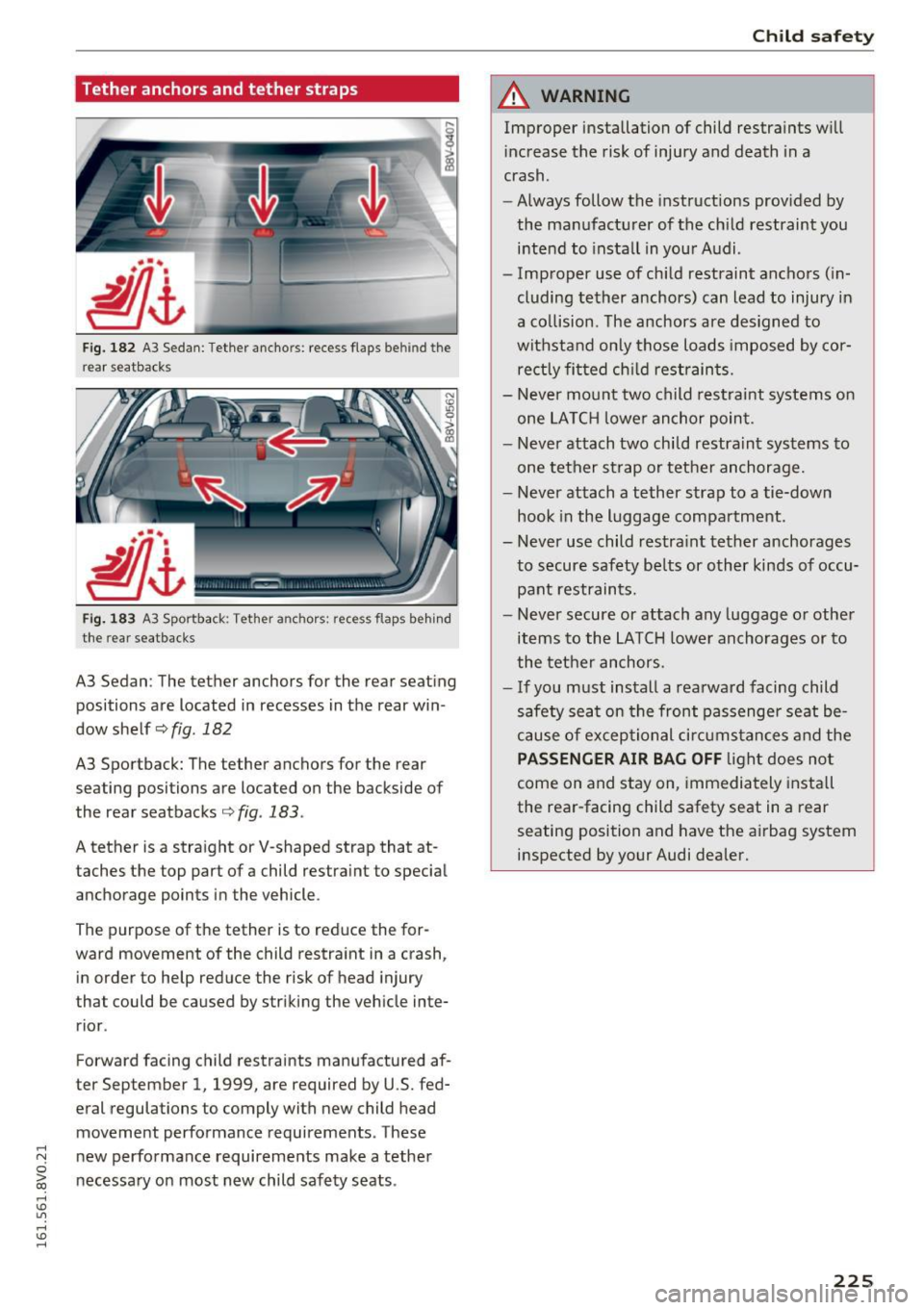
Tether anchors and tether straps
Fig. 182 A3 Sedan: Tether anchors: recess flaps behind the
rear seatbacks
Fig. 183 A3 Sportback : Tether anchors : recess flaps behind
the rear seatbacks
A3 Sedan : The tether anchors for the rear seating
positions are located in recesses in the rear win
dow she lf
r::;, fig . 182
A3 Sportback: The tether anchors for the rear
seating positions are located on the backside of
the rear seatbacks
r::;, fig . 183.
A tether is a straight or V-shaped strap that at
taches the top part of a child restraint to special
anchorage points in the vehicle .
The purpose of the tether is to reduce the for
ward movement of the child restraint in a crash,
in order to help reduce the risk of head injury
that could be caused by striking the vehicle inte
rior .
Forward facing child restraints manufactured af
ter September 1, 1999, are required by U.S. fed
eral regulations to comply with new child head
movement performance requirements . These
.... "' new performance requirements make a tether 0
iii necessary on most new child safety seats .
.... I.Cl U"I
.... I.Cl ....
Child sa fety
A WARNING
-Improper installation of child restra ints wi ll
i ncrease the risk of injury and death in a
crash .
- Always follow the instructions prov ided by
the manufactu rer of the ch ild restraint you
intend to insta ll in you r A udi .
- Improper use of chi ld restraint anchors (in
cluding tether anchors) can lead to injury in
a co llision . The anchors are designed to
withstand on ly those loads imposed by co r
rectly fi tted ch ild res traints.
- Never mo unt two child rest raint systems on
one LA TC H lowe r anchor point.
- Neve r attach two child restraint systems to
one tether st rap or tethe r anchorage.
- Never attach a tether strap to a tie-down
hook in the luggage compa rtment.
- Never use child restra int tether anchorages
to secure safety be lts or other kinds of occu
pant restrain ts.
- Never secure or attach any luggage or othe r
items to the LA TCH lower anchorages or to
the tether anchors.
- If you must install a rearwa rd facing child
safety seat on the front passenger seat be
cause of excep tional ci rcumstance s and the
PASSENGER AIR BAG OFF light does not
come on and stay on, immediately install
the rear -facing child safety seat in a rear
seating position and have the a irbag system
inspected by your Audi dealer.
225
Page 240 of 328

Check ing and F illing
Read and follo w the WARN IN GS before check
ing anything in the engine compartment
c::> page 236, Working in the engine compart
ment.
Make sure the wiper arms are not raised up from
the windshield. Otherwise the paint could be
damaged .
Applies to vehi cles w ith p lug-in hybrid dr ive* :
switch the ignition off before re leasing the hood
so that the gasoline engine does not start auto mat ica lly.
... With the driver's door open, pull the lever be
low the instrument panel in the direction of the
arrow
c::> fig. 191 .
... Raise the hood s lightly c::> ,&. .
... Press the rocker switch under the hood upward
c::> fig. 192. This releases the catch.
... Open the hood .
A WARNING
Never open the hood when you see that steam
or coolant drips from the engine compart-
238
ment- there is a dange r of bu rns! Wait unt il
no steam or coolant flows out.
Closing the hood
... Push the hood down until the force of the strut
is overcome.
... Let the hood fall lightly into the latch .
Do not
press it in .
c::> ,&..
A WARNING
If the hood is not latched complete ly, it could
f ly up wh ile you are dr iving and obst ruct your
vision .
- For safety reasons, the hood m ust always be
closed securely while driv ing. Because o f
this, always chec k the hood after closing it
to make sure it is latched correctly. The
hood is latched if the front corners cannot
be lifted.
- If you notice that the hood is not latched
while you are driving, stop immed iate ly and
close it, because this increases the risk of an
accident.
Page 245 of 328
,....,
N
0 > co ,....,
ing anything in the engine compartment
c::> page 236, Working in the engine compart
ment.
.. Turn the engine off.
.. Unscrew the engine oil filler opening cap~
c::>fig.197, c::>page239, fig.193 .
.. Carefully add 0.5 quart (0.5 liter) of the appro
priate oil
c::> page 240.
.. Check the oil level again after two minutes
c::> page 242, Checking the engine oil level .
.,. Add o il, if necessary.
.. Close the engine oil filler cap and push the dip
stick all the way in .
A WARNING ,--
- When adding oil, do not let oil drip onto hot
engine components . There could be risk of a
fire.
- You must secure the cap on the oi l filler
opening correctly so that oil does not leak
out onto the hot engine and exhaust system
when the eng ine is running, because this is
a fire hazard.
- Always clean skin thoroughly if it comes into contact with engine oil.
(D Note
-Applies to vehicles with a gasoline engine:
the oil level cannot be above the
0 range
c> page 242, fig. 195 or else yo u risk dam
aging the catalytic converter and the en
gine . Contact an authorized Audi dealer or
authorized Audi Serv ice Facility to have ex
cess oil extracted if necessary .
-Applies to vehicles with a diesel eng ine: the
oil level must not be in the
G) range
c::>page 242, fig. 196-The oil must not be
extracted or else you risk damaging the en
gine. Drive to an authorized Aud i dealer or
authorized Audi Service Facility immediate
l y.
- Do not mix any additional l ubricants into
the engine o il. Damage cause by such addi
tives is not covered by the warranty.
Checking and Filling
{® For the sake of the environment
-Oil shou ld never enter the sewer system or
come into contact with the ground.
- Pay attention to lega l requirements when
disposing of empty oil containers .
Changing the engine oil
We recommend that have your oil changed by an
authorized Audi dealer or a qualified service sta
tion .
Before you check anything in the engine compart
ment,
always read and heed all WARNINGS
c::> page 236.
The engine o il must be changed according to the
intervals specified in your Warranty
& Mainte
nance book let. This is very important because the
lubricating properties of oil diminish gradua lly
during norma l vehicle use.
Under some circumstances the engine oil shou ld
be changed more frequent ly. Change oil more of
ten if you drive mostly short distances, operate
the vehicle in dusty areas or under predominantly
stop-and-go traff ic conditions, or have your vehi
cle where temperatures remain below freezing
for extended periods.
Detergent additives in the oi l will make fresh oil
look dark after the engine has been running for a
short time. This is normal and is not a reason to
change the oil more often than recommended.
Because of the problem of proper disposal, along
with the special tools and necessary expertise re
quired, we strongly recommend that you have
your o il changed by an authorized
Audi dealer or
a qualified service stat ion.
If you choose to change your oil yourself, please
note the following important information:
A WARNING ,-~
To reduce the risk of personal injury if you
must change the engine oil in your vehicle
yourself:
- Wear eye protection.
243
Page 247 of 328
.... N
0 > CX)
.... I.Cl U"I
.... I.Cl ....
corrosion can cause a loss of coolant and
serious engine damage .
- Do not add any type of radiator leak sealant
to your vehicle's engine coolant . Adding ra
diator repair fluid may adversely affect the
function and performance of your cooling
system and could result in damage not cov
ered by your New Vehicle Limited Warranty.
Adding coolant
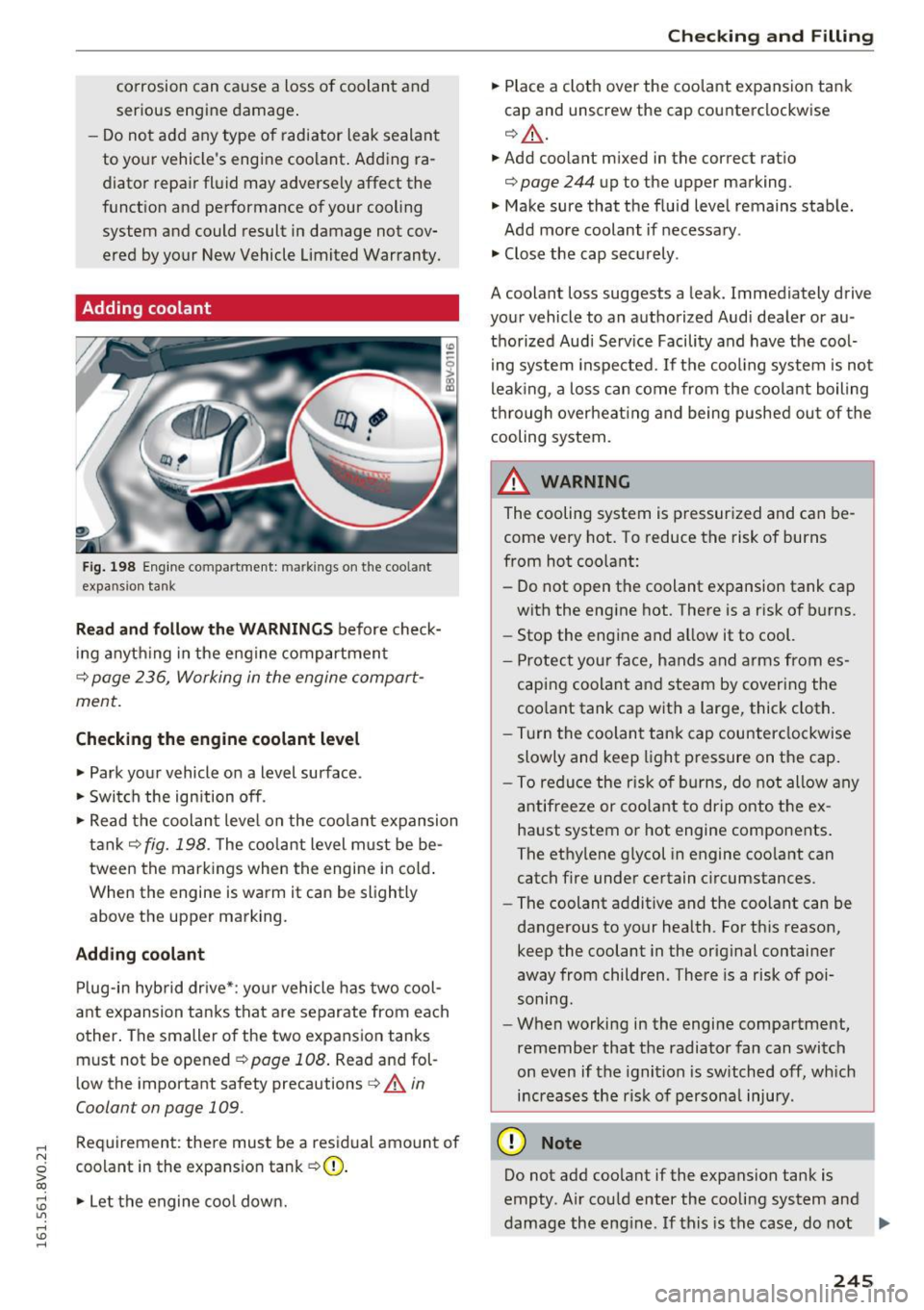
F ig . 198 Engine compa rtment: mark in gs on t he coo lant
expa nsion tank
Read and follow the WARNINGS before check
ing anything in the engine compartment
¢ page 236, Working in the engine compart
ment.
Checking the engine coolant level
• Park your vehicle on a level surface .
• Switch the ignition off .
• Read the coolant level on the coolant expansion
tank
¢ fig. 198 . The coolant level must be be
tween the markings when the engine in cold .
When the engine is warm it can be slightly above the upper marking.
Adding coolant
Plug-in hybrid drive*: your vehicle has two cool
ant expansion tanks that are separate from each
other. The smaller of the two expansion tanks
must not be opened
¢ page 108. Read and fol
low the important safety precautions ¢
A in
Coolant on page 109.
Requirement: there must be a residual amount of
coolant in the expansion tank ¢(D .
• Let the engine cool down .
Checking and Filling
• Place a cloth over the coolant expansion tank
cap and unscrew the cap counterclockwise
¢ A .
• Add coolant mixed in the correct ratio
¢
page 244 up to the upper marking.
• Make sure that the fluid level remains stable.
Add more coolant if necessary.
• Close the cap securely .
A coolant loss suggests a leak. Immediately drive
your vehicle to an authorized Audi dealer or au
thorized Audi Service Facility and have the cool
i ng system inspected. If the cooling system is not
leak ing, a loss can come from the coolant boiling
through overheat ing and being pushed out of the
cooling system .
,&_ WARNING
-= -The cooling system is pressurized and can be
come very hot. To reduce the risk of burns
from hot coolant:
- Do not open the coolant expansion tank cap
with the engine hot. There is a risk of burns.
- Stop the engine and allow it to cool.
- Protect your face, hands and arms from es-
caping coolant and steam by covering the
coo lant tank cap with a large, thick cloth.
- Turn the coolant tank cap counterclockwise
slowly and keep light pressure on the cap.
- To reduce the risk of burns, do not allow any
antifreeze or coolant to drip onto the ex
haust system or hot engine components.
The ethylene glycol in engine coo lant can
catch fire under certain circumstances .
- The coolant additive and the coolant can be
dangerous to your health . For th is reason,
keep the coolant in the original container
away from children. There is a risk of poi
soning .
- When working in the engine compartment,
remember that the radiator fan can switch
on even if the ignition is switched off, wh ich
increases the risk of persona l injury.
(J) Note
Do not add coolant if the expansion tank is
empty . Air could enter the cooling system and
damage the eng ine.
If this is the case, do not ..,_
245
Page 283 of 328
.... N
0 > CX)
.... I.Cl U"I
.... I.Cl ....
both tabs on the side panels ¢ fig. 209 (top im
age).
.. A3 Sedan: clip the plastic hook@ into the lug
gage compartment seal¢
fig. 209 (bottom im
age) .
Side panel
.. Open the twist lock and remove the cover @* I
@ ¢fig. 208 .
.&_ WARNING
Improper use of the vehicle jack can cause se
rious personal injuries.
- Never use the screw driver hex head to
tighten wheel bolts, since the bolts cannot
atta in the necessary tightening torque if you
use the hex head, potentially caus ing an ac
c ident.
- The factory-supplied jack is intended only
for your vehicle model. Under no circum
stances should it be used to
lift heavy
vehicles o r other loads; you r is k inju ring
yo urself.
- Never start the engine when the vehicle is
ra ised, whi ch could cause an accide nt.
- Support the veh icle secure ly with app ropr i
ate stands if wor k is to be perfo rmed under
neath t he vehicle; otherwise, the re is a po
tent ial risk for in jury.
- Never use the jack s upplied with your Audi
on another vehicle, par tic ularly on a heav ier
one. The jack is only suitab le for use on the
vehicle it came with .
(D Tips
The vehicle jack* in your vehicle is mainte
na nee-free.
Tire mobility kit
Preparation
A ppl ies to vehicles: W ith t ire re pair set
.. Read and fo llow th e import ant saf ety pr ecau
tion s¢
page 280, General information .
.. Check if a repair w ith the t ire mobility k it is pos
s ible
¢ page 281.
Emergen cy a ssis tanc e
Using the tire mobility kit
App lies to vehic les : With tire r epair set
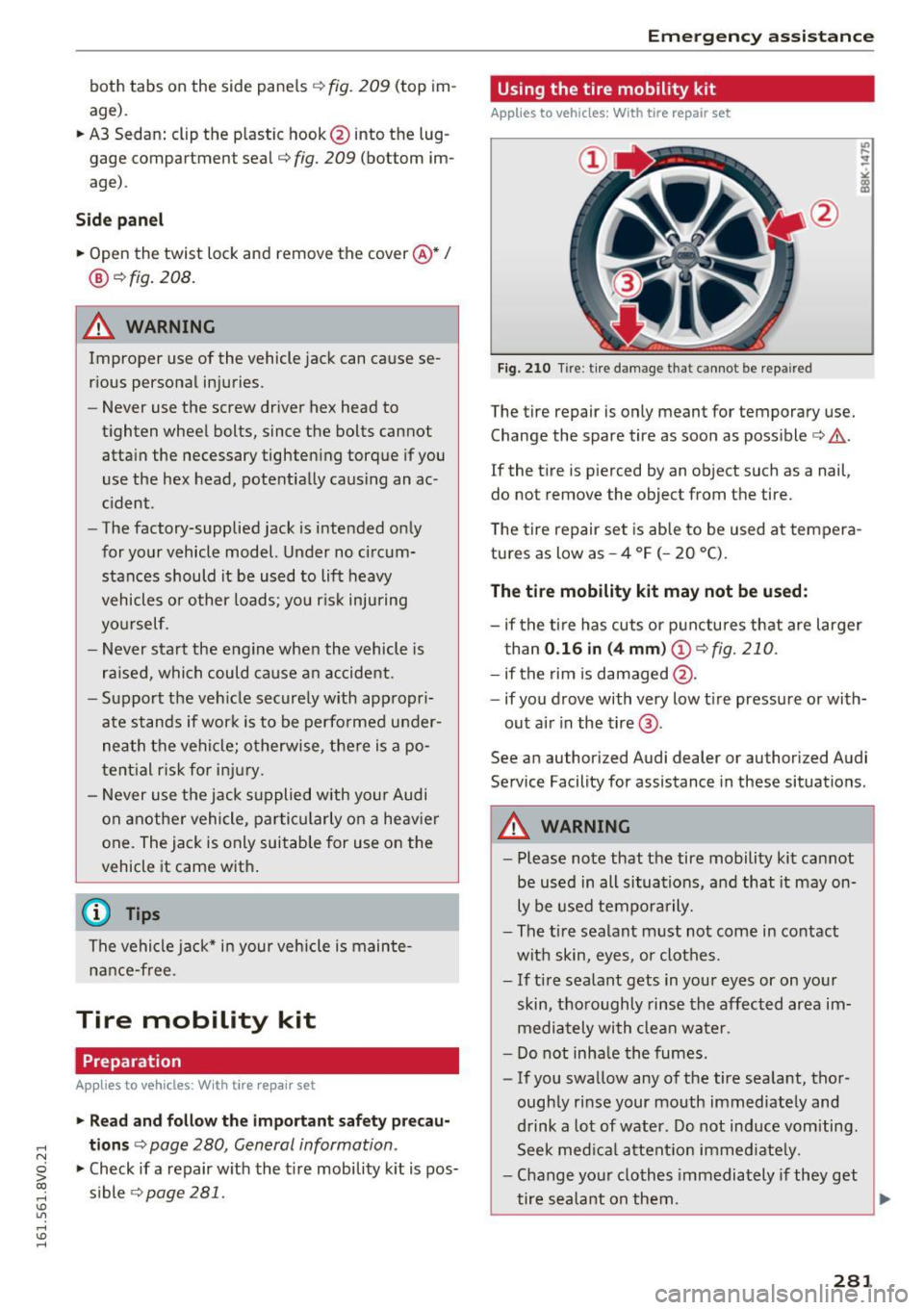
F ig. 210 T ire: t ire damage t hat cannot be repaired
The tire repair is only meant for temporary use.
Change the spare tire as soon as possible <=>,&. .
If the t ire is p ierced by an object such as a nail,
do not remove the object from the tire.
The tire repair set is ab le to be used at tempera
tures as low as - 4 °F (- 20 °C).
The t ire mobility kit may not be us ed:
- if the ti re has cuts or punctures that are larger
than
0 .1 6 in (4 mm)@ ¢ fig. 210.
-if the rim is damaged @.
- if you drove with very low t ire pressure or with-
out air in the tire @.
See an authorized Audi dealer or authorized Audi
Service Facility for assistance in these situations .
.&_ WARNING
>=
-Please note that the tire mobility kit cannot
be used in all situations, and that it may on
ly be used temporarily.
- The tire sealant must not come in contact
wit h skin, eyes, o r clothes.
- If ti re sealant gets in you r eyes or on yo ur
skin, tho ro ughly rinse the affected area im
mediately wi th clea n wate r.
- Do not inha le the fumes.
- If you swallow any of the tire sealant, thor-
ough ly rinse your mouth immediately and
drink a lot of water . Do not ind uce vomiting.
Seek med ica l attent io n immed iate ly .
- Change yo ur clothes immediately if they get
tire seala nt on them.
~
281