door lock AUDI S3 2016 Owner's Manual
[x] Cancel search | Manufacturer: AUDI, Model Year: 2016, Model line: S3, Model: AUDI S3 2016Pages: 328, PDF Size: 81.78 MB
Page 111 of 328
,....,
N
0 > CX) ,....,
I.Cl U"I ,....,
I.Cl ,....,
,&_ WARNING
-Read and follow t he warn ings in
¢ page 236, Working in the engine com
partment
before open ing the hood and
check ing t he coolant level.
- The expansion tank @ may only be opened
and filled by an a uthorized Aud i dea ler or
authorized Aud i Service Fac ility.
- Coo la nt can enter the inside of the battery
when f illing the expansion tank @ and
cause a short c ircuit, which inc reases the
risk of fi re .
Refueling
Opening the fuel filler flap
Appl ies to vehicles: with plug- in hybrid drive
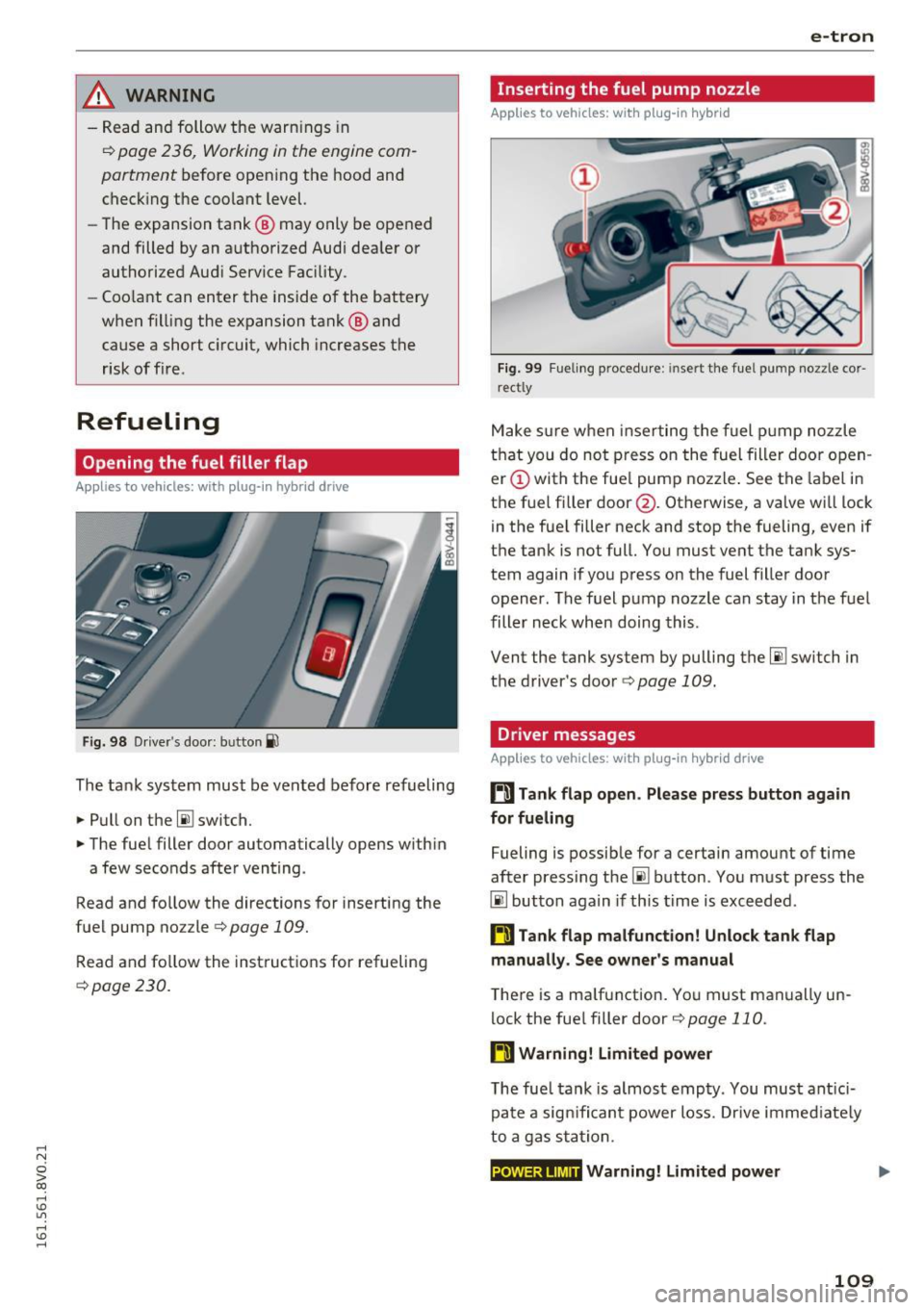
Fig. 9 8 Driver 's doo r: button il
The ta nk sys tem must be ve nted be for e refueling
.. Pull on the
Iii switch.
.. The fue l filler door automatically opens w ith in
a few seconds afte r vent ing .
Read and fo llow the directions for inserting the
f u el pump noz zle
¢ page 109.
Read and fo llow the inst ruct io ns for refueling
¢ page 230.
e-tron
Inserting the fuel pump nozzle
Applies to vehicles: with plug- in hybrid
Fig . 99 Fue ling proce du re : in ser t the fuel pump nozzle co r
r ect ly
M ake s ure w hen inse rting the f uel pu mp noz zle
t h at you do no t press o n the fuel filler door open
er (!) with the fue l pum p nozzle . See the labe l in
the f ue l fi ller door @. Otherwise, a va lve wi ll lock
in the fue l filler neck and stop the fueling , even if
t h e tank is not full. You must vent the tank sys
tem again if yo u press on the fuel fille r doo r
opener. The f uel p ump nozzle can stay in the fue l
filler neck when doing this.
Vent the tank system by pulling the
Iii switch in
the d river's door
¢ page 109.
Driver messages
Applies to vehicles: with plug-in hybrid drive
ti Tank flap open . Please press button again
for fueling
Fueling is possib le for a certain amou nt of time
after press ing the
Iii button . Yo u m ust press the
Iii button again if th is time is exceeded .
ti Tank flap malfunction! Unlock tank flap
manually . See owner's manual
T he re is a ma lfunction. Yo u must man ually un
lock the fue l fi ller door
¢ page 110.
ti Warning! Limited power
The fue l ta nk is almos t emp ty . You must ant ici
p at e a sign ifi can t power loss. Drive i mmed iate ly
t o a ga s st at ion .
POWER LIMIT Warning! Limited power
109
Page 116 of 328
e-tron
Charging dock
Applies to vehicles: with p lug -in hybrid drive and charging
dock
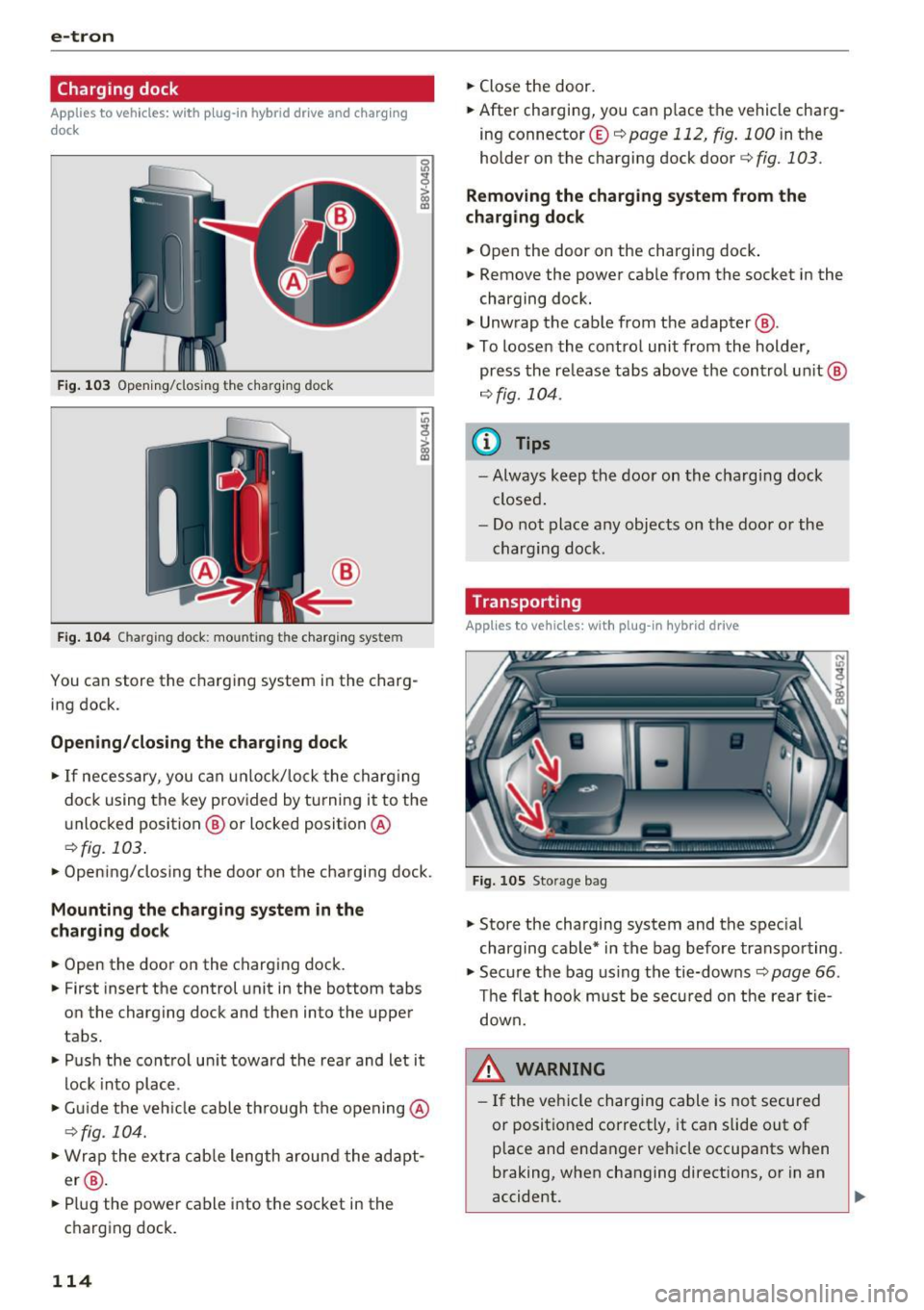
F ig . 1 03 Opening/clos ing t he charg ing dock
®
Fig . 1 04 Charging dock: mounting the ch arging system
You can store the charg ing system in the charg
ing dock.
Opening /closing the charging dock
• If necessary, you can u nlock/lock the charg ing
dock using the key provided by turning it to the
unlocked position @ or locked position @
¢fig. 103.
• Opening/closing the door on the charging dock.
Mounting the cha rging system in the
charging dock
• Open the door on the charging dock.
• First insert the control unit in the bottom tabs
on the charging dock and then into the upper
tabs.
• Push the control un it toward the rea r and let it
lock into place.
• Gu ide the vehicle cable th rough the opening @
¢fig_ 104.
• Wrap the extra c ab le length around the adapt
er @ .
• Plug the power cable into the socket in the
charging dock.
114
• Close the door.
• After charging, you can place the vehicle charg
ing connecto r© ¢
page 112 , fig. 100 in the
holder on the charging dock door¢
fig. 103.
Removing the charging system from the
charging dock
• Open the door on the charging dock .
• Remove the power cable from the socket in the
charging dock.
• Unwrap the cable from the adapter @.
• To loosen the contro l unit from the holder,
press the re lease tabs above the cont rol un it @
r=:> fig. 104.
(D Tips
- Always keep the door on the cha rg in g dock
closed .
- Do not place any objects on the doo r or the
charging dock.
Transporting
Applies to vehicles: with plug-in hybrid drive
Fig. 105 Storage bag
• Store the charging system and the spec ial
charging cable* in the bag before transpo rting.
• Secure the bag us ing the tie-downs¢
page 66.
The flat hoo k m ust be sec ured on t he rear tie
down.
8_ WARNING
- If the veh icle charging cable is no t secured
or positioned correctly, it can slide out of
p lace and endanger ve hicle occupants when
braking, when changing directions, or in an
accident.
Page 119 of 328

...... N
0 > CX)
...... I.Cl U"I
...... I.Cl ......
can set whether you would like to charge with the
full or half of the charging power.
• Press the I OKI @¢ page 115, fig. 106 button
on the cont rol unit .
• Enter the P IN if necessary.
• PO WER and SET P IN appear on the disp lay
field.
• Select
POWER using the arrow button@.
• Press the IOKI @ button.
• The charging power display appears . The cur
re nt set value (50% or 100%) is marked w ith a
frame .
• If necessary, change the sett ing us ing the ar
row button © to move downward or upward.
• Press the IOKI @ but ton .
(D Tips
- If a ho usehold socket is used fo r the charg
i ng process, the charging powe r leve l is au
tomatically set to 100% . If multiple electri
ca l cons umers are connected to a circuit,
the charging power may be limited to 50%
when charging with a household socket in
order to relieve the load on the electrical in
stallation. This does not apply to 100/110 V
household sockets since the charging power
would be too low and this would cause the
chargi ng p rocess to end.
- If an industr ial socket is used for the charg
i ng process, the charging power leve l is au
tomatically set to 50% . To receive the max i
mum charging power, the value must be set
to 100% .
- A selected val ue rema ins set unt il the power
cable is connected again .
e-tron
After charging
Applies to vehicles: with plug -in hybrid drive
Fig. 110 Rad iator grille : unlock ing and removing the vehi
c le charging connector
After completing the cha rgi ng or climate cont rol
process, the vehicle enters a sleep mode. No dis
plays are visible on the charging unit du ring this
period .
Deacti vating sleep mode
• Unlo ck the vehicle ~ page 35. Or
• Open the driver's door. Or
• Press the button @ ¢page 115, fig. 107 .
Unlocking the vehicl e charging connector
• Press the release (!)¢ fig. 110.
• Remove the veh icle charg ing connector @.
Closing the ch arging unit
• Put the cap back on the charging port
¢ page 115, fig. 109.
• Carefully slide the cover back in its original po
sition .
• Tu rn the lock to the hor izontal position
¢ page 115, fig. 108.
(D Note
An open or un locked cha rging unit is not dis
played . Check befo re every drive after charg
i ng if the cover is locked .
- If you dr ive with an ope n charging unit,
both the cover and the electronics installed
beh ind it cou ld be damaged .
117
Page 175 of 328
.... N
0 > co ....
~page 166.
A WARNING
To help prevent poisonous exhaust gas from
being drawn into the vehicle, always keep the
rear lid closed while driving .
- Never transport objects larger than those
fitting completely into the luggage area be
cause the rear lid cannot be fully closed .
-If you absolutely must drive with the rear lid
open, observe the following notes to reduce
the risk of poisoning:
- Close all w indows,
- Close the power roof*,
- Open all air outlets in the instrument pan-
el,
- Switch off the air recirculation,
- Set the fresh air fan to the highest speed .
A WARNING
-
Always make sure that the doors, all win
dows, the power roof* and the rear lid are se
curely closed and locked to reduce the risk of
injury when the vehicle is not being used.
- After closing the rear lid, always make sure
that it is properly closed and locked.
- Never leave your vehicle unattended espe
cially with the rear lid left open. A child
could crawl into the vehicle through the lug
gage compartment and close the rear lid be
coming trapped and unable to get out. Be
ing trapped in a vehicle can lead to serious
personal injury.
- Never let children play in or around the vehi
cle.
- Never let passengers r ide in the luggage
compartment. Vehicle occupants must al
ways be properly restrained in one of the ve
hicle's seating positions.
(D Tips
- Air circulation helps to reduce window fog
ging. Stale air escapes to the outside
through vents in the trim panel. Be sure to
keep these slots free and open.
Driving safety
-The tire pressure must correspond to the
load. The tire pressure is shown on the tire
pressure label. The tire pressure label is lo
cated on the driver's side B-pillar . The tire
pressure label lists the recommended cold
tire inflation pressures for the vehicle at its
maximum capacity weight and the tires that
were on your vehicle at the time it was man ufactured. For recommended tire pressures
for normal load conditions, please see chap
ter
~ page 263.
' Tie-downs
The luggage compartment is equipped with four
tie-downs to secure luggage and other items.
Use the tie-downs to secure your cargo properly
~ page 172, Loading the luggage compartment.
In a collision, the laws of physics mean that even
smaller items that are loose in the vehicle will
become heavy missiles that can cause serious in
jury. Items in the vehicle possess energy which
vary w ith vehicle speed and the weight of the
item. Vehicle speed is the most significant factor.
For example, in a frontal collision at a speed of
30 mph (48 km/h), the forces acting on a 10-lb
(4.5 kg) object are about 20 times the normal
weight of the item. This means that the weight
of the item would sudden ly be about
200 lbs. (90 kg). You can imagine the injuries
that a 200 lbs. (90 kg) item flying freely through
the passenger compartment could cause in a col
lision like th is.
A WARNING
-Weak, damaged or improper straps used to
secure items to tie-downs can fail dur ing hard
braking or in a collision and cause serious per
sona l injury.
- Always use suitable mounting straps and
properly secure items to the tie-downs in
the luggage compartment to help prevent
items from shifting or flying forward as dan
gerous missiles .
- When the rear seat backrest is folded down,
always use suitable mounting straps and
properly secure items to the tie-downs in
173
Page 217 of 328
.... N
0 > CX)
.... I.Cl U"I ,....,
I.Cl ....
_& WARNING
A child in a child safety seat installed with the
LATCH lower anchorages or w ith the standard
safety belt or a child in a booster seat on the
rear seat could play with unused rear seat
safety belts and become entangled. This
co uld cause the ch ild ser ious personal inj ury
and even death .
- Always se cure unused rear seat safety belts
out of reach of ch ildren in child seats such
as by properly routing them around the
head restraint of the seat where the child
restraint is installed .
- Never activate the convertible locking re
tractor when routing the safety belts around
the head restraints.
- Never let anyone sit at the center rear seat
ing position if the center rear safety belt has
been routed around a rear head restraint.
Child seats
Infant seats
Babies and infants up to about one year old and
20 lbs. or
9 kg need special rearward-facing
child restraints that support the back, neck and
head in a crash .
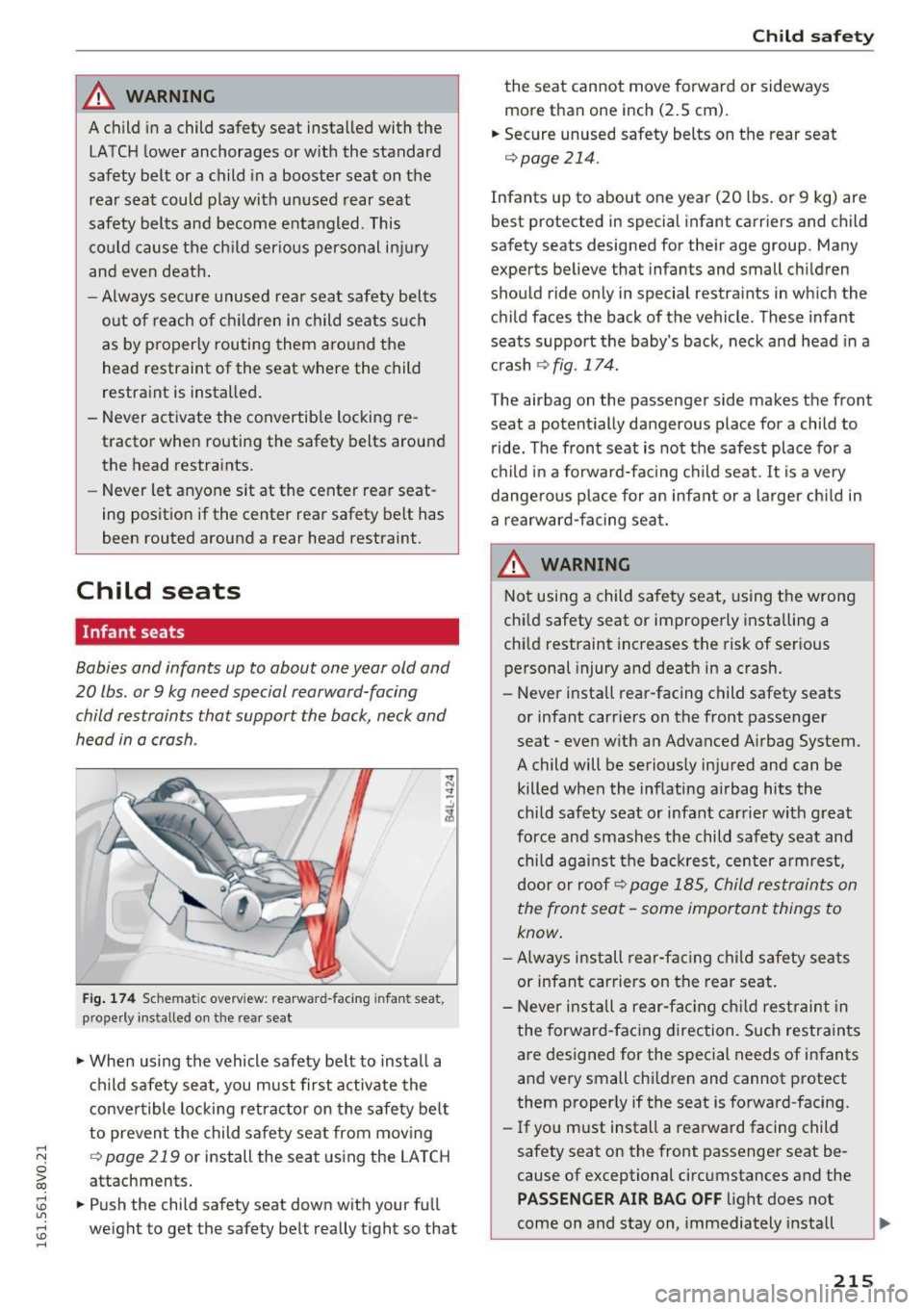
Fig. 174 Schematic overv iew: rearwa rd-facing infant seat,
properly installed on the rear seat
• When using the vehicle safety be lt to install a
ch ild safety sea t, you must first activate the
co nve rtible locking retractor on the safety be lt
to prevent the child safe ty seat from moving
r=.> page 219 or install the seat using the LA TCH
attachments .
• Push the child safety seat down with your fu ll
weight to get the safety be lt rea lly t ight so that
Child sa fety
the seat cannot move forward or sideways
more than one inch (2.5 cm).
• Secure unused safety belts on the rear seat
r::;, page 214.
Infants up to about one year (20 lbs . or 9 kg) are
best protected in special infant carr iers and child
safety seats designed for their age group. Many
experts believe that infants and small children
should ride only in special restra ints in wh ich the
child faces the back of the vehicle . These infant
seats support the baby's back, neck and head in a
crash
¢ fig . 174.
The airbag on the passenger side makes the front
seat a potent ially dangerous place for a child to
ride. The front seat is not the safest place for a
c h ild in a forward-fac ing c hild seat.
It is a very
dange ro u s p lace for an infant or a la rger ch ild in
a rearward-facing sea t.
_& WARNING
-
No t usi ng a child sa fety seat, using t he wrong
chi ld safety seat or imprope rly installing a
chi ld restraint increases the risk of serious
personal injury and death in a crash.
- Never install rear-facing child safety seats
or infant carriers on the front passenger
seat -even w ith an Advanced A irbag System .
A child will be serious ly injured and can be
killed when the inflating airbag hits the
child safety seat or infant carrier with great
force and smashes the child safety seat and child agai nst the ba ckrest, center armrest,
door or roof
r::!.> page 185, Child restraints on
t he front seat -some important things to
know .
-Always install rear-fac ing child safety seats
or infant carriers on the rear seat .
- Never install a rear-fac ing ch ild restraint in
the forward-fac ing direction. Such restrain ts
are des igned for the special needs of infants
and ve ry small children and cannot protect
them proper ly if the seat is forward-facing.
- If you m ust install a rearward facing child
safety seat on the front passenger seat be
cause of exceptional circumstances and the
PASSENGER AIR BA G OFF light does not
come on and stay on, immediately install
215
Page 222 of 328
Child safety
children, especially those 12 years and younger,
should always ride in the back seat properly re
strained for their age and size.
.&_ WARNING
-
Improperly installed child safety seats in
crease the risk of serious personal injury and
death in a collision.
- Always make sure that the safety belt re
tractor is locked when installing a child
safety seat . An unlocked safety belt retrac
tor cannot hold the child safety seat in place during normal driving or in a crash.
-Always buckle the child safety seat firmly in
place even if a child is not sitting in it . A
loose child safety seat can fly around during
a sudden stop or in a collision.
- Always make sure that the rear seat back
rest to which the center rear safety belt* is
attached is securely latched whenever the
rear center safety belt is being used to se
cure a child restraint.
- If the backrest is not securely latched, the
child and the child restraint will be thrown
forward together with the backrest and will
strike parts of the vehicle interior. The child
can be seriously injured or killed.
- Never install rear-facing child safety seats
or infant carriers on the front passenger
seat. A child will be seriously injured and can be killed when the passenger airbag in
flates.
- The inflating airbag will hit the child safety
seat or infant carrier with great force and
will smash the child safety seat and child
against the backrest, center armrest, door
or roof.
- Always install rear-facing child safety seats
or infant carriers on the rear seat.
- Forward-facing child safety seats or infant
carriers installed on the front passenger's
seat may interfere with the deployment of
the airbag and cause serious injury to the
child.
- It is safer to install a forward-facing child
safety seat on the rear seat.
- Always read and heed all WARNINGS when
ever using a child restrained in a vehicle is
220
being used¢ page 209. Special precautions
apply when installing a child safety seat on
the front passenger seat¢
page 185, Child
restraints on the front seat -some impor
tant things to know.
.&_ WARNING
Always take special precautions if you must
install a forward or rearward-facing child re
straint on the front passenger's seat in excep
tional situations:
- Whenever a forward or rearward-facing
child restraint is installed on the front pas
senger seat, the
PASSENGER AIR BAG OFF
light must come on and stay on whenever
the ignition is switched on.
- If the
PASSENGER AIR BAG OFF light does
not come on and stay on, perform the
checks described ¢
page 196, Monitoring
the Advanced Airbag System.
- Take the child restraint off the front passen
ger seat and install it properly at one of the rear seat positions if the
PASSENGER AIR
BAG OFF light does not stay on whenever
the ignition is switched on.
- Improper installation of child restraints can
reduce their effectiveness or even prevent
them from providing any protection .
- An improperly installed child restraint can
interfere wi th the airbag as it deploys and
seriously injure or even kill the child.
- Always carefully follow the manufacturer's
instructions provided with the child safety
seat or carrier .
- After checking to make sure that the child
restraint is properly installed, make certain
that the child restraint is correctly recog
nized by the capacitive passenger detection
system in the front passenger seat and that
the
PASSENGER AIR BAG OFF light signals
the correct front passenger frontal airbag
status.
_&. WARNING
Forward-facing child restraints:
-
Page 223 of 328

,....,
N
0 > co ,....,
has been designed and certified by its man
ufacturer for use on a front seat with a pas
senger front and side airbag.
- Never put the forward-facing child restraint
up, against or very near the instrument pan
el.
- Always move the passenger seat into its
rearmost position in the seat's fore and aft
adjustment range, as far away from the air
bag as possib le before installing the for
ward-facing child restra int. The backrest
must be adjusted to an up right posit ion.
- Make sure that the
PASSEN GER AI R BA G
OFF
light comes on and stays on all the time
whenever the ignition is switched on.
_& WARNING
Rearwa rd-facing child restra ints:
- A ch ild in a rea rwa rd-facing child safety seat
installed on the front passenger seat wi ll be
seriously injured and can be killed if the
front airbag inflates - even with an Ad
vanced Airbag System .
- The inflating airbag will hit the child safety
seat or infant carrier with great force and
will smash the chi ld safety seat and chi ld
against the backrest, center armrest, door
or roof.
- Always be especially careful if you must in
stall a rearward facing child safety seat on
the front passenger seat in exceptional c ir
cumstances.
- Make sure that the
PA SSEN GER AIR BA G
OFF
light comes on and stays on all the time
whenever the ignition is switched on .
- If the
PASSEN GER A IR BAG OFF light does
not come on and stay on, immediately in
stall the rear-fac ing ch ild safety seat in a
rear seat ing pos ition and have the airbag
system inspected by your Aud i deale r.
Ch ild safety
Activating the convertible locking retractor
Use the convertible locking retractor to secure a
child restraint .
Always heed the ch ild safety seat manufacturer's
instruct ions when installing a child restraint in
your vehicle. To activate the convertible locking retractor:
.. Place the child restraint on a seat, preferably
on the rear seat.
.. Slowly pull the belt
all the w ay out .
.. Route it around or through the child restra int
be lt path
¢ & .
.. Push the ch ild safety seat down with you r full
weight to get the safety belt really tight.
.. Insert the belt tongue into the buckle for that
seating position.
.. Guide the safety belt back into the retractor un
til the belt lies flat and snug on the child safety
seat.
.. You should hear a ''cl icking" noise as the belt
w inds back into the inertia reel. Test the con
vert ible lock ing retractor by pull ing on the belt.
You shou ld no longer be able to pull the belt
out of the retractor. The convertib le loc kin g re
t ractor is now activated.
.. Make sure that the red release button is facing
away from the c hild restraint so that it can be
unbuckled quickly .
.. Pull on the belt to make sure the safety belt is
properly tight and fastened so that the seat
cannot move forward or sideways more than
one inch (2 .5 cm) .
_& WARNING
Using the wrong ch ild rest raint o r an improp
e rly inst alled child restra int can cause se rious
personal injury or death in a crash.
- Always make sure that the safety be lt re
tr actor is locked when installing a child
safety seat . An un locked safety be lt retrac
tor cannot hold the ch ild safety seat in p lace
during normal driving or in a crash.
- Always buckle the child safety seat fi rm ly in
p lace even if a child is not sitting in it. A
loose child safety seat can fly a round during
a sudden stop or in a crash. .,.
221
Page 228 of 328
Child safety
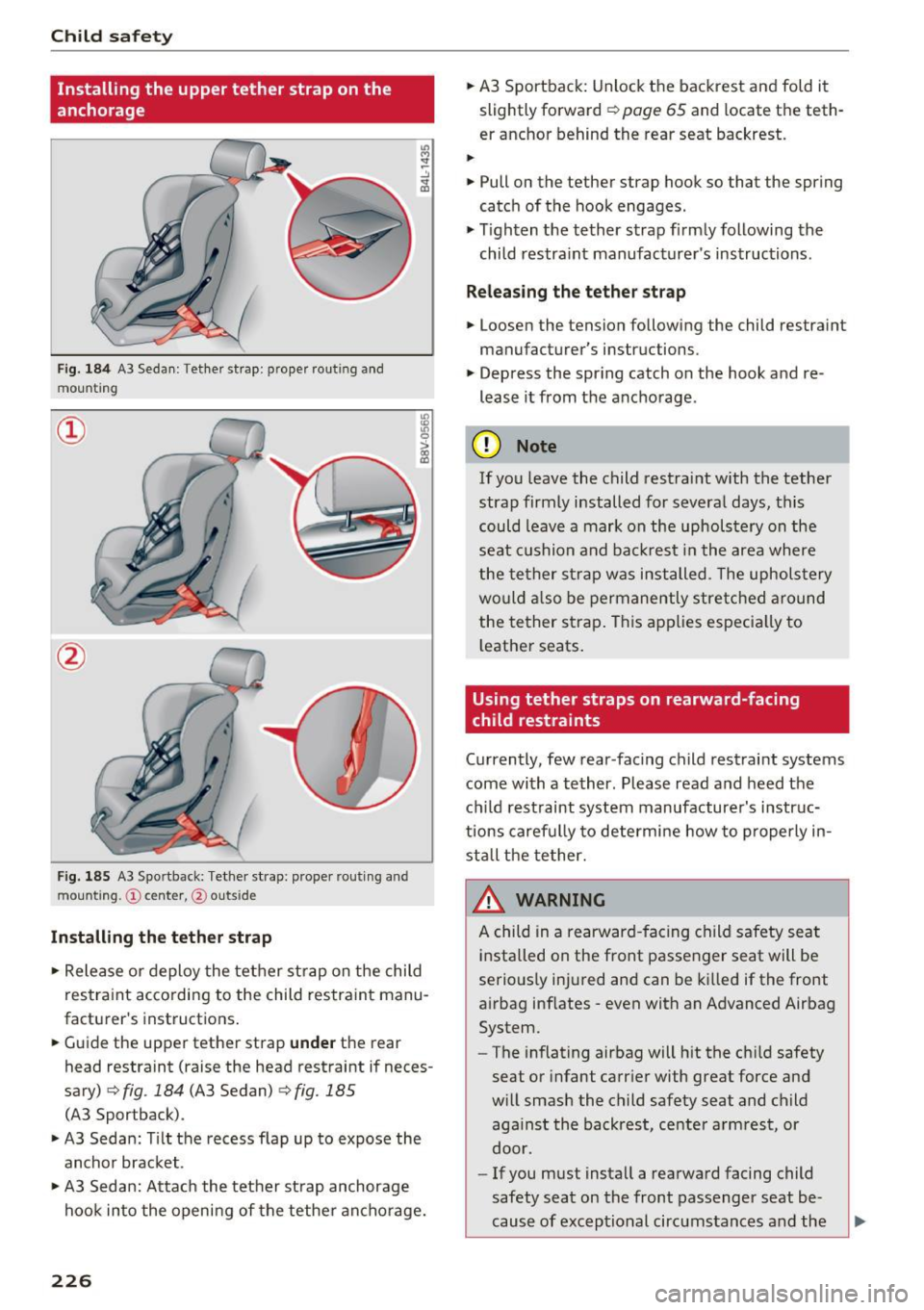
Installing the upper tether strap on the
anchorage
Fig. 184 A3 Sedan : Tethe r strap : prope r rout ing and
m oun ting
F ig . 185 A3 Sportback: Tet her st rap: p roper rout ing an d
m oun ting. (!) cent er, @ outs ide
Inst all ing th e teth er strap
"' ' ~ I 0 :> gi
,... Release or deploy the tether strap on the child
restra int according to the child restraint manu
facturer's instructions .
,... Guide the upper tether strap
unde r the rear
head restraint (raise the head restraint if neces
sary) ¢
fig. 184 (A3 Sedan) ¢ fig. 185
(A3 Sportback) .
,... A3 Sedan: T ilt the recess flap up to expose the
anchor bracket .
,... A3 Sedan: Attach the tether st rap anchorage
hook into the opening of the tether anchorage.
226
,... A3 Sportback: Unlock the backrest and fold it
slightly forward ¢
page 65 and locate the teth
er anchor behind the rear seat backrest .
..
,... Pull on the tether strap hook so that the spring
catch of the hook engages .
,... Tighten the tether strap f irmly following the
child restra int manufacturer's instructions .
Releasing the tether str ap
,... Loosen the tension following the child restraint
manufacturer's instructions.
,... Depress the spr ing catch on the hook and re
lease it from the anchorage .
(D Note
If you leave the child restraint with the tether
strap firmly installed for several days, this
could leave a mark on the upholstery on the
seat cushion and backres t in the area where
the tether s trap was installed . T he upholstery
would a lso be permanently stretc hed around
the tether strap. This applies especially to
l eather seats .
Using tether straps on rearward-facing
child restraints
Currently, few rear -facing child restraint systems
come with a tether. Please read and heed the
ch ild rest raint system manufacturer's instruc
tions carefully to determi ne how to p roperly in
stall the te ther.
_.6 WARNING
A child in a rearward -facing ch ild safety seat
installed on the front passe nger seat will be
serious ly injured and can be killed if the front
airbag inflates - even with an Advanced Airbag
System.
- The inflating airbag will h it the ch ild safety
seat or infant carr ier with great force and
w ill smash the child safety seat and child
against the backrest , center arm rest, or
door.
- If you must install a rearward facing child
safety seat on the front passenger seat be
cause of exceptional circumstances and the
Page 232 of 328
Checking and Filling
Refueling
Fuel filler neck
The fuel filler neck is located on the right rear
side panel behind the fuel fi ller flap.
If the power locking system should fail, you can
still open the flap manually· for deta iled instruc
tions see~
page 232 .
You can find the fuel tank capacity of your vehicle
in
c::;, page 303 .
The label on the inside of the fuel filler flap tells
you the correct fuel for your vehicle . For more in
formation about fuel specifications, see
c::;, page 228 .
Your vehicle fuel tank has an onboard refuelling
vapor recovery system . This feature helps to pre·
vent fuel vapors from escap ing from the tank and
polluting the environment while you refuel your
veh icle. In order to fill the tank properly while
protecting the environment, please fo llow this
refueling procedure carefully .
.&, WARNING
Under normal operating conditions, never car
ry additional fuel containers in your car. Gas
canisters and other containers used to trans
port fuel can be dangerous . Such containers,
full or empty, may leak and could cause a fire
in a collision. If you must transport fuel to
use for your lawn mower, snow blower, etc.,
be very careful a nd always observe local and
state laws regard ing the use, t ransportation
and storage of such fue l containers. Make cer·
tain the container meets industry standards (ANSI/ASTM F852 · 86).
(D Note
Never drive yo ur vehicle unt il the fuel tank is
completely empty. The ir regula r supply of
fue l can cause misfiring. Gasoline could enter
the exhaust system and damage the catalytic
converter.
230
Fueling procedure
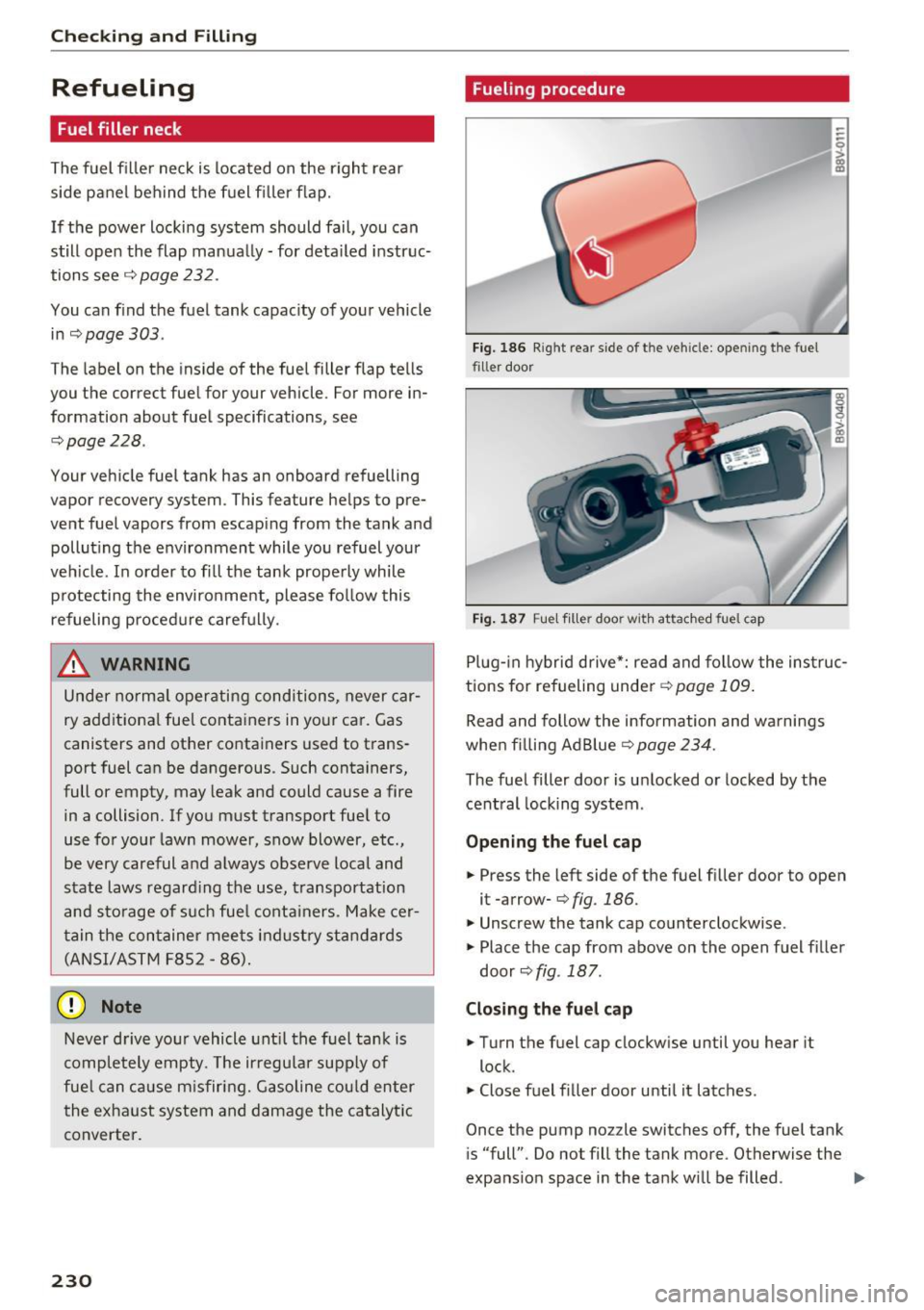
Fig. 186 R ig ht rea r side of t he ve hicle: ope ning the fuel
fil ler door
Fig. 187 Fuel fill er doo r wit h attached fue l cap
--0 > g:
Plug -in hybrid drive*: read and follow the instruc
tions for refueling unde r
c::;,page 109.
Read and follow the information and warnings
when filling AdBlue
c::;,page 234.
The fuel filler door is unlocked or locked by the
central locking system .
Opening the fuel cap
.. Press the left side of the fuel filler door to open
it -arrow-¢
fig. 186.
.,. Unscrew the tank cap counterclockwise .
.. Place the cap from above on the open fuel filler
door ¢
fig. 187.
Closing the fuel cap
.. Turn the fuel cap clockwise until you hear it
lock.
.. Close fuel f iller door until it latches .
Once the pump nozzle switches off, the fuel tank
is "full". Do not fill the tank more. Otherwise the
expans ion space in the tank will be filled .
IJ.
Page 234 of 328
Checking and Filling
@ Tips
Fue l can age and may lead to prob lems when
starting. Audi recommends replacing the fuel
in your vehicle within six months.
@ Tips
- If the engi ne is running while fueling, va
pors can escape or the fuel can spill over.
Because of th is, the fuel no zzle switches off
before the tank is full.
- Do not fuel the vehicle when the ignition is
switched on. Otherwise, the fuel gauge may
not show t he correct level after fueling the
vehicle .
- Diesel veh icles are equ ipped with a diesel
misfueling guard
1>. It allows the vehicle to
be f ueled on ly w ith a diesel fuel pump noz
zle .
- A wo rn o r damaged nozzle or a nozzle that
i s too smal l may not be ab le to open the
diesel misfueling protector . If this is the
case, try t urning the nozzle before inserting
i t in the f uel fille r neck, u se a d ifferent fue l
pump or see an aut horized Audi dea ler or
a uthorized Audi Service Facility fo r assis
tance .
- The misf ueling guard does not open when
adding fue l from a fue l conta iner . You can
bypass it by adding the diesel fuel slow ly.
- The fuel filler door on your ve hicle does not
l ock when you lock the vehicle from the in
side.
l ) Ma rket -specifi c
232
Fuel filler door emergency release
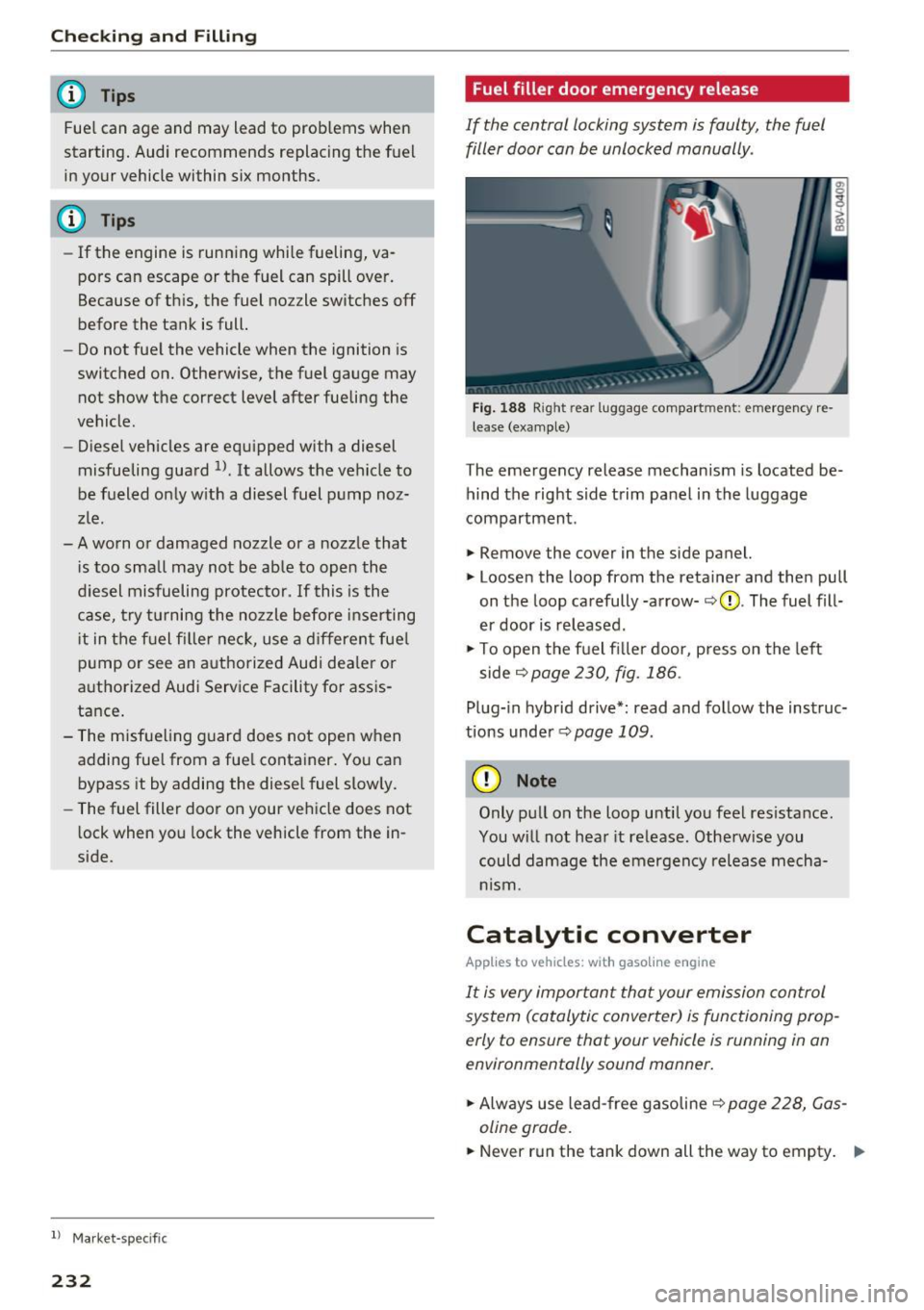
If the cen tral locking system is faulty, the fuel
filler door can be unlocked manually .
Fig. 188 Right re ar l ug gag e compa rtm en t: em erg enc y re
lease (example)
T he emergency release mechan ism is located be
hind the right s ide trim panel in the luggage
compartment.
.,. Remove the cover in the side panel.
.,. Loosen the loop from the retainer and then pull
on the loop carefully-arrow-
~ CD. The fuel fill
er door is released .
.,. To open the f uel filler door, press on the left
side
~ page 230, fig. 186 .
Plug-in hybrid drive*: read and follow the instruc
tions unde r
Qpage 109.
(D Note
Only pu ll on the loop until you feel res ista nce .
You wil l not hear it re lease. Otherw ise you
could damage the emergency release mecha
n ism .
Catalytic converter
Applies to vehicles: with gasol ine engine
It is very important tha t your emi ssion control
sys tem (ca talytic conv erter) is functioning prop
erly to ensure that your vehicle is running in an
env ironmentally sound manner .
.,. Always use lead-free gasoline ~ page 228, Gas
oline grade .
.,. Never run the tank down all the way to empty . ..,.