service AUDI S3 2016 Owner's Manual
[x] Cancel search | Manufacturer: AUDI, Model Year: 2016, Model line: S3, Model: AUDI S3 2016Pages: 328, PDF Size: 81.78 MB
Page 39 of 328
..... N
0 > CX)
..... I.Cl U"I
..... I.Cl .....
.. The LED blinks several times when you press a
button longer (convenience opening*) .
.. If the LED does not blink, the remote control
key battery is dead. The message
1:1 Please
change key battery
may also appear in the in
strument cluster display . Replace the battery .
Replacing the remote control key battery
.. Pry the cover @off of the key (Dusing a coin
c::>fig . 20 .
.,. Insert the new battery with the "+" facing up .
.. Press the cover back onto the key until it clicks
into place .
We recommend having the battery replaced by
an authorized Audi dealer or authorized Audi
Service Facility .
@ For the sake of the environment
Dead batteries must be disposed of using
methods that will not harm the env ironment.
Do not dispose of them in household trash .
@ Tips
The replacement battery must meet the same
specifications as the orig inal battery.
Remote control key synchronization
The remote control key must be synchronized if
the vehicle does not lock and unlock with the re
mote control.
.. Press the remote control key button~-
.. Insert the key in the driver's door lock within 30
seconds .
.,. Press the~ button or~ button .
Open ing and closing
Unlocking/locking by remote control
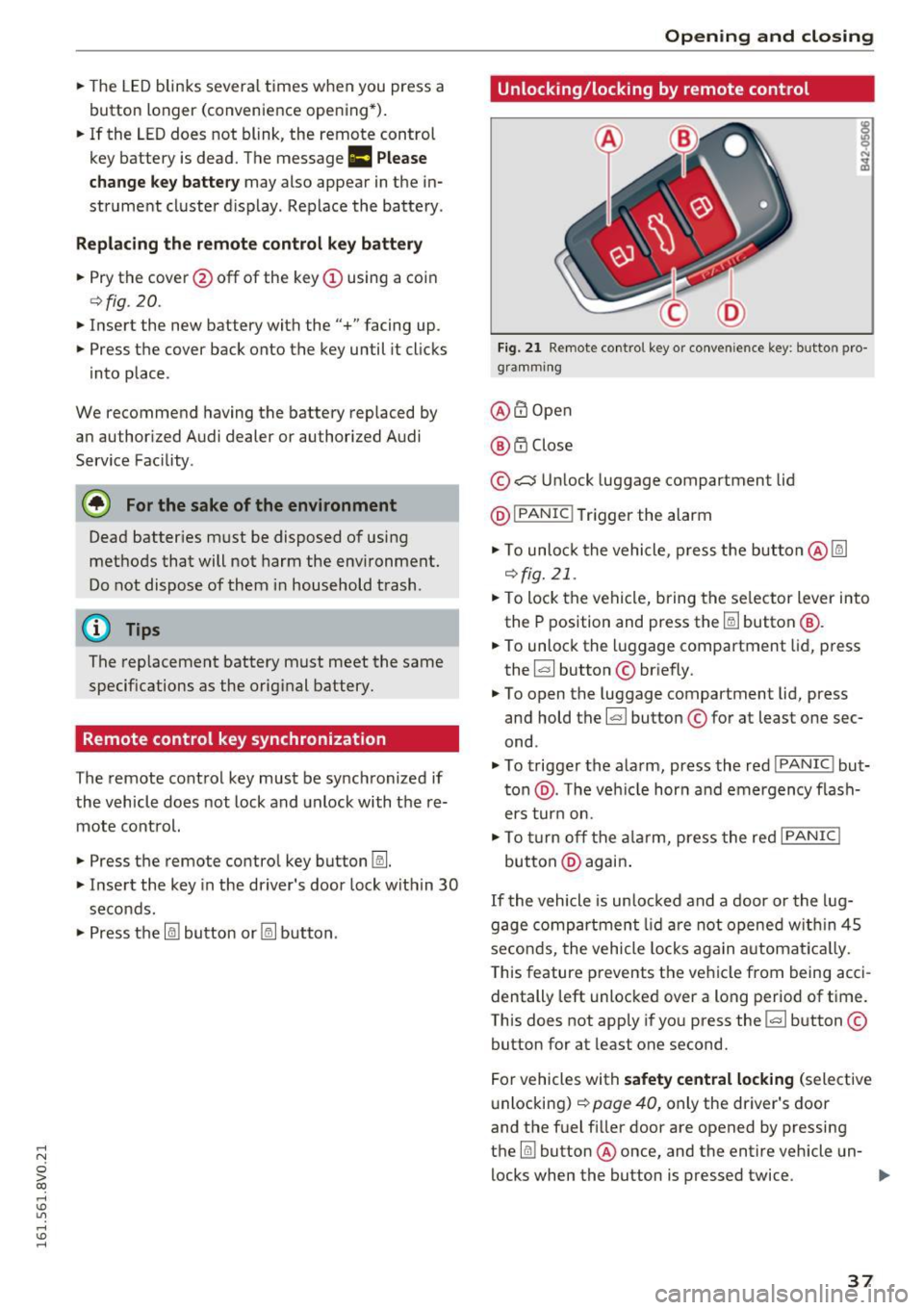
Fig. 21 Remote control key or conve nien ce key : button pro
gramm ing
@ m Open
@ i'.D Close
© .:::::$Unlock luggage compartment lid
@ IPANIC !T rigger the alarm
... To unloc k the vehicle, press the button@~
c::>fig. 21 .
.. To lock the vehicle, bring the selector lever into
the P position and press the~ button
@.
.. To unlock the luggage compartment lid, press
the ~ button © briefly.
.,. To open the luggage compartment lid, press
and hold the~ button © for at least one sec
ond .
... To trigger the alarm, press the red I PANIC ! but
ton @. T he veh icle horn and emergency flash
ers turn on.
.. To turn off the alarm, press the red I PANIC !
button @again .
If the vehicle is unlocked and a door or the lug
gage compartment lid are not opened w ithin 45
seconds, the vehicle locks again automat ically.
This feature prevents the vehicle from being acci
dentally left unlocked over a long period of time.
This does not apply if you press the~ button ©
button for at least one second.
For vehicles with
safety central locking (selective
unlocking)
c::> page 40, only the driver's door
and the fuel f iller door are opened by pressing
the ~ button @ once, and the entire vehicle un-
locks when the button is pressed twice .
Ill>
37
Page 49 of 328
.... N
0 > CX)
.... I.Cl U"I
.... I.Cl ....
When switched on, adaptive light adjusts to
curves depending on the vehicle speed and steering wheel angle. This provides better lighting
through the curve. The system operates in a
speed range from approximately 6 mph (10 km/
h) to 68 mph (110 km/h).
Static cornering light* (vehicles with adaptive
light) -the cornering light switches on automati
cally when the steering wheel is turned at acer
tain angle at speeds up to approximately 44 mph
(70 km/h) and when the turn signal is activated
at speeds up to approximately 25 mph (40 km/
h). The area to the side of the vehicle is illuminat
ed better when turning.
Speed dependent light distribution* -The speed
dependent light distribution adapts the light in
towns and on highways or expressways . Intersec
tions can also be illuminated on vehicles with a
navigation system* .
Highway light function*
(Vehicles with adaptive light or LED headlights) -
This function adapts the lighting for highway
driving based on vehicle speed .
& WARNING
-Automatic headlights* are only intended to
assist the driver. They do not relieve the
driver of responsibility to check the head
lights and to turn them on manually accord
ing to the current light and visibility condi
tions. For example, fog cannot be detected by the light sensors . So always switch on the
low beam under these weather conditions
and when driving in the dark
io.
-Accidents could occur if you cannot see the
road ahead of you well and if others on the
road cannot see you . Always switch your
headlightsonsothatyoucanseetheroad
ahead of you and others can see your vehicle
from behind.
- The rear fog lights should only be turned on
in accordance with traffic regulations, to
prevent glare for traffic behind your vehicle .
-If the battery has been discharging for a
while, the parking lights may switch off au
tomatically to conserve the battery charge
Lights and Vision
for the next time the engine is started. Al·
ways make sure your vehicle complies with
legal regulations regarding sufficient and
safe lighting when parking it. Avoid using
the parking lights for several hours.
- Please observe legal regulations when using
the lighting systems described .
@ Tips
-The light sensor for the automatic head
lights* is in the rearview mirror mount.
Therefore, do not place any stickers in this
area on the windshield.
- Some functions of the exterior lighting can
be adjusted
¢ page 48 .
-If you turn off the ignition while the exterior
lights are on and open the door, you will
hear a warning tone.
- In some market-specific versions, the tail
lights do not turn on when switching on the
daytime running lights .
- In cool or damp weather, the inside of the
headlights, turn signals and tail lights can
fog over due to the temperature difference
between the inside and outside. They will
clear shortly after switching them on. This
does not affect the service life of the light
ing.
- A message will appear in the instrument
cluster if there is a malfunction in the light
sensor
¢ page 25.
Emergency flasher
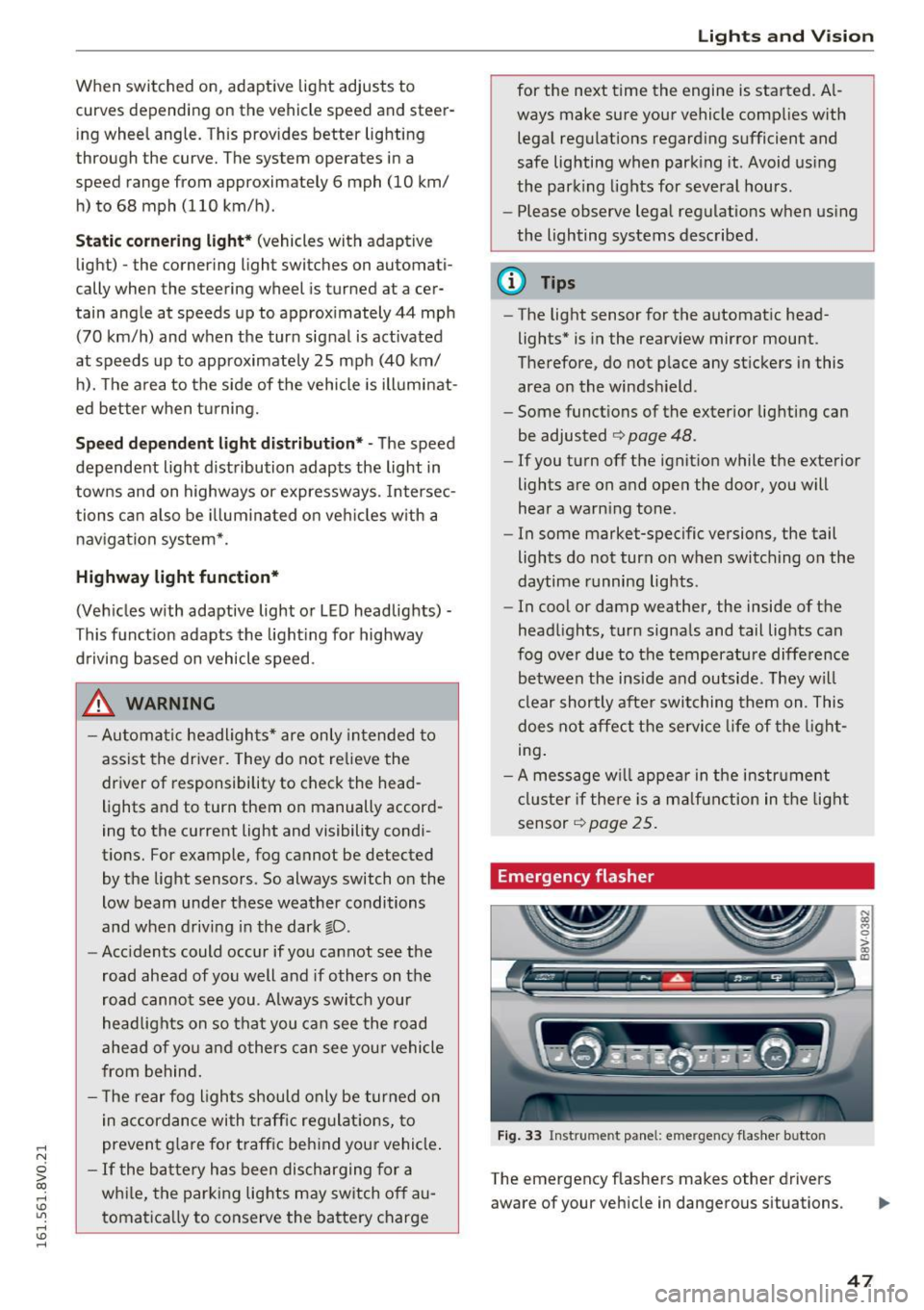
Fig. 33 Inst rume nt panel: e merge ncy flasher butto n
The emergency flashers makes other drivers
aware of your vehicle in dangerous situations .
N Cl) M 0
> Cl) (0
47
Page 56 of 328
Lights and Vision
Wiper service position /blade replacement
po sit ion
.. To bring the wipers into the service position,
turn the ignition
off and move the windshield
wiper lever into position@¢
page 52, fig. 41 .
.. To bring the wipers into the starting pos it ion,
turn the ignition on and move the windsh ield
wipe r lever into position@¢
page 52, fig. 41.
Removing th e wiper blade
.. Fo ld the windshield wiper arm away from the
winds hield.
.. Press the lock ing knob
(D ¢ fig. 43 on the wiper
blade . Hold the w iper blade firmly .
.. Remove the wipe r blade in the direct ion of the
arrow.
Installing th e wiper blade
.. Insert the new wiper b lade into the mount on
the wiper arm @unti l you hea r it latch into
place .
.. Place the w ipe r arm back on t he w indshie ld .
.. Turn the serv ice position off.
_& WARNING
F or safety re asons, t he wind shie ld wiper
blades sho uld be replaced once or twice each
year .
- T he wi ndshield wipe rs mus t only be folded
away w hen in the serv ice posi tion. Other
wise, you r is k damaging the paint on the
hood or the windshield wiper motor .
- You should not dr ive your ve hicle or press
the windshie ld wiper lever when the wiper
a rms are fo lded away from the windshield.
The windshield wipers would move back in
to the ir o rig inal position and could damage
the hood and w indshield.
- To prevent damage to t he windshie ld wash
er system, a lways loosen wiper blades that
have frozen to the w indshield before turn
i ng the wipers on .
- To preve nt damage to the wiper b lades, do
not apply gasol ine, pet roleum, thinning
54 agents o
r othe r solvents on the wi per
blades or near them .
- T o prevent damage to the wiper arms or
other components, do not try to move the
windshield wipe rs by hand.
@ Tips
- C ommercial hot wax s uch a s the types used
by car washes make it more diffic ult to
clean the w indshie ld .
- You can also use the service pos it ion, for ex
amp le, if you want to protect the winds hield
from icing by using a cover.
- You cannot activate the service posit ion
when the hood is open .
Replacing rear windshield wiper blade
Applies to vehicles: with rear window wiper (A3 Sportback)
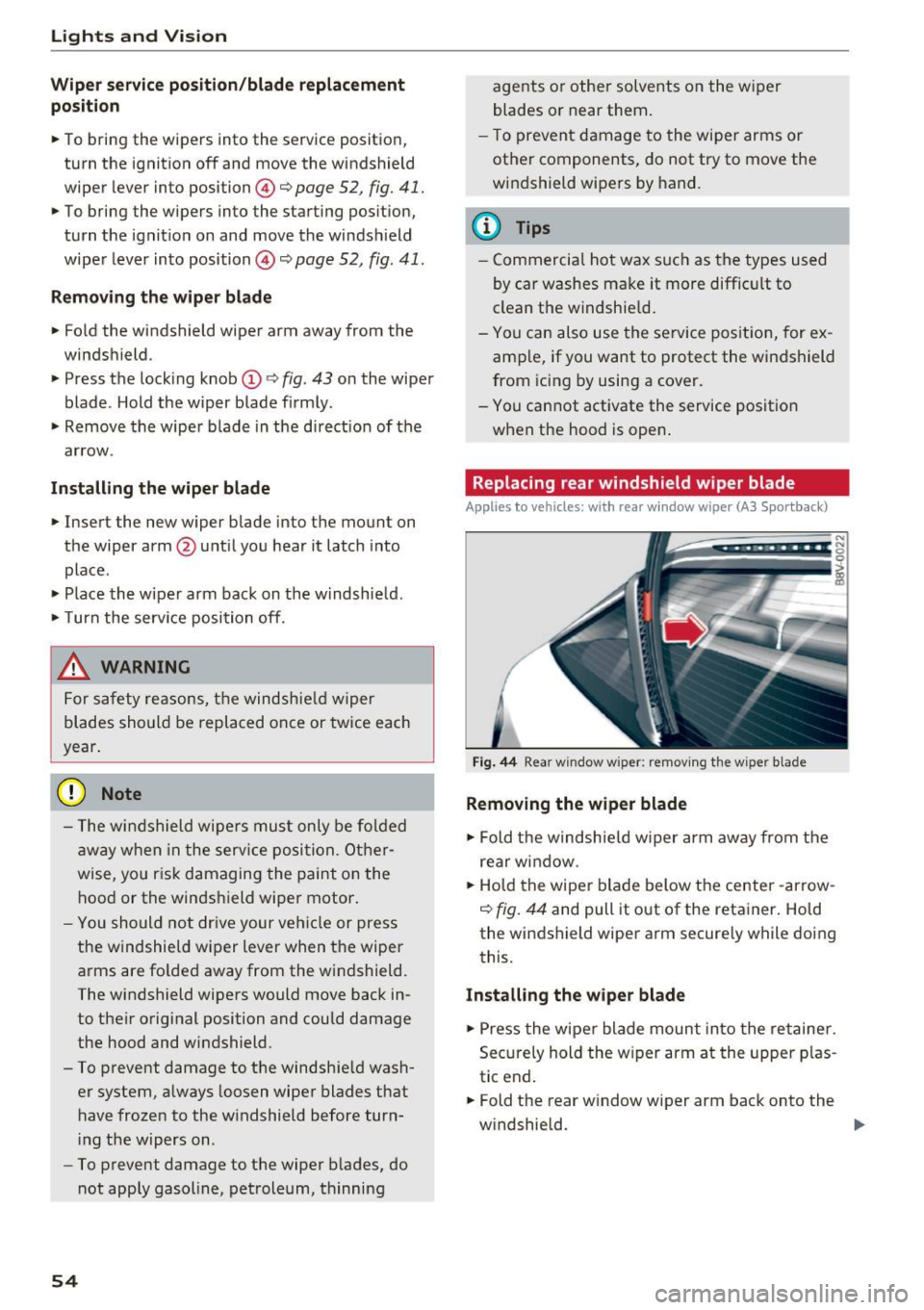
Fig.
44 Rear win dow w ipe r: remov ing t he wipe r blade
Removing the wiper blade
.. Fold the w indshie ld w iper arm aw ay from the
rear wi ndow.
.. Ho ld the wiper blade below the center -arrow
¢
fig. 44 and pull it o ut of the reta iner. Hold
the windshield wiper a rm secure ly while doing
this.
Installing the w iper blade
.. Press the wipe r blade mount into the re tainer.
Securely hold the w iper arm at the upper p las
tic end .
.. Fold the rear window wiper arm back onto the
w indshield. .,..
Page 72 of 328
Warm and cold
Warm and cold Climate control system
Description
Different systems could be installed.
- manual climate control system* or
- automatic climate control system*
- Plug-in hybrid drive* climate control
¢page 122
The climate control system* cools and removes
humidity from the air in the vehicle interior. It is
the most effective when the windows and panor
ama sunroof* are closed.
If there is a build-up of
heat inside the vehicle, ventilation can help to
speed up the cooling process. For this reason, the
windows and panorama sunroof can be opened from the outside .
¢ page 43, Convenience open
ing/closing
Pollutant filter
The pollutant filter removes pollutants such as
dust and pollen from the air .
Key recognition
You can store various settings for the manual and
automatic
climate control system* and assign
them to the key being used.
A WARNING
Poor visibility can lead to accidents.
- For safer driving, keep all windows free of
ice, snow and fog.
- Become familiar as quickly as possible with
the correct use and function of the cl imate
control system, especially with the defrost
ing and defogg ing function.
- When the temperature is below freezing,
only use the windshield washer system after
70
the windshield has been warmed by the cli
mate control system. The washer fluid could
freeze on the windshield and impair visibili
ty.
Cl) Note
- If you suspect that the climate control sys
tem is damaged, switch the system off to
prevent further damage and have it checked
by an authorized Audi dealer or authorized
Audi Service Facility.
- Repairs to the Audi climate control system
require special technical knowledge and
special tools. See an authorized Aud i dealer
or authorized Aud i Service Facility .
@ For the sake of the environment
Reducing the amount of fuel used also re
duces the amount of pollutants that enter the
air.
(D Tips
- To prevent interference with the heating
and cooling output and to prevent the win
dows from fogging over, the a ir intake in
front of the windshie ld must be free of ice,
snow or leaves.
- Condensation from the cooling system* can
dr ip and form a puddle of water unde r the
vehicle. This is norma l and does not mean
there is a leak.
- Th e energy management system may switch
the seat heating* or rear window defroster
off temporarily. These systems are available
again as soon as the energy supply has been
restored.
- The f lows through the vents under the rear
window. Make sure the openings are not
covered when placing clothing on the lug
gage compartment cover .
Page 78 of 328
Warm and cold
outlet, regardless of whether it is protected
against a short circuit or not.
- Always disconnect the connector cable and
close the cover
(D before starting the engine.
.&_ WARNING
Using the engine preheater incorrectly can
cause short circuits, electric shocks, fire, seri
ous injuries and death.
- The connector cable must always be con
nected to a grounded 120 Volt socket that
is equipped with a GFI circuit breaker . Al
ways protect the sockets from water, mois
ture and other fluids .
- Never plug the engine preheater into a con
ventional outlet, regardless of whether it is protected against a short circuit or not .
.&_ WARNING
-
Short circuiting, fire, serious injuries and life
threatening or lethal electric shock can result
from using unsuitable or damaged sockets and connector cables/extension cords, using
electrical equipment incorrectly, and/or disre
garding general safety precautions.
- Always plug the extension cord into a 120 V
socket that is properly functioning, ground
ed, equipped with a GFI circuit breaker and
is protected against water, moisture and
other fluids.
- Never connect the engine preheater to a
conventional socket, even if the socket is
protected by a fuse.
- Always check the fuse on the 120 Volt GFI
socket before connecting the connector ca
ble to the engine preheater on the vehicle.
- Only use highly durable extension cords that
are class 12 or better and can be properly grounded to a three-prong wall socket with
a GFI circuit breaker . The extension cord
must not be longer than 100 feet (30 me
ters).
- Never use damaged connector cables, ex
tension cords or sockets . Always check the
connector cable, extension cord and sockets
for damage before using them. Damaged
parts must be replaced. If damaged, replace
76
the engine preheater connector cable at an
authorized Audi dealer or authorized Audi
service facility .
- Only use the connector cable provided to
connect the vehicle socket to a suitable
power source. Use a suitable extension cord
if necessary .
- Always disconnect the connector cable from
the vehicle socket before starting the en
gine. Switch off the power supply to the
connector cable and to the extension cord if necessary, or disconnect the cable or exten
sion cord from the 120 Volt socket equip
ped with a GFI circuit breaker. Never leave
the connector cable or extension cord con
nected to a live power source.
- Never make alterations or repairs to the
connector cables or extension cords that
supply power to the engine preheater or to
any components that affect the engine pre
heater.
- Always protect the connections from water,
moisture and other fluids. Always store the
connector cable and extension cord securely
and in a dry place when they are not being
used, and disconnect them from the power
source before storing .
(D Tips
Test the GFI circuit breaker once a month if
you use the engine preheater occasionally, and test it weekly if you use it regularly.
Page 80 of 328
Driving
If you anticipate what you need to do next and
drive economically, you can easily cut your fuel
consumption by 10-15 percent. This section will
give you some tips on how you can help the envi ronment and your pocketbook.
(D Tips
The consumption estimates as published by ENVIRONMENTAL PROTECTION AGENCY
(EPA) and Transport Canada may not corre
spond to your actual consumption on the
road, which will vary depending upon vehicle
load and speed, road and weather conditions,
trip length, etc.
Drive smoothly and keep a lookout ahead
Vehicles use the most fuel when they are acceler
ating.
.. Avoid unnecessary accelerating and braking .
Vehicles use the most fuel when they are acceler
ating. If you anticipate what is going to happen next, you will need to brake less and, thus, accel
erate less. Let the vehicle coast whenever possi
ble -for example when you see that the next traf
fic light is red.
Avoid full throttle
Driving at moderate speeds saves fuel and im
proves your mileage.
.. Try and keep well below your car's maximum
speed .
Accelerating gently reduces fuel consumption,
engine wear, and does not disturb the environ ment.
Fuel consumption, exhaust emissions and engine
noise increase disproportionately at high speeds.
If you drive at approximately three quarters of
top speed, fuel consumption will be reduced by
one half . Never drive faster than the posted
speed limit and weather conditions permit.
78
· Reducing unnecessary idling
Even when your car is just idling it burns up fuel .
.. Shut the engine off when you are not driving
the vehicle .
.,. Do not warm up the vehicle by letting the en-
gine run at idle .
It is efficient to switch off the engine when stop
ped at railroad crossings and long red lights.
Turning the engine off for just 30 -40 seconds
saves more fuel than is burned by starting the
engine again .
It takes a long time for the engine to warm up
fully when it is running at idle . However, wear
and noxious emissions are especially high when
the engine is warming up . So you should drive
away as soon as you start the engine and avoid running at high rpms while the engine is still
warming up .
@ Note
Do not leave engine idling unattended after
starting. If warning lights should come on to
indicate improper operation, they would go
unheeded. Extended idling also produces
heat, which could result in overheating or
other damage to the vehicle or other proper
ty.
Regular maintenance
A badly tuned engine unnecessarily wastes a lot
of fuel.
.. Have your vehicle serviced at regular intervals.
By having your vehicle regularly serviced by an
Audi dealer helps to ensure that it runs properly
and economically. The condition of your vehicle
not only affects its safety and ability to hold its
value, it also affects
fuel consumption.
Check your oil each time you fill your tank.
The amount of oil used is related to engine load
and speed.
It is normal for the oil consumption of a new en
gine to reach its lowest value after a certain mile -
age has been driven . ..,.
Page 81 of 328
.... N
0 > CX)
rl I.Cl U"I
rl I.Cl ....
You must drive your vehicle about 3,000 miles
(5 ,000 kilomet ers) before you can prop erly as
sess o il consumption .
This a lso applies to fuel consump tion and engine
output .
(D Note
-Have your vehicle mainta ined properly and
i n accor dance wi th the service re commenda
tions in yo ur War ranty
& Maintenance book
l et. Lack of proper maintenance as well as
i mproper use of the vehicle will impair the
function of the emission control system and
could lead to damage .
- Do not alter or remove any component of
the Em ission Control System unless ap
proved by the manufacturer.
- Do not alter or remove any device, such as
heat shie lds, sw itches, ignition wires,
valves, which a re designed to protect yo ur
vehicle's Em ission Control System and other
i mportant vehicle components.
Fewer short trips
Fuel consumption will always be relatively high
on short trips.
• Try to avoid driving short dist ances with a cold
engi ne .
T he eng ine and catalytic converter have to reach
their optimal
operating tempe rature to reduce
fuel consump tion and noxious emissions effec
tively .
Just after starting, a cold engine in a mid-si ze car
only achieves a fuel economy of 6-8 miles per
ga llon (30-40 l/100 km). A fter about a half a
m ile , fuel economy cl imbs to 12 mpg (20 l/
100 km) . After about
2.5 miles (4 km), the en
g ine is a t its prope r operating temperature and
fuel economy has reache d a normal level. So you
c a n see t hat you s hou ld avoid sho rt t rips whenev
er possib le .
The
outside temperature is also cr itical in th is re
g ar d. Yo ur car c onsumes mo re fuel in the w in ter
than in the s umme r.
D rivi ng
Steering
Adjusting the steering wheel position
The steering wheel position is fully adjustable up
and down and forward and back.
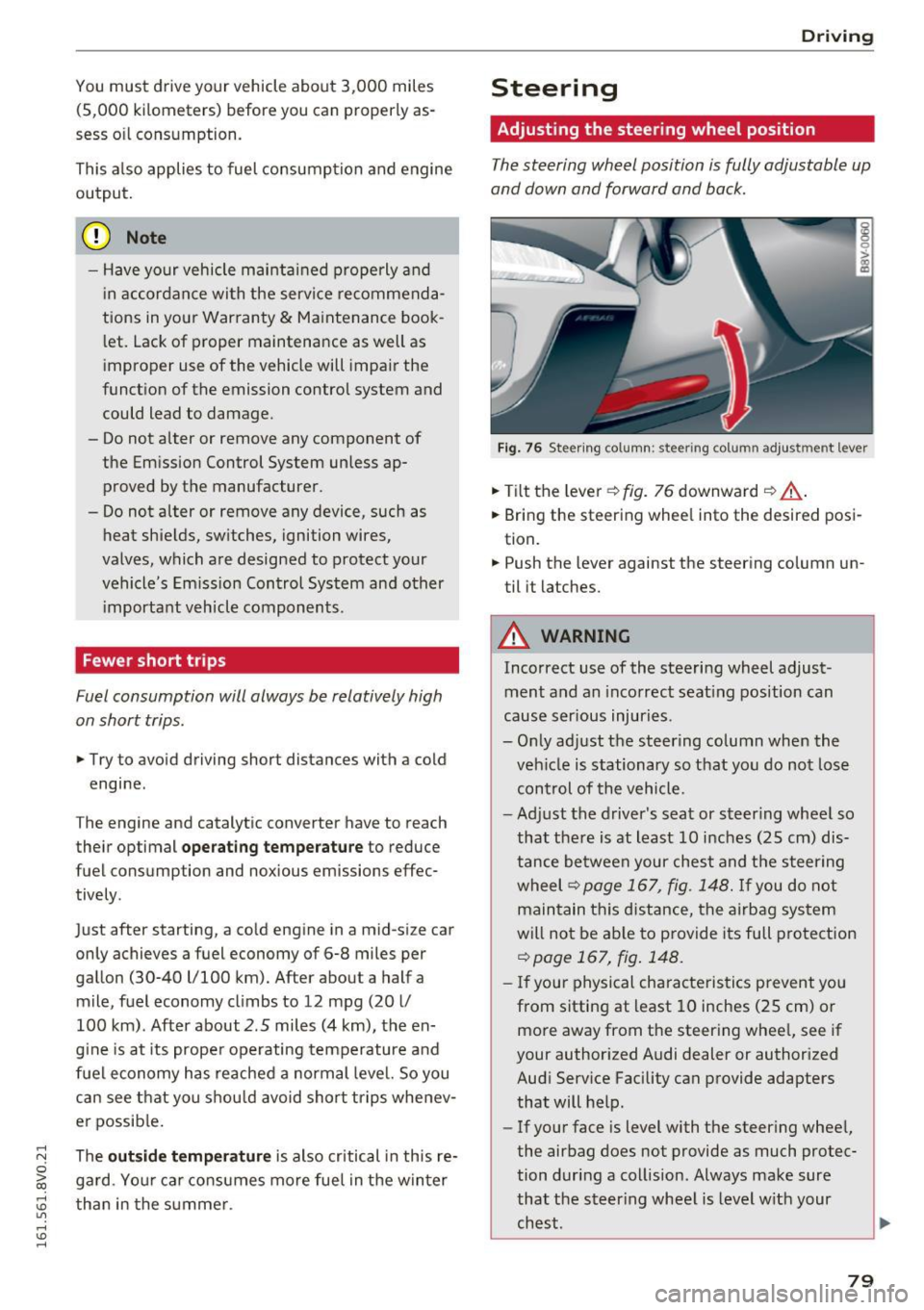
F ig . 7 6 Stee rin g c olu m n: steering co lumn adjustm en t leve r
• Tilt the leve r¢ fig. 76 downward ¢&_ .
• Bring the steer ing whee l into the desired pos i
tion.
• Push the lever against the steer ing column un
til it latches.
A WARNING
-
Incorrect use of the stee ring wheel adjust
ment and an incorrect seat ing position can
cause ser ious injuries .
- On ly ad just the steering column when the
veh icle is stationary so that yo u do not lose
con trol of the vehicle.
-
-Ad just the driver 's sea t or s teer ing whee l so
that the re is at least 10 inc hes (25 cm) dis
tance be tween your ches t and t he steer ing
wheel
r:!> p age 16 7, fig. 1 48 . If y ou d o not
main tain t his d istance, t he ai rb ag sys tem
will not be ab le to provide its fu ll pro tection
r:!> page 167, fig . 148.
- If your phy sical ch aracteris tic s prevent you
from sitting at least 10 inches ( 25 cm) o r
mo re away from the steer ing whee l, see if
your author ized Audi dealer or authorized
Aud i Serv ice Facility can provide adapters
that will help.
- If your face is level with the steer ing whee l,
the airbag does not provide as much protec
tion dur ing a col lision . Always make sure
that the steer ing whee l is level w ith your
chest.
~
79
Page 82 of 328
Driving
-Always hold the steering wheel with your
hands in the 9 o'clock and 3 o'clock posi
t ions to reduce the risk of injury if the airbag
deploys.
- Never hold the steer ing whee l in the
12
o'clock posit ion or with both hands on the
rim or the center of the steer ing whee l.
Holding the steering wheel inco rrectly s ig
nificantly incr eas es the risk of inju ry to the
h ands, arms and head if t he ai rbag dep loys.
Starting and stopping
the engine (vehicles with
an ignition Lock)
Starting the engine with the key
A pp lies to veh icles: w ith ig ni tion lock
The ignition is switched on and the engine start
ed with the key in the ignition .
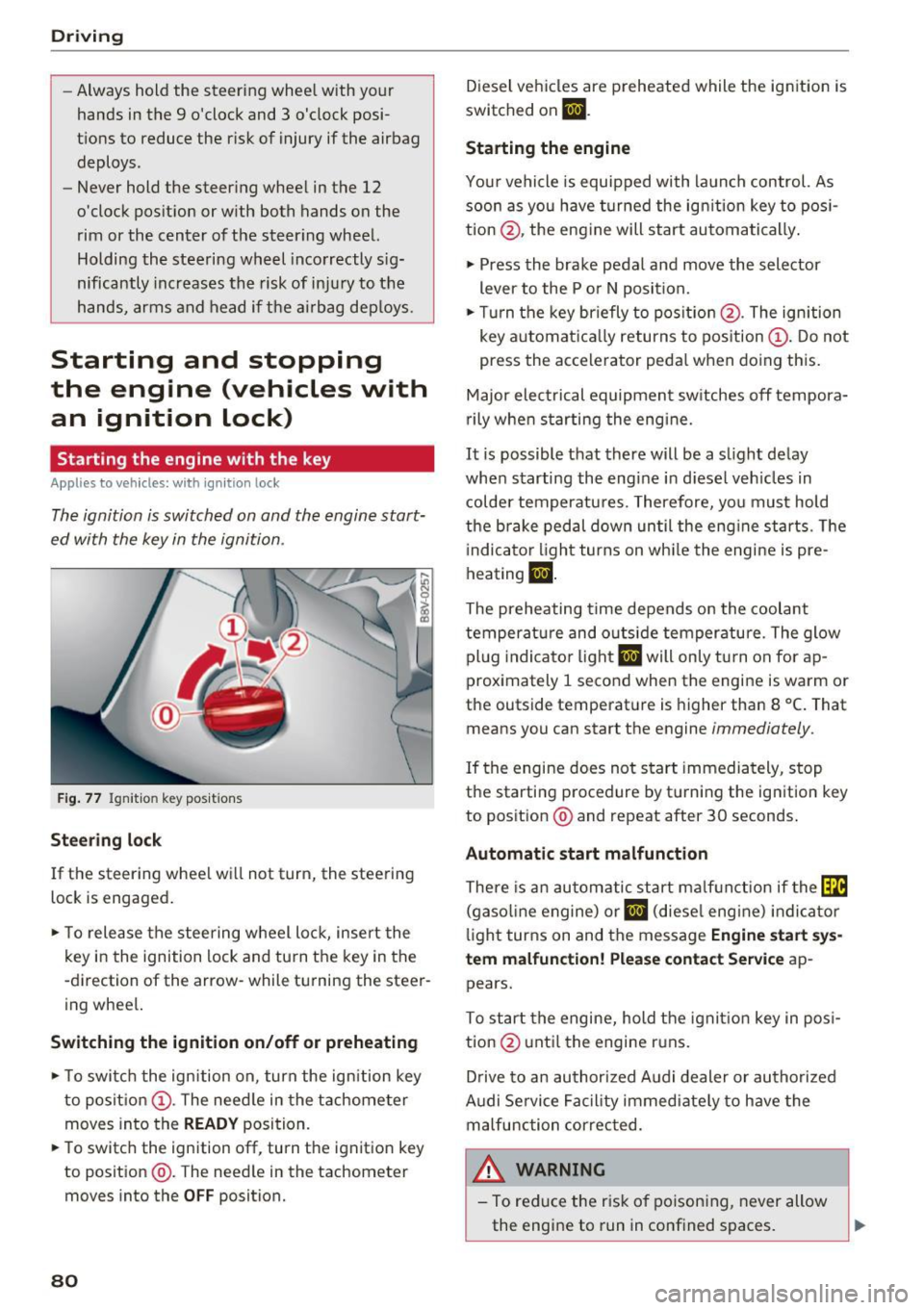
Fig . 77 Ign it io n key pos it ions
Stee ring lock
If the steering whee l w ill not turn, the steering
lock is engaged .
.,. To release the steering wheel lo ck, inse rt the
k ey i n the ignition lock and tu rn t he key in the
-d irection of the arrow- while tu rning the steer
ing wheel.
Sw itching the ignition on/off or preheating
.,. To switc h the ignition on, turn the ign ition key
to posit io n @ . The need le in the tachometer
moves into the
READY position.
.,. To switc h the ign ition off, turn the ignit ion key
to position @. The need le in the tachometer
moves into the
OFF position.
80
D iesel ve hicl es are p reheated while the ig nition is
switched on
m .
Starting the engine
You r vehicle is equipped wi th la unch control. As
soon as you have turned the ig nition key to pos i
tion @, the eng ine will start au tomati cally .
.,. Press the brake pedal and move the sele ctor
lever to the P o r
N position.
.,. Turn the key briefly to pos it ion @. The ign ition
key a utomat ically returns to position @. D o not
press the acce lerator peda l when doing this.
Major elec trical equipmen t sw itches off tempora
r ily whe n starting the engine.
It is possible t hat there will be a s ligh t de lay
whe n starting the engine in diesel veh icles in
colder temperatu res. Therefore, yo u must hold
t h e b rake pedal down until the eng ine starts . T he
i ndicato r ligh t turns on wh ile the engine is pre
heating
iJ.
The preheating time depends on the coolant
temper ature and o utside temperature. The glow
pl ug indi cato r light
m will only tu rn on for ap
proximately
1 second when the engine is warm or
t h e outside temperat ure is higher than
8 °C. That
means you can start the engine
immediately.
I f the engine does not s tart immedia tely, s top
the starti ng p rocedure by tu rni ng the ig nition key
to posit ion @ and repeat after
30 seconds .
Automatic start malfunction
There is an a utom atic st art ma lf u nct ion if the ~
(ga so lin e engine) or
m (diese l eng ine) indica tor
li ght tur ns on and the message
Engine start sys·
tem malfun ction! Please contact Service
ap
pears.
To star t the engine, hold the igni tion key in pos i
tion @unt il the engine r uns.
D rive to an au thori zed A udi dealer or au thori zed
A udi Se rvice Fa cility immed iate ly to h ave the
malfunc tion correc ted .
& WARNING
- To red uce the r isk o f po ison ing, never allow
the engine to run in conf ined spaces .
Page 85 of 328
,....,
N
0 > co ,....,
There is an automatic start malfunction if the~
(gasoline engine) or
II (diesel engine) indicator
light turns on and the message
Engine start sys
tem malfunction! Please contact Service
ap
pears.
To start the engine, press and hold the
I S TART ENGINE STOPI button until the engine
runs.
Drive to an authorized Audi dealer or authorized
Audi Service Facility immediately to have the
malfunction corrected.
& WARNING
- To reduce the risk of poisoning, never allow
the engine to run in confined spaces.
- Always take the vehicle key with you when
leaving the vehicle, even for a short period
of time. This applies particularly when chil
dren remain in the vehicle. Otherwise the
children could start the engine or operate
electrical equipment such as power win
dows .
- Please note that the brake booster and pow
er steering only work when the engine is
running . When the engine off, you must use
more force to steer or brake the vehicle. Be
cause the usual steering and braking capa
bility is not available, the risk of accidents or
injuries increases.
(D Note
- Avoid high engine speed, full throttle, and
heavy engine load as long as the engine has
not reached operating temperature yet. You
could damage the engine.
- The engine cannot be started by pushing or
towing.
@) For the sake of the environment
Do not let the engine run while parked to
warm up. Begin driving immediately. This re
duces unnecessary emissions.
,....,
{!) Tips
-Some noise after starting the engine is nor
mal and is no cause for concern.
- If the . indicator light blinks in the instru
ment cluster before switching the ignition
off, the ignition will not switch on again.
¢page 162
-If you leave your vehicle with the ignition
switched on, the ignition will switch off af
ter a certain amount of time. Make sure that electrical equipment such as the exterior
lights are switched off .
Turning the engine off using the
button
Applies to vehicles: with convenience key
Plug-in hybrid drive*: refer to the information un
der
¢ page 100.
"' Bring the vehicle to a full stop.
"' Move the selector lever into the P position.
.. Press the
!STAR T ENGINE STOP ! button
¢ page 82, fig. 78.
The needle in the tachometer moves to OFF when
the ignition switches off.
Steering lock1
)
The steering locks when you turn the engine off
using the
I START ENGINE STOPI* button, move
the selector lever into the P position and open
the driver's door.
The locked steering helps prevent vehicle theft.
Emergency off function
If it is absolutely necessary, the engine can also
be turned off while driving at speeds lower than
6 mph (10 km/h). To switch the engine off, press
the
I START ENGINE STOPI button twice in a row
briefly or press and hold for longer than two sec -
onds. ..,.
83
Page 86 of 328
Driving
_& WARNING
- Never turn off the engine before the vehicle
has come to a complete stop. The full func
tion of the brake booster and the power
steering is not guaranteed. You must use
more force to turn or brake if. Because you
cannot steer and brake as you usually
would, this could lead to accidents and seri
ous injuries.
- Please note that the brake booster and pow
er steering only work when the engine is
running. When the engine off, you must use
more force to steer or brake the vehicle. Be
cause the usual steering and brak.ing capa
bility is not available, the risk of accidents or
injuries increases .
- Always take the vehicle key with you when
leaving the vehicle, even for a short period
of time. This applies particularly when chil
dren remain in the vehicle . Otherwise the
children could start the engine or operate
electrical equipment such as power win
dows.
- For safety reasons, always park the vehicle
with the selector lever in the P position.
Otherwise, there is the risk that the vehicle
could roll.
- After the engine has been switched off, the
radiator fan can continue to run for up to 10
minutes -even with the ignition switched
off. It can also switch on again after some
time if the coolant temperature rises as the result of heat buildup or if the engine com
partment is heated by the sun's rays and the
engine is hot.
(D Note
If the engine has been under heavy load for
an extended period of time, heat builds up in
the engine compartment after the engine is
switched off- there is a risk of damaging the
engine. For this reason, let the engine run for
at idle for approximately two minutes before
shutting it off.
84
Starting the engine if there is a
malfunction
Applies to vehicles: with convenience key
It may not be possible to start the engine under
certain circumstances, for example if the battery
in the vehicle key is drained, if interference is af
fected the key or if there is a system malfunc
tion.
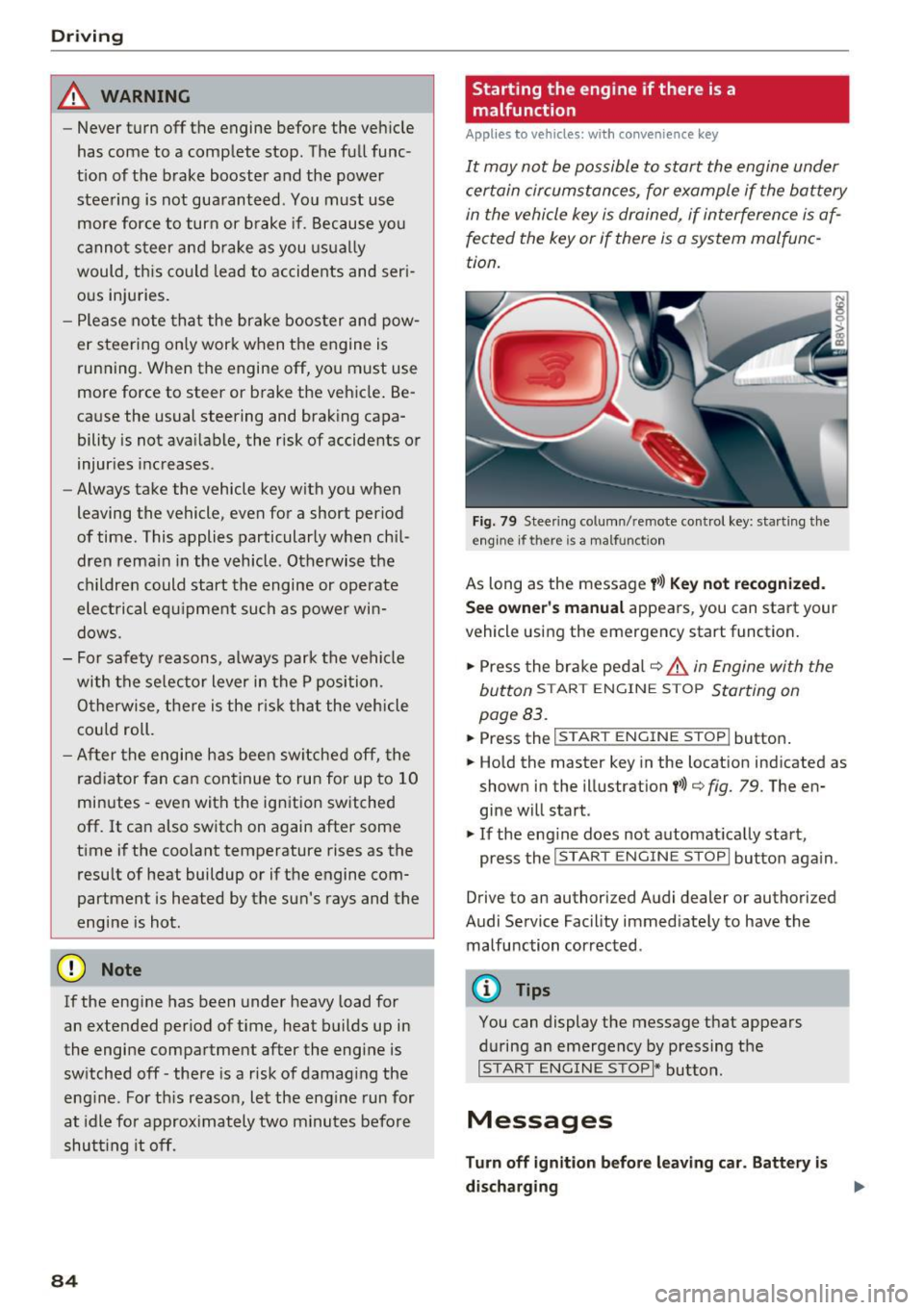
Fig. 79 Steering column/remote control key: starting the
e ngin e if there is a malfunct ion
As long as the message y>>) Key not recognized.
See owner's manual
appears, you can start your
vehicle using the emergency start function.
.,. Press the brake pedal¢ ,&.
in Engine with the
button
START ENGINE S TOP Starting on
page 83.
.,. Press the ~1s=T-A~R~T~E-N~G=r-N~E~S~T~O~P~ I button.
.,. Hold the master key in the location indicated as
shown in the illustration
t>>) ¢ fig. 79. The en
gine will start.
.,. If the engine does not automatically start,
press the
I START ENGINE STOPI button again .
Drive to an authorized Audi dealer or authorized
Audi Service Facility immediately to have the
malfunction corrected .
@ Tips
You can display the message that appears
during an emergency by pressing the
I START ENGINE STOPI* button.
Messages
Turn off ignition before leaving car. Battery is
discharging .,.