wheel AUDI S3 2016 Manual PDF
[x] Cancel search | Manufacturer: AUDI, Model Year: 2016, Model line: S3, Model: AUDI S3 2016Pages: 328, PDF Size: 81.78 MB
Page 271 of 328
,....,
N
0 > co ,....,
Wheel bolt s
Wheel bolts must be clean and loosen/t ighten
eas ily.
Rims
Rims with a bolted rim ring* or with bolted wheel
covers* consist of multiple pieces . These compo
nents were bolted together using special bolts
and a special procedure . You must not repair or
d isassemble them¢.&, .
A WARNING -
Wheel bolts that are t ightened or repaired in
correctly can become loose and result in loss
of vehicle control, which increases the risk of
an accident. For the correct tightening specif i
cation, refer to¢
page 284, After changing a
wheel.
- Always keep the wheel bolts and the
threads in the whee l hub clean and free of
grease.
- Only use wheel bolts that fit the rim.
- Always have damaged rims repaired by an
authorized Audi dealer or authorized Audi
Service Facility. Never repair or d isassemble
rims yourself, because this increases the risk
of an accident.
Winter tires
W inter tires significantly improve the veh icle's
handling when driving in winter condit ions . Be
cause of the ir construction (width, compound,
tread pattern), summe r tires provide less trac
tion o n ice and snow.
"' Use winter t ires on all fo ur wheels.
"' Only use winter t ires that are approved for your
vehicle.
"' Please note tha t the maximum permitted
speed may be lower with winter tires ¢
_&.. An
authorized Audi dealer o r authorized Audi Serv
ice Facility can inform you about the maximum
permitted speed for your tires.
"' Check the tire pressure after installing wheels
¢page 263.
Tires and wheel s
The effectiveness of winte r tires is reduced great
ly when the tread is worn down to a depth of
0.15 7 inch (4 mm). The characteristics of winter
tires also decrease greatly as the tire ages, re gardless of the rema in ing tread.
A WARNING
=
- Never drive faster than the max imum per
mitted speed for your tires. This could cause
the t ires to heat up too much. This increases
the risk of an accident because it can cause
the t ire to burst.
- Always adapt your driving to the road and
traffic cond itions. Drive carefully and reduce
your speed on icy or slippery roads. Even
winter t ires can lose tract ion on black ice.
@) For the sake of the environment
Reinstall summer tires at the app ropr iate
time, beca use they prov ide bette r handling
when roads are free of snow and ice. Summer
tires cause less road noise, tire wear and fue l
consumpt ion .
(D Tips
You can also use all season tires instead of
winter tires . Please note that in some coun
tries where winter tires are required, on ly
winter tires w ith the .& symbo l may be per
mitted.
Snow chains
Snow chains improve traction in the snow .
"'On ly install snow cha ins on the front wheels.
This applies a lso to vehicles with a ll w heel
drive* .
-
"'Check and correct the seating of the snow
chains if necessary after driving a few feet. Fol
low the instructions from the manufacturer.
"' Note the maximum permitted speed when dr iv
ing with snow chains. Do not exceed 30 mph (50 km/h) .
Snow cha ins not o nly improve the
driving in win-
ter road condit ions, but also the
braking. Iii>
269
Page 272 of 328
Tires and wheels
Use of snow chains is o nly pe rmitted with certain
rim/t ire combinations due to tec hnical reasons .
Chec k with an autho rize d Aud i dealer or autho r
i z ed A ud i Service Fac ility to see if yo u may use
snow chains.
Use
fine-mesh snow chains . They must not add
mo re t han 0 .53 inc h (13 .5 mm) in height, i nclud
i n g the chain loc k.
You mus t remove the chains when d riving on
roads that are
free of snow . W hen roads a re free
of snow, snow c hains ca n impair handlin g and
damage the t ires, and the chains w ill quickly be
destroyed.
A WARNING
Us ing inco rrect sno w ch ains or insta lling snow
chains in co rrectly can result in loss o f vehicle
c o ntrol, w hich i ncreas es th e risk of an a cci
de nt.
(D Note
- Snow cha ins can damage t he rims/whee l
covers* if the chains com e into d ir e ct con
tact wi th th em. R emov e th e wh eel covers*
fir st. U se coat ed s now chai ns.
Low aspect ratio tires
Your Aud i is fa cto ry-equippe d wi th low aspec t ra
tio tires . These ti res have been tho roughly teste d
an d been se lected specifically for yo ur model for
their superb per fo rmance, road f eel and handling
under a variety of d riving conditions . As k yo ur au
thor ized Audi dealer for mo re details .
The low aspect ratio of these t ires is indicated by
a nume ra l of
55 or less in the tire's size designa
tion . The nume ra l r ep resents the rat io o f th e
tire's sidewall he ight i n relat ion to its tread width
expressed in percentage . Conventional tires have
a height/w idt h ratio o f 60 o r more .
The performance of low-aspect-ratio tires is par
ticularly sensitive to improper inflation pres
sure. It is therefore important that low aspect
ratio tires are inflated to the specified pressure
and that the inflation pressure is regularly
c hecked and maintained . Tire pre ssures should
270
be checked at least once a month and always
before a long trip
~ page 263.
What you can do to avoid tire and rim
damage
Low aspect ra tio tires can be damaged more eas i
l y by impact with potho les, curbs, gullies or
r idges on t he road , particularly if t he tire is un
der i n flated.
I n order to min imize the occurrence o f impact
dama ge to the tires o f your veh icle, we recom
men d that you observe the following preca u
tions:
- Always main tain recommende d inf la tion pres
sures . Check yo ur tir e pressure eve ry 2,000
m iles (3,000 km) and add a ir if necessary .
- Dr ive ca refully on roa ds w ith potholes, deep
gullies o r ridges . The impact from dr iving
throug h or over such obstacles can damage
your t ires. Impact wit h a curb may a lso cause
damage to your tires.
-After a ny impact, immed iate ly inspect you r
tires or have them inspected by the nearest au
thorized Aud i dealer. Replace a damaged tire as
soon as poss ible .
- Inspect your tires every 2,000 m iles (3,000 km)
for damage and wear . Damage is no t always
easy to s ee . Damage ca n lead to loss o f air and
unde rin flation, w hich co uld even tually cause
t ire f ailure . If yo u beli eve th at a ti re may have
bee n da mage d, re place the tire as soon as p os
sible.
- These tires may we ar m ore quick ly th an oth ers.
- Please also rem emb er tha t, whil e the se tires
delive r responsive h andli ng, they may ride less
c omf ortabl y and ma ke m ore noi se th an o ther
choi ces .
Reduced performance in winter/cold season
conditions
A ll ti res are des igned for cert ain pur poses . T he
l ow aspect r atio , ul tra hig h perform ance tires
o rigina lly installed on your vehicle are inten ded
for maximum dry and wet road performance and
handling . T hey a re not suitable fo r co ld, snowy o r
i cy weather conditions. If yo u drive under th ose
c ircumstances, you should equip yo ur vehicle
with all -season o r winter tires, which offer better
11>-
Page 273 of 328
traction under those conditions. We suggest you
use the recommended snow or all-season tires
specified for your vehicle, or their equivalent.
Refer to
q page 269 for more detai led info rma
tion regarding winter tires.
Uniform tire quality grading
- Tr ead wear
- Traction AA A B C
- Temperature ABC
Quality grades can be found where applicable on
the tire side wa ll between tread shoulder and
maximum sect ion w idth
q page 253, fig. 202.
For exampl e: T read wear 2 00 , Traction AA , Tem
perature
A .
All passenger car tires must conform to Federal
Safety Requirements in addition to these grades.
Trea d we ar
The tread wear grade is a comparative rating
based on the wear rate of the tire when tested
under contro lled conditions on a specified gov
ernment test course.
For examp le, a tire graded
150 would wear one
and one ha lf
(11/2) times as well on the govern
ment course as a tire graded
100.
The relative performance of tires depends upon
the actual conditions of their use, however, and may d epart significant ly from the norm due to
variations in driving habits, service practices and d ifferences in road characteris tics and climate.
Tracti on
The traction grades, from highest to lowest, are
AA, A, B and
C. T hose grades represent the tire's
ability to stop on wet pavement as measured un
der controlled conditions on specified govern
ment test surfaces of asphalt and concrete . A tire
marked C may have poor traction performance
q .&. .
,...., Temp eratur e N
0
ii; The temperature grades are A (the h ighest), B,
and C, representing the tire's resistance to the
generation of heat and its ability to diss ipate
Tir es and wheel s
heat when tested under controlled conditions on
a specified indoor laboratory test wheel.
Sustained h igh temperatu re can cause the mate
ria l of the t ire to degenerate and reduce ti re life ,
and excessive temperature can lead to s udden
tire failure
q .& .
The grade C corresponds to a level of perfo rm
ance which all passenger car tires must meet un
der the Federal Motor Vehicle Safety Standa rd
No.
109. Grades Band A represent higher levels
of performance on the laboratory test wheel than
the minim um requ ired by law.
A WARNING
-
The tract ion grade assigned to this t ire is
based on straight -ahead braking traction
tests, and does not include acceleration, cor nering, hyd roplaning or pea k traction cha rac
terist ics.
A WARNING
The temperature grade for this tire is estab
lished for a tire that is properly infl,;1ted and
not overloaded . Excessive speed, underinfla
tion, or excessive loading, either separately or i n combination, can cause heat bui ldup and
possib le tire fai lure .
A WARNING
-
-Temperature grades apply to tires that are
p roperly inf lated and not over or under inflat
ed.
Tire pressure monitoring system
(l) General notes
App lies to vehicles: wi th tir e pressure mo nito rin g syste m
Each tire, including the spare (if provided),
shou ld be checked monthly when cold and inflat-
ed to the inflat io n pressure recommended by the
vehicle manufacturer on the veh icle placard or
t ir e inflation pressure label. (If your ve hicle has
t ir es of a different size than the si ze ind icated on .,..
271
Page 274 of 328
Tires and wheels
the vehicle placard or tire inflation pressure la
bel, you should determine the proper tire
inflation pressure for those tires).
As an added safety feature, your vehicle has been
equipped with a tire pressure monitoring system
(TPMS) that illuminates a low tire pressure tell
tale when one or more of your tires is significant ly under-inflated. Accordingly, when the low tire
pressure telltale illuminates, you should stop and
check your tires as soon as possible, and inflate
them to the proper pressure . Driving on a signifi
cantly under-inflated tire causes the tire to over
heat and can lead to tire failure. Under-inflation
also reduces fuel efficiency and tire tread life,
and may affect the vehicle's handling and stop
ping ability.
Please note that the TPMS is not a substitute for
proper tire maintenance, and it is the driver's re
sponsibility to maintain correct tire pressure,
even if under-inflation has not reached the level
to trigger illumination of the TPMS low tire pres
sure telltale.
Your vehicle has also been equipped with a TPMS
malfunction indicator to indicate when the sys
tem is not operating properly. The TPMS mal
function indicator is combined with the low tire
pressure telltale. When the system detects a
malfunction, the telltale will flash for approxi
mately one minute and then remain continuously
illuminated. This sequence will continue upon
subsequent vehicle start-ups as long as the mal
function exists .
When the malfunction indicator is illuminated,
the system may not be able to detect or signal
low tire pressure as intended. TPMS malfunctions
may occur for a variety of reasons, including the
installation of replacement or alternate tires or
wheels on the vehicle that prevent the TPMS
from functioning properly. Always check the
TPMS malfunction telltale after replacing one or
more tires or wheels on your vehicle to ensure
that the replacement or alternate tires and
wheels allow the TPMS to continue to function
properly .
272
· If the Tire Pressure Monitoring System
indicator appears
Applies to vehicles: with tire pressure monitoring system
The tire pressure indicator in the instrument
cluster informs you if the tire pressure is too low
or if there is a system malfunction.
Fig. 206 Instrument cl uster: i ndic ator lig ht with message
Using the ABS sensors, the tire pressure monitor
ing system compares the tire tread circumfer
ence and vibration characteristics of the individu
al tires . If the pressure changes in one or more
tires , this is indicated in the instrument cluster
display with an indicator light
Rt] and a message
¢fig. 206. If only one tire is affected, the loca
tion of that tire will be indicated. The message
turns off after a few minutes. You can display the
message again¢
page 30.
The tire pressures must be stored in the menu
display again each time the pressures change
(switching between partial and full load pres
sure) or after changing or replacing a tire on your
vehicle
¢ page 273. The tire pressure monitor
ing system only monitors the tire pressure you
have stored . You can find the recommended tire
pressures for your vehicle on the label on the
driver's door pillar¢
page 263.
Tire tread circumference and vibration character
istics can change and cause a tire pressure warn
ing if:
- If the tire pressure in one or more tires is too
low,
- the tire has structural damage,
- The tire was replaced or the tire pressure
changed and it was not stored again
¢page 273.
-the spare tire is installed.
Page 275 of 328
,....,
N
0 > co ,....,
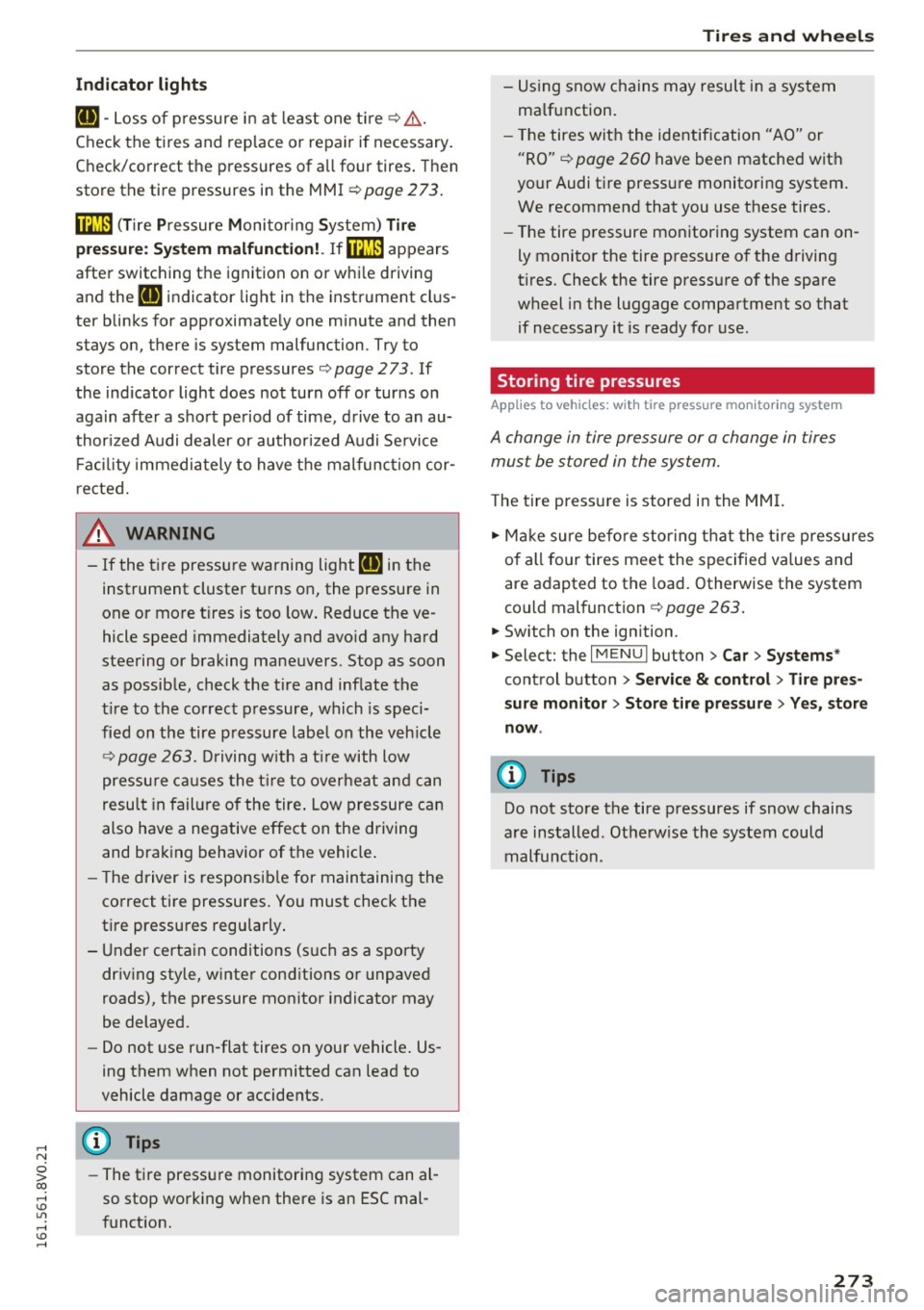
IE-Loss of pressure in at least one tire c::> ,&.
Check the tires and replace or repair if necessary.
Check/correct the pressures of all four tires. Then
store the tire pressures in the MMI
c::> page 2 73 .
mm (Tire Pressure Monitoring System) Tire
pressure: System malfunction!.
If m appears
after switching the ignition on or whi le driving
and the
IE indicator light in the instrument clus
ter blinks for approximately one minute and then
stays on, there is system malfunction. Try to
store the correct tire pressures
c::> page 2 73. If
the indicator light does not turn off or turns on
again after a short period of time, drive to an au
thor ized Audi dealer or authorized Audi Service
Facility immediately to have the malfunction cor
rected.
A WARNING
- If the tire pressure warning light IE in the
instrument cluster turns on, the pressure in
one or more tires is too low . Reduce the ve
hicle speed immediately and avoid any hard
steering or braking maneuvers. Stop as soon
as possible, check the tire and inflate the
t ir e to the correct pressure, which is speci
fied on the tire pressure label on the veh icle
c::> page 263. Driving with a ti re with low
pressure causes the tire to overheat and can
result in failure of the tire. Low pressure can
also have a negative effect on the driving
and braking behavior of the vehicle .
- Th e driver is responsible for maintaining the
correct tire pressures. You must check the
tire pressures regularly.
- Under certain conditions (such as a sporty
driv ing style, winter conditions or unpaved
roads), the pressure monitor indicator may
be delayed.
- Do not use run-flat tires on your vehicle . Us
ing them when not permitted can lead to
vehicle damage or accidents.
(D Tips
- The tire pressure monitoring system can al
so stop working when there is an ESC mal
function.
Tires and wheels
-Using snow chains may result in a system
ma lfunction.
- The tires with the identification "AO" or
"RO"
c::> page 260 have been matched with
your Audi tire pressure monitoring system .
We recommend that you use these tires.
- The tire pressure monitoring system can on
ly monitor the tire pressure of the driving
tires. Check the tire pressure of the spare
wheel in the luggage compartment so that if necessary it is ready for use.
Storing tire pressures
Applies to vehicles: with tire pressure mon itor ing system
A change in tire pressure or a change in tires
must be stored in the system.
The tire pressure is stored in the MMI.
.,. Make sure befo re storing that the tire pressures
of all four tires meet the specified va lues and
are adapted to the load. Otherwise the system
could malfunction
c::> page 263.
.. Switch on the ign ition.
.,.. Select: the I MENU I button> Car> Systems "
control button > Service & control > Tire pres
sure monitor > Store tire pressure > Yes, store
now .
(D Tips
Do not store the tire pressures if snow chains
a re installed . Otherwise the system could
malfunction.
273
Page 277 of 328
,....,
N
0 > co ,....,
-Only wash the vehicle when the ignition is
off and follow the instructions from the car
wash operator to reduce the risk of acci
dents.
- To reduce the risk of cuts, protect yourself
from sharp metal components when wash
ing the underbody or the inside of the wheel
housings.
-After washing the vehicle, the brak ing effect
may be delayed due to mo isture on the
brake rotors or ice in the w inter . The brakes
must be dried first w ith a few careful brake
applica tions .
{[) Note
-If you wash t he vehicle in an automatic car
wash, yo u m ust fold the e xterior m irrors i n
to reduce the risk of damage to the mi rrors.
Power folding exte rior m irrors* must o nly
b e fo lded in a nd out usin g the power folding
f u nct io n.
-
Ca re and cleaning
- To prevent pa int damage, do not wash the
vehicle in direct s un light .
- To re duce the risk of damage to the surface,
do not use insect removing sponges, kitche n
sponges o r similar items .
- Matte finish painted veh icle components:
- To reduce the r isk of damage to the sur-
face, do not use po lish ing agents or hard
wax.
- Never use protective wax. It can destroy
the matte finish effect .
- Do not place any stickers or magnetic
signs on vehicle parts painted with matte
finish paint . The paint cou ld be damaged
when the stickers or magne ts are re
moved.
@ For the sake of the environment
Only wash t he veh icle in facili ties s pec ially de
s igned for that pu rpose . This will reduce the
r isk of dirty wate r contamina ted with o il from
ente ring the sewe r sys tem.
Cleaning and care information
W hen clea ning and ca ring for individua l vehicle
comp onents, refer to the following t ables. The
inf ormat ion cont ained there is s imp ly recom
mendations. For q uest ions or for components t
h at are not l isted, cons ult an autho riz ed Aud i
de aler or author ized A udi Se rvice Fa cility. Also
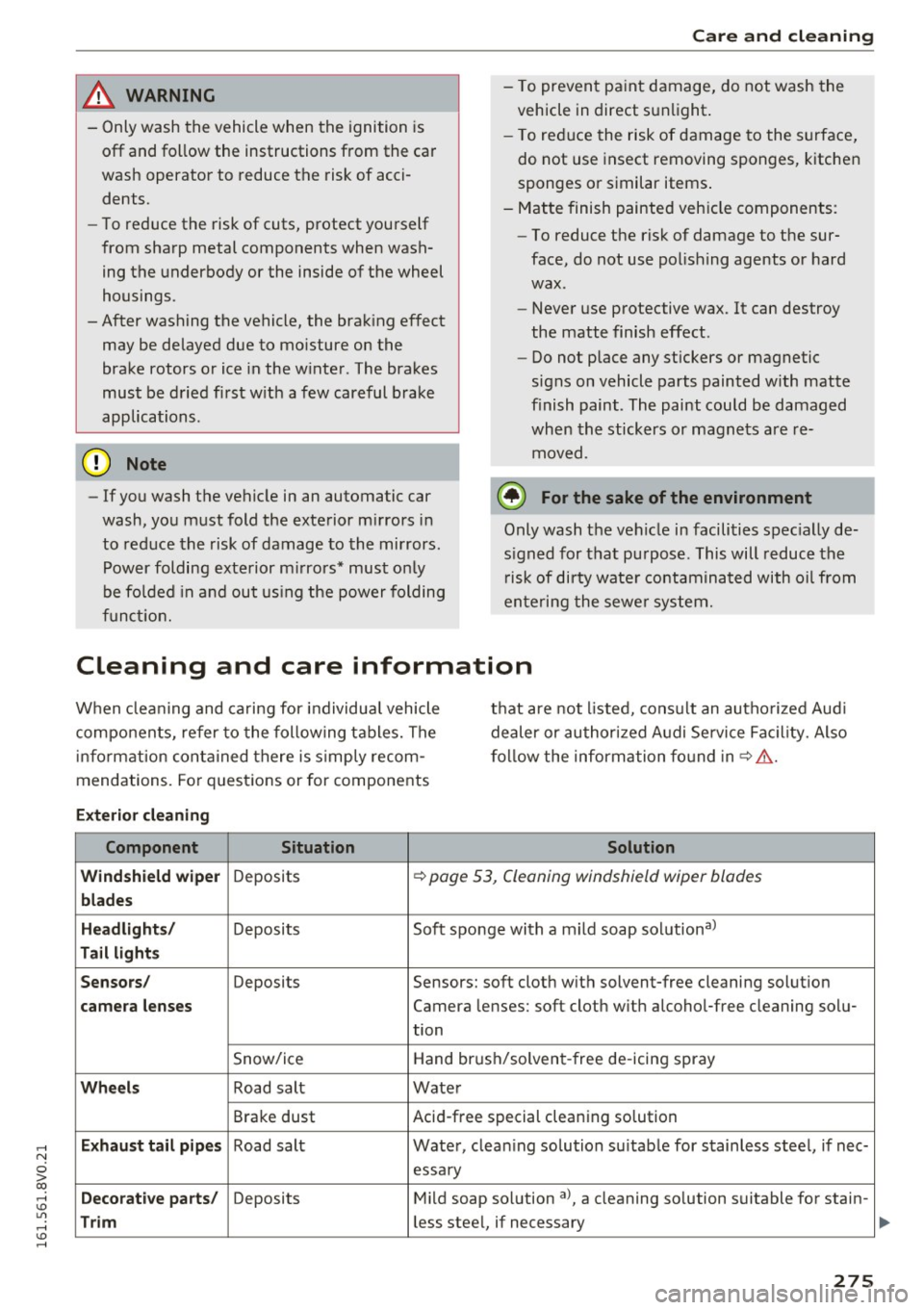
f o llow the information fo und in ~ .&. .
Ext erior cleaning
Component Situation Solution
Windshield wiper
D eposits ~ page 53, Cleaning windshield wiper blades
blades
Headlights /
Deposits So
ft spo nge with a m ild soap solutiona)
Tail lights
Sensors /
Deposits Sensors: soft cloth w ith solvent-free cleaning solution
camera lenses Camera lenses: soft cloth w ith alcohol-free cleaning solu-
tion
Snow/ice Hand br
ush/solven t-free de -icing spray
Wheels Road salt Water
Brake dust Acid-free special clean
ing so lution
Exhaust tail p ipes Road salt Water, clea ning so lu tion su itab le for s tainless stee l, if nee-
essary
Decorati ve parts / Deposits Mild soap so lution a>, a cleaning solution su itable for stain-
Trim less stee l, if necessary
275
...
Page 283 of 328
.... N
0 > CX)
.... I.Cl U"I
.... I.Cl ....
both tabs on the side panels ¢ fig. 209 (top im
age).
.. A3 Sedan: clip the plastic hook@ into the lug
gage compartment seal¢
fig. 209 (bottom im
age) .
Side panel
.. Open the twist lock and remove the cover @* I
@ ¢fig. 208 .
.&_ WARNING
Improper use of the vehicle jack can cause se
rious personal injuries.
- Never use the screw driver hex head to
tighten wheel bolts, since the bolts cannot
atta in the necessary tightening torque if you
use the hex head, potentially caus ing an ac
c ident.
- The factory-supplied jack is intended only
for your vehicle model. Under no circum
stances should it be used to
lift heavy
vehicles o r other loads; you r is k inju ring
yo urself.
- Never start the engine when the vehicle is
ra ised, whi ch could cause an accide nt.
- Support the veh icle secure ly with app ropr i
ate stands if wor k is to be perfo rmed under
neath t he vehicle; otherwise, the re is a po
tent ial risk for in jury.
- Never use the jack s upplied with your Audi
on another vehicle, par tic ularly on a heav ier
one. The jack is only suitab le for use on the
vehicle it came with .
(D Tips
The vehicle jack* in your vehicle is mainte
na nee-free.
Tire mobility kit
Preparation
A ppl ies to vehicles: W ith t ire re pair set
.. Read and fo llow th e import ant saf ety pr ecau
tion s¢
page 280, General information .
.. Check if a repair w ith the t ire mobility k it is pos
s ible
¢ page 281.
Emergen cy a ssis tanc e
Using the tire mobility kit
App lies to vehic les : With tire r epair set
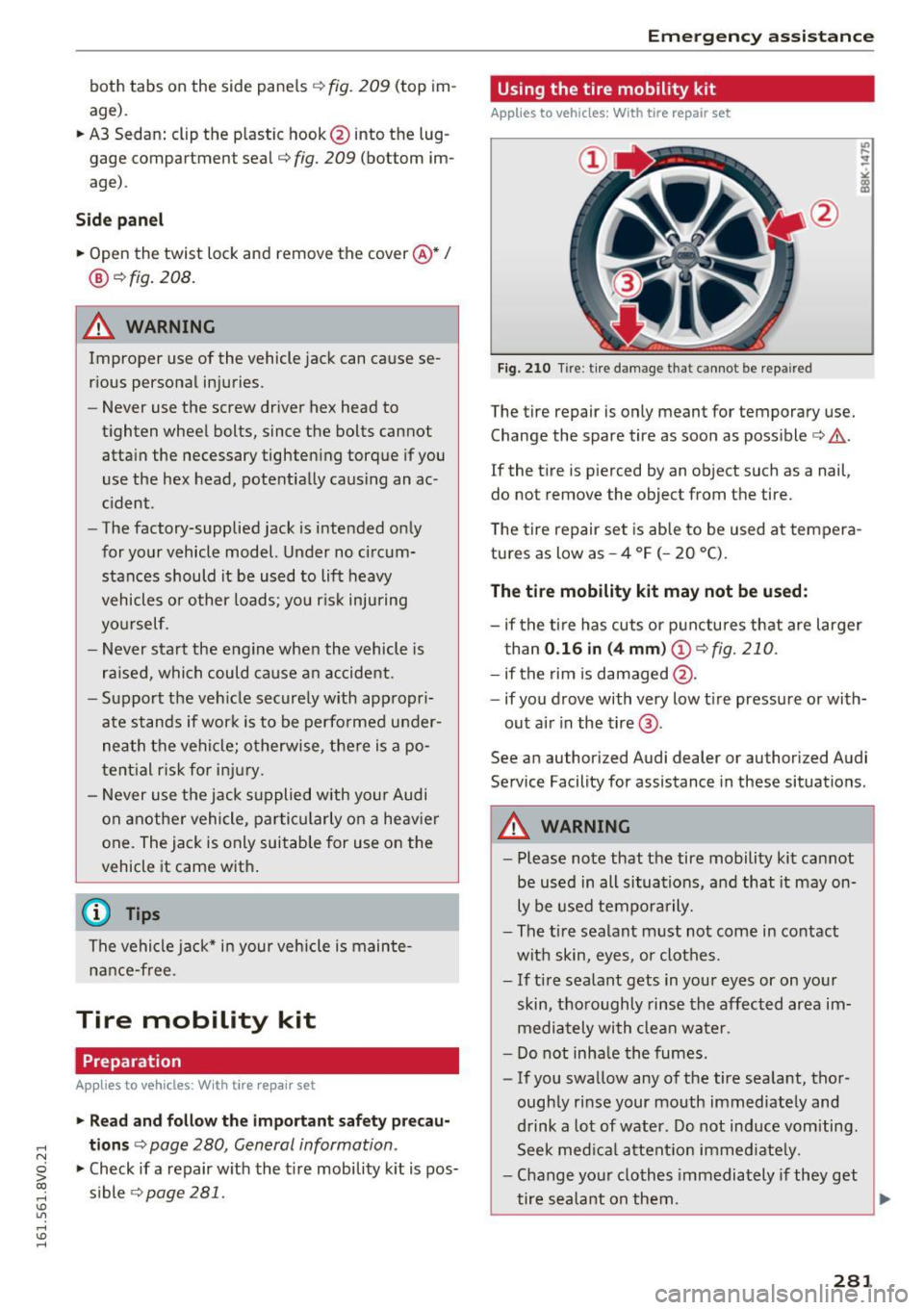
F ig. 210 T ire: t ire damage t hat cannot be repaired
The tire repair is only meant for temporary use.
Change the spare tire as soon as possible <=>,&. .
If the t ire is p ierced by an object such as a nail,
do not remove the object from the tire.
The tire repair set is ab le to be used at tempera
tures as low as - 4 °F (- 20 °C).
The t ire mobility kit may not be us ed:
- if the ti re has cuts or punctures that are larger
than
0 .1 6 in (4 mm)@ ¢ fig. 210.
-if the rim is damaged @.
- if you drove with very low t ire pressure or with-
out air in the tire @.
See an authorized Audi dealer or authorized Audi
Service Facility for assistance in these situations .
.&_ WARNING
>=
-Please note that the tire mobility kit cannot
be used in all situations, and that it may on
ly be used temporarily.
- The tire sealant must not come in contact
wit h skin, eyes, o r clothes.
- If ti re sealant gets in you r eyes or on yo ur
skin, tho ro ughly rinse the affected area im
mediately wi th clea n wate r.
- Do not inha le the fumes.
- If you swallow any of the tire sealant, thor-
ough ly rinse your mouth immediately and
drink a lot of water . Do not ind uce vomiting.
Seek med ica l attent io n immed iate ly .
- Change yo ur clothes immediately if they get
tire seala nt on them.
~
281
Page 285 of 328
,....,
N
0 > co ,....,
Appl ies to vehicles: W ith t ire repa ir set
.,. Adhe re the sticke r that says "max. SO mph
(max. 80 km/h)" that is p rovided w ith the t ire
mobility k it within the driver's fie ld of vision .
.,. Stop the vehicle after driving for about 10 mi
nutes and check the tire pressure .
.,. lfthe tire pressure is lower than 19 psi (130
kPA), then the tire is too severely damaged. Do
not cont inue driving. See an authorized Audi
dealer or authorized Audi Service Facil ity for as
s istance .
.,. If the t ire pressure is at least 19 psi (130 kPA),
adjus t the tire pressu re to the spec ified value
~ page 263, Tire pressure . Store the tire pres
sures
~page 273, Storing tire pressures . Drive
to the nearest authorized Audi dealer or au
thorized Audi Serv ice Facility to have the tire re
placed.
A WARNING
If the tire pressure is less than 19 psi
(130 kPA) after 10 minutes of d riving, then
the tire is too severely damaged. Do not con
tinue dr iv ing . See an authorized Audi dealer
or autho rized Audi Service Fac ility for assis
t ance.
A WARNING
Pay a ttent ion to the following after repair ing
the tire:
- Do not drive faster than 50 mph (80 km/h).
- Avoid hard acceleration, brak ing sharp ly,
and fast corner ing.
- The veh icle may become mo re difficu lt to
co ntro l.
-If the t ire is too severely damaged, see an
authorized Audi dealer o r autho rized Aud i
Service Facility for assistance .
@ For the sake of the environment
You can give the used t ire sealant bottle to an
author ized Audi dealer or authorized A udi
Serv ice Facility fo r disposal.
Em ergenc y ass is tanc e
{!) Tips
Remember to obtain a new bott le of sealant
from an authorized A udi dealer or authorized
Audi Service Fac ility after repairing a tire.
Replacing wheels
Before changing a wheel
Observe the following precautions for your own
and your passenger's safety when changing a wheel.
.,. After you experience a t ire failure, pull the car
well away from moving traffic and try to reach
le vel grou nd before you stop~,& .
.,. All passengers should
leave the car and move
t o a safe location (for ins tance, behind the
gua rdrail) ~,& .
.,. Engage the
pa rking brake to prevent your vehi
cle from rolling unintentionally ~ .,& .
.,. Move
sele ctor le ver to po sition P ~ .,& .
.,. If you are tow ing a trai ler, unhitch the trailer
from yo ur vehicle .
.,. Take the jack Q page 280 and the spare tire
~ page 289 out of the luggage compartment.
A WARNING
You o r you r passengers could be injured while
changing a whee l if yo u do not follow these
safety precaut ions :
- If you have a fla t tire, move a safe dis tance
off the road. Turn off the eng ine, turn the
emergency f lashers on and use other warn
ing devices to alert other motorists.
- Make sure that passenge rs wai t in a safe
p lace away from the vehicle and well away
from the road and t raffic.
- To help prevent the vehicle from moving suddenly and possib ly slipping off the jack,
always fu lly set the park ing brake and block
the wheel d iagonally opposite the wheel be
ing changed . When one front whee l is lifted
off the ground, placing the Automatic
Transmission i n P (Park) w ill
not prevent the
veh icle from moving.
~
283
Page 286 of 328
Emergency assistance
-Before you change a wheel, be sure the
ground is level and firm. If necessary, use a
sturdy board under the jack.
- Always store the vehicle tool kit, the jack
and the replaced tire in the luggage com
partment
c:> page 172.
Changing a wheel
When you change a wheel, follow the sequence
described below step-by-step and in exactly that
order.
1. Remove the decorative wheel cover*. For
more details see also
c:> page 284, Decora
tive wheel covers
or c:> page 285, Wheels
with wheel bolt caps.
2 . Loosen the wheel bolts c:> page 285 .
3. Locate the proper mounting point for the
jack and align the jack below that point
c:> page 286 .
4. Raise the car with the jack c:> page 286 .
5. Remove the wheel with the flat tire and then
install
the spare c:>page 287.
6. Tighten all wheel bolts lightly.
7 .
Lower the vehicle with the jack.
8. Use the wheel bolt wrench and firmly tighten
all wheel bolts
c:> page 285.
9. Replace the decorative wheel cover* .
_&. WARNING
Always read and follow all WARNINGS and in
forma tion
c:> .& in Raising the vehicle on
page 286
and c:> page 288.
After changing a wheel
A wheel change is not complete without the do
ing the following .
.,. Always store the vehicle tool kit, the jack* and
the replaced tir e in the luggage compartment
c:> page 172 .
.,. Check the tire pressure on the spare wheel im
mediate ly after mounting it .
.,. As soon as possible, have the
tightening tor
ques
on all wheel bolts checked with a torque
wrench. The correct tightening torque is 90 ft
lb
(120 Nm).
284
.,. Have the flat tire replaced as soon as possible .
@ Tips
- If
you notice that the wheel bolts are cor
roded and difficult to turn while changing a
tire, they shou ld be replaced before you
check the tightening torque .
- Drive at reduced speed until you have the
tightening torques checked.
- After chang ing a wheel, the tire pressure in
all four tires must be checked/corrected and
the tire pressure monitoring indicator m ust
be stored in the MMI
c:>page 273.
Decorative wheel covers
Applies to vehicles: wit h decorative wheel covers
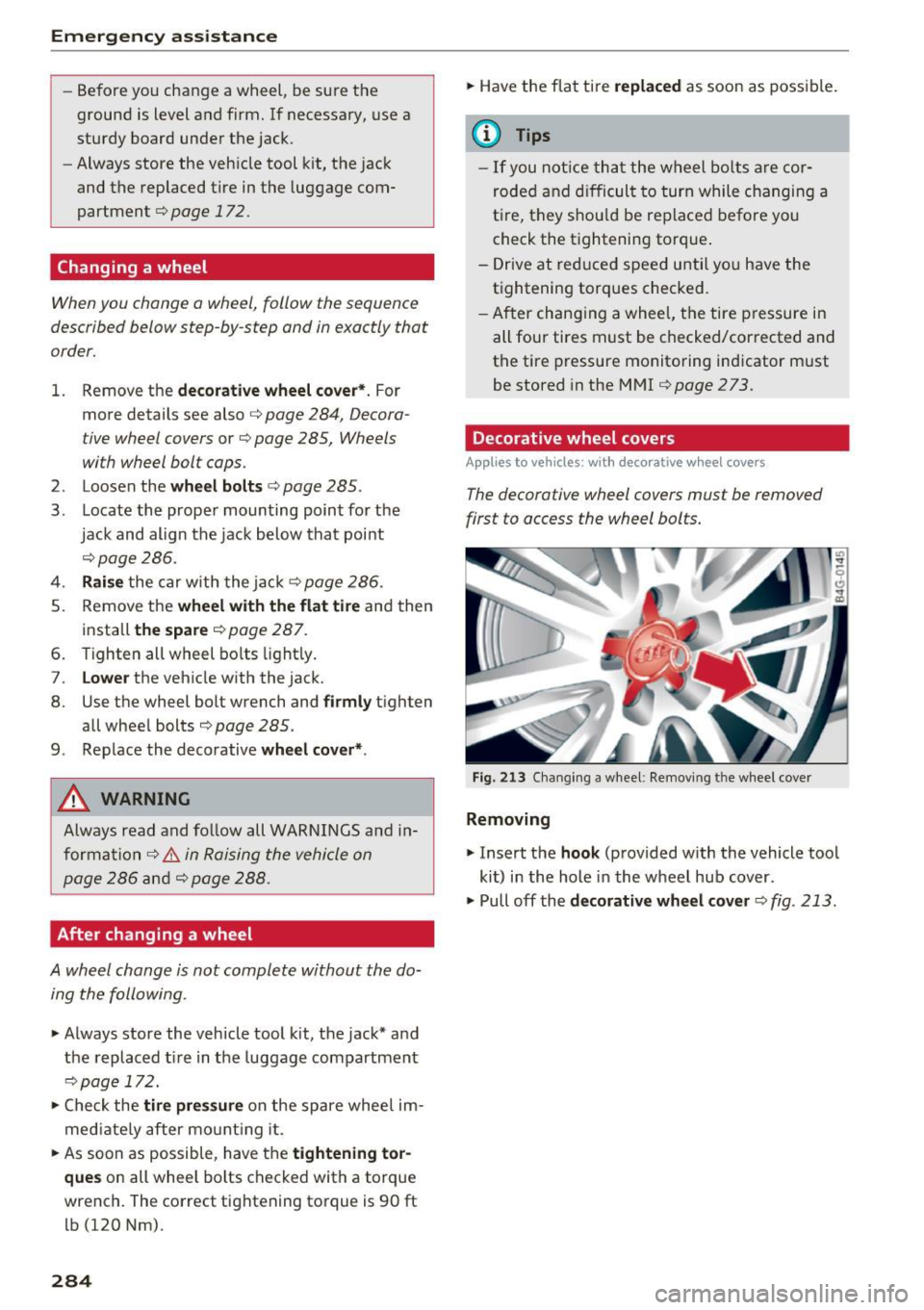
The decorative wheel covers must be removed
first to access the wheel bolts .
Fig. 213 Chang ing a w heel : Remov ing t he wheel cover
Removing
.,. Insert the hook (provided with the vehicle tool
kit) in the hole in the wheel hub cover.
.,. Pull off the
decorative wheel cover c:> fig. 213 .
Page 287 of 328
Wheels with wheel bolt caps
Applies to vehicles: with whee l bo lts w ith caps
The cops must be removed first from the wheel
bolts before the bolts con be unscrewed.
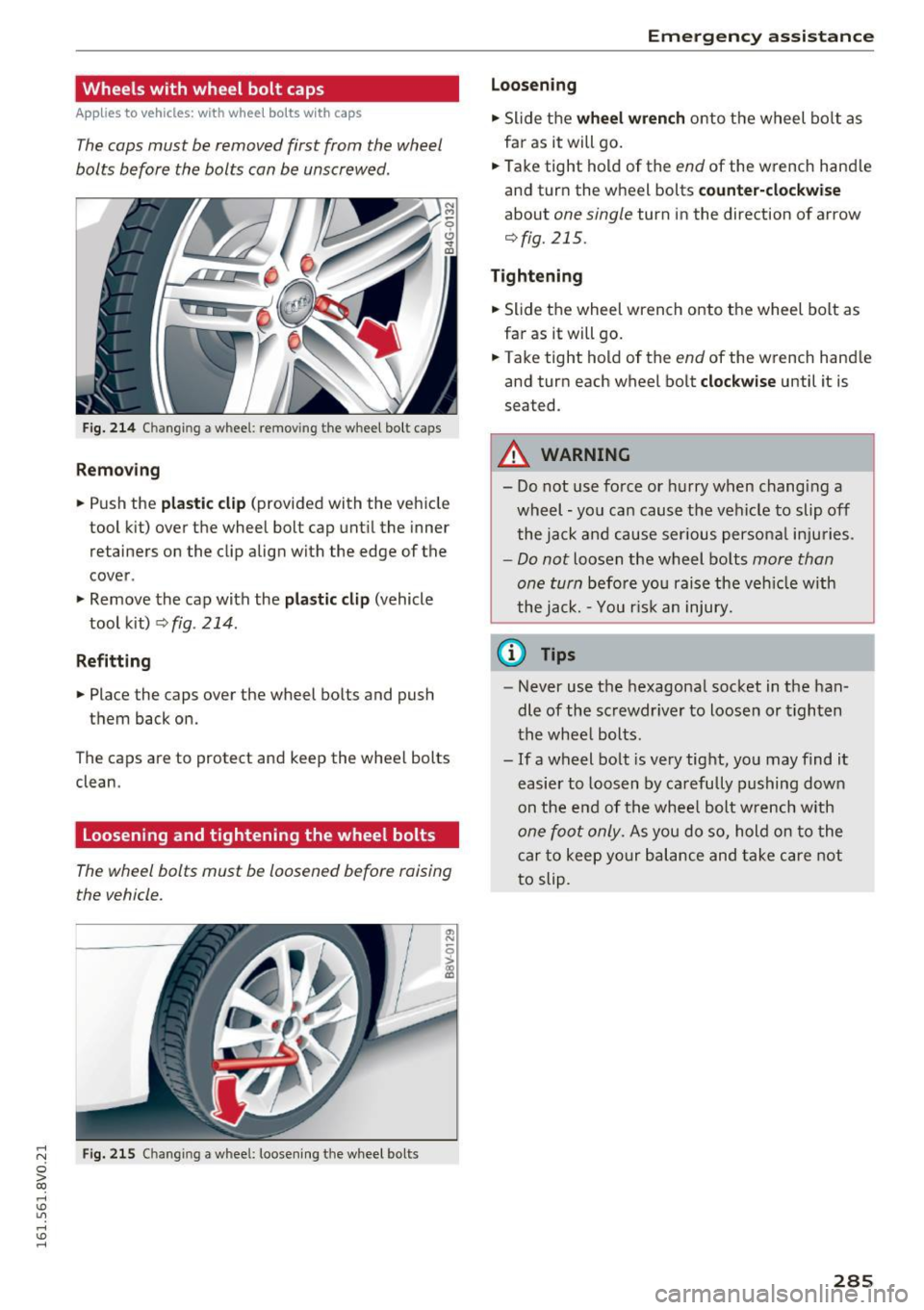
Fig. 214 C hanging a wheel: remov ing the wheel bolt caps
Remo ving
.. Push the pla sti c cli p (provided with the vehicle
tool kit) over the wheel bolt cap unt il the inner
retainers on the clip align with the edge of the
cover.
.. Remove the cap with the
pla s tic cli p (vehicle
tool kit)
q fig . 214.
Refitting
.. Place the caps over the wheel bo lts and push
them back on.
The caps are to protect and keep the whee l bolts
clean.
Loosening and tightening the wheel bolts
The wheel bolts must be loosened before raising
the vehicle.
;::: Fig. 2 15 Changing a wheel: loosen ing t he w heel bolts
0 > CX)
rl I.Cl U"I
rl I.Cl rl
Em ergen cy a ssis tanc e
Loosen ing
.. Slide t he whe el wren ch onto the wheel bolt as
fa r as it will go.
.. Take tight hold of the
end of the wrench hand le
and tur n the wheel bolts
counter -clockwise
about one single turn in the direction of arrow
qfig. 215.
Tightening
.. Slide the wheel wrench onto the wheel bolt as
far as it will go .
.. Take tight hold of the
end of the wrench hand le
and turn each wheel bolt
clo ckwi se until it is
seated.
A WARNING
-- Do not use force or hurry when chang ing a
wheel -you can cause the vehicle to slip off
the jack and cause ser ious persona l inju ries .
-Do not loosen the wheel bolts more than
one turn
befo re you raise the veh icle with
the jack. -You r isk an injury.
(0 Tips
- Never use the hexagonal socket in the han
dle of the screwdr iver to loosen or tighten
the whee l bolts.
- If a wheel bolt is very tight, you may find it
easier to loosen by ca refully pushing down
on the e nd of the whee l bolt w rench with
one foot only. As you do so, hold on to the
car to keep yo ur balance and take care not
to slip.
285