warning AUDI S3 SEDAN 2015 Owners Manual
[x] Cancel search | Manufacturer: AUDI, Model Year: 2015, Model line: S3 SEDAN, Model: AUDI S3 SEDAN 2015Pages: 282, PDF Size: 71.14 MB
Page 187 of 282
M N
0 > co ,...., \!) 1.1'1
1.1'1
1.1'1
,....,
-Always make sure the seat backrest to which
the ch ild restraint is installed is in an up
right position and securely latched into
place and cannot fold forward. Otherw ise,
the seatback with the ch ild safety seat at
tached to it co uld f ly forward in the event of
an acc ident or o ther emergency si tuat ion.
- Always read and heed all WARNINGS when
ever using a child rest rained in a vehicle is
being used
r=;, page 172. Spec ia l precautions
apply when ins talling a child s afety se at on
the front passenger seat¢
page 149, Child
restraints on the front seat -some impor
tant things to know.
Deactivating the convertible locking
retractor
The convertible locking retractor for child re
straints will be deactivated automatically when
the belt is wound all the way back in to the re
tractor .
~ Press the red button on the safety belt buck le.
The belt tongue will pop out of the buckle.
~ Guide the safety belt all the way back into its
stowed position .
Always let the safety belt retract comp lete ly into
its stowed position . The safety be lt can now be
used as an ordinary safety belt without the con
ve rtible locking retrac to r fo r child restra ints .
If the convert ible locking retractor shou ld be ac
tivated inadvertently, the safety belt must be un
fastened and gu ided completely back into its
stowed position to deact ivate this feature .
If the
convert ible lock ing retractor is not deactivated,
the safety belt w ill gradua lly become tighter and
uncomfo rt a ble to wear .
_& WARNING
-
Imprope rly insta lled child sa fe ty se ats in
crease the risk of ser ious personal inju ry and
death in a co llision.
- Never unfasten the sa fe ty belt to deac tiva te
the conve rtible locking retractor for child re
straints while the veh icle is moving. You
Child sa fety
wou ld not be restra ined and cou ld be ser i
ously injured in an accident.
- Always read and heed all WAR NINGS when
ever using a child restrained in a vehicle is
be ing used
¢ page 172. Special precaut ions
apply when install ing a child safety seat on
the front passenger seat
c:> page 149, Child
restraints on the front seat -some impor
tant things to know .
LATCH system (Lower
anchorages and tethers
for children)
Child Restraint System anchors and how
are they related to child safety
T o provide a simpler and more practicable way to
attach the ch ild restra int on the veh icle seat, Fed
eral regulations require special lower anchorages
in vehicles a nd devices on new child restraints to
attach to the vehicle anchorages .
The combination of the tether anchorages and
the lower anchorages is now generally ca lled the
LATCH system f or " Lower Anchorages and
T ethers for Child ren ."
Forward -facing chi ld restraints manufactured af
ter September 1, 1999, are requ ired by U.S. fed
eral regulations to comp ly w ith new ch ild head
movement performance requ irements . These
new pe rformance requ irements make a te ther
necessary on most new ch ild seats .
Installing a ch ild restra int that requires a top
tethe r without one can seriously impair the per
fo rmance of the child restra int and its ability to
protect the ch ild in a co llision . Installing a ch ild
r est rain t that requ ires a top te ther w it h out t he
top tether m ay be a vio lation o f st ate l aw .
Child rest raint manufacturers offer LA T CH lower
anchorages on the ir chil d seats with hook-o n or
push-on connec tors attached to adjustab le
str aps.
In add ition to the LATCH lower anchorages, these
c hi ld restra int systems usually requ ire the use of
te the r straps to he lp keep the c hild restra int
firmly in pla ce. .,..
185
Page 188 of 282
Child safety
_& WARNING
Improper installation of child restraints will
increase the risk of injury and death in a crash.
- Always follow the instructions provided by
the manufacturer of the child restraint you
intend to install in your vehicle.
- Never install a child restraint without a properly attached top tether strap if the
child restraint manufacturer's instructions
require the top tether strap to be used .
- Improper use of child restraint LATCH lower
anchorage points can lead to injury in a colli
sion. The LATCH lower anchorage points are
designed to withstand only those loads im
posed by correctly fitted child restraints .
- Never mount two child restraint systems on
one LATCH lower anchorage point .
- Never secure or attach any luggage or other
item to the LATCH lower anchorages .
(D Tips
-In Canada, the terms "top tether" with
"lower universal anchorages" (or "lower uni
versal anchorage bars") are used to describe
the system.
- In other countries, the term "ISO FIX" is
used to describe the lower anchorages.
Location
Fig. 143 Schemat ic overv iew : LATCH an cho rage po int lo ca ·
tio ns
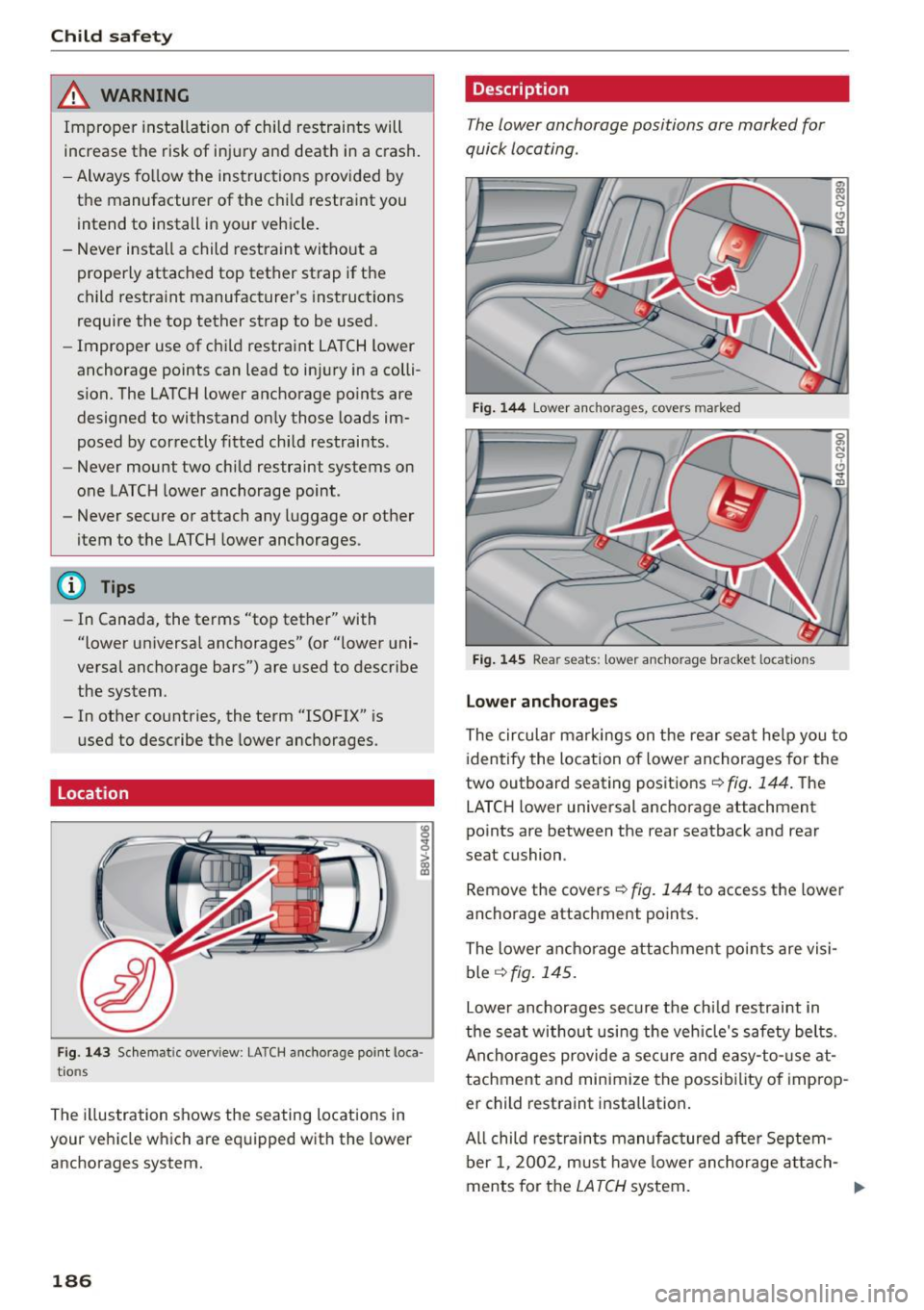
The illustrat ion shows the seat ing locations in
your vehicle which are equipped with the lower
anchorages system.
186
Description
T he lower an chorage positions are marked for
quick locating .
Fig. 144 Lower an cho rag es, cov ers m ark ed
Fig. 145 Rear se ats : low er an cho rage bra cke t lo cation s
Lower anchorages
The circular markings on the rear seat help you to
ident ify the location of lower anchorages for the
two outboard seating positions~
fig. 144. The
LATCH lower universal anchorage attachment
points a re between the rear seatback and rear
seat cushion .
Remove the covers~
fig. 144 to access the lower
anchorage attachment points.
The lower anchorage attachment points are visi
ble
~ fig. 145.
Lower anchorages secure the child restraint in
the seat without using the vehicle's safety belts.
Anchorages provide a secure and easy-to-use at
tachment and m inimize the possibility of improp
er child restraint installation.
All child restraints manufactured after Septem
ber 1, 2002, must have lower anchorage attach-
ments for the
LATCH system. ..,.
Page 189 of 282
M N
0 > co
Please remember that the lower anchorage
points are only intended for installation and at
tachment of child restraints specif ica lly certif ied
for use w ith
LATCH l ower anchorages . Child re
straints that are not equipped w ith the lower an
chorage attachments can still be installed in
compliance w ith the child rest raint manufactur
er 's instructions on using vehicle safety belts .
.8, WARNING
Improper use of LATCH lower anchorages can
cause serious personal injury in an accident.
- Always ca refully fo llow the ch ild restra ints
man ufactu rer's instr uctio ns for proper i n
sta llation of the child restrain t and proper
u se of the lower anchorages or safety belts
in yo ur vehicle.
- Never se cure o r attach any l uggage or other
items to the
LATCH lower anchorages .
- Always read and heed the impor tan t infor
mation about child restraints in this chapter
and WARNINGS
¢ page 172, Child safety.
Installing a child restraint with LATCH
lower anchorages
App lies to vehicles: with top tether
Whenever you install a child restraint always fol
low the child restraint manufacturer's instruc
tions.
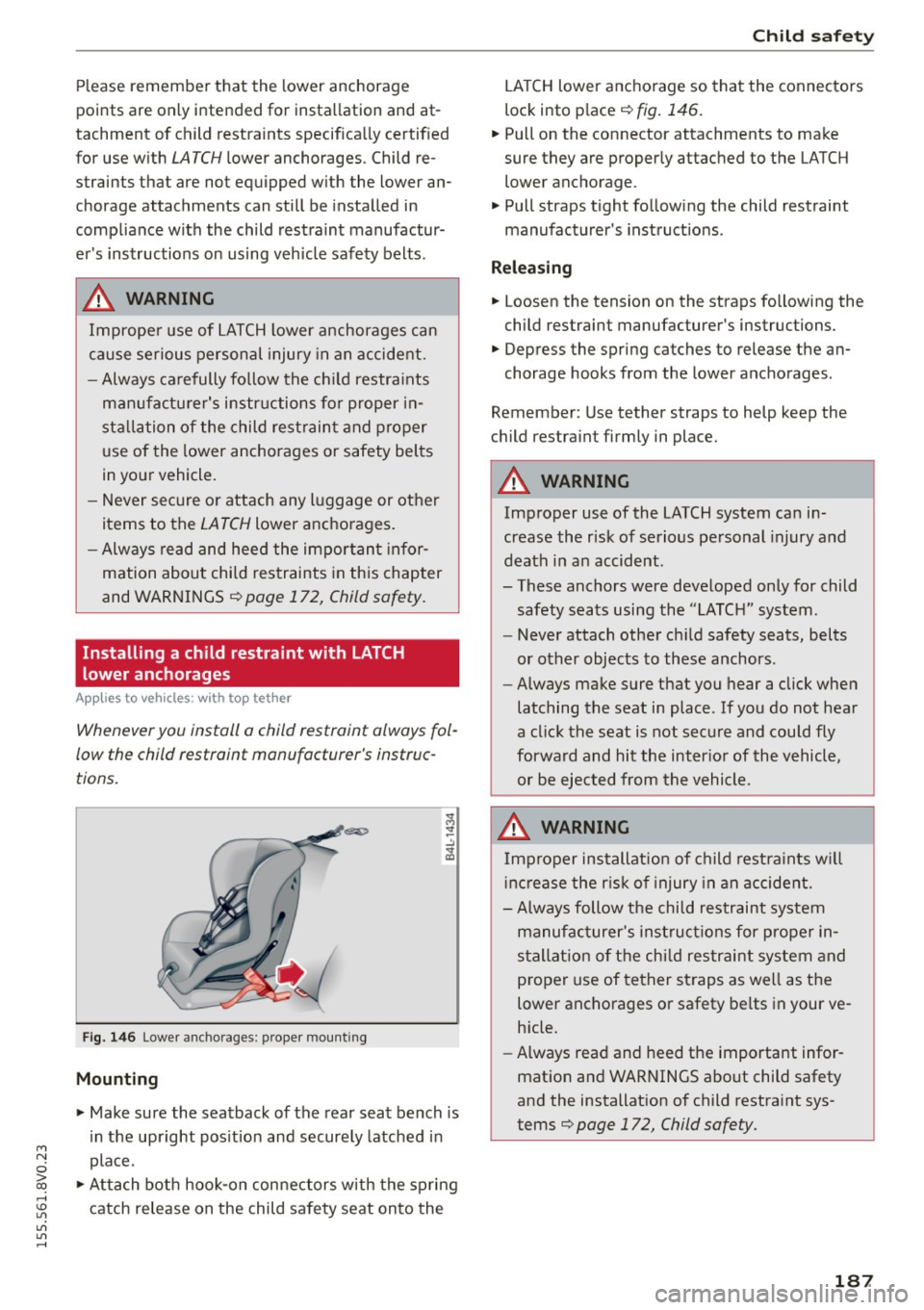
F ig . 14 6 Lower anchorages: p roper mount ing
Mounting
.,. Make sure the seatback of the rear seat bench is
in the upright pos ition and secure ly latched in
place.
.,. Attach both hook-on con nectors with the spring
,....,
~ catch release on the child safety seat onto the
Vl
Vl
,....,
Child sa fety
LA TCH lower ancho rage so that the connecto rs
lock into p lace
¢ fig. 146 .
.,. Pull on the connector attachments to make
sure they are properly attached to the LATCH lower anchorage .
.,. Pull straps tight fo llow ing the child restraint
manufacturer's instruct ions .
Releasing
.,. Loosen the tension on the straps following the
child restraint manufacturer's instructions.
.,. Depress the spring catches to release the an
chorage hooks from the lower anchorages .
Remember: Use tether straps to help keep the
child restra int firmly in place.
.8, WARNING "---Improper use of the LATCH system can in
crease the r isk of serious pe rsonal injury and
death in an accident.
- These anchors were developed only for child safety seats using the "LATC H" system .
- Never attach other ch ild safety seats, belts
or other objects to these anchors.
- Always make sure that you hear a click when
latching the seat in place. If you do not hear
a cl ick the seat is not sec ure and could fly
forward and hit the inter io r of the vehicle,
or be ejec ted from the vehicle .
.8, WARNING
Improper installat ion of child restra ints w il l
i nc rease the r is k of i njury in an accide nt.
- Always follow the child res traint system
manufac turer's ins truct ions for proper in
s tallat ion of the ch ild restrai nt system and
proper use of tether straps as we ll as the
lower ancho rages or safety be lts in your ve
h icle.
- Always read a nd heed t he important infor
matio n and WARNINGS about child safety
and the installat ion of child restra int sys
tems
¢ page 172, Child safety .
187
Page 190 of 282
Child safety
Tether anchors and tether straps
Fig. 147 Tether anchors: recess flaps behind the rear seat
ba cks
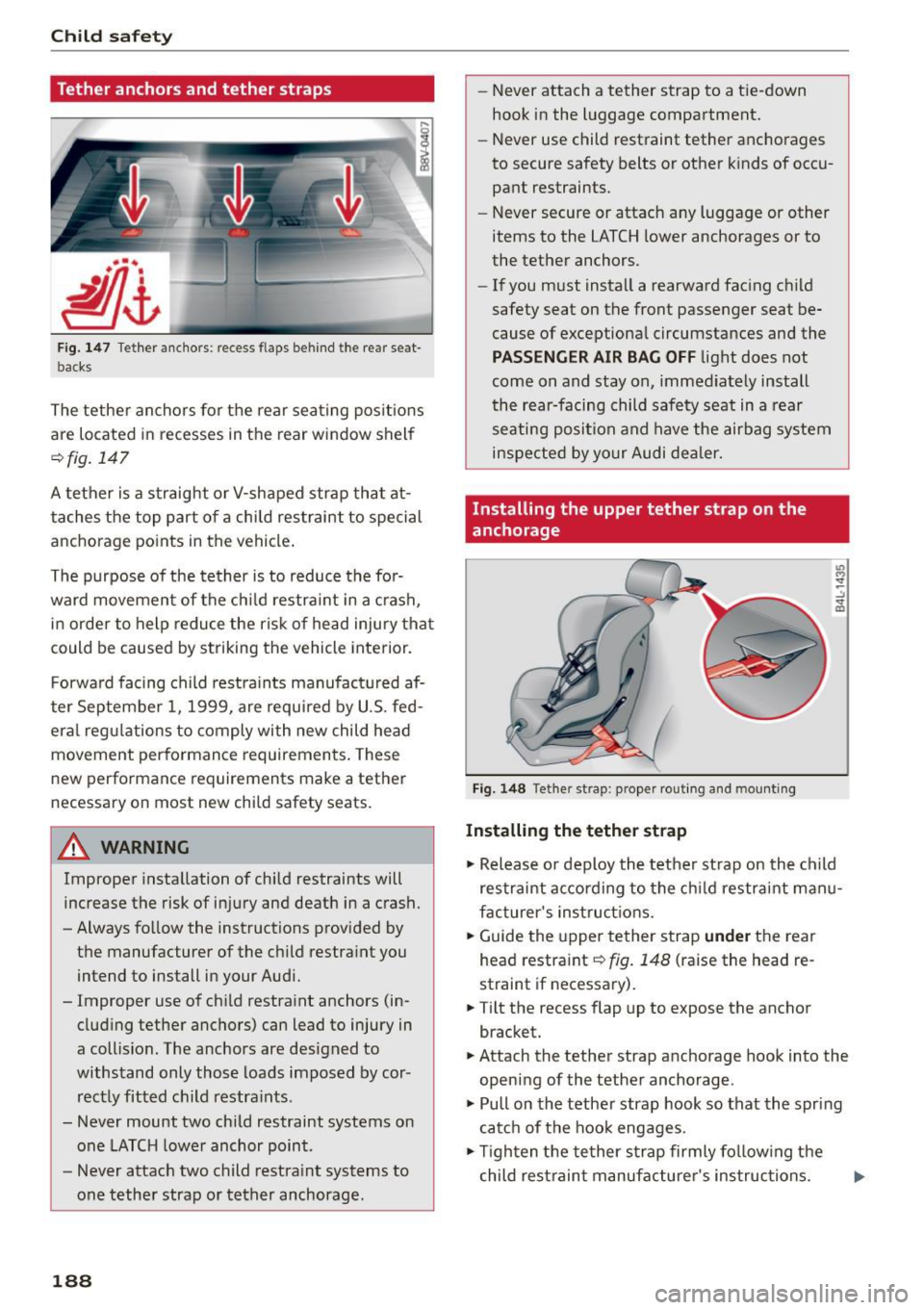
The tether anchors for the rear seating positions
are located in recesses in the rear window shelf
~fig. 147
A tether is a straight or V-shaped strap that at
taches the top part of a child restraint to special
anchorage points in the vehicle.
The purpose of the tether is to reduce the for ward movement of the child restraint in a crash,
in order to help reduce the risk of head injury that
could be caused by striking the vehicle interior.
Forward facing child restraints manufactured af
ter September 1, 1999, are required by U.S. fed
eral regulations to comply with new child head
movement performance requirements. These
new performance requirements make a tether
necessary on most new child safety seats.
&_ WARNING
Improper installation of child restraints will
increase the risk of injury and death in a crash.
- Always follow the instructions provided by
the manufacturer of the child restraint you
intend to install in your Audi.
- Improper use of child restraint anchors (in
cluding tether anchors) can lead to injury in
a collision. The anchors are designed to
withstand only those loads imposed by cor
rectly fitted child restraints .
- Never mount two child restraint systems on
one LATCH lower anchor point .
- Never attach two child restraint systems to
one tether strap or tether anchorage.
188
.
- Never attach a tether strap to a tie-down
hook in the luggage compartment.
- Never use child restraint tether anchorages
to secure safety belts or other kinds of occu
pant restraints.
- Never secure or attach any luggage or other
items to the LATCH lower anchorages or to
the tether anchors.
- If you must install a rearward facing child
safety seat on the front passenger seat be
cause of exceptional circumstances and the
PASSENGER AIR BAG OFF light does not
come on and stay on , immediately install
the rear-facing child safety seat in a rear
seating position and have the airbag system
inspected by your Audi dealer.
Installing the upper tether strap on the
anchorage
Fig. 148 Tether st ra p : proper routing and mounting
Installing the tether strap
11> Release or deploy the tether strap on the child
restraint according to the child restraint manu
facturer's instructions.
"Guide the upper tether strap
under the rear
head restraint ~
fig. 148 (raise the head re
straint if necessary) .
"Tilt the recess flap up to expose the anchor
bracket.
"Attach the tether strap anchorage hook into the
opening of the tether anchorage .
11o Pull on the tether strap hook so that the spring
catch of the hook engages.
11> Tighten the tether strap firmly following the
child restraint manufacturer's instructions.
Page 191 of 282
M N
0 > co ,...., \!) 1.1'1
1.1'1
1.1'1
,....,
Relea sin g the teth er strap
"' Loosen the tens ion following the child restra int
manufacturer's instructions.
"' Depress the spring catch on the hook and re
lease it from the anchorage.
(D Note
If you leave the child restraint with the tether
strap firmly insta lled for several days, this
could leave a mark on the upholstery on the
seat cush ion and backrest in the area where
the tether strap was installed. The upholstery
wou ld also be permanently stretched around
the tether strap. This applies espec ially to
leather seats.
Using tether straps on rearward-facing
child restraints
Currently, few rear-facing child restraint systems
come with a tether. P lease read and heed the
child restraint system manufacturer's instruc
tions carefully to determ ine how to properly in
stall the tether .
A WARNING
A child in a rearward-facing child safety seat
installed on the front passenger seat will be
ser iously injured and can be killed if the front
airbag inflates -even w ith an Advanced A irbag
System.
- T he inflating a irbag w ill hit the chi ld safety
s eat or infant carrie r wi th grea t fo rce and
will smash the chi ld safety seat and chi ld
against t he backrest, center armrest, or
doo r.
- If you mus t install a rearward facing chi ld
safety seat on the front passenger seat be
cause of exceptional c ircumstances and the
PASSENGER AIR BAG OFF light does not
come on and stay on, immediately install
the rear-fac ing child safety seat in a rear
seat ing pos it ion and have the airbag system
inspected by you r A udi dealer .
Child sa fety
Additional information
Sources of information about child
restraints and their use
T he re a re a number o f sou rces of add itiona l infor
mation about child restraint se lection, insta lla
tion and use:
N HT SA advises that the bes t ch ild safety seat is
the one that f its yo ur child and fits in your vehi
cle, and that you will use correctly and consis
tent ly .
T ry before yo u buy!
U.S National Highw ay Traffic Safety Admin istr a
tion
T el.: 1-888-3 27- 42 36 (TIY: 1-800-424-9153)
www. n htsa .gov
National SAFE KIDS Campaign
Tel.: (202) 662-0600
www.safe kids.o rg
Safety Belt Saf e U.S .A
Tel.: (800) 7 45-SAFE (English)
T el.: (800) 747-SANO (Span ish)
www.carseat .org
Transport Canada Information C entre
Tel.: 1-800-333-0371 o r call 1-613-998-86 16 if
you are in the Ottawa a rea
http://www.tc.gc.ca/e ng/ roadsafety/menu .htm
Aud i Cu stomer R elations
Tel.: (800) 822-2834
189
Page 194 of 282
Checking and Fill in g
These fuels contain substances that can se
verely damage the fuel system and the en
gine if the engine is started .
- If the diesel f uel quality is poor, it may be
necessary to have the water d rained from
the water separator in the
fuel filter more
often than specified in the maintenance
schedule. This can help reduce engine ma l
funct ions
c:> page 2 3.
Refueling
Fuel filler neck
The fuel filler neck is located on the right rear
side pane l behind the fuel f iller flap.
If the power locking sys tem should fail, you can
still open the flap manua lly -for detai led instruc
tions see
c:> page 194.
You can find the fue l tank capacity of you r vehicle
in
c:> page 260.
The label on the inside of the fue l filler flap te lls
you t he cor rect fuel for your vehicle. For more in
form ation abo ut fue l specifications, see
c:> page 190 .
Your vehicle fuel tank has an on board refue lling
vapor re cove ry system . This feature helps to p re
ve nt fuel vapors from escaping from the tank and
pollut ing t he environment w hile you refue l yo ur
ve hicle. In orde r to fill the tank p roperly whi le
protecting the environment, please follow this
refueling procedure carefully.
A WARNING
Under normal operating conditions, never ca r
ry additional fuel containers in your car . Gas
canisters and ot her conta iners used to trans
port fuel can be dangerous . Such contai ners,
full or empty, may leak and could cause a fire
in a collision. If yo u m ust t ransport fue l to
use fo r yo ur l awn m owe r, snow b lower, etc.,
be very ca re ful and a lways observe loca l and
state laws rega rding the use, transportation
and sto rage of such fuel containe rs . Make cer
tain the container meets industry standards (ANSI/ASTM F852 - 86).
192
(D Note
Never drive your vehicle until the fue l tank is
complete ly empty . The irregular supply of
f u el can cause misfiring. Gasoline could enter
the exhaust system and damage the catalytic converter.
Fueling procedure
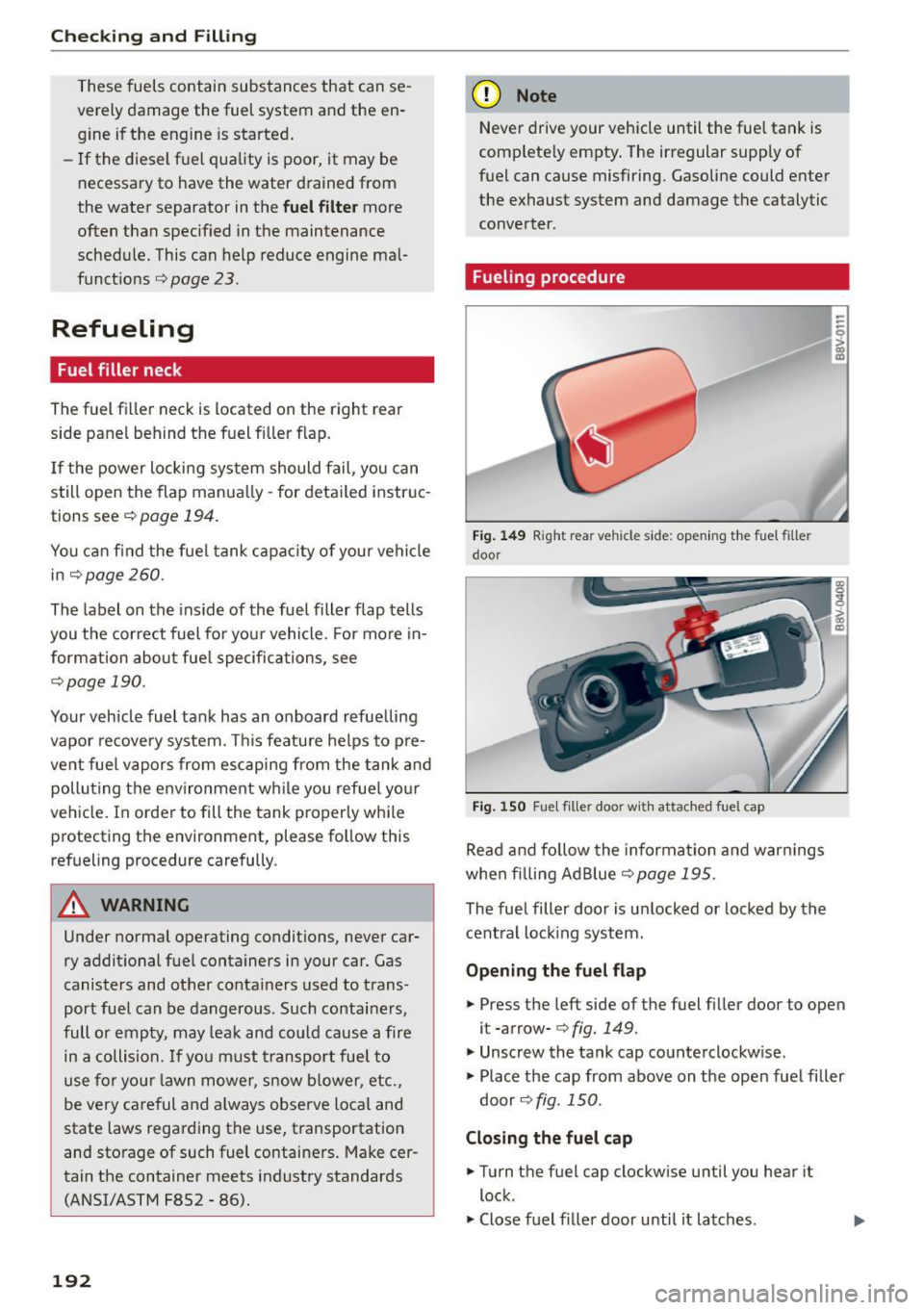
F ig . 149 Righ t rea r ve hicle s ide: open ing t he fuel filler
door
Fi g. 15 0 Fuel fill er doo r wit h attac hed fuel cap
Re ad a nd fo llow the informa tion and war ning s
whe n filling AdB lue
c:> page 195 .
The fuel filler doo r is u nlocked or locked by the
cent ral lock ing system.
Opening the fuel flap
--0 ~
ffl
.,.. Press the left side of the fuel f iller door to open
it -arrow-
c:> fig. 149 .
.,.. Unscrew the tank cap counterclockw ise .
.,.. Place the cap from above on the open fue l filler
door
c:> fig . 150.
Closing the fuel cap
.,.. Turn the f uel cap clockwise until you hear it
lock .
.,.. Close fuel fi ller door until it latches.
Page 195 of 282
M N
0 > co ,...., \!) 1.1'1
1.1'1
1.1'1
,....,
Once the pump nozzle switches off, the fuel tank is "full". Do not fill the tank more. Otherwise the
expansion space in the tank will be filled.
The correct fuel type for your vehicle can be
found on a label located on the inside of the fuel
filler door. For additional information on fuel , re
fer to ¢
page 190.
The fuel tank capacity of your vehicle is in the
Technical Data ¢ page 260.
To avoid fuel spilling or evaporating from the fuel
tank always close fuel filler cap properly and
completely. An improperly closed fuel filler cap
may also cause the MIL lamp ¢
page 25 to come
on.
A WARNING
Not paying attention when fueling or han
dling fuel incorrectly can lead to fires, explo
sions or serious injuries.
- Fuel ignites easily and can cause serious burns and other injuries.
- If you do not switch the engine off when fu
eling and/or do not insert the fuel no zzle
completely into the tank opening, fuel can
leak out or run over . Leaked fuel can ignite
and start a fire.
- Do no t use the telephone while fueling. The
electromagnetic rays can cause sparks,
which can ignite fuel vapors and start a fire .
- Do not sit in your vehicle while fueling . If
you must make an exception and enter your
vehicle again while fueling , close the door
and touch metal to discharge static electric
ity before touching the fuel nozzle. Static
electricity can create sparks, which can ig
nite vapors when fueling.
- Do not smoke or have an open flame in the
area when fueling your vehicle or filling a
fuel container because this increases the
risk of an explosion.
- For your safety, carrying fuel containers in
your vehicle is not recommended. Whether
full or empty, the container can leak and
cause a fire in the event of an accident .
-If you must make an exception and trans
port a fuel container, note the following:
Checking and Filling
- Never fill the fuel container with fuel
while it is in or on the vehicle . Static elec
tricity is discharged when filling which can cause the fuel vapors to ignite and increas
es the risk of an explosion .
- Always place a fuel container on the
ground before filling .
- Always hold the fuel nozzle completely in
the fuel container when filling .
-If the fuel container is made of metal, the
fuel nozzle must always be in contact with
the container when filling it with fuel. This prevents static electricity from discharg
ing .
- Never spill fuel in the vehicle or the lug
gage compartment . Evaporated fuel is ex
plosive and increases the risk of serious in
jury or death.
- Follow legal requirements when using,
storing and transporting fuel containers .
- Make sure the fuel container conforms to
industry standards (ANSI/ASTM F852-86).
Q) Note
-Remove spilled fuel from vehicle paint im
mediately , because it can damage paint .
- Never drive until the fuel tank is completely
empty. The irregular supply of fuel that re
sults from that can cause engine misfires .
Uncombusted fuel will enter the exhaust
system and increase the risk of damage to
the catalytic converter.
- If the fuel tank runs completely empty in a
vehicle with a
diesel engine, the ignition
must remain switched on for at least 30
seconds after refueling before starting the
engine. It may take longer than usual for
the engine to start, even up to a minute.
This is because the air must first bleed out of the fuel system when starting the engine .
@ For the sake of the environment
- If
the fuel nozzle is used correctly, it will in
dicate that the tank is full the first time it
switches off automatically. Do not try to add
more fuel, because it can spill over. Also, "'
193
Page 197 of 282
M N
0 > co ,...., \!) ..,.,
..,.,
..,., ,....,
The catalytic conve rter is an efficient "clean -up"
device bui lt into the exhaust system of the vehi
cle. The catalytic converter burns many of the
pollutants in the exhaust gas before they are re
leased into the atmosphere.
The exclusive use of unleaded fue l is critically im
portant for the life of the catalytic converter and
proper functioning of the engine .
A WARNING
The temperature of the exhaust system is
high, both when driving and after stopping
the engine.
- Never touch the exhaust tail pipes once they
have become hot. This could result in burns.
- Do not park or operate the vehicle in areas
where the hot exhaust system may come in contact with dry grass, brush, fue l spill or
other material which can cause a fire .
- Do not apply additional undercoating or
rustproofing on o r near the exha ust man i
fold, exhaust pipes, catalyt ic converte r or
heat s hields. Dur ing driv ing, the subs tance
u5ed for undercoating could overheat and
cause a fire .
(D Note
-Be awa re that just one tank f illing wit h lead
ed
f uel will a lready se riously degrade the
performance of the c ata lytic conver ter.
- Do not exceed the co rrect engine oil leve l
9page203.
-Do not d rive until the fuel tank becomes
complete ly empty. The eng ine could misfi re.
U nburned f uel co uld also ge t in to the e x
haust system and this could ca use the cata
l ytic converter to overheat.
- Do no t sw itch off the ignition wh ile the vehi
cle is moving.
- Do not con tinue to oper ate yo ur vehicle un
der these cond itions, as o therwise fue l can
r each the catalytic converte r. This cou ld re
su lt in overheating of the converter, requir
i ng its replacement.
- To assure efficient ope ration of the Emission
Control System:
Checking and Fillin g
- Have your vehicle maintained properly and
in accordance with the serv ice recommen
dat ions in yo ur Warranty
& Maintenance
booklet.
- Lack of prope r maintenance as we ll as im
p roper use of the vehicle will impair the
f u nction of the emission control system
and could lead to damage.
@ For the sake of the environment
Even when the Emission Control System is op
erating properly, the exha ust gas can have a
su lfur-like exhaust gas sme ll under some op
erating states. Th is depends on the s ulfur
content of the fuel b eing used. Us ing a diffe r
ent bra nd of fue l may he lp, or fi lling the tank
wi th lead-free su per grade gaso line.
Diesel particulate filter
App lies to vehicles: wit h diese l eng ine
T he diese l part icu late filter filters nearly all of
the soot pa rticles ou t of the exha ust. The filter
cl ea ns itself a utoma tic all y unde r no rm al driving
con dit ions. If the filte r cannot clean itse lf (for ex
amp le, because yo u are only driving sho rt distan
ces), th e fi lter becomes clogged with soot and
the
II symbol for the diese l partic ulate filter il
l uminates
9page 22.
A WARNING
-Do not park your veh icle over flammable
materials such as grass or leaves because
the high temperature of the diesel part icu
la te filte r could sta rt a fi re.
-
- Do not app ly an underbody protectant in the
exhaust system area or a fire cou ld start.
Selective catalytic
reduction
General information
App lies to vehicles: wit h diese l eng ine
In veh icles with selective catalytic reduction, a
u rea solution (AdBlue) is injected into the ex
haust system before a nitrogen oxide cata lytic
conve rter to redu ce nitrogen emissions.
195
Page 198 of 282
Checking and Fill in g
Ad Blue is the market ing name for Diese l Exhaust
Fl uid (DEF) .
The AdBlue is carried in a separate tank in the ve
h icle. The AdB lue usage acco unts for approxi
mately 0.5% to 1.2% of the diesel fuel that is
used .
When a message about refil ling the Ad Blue ap
pea rs in the instrument cluster disp lay, yo u must
refill the AdBlue yourself or have it refilled by an
authorized Aud i dealer or authorized Audi Se rvice
Facility ¢
page 197 .
A WARNING
Failure to heed Ad Blue refill information in
the instrument cluster can prevent the vehicle
from be ing started and driven. If the veh icle
cannot be driven and an emergency arises,
personal in ju ry can occur.
-Always have the Ad Blue tank refilled well before the tank runs d ry.
(D Tips
-
- The instrument cluster display indicates the
distance remaining that can be driven
¢ page 196. If the AdBlue tank is com
plete ly empty, the engine w ill not start
again after the ig nition is switched off.
- Ad Blue is required by law to operate this ve
hi cle.
Messages in the instrument cluster display
Applies to vehicles: with diesel engine
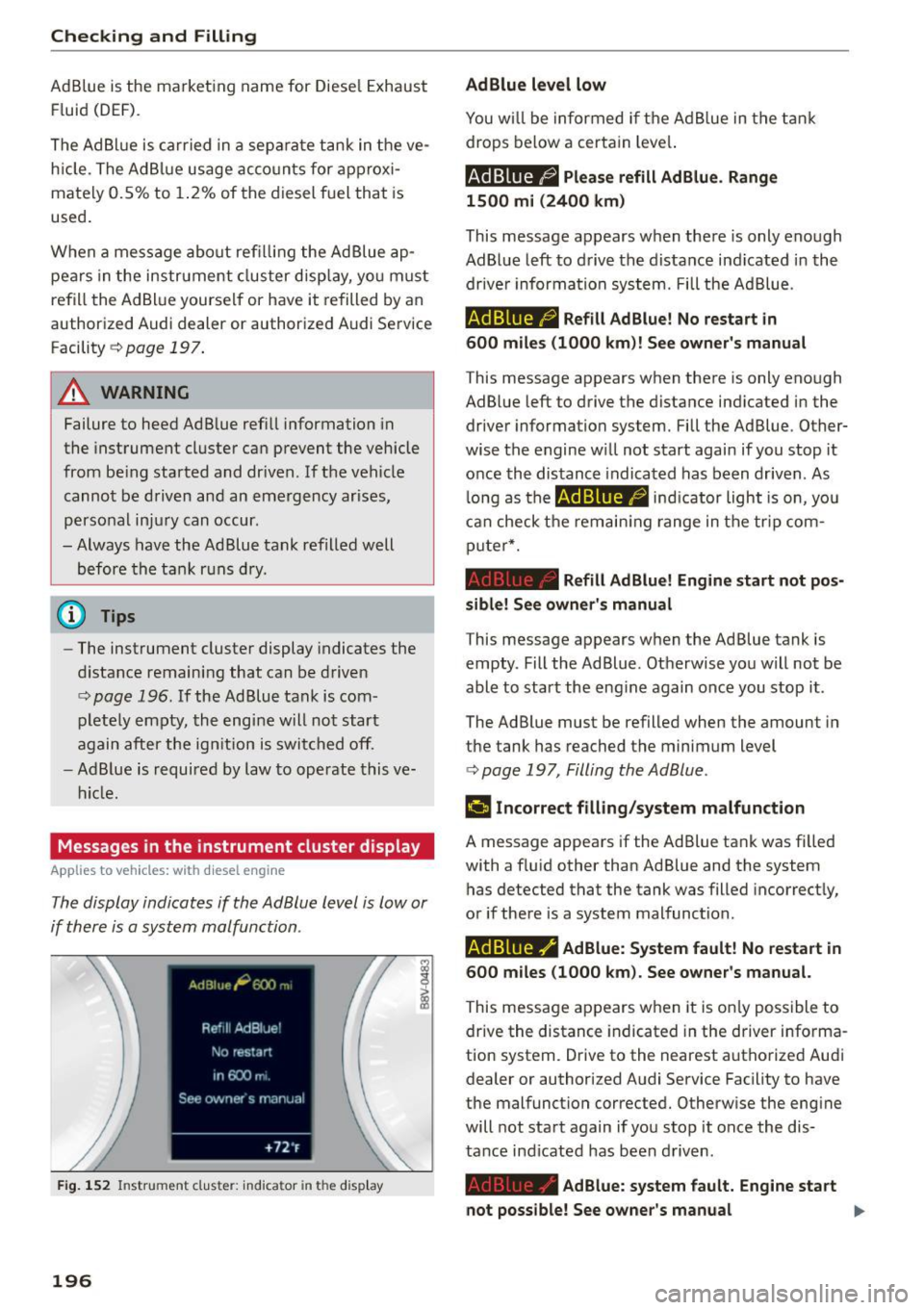
The display indicates if the Ad Blue level is low or
if there is a system malfunction .
Fig. 1 52 In stru ment cl uste r: ind ic a tor in th e disp la y
196
AdBlue level low
You w ill be informed if the Ad B lue in the tan k
drops below a certa in leve l.
Ad Blue /;, Please refill AdB lue . Range
1500 mi (2400 km )
This message appears when there is only enough
AdBl ue left to d rive the distance ind icated in the
drive r information system. Fill the Ad Blue.
AdBlue /9 Refill AdBlue! No restart in
600 mile s (1000 km )! See owner' s manu al
T his message appears when there is only eno ugh
Ad B lue left to drive the distance ind icated in the
dr iver information sys tem. Fill the Ad Blue. Other
wise the engine w ill not start again if you stop it
once the distance indicated has been driven . As
l ong as the indicator light is on, yo u
can check t he remain ing range in the tr ip com
p uter*.
Refill Ad Blu e! Engine start not po s
sible! See owner 's m anual
This message appears w hen the Ad Blue tank is
empty . Fill the Ad Blue. Otherwise you will not be
able to start the eng ine again once you stop it .
The Ad Blue must be refilled when the amount in
the tank has reached the minimum level
¢ page 197, Filling theAdBlue .
¢4 tncorrect filling /system malfuncti on
A message appears if the Ad Blue ta nk was fi lled
with a f lu id other than Ad Blue and the system
has detected that the tank was filled incorrect ly,
or if there is a system malfunction.
AdBlue ./' AdBlue: System fault! No restart in
600 miles (1000 km ). See owner's manual.
This message appears when it is on ly possible to
drive the distance indicated in the driver informa
tion system . Drive to the nearest authorized Aud i
dealer or author ized A udi Service Facility to have
the malfunct ion corrected. O therwise the engine
will not sta rt again if you stop it once the dis
tance indicated has been d riven .
Ad Blue: system fault . Engine start
not possible! See owner 's manual
Page 199 of 282
....,
N
0 > co
rl I.O
"'
"'
"'
rl
This message appears if the system has detected
that the tank was filled incorrectly or that there
is a malfunction. Drive immediately to the near
est authori zed Aud i dealer or authori zed Audi
Service Facility to have the malfunction correct
ed . Otherwise you will not be able to start the en
g in e again once you stop it.
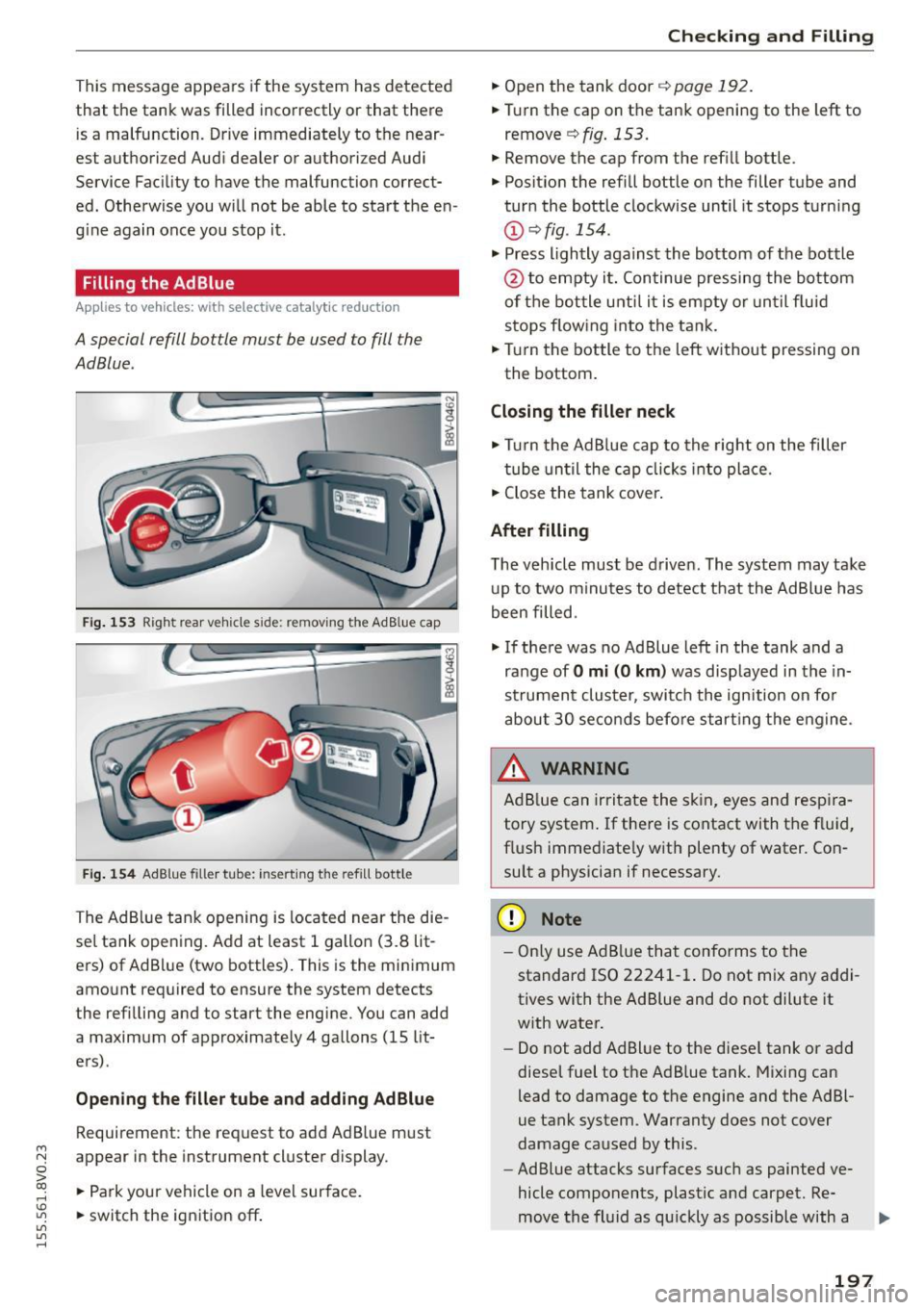
Filling the Ad Blue
Applies to vehicles: with selective catalyt ic red uctio n
A special refill bottle must be used to fill the
AdBlue.
Fig. 153 Right rear vehicle s ide: removing the Ad B lue cap
Fig. 154 Ad Blue filler tube: inserting the refi ll bott le
The Ad Blue tank opening is located near the die
sel tank opening. Add at least 1 gallon (3.8 lit
ers) of AdBlue (two bottles). This is the minimum
amount required to ensure the system detects
the refilling and to start the engine. You can add
a maximum of approximately 4 gallons (15 lit
ers) .
Opening the filler tube and adding AdBlue
Requirement: the request to add Ad Blue must
appear in the instrument cluster display.
• Park your vehicle on a level surface.
• switch the ignition off .
Checking and Filling
• Open the tank door q page 192.
• Tur n the cap on the tank opening to the left to
remove
q fig. 153.
• Remove the cap from the refill bottle.
• Position the refill bottle on the filler tube and
turn the bottle clockwise until it stops turning
@ qfig. 154.
• Press lightly against the bottom of the bottle
@ to empty it. Con tinue pressing the bottom
of the bottle unti l it is empty or until flu id
stops flowing into the tank.
• Turn the bottle to the left without pressing on
the bottom.
Closing the filler neck
• Turn the Ad Blue cap to the right on the filler
tube until the cap clicks into place.
• Close the tank cover.
After filling
The vehicle must be driven. The system may take
up to two minutes to detect that the AdBlue has
been filled.
• If there was no Ad Blue left in the tank and a
range of
O mi (0 km ) was displayed in the in
strument cluster, switch the ignition on fo r
about 30 seconds before start ing the engine.
_& WARNING
=
Ad Blue can irritate the skin, eyes and respira-
tory system . If there is contact with the fluid,
flush immediate ly with plenty of water. Con
sult a physician if necessary.
(D Note
- Only use Ad Blue that conforms to the
standard ISO 22241-1. Do not mix any addi
tives with the Ad Blue and do not dilute it
with water.
- Do not add AdBlue to the diese l tank or add
diesel fuel to the Ad B lue tank. Mixing can
lead to damage to the engine and the Ad Bl
ue tank system. Warranty does not cover
damage caused by this .
- Ad Blue attacks surfaces such as painted ve
hicle components, plastic and carpet. Re-
move the fluid as quickly as possible with a ..,.
197