warning AUDI S3 SEDAN 2015 Owners Manual
[x] Cancel search | Manufacturer: AUDI, Model Year: 2015, Model line: S3 SEDAN, Model: AUDI S3 SEDAN 2015Pages: 282, PDF Size: 71.14 MB
Page 176 of 282
Child safety
Advanced front airbag system and children
Your vehicle is equipped with a front "Advanced
Airbag System" in compliance with United States Federal Motor Vehicle Safety Standard (FMVSS)
208 as applicable at the time your vehicle was
manufactured.
The Advanced Airbag system in your vehicle has
been certified to meet the "low-risk" require
ments for 3- and 6-year old children on the pas
senger side and small adults on the driver side.
The low risk deployment criteria are intended to
reduce the risk of injury through interaction with
the airbag that can occur, for example, by being
too close to the steering wheel and instrument panel when the airbag inflates. In addition, the
system has been certified to comply with the
"suppression " requirements of the Safety Stand
ard, to turn off the front airbag for infants up to
12 months who are restrained on the front pas
senger seat in child restraints that are listed in
the Standard.
Even though your vehicle is equipped with an Ad
vanced Airbag system, all children, especially
those 12 years and younger, should always ride in
the back seat properly restrained for their age
and size. The airbag on the passenger side makes
the front seat a potentially dangerous place for a
child to ride. The front seat is not the safest place
for a child in a forward-facing child safety seat .
It
can be a very dangerous place for an infant or a
larger child in a rearward-facing seat .
The vehicle's Advanced Airbag System has a ca
pacitive passenger detection system in the front
passenger seat cushion that can detect the pres
ence of a baby or a child in a child restraint sys
tem on this seat.
The capacitive passenger detection system regis
ters the changes that result in an electrical field
when a child, a child restraint, and a baby blanket
are on the front passenger seat. The change in
the measured capacitance due to the presence of
a child, a child restraint, and a baby blanket on
the front passenger seat is related to the child re
straint system resting on the seat. The measured
capacitance of a child restraint system varies de-
174 pending
on the type of system and specific make
and model.
The electrical capacitance of the various types, makes, and models of child restraints specified
by the U.S.National Highway Traffic Safety Ad
ministration (NHTSA) in the relevant safety
standard are stored in the Advanced Airbag Sys
tem control unit together with the capacitances
typical of infants and a 1-year old child. When a
child restraint is used on the front passenger seat
with a typical 1 year-old infant, the Advanced Air
bag System compares the capacitance measured
by the capacitive passenger detection system
with the data stored in the electronic control
unit.
Child restraints and Advanced front airbag
system
Regardless of the child restraint that you use,
make sure that it has been certified to meet Unit
ed States Federal Motor Vehicle Safety Standards
and has been certified by its manufacturer for
use with an airbag. Always be sure that the child
restraint is properly installed at one of the rear
seating positions. If in exceptional circumstances
you must use it on the front passenger seat, care
fully read all of the information on child safety
and Advanced Airbags and heed all of the appli cable WARNINGS. Make certain that the child
and child restraint are correctly recognized by the
capacitive passenger detection system in the
front passenger seat, that the front passenger airbag is turned off, and that the airbag status is
always correctly signaled by the
PASSENGER AIR
BAG OFF
light .
Many types and models of child restraints have
been available over the years, new models are in
troduced regularly incorporating new and im
proved designs and older models are taken out of
production. Child restraints are not standardized.
Child restraints of the same type typically have
different weights and sizes and different "foot
prints", the size and shape of the bottom of the
child restraint that sits on the seat, when they
are installed on a vehicle seat . These differences
make it virtually impossible to certify compliance
with the requirements for advanced airbags with ..,.
Page 177 of 282
M N
0 > co ,...., \!) 1.1'1
1.1'1
1.1'1
,....,
each and every child rest raint that has ever been
sold in the past or will be sold over the course of
the useful life of your veh icle.
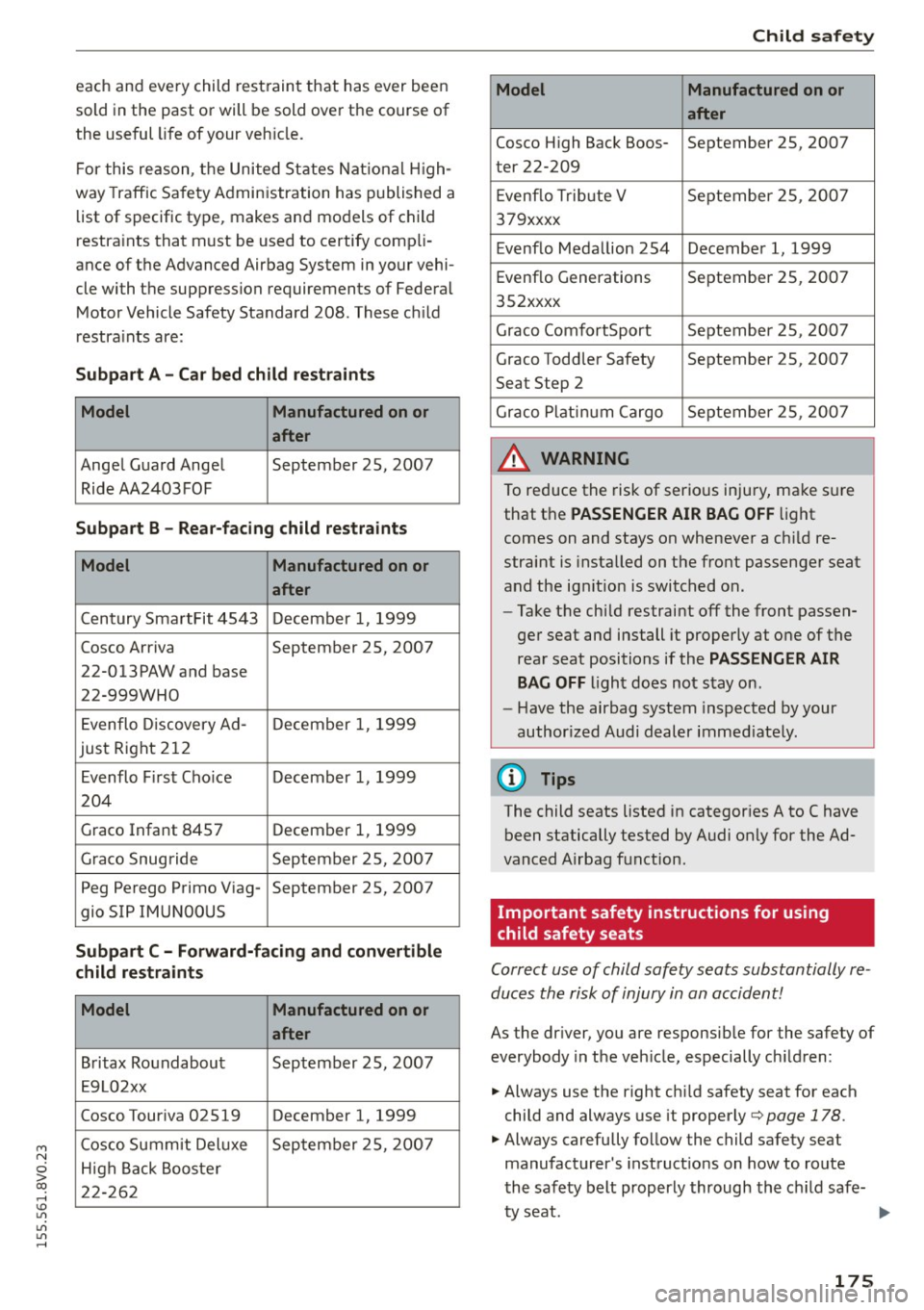
F or this reason, the United States Nat ional H igh
way Traffic Sa fety Admin istration has published a
list of specific type, makes and models of child
restra ints that must be used to certify compli
ance of the Advanced Airbag System in your vehi
cle with the suppression requirements of Federal
Motor Vehicle Safety Standard 208. These chi ld
restra ints are:
Subpart A - C ar bed child restraints
Model Manufactured on or
after
Angel Guard Ange l September 25, 2007
Ride AA2403FOF
Subp art B -Rear-facing child restraints
Model Manufactured on or
after
Century SmartFit 4543 December 1, 1999
C osco Arriva
September 25, 2007
22-013PAW and base
22-999WHO
E venflo D iscovery Ad-December 1, 1999
just Right 2 12
Evenflo F irst Cho ice December 1, 1999
204
Grace Infant 8457 December 1, 1999
Grace Snugride September 25, 2007
Peg Perego Primo V iag-
September 25, 2007
gio SIP IMUNOOUS
Subpart C - Forward-facing and conv ertible
child restraints
Model Manufactured on or
after
B ritax Roundabout Sept ember 25, 2007
E 9 L0 2xx
Cosco Touriva 02519 December 1, 1999
Cosco Summit Deluxe September 25, 2007
H igh Back Booster
2 2-262
Child sa fety
Model Manufactured on or
after
Cosco High Back Boos- September 25, 2007
ter 22-209
E venflo Trib ute V September 25, 200 7
379xxxx
Evenflo Meda llion 254 Decembe r 1, 1999
Evenflo Generations September 25, 2007
352xxxx
Graco ComfortSport September 25, 2007
Grace Toddler Safety September 25, 2007
Seat Step 2
Gr aco Plati num Cargo September 25, 200 7
A WARNING
To reduce the risk of serio us injury, make s ure
that the
PASSENGER AIR BAG OFF li ght
comes on and stays on whenever a ch ild re
straint is installed on the front passenger seat
and the ign it ion is switched on.
- Ta ke the chi ld restraint off the front passen
ger seat and install it properly at one of the
rea r seat positions if the
PASSENG ER AIR
BAG OFF ligh t does not stay on.
- Have the airbag system inspected by your
author ized Audi dealer immed iate ly.
(D Tips
The child seats listed in categor ies A to C have
been statically tested by Audi only for the Ad
vanced Airbag function.
Important safety instructions for using
child safety seats
Correct use of child safety seats substantially re
duces the risk of injury in an accident!
As the driver, you are responsible for the safety of
everybody in t he veh icle, especially ch ildren:
.. Always use the right child safety seat for each
child and always use it properly
¢ page 178 .
.. Always carefully follow the child safety seat
manufacturer's instruct ions on how to route
the safety belt properly through the c hild safe-
t y seat. .,,.
175
Page 178 of 282
Child safet y
"'When using the vehicle safety be lt to insta ll a
child safety seat, you must first activate the
convertible locking retractor on the safety belt
to prevent the ch ild safety seat from moving
¢ page 182.
"' Push the child safety seat down with your full
weight to get the safety belt really tight so that
the seat cannot move forward or sideways more
than one inch (2.5 cm).
"' Secu re unused safety belts on the rear seat
¢ page 177 .
Always remember: Even thoug h your veh icle is
eq uipped w ith an Advanced Ai rbag system, all
chi ldren, espec ia lly those 12 years and yo unger,
should always ride in the back seat properly re
strained for their age and s ize.
A WARNING
Not using a chi ld safety seat, using the wrong
child safety seat or improperly insta lling a
child restraint increases the r isk of serious
personal injury and death .
- All veh icle occupants and especially children
must be restra ined properly whenever riding
in a vehicle. An unrestrained or improperly
restrained child could be injured by striking
the interior or by being ejected from the ve
hicle du ring a sudden maneuver or impact.
An unrestrained or improperly restrained
child is also at greater risk of injury or death
thro ugh contact with an inflat ing airbag .
- Commercially avai lab le child safety seats
are required to comply with U.S . Fede ral Mo
tor Vehicle Safety Standard ( FMVSS) 213 (in
Canada CMVSS 213).
- When buying a ch ild restraint, select one
that fits your child and the vehicle.
- On ly use child restra int systems that fully
contact the flat port ion of the seat cush
ion. The ch ild restra int must not tip o r
lean to either s ide. Audi does no t recom
mend using child safety seats that res t on
legs o r tube -like frames. They do not pro
vide adequate contact with the seat.
- Always heed all legal requirements pe r
taining to the installation and use of ch ild
safety seats and carefully follow the in-
176
str uctions provided by the manufacturer
of the seat you are using.
- Never allow children under 57 inches
(1.45 meters) to wear a norma l safety belt.
They must always be restrained by a proper
child restraint system. Otherwise, they
could sustain injuries to the abdomen and
neck areas during sudden braking maneu
vers or accidents.
- Never let more than one child occupy a child safety seat.
- Never let babies or o lder children ride in a
veh icle wh ile sitting on the lap of another
passenger .
- Holding a child in your arms is never a sub
stitute for a child restraint system.
- The strongest pe rson could not hold the
child with the forces that exist in an acci
dent. The child will strike the interior of
the veh icle and can also be struck by the
passenger.
- The child and the passenger can also in jure each other in an accident .
- Never install rear-facing child safety seats or
infant carriers on the front passenger seat.
A child will be serious ly injured and can be
killed when the passenger airbag inflates -
even with an Advanced Airbag System .
- The inflating airbag will h it the ch ild safety
seat or infant carr ier with great force and
will smash the child safety seat and child
aga inst the backrest, center armrest, door
or roof.
- Always install rear-facing ch ild safety seats
or infant car riers on the rear sea t.
- Forwa rd-facing child safety seats instal led
on the front passenger's seat can inte rfe re
wit h the airbag when it inflates and cause
serious injury to the child. A lways install fo r
ward-facing child sa fety seats on the rear
seat.
- If except ional circumstances req uire the use
of a fo rward-facing child restraint on the
front passenger's seat, the child's safety
and well-be ing require that the following
special precautions be taken : ..,.
Page 179 of 282
....,
N
0 > co
rl I.O
"'
"'
"'
rl
-Make sure the forward-facing seat has
been designed and certified by its manu
facturer for use on a front seat with a pas
senger front and side airbag.
- Always carefully follow the manufacturer's
instructions provided with the child safety
seat or carrier.
- Always move the front passenger seat into
the rearmost position of the passenger
seat's fore and aft adjustment range, and
as far away from the airbag as possible be
fore installing the child restraint.
- Always make sure that nothing prevents
the front passenger's seat from being
moved to the rearmost position in its fore
and aft adjustment range .
- Always make sure that the backrest is in
the upright position.
- Never place or use any electrical device
(such as a laptop, CD player, electronic
games device, power inverter or seat heat
er for child seats) on the front passenger
seat if the device is connected to the 12-
volt socket or the cigarette lighter socket.
- If a seat heater has been retrofitted or
otherwise added to the front passenger
seat, never install any child restraint sys
tem on this seat.
- Make sure that there are no wet objects
(such as a wet towel) and no water or oth
er liquids on the front passenger seat
cushion.
- Never place objects on the seat (such as a
laptop, CD player, electronic games device,
power inverter or seat heater for child
seats). These may influence the electrical
capacitance measured by the capacitive
passenger detection system and can also
fly around in an accident and cause serious
personal injury.
- Always buckle the child safety seat firmly in
place even if a child is not sitting in it. A
loose child safety seat can fly around during
a sudden stop or in a collision .
- Always read and heed all WARNINGS when
ever using a child restrained in a vehicle is
being used
¢ page 140, Safety belts,
Child safety
¢ page 148, Airbag system and
¢ page 172, Child safety.
A WARNING
-
To reduce the risk of serious injury, make sure
that the
PASSENGER AIR BAG OFF light
comes on and stays on whenever a child re
straint is installed on the front passenger seat
and the ignition is switched on.
- Take the child restraint off the front passen ger seat and install it properly at one of the
rear seat positions if the
PASSENGER AIR
BAG OFF
light does not stay on.
- Have the airbag system inspected by your
authorized Audi dealer immediately.
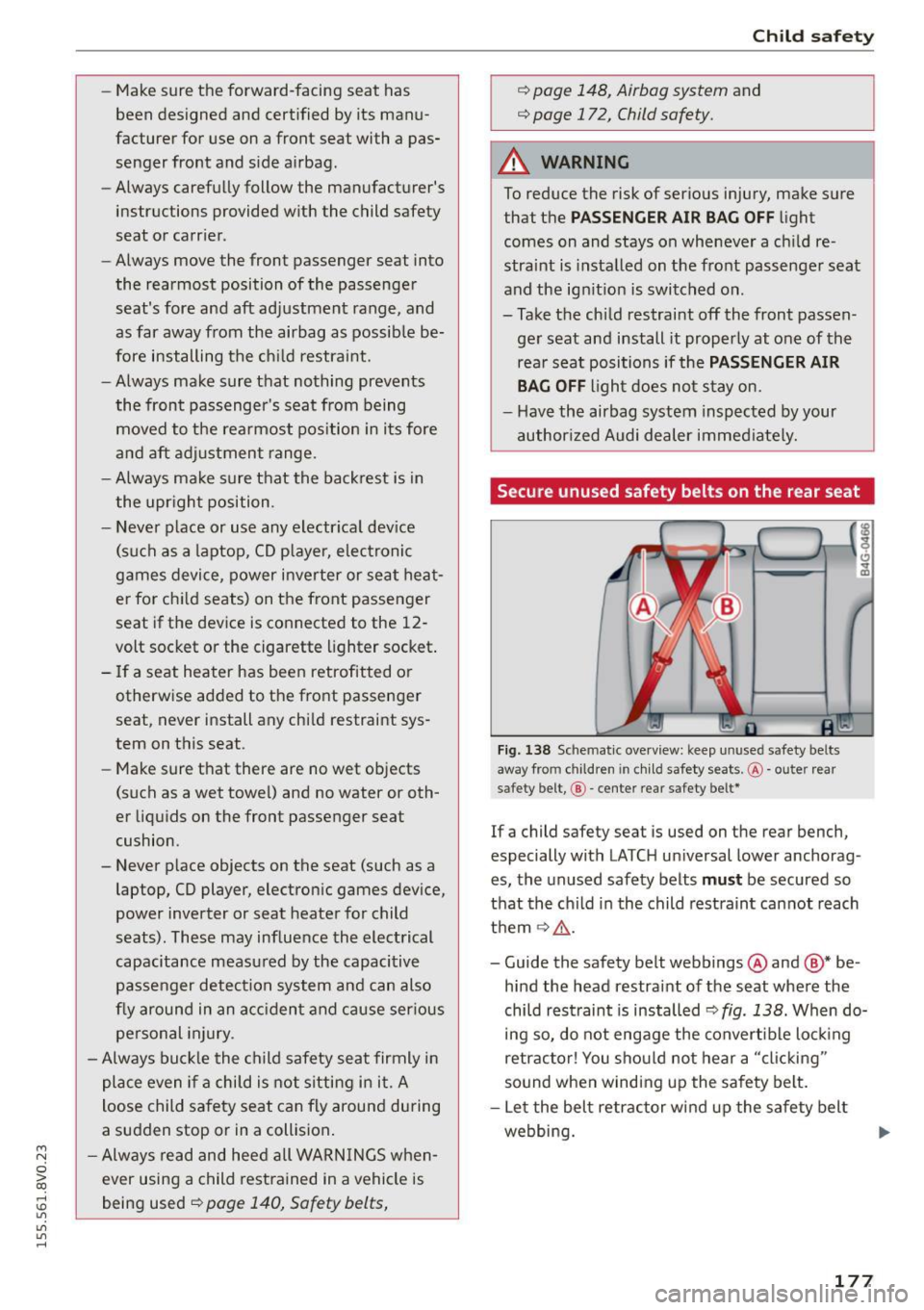
Secure unused safety belts on the rear seat
Fig. 138 Schematic overview: keep unused safety belts
away from children in c hild safety seats. @-outer rear
safety belt, @ -ce nter rear safety belt*
If a child safety seat is used on the rear bench,
especially with LATCH universal lower anchorag
es, the unused safety belts
must be secured so
that the child in the child restraint cannot reach
them ¢_& .
- Guide the safety belt webbings @and
®* be
hind the head restraint of the seat where the
child restraint is installed
¢ fig. 138. When do
ing so, do not engage the convertible locking
retractor! You should not hear a "clicking "
sound when winding up the safety belt.
- Let the belt retractor wind up the safety belt
webbing.
177
Page 180 of 282
Child safety
_& WARNING
A child in a child safety seat installed with the LATCH lower anchorages or with the standard
safety belt or a child in a booster seat on the
rear seat cou ld play with unused rear seat
safety belts and become entangled. This
could cause the child serious personal injury
and even death.
- Always secure unused rear seat safety belts
out of reach of children in child seats such
as by properly routing them around the
head restraint of the seat where the child re
straint is installed.
- Never activate the convertible locking re tractor when routing the safety belts around
the head restraints.
- Never let anyone sit at the center rear seat
ing position if the center rear safety belt has
been routed around a rear head restraint.
Child seats
Infant seats
Babies and infants up to about one year old and
20 lbs. or 9 kg need special rearward-facing
child restraints that support the back, neck and
head in a crash.
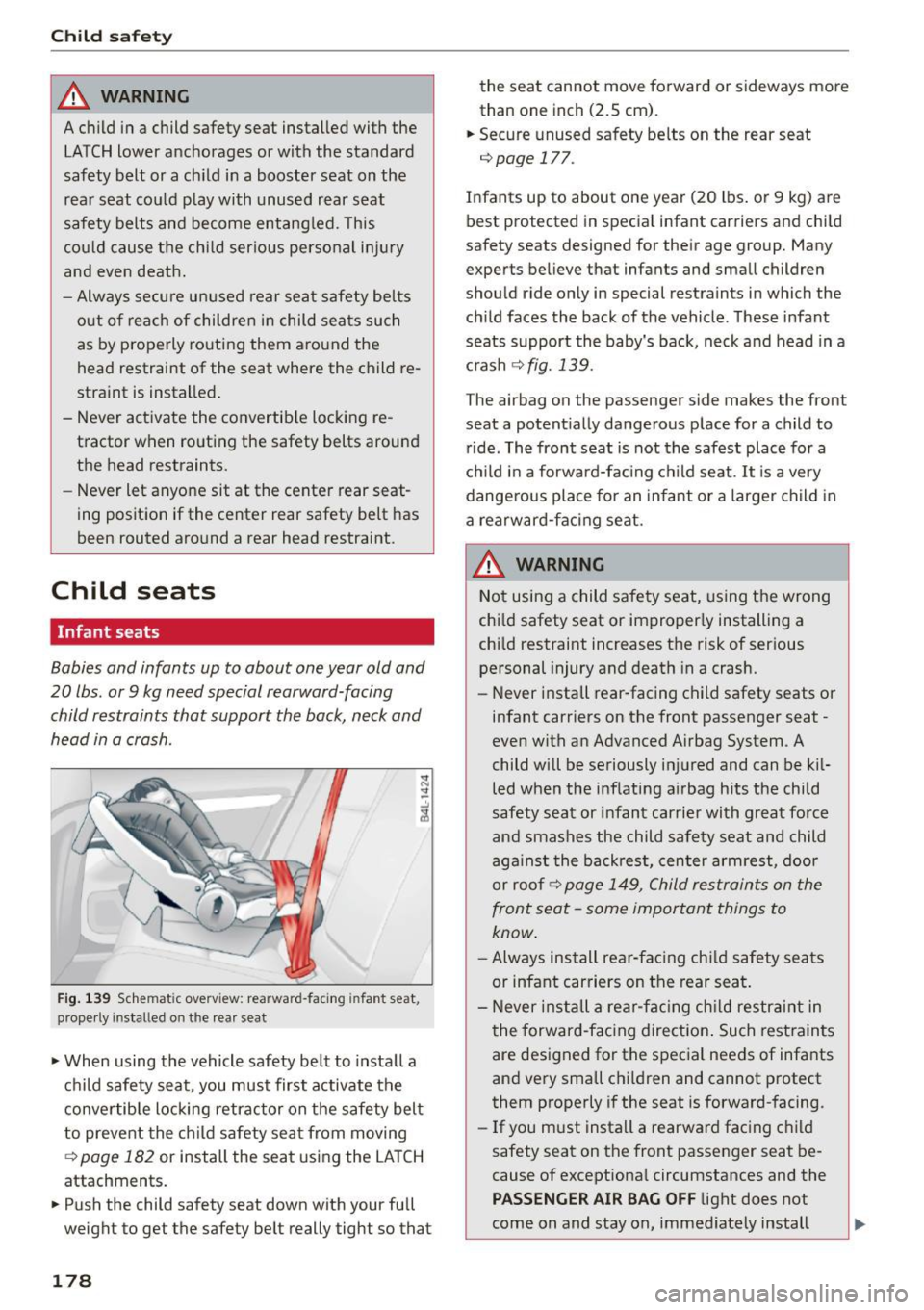
Fig. 139 Schematic overview: rearward-facing infant seat,
properly installed on the rear seat
.. When using the vehicle safety be lt to install a
child safety seat, you must first activate the
convertible locking retractor on the safety belt
to prevent the child safety seat from moving
c::> page 182 or install the seat using the LATCH
attachments.
.. Push the child safety seat down with your full
weight to get the safety belt really tight so that
178
the seat cannot move forward or sideways more
than one inch (2.5 cm).
.. Secure unused safety belts on the rear seat
c::>page 177.
Infants up to about one year (20 lbs. or 9 kg) are
best protected in special infant carriers and child
safety seats designed for their age group. Many
experts believe that infants and small children
should ride only in special restraints in which the
ch ild faces the back of the vehicle. These infant
seats support the baby's back, neck and head in a
crash
c::> fig. 139.
The airbag on the passenger side makes the front
seat a potent ially dangerous place for a child to
ride . The front seat is not the safest place for a
child in a forward-facing ch ild seat.
It is a very
dangerous place for an infant or a Larger child in
a rearward-facing seat.
_& WARNING
Not using a child safety seat, using the wrong
child safety seat or improperly installing a
child restraint increases the risk of serious personal injury and death in a crash.
- Never install rear-facing child safety seats or
infant carriers on the front passenger seat -
even with an Advanced Airbag System. A
child will be seriously injured and can be kil led when the inflating airbag hits the child
safety seat or infant carrier with great force
and smashes the child safety seat and child
against the backrest, center armrest, door
or roof
c::> page 149, Child restraints on the
front seat -some important things to
know .
-Always install rear-facing chi ld safety seats
or infant carriers on the rear seat.
- Never install a rear-fac ing ch ild restraint in
the forward-facing direction. Such restraints
are designed for the special needs of infants
and very small children and cannot protect
them properly if the seat is forward-facing.
- If you must install a rearward facing child
safety seat on the front passenger seat be
cause of exceptional circumstances and the
PASSENGER AIR BAG OFF light does not
come on and stay on, immediately install
~
Page 181 of 282
....,
N
0 > co
rl I.O
"'
"'
"'
rl
the rear-facing ch ild safety seat in a rear
seating pos it ion and have the airbag system
inspected by your Audi dealer.
- Never place or use any electrical device
(such as a laptop, CO player, electron ic
games dev ice, power inverter or seat heater
for child seats) on the front passenger seat if the dev ice is connected to the 12-volt
socket or the c igarette lighter socket.
- If a seat heater has been retrofitted or oth
erwise added to the front passenger seat,
never i nstall any ch ild restra int system on
this seat.
- Make sure that there are no wet objects
(such as a wet towel) and no wa ter or othe r
liquids on the front passenger seat c ushion.
- Never place objects on the seat (such as a
laptop, CD playe r, e lectronic games dev ice,
power inverter or seat heater for chi ld
seats). These may influence the e lectr ica l
capacitance measured by the capacitive pas·
senger detection system and can a lso fly
around in an accident and cause serious per
sonal injury.
- Always read and heed all WARNINGS when·
ever using a child restrained in a vehicle is
being used
c:::> page 140, Safety belts,
¢ page 148, Airbag system and
c::> page 172, Important information.
Convertible child safety seats
Properly used convertible child safety seats can
help protect toddlers and children over age one
who weigh between 20 and 40 lbs. (9 and 18 kg)
in a crash.
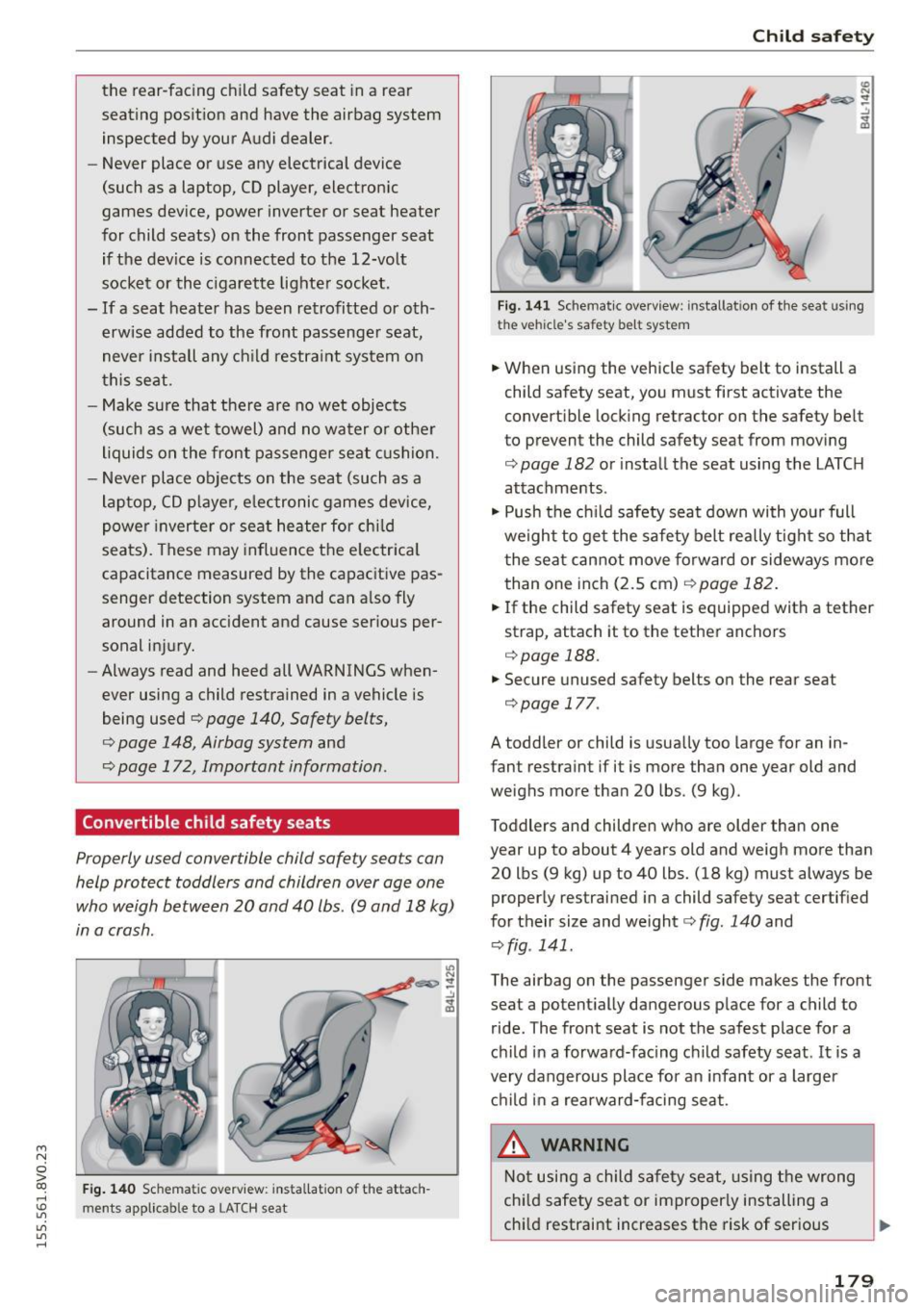
F ig . 140 Schemat ic overview : installat ion of t he atta ch
ments applicab le to a LATCH seat
Chil d sa fe ty
Fig. 141 Schemat ic overv iew: installat io n of the seat us ing
the vehicle's sa fety belt system
.. When using the vehicle safety belt to install a
child safety seat, you must first activate the
convert ible lock ing retractor on the safety belt
to prevent the child safety seat from moving
c::> page 182 or install the seat using the LATC H
attachments .
.. Push the ch ild safety seat down with your full
weight to get the safety belt rea lly t ight so that
t he seat cannot move forward or sideways more
than one inch (2.5 cm)
c::> page 182.
.. If the child safety seat is equipped with a tether
strap, attach it to the tether anchors
c::> page 188 .
.. Secure unused safety belts on the rear seat
c::>page 177.
A toddler or child is usua lly too large for an in
fant restraint if it is more than one year old and
weighs more than 20 lbs. (9 kg).
Toddlers and children who are older than one
year up to about 4 years old and weigh more than 20 lbs (9 kg) up to 40 lbs. (18 kg) must always be
properly restrained in a child safety seat certif ied
for their size and we ight
c:::> fig . 140 and
c::> fig . 141.
The airbag on the passenger side makes the front
seat a potent ially dangerous p lace for a child to
ride . The front seat is not the safest place for a
child i n a forward-fac ing child safety seat. It is a
very dangerous place for an infant or a larger
c h ild in a rearward-facing seat.
_&. WARNING
No t using a child sa fety seat, us ing the wrong
child safety seat or improper ly installing a
child restraint increases the risk of serious
~
179
Page 182 of 282
Child safety
personal injury and death in a collision or oth
er emergency situation.
- Children on the front seat of any car, even
with Advanced Airbags, can be seriously in
jured or even killed when an airbag inflates.
A child in a rearward-facing child safety seat
installed on the front passenger seat will be
seriously injured and can be killed if the
front airbag inflates -even with an Ad
vanced Airbag System.
- The inflating airbag will hit the child safety
seat or infant carrier with great force and
will smash the child safety seat and child
against the backrest, center arm rest, door
or roof.
- Always install rear-facing child safety seats
on the rear seat.
- If you must install a rearward facing child
safety seat on the front passenger seat be cause of exceptional circumstances and the
PASSENGER AIR BAG OFF light does not
come on and stay on, immediately install
the rear-facing child safety seat in a rear
seating position and have the airbag system inspected by your Audi dealer .
- The rear side of the child safety seat should
be positioned as close as possible to the
backrest on the vehicle seat .
- For adjustable head restraints: adjust or re
move the rear seat head restraint if it is dif
ficult to install the child seat with the head
restraint in place
Q page 56 . Install the
head restraint again immediately once the
child seat is removed. Driving without head
restraints or with head restraints that are
not properly adjusted increases the risk of
serious or fatal neck injury dramatically.
- Always read and heed all WARNINGS when
ever using a child restrained in a vehicle is
being used
Q page 140, Safety belts,
Q page 148, Airbag system and
Q page 172, Important information.
A WARNING
If exceptional circumstances require the use
of a forward-facing child restraint on the front
passenger's seat, the child's safety and well-
180
being require that the following special pre
cautions be taken :
- Make sure the forward-facing seat has been
designed and certified by its manufacturer
for use on a front seat with a passenger
front and side airbag .
- Always follow the manufacturer's instruc
tions provided with the child safety seat or infant carrier .
- Always move the front passenger seat into
the rearmost position of the passenger
seat's fore and aft adjustment range, and as
far away from the airbag as possible before installing the child restraint .
- Always make sure that nothing prevents the
front passenger's seat from being moved to
the rearmost position in its fore and aft ad
justment range.
- Always make sure the backrest is in an up
right position .
- Never place or use any electrical device
(such as a laptop, CD player, electronic
games device , power inverter or seat heater
for child seats) on the front passenger seat
if the device is connected to the 12-volt
socket or the cigarette lighter socket.
- If a seat heater has been retrofitted or oth
erwise added to the front passenger seat, never install any child restraint system on
this seat.
- Make sure that there are no wet objects
(such as a wet towel) and no water or other
liquids on the front passenger seat cushion.
- Never place objects on the seat (such as a
laptop, CD player, electronic games device,
power inverter or seat heater for child
seats). These may influence the electrical
capacitance measured by the capacitive pas
senger detection system and can also fly
around in an accident and cause serious per
sonal injury.
- Make sure that the
PASSENGER AIR BAG
OFF
light comes on and stays on all the time
whenever the ignition is switched on.
- If the
PASSENGER AIR BAG OFF light does
not come on and stay on, immediately in
stall the forward-facing child seat at a seat-
ing position on the rear seat and have the
~
Page 184 of 282
Child safet y
In order for the airbag to offer protection, it is
important that all vehicle occupants, especially
any children, who must be in the front seat be
cause of except ional circumstances, be proper ly
restrained and as far away from the airbag as
possible . By keeping room between the child's
body and the front of the passenger compart
ment, the airbag can inflate comp letely and pro
vide supp lemental protection in ce rtain frontal
coll is ions .
A WARNING
Not using a booster seat, using the booster
seat improperly, incorrect ly installing a boos
ter seat or using the vehicle safety belt im
properly increases the risk of serious personal
injury and death in a collision or other emer
gency situat ion. To help reduce the risk of se
r ious personal injury and/or death:
- The shoulder belt must lie as close to the
center of the child's collar bone as possible
and must lie flat and snug on the upper
body .
It must never lie across the throat or
neck. The lap belt must lie across the pelv is
and never across the stomach or abdomen.
Make sure that the be lt lies flat and snug.
Pull on the belt to tighten i f necessa ry .
- Failure to properly route safety be lts over a
child 's body will cause severe injuries in an
accident or other emergency sit uation
¢ page 140.
- The rear side of the child safety seat shou ld
be positioned as close as possible to the
backrest on the vehicle seat.
- For adjustable head restraints: adjust or re
move the rear seat head restraint if it is dif
ficult to install the child seat with the head
restraint in place¢
page 56. Install the
head restraint again immediately once the
child seat is removed . Driv ing without head
restraints or with head restraints that are
not properly adjusted increases the r isk of
serious o r fatal neck injury dramatically .
- Children on the front seat of any car, even
with Advanced Airbags, can be ser iously in
jured or even killed when an airbag inflates.
- Never let a child stand or knee l on any seat,
for example the front seat.
182
-
- Never let a child ride in the cargo area of
your veh icle.
- Always remember that a child leaning for
ward, sitting sideways or out of position in any way during an acc ident can be struck by
a deploying airbag. This will resu lt in serious
personal injury or death.
- If you must install a booster seat on the
front passenger seat because of exceptional
circumstances the
PASSENGER AIR BAG
OFF
li ght must come on and stay on, when
eve r the ign it ion is switched on.
- If the
PASSENGER AIR B AG OF F light does
not come on and stay on, perform the
checks described ¢
page 160, Monitoring
the Advanced Airbag System.
- Ta ke the child restraint off the front passen
ge r seat and install it properly at one of the
rear seat positions if the
PA SSENGER AIR
BAG OFF
light does not stay on whenever
the ignition is switched on .
- Always read and heed a ll WARNINGS when
ever using a child restrained in a vehicle is
being used¢
page 140, Safety belts,
¢page 148, Airbag system
and
¢ page 172, Important information.
Securing child seats
Securing a child safety seat using a safety
belt
Safety belts for the rear seats and the front pas
senger can be locked with the convertible lo cking
retractor to properly secure child safety seats .
The safety belts emergency locking retracto rs fo r
the rear seats safety belts and for the front pas
senger's seat safety be lt have a convert ible lock
ing retractor for chi ld restraints. The safety belt
must be locked so that belt webbing cannot un
reel. The retractor can be activated to lock the
safety belt and prevent the safety be lt webbing
from loosening up during normal driving. A child
safety seat can on ly be properly installed when
the safety belt is locked so that the child and
c hi ld safety seat will stay in p lace .
Always remember: Even though your vehicle is
equipped with an Advanced Airbag system, all
Page 185 of 282
M N
0 > co ,...., \!) ..,.,
..,.,
..,., ,....,
children, especially those 12 years and younger,
should always ride in the back seat properly re
strained for their age and size.
A WARNING
-
Improperly installed child safety seats in
crease the risk of serious personal injury and
death in a collision.
- Always make sure that the safety belt re
tractor is locked when installing a child safe
ty seat. An unlocked safety belt retractor
cannot hold the child safety seat in place
during normal driving or in a crash.
- Always buckle the child safety seat firmly in
place even if a child is not sitting in it . A
loose child safety seat can fly around during
a sudden stop or in a collision.
- Always make sure that the rear seat back
rest to which the center rear safety belt* is
attached is securely latched whenever the
rear center safety belt is being used to se
cure a child restraint.
- If the backrest is not securely latched, the
child and the child restraint will be thrown
forward together with the backrest and will strike parts of the vehicle interior. The child
can be seriously injured or killed.
- Never install rear-facing child safety seats or
infant carriers on the front passenger seat.
A child will be seriously injured and can be killed when the passenger airbag inflates.
- The inflating airbag will hit the child safety seat or infant carrier with great force and
will smash the child safety seat and child
against the backrest, center armrest, door
or roof.
- Always install rear-facing child safety seats or infant carriers on the rear seat.
- Forward-facing child safety seats or infant
carriers installed on the front passenger's
seat may interfere with the deployment of
the airbag and cause serious injury to the child.
- It is safer to install a forward-facing child
safety seat on the rear seat.
- Always read and heed all WARNINGS when
ever using a child restrained in a vehicle is
being used
r:::> page 172 . Special precautions
Child safety
apply when installing a child safety seat on
the front passenger seat
r:::> page 149, Child
restraints on the front seat -some impor
tant things to know .
A WARNING
Always take special precautions if you must
install a forward or rearward-facing child re
straint on the front passenger's seat in excep
tional situations:
- Whenever a forward or rearward-facing
child restraint is installed on the front pas
senger seat, the
PASSENGER AIR BAG OFF
light must come on and stay on whenever
the ignition is switched on.
- If the
PASSENGER AIR BAG OFF light does
not come on and stay on, perform the
checks described
r:::> page 160, Monitoring
the Advanced Airbag System.
- Take the child restraint off the front passen
ger seat and install it properly at one of the
rear seat positions if the
PASSENGER AIR
BAG OFF
light does not stay on whenever
the ignition is switched on.
- Improper installation of child restraints can
reduce their effectiveness or even prevent
them from providing any protection.
-An improperly installed child restraint can interfere with the airbag as it deploys and
seriously injure or even kill the child.
-Always carefully follow the manufacturer's
instructions provided with the child safety
seat or carrier.
- After checking to make sure that the child
restraint is properly installed, make certain
that the child restraint is correctly recog nized by the capacitive passenger detection
system in the front passenger seat and that
the
PASSENGER AIR BAG OFF light signals
the correct front passenger frontal airbag
status.
A WARNING
Forward-facing child restraints:
-
183
Page 186 of 282
Child safety
-Always make sure the forward-facing seat
has been designed and certified by its man
ufacturer for use on a front seat with a
passenger front and side airbag.
- Never put the forward-facing child restraint
up, aga inst or very near the instrument pan
el.
- Always move the passenger seat into its
rearmost position in the seat's fore and aft
adjustment range, as far away from the air
bag as possible before installing the for
ward-fac ing child restraint. The backrest
must be adjusted to an upright posit ion.
- Make sure that the
PASSENGER AIR BAG
OFF
light comes on and stays on all the time
whenever the ignition is switched on.
_&. WARNING
Rearward-fac ing ch ild restra ints:
- A child in a rearward-facing child safety seat
installed on the front passenger seat will be
seriously injured and can be killed if the
front airbag inflates -even with an Ad
vanced Airbag System .
- T he inflating airbag wil l hit the child safety
seat or infant carrier with great force and
will smash the chi ld safety seat and child
against the backrest, center armrest, door
or roof.
- Always be especially carefu l if you must in
stall a rearward facing child safety seat on
the front passenger seat in exceptional cir
cumstances.
- Make sure that the
PASSENGER AIR BAG
OFF
light comes on and stays on all the t ime
whenever the ignition is switched on .
- If the
PASSENGER AIR BAG OFF light does
not come on and stay on, immed iately in
stall the rear-fac ing ch ild safety seat in a
rear seating position and have the airbag
system inspected by your Aud i dealer.
184
· Activating the convertible locking retractor
Use the convertible locking retractor to secure a
child restraint.
Always heed the child safety seat manufacturer's
instructions when installing a child restraint in
your vehicle . T o activate the convert ible locking
retractor:
.. Place the child restraint on a seat, preferably on
the rear seat .
.. Slowly pull the belt
all the way out.
.. Route it around or through the child restraint
belt pat h
c::> ,&..
.. Push the ch ild safety seat down with your full
weight to get the safety belt really tight.
.. Insert the belt tongue into the buckle for that
seating position.
.. Guide the safety be lt back into the retractor un
til the belt lies flat and snug on the ch ild safety
seat.
.. You should hear a "clicking" noise as the belt
w inds back into the inertia reel. Test the con
vert ible lock ing retractor by pulling on the belt .
You should no longer be able to pull the belt
out of the ret ractor. The convertible locking re
tractor is now activated .
.. Make sure that the red release button is facing
away from the child restraint so that it can be
unbuckled quickly .
.. Pull on the belt to make sure the safety belt is
properly tight and fastened so that the seat
cannot move forward or s ideways more than
one inch (2 .5 cm).
_&. WARNING
Using the wrong child restraint or an improp
erly installed child restraint can cause serious
personal injury or death in a crash.
- Always make sure that the safety belt re
tractor is loc ked when insta lling a child safe
ty seat. An unlocked safety belt retractor
cannot hold the child safety seat in place
during normal driving or in a crash.
- Always buckle the child safety seat firmly in
place even if a chi ld is not sitting in it. A
loose child safety seat can fly around during
a sudden stop or in a crash.
.