warning AUDI S3 SEDAN 2015 Owners Manual
[x] Cancel search | Manufacturer: AUDI, Model Year: 2015, Model line: S3 SEDAN, Model: AUDI S3 SEDAN 2015Pages: 282, PDF Size: 71.14 MB
Page 138 of 282
Driving safet y
mats wi ll prevent them from sliding into posi
tions that cou ld interfere with the peda ls or im
pa ir safe operation of your vehicle in other ways .
A WARNING
Pedals that cannot move freely can result in a
loss of vehicle control and increase the risk of
serious persona l injury .
- Always make sure that floor mats are prop
erly secured .
- Never place or insta ll floor mats or other
floor coverings in t he veh icle that cannot be
properly secured in place to prevent them
from slipping and inte rfering w ith the ped
als or the ability to control the veh icle .
- Never place or insta ll floor mats or other
floor coverings on top of already installed
floor mats. Additiona l floo r mats and other
c overings w ill reduce the si ze of the pedal
area and interfere w ith the pedal s.
- Always proper ly reinstall and secu re floor
mats that have been take n ou t for clean ing .
- Always make sure that objects cannot fa ll
in to the dr iver footwell while the veh icle i s
moving. Obje cts can be come trapped unde r
the brake pedal an d accelerator peda l caus
ing a loss of vehicle cont ro l.
Storing cargo correctly
Loading the luggage compartment
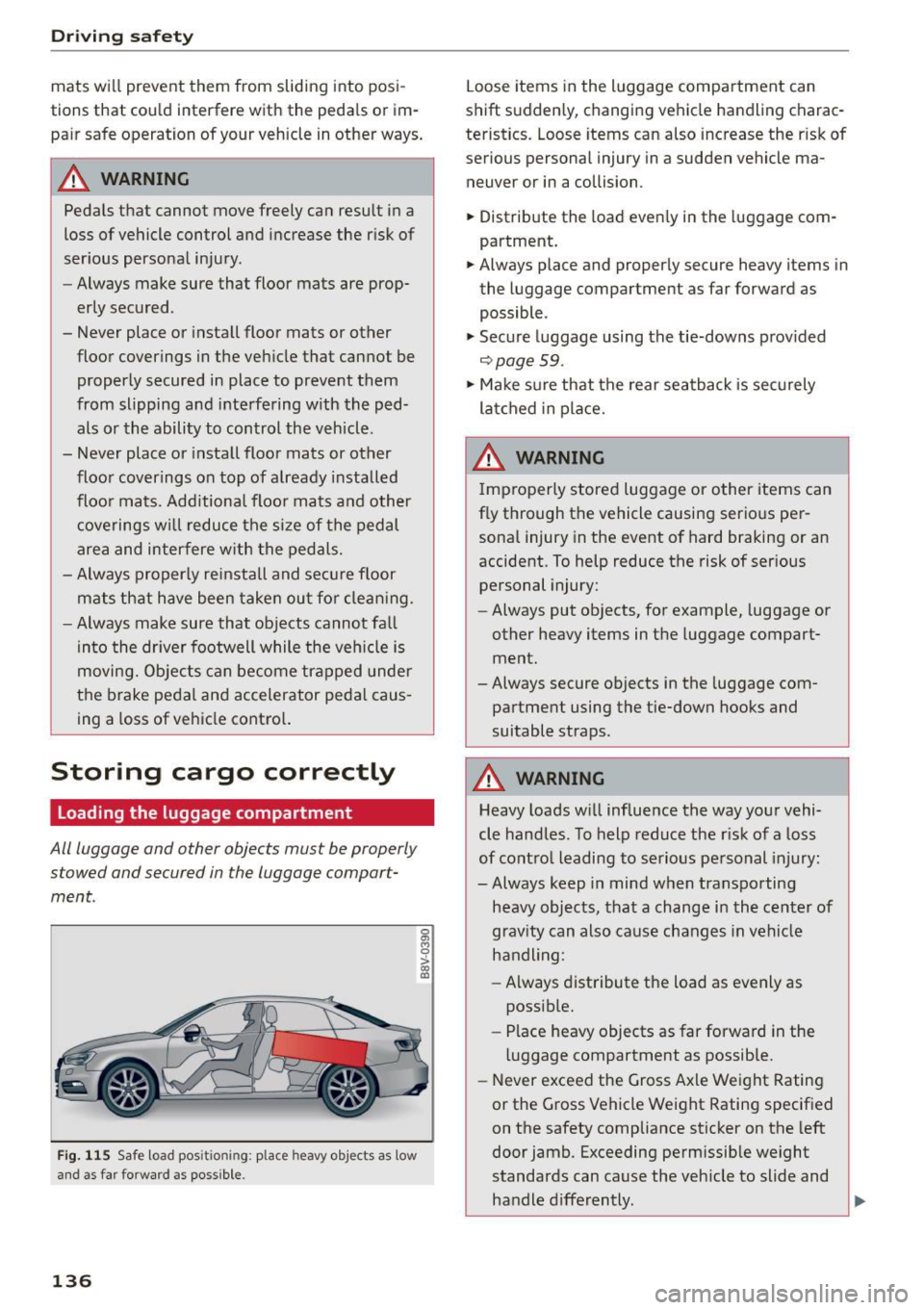
All luggage and other objects must be properly
s towed and secured in the luggage compart
ment.
F ig . 11 5 Safe load pos it io nin g: place heavy objects as low
an d a s far for ward as possib le .
136
Loose items in the luggage compa rtment can
shift suddenly, changing vehicle handling charac
teristics. Loose items can also increase the r isk o f
serious persona l injury in a sudden vehicle ma
neuver or in a collision.
.,. Distribute the load even ly in the luggage com
partment.
.,. Always place and properly secure heavy items in
the luggage compartment as far forward as
possible .
.,. Secure luggage using the tie-downs prov ided
~ page 59.
.,. Ma ke s ure that the rear seatback is securely
la tc hed in place.
A WARNING
I mproperly stored luggage or other items can
fly through the vehicle causing serio us per
sona l injury in the event o f hard braking or an
accident. To help reduce the risk of ser ious
personal injury:
- Always put objects, for example, luggage or
other heavy items in the luggage compart
ment.
- Always secure objects in the luggage com
partment using the tie-down hooks and
suitable straps.
A WARNING
H eavy loads wi ll influence the way your vehi
cle handles . To help reduce the r isk of a loss
of contro l leading to se rio us pe rsonal injury:
-Always keep in mind when transpo rting
heavy objects, tha t a change i n the center of
grav ity can also cause changes in vehi cle
h a ndli ng:
- Always distribute the load as evenly as
possib le.
- Place heavy objects as far forward in the
luggage compartment as possib le.
- Never exceed the Gross Axle Weight Rating
or the Gross Vehicle Weight Rating specif ied
on the safety compliance sticker on the left
door jamb. Exceeding permissib le weight
standards can cause the veh icle to slide and
handle d ifferently. ,...
Page 139 of 282
M N
0 > co ..... \!) 1.1"1
1.1"1
1.1"1
.....
-Please observe information on safe driving
~page 130.
A WARNING
To help prevent poisonous exhaust gas from
being drawn into the vehicle, always keep the
rear lid closed while driving .
- Never transport objects larger than those
fitting completely into the luggage area be
cause the rear lid cannot be fully closed.
- If you absolutely must drive with the rear lid
open, observe the following notes to reduce
the risk of poisoning:
- Close all windows,
- Close the power roof*,
- Open all air outlets in the instrument pan-
el,
- Switch off the air recirculation,
- Set the fresh air fan to the highest speed.
A WARNING
Always make sure that the doors, all windows,
the power roof* and the rear lid are securely
closed and locked to reduce the risk of injury
when the vehicle is not being used.
-After closing the rear lid, always make sure
that it is properly closed and locked.
- Never leave your vehicle unattended espe
cially with the rear lid left open . A child
could crawl into the vehicle through the lug
gage compartment and close the rear lid be
coming trapped and unable to get out. Be
ing trapped in a vehicle can lead to serious
personal injury.
- Never let children play in or around the vehi
cle.
- Never let passengers ride in the luggage
compartment. Vehicle occupants must al
ways be properly restrained in one of the ve hicle's seating positions.
(D Tips
- Air circulation helps to reduce window fog
ging. Stale air escapes to the outside
through vents in the trim panel. Be sure to keep these slots free and open.
Driving safety
-The tire pressure must correspond to the
load. The tire pressure is shown on the tire
pressure label. The tire pressure label is lo
cated on the driver's side B-pillar. The tire
pressure label lists the recommended cold
tire inflation pressures for the vehicle at its
maximum capacity weight and the tires that
were on your vehicle at the time it was man ufactured. For recommended tire pressures
for normal load conditions, please see chap
ter ~
page 224.
' Tie-downs
The luggage compartment is equipped with four
tie-downs to secure luggage and other items.
Use the tie-downs to secure your cargo properly
~page 136, Loading the luggage compartment.
In a collision, the laws of physics mean that even
smaller items that are loose in the vehicle will
become heavy missiles that can cause serious in
jury. Items in the vehicle possess energy which
vary with vehicle speed and the weight of the
item. Vehicle speed is the most significant factor.
For example, in a frontal collision at a speed of
30 mph (48 km/h) , the forces acting on a 10-lb
(4.5 kg) object are about 20 times the normal
weight of the item. This means that the weight
of the item would suddenly be about
200 lbs. (90 kg). You can imagine the injuries
that a 200 lbs. (90 kg) item flying freely through
the passenger compartment could cause in a col
lision like this.
A WARNING
-Weak, damaged or improper straps used to
secure items to tie-downs can fail during hard
braking or in a collision and cause serious per
sonal injury .
- Always use suitable mounting straps and
properly secure items to the tie-downs in
the luggage compartment to help prevent
items from shifting or flying forward as dan
gerous missiles.
- When the rear seat backrest is folded down,
always use suitable mounting straps and
properly secure items to the tie-downs in
137
Page 142 of 282
Safety belt s
Safety belts
General notes
Always wear safety belts!
Wearing safety belts correctly saves lives!
This chapter explains why safety belts are neces
sary, how they work and how to adjust and wear
them correctly.
.. Read all the information that follows and heed
all of the instructions and WARNINGS.
&_ WARNING
Not wearing safety belts or wearing them im
properly increases the risk of serious personal
injury and death.
- Safety belts are the single most effective
means available to reduce the risk of serious
injury and death in automobile accidents.
For your protection and that of your passen
gers, always correct ly wear safety belts
when the vehicle is moving.
- Pregnant women, injured, or physically im
paired persons must also use safety belts.
L ik e all veh icle occupants, they are more
likely to be seriously injured if they do not
wear safety be lts . The best way to protect a
fetus is to protect the mother - throughout
the ent ire pregnancy.
Number of seats
Your Audi has a total of five seating positions:
two in the front and three in the rear. Each seat
ing position has a safety belt .
&_ WARNING
Not wearing safety belts or wearing them im
properly increases the risk of serious personal
injury and death.
- Never strap more than one person, includ
ing small ch ildren, into any belt. It is espe
cially dangerous to place a safety belt over a
child sitting on your lap.
- Never let more people ride in the vehicle
than there are safety belts available.
140
-Be sure everyone riding in the vehicle is
properly restrained with a separate safety
belt or child restraint.
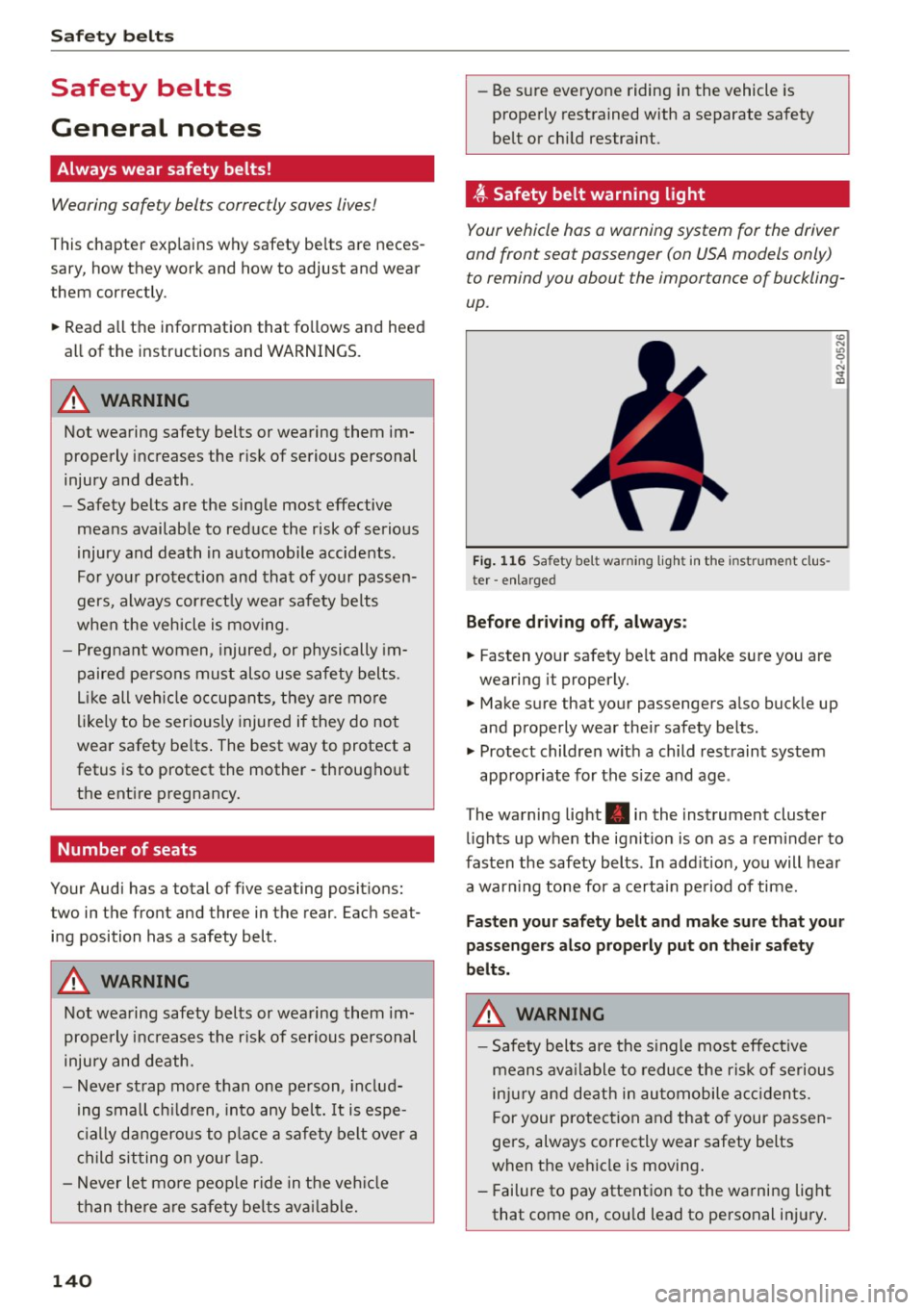
~ -Safety belt warning light
Your vehicle has a warning system for the driver
and front seat passenger (on USA models only) to remind you about the importance of buckling
up .
Fig. 116 Safety belt warning light in the instrument cl us
ter -enlarged
Before driving off, always:
.. Fas ten your safety belt and make sure you are
wearing it properly .
(0
"'
"' 9
"'
and properly wear their safety belts .
.. Protect children with a child restraint system
appropriate for the s ize and age .
The warning light . in the instrument cluster
light s up when the ign it ion is on as a reminder to
fasten the safety belts . In add ition, you will hear
a warn ing tone for a certain pe riod of time.
Fasten your safety belt and make sure that your
passengers also properly put on their safety
belts .
&_ WARNING
-Safety belts are the sin gle most effect ive
means available to reduce the risk of serious
injury and death in automobile accidents.
F or your protection and that of your passen
gers, always correctly wear safety belts
when the vehicle is moving .
- Failure to pay attention to the warning light
that come on, cou ld lead to personal injury .
-
Page 145 of 282
....,
N
0 > C() rl I.O
"'
"'
"'
rl
_& WARNING
Not wearing safety belts or wearing them im
properly increases the risk of serious personal
injury and death. Safety belts can work only
when used correctly .
- Always fasten your safety belts correctly be
fore driving off and make sure al l passen
gers are correctly restrained.
- For maximum protection, safety belts must
always be pos itioned properly on the body.
- Never strap more than one person, includ
ing small ch ildren, into any belt.
- Never place a safety belt over a child sitting
on your lap.
- Always keep feet in the footwell in front of
the seat while the vehicle is being driven.
- Never let any person ride with their feet on
the instrument panel or sticking out the
window or on the seat.
- Never remove a safety belt while the vehicle
is moving . Doing so will increase your risk of
being injured or killed.
- Never wear belts twisted.
- Never wear belts over rigid or breakable ob-
jects in or on your clothing, such as eye
glasses, pens, keys, etc., as these may cause
injury.
- Never allow safety belts to become dam
aged by being caught in door or seat hard
ware.
- Do not wear the shoulder part of the belt
under your arm or otherwise out of position.
- Several layers of heavy clothing may inter
fere with correct positioning of belts and re duce the overall effectiveness of the system.
- Always keep belt buckles free of anything
that may prevent the buckle from latching
securely.
- Never use comfort clips or devices that cre
ate slack in the shoulder be lt. However, spe
cial clips may be required for the proper use
of some child restraint systems.
- Torn or frayed safety belts can tear, and
damaged belt hardware can break in an acc i
dent. Inspect belts regularly. If webb ing,
bind ings, buckles, or retracto rs are dam-
Safety belts
aged, have belts replaced by an authorized
Audi dealer or qualified workshop.
- Safety belts that have been worn and loaded
in an accident must be replaced with the
correct replacement safety belt by an au
thorized Audi dealer. Replacement may be
necessary even if damage cannot be clearly
seen. Anchorages that were loaded must al
so be inspected.
- Never remove, modify, d isassemble, o r try
to repair the safety belts yourself.
-Always keep the belts clean. Dirty belts may not work properly and can impair the func
tion of the inertia reel~
table Internal
cleaning on page 237.
Safety belts
Fastening safety belts
Safety first -everybody buckle up!
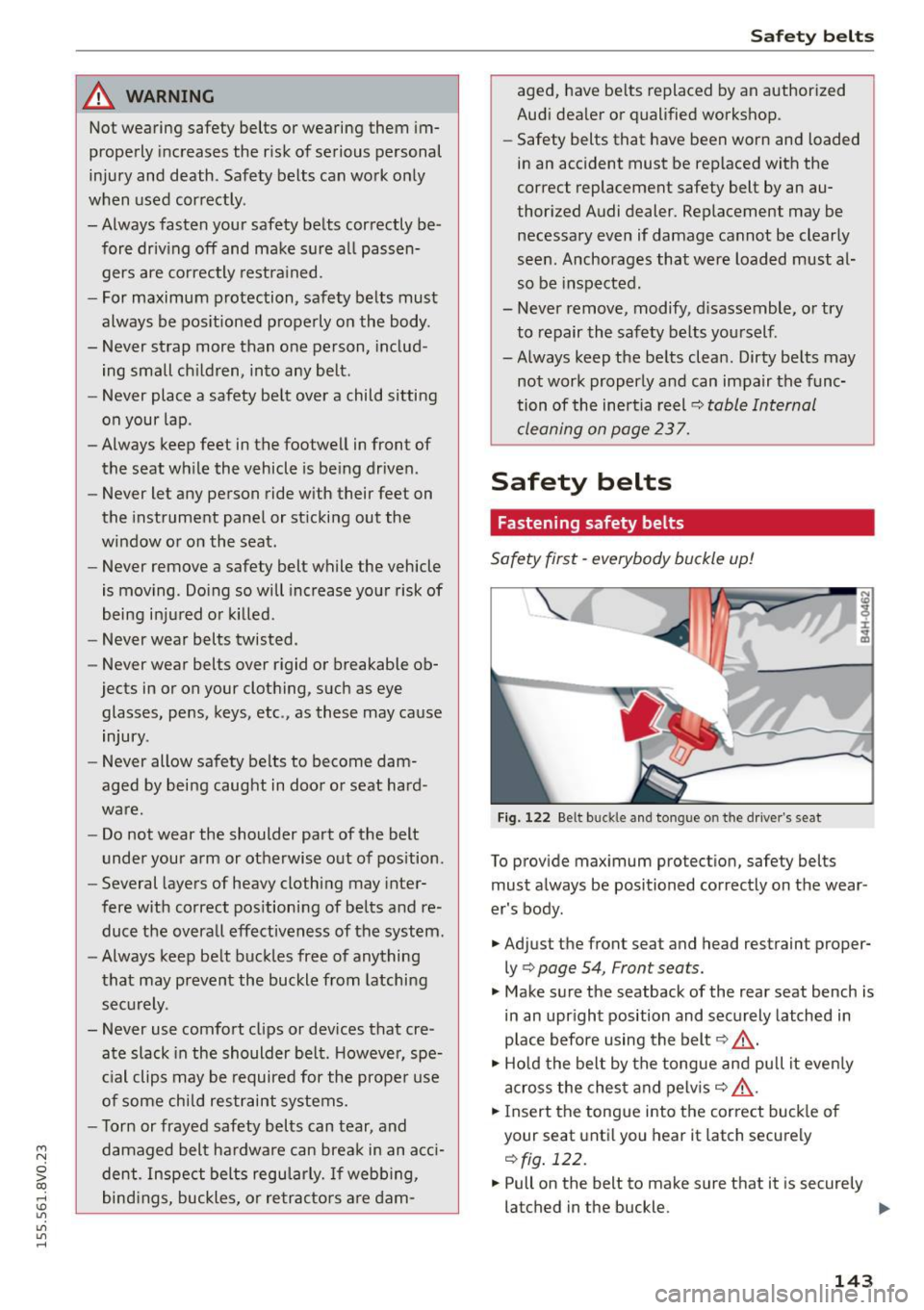
Fig. 122 Belt buck le and tongue on the d rive r's seat
To provide maximum protection, safety belts
must always be positioned correctly on the wear
er's body.
.. Adjust the front seat and head restraint proper
ly ¢
page 54, Front seats.
.. Make sure the seatback of the rear seat bench is
in an upright position and securely latched in
place before using the belt¢.&, .
.. Ho ld the belt by the tongue and pull it even ly
across the chest and pelvis ¢.&_ .
.. Insert the tongue into the correct buckle of
your seat until you hear it latch securely
¢ fig. 122 .
.. Pull on the belt to make sure that it is securely
latched in the buckle.
Ill>
143
Page 146 of 282
Safety belts
Autom atic safet y belt retractors
Every safety belt is eq uipped w ith an automatic
be lt retractor on the shou lder belt. This feature
locks the belt when the be lt is pulled o ut fast,
during hard brak ing and in an accident . The belt
may also lock when you drive up or down a steep
hill or through a sharp curve. During normal driv
ing the belt lets you move freely.
S afety belt p rete n sioner s
The safety be lts are equipped with a belt preten
sioner that helps to t ighten the safety belt and
remove s lack when the pretensioner is activated
¢ page 146. The funct ion of the pretensioner is
mon itored by a warning light
<=:>page 20.
Converti ble lock ing r etra ctor
Every safety belt except the one on the driver
seat is equipped w ith a convertib le locking retrac
tor that
must be used when the safety belt is
used to attach a child seat. Be sure to read the
important information about this feature
¢page 182 .
.&_ WARNING
Improperly positioned safety belts can cause
serious injury in an accident¢
page 144,
Safety belt posi tion.
- Safety belts offer optimum protection only
when the seatback is upright and belts are
properly positioned on the body.
- Always make sure that the rea r seat back
rest to which t he center rear safety belt* is
attached is securely latched whenever the
rear center safety be lt is being used .
If the
backrest is not securely latched, the passen
ger wi ll move forward with the backrest dur
ing sudden braking, in a sudden maneuver
and especially in a crash.
- Never attach the safety belt to the buck le
for another seat. Attaching the belt to the
wrong buckle will reduce safety be lt effec
t iveness and can cause serious persona l in
jury.
- A passenger who is not properly restrained can be se riously in jured by the safety belt it
self when it moves from the stronger parts
144
of the body into critical areas like the abdo
men.
- Always lock the convertible locking retractor
when you are secur ing a child seat in the ve
hicle
¢page 184.
(D Tips
For information on safety belt pretensioners,
refer to
¢page 146.
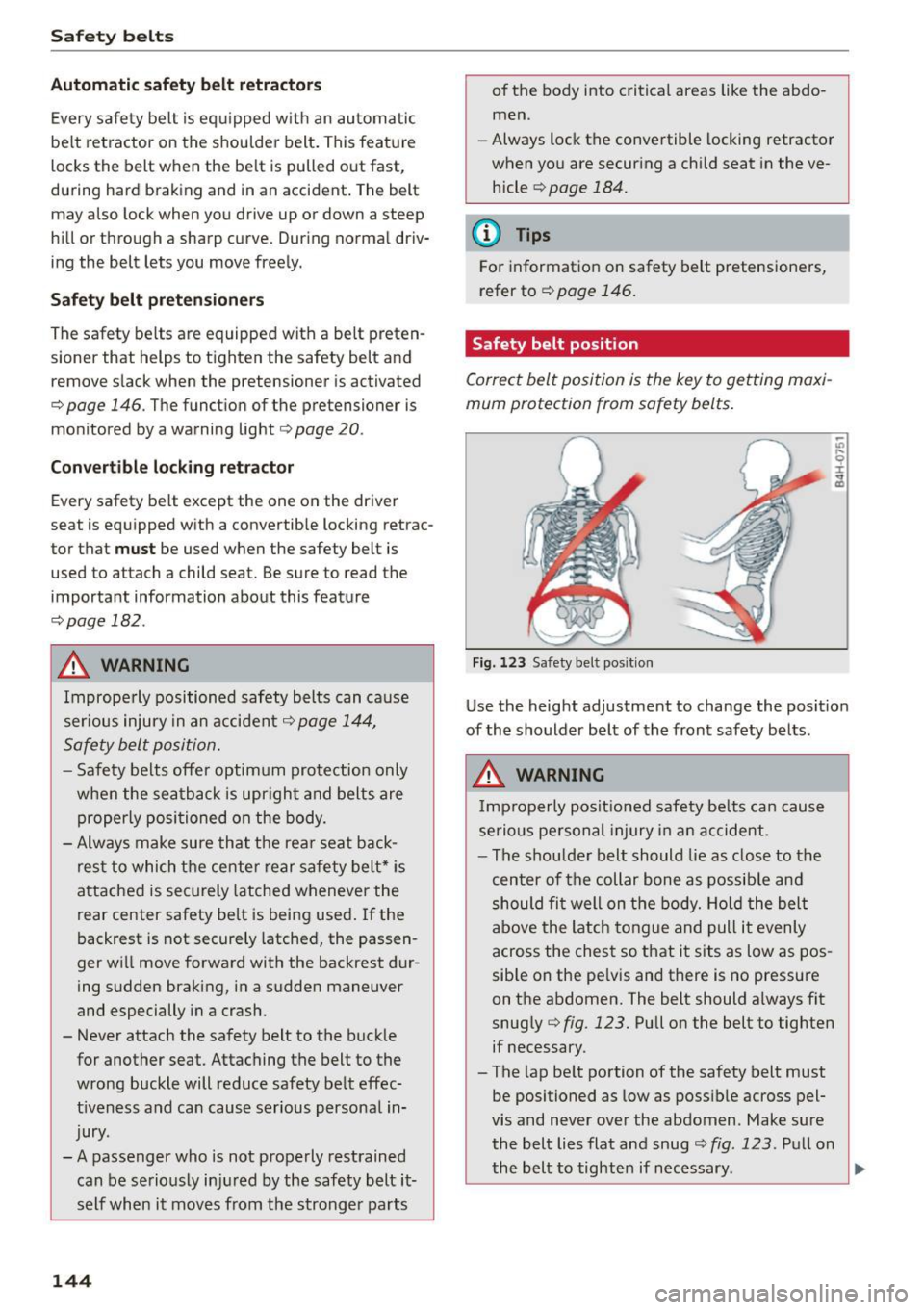
Safety belt position
Correct belt position is the key to getting maxi
mum protection from safety belts .
Fig. 123 Safety belt posit ion
Use the height adjustment to change the posit ion
of the shoulder belt of the front safety belts.
.&_ WARNING
I mp roperly posit ioned safety be lts can cause
serio us pe rsonal injury in an accident.
- The shou lder belt should lie as close to the
center of the collar bone as possib le and
should fi t well on the body. Ho ld the bel t
above the latch to ng ue and pull it evenly
across the chest so that it sits as low as pos
sible on the pe lvis and there is no pressure
on the abdomen. The belt should always fit
snug ly¢
fig. 123. Pull on the belt to tighten
if necessary.
- The lap be lt portion of the safety belt must
be positioned as low as poss ible across pel
vis and never over the abdomen. Make sure
the belt lies flat and snug
c::> fig. 123. Pu ll on
the belt to tighten if necessary.
~
Page 147 of 282
....,
N
0 > co
rl I.O
"'
"'
"'
rl
-A loose-fitting safety belt can cause serious
injuries by shifting its position on your body
from the strong bones to more vulnerable,
soft tissue and cause serious injury.
- Always read and heed all WARNINGS and
other important information ¢
page 142.
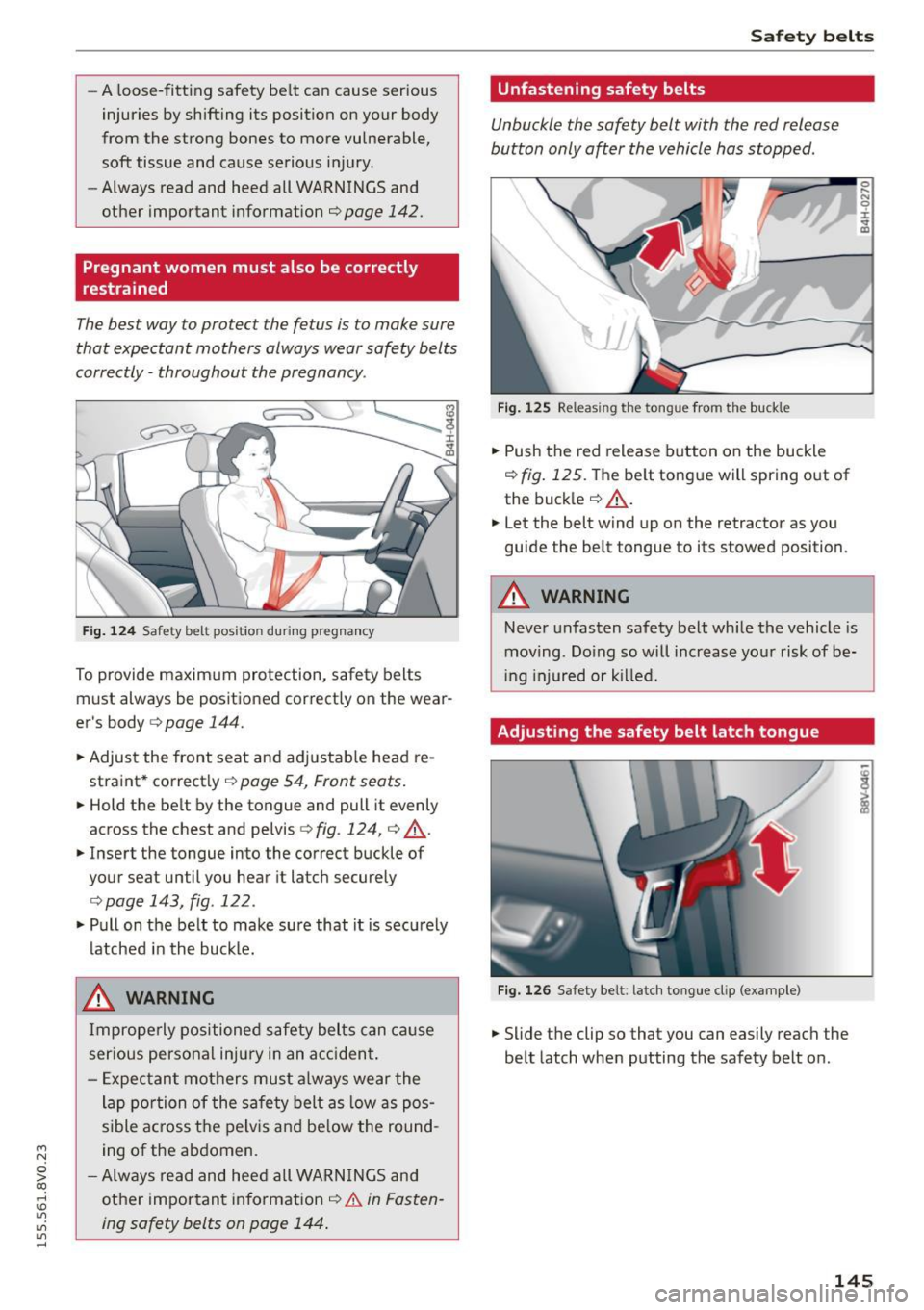
Pregnant women must also be correctly
restrained
The best way to protect the fetus is to make sure
that expectant mothers always wear safety belts
correctly -throughout the pregnancy .
Fig. 124 Safety belt position during pregnancy
To provide maximum protection, safety belts
must always be positioned correctly on the wear
er's body
c:> page 144.
• Adjust the front seat and adjustable head re
straint* correctly¢
page 54, Front seats.
• Hold the belt by the tongue and pull it evenly
across the chest and pelvis ¢
fig. 124, c:> .&_.
• Insert the tongue into the correct buckle of
your seat until you hear it latch securely
¢page 143, fig. 122 .
•Pullon the belt to make sure that it is securely
latched in the buckle.
_& WARNING
Improperly positioned safety belts can cause
serious personal injury in an accident.
- Expectant mothers must always wear the
lap portion of the safety belt as low as pos
sible across t he pelvis and below the round
ing of the abdomen .
- Always read and heed all WARNINGS and
other important information
¢ .&. in Fasten
ing safety belts on page 144.
Safety belts
Unfastening safety belts
Unbuckle the safety belt with the red release
button only a~er the vehicle has stopped .
J-L
Fig. 125 Releasing the tongue from the buckle
• Push the red release button on the buckle
¢
fig. 125. The belt tongue will spring out of
the buckle
c:> .&_ .
• Let the belt wind up on the retractor as you
guide the belt tongue to its stowed position .
_& WARNING
-Never unfasten safety belt while the vehicle is
moving. Doing so will increase your risk of be
ing injured or killed.
Adjusting the safety belt latch tongue
Fig. 126 Safety belt: la tch tongue cl ip (example)
.,.. Slide the clip so that you can easily reach the
belt latch when putting the safety belt on .
0 ..... N 0 :i:
"' CD
145
Page 148 of 282
Safety belts
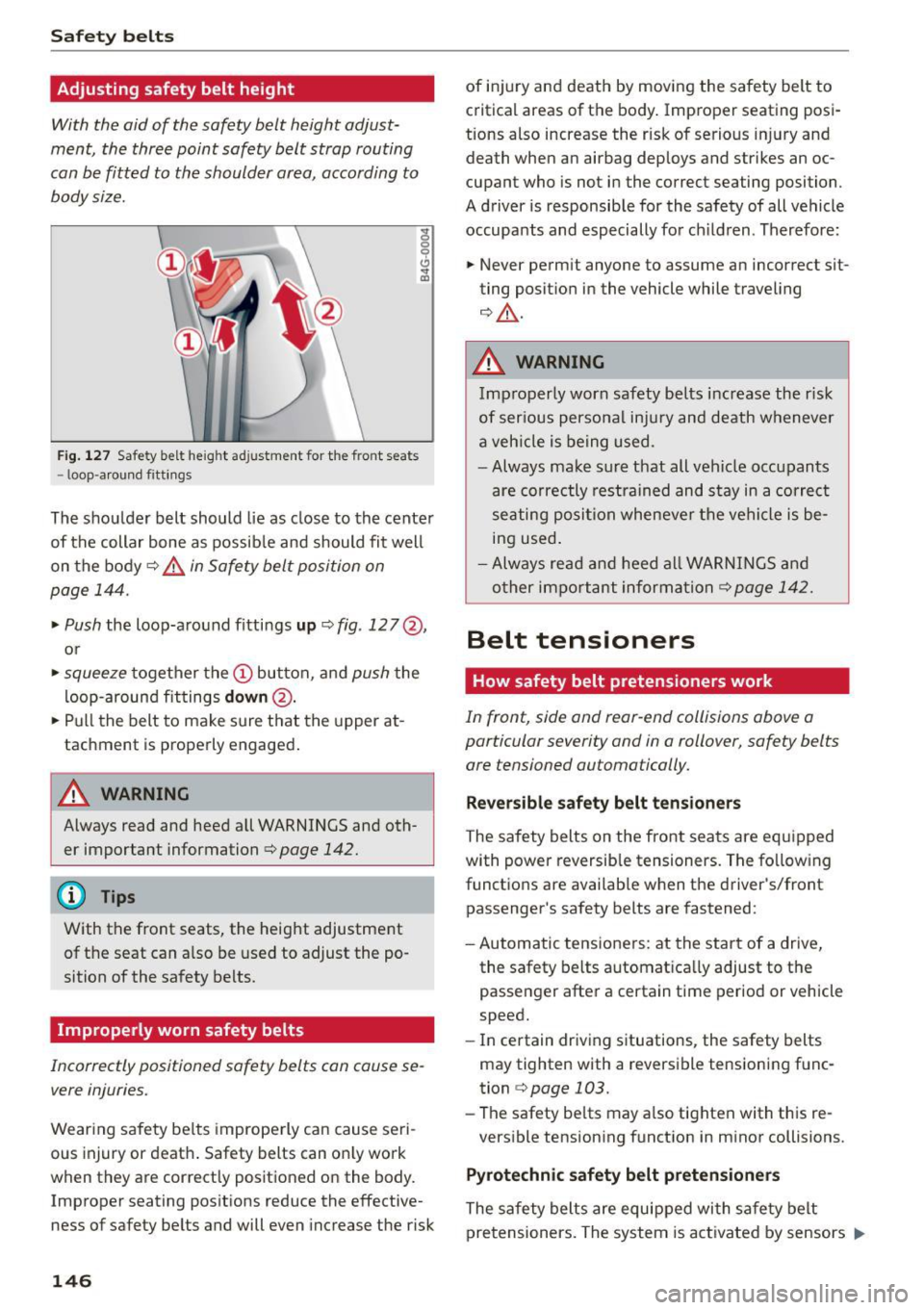
Adjusting safety belt height
With the aid of the safety belt height adjust
ment, the three point safety belt strap routing
can be fitted to the shoulder area, according to
body size.
F ig . 127 Safety belt height ad justment for t he front seats
- loop -a round f itt ings
The shou lder belt should lie as close to the center
of the collar bone as possib le and should fit well
on the body¢ .&.
in Safety belt position on
page 144 .
... Push
the loop-around fittings up ¢ fig . 127 @,
or
... squeeze together the (D button, and push the
l oop-around fit tings
down @.
... Pull the belt to make sure t hat the upper at
tachment is properly engaged .
A WARNING
Always read and heed all WARNINGS and oth
er important information
¢ page 142.
(D Tips
With the front seats, the height adjustment
of the seat can a lso be used to adjust the po
sition of the safety belts.
Improperly worn safety belts
Incorrectly positioned safety belts con cause se vere injuries.
Wearing safety be lts imprope rly can cause seri
ous injury or death . Safety belts can on ly work
when they are correctly positioned on the body.
Improper seating positions reduce the effective
ness of safety be lts and will
even i ncrease the risk
146
of injury and death by moving the safety belt to
critical areas of the body . Improper seating posi
tions also increase the risk of serious in jury and
death when an airbag deploys and strikes an oc
cupant who is not in the correct seating position.
A driver is responsible for the safety of all vehicle
occupants and especially for ch ildren . Therefore:
... Never permit anyone to assume an incorrect sit-
ting posit ion in the vehicle while traveling
¢ &_ .
A WARNING
Improperly worn safety belts increase the r isk
of serious personal inju ry and death wheneve r
a veh icle is being used.
- Always make sure that all vehi cle occupants
are correctly restrained and stay in a correct
seating position wheneve r the vehicle is be
ing used .
- Always read and heed a ll WARNINGS and
o ther important informa tion
¢ page 142.
Belt tensioners
How safety belt pretensioners work
In front, side and rear -end collisions above a
particular severity and in a rollover, safety belts are tensioned automatically.
R ev ersib le safety belt t ensione rs
The safety belts on the front seats are equipped
with power reversib le tensioners. The fo llow ing
functions are availab le when the driver's/front
passenger's safety belts are fastened:
- Automatic tensio ners: at the start of a drive,
the safety belts automat ica lly adjust to the
passenger after a certain t ime period or vehicle
speed.
- In certain driving situations, the safety belts
may tighten with a reversible tensioning func
tion
¢page 103.
-The safety belts may a lso tighten with this re-
vers ible tensioning function in minor collisions.
Pyrotechn ic safet y belt pretens ioner s
The safety belts are equipped with safety belt
pretensioners. The system is activated by sensors ..,.
Page 149 of 282
M N
0 > co ,...., \!) 1.1'1
1.1'1
1.1'1
,....,
in front, side and rear-end collisions of great se
verity and in a rollover. This tightens the belt and
takes up belt slack¢.&.
in Service and disposal of
safety bel t pretensioner on page 147.
Taking up
the slack helps to reduce forward occupant movement during a collision.
A WARNING
- It is possible for the pretensioners to deploy
incorrectly .
- The pyrotechnic system can only provide protection for one collision . If the pyrotech
nic pretensioners deploy, the pretensioning
system must be replaced.
(D Tips
The pyrotechnic safety belt pretensioners can
only deploy once .
- The safety belt pretensioners do not deploy
in minor frontal and side collisions, in rear
end collisions, in rollovers and in collisions
involving very little impact force.
-A fine dust is released when the pyrotechnic
safety belt pretensioners deploy. This is nor
mal and is not caused by a fire in the vehi
cle.
- The relevant safety requirements must be
observed when the vehicle or components
of the system are scrapped. A qualified
dealership is familiar with these regulations
and will be pleased to pass on the informa
tion to you.
- Be sure to observe all safety, environmental
and other regulations if the vehicle or indi
vidual parts of the system, particularly the
safety belt or airbag, are to be disposed. We recommend you have your authorized Audi
dealer perform this service for you.
Service and disposal of safety belt preten
sioner
The safety belt pretensioners are parts of the
safety belts on your Audi. Installing, removing,
servicing or repairing of belt pretensioners can
damage the safety belt system and prevent it
from working correctly in a collision.
Safety belts
There are some important things you have to
know to make sure that the effectiveness of the
system will not be impaired and that discarded
components do not cause injury or pollute the
environment.
A WARNING
= -
Improper care, servicing and repair proce
dures can increase the risk of personal injury
and death by preventing a safety belt preten
sioner from activating when needed or acti
vating it unexpectedly:
- The belt pretensioner system can be activat
ed only once. If belt pretensioners have
been activated, the system must be re placed.
- Never repair, adjust, or change any parts of
the safety belt system.
- Safety belt systems including safety belt
pretensioners cannot be repaired. Special
procedures are required for removal, instal
lation and disposal of this system.
- For any work on the safety belt system, we
strongly recommend that you see your au
thorized Audi dealer or qualified technician
who has an Audi approved repair manual,
training and special equipment necessary .
@ For the sake of the environment
Undeployed airbag modules and pretension
ers might be classified as Perchlorate Material
-special handling may apply, see
www.dtsc.ca.gov/hazardouswaste/perchlo
rate. When the vehicle or parts of the re
straint system including airbag modules safe
ty belts with pretensioners are scrapped, all
applicable laws and regulations must be ob
served. Your authorized Audi dealer is familiar
with these requirements and we recommend
that you have your dealer perform this service
for you.
147
Page 151 of 282
M N
0 > co ,...., \!) 1.1'1
1.1'1
1.1'1
,....,
also not inflate in side or rear co llisions, or in roll
overs .
Alwa ys rememb er: Airbag s wi ll deploy on ly once,
and on ly in cer tain kinds of collisions. Your safety
b e lts a re a lways there to offer protection in those
situations in which airbags are not supposed to
deploy, or when they have already deployed; for
examp le, when your vehicle str ikes or is struck by
another vehicle after the first collision.
This is just one of the reasons why an airbag is a
supp lementary restraint and is not a substitute
for a safety belt. The airbag system works most
effectively when used w ith the safety belts.
Therefore, always properly wear your safety belts
c::>page 140.
A WARNING
Sitting too close to the steer ing whee l o r in
strument panel will decrease the effect ive
ness of the airbags and will increase the risk
o f persona l injury in a coll is ion .
- Never sit closer than 10 inches (25 cm) to
the steering wheel or instrument panel.
- If you cannot sit more than 10 inches
(25 cm) from the steer ing whee l, investi
gate whethe r adaptive equipment may be
available to help yo u reach the peda ls and
increase your seating distance from the
steering wheel.
- All veh icle occupants and especially children
must be restrained properly whenever riding
in a vehicle. An unrestrained or improperly
restrained child cou ld be injured by striking
the inte rior or by being ejected from the ve
hicle during a sudden maneuver or impact.
An unrestrained or improperly restrained
child is also at greater risk of injury o r death
thro ugh contact wi th an infla ting airbag.
- If you are unrestrained, lean ing fo rward, sit
t ing s ideways o r ou t of position in any way,
yo ur risk of in jury is much highe r.
- You w ill also receive serio us inju ries and
c ou ld even be killed if you are up against the
airbag or too close to it when it in flates -
even with an Advanced Ai rbag .
-
Airbag syste m
- To reduce the risk of injury when an a irbag
inflates, always wear safety belts properly
c::> page 143, Safety belts.
- Always make certain that ch ildren age 12 or
younger always ride in the rear seat. If chil
dren a re not properly restrained, they may
be severe ly injured or killed when an a irbag
inflates.
- Never let ch ildren ride unrestrained or im
properly rest rained in the vehicle . Ad just the
front seats p roperly .
- Never ride with the backrest reclined.
- Always sit as far as possible from the steer-
ing wheel or the instrument panel
c::> page 131.
- Always sit upright with your back against
the backrest of your seat .
- Never p lace your feet on the instrument
panel or on the seat. Always keep both feet
on the floor in front of the seat to help pre
vent serious injur ies to the legs and hips if
the airbag inflates.
- Never recli ne the front passenger 's seat to
transport objects. Items can also move into
the area of the side airbag or the front air
b ag during bra king or in a sudden maneu
ver . Ob je cts near the airbags can become
p rojectiles and ca use inj ury when an airbag
inflates.
A WARNING
Airbags that have deployed i n a crash must be
replaced.
- Use on ly original equipment airbags ap
proved by Aud i and installed by a trained
technician who has the necessary too ls and
d iagnostic equipment to properly rep lace
any airbag in your vehicle and assure system
effectiveness in a crash.
- Never permit salvaged or recycled airbags to
be installed in you r vehicle.
Child restraints on the front seat - some
important things to know
.,. Be s ure to read the importa nt information and
heed the WARNI NGS for important detai ls
149
Page 153 of 282
M N
0 > co ,...., \!) 1.1'1
1.1'1
1.1'1
,....,
take place at lowe r decelerations as defined in
the electronic contro l unit ¢
page 160, PASSEN
GER AIR BAG OFF light.
Always remember, a chi ld seat or infant carrie r
installed on the front seat may be struck and
knocked out of position by the rapidly inflating
passenger's a irbag in a frontal collision . The air
bag could greatly reduce the effectiveness of the
child restraint and even ser iously injure the ch ild
during inflation .
For this reason, and because the back seat is the
safest place for ch ildren -when properly restrain
ed according to their age and s ize -we strongly
recommend that ch ild ren always s it in the back
seat
¢ page 172, Child safety .
A WARNING
A child in a rearward-facing child seat instal
led on the front passenger seat w ill be seri
ously in jured and can be killed if the front air
bag inflates -even with an Advanced Airbag
System.
- T he inflating a irbag w ill hit the child seat or
infant carrier w ith great force and will
smash the child seat and child against the
backrest, center armrest, door or roof.
-
- Always install rear -facing child seats on the
rear seat.
- If you mus t install a rearward facing child
seat on the front passenger seat beca use of
exceptional circ umstances and the
PASSEN ·
GER AIR BAG OFF
light does not come on
and stay on, immediately install the rear
facing child seat in a rear seating position
and have the a irbag system inspected by
yo ur Audi dealer.
- Forward-fac ing ch ild seats installed on the
front passenger's seat may interfere with
the deployment of the airbag and cause se rious persona l injury to t he ch ild.
A WARNING
If, in exceptional c ircumstances, you mus t in
stall a forward-facing ch ild restraint on the
front passenger's seat :
- Always make sure the forward-fac ing seat
h as been designed and ce rtified by i ts man-
Airbag syste m
ufacturer for use on a front seat with a pas
senger front and s ide a irbag.
- Never put t he fo rward-facing child restraint
up aga inst or very near the instrument pan
el.
- Always move the passenge r seat into its
rearmost pos ition in the seat's fore and aft
ad justment range, as far away from the a ir
bag as possible before installing the for
ward-facing child restraint. The backrest
m ust be adjusted to an upr ight position .
- Make sure that the
PASSENGER AIR BAG
OFF
li ght comes on and stays on all the time
wheneve r the ignit ion is switched on.
A WARNING
= -To reduce the risk of serious inju ry, ma ke su re
that t he
PASSENGER AIR BAG OFF ligh t will
b e d isplayed whenever a ch ild restr aint is in
stalled on the front passenger seat and the
ignition is switched on.
- If the PASSENGER AIR BAG OFF light does
not stay on, pe rform the checks describe d
~ page 160, Monitoring the Advanced Air ·
bag System.
-Take the chi ld restraint off the front passen
ge r seat and install it properly at one of the
rea r seat positions if the
PASSENGER AIR
BAG OFF
light does not stay on.
- Have the airbag system inspected by your
Aud i dealer immediately.
- Always carefu lly follow instr uctions from
child restraint manufacturers when instal
ling child restraints.
A WARNING
If, in except ional circumstances, you m ust in
stall a forward or rearward-fac ing ch ild re
straint on the front passenger's seat:
- Improper installation of ch ild restra ints can
red uce their effectiveness or even prevent
them from providing any pro tect ion.
- An improperly installed ch ild restra int can
interfere with the airbag as it deploys and
serio usly injure or even kill the child -even
with an Advanced A irbag Sys tem.
~
151