pressure AUDI S3 SEDAN 2018 User Guide
[x] Cancel search | Manufacturer: AUDI, Model Year: 2018, Model line: S3 SEDAN, Model: AUDI S3 SEDAN 2018Pages: 404, PDF Size: 62.3 MB
Page 251 of 404
u. 00 .-< N l' N .-< 0 N > 00
Driving safety
Basics
Safe driving habits
Please remember -safety first!
The individual safety features of your vehicle can
work together as a system to help protect you
and your passengers in a wide range of accidents.
These features cannot work as a system if they
are not always correctly adjusted and correctly
used .
This chapter contains important informat ion,
tips, instructions and warnings that you need to
read and observe for your own safety, the safety
of your passengers and others . We have summar
iz ed here what you need to know about safety
belts, airbags, child restraints as well as child
safety. Your safety is for us
priority number 1. Al
ways observe the information and warnings in
this section -for your own safety as well as that
of your passengers.
The informa tion in t his section applies to all
model versions of your vehicle. Some of the fea
tures described in this sections may be standard
eq uip ment on some models, or may be optional
equ ipment on others. If you are not sure, ask
your author ized Audi dealer.
A WARNING
-Always make sure that you follow the in
struct ions and heed the WARNINGS in this
Manual. It is in your interest and in the in
terest of your passengers .
-
-Always keep the complete Owner's Litera
ture in your Audi when you lend or sell yo ur
vehicle so that this important information
w ill always be available to the driver and
passengers.
-Always keep the Owner's literature handy so
that you can find it easily if you have ques
tions .
Driving safety
Important things to do before driving
Safety is everybody 's job ! Vehicle and occupant
safety always depends on the informed and care
ful driver .
For your safety and the safety of your passen
gers,
before driving always:
.. Make sure that a ll lights and signals are operat
ing correctly.
.. Make sure tha t the tire pressure is correct .
.. Make sure that all w indows are clean and afford
good vis ibility to the outs ide.
.. Secure all luggage and othe r items ca refully
c::> page 63, c::> page 63 .
.. Make sure that nothing can interfere with the
peda ls .
.. Adjust front seat, head restraint and mirrors
correct ly for your height.
.. Instruct passengers to adjust the head re
straints according to their height.
.. Make sure to use the right child restraint cor
rectly to protect children
c::> page 294, Child
safety .
.. Sit properly in your seat and make sure t hat
your passengers do the same
c::> page 59, Front
seats .
.. Fasten your safety belt and wear it properly. Al
so instruct your passengers to fasten their safe
ty belts properly
c::> page 260.
What impairs driving safety?
Safe driving is directly related to the condition of
the vehicle , the driver as well as the driver 's abili
ty to concentrate on the road without being dis
tracted.
The driver is responsible for the safety of the ve
hicle and a ll of its occupants. If your ability to
drive is impa ired, safety risks for everybody in the
vehicle increase and you a lso become a hazard to
everyone else on the road
c::> &_ . Therefore:
.. Do not let yourse lf be distracted by passengers
or by using a cellular telephone .
.. NEVER drive when your driving abi lity is im
pa ired (by med ications, alcohol, drugs, etc .) .
.. Observe all traffic laws, rules of the road and
speed lim its and plain common sense .
.,.
249
Page 258 of 404
Drivin g saf ety
- After closing the rear lid, a lways make sure
that it is properly closed and locked.
- Never leave yo ur vehicle unattended espe
c ia lly w ith the rear lid left open. A ch ild
could crawl into the ve hicle through the lug
gage compartment and close the rear lid be
coming trapped and unable to get out . Be
ing t rapped in a veh icle can lead to se rious
persona l injury.
- Never let children play in or around the veh i
cle .
- Never let passengers ride in the luggage
compartment. Ve hicle occupants m ust al
ways be prope rly rest ra ined in one of the ve
hicle's seating posi tions.
(D Tips
- A ir c irculat io n helps to reduce window fog
g ing . Stale air escapes to the outside
th rough vents i n the t rim panel. Be s ure to
k eep these slots free and open.
- The t ire pressu re must correspond to the
l oad. The tire p ressure is shown on the tire
p ressure labe l. Th e tire pressu re labe l is lo
ca ted on t he driver 's s ide B-p illar. The tir e
p ressure labe l lists the recommended cold
tire inflation pressures for the vehicle at its max imum capacity weig ht and the t ires t hat
were on your vehicle at the t ime it was man
ufactured. For recommended tire pressures
for normal load cond itions, please see chap
ter
¢ page 341.
Tie-downs
The luggage compartment is equipped with four
tie -downs to secure luggage and other items .
Use the tie-downs to secure your cargo proper ly
¢ page 255, Loading the luggage compartment.
In a col lision, the laws of p hysics mean that even
sma ller items that are loose in the vehicle will
become heavy missiles that can cause ser ious in
jury. Items in t he ve hicle possess energy which
vary with vehicle speed and the weight of the item . Veh icle speed is the most s ignificant factor .
For examp le, in a frontal collision at a speed of
30 mph (48 km/h), the forces act ing o n a 10-lb
256
(4.5 kg) object are about 20 times the normal
weight of the item . This means that the weight
of the item would s udden ly be about
200 lbs. (90 kg). You can imag ine the in juries
that a 200 lbs. (90 kg) item flying freely through
the passenger compartment could cause in a col
l is ion like t his.
A WARNING
Weak, damaged or imp roper straps used to
secure items to tie-downs can fa il dur ing hard
b raking or in a coll is ion and cause ser io us pe r
sona l injury .
- Always use s uitable mo unt ing st raps and
p roper ly sec ure i tems to the t ie -downs in
the l uggage compa rtment to help preven t
items from shifting or flying forward as dan
ge rous missi les .
- W hen the rear seat backrest is fo lded down,
a lways use s uitable mo unting straps and
properly sec ure items to the tie-downs in
the luggage compartment to help prevent items from flying forward as dangerous
m iss iles into the passenger compartment.
- Never attach a child safety seat tether strap
to a t ie-down.
-
Page 267 of 404
LL co ..... N
" N ..... 0 N > co
Safety belt position
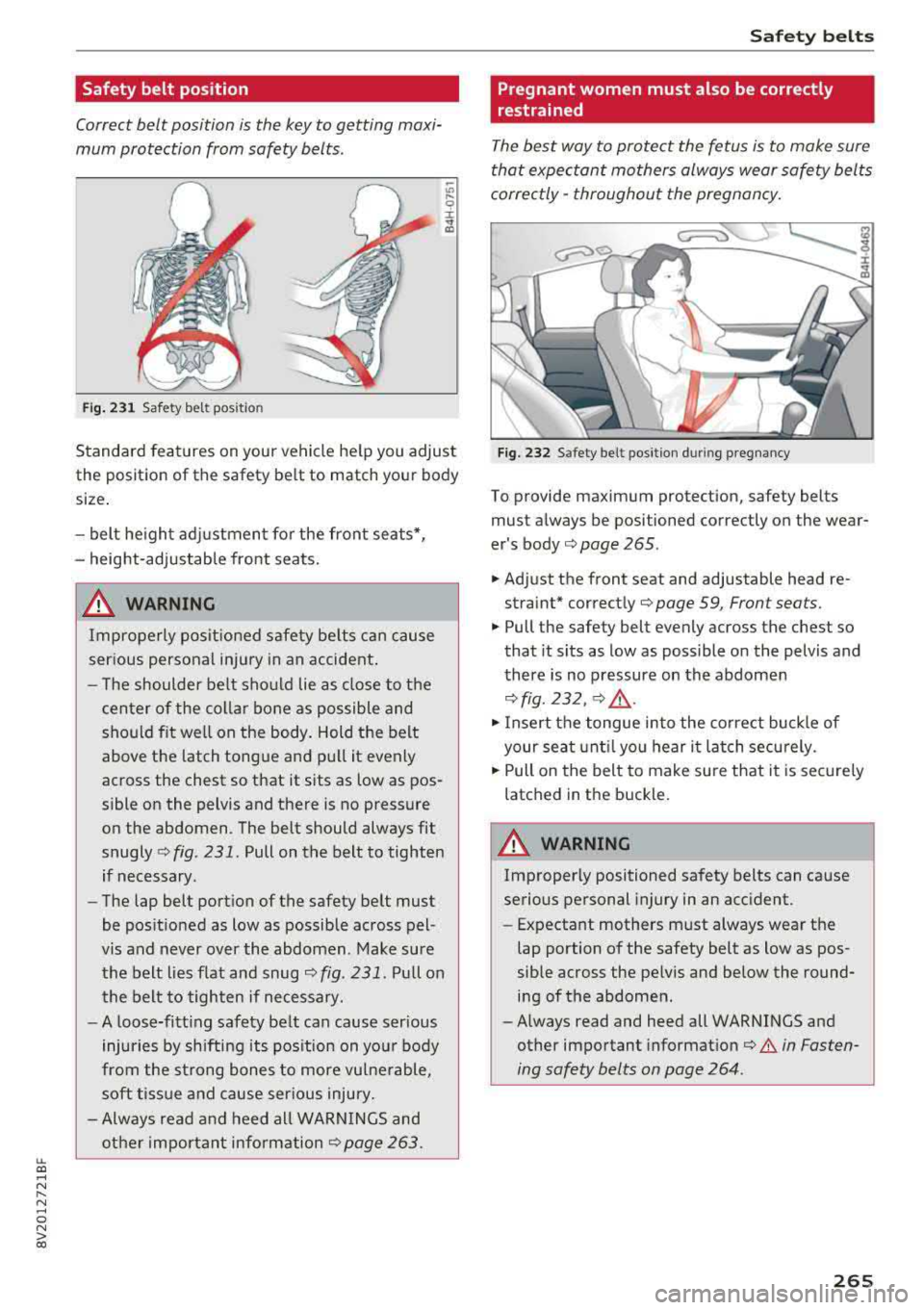
Correct belt position is the key to getting maxi
mum protection from safety belts .
~
"' ,-.
9 r
Fig. 231 Safety belt pos it ion
"' a,
Standard feat ures on your vehicle he lp you adjust
the position of the safety be lt to match your body
size .
- belt he igh t adjustmen t fo r the front seats *,
- height-adjustable front seats.
.8, WARNING
Improperly posit ioned safety be lts ca n ca use
ser ious personal inj ury in an accident .
- T he shoulder belt sho uld lie as close to the
center of the co llar bone as possible and
should fit we ll on the body. Hold the belt
above the latch tong ue a nd pu ll it evenly
across the chest so that it sits as low as pos
sible on the pelvis and there is no press ure
on the abdomen . The belt should always fit
snugly
Q fig. 231. Pull on the belt to tighten
if necessary.
- The lap belt portion of the safety be lt must
be pos itioned as low as possible across pel
vis and never over the abdomen. Make sure
the belt lies flat and snug
Q fig . 231 . Pull on
th e belt to tighten if necessary.
- A loose-fitt ing safety be lt can cause ser ious
injuries by shifting its pos ition on you r body
fr om the st rong bones to more vu lne rable,
soft tiss ue a nd c ause ser ious injury.
- Always read and heed all WA RN INGS and
other importa nt inform ation¢
page 263.
Safet y bel ts
Pregnant women must also be correctly
restrained
The best way to protect the fetus is to make sure
that expectant mothers always wear safety bel ts
correctly
-throughout the pregnancy.
F ig . 2 32 Safe ty bel t pos ition durin g pregnancy
To provide maximum protect ion, safety belts
must always be positioned correctly on the wear
er's
body ¢ page 265 .
.. Adjust the front seat and adjustable head re
straint*
correctly¢ page 59, Front seats .
.,. Pull the safety belt evenly across the chest so
that it s its as low as possible on the pelvis and
there is no pressure on the abdomen
¢ fig. 232, Q .&, .
.,. Insert the tongue into the co rrect buckle of
your se at unt il yo u h ear i t latch secu rely.
.. Pull on the belt to make sure that i t is sec urely
latched in the buckle.
_& WARNING
Improperly positioned safety belts can ca use
serious pe rsonal injury in an acc ident.
-Expectant mothers m ust always wea r th e
lap portion of the safety belt as low as pos
sible across the pelvis and below the round
ing of the abdomen.
- Always read and heed all WARNINGS and
other important
i nformation¢ .&. in Fasten
ing safety belts on page 264.
265
Page 292 of 404
Airbag system
-Damage to the original seat covers or to
the seam in the area of the side airbag module must always be repaired immedi
ately by an authorized Audi dealer .
- Objects between you and the airbag can in
crease the risk of injury in an accident by in
terfering with the way the airbag unfolds or by being pushed into you as the a irbag in
flates.
- Never place or attach accessories or other
objects (such as cup holders, telephone
brackets, or even large, bulky objects) on
the doors, over or near the area marked
"AIRBAG" on the seat backrests .
- Such objects and accessories can become
dangerous projectiles and cause injury
when the supplemental s ide airbag de
ploys.
- Never carry any objects or pets in the de
ployment space between them and the
airbags or allow chi ldren or other passen
gers to travel in this posit ion.
- Always use the built-in coat hooks only for
lightweight clothing . Never leave any heavy
or sharp-edged objects in the pockets that
may interfere with side airbag deployment
and can cause personal injury in an accident .
- Always prevent the side airbags from being
damaged by heavy objects knocking against
or hitting the sides of the seatbacks.
- T he airbag system can only be triggered
once .
If the airbag has been triggered, the
system must be replaced by an authorized
Audi dealership.
- Damage (cracks, deep scratches etc.) to the
original seat covers or to the seam in the
area of the side airbag modu le must always
be repaired immediately by an authorized
Audi dealer.
-If children are seated improper ly, their risk
of injury increases in the case of an acc ident
¢ page 2 94, Child safety.
-Never attempt to modify any components of
the a irbag system in any way.
-In a side collision, side airbags w ill not func
t ion properly if sensors cannot correctly
measure increasing air pressure inside the
290
doors when air escapes through larger, un
closed openings in the door panel.
- Never drive with inte rior door trim panels
r emoved.
- Never dr ive when parts have been re
moved from the inside door panel and the
openings they leave have not been proper
l y closed.
- Never drive when loudspeakers in the
doors have been removed unless the
speaker holes have been properly closed.
- Always make certain that openings are
cove red or filled if additional speakers or
other equipment is installed in the inside
door panels .
- Always have work on the doors done by an
authorized Aud i dealer or qualified work
shop .
Side curtain airbags
Description of side curtain airbags
Applies to: vehicles with side curtain airbags
The side curtain airbag sys tem can provide sup
plemental protection to properly restrained oc
cupants .
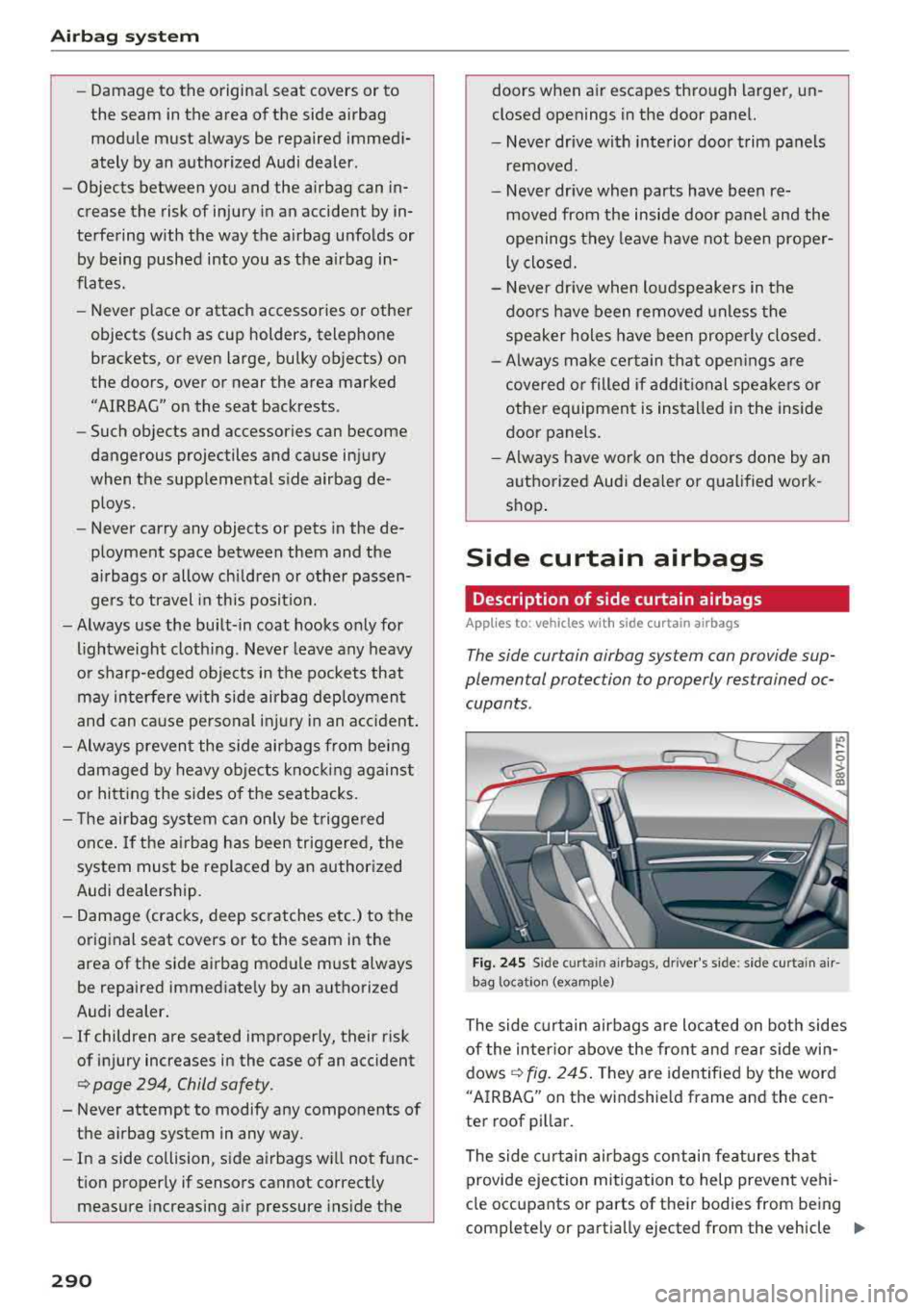
Fig. 24S Sid e curt ain air b ags , driver's s ide: s ide curt ain air
bag location (example)
The side curtain airbags are located on both sides
of the inter ior above the front and rear side win
dows ¢
fig. 245. They are identified by the word
"A IRBAG" on the windshie ld frame and the cen
ter roof pillar.
The side curtain airbags contain features that
provide ejection mitigation to help prevent vehi-
cle occupants or parts of their bodies from being completely or partia lly ejected from the vehicle
II>
Page 328 of 404
Checking and Filling
Coolan t loss usu ally indicates there is a leak. Im
m ed iately drive your v ehicle to an authorized
Aud i dea ler or authorized Aud i Serv ice Facility
and have the cooling system inspected. If the
coo ling system is not leaking, a loss can come
from the coolant boiling through overheating
and be ing pushed out of the cool ing system.
.&_ WARNING
- The coo ling system is under pressure . Do
not open the coolant expans ion tank cap
when the eng ine is ho t. This inc reases the
risk of burns .
- T he coo lant add itive and the coolant can be
d angerous to your healt h. For this reason,
keep the coolant in the origina l container
and away from children . There is a risk of
poisoning .
- When working in the engine compartment,
remember that the rad iator fan can switch
on even if the ign ition is switched off, which
increases the risk of in jury .
-
CD Note
Do not add coolant if the expansion tank is
empty . Air could enter the cooling system and
damage the engine. If this is the case , do not
cont inue driving. See an authorized Audi deal
er or author ized Audi Service Facility for assis
tance .
Brake fluid
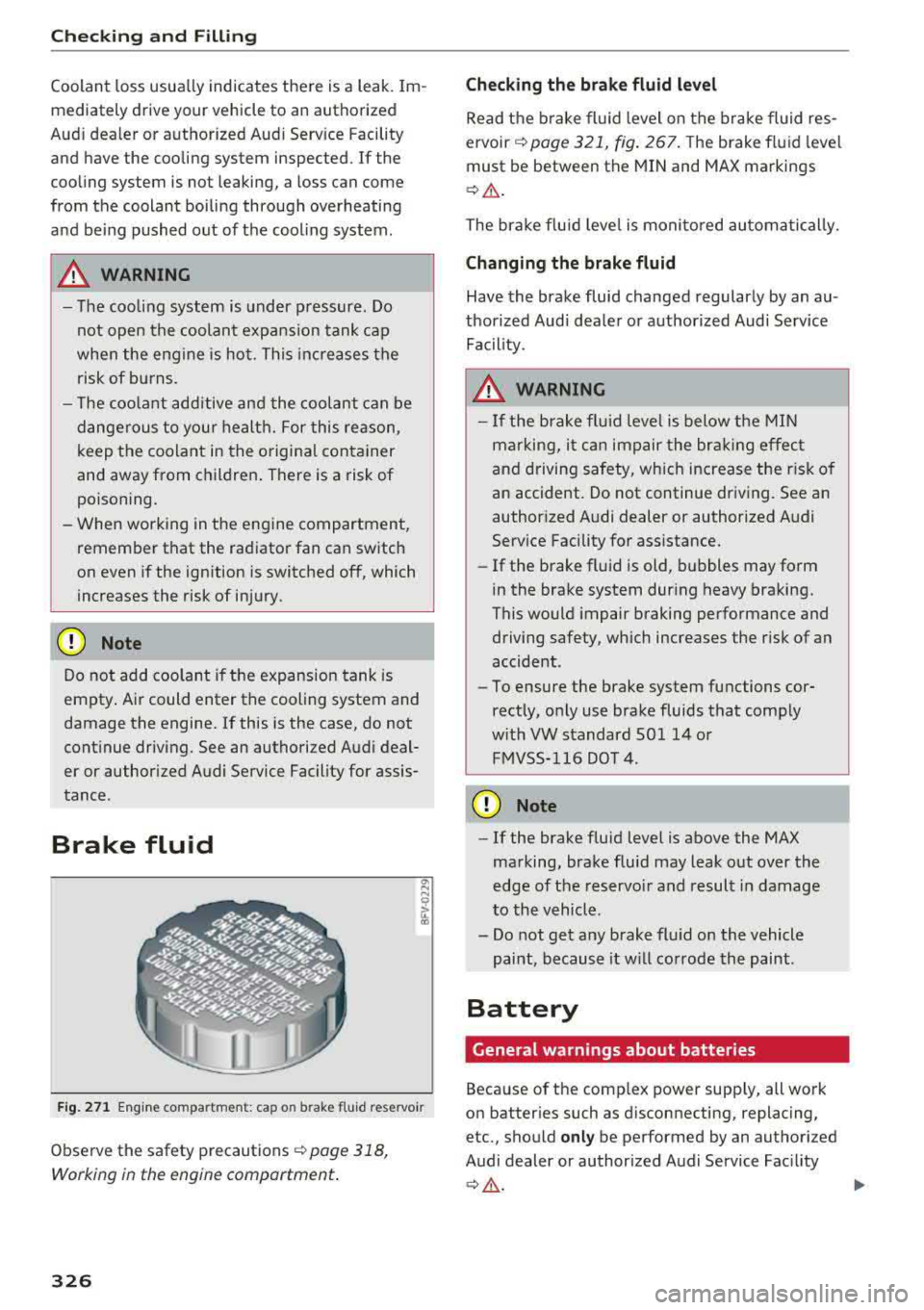
Fig. 271 Eng in e co mpar tment : cap on b rake flu id r eservo ir
O bserve the safety precautions ¢ page 318,
Working in the engine compartment .
326
Checking the brake fluid level
Read the b rake fluid level on the br ake fluid res
ervoir ¢ page 321, fig . 267. The brake f lu id leve l
must be between the MIN and MAX markings
¢ ,& .
The brake f lu id leve l is monito red automa tically .
Changing the brake fluid
Have the brake fluid changed regularly by an au
thorized Aud i dea ler or authorized Audi Service
Facility.
.&_ WARNING
- I f the b rake fl uid leve l is below the MIN
marking, i t can impair the bra king effec t
and driving safety, wh ich increase the r isk o f
an accident. Do not continue driving . See an
authorized A udi dealer or authorized A udi
Serv ice Facility fo r ass istance.
- If the brake fl uid is old, b ubbles may form
in the brake system dur ing heavy braking.
This would impair braking performance and
driving safety, which increases the risk of an
accident .
- To ensure the brake system functions cor
rectly, only use brake fluids that comp ly
w ith VW standard S0 l 14 or
FMVSS- 116 DOT 4 .
CD Note
-If the brake f luid level is above the MAX
marking, brake fluid may leak o ut over the
edge of the reservoi r and result in damage
to the vehicle .
- Do not ge t any brake fl uid on the vehicle
pai nt, b ecause it w ill co rrode the paint .
Battery
General warnings about batteries
Because of t he comp lex power supp ly, all work
on batter ies such as d isconnecting, replacing ,
etc., shou ld
only be pe rformed by an authori zed
Audi dealer or authorized A udi Service Fac ility
¢ _& . ~
Page 334 of 404
Wheel s
0 US DOT number (TIN) and
manufacture date
T he manufacture date is listed on
the tire sidewall (it may only ap
pear on the inner side of the tire) :
DOT ... 2217 ...
means, for example, that the tire
was produced in the 22nd week of
the year 2017.
@ Audi Original Tires
Audi Original equipment tires
with the designation
"AO" have
been specially matched to your
Audi. When used correctly, these
tires meet the highest standards
for safety and handling. An au
thorized Audi dealer or author
ized Audi Service Facility will be
able to provide you with more in
formation.
® Mud and snow capability
"M/5" or "M+S" indicates the tire
is suitable for driving on mud and
snow.
& indicates a winter tire.
@ Composition of the tire cord
and materials
T he number of plies indicates the
number of rubberized fabric lay
ers in the tire . In general: the
more layers, the more weight a
tire can carry. Tire manufacturers
332
must also specify the materials
used in the tire. These include
steel, nylon, polyester and other materials.
@ Maximum permitted load
This number indicates the maxi
mum load in kilograms and
pounds that the tire can carry.
@ Uniform t ire quality grade
standards for treadwear ,
traction and temperature resistance
Treadwear, traction and tempera
ture ranges
q page 347 .
@ Running d ir e ction
The arrows indicate the running
direction of unidirectional tires.
You must always follow the speci
fied running direction
q page 368 .
@ Maximum permitted
inflation pressu re
This number indicates the maxi
mum pressure to which a tire can
be inflated under normal operat
ing condit ions.
Page 335 of 404
u. a, ... N
" N ... 0 N > a:,
Glossary of tire and loading
terminology
Accessory weight
means the combined weight ( in
excess of those standard items
which may be replaced) of auto matic transmission , power steer
ing, power brakes, power win
dows, power seats, radio, and
heater, to the extent that these
items a re available as factory- in
stalled equipment (whether i n
stalled or not) .
Aspect ratio
means the ratio of the height to
the width of the tire in percent .
Numbers of 55 or lower indicate a
low s idewall for improved steer
ing response and better overall
handling on dry pavement.
Bead
means the part of the tire that is
made of steel wires, wrapped or
reinforced by ply cords and that is
shaped to fit the rim .
Bead separation
means a breakdown of the bond
between components in the bead .
Wheel s
Cord
means the strands forming the
plies in the tire .
Cold tire inflation pressure
means the tire pressure recom
mended by the vehicle manufac
turer for a tire of a designated
size that has not been driven for
more than a couple of miles (kilo
meters) at low speeds in the
three hour period before the tire pressure is measured or adjusted .
Curb weight
means the weight of a motor ve
hicle with standard equipment in
cluding the maximum capacity of
fuel, oil , and coolant, air condi
tioning and additional weight of
optional eq uipm ent .
Extra load tire
means a tire designed to operate
at higher loads and at highe r in
flation pressures than the corre
sponding standard tire . Extra load
tires may be identified as "X L",
"xl", "EXTRA LOAD", or "RF" on
the sidewall.
.,.
333
Page 336 of 404
Wheel s
Gross Axle Weight Rating
("GAWR ")
means the load -carrying capacity
of a single axle system, measured
at the tire -ground interfaces.
Gross Vehicle Weight Rating
(" GVWR ")
means the maximum total loaded
weight of the vehicle .
Groove
means the space between two ad
jacent tread ribs .
Load rating (code )
means the maximum load that a
tire is rated to carry for a given in
flation pressure. You may not find
this information on all tires be
cause it is not required by law .
Max imum load rating
means the load rating for a tire at
the maximum permissible infla
tion pressure for that tire.
Ma ximum loaded vehicle
weight
means the sum of:
(a) Curb weight
(b) Accessory weight
(c) Vehicle capacity weight, and
(d) Production options weight
33 4
Maximum (permissible)
inflation pressu re
means the maximum cold infla
tion pressure to which a t ire may
be inflated. A lso called "maxi
mum inflat ion pressure."
Normal occupant weight
means 150 lbs. (68 kilograms)
times the number of occupants seated in the vehicle up to the to
tal seating capacity of your vehi
cle.
Occupant distribution
means distribution of occupants
in a vehicle.
Outer diameter
means the overall diameter of an
inflated new tire.
Overall width
means the linear distance be
tween the exteriors o f the side
walls of an inflated tire , includ ing
elevations due to labeling, deco rations, or protective bands or
ribs .
Ply
means a layer of rubber-coated
parallel cords .
Page 337 of 404
u. a, ... N
" N ... 0 N > a:,
Production options weight
means the combined weight of
those installed regular production
options weighing over 5 lbs.
(2.3 kg) in excess of those stand
ard items which they replace, not
previously considered in curb
weight or accessory we ight, in
c luding heavy duty brakes, ride
levelers, roof rack, heavy duty
battery, and special trim .
Radial ply tire
means a pneumatic tire in which
the ply cords that extend to the beads are laid at substantially
90 degrees to the centerline of
the tread.
Recommended inflation
pressure
see ¢ page 333, Cold tire infla
tion pressure .
Reinforced tire
means a tire designed to operate
at higher loads and at h igher in
flat ion pressures than the corre
sponding standard tire. Rein
forced t ires may be identified as
"XL " "xl" "EXT RA LOA D" or "RF" , , ,
on the sidewall.
Wheels
Rim
means a metal support for a tire
or a tire and tube assembly upon
which the tire beads are seated .
Rim diameter
means nominal diameter of the
bead seat. If you change your
whee l size, you will have to pur
chase new tires to match the new
rim diameter .
Rim size designation
means rim diameter and width .
Rim width
means nominal distance between
rim flanges .
Sidewall
means that portion of a ti re be
tween the tread and bead.
Speed rating (letter code)
means the speed at which a tire is
designed to be driven for extend
ed periods of time . The rat ings
range from
93 mph (150 km/h)
to
186 mph (298 km/h) ¢ table
on page 331.
You may no t find
this info rmat ion on all tires be
cause it is not required by law.
T he speed rating letter code,
where applicable, is molded on
the tire sidewall and indicates t he
11>
335
Page 338 of 404
Wheels
maximum permissible road
speeds . See also ¢
A in General
information on page 330 .
Tire pressure monitoring
system *
means a system that detects
when one or more of a vehicle's
tires are underinflated and illumi
nates a low tire pressure warning
telltale .
Tread
means that portion of a tire that
comes into co ntact with the road.
Tread separat ion
means pulling away of the tread
from the tire carcass.
Treadwear indicators (TWI)
means the projections within the
pr incipal grooves designed to g ive
a vis ual indication of the degrees
of wear of the tread . See
¢ page 339, Treadwear indicator
for more information on measu r
ing tire wear.
Uniform Tire Quality Grading
is a tire information system devel
oped by the United States Nat ion
a l Highway Traffic Safety Admin
istration ( NHTSA) tha t is designed
to he lp buyers make relative com-
33 6
parisons among tires . The UTQG
is not a safety rat ing and not a
guarantee that a tire will last for
a prescribed number of miles (kilo meters) or perform in acer
t ain way . It simply g ives tire buy
ers add itiona l information to
combine with other considera
tions , such as price, brand loyalty
and dealer recommendations. U n
de r UT QG, tires a re graded by the
tire manufacturers in three areas: treadwear, tract ion, and tempera
ture res istance. The UTQG info r
mation on the tires , molded into
the si dewalls .
U.S. DOT Tire Identification
Number (TIN)
This is the tire's "serial number".
It beg ins with the letters
"DO T"
and indicates that the tire meets
all federal s tandards. The next
two numbers or le tters indicate
the plant whe re it was ma nufac
tured, and t he last four num bers
represent the week and year of
manufacture. Fo r example,
DOT ... 2217 .. .
means that the tire was produced
in the 22nd week o f 2017. The
other numbers are ma rketing co
des that may or may not be used
~