ECU AUDI S3 SEDAN 2018 Owner's Manual
[x] Cancel search | Manufacturer: AUDI, Model Year: 2018, Model line: S3 SEDAN, Model: AUDI S3 SEDAN 2018Pages: 404, PDF Size: 62.3 MB
Page 92 of 404
Driving
Drive to an authorized Audi dealer or authorized
Audi Service Facility immediately to have the
malfunct ion corrected .
[i1 Transmission: malfunction! You can contin
ue driving with limited function. No reverse
gear
There is a system malfunction in the transm is
sion. The transmission is switching to emergency
mode. This mode only shifts into certain gears or
will no longer shift at all. The engine may stall.
You cannot engage the reverse gear. Drive to an
authorized Audi dealer or author ized Audi Service
Facility immediately to have the malfunction cor
rected .
[i1 Transmission: malfunction! You can contin
ue driving in
D until engine is off
Drive the vehicle away from movi ng traffic and
park. See an authorized Audi dealer or authorized
Aud i Serv ice Facility for assistance.
[i1 Transmission: too hot . Please adapt driving
style
The transmission tempe rature has increased s ig
n ificant ly. Dr ive very cautiously or take a break
from driving unt il the temperature returns to the
normal range and the indicator light turns off.
[O] Transmis sion: please press brake pedal and
select gear again
If the transmission malfu nctions because the
temperature is too high, a message appears
when the transmission is cooled .
90
Selector lever emergency release
Applies to : vehicles wi th automatic transmissions
If the vehicle's power supply fails, the selector
lever can be released in an emergency .
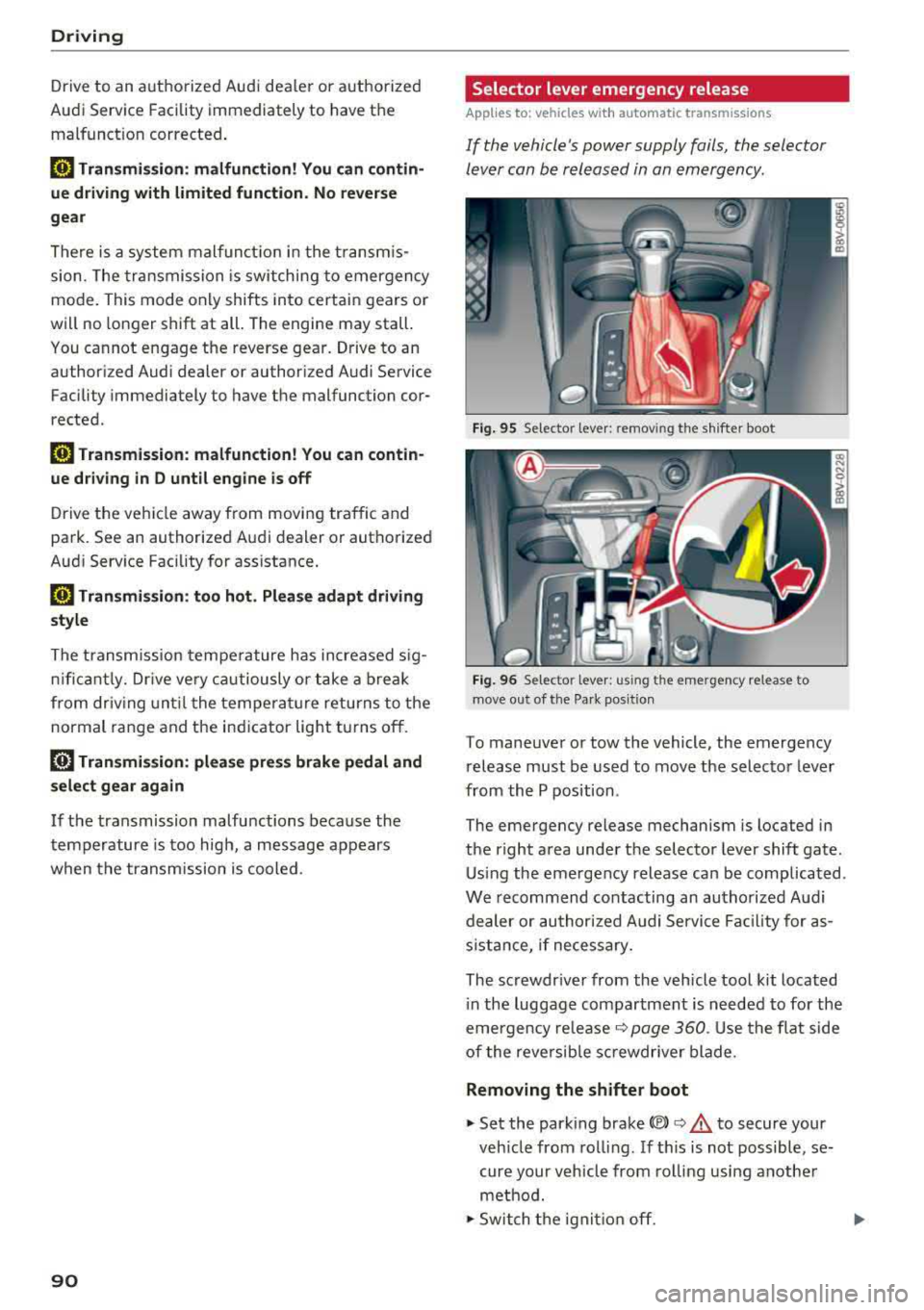
Fig. 95 Selector leve r: remov ing the shifter boot
Fig. 96 Selector lever: using the emergency release to
move out of the Pa rk posit ion
To maneuver or tow the vehicle, the emergency
release must be used to move the selector lever
from the P position .
The emergency release mechanism is located in
the right area under the selector lever shift gate .
Using the emergency release can be complicated .
We recommend contacting an authorized Audi
dealer or authorized Aud i Service Facility for as
s is tance, if necessary.
The screwdr iver from the vehicle tool kit located
i n the luggage compartment is needed to for the
emergency re lease
c::> page 360 . Use the flat side
of the reversible screwdriver blade.
Removing the shifter boot
.,. Set the park ing brake(®) ¢.& to secure your
veh icle from rolling. If this is not possible, se
cure your vehicle from rolling using another
method .
.,. Switch the ignit ion off.
Page 93 of 404
u. 00 ... N l' N ... 0 N > 00
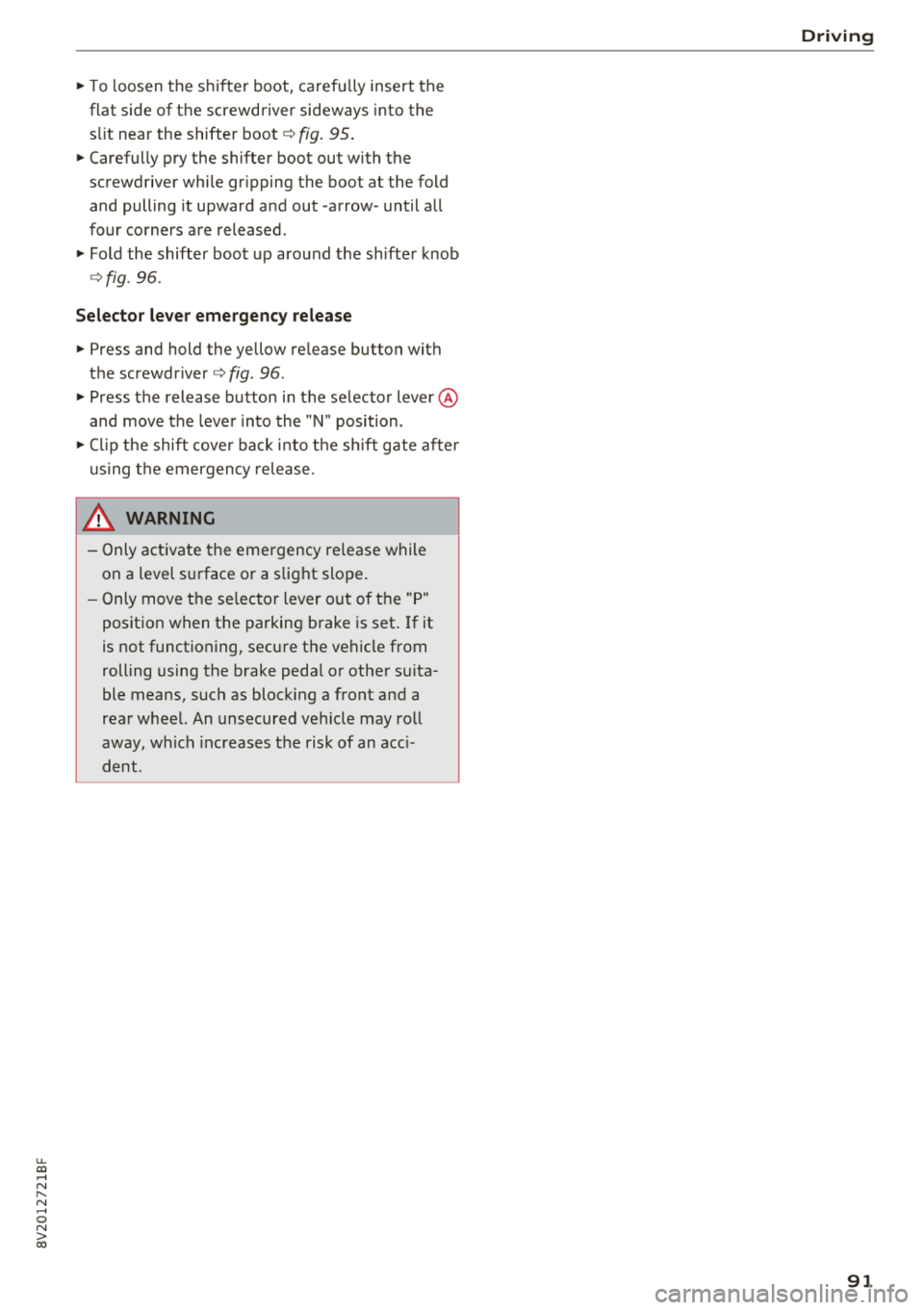
~ To loosen the s hifter boot, carefu lly insert the
flat side of the screwdriver sideways into the s li t near the shifter
boot ¢ fig. 95 .
~ Carefully pry the shifter boot out with the
screwdriver while gr ipping the boot at the fold
and pulling it upward and out -arrow -until all
four corners are released .
~ Fold the shifter boot up aro und the shifte r knob
¢ fig. 96.
Selector le ver eme rgenc y release
~ Press and hold the yellow re lease button with
the
screwdriver ¢ fig. 96 .
~ Press the release button in the selector lever @
and move the leve r into the "N" position .
~ Clip the shift cover back i nto t he shift gate after
us ing t he emergency release .
A WARNING
-Only activate the emergency re lease while
on a level s urface or a slight slope.
-Only move the se lec tor lever out of the "P"
position when the parking brake is set . If it
is not functioning, sec ure t he vehicle from
rolling using the brake peda l or other su ita
ble means, such as block ing a front and a
rear wheel. An unsecured ve hicle may ro ll
away, wh ich increases the risk of an acc i
dent .
-
Driving
91
Page 95 of 404
u. 00 ... N l' N ... 0 N > 00
injuries. When the vehicle enters drive ready
mode, the status message
e-no"' ~... ap
pears briefly in the instrument cluster display
and the needle in the power meter points to
READY ¢ page 9 5.
-Make sure that the selector lever is in the P
position and the ignition is switched off
when leaving the vehicle.
@ Note
-The high-voltage system can be damaged if
the vehicle underbody comes into contact
with the ground . Immediately drive your ve
hicle to an authorized repair facility and
have it inspected.
- The electric drive motor can become very
hot during operation . Do not stop the vehi
cle if there is oil, fuel residue or other flam
mable substances under or next to the vehi
cle.
Special considerations for the high-voltage
battery
Applies to: vehicles with plug-in hybrid drive
Please first read and note the introductory infor
mation and heed the warnings
¢page 92.
All batteries age with use and over time. There
are things you should know about the care of the
high voltage battery that will help it keep giving
you good service and reliability over time. Please
read and keep the following information in mind
while you enjoy the performance and economy of
your vehicle.
- Be sure to charge the high voltage battery be
fore leaving the vehicle parked and unused for a longer period of time. Ideally the high-voltage
battery should have a charge level between
40 % and 60 % when parked for a long t ime .
- If the battery charge level is below 3 %, never
park the vehicle for more than 21 days without
charging the high-voltage battery. Should you
have to park the vehicle for a long time, make
sure that the charge level is sufficient to help
prevent the battery from aging prematurely.
- Frequent and consecutive charging of the high
voltage battery when the charge level is above
e-tron
98 % can also decrease the capacity of the
high-voltage battery. Make sure the charge lev
el is be low 98 % when you start the charging
process.
- Should the vehicle be parked for longer than
2 days at temperatures below -13 °F ( -25 °C),
the high-voltage battery could free ze and not
be able to provide energy to the electric motor.
The battery will start working again, once it
warms up . The battery can be warmed up when
the outside temperature rises or when the vehi
cle is garaged appropriately. The battery will al
so warm up when being used (sw itching on the
air conditioner, the heater or by driving the ve
hicle) . Should you have to park your vehicle at
very low temperatures for longer than 1 day,
make sure that the high-voltage battery does
not freeze by parking the vehicle in a garage
that is heated or protected from the outside
temperature.
- The high-voltage battery can be damaged and
the capacity can be decreased when the vehicle
is parked for longer than 24 hours when the
ambient temperature is higher than 118 °F
(48 °C). Always make sure that the h igh-volt
age battery is not exposed to temperatures
above 118 °F (48 °C) for a long time.
- Never park the veh icle in areas that are lik ely to
be flooded, such as beaches or river banks, and
never drive the vehicle in WA TER, on flooded
roads or through water that is higher than the
bottom of the vehicle body. The high-voltage
battery, along with other vehicle components,
can be damaged severely if the high-voltage battery is exposed to open water especially for
a longer time. However, you can drive through
water on roads under certain conditions
~ page 72.
Failure to heed any of these requirements can
age the battery prematurely and lead to a perma
nent decrease of the high-vo ltage battery's ca
pacity.
(D Tips
Always make sure that the high-voltage bat
tery is not exposed to extremely low and high
temperatures as well as to water espec ially
for a longer time. Failure to protect and care
93
Page 98 of 404
e-tron
For additional information, see ¢ page 17, Trip
computer (Audi virtual cockpit).
~ Applies to: vehicles with analog instrument
cluster: Open the
Tachometer display by turn
ing the left thumbwheel on the multifunction
steering wheel.
When opening the driver's door, the charge level is shown in the instrument cluster when the igni
tion is switched on, or the charge level and the
remaining charge time for the high -voltage bat
tery is displayed when charging .
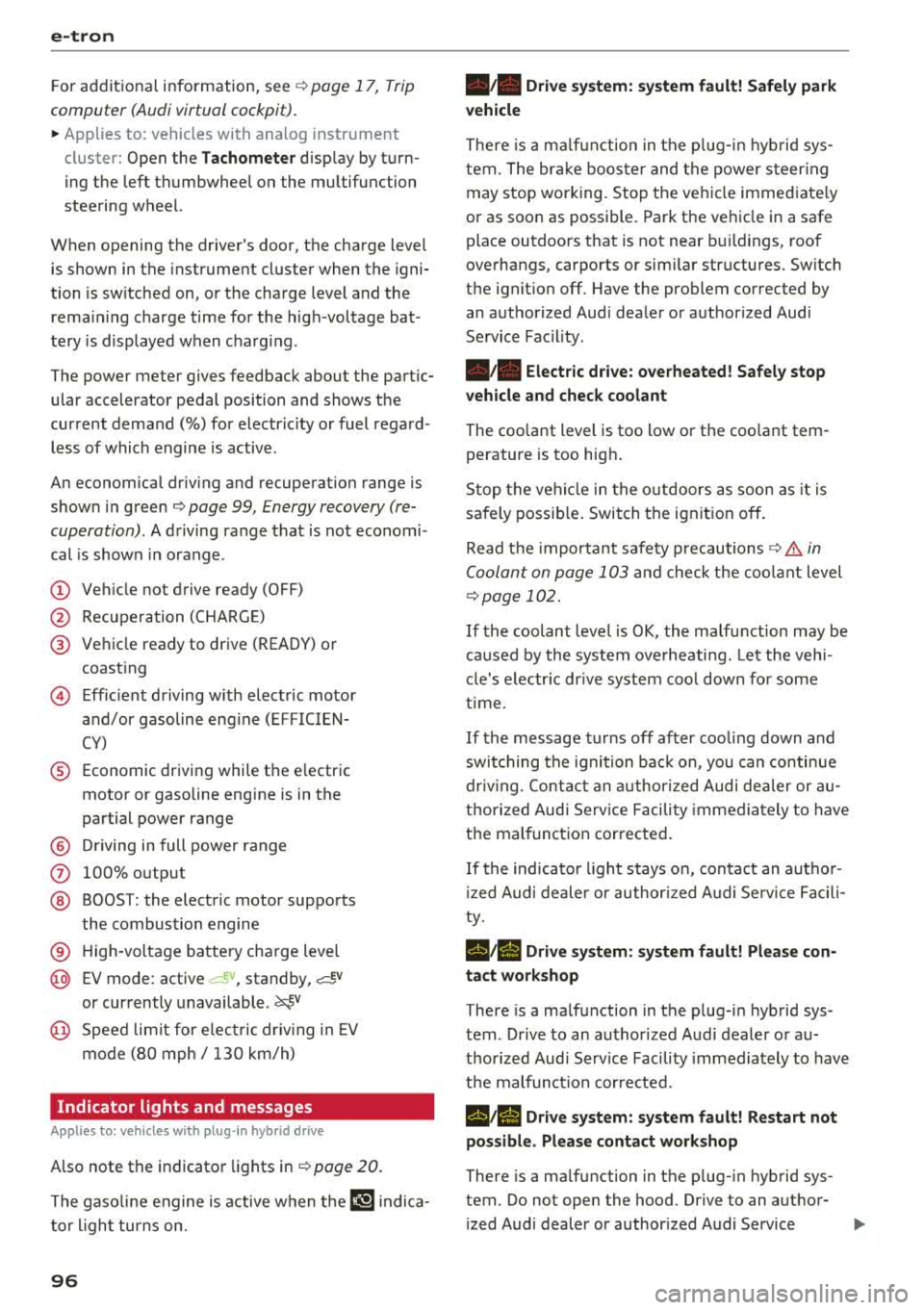
The power meter gives feedback about the partic ular accelerator pedal position and shows the
current demand
(%) for electricity or fuel regard
less of which engine is active.
An economical driving and recuperation range is
shown in green
¢ page 99, Energy recovery (re
cuperation) .
A driving range that is not economi
cal is shown in orange .
(D Vehicle not drive ready (OFF)
@ Recuperation (CHARGE)
@ Vehicle ready to drive (READY) or
coasting
© Efficient driving with electric motor
and/or gasoline engine (EFFICIEN
CY)
® Economic driving while the electric
motor or gasoline engine is in the
partial power range
@ Driving in full power range
0 100% output
@ BOOST: the electric motor supports
the combustion engine
® High-voltage battery charge level
@ EV mode: active a=,v, standby, a=,v
or currently unavailable. ~v
@ Speed limit for electric driving in EV
mode (80 mph/ 130 km/h)
Indicator lights and messages
Applies to: vehicles with plug -in hybr id drive
Also note the indicator lights in¢ page 20.
The gasoline engine is active when the II'§] indica
tor light turns on.
96
•• Drive system: system fault! Safely park
vehicle
There is a malfunction in the plug-in hybrid sys
tem. The brake booster and the power steering
may stop working. Stop the vehicle immediately
or as soon as possible. Park the vehicle in a safe place outdoors that is not near buildings, roof
overhangs, carports or similar structures. Switch
the ignition off. Have the problem corrected by
an authorized Audi dealer or authorized Audi
Service Facility.
•• Electric drive: overheated! Safely stop
vehicle and check coolant
The coolant level is too low or the coolant tem
perature is too high.
Stop the vehicle in the outdoors as soon as it is
safely possible. Switch the ignition off.
Read the important safety
precautions ¢.& in
Coolant on page 103
and check the coolant level
¢page 102.
If the coolant level is OK, the malfunction may be
caused by the system overheating. Let the vehi
cle's electric drive system cool down for some
time .
If the message turns off after cooling down and
switching the ignition back on, you can continue
driving. Contact an authorized Audi dealer or au
thorized Audi Service Facility immediately to have
the malfunction corrected.
If the indicator light stays on, contact an author
ized Audi dealer or authorized Audi Service Facili
ty.
lltll Drive system: system fault! Please con
tact workshop
There is a malfunction in the plug-in hybrid sys
tem . Drive to an authorized Audi dealer or au
thorized Audi Service Facility immediately to have
the malfunction corrected.
1/1111 Drive system: system fault! Restart not
possible. Please contact workshop
There is a malfunction in the plug-in hybrid sys
tem. Do not open the hood. Drive to an author- ized Audi dealer or authorized Audi Service
.,,_
Page 101 of 404
u. 00 ... N l' N ... 0 N > 00
(D Tips
It may be necessary for the gasoline engine to
r u n longer for technical reasons, such as
when condensation accumu lates in the en
gine. Driving exclusively in electric mode is
not possible in this phase.
Plug-in hybrid functions
Applies to: vehicles with plug-in hybrid drive
The funct ions descr ibed below act ivate automati
cally depending on the driv ing sty le.
Full-throttle acceleration (boost)
The boost funct ion is act ivated by pressing the
accelerator pedal farther down (kick-down). The
vehicle is powered by both the gasoline engine
and the electric motor when in full accelerat io n.
Boost is only availab le for a sho rt time , because it
uses a large amou nt of energy. Ava ilability de
pends on the high-voltage battery charge level.
Coasting
The gasoline engine switches off and disengages
at speeds up to approximate ly 112 mph
(180 km/h) if the accelerator pedal is not p ress-
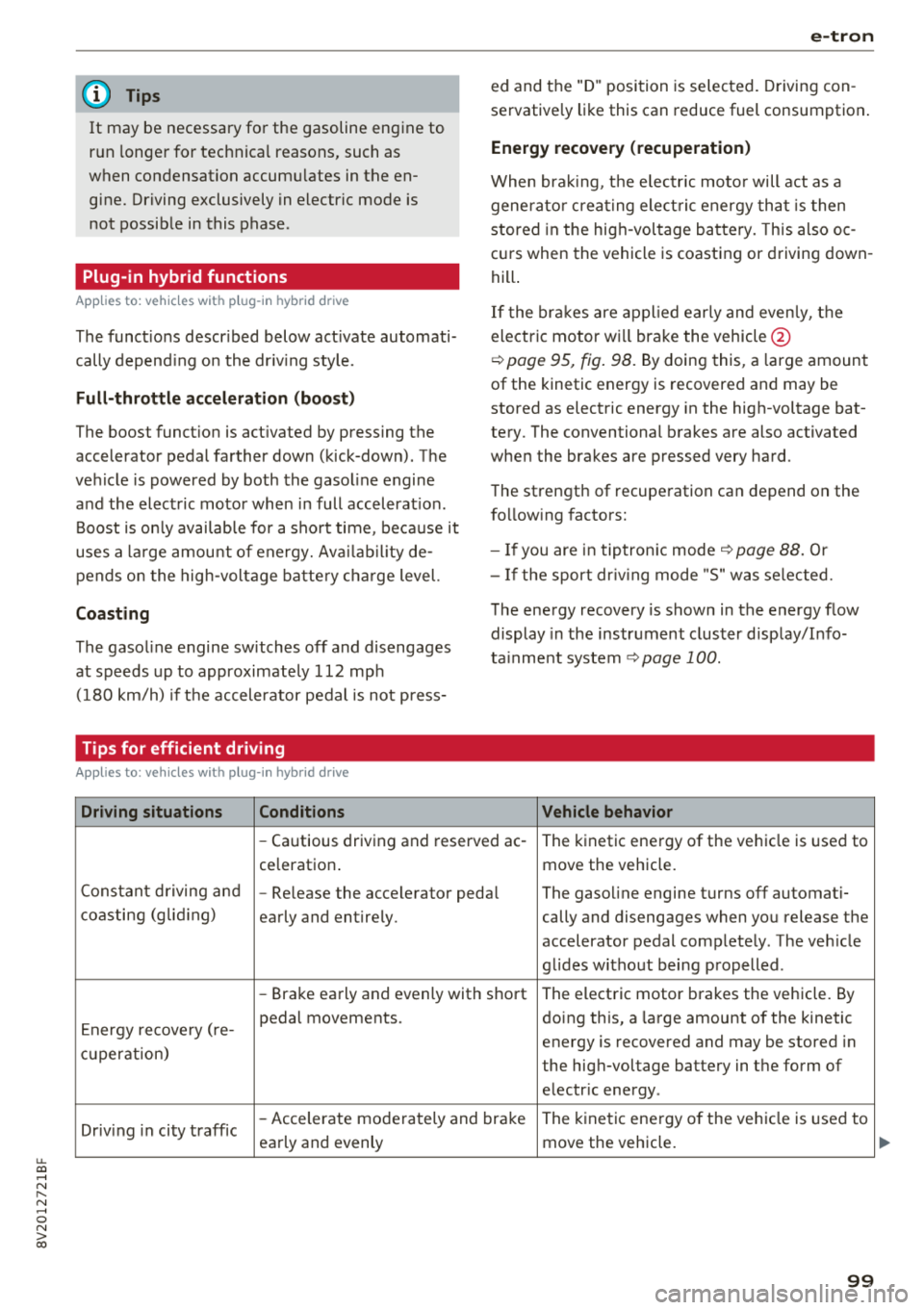
Tips for efficient driving
Applies to: vehicles with plug-in hybrid drive
Driving situations Conditions
e-tron
ed and the "D" position is selected. Driving con
servative ly like this can reduce fuel consumption .
Energy recovery (recuperation)
When braking, t he e lectr ic moto r will act as a
generato r creat ing elect ric energy that is then
stored in the hig h-voltage battery. This also o c
curs when the vehicle is coasting or driving down
hill .
If the brakes are applied early and evenly, the
electric motor w ill brake the vehicle @
¢
page 95, fig. 98. By doing this, a large amount
of the kinetic energy is recovered and may be
stored as electric energy in the high-voltage bat
tery . The conventional brakes are also activated
when the brakes are pressed very hard.
The strength of recuperation can depend on the
following factors:
- If you are in tiptronic mode ¢
page 88. Or
- I f the sport dr iv ing mode "S" was se lected.
The energy recovery is shown in the energy flow
display in the instrument cluster display/Info
ta inment system
¢ page 100.
Vehicle behavior
-Cautious driving and reserved ac- The kinetic energy of the ve hicle is used to
ce leration . move the vehicle.
Constant driving and
-Re lease the accelerator pedal The gasoline engine turns off automati-
coasting (gliding)
early and entirely. cally and disengages when you release the
accelerator pedal completely . The veh icle
glides w ithout being propelled .
-Brake early and evenly with short The electric motor brakes the vehicle. By
E nergy recove ry ( re- pedal movements.
doing this, a large amount of the kinetic
energy is recovered and may be stored in
cu perat ion)
the high-voltage battery in the form of
electr ic energy .
Driv ing in city traffic
-Accelerate moderately and brake The kinetic energy o f the ve hicle is used to
early and evenly move the vehicle.
99
...
Page 103 of 404
LL co .... N
" N
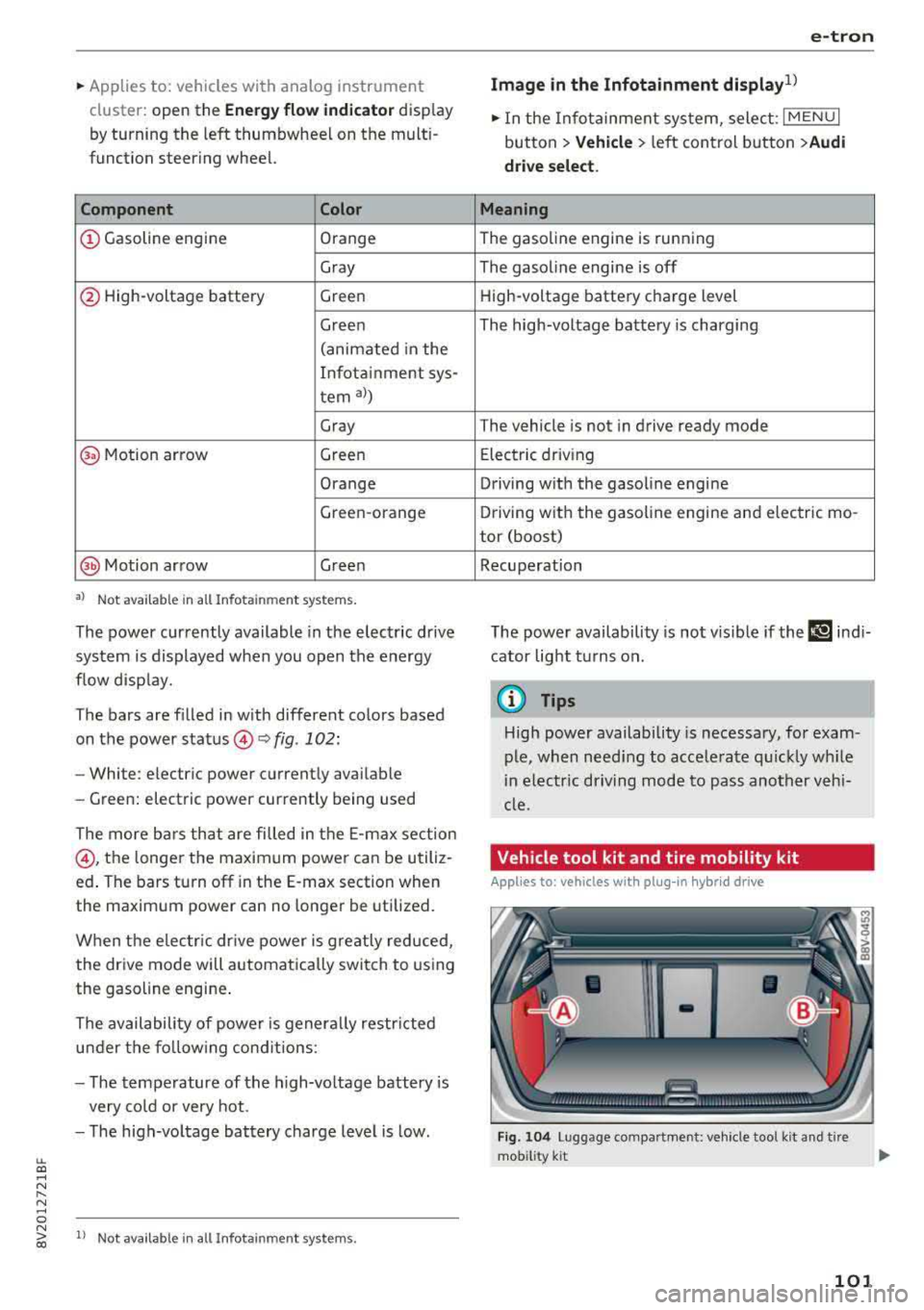
~ Applies to: vehicles with analog instrument cluster: open the
Energy flo w ind icator disp lay
by turning the left thumbwhee l on the mult i
function steering wheel.
Component Color
(D Gasoline engine Orange
Gray
@ High-voltage battery Green
Green
(animated in the
Infota inment sys-
tern
al)
Gray
(§) Motion arrow Green
Orange
Green -orange
@ Motion arrow Green
a) Not avail ab le in all Infot ainmen t systems.
The power currently available in the electric drive
sys tem is displayed when you open the energy
flow disp lay.
The bars are filled in with different colors based
on the power
status @~ fig. 102:
- White : electric power currently availab le
- Green: electric power currently being used
The more ba rs that are filled in the E-max section
@ , the longe r the maximum power can be utiliz
ed . The bars turn off in the E-max section when
the maximum power can no longer be utilized.
When the elec tric dr ive power is greatly red uced,
the drive mode will automatically switch to using
the gasoline engine.
The availability of power is genera lly restr icted
under the fo llow ing cond itions:
- The temperature of the high-voltage battery is
very co ld or very hot.
- The high-voltage battery charge level is low.
.... 0 N ii'i l) Not availab le in al l Infota inment system s.
e-tron
Image in the Infota inment display1
)
~ In the Infotainment system, select: I MENU I
button > Veh icl e > left control button >Audi
d rive select .
M eaning
The gasoline engine is running
The gasoline engine is off
High-voltage battery charge level
The high-voltage battery is charging
The vehicle is not in drive ready mode
E lectric driv ing
Driving w ith the gasoline engine
Driving with the gasoline engine and electric mo-
tor (boost)
Recuperation
The power availability is not v is ible if the
111 ind i
cator light turns on.
(0 Tips
High power availability is necessary, for exam
ple, when need ing to acce lerate q uickly wh ile
i n e lectric driving mode to pass another vehi
cle.
Vehicle tool kit and tire mobility kit
Applies to: vehicles wit h plug -in hybr id drive
F ig. 104 Lu ggage compartment: veh icle tool kit and tire
mob ility k it
101
Page 109 of 404
LL co ..... N
" N ..... 0 N > co
-Using the control unit while operating the
charging dock*
c;, page 108 or charging
clip*
c;, page 108 is recommended .
-Do not immerse the control un it in water or
cover with snow or ice.
(D Tips
-Always place the Audi e-tron charging sys
tem on a secure surface when charg ing.
-To reduce the risk of overheat ing during op
eration, do not place the Audi e -tron charg
i ng system in direct sunlight for long peri
ods of time.
-If the temperature inside the control unit rises above 176 °F (80 °C), the charging
process will stop automatically unti l the
temperature decreases back down to the normal range.
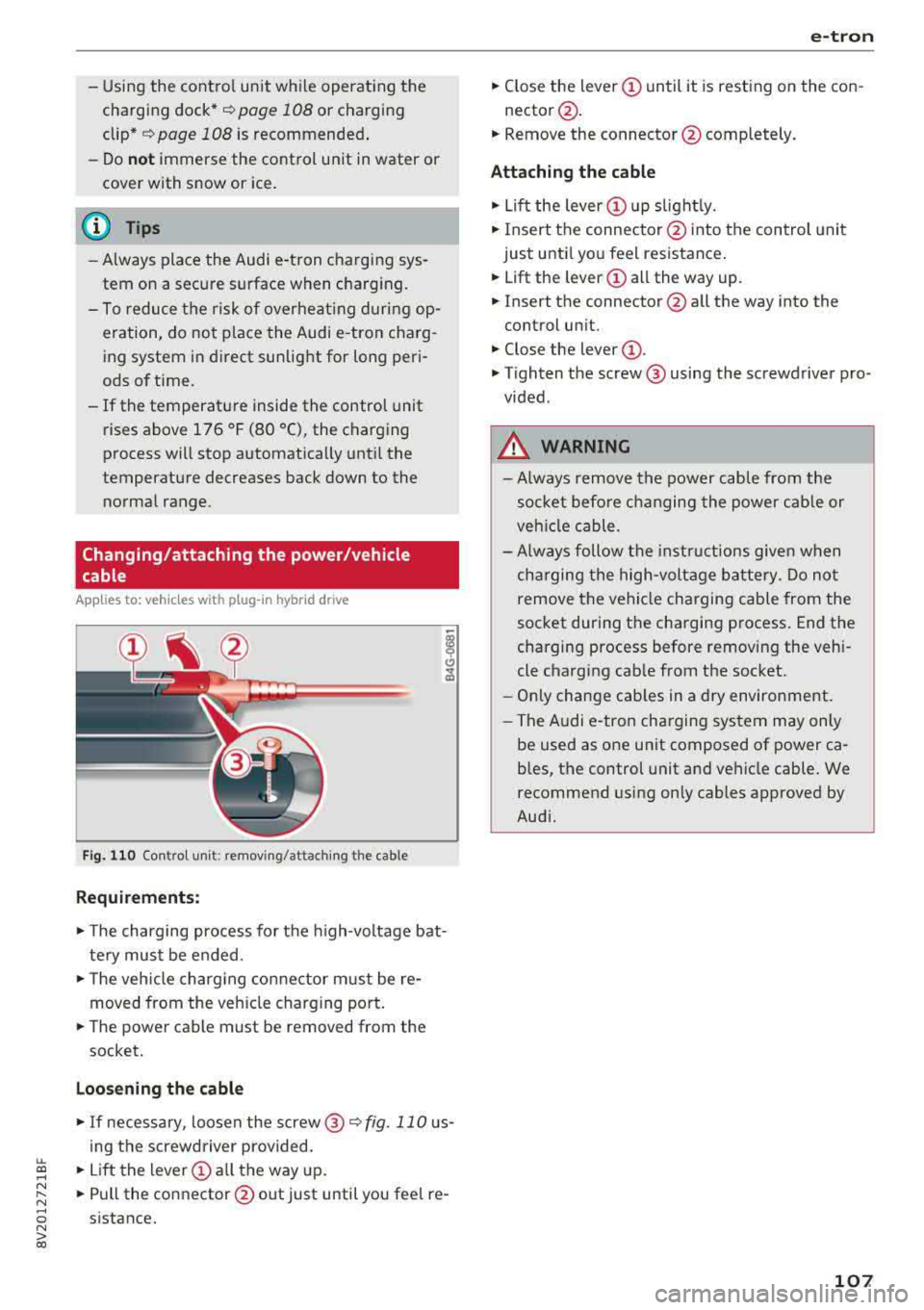
Changing/attach ing the power/vehicle
cable
Ap plies to: ve hicles with p lug -in hybrid drive
Fig. 110 Co ntro l u nit: remov ing/attac hing the cable
Requirement s:
.,. The charging process for the h igh-voltage bat
te ry must be ended .
.,. The veh icle charg ing connector m ust be re
moved from the veh icle charging port.
.,. The power cable must be removed from the
socket.
Loo sening the cable
.,. If necessary, loosen the screw @ c;, fig. 110 us
ing the screwdriver provided.
.,. Lift the lever CD a ll the way up.
.,. Pull the connector @out just until you fee l re
sistance.
e-tron
.,. Close the lever CD until it is resting on the con-
nector @.
.,. Remove the connector @completely.
Attachin g the cable
.,. Lift the lever CD up slight ly.
.,. Insert the connector @ into the control unit
just until you feel resistance .
.,. Lift the lever CD all the way up.
.,. Insert the connector@all the way into the
control un it.
.,. Close the lever CD -
.,. Tighten the screw @ using the screwdriver pro
vided.
A WARNING
-Always remove the power cable from the
socket before changing the power cab le or
veh icle cable.
-Always follow the instructions given when
charging the high-voltage battery. Do not remove the vehicle charging cable from the
socket during the charging process. End the
charging process before removing the vehi
cle charging cable from the socket.
-Only change cab les in a dry environment.
-The Audi e-tron charging system may only
be used as one unit composed of power
ca
b les, the control unit and vehicle cable. We
recommend using on ly cables approved by
Audi.
-
107
Page 111 of 404
LL co ..... N
" N ..... 0 N > co
Removing the charging system from the
charging clip
.,. Remove the power cable connector from the
socket @ .
.,. Unwind the cable from the charging connector
mount (D .
.,. To loosen the control unit from the bracket,
push the lock ing mechan ism @ upward
9fig. 113.
Transporting
Ap plies to: veh icles with plug-in hybrid drive
Fig. 114 Storage bag
.,. Store the charg ing system and the special
charg ing cable* in the bag befo re transporting .
.,. Secure the bag using the tie-downs¢ page 64.
The flat hook must be secured to the left side
of the tie-downs.
& WARNING
-If the vehicle charging cab le is not secured
or positioned correctly, it can slide out of
place and endanger vehicle occupants when
brak ing, when changing directions, or in an
accident.
- Never transport the Audi e-tron charging
system or the special charg ing cable" unse
cured.
- Store the Audi e-tron charging system or the special charging cable* in the storage
bag in the luggage compartment.
- Always transport the storage bag in the lug
gage compartment and never in the passen
ger compartment (for example the seats or
in front of them) .
e-tron
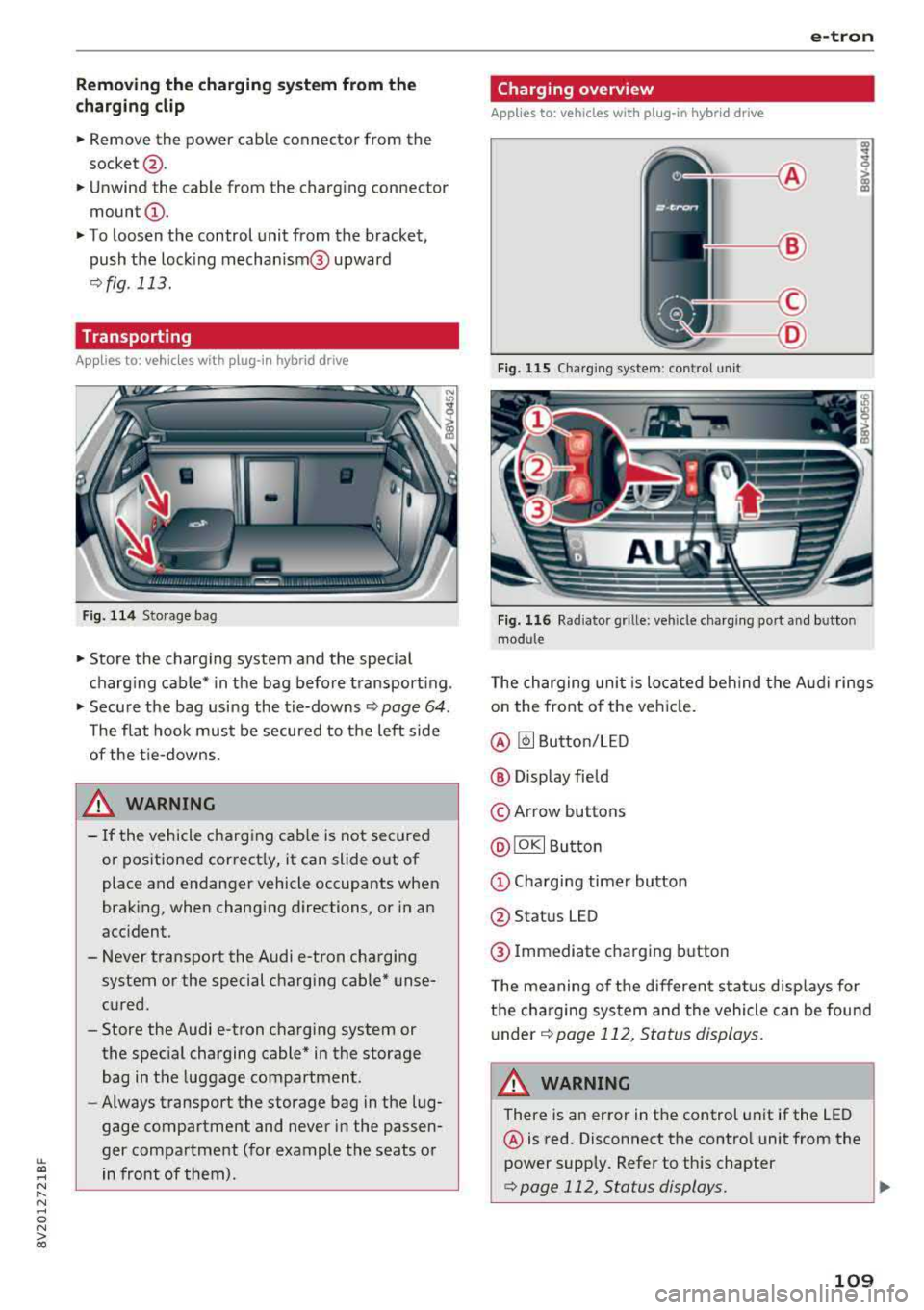
Charging overview
Applies to: vehicles with plug -in hybrid drive
Fig. 115 Charging system : control unit
Fig . 116 Radiator grille: veh icle charg ing port and bu tto n
mod ule
The charging unit is located behind the Audi rings
on the front of the vehicle .
@ ~ Button/LED
® Display field
© Arrow buttons
@IOK I Button
(D Charging timer button
@Status LED
@ Immediate charging button
T he meaning of the different status displays for
the charging sys tem and the vehicle can be found
un der
9 page 112, Status displays.
A WARNING
There is an error in the control unit if the LED
@is red. Disconnect the control unit from the
power supply . Refer to th is chapter
¢page 112, Status displays. llll-
109
Page 120 of 404
Trail er to wing
Trailer towing
Driving with a trailer
General information
Your veh icle is primari ly intended for transport
ing peop le and luggage. Howeve r, if you dr ive
with a tra iler , follow the techn ica l requirements ,
the operation and driving tips, and the lega l reg
ulations.
Dr iving w ith a trailer affects the vehicle 's fuel
consumpt ion, performance and wear. It a lso re
quires higher concentration from the driver .
A WARNING
Do not transport any people in a trailer due to
the risk of fatal injury .
Technical requirements
Certain requirements must be met when towing
a trailer.
Trailer hitch
Only use a trailer hitch with a removab le ball
h itch mount and ball h itch. The tra ile r hitc h must
be pe rm it t ed for the vehicle, the tra iler and the
permitted tota l weight of the trailer being
pu lled . Above all, it must be secure ly and safe ly
attached to the vehicle trailer.
Never mo unt a t rai ler hitch on the bumper. The
trai ler hitc h must be mounted in a way that does
not impair the function of the bumper. Do not
make any changes to the exhaust system and the
brake system.
Check regu larly if the trai ler hitc h is securely
mounted . A lways follow the instructions given by
the trai ler hitch manufacturer .
Trailer brakes
If t he tra ile r has its own bra ke system, then fol
low the manufacturer specifica tions. Howeve r,
the brake system on the trai ler must never be
connected to the vehicle brake system.
118
Engine cooling system
D riving w ith a tra ile r means a higher load on t he
engine and the cooling sys tem. The coo ling sys
tem must be designed for additiona l load and
contain enoug h
coolant ¢@ .
@ Note
Longer incl ines cannot be driven wi tho ut a
suitab le cooling system, especia lly if the out
side temperatures are high . ot herwise, this
i ncreases the risk of eng ine damage.
Operating instructions
Several things must be noted when towing a
trailer.
Towing capacity
Yo ur vehicle can only be ope ra ted with class 1 or
class 2 trai le rs.
Load distribution
Poor cargo load and distr ib ution can negatively
i mpact vehicle handling . T o have the lowest im
pact as poss ible, load the tra ile r according to
t h ese cr ite ria :
- Store objects preferably in the vehicle luggage
compartment . The vehicle should a lways carry
the heaviest poss ib le load and the trailer
should have t he lig htest poss ible load .
- Dist ribute the load in the t railer so that the
heavy objects a re as close to the axle as poss i
ble.
- Secu re objects from s lid ing o ut of place.
- Ut il ize the maximum permitted tongue we ight
if poss ible .
Tire s
Set the tire pressure on your vehicle for a "full
load"; see the tire pressure
st icker ¢ page 341.
If necessary, also adjust the t ire pressure on the
trailer acco rding to the manufactu rer's recom
mendat ion.
Winter tires should be mounted on the vehicle and on the trailer during w inter temperatures .
Page 134 of 404
Ass is tanc e system s
-your vehicle is traveling at speeds between ap
proximately 20 to 50 mph (30 to 85 km/h) and
it approaches a stationary vehicle.
- your vehicle is traveling at speeds between ap
proximately 20 to 155 mph (30 to 250 km/h)
and it approaches a vehicle that is clearly trav
eling more slowly or a veh icle in your direction
o f travel tha t is stopped.
When this warning occurs, it may only be possi
b le to avoid a collision by swerving or braking
strong ly. The message
A udi pre sense.
¢ fig. 134 and a warning tone will warn you
about the danger .
If there is an impending collision with vehicles,
there will a lso be an
acute warning in the form of
sharp braking. If you do not react to the acute
warn ing, pre sense front can brake with increas
ing force within the limits of the system . T his re
duces the vehicle speed in the event of a coll i
sion .
Autom atic deceleration
Depending on the speed, pre sense front can de
cel erate automatica lly
shortly before a collision:
-if there are stationary vehicles when you are
traveling at speeds up to approx imately 28
mph (45 km/h)
-if there are veh icles dr iv ing or stopped ahead
whe n you are traveling at speeds up to approxi
mately 155 mph (250 km/h)
Autom atic bra king force inc rea se
If pre sense front determines that you are not
braking strongly enough when a co llision is imm i
nent, it can inc rease the braking force, depending
on the situation and speed:
-if there are stationary vehicles when you are
traveling at speeds up to approx imately 50
mph (85 km/h)
-if the re are ve hicles driving or stopped ahead
when you are traveling at speeds up to approxi
mately 155 mph (250 km/h)
A WARNING
Pre sense front cannot ove rcome the laws of
physics . It i s a system des igned to assist and
132
it cannot prevent a coll is io n in eve ry ci rc u m
stance . The driver m ust always intervene. The
driver is always respons ible for braking at the
correct time . Do not let the inc reased safety
provided tempt yo u into tak ing risks . This
could inc rease your r isk of a co llision.
-Keep in mind that pre sense front can pro
vide war nings or b rake unexpectedly. Al
ways secure a ny cargo or objects that yo u
a re transporting to reduce t he ris k of dam
a ge or inj ury.
-The system can dep loy in co rre ctly due to
sys tem -specific li mits.
-Please note that the se nsor does not a lways
detect a ll obje cts. Thi s increases the r is k of
a c ollision .
-Pre sense front does not rea ct to ve hicles
tr ave ling towa rd yo u in the same lane, to
peop le, groups of people, anim als, ob je cts
that are crossing the road, or objects t hat
are difficult to
detect ¢.& in General infor
mation on page 124 .
A WARNING
Pre sense front may be restricted o r not avai l
ab le in the fo llow ing example s ituations :
-if there a re othe r reflective objects nearby,
such as gua rd ra ils or vehicles
-when driving into a tunnel
-in heavy fog, ra in, sp ray o r snow
-if the rada r senso r is d irty, covered in ice,
d amaged, or cove red
- in curves
- if the ESC was restr icted or sw itched off
@ Note
The sensor can be d isplaced by impacts or
damage to the bumper, wheel housing and underbody. Pre sense front can be impaired
by this . Have an author ized A udi dealer or au
thor ized Audi Se rvice Facility check t heir func-
-
tion. 1111-