ECU AUDI S3 SEDAN 2018 Workshop Manual
[x] Cancel search | Manufacturer: AUDI, Model Year: 2018, Model line: S3 SEDAN, Model: AUDI S3 SEDAN 2018Pages: 404, PDF Size: 62.3 MB
Page 307 of 404
u. 00 .-< N l' N .-< 0 N > 00
provide supplementa l protection in certain fron
tal collisions .
A WARNING -
Not using a booster seat, using the booster
seat improperly, incorrectly insta lling a boos
ter seat or using the vehicle safety belt im
properly increases the risk of serious personal
injury and death in a collision or other emer
gency situat ion . To help reduce the r isk of se
r ious personal inj ury and/o r death:
- The shoulder belt must l ie as close to the
center of the child 's collar bone as poss ible
and must lie flat and snug on the uppe r
body . It must neve r lie across the t hroat or
neck . The lap be lt must lie across the pe lv is
and never across the stomac h or abdomen.
Make sure that the belt lies flat and sn ug .
Pull on the belt to tighten if necessary.
- Failure to proper ly route safety belts over a
child's body will ca use severe injuries in an
acc ident or other emergency situation
¢ page 260.
- The rear side of the child safety seat should be pos it ioned as close as poss ible to the
backrest on the vehicle seat.
- For adjustable head restraints: ad just o r re
move the rear seat head restraint if it is d if
ficult to install the child seat w ith the head
restra int i n place
¢ page 61 . Install the
head restraint again immediately once the
c hild seat is removed. Driving w ithout head
restra ints or w ith he ad restraints t hat are
not p roper ly adjusted increases the risk of
serious or fata l neck injury d ramatically.
- Never le t a child put the sho uld er be lt un der
the arm or be hind t he back, because it co ul d
cause severe injuries in a c rash .
- C hildren o n the front sea t of any car, even
with Adva nced Ai rbags, can be serio usly in
jure d or even killed when a n ai rbag inflates.
- Never le t a child stan d or knee l on any seat,
for example the front seat.
- Never le t a child ride in the c argo a re a of
yo ur vehicle.
- Alw ays remem ber th at a c hild leaning for
wa rd, s itting sideways or out of position in
any way during an accident can be struck by
Ch ild saf ety
a dep loying airbag. Th is w ill resu lt in serious
pe rsonal in jury or death.
- If you m ust insta ll a booster seat on the
front passenger seat because of exceptiona l
circumstances the
PASSENGER AIR BAG
OFF
li ght must come on a nd stay on, when
ever the ignit ion is switched on.
- If t he
PASSENGER AIR BAG OFF light does
not come on and stay on, perform the
checks described
Q page 281, Monitoring
the Advanced Airbag System .
-Take the child restraint off the front passen
ge r seat and install it properly at one of the
rear seat pos itions if t he
PASSENGER AIR
BAG OFF
ligh t does not stay on wheneve r
t he ig nit io n is sw itch ed on.
- Always read and heed all WAR NINGS whe n
eve r using a ch ild restrained in a vehicle is
be ing use d
Q page 260, Safe ty belts,
Q page 269, Airbag system and
Q page 294, Important information .
Securing child safety
seats
Securing a child safety seat using a safety
belt
Safety belts for the rear seats and the front pas
senger can be locked with the convertible locking
retractor to properly secure child safety seats .
The safety belts emergency loc king retr actors for
the rear seats safety be lts and for the front pas
senger's seat safety be lt have a convertible lock
ing retractor for child restraints . The safety be lt
must be locked so that be lt webb ing cannot un
reel. The retractor can be act ivated to lock the
safety belt and prevent the safety belt webbing
from loosening up dur ing norma l driving . A ch ild
safety seat can only be prope rly installed when
the safety be lt is locked so t hat the ch ild and
c hi ld safety seat will stay in place.
Always remember : Even though your veh icle is
equipped with an Advanced Airbag system, all
c hi ldren, especia lly those 12 yea rs and younger,
sho uld a lways r ide in t he bac k seat p roperly re-
st rained for thei r age and s ize.
..,..
305
Page 308 of 404
Child sa fety
A WARNING
-
Improperly installed child safety seats in
crease the risk of serious personal injury and
death in a collision .
- Always make sure that the safety belt re
tractor is locked when installing a child
safety seat. An unlocked safety belt retrac
tor cannot hold the child safety seat in place dur ing normal driving or in a cras h.
- Always buckle the child safety seat firmly in
place even if a child is not s itting in it. A
loose child safety seat can fly around during
a sudden stop or in a coll is ion .
- Always make sure that the rear seat back
rest to which the center rear safety belt* is
attached is securely latched whenever the
rear cente r safety belt is being used to se
cu re a ch ild rest raint.
- If the backrest is not securely latched, the
child and the child restraint will be thrown
forward toge ther w ith the backrest and will
strike parts of the vehicle interior. The chi ld
can be seriously in jured or killed .
- Never ins tall rear-f acing chi ld safety seats
or infant carr iers on the front passenger
seat . A child will be serio usly injured and
can be killed when the passenger airbag in
flates.
- The inflating airbag will hit the child safety
seat or infant carrier with great force and
will smash the chi ld safety seat and child
against the backrest, center armrest, door
or roof.
- Always install rear-facing child safety seats
or infant carr iers on the rear seat.
- Forward-facing ch ild safety seats or infant
carr iers installed on the front passenger's
seat may interfere with the deployment of
the a irbag and cause serious injury to the
child.
- It is safe r to install a forward-facing ch ild
safety seat on the rear seat.
- Always read and heed all WARNINGS when
ever using a child restrained in a veh icle is
being
used~ page 294 . Special preca utions
apply when installing a child safety seat on
the fron t passenger
seat~ page 2 70, Child
306
restraints on the front seat -some impor
tant things to know.
A WARNING
A lways take special p recautions if you must
install a forward or rearward-facing child re
stra int on the front passenger's seat in excep
tional s ituations:
- Whenever a forward or rearward-fac ing
child restraint is installed on the front pas
senger seat, the
PASSENGER AIR BAG OFF
light must come on and stay on whenever
the ignition is switched on.
- If the
PASSENGER AIR BAG OFF light does
not come on and stay on, perform the
checks desc ribed
~ page 281, Monit oring
the Advanced Airbag System.
- Take the child res tra int off the front passen
ge r seat an d inst all it prope rly at one of the
rear sea t positions i f the
PASSENGER AIR
BAG OFF
light does not stay on whenever
the ignition is switched on .
- Improper installat ion of child res traints can
reduce the ir effectiveness or even prevent
them from provi ding any protect ion .
- An improperly installed child restra int can
interfere with the airbag as it deploys and
serious ly injure or even kill the child.
- Always carefully follow the manufacturer's
instructions provided with the child safety
seat or carrie r.
- After checking to make sure that the ch ild
restraint is proper ly installed, make ce rtain
that the child restraint is correctly recog nized by the capacitive passenger detection
system in the front passenger seat and that
the
PASSENGER AIR BAG OFF light signals
the co rrect front passenger frontal a irbag
s tat us.
A WARNING
Forward- facing child restr aints:
- Always make sure the forward-facing seat
has bee n des igned and certified by its man
uf ac turer for use on a front sea t wit h a pas
senger front and side air bag.
-
Page 309 of 404
u. 00 .-< N l' N .-< 0 N > 00
-Never put the forward-facing child restraint
up, against or very near the ins trumen t pan
el.
- Always move t he front passenger seat to
the h ighest position in the up an d down ad
justment range and move it back t o the
r e armost position in t he seat's fore a nd aft
adjustment range, as fa r away from the air
bag as possib le, before insta lling the for
wa rd-facing child restra int.
- Always make sure that the safety belt upper
anchorage is beh ind the child restraint and
not next to or in front of the chi ld restrain t
so tha t the safety bel t will be properly pos i
tioned.
- Make sure tha t the
PASSENGER AIR BAG
OFF
light comes on and s tays on all the time
whenever the ignition is switched on .
A WARNING
Rearward-facing child restraints:
- A ch ild in a re arwa rd-facing child sa fety seat
installed on the front passenger seat wi ll be
seriously injured and can be killed if the
front airbag inflates
-even with an Ad
vanced Airbag System.
- The inflating airbag will hit the child safety
seat or infant carrier with great force and
will smash the ch ild safety seat and chi ld
against the backrest, center armrest , door
o r roof .
- Always be especially careful if you must in
sta ll a rearward facing child safety seat on
the fron t passenger seat in exceptional c ir
c u ms tances .
- Make sure that the
PASSENGER AIR BAG
OFF
light comes on and s tays on all the time
whenever the ignition is switched on.
- If the PASSENGER AIR BAG OFF light does
not come on and stay on, immedia tely in
st al l t he rear-fac ing ch ild safety sea t in a
re ar seat ing pos ition and have the airbag
system inspected by your Au di deale r.
Ch ild saf ety
Activating the convertible locking retractor
Use the convertible locking retractor to secure a
child restraint.
Always heed the c hild safety seat manufactu rer 's
i ns truc tio ns when instal ling a child restra int i n
your vehicle . To activate the convertib le locking
retractor:
.,. Place the child restraint on a seat, preferably
on the rear sea t.
.,. Slowly pull the belt all the way out .
.,. Route it arou nd or through the child restra int
be lt
path ~,&. .
.,. Push the c hild safety sea t down with yo ur full
weigh t to ge t the safe ty belt really tight.
.,. Insert t he be lt tong ue into the b uckl e for tha t
seating position .
.,. Guide the safety be lt back into t he ret ractor un
til the be lt lies flat and sn ug on the c hild safety
seat .
.,. You s hou ld hear a "cl icking" noise as the belt
w inds back into the inertia reel. Test the con
vert ib le lock ing retractor by pull ing on the belt .
You s hou ld no lo nger be able to pull the belt
ou t of the re tra cto r. T he convertib le lo ckin g re
t ra cto r is now activated.
.,. Ma ke sure that t he red release bu tton is facing
away from the c hild restraint so that it can be
unb uc kled quickly .
.,. Pull on the belt to make sure the safety belt is
properly t ight and fastened so that the seat
cannot move forward or sideways more t han
one inch (2 .5 cm) .
A WARNING
Using the wro ng ch ild rest raint o r an impro p
e rly instal led child restr aint can cause se rious
person al injury or death in a crash.
- Always make sure th at the s afety be lt re
tr act or is locked when installing a child
safety sea t. An un locked safe ty be lt retrac
tor cannot hold the ch ild safety seat in p lace
du ring norma l drivin g or in a c rash.
- Always buckle the child safety seat fi rm ly in
p lace even if a ch ild is not sitt ing in it . A
loose child safety seat can fly around dur ing
a sudden stop or in a crash.
~
307
Page 310 of 404
Child sa fety
- Always make sure the seat backrest to which
t h e chi ld restraint is installed is in an up
rig ht p osition and s ecurely latched into
plac e and can not f old forward . O therwise,
t he se atback with t he ch ild safe ty seat at
tached to it could fly forward in the event of
an accident or other emergency situation.
- Always read and heed all WARNINGS when
ever using a child restrained in a veh icle is
being used
¢ page 294. Specia l preca utions
apply when installing a child safety seat on
the front passenger
seat ¢ page 2 70, Child
restraints on the front seat -some impor
tant things to know.
Deactivating the convertible locking
retractor
The convertible locking r etractor for child
re
straints will be deactivated automatically when
the bel t is wound all the way back in to the re
tractor .
~ Press the red button on the safety belt b uckle.
Th@ belt tongue w ill pop out of the buckl e.
~ Gu ide the safety belt a ll the way back into its
stowed position .
Always let the safety belt retract complete ly into
its stowed position . The safety bel t can now be
used as an ordinary safety belt without the con
vert ible lock ing retractor for child restra ints .
If the convert ible lock ing retractor should be ac
tiva ted inadve rtently, the safe ty belt must be un
fastened and gu ided completely back into its
stowed position to deact ivate this feature .
If the
convertib le lock ing retractor is not deact ivated,
the safety belt w ill gradually become tighte r and
uncomfo rtable to wea r.
A WARNING
-
Improperly installe d child safety seats in
crease the risk of serio us pe rsonal injury and
death in a collision .
- Never unfasten the safe ty belt to deactiva te
the convert ible locking retractor for child re
straints while the vehicle is moving . You
308
wou ld not be rest rained and could be seri
ously in jured in an acc ident.
- Always read and heed all WARNINGS when
ever us ing a child restrained in a vehicle is
be ing
used¢ page 294. Special p recautions
apply when installing a child safety seat on
the front passenge r seat
¢ page 2 70, Child
restraints on the front seat -some impor
tant things to know.
LATCH system (lower
anchorages and tethers
for children)
Child Restraint System anchors and how
are they related to child safety
To p rovide a simp ler and mo re practicab le way to
attach the ch ild restraint on the vehicle seat,
Federal regulations require spec ia l lower ancho
rages in vehicles and devices on new ch ild re
straints to attach to the vehicle anchorages .
In the United States, the combination of the
tethe r ancho rages and the lower anchorages is
now generally called t he LATCH system for
" Lower Anchorages and Tethers for Children" . In
Canada, the terms
" top tet her " wi th "lower u ni
versa l anchorages " (o r "lowe r universa l anchor
age bars") a re used to des cribe the system .
In other co untries the term
"ISOF IX" is used to
desc ribe the lower anchorages .
Fo rward-facing chi ld restraints manufactured af
ter September
1, 1999, are required by U.S . fed
era l regulations to comply with new child head
movement performance req uir ements . These
new performance requ irements make a tether
necessary on most new ch ild sea ts.
Installing a ch ild restraint that requires a top
tether wi thout one can se riously impair the per
fo rmance of the c hild rest raint and its ab ility to
pro tect the ch ild in a co ll ision. I nstalling a ch ild
r es trai nt th at r equi res a top te ther wi tho ut the
top tether may be a vio lation o f st ate law.
Child restra int manufactu rers offe r LATCH lowe r
ancho rages on t heir child seats w ith hook-on or
...
Page 311 of 404
LL co .... N
" N .... 0 N > co
push-on connectors attached to adjustable
straps .
I n addi tion to the LATCH lower anchorages, these
chi ld restrain t systems usually require the use of
tether straps to he lp keep the child restraint
firm ly in plac e.
A WARNING
Improper installation of c hild restraints will
increase the risk of injury and death in a
crash.
- Always follow the instructions provided by the manufacturer of the child restra int you
intend to install in your veh icle.
- Never install a child restra int w ithout a
properly attached top tether strap if the
child restraint ma nufacturer's instruct ions
requ ire the top tether strap to be used .
- Improper use of child restra int LATC H lower
anchorage po ints can lead to injury in a colli
sion . The LATCH lower anchorage points a re
designed to withstand only those loads im
posed by correc tly fi tted child res traints .
- N ever mount two chi ld restraint systems on
one LATCH lower a nchorage poin t.
- Never secure or attach a ny luggage or other
item to the LA TCH lower anc horages .
Location
Fig . 2 52 Schema tic overv iew: LATCH a nchor age po int loca
ti ons (ex ampl e)
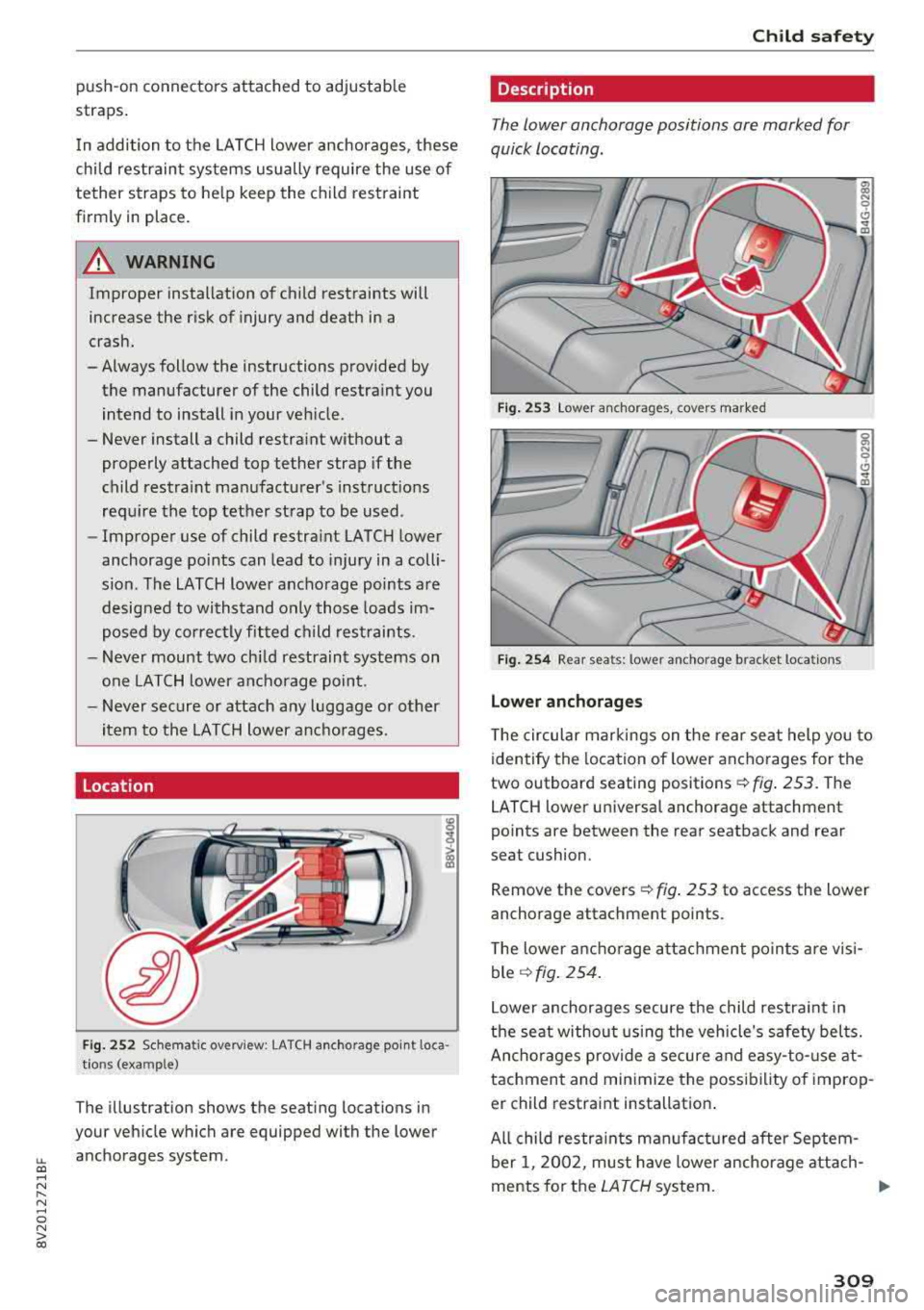
The illustration shows the seating locations in
your veh icle which are equipped with the lower
anchorages system.
Ch ild s afe ty
Description
T he lower anchorage positions are marked for
quick locating .
Fig . 253 Lower an cho ra g es , covers marked
Fig . 25 4 Rear s eats: lowe r an chorag e bra cket lo ca tions
Lower anchorages
The circular markings on the rear seat help you to
identify the location of lower anchorages for the
two outboard seating positions ¢
fig. 253. The
LATCH lower universal anchorage attachment
points are between the rear seatback and rear
seat cushion.
Remove the covers ¢
fig. 253 to access the lower
anchorage attachment points.
T he lower anc horage attac hment po in ts a re v is i
ble ¢
fig. 254.
Lower anchorages secure the child restra int in
the seat withou t using the veh icle's safety bel ts.
Anchorages provide a secure and easy-to-use at
tachment and minimize the possibi lity of improp
er child restraint installation .
All child res tra ints manufac tured after Septem
ber 1, 2002, must have lower anchorage attach-
ments for t he
LATCH system. ..,_
309
Page 312 of 404
Child sa fety
Please remember that the lower anchorage
points are only intended for installation and at
tachment of child restraints specifically cert ified
for use w ith LATCH lower anchorages. Ch ild re
stra ints that are not equipped with the lower an
chorage attachments can st ill be installed i n
compl iance with the child restra int manufactur
er 's instructions on using vehicle safety belts .
.&_ WARNING
Improper use of LA TC H l ower anchorages ca n
cause se rious pe rsonal injury in an acc ident.
- Always ca ref ull y follow the child restra ints
ma nufactu rer's inst ru ct io ns for p roper in
st all ation of the child res tra int and p roper
use of the lower anchorages or safety be lts
in your vehicle .
- Never secure or a ttac h any luggage or o ther
items to the LATCH lower anchorages.
- Always re ad a nd heed t he important infor
mation about child restraints in this c hapter
and WA RNINGS
¢page 294, Child safety .
Installing a child restraint with LATCH
lower anchorages
Applies to: vehicles w ith Top Tether
Whenever you install a child restraint always fol
low the child restraint manufacturer's instruc
tions.
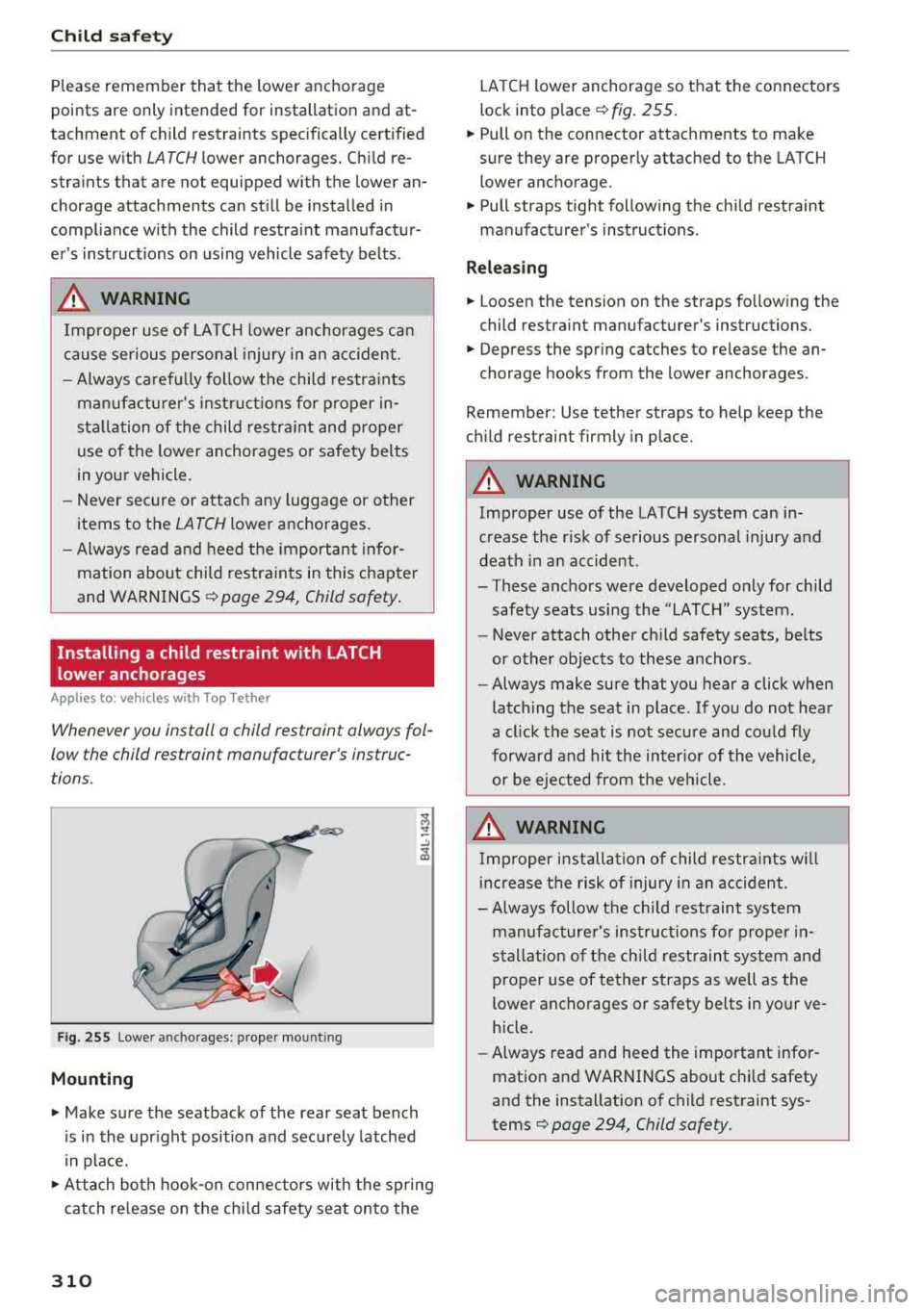
F ig . 2 55 Lower anchorages: proper mounting
Mounting
.,. Make sure the seatback of the rear seat bench
is in the upr ight position and sec urely latched
i n p lace .
.,. Attach both hook-on connectors with the sp ring
catch re lease on the chi ld safety sea t onto the
310
LA TCH lower anchorage so that the connectors
lock into place¢
fig. 255.
.,. Pull on the connector attachments to make
sure they are properly attached to the LATCH
lower anchorage.
.,. Pull straps tight following the ch ild restraint
manufacturer 's instruct ions .
Relea sing
.,. Loosen the tension on the straps fo llowing the
child restra int manufacturer's instructions.
.,. Depress the spring catches to release the an
chorage hooks from the lower anchorages.
Remember: Use tether straps to help keep the
ch ild restraint firmly in p lace.
.&_ WARNING
-
Improper use of the LATCH system can in
crease the r isk of serious persona l injury a nd
death in a n accident .
- These anchors were developed only for child
safety seats using the "LATCH" system .
- Never attach other ch ild safety seats, be lts
or other objects to these anchors.
- Always make sure that you hear a click when
latching the seat in place. If you do not hear
a cl ick the seat is not sec ure and co uld fly
forward and hit the inter ior of the vehicle,
or be ejec ted from the veh icle .
.&_ WARNING
Imp roper i nstalla tion of child restra ints w ill
in cre ase t he risk of inju ry in a n accident.
- Always follow the ch ild restraint system
manufact ure r's ins truc tions fo r prope r in
s tallat ion of t he ch ild restrain t sys tem an d
proper use of te ther straps as we ll as the
lower anchorages or safety belts in you r ve
hicle.
- Always read and heed the important infor
mation and WARNINGS about chi ld safety
and the installation of c hild restraint sys
tems¢
page 294, Child safety.
-
Page 313 of 404
LL co ..... N
" N ..... 0 N > co
Tether anchors and tether straps
I
Applies to: Sedan
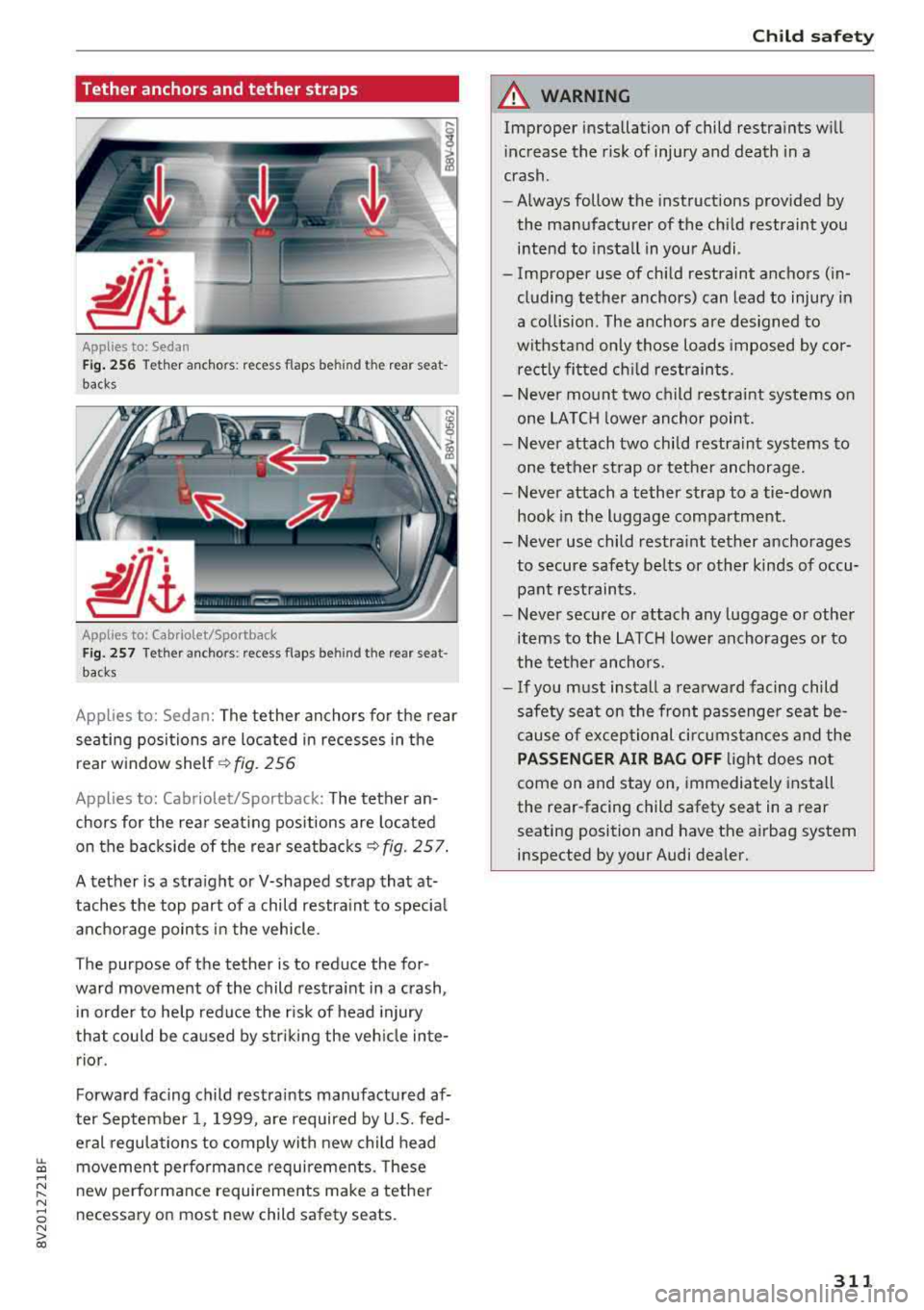
Fig . 256 Tet he r ancho rs: recess flaps be hind th e rea r sea t
backs
Applies to: Cabriolet/Sportback
F ig. 257 Tethe r ancho rs: recess flaps be hind the re ar seat
ba cks
Applies to: Sedan: The tether anchors fo r the rear
seating positions a re located in recesses in the
rear window
shelf ¢ fig. 256
Applies to: Cabriolet/Sportback: The tether an
chors for the rear seat ing positions are located
on the backside of the rear seatbacks
¢ fig. 257.
A tether is a stra ight or V-shaped strap that at·
taches the top part of a child restra int to special
anchorage points in the vehicle .
T he purpose of the tether is to reduce the for
ward movement of the child restra int in a crash,
in order to help reduce the r isk of head injury
that could be ca used by str iking the veh icle in te
rior .
Forward facing child restrai nts manufactured af
ter September 1, 1999, are required by U .S. fed·
eral regulations to comply with new child head
movement perfo rmance requirements . T hese
new perfo rmance requirements make a tether
necessary on most new child safety seats .
Ch ild s afe ty
A WARNING
Improper installation of child restra ints wi ll
i ncrease the risk of injury and death in a
crash .
- Always follow the instructions prov ided by
the manufacturer of the ch ild restraint you
intend to insta ll in your Audi .
- Improper use of child restraint anchors (in
cluding tether anchors) can lead to injury in
a co llision . The anchors are designed to
withstand only those loads imposed by
car ·
rectly fi tted ch ild restraints.
- Never mo unt two child restraint systems on
one LA TC H lowe r anchor point.
- Never attach two child restraint systems to
one tether strap or tether anchorage.
- Never attach a tether strap to a tie-down
hook in the luggage compa rtment.
- Never use child restra int tether anchorages
to secure safety be lts or other kinds of occu
pant restrain ts.
- Never secure or attach any luggage or othe r
items to the LA TCH lower anchorages or to
the tether anchors.
- If you must install a rearward facing child
safety seat on the front passenger seat be
cause of excep tional cir cumstances a nd the
PASSENGER AIR BAG OFF light does not
come on and stay on, immediately install
the rear -facing child safety seat in a rear
seating position and have the a irbag system
inspected by your Audi dealer.
311
Page 322 of 404
Checking and Filling
Opening/closing the hood
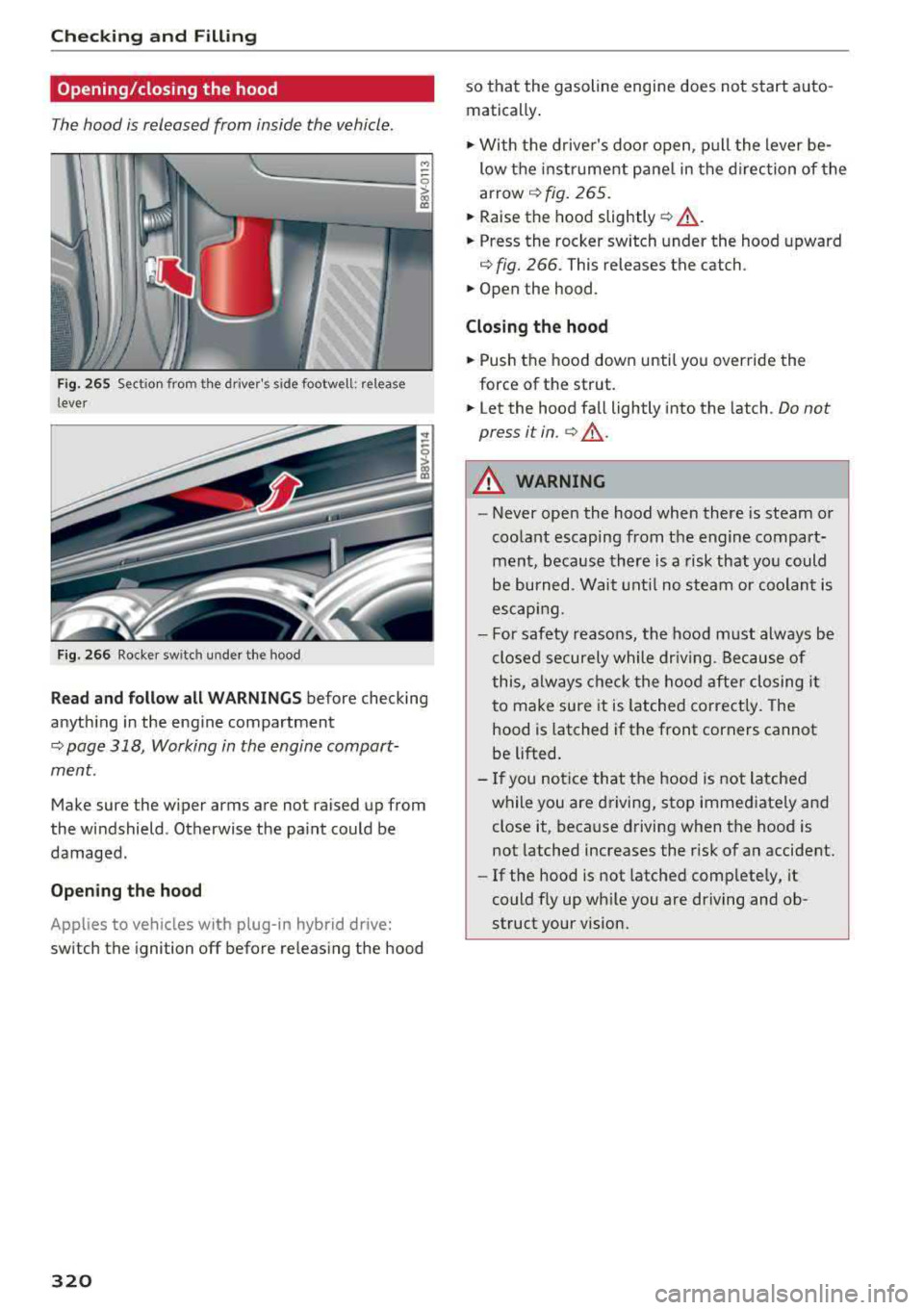
The hood is released from inside the vehicle .
Fig. 265 Sect ion from th e driver's side footwell: release
l ever
F ig. 266 Rocker switc h under the hood
Read and foll ow all WARNINGS before checking
anyth ing in the eng ine compartment
~ page 318, Working in the engine comport
ment .
Make sure the wiper arms are not raised up from
the windshield . Otherwise the pa int could be
damaged .
Opening the hood
Applies to vehicles w ith plug-in hybrid dr ive:
switch the ignition off before re leasing the hood
320
so that the gasoline engine does not start auto
matically .
.,. With the drive r's door open, p ull the lever be
low the instrument pane l in the d irec tion of the
arrow ~ fig. 265 .
... Raise the hood slightly c:> .&, .
... Press the rocker switch under the hood upward
<=:> fig. 266. This releases the catch .
... Open the hood .
Closing the hood
... Push the hood down unti l you override the
force of the strut.
... Let the hood fall lightly into the latch . Do not
press it in.
<=:> .&, .
A WARNING
-Never open the hood when there is steam or
coolant escaping from the engine compart
ment, because there is a risk that yo u could
be burned. Wait unt il no steam or coolant is
escaping.
- For safety reasons, the hood m ust always be
closed securely while driv ing. Because of
this, always c hec k t he hood after closing i t
to make sure it is latched correctly. The
hood is latched if the front corners cannot
be lifted.
- If you no tice that the hood is not latched
while you are driving, stop immediate ly and
close it, because driving when the hood is not latched increases the risk of an accident .
-If the hood is not latched comp letely, it
could f ly up wh ile you are driving and ob
struct your vision.
Page 325 of 404
u. 00 .-< N l' N .-< 0 N > 00
up, the oil consumption may increase over
time unti l replacement of worn components
may become necessary .
- With a ll these variab les coming into p lay,
no standard rate of oil consumption can be
estab lished or specified. There is no alterna
tive to checking the o il level regu larly and
frequently.
- If you have the impression your engine con
sumes excessive amounts of oil, we recom mend that you consult an authorized Aud i
dealer to have the cause of your concern properly d iagnosed . Keep in mind that the
accu rate measurement of oil consumption
r equ ires gre at ca re and may take some
time. An a uthorized Audi dea ler has instruc
tions about how to measure oil consump
tion acc urately.
- You can find information on engine oi l and
engine oil capacities for the USA at
www.audiusa.com/help/maintenance, or
for Canada at www.audi.ca/ca/web/en/
customer-area/ ca re-and-ma i ntena nee/ a ud
i
service-sched u les. html, or ca ll
800-822-2834.
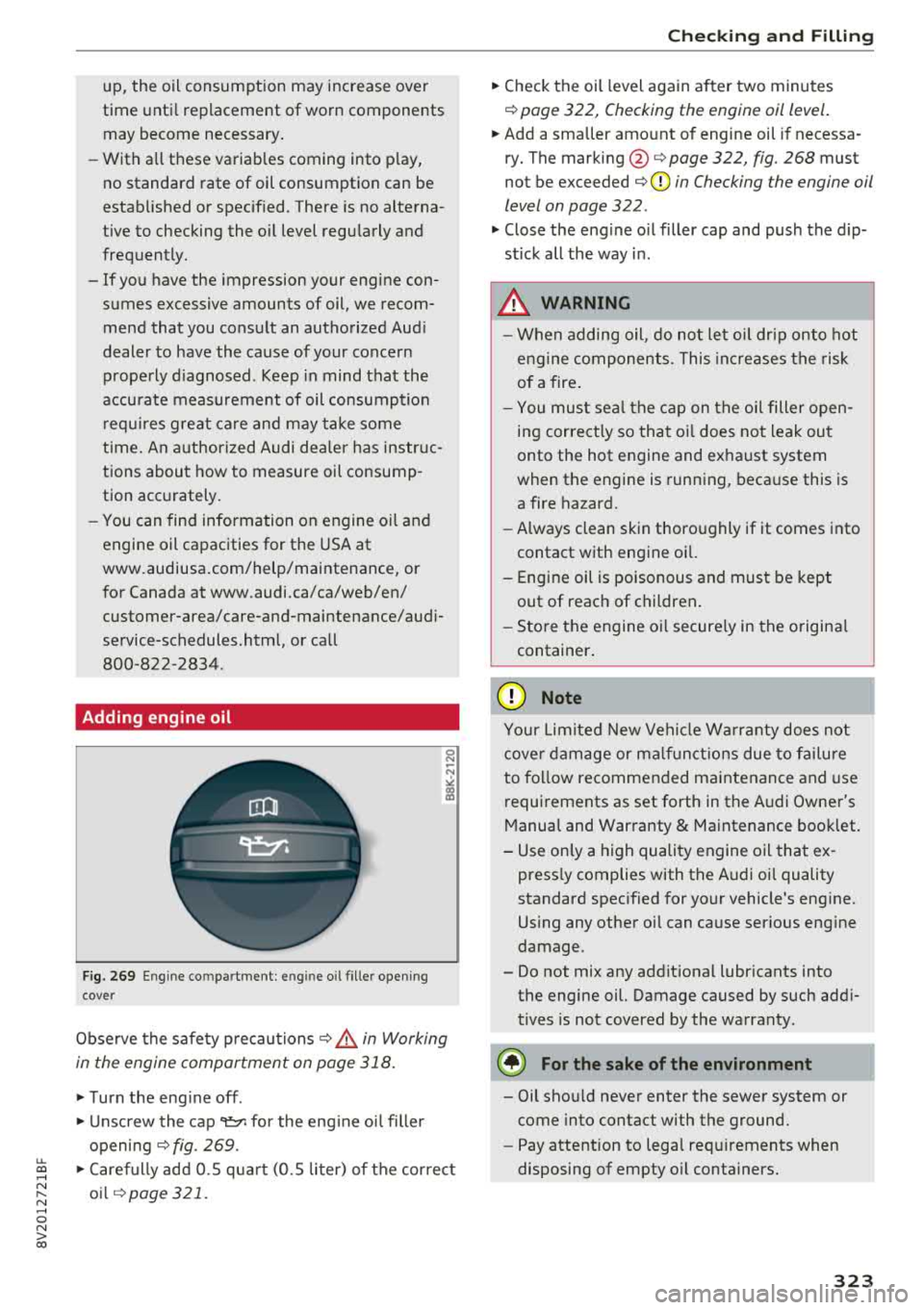
Adding engine oil
F ig. 269 Eng ine co mpartment : engin e oil fille r open ing
cover
Obse rve the safety p recautions i::> &. in Working
in the engine compartment an page 318.
.,. T urn the eng ine off .
.,. Unscrew the cap~ for the eng ine oi l filler
opening
i::> fig. 269 .
.,. Care fully add 0.5 qua rt ( 0.5 liter) of the cor rect
o il
q page 321.
Ch eck ing and F illing
.,. Check the oi l level again a fter two minutes
i::> page 322 , Checking the engine oil level .
.,. Add a smaller amo unt of engine oil if necessa
ry. The
marking @i::>page 322, fig. 268 must
not be exceeded
i::> @ in Checking the engine oil
level on page 322 .
.,. Close the engine o il filler cap and push the d ip
stick all the way i n.
.8, WARNING
-W hen adding oil, do not let o il dr ip onto hot
e ng ine components. This in cr eases the risk
of a fire .
- You mus t se al the c ap on the o il filler open
ing correct ly so tha t oi l does not leak ou t
onto the hot engine and ex haust system
when the engine is running, beca use this is
a fire hazard.
- Always clean skin thoro ughly if it comes into
contact with engine oi l.
- Engine oil is poisonous and must be kept
out of reac h of children .
- Sto re t he engine oi l secure ly in the o rigina l
container .
(Llj) Note
You r Lim ited New Veh icle Wa rra nty does no t
cove r damage or m alfu nct io ns due to f ailure
to fo llow recommended maintenance and use
requirements as set forth in the A udi Owner's
M anua l and War ranty
& Maintenance boo klet.
- Use on ly a high quality engine oil that ex -
press ly complies with the A udi oi l quality
standard spec ified for yo ur vehicle's eng ine.
Us ing any othe r oi l can cause ser ious eng ine
damage.
- Do not mix any addit iona l lubr icants into
the engine oil. Damage caused by such add i
t ives is not covered by the wa rranty.
@ For the sake of the environment
- Oil sho uld never enter the sewer system or
come into contact with the ground .
- Pay attention to lega l req uirements when
disposing of empty o il conta iners.
323
Page 327 of 404
LL co .... N
" N .... 0 N > co
Coolant additive
The coolant additive is made of anti-freezing and
corrosion protection agents. Only use the follow
ing coolant additives . These additives may be
mixed with each other .
Coolant additive Specification
Gl3 TL 774 J
Gl2++ TL 774 G
The amount of coo lant add itive that needs to be
mixed with water depends on the climate where
the vehicle will be operated .
If the coolant addi
tive percentage is too low, the coolant can freeze
and damage the engi ne.
Coolant Freeze protec-
additive tion
Warm min
.40% m in. -13 ° F
regions (-25 °C)
max. 45%
Cold min. 50% max . -40 °F
reg ions (-40 °C)
max. 55%
(D Note
- Before t he start of winter, have an author
i zed Audi dealer or author ized Audi Se rvice
Facil ity check if the coolant additive in yo ur
vehicle matches the percentage appropriate
for the climate . Th is is especially important
when driving in co lder climates .
- If the appropriate coolant additive is not available in an emergency, do not add any
other additive. You co uld damage the en
gine. If this happens, only use water and re
store the correct mixture ratio with the
spec ified coolant additive as soon as possi
ble .
- Only refill with new coo lant .
- Radiator sealant must not be mixed with
the coolant.
@ Tips
App lies to: RS models: In certain weather
conditions, moisture such as rain or snow may
evaporate on the rad iator after stopping the
Chec king and Filling
vehicle . This may cause s team to escape from
the front of the vehicle .
Adding coolant
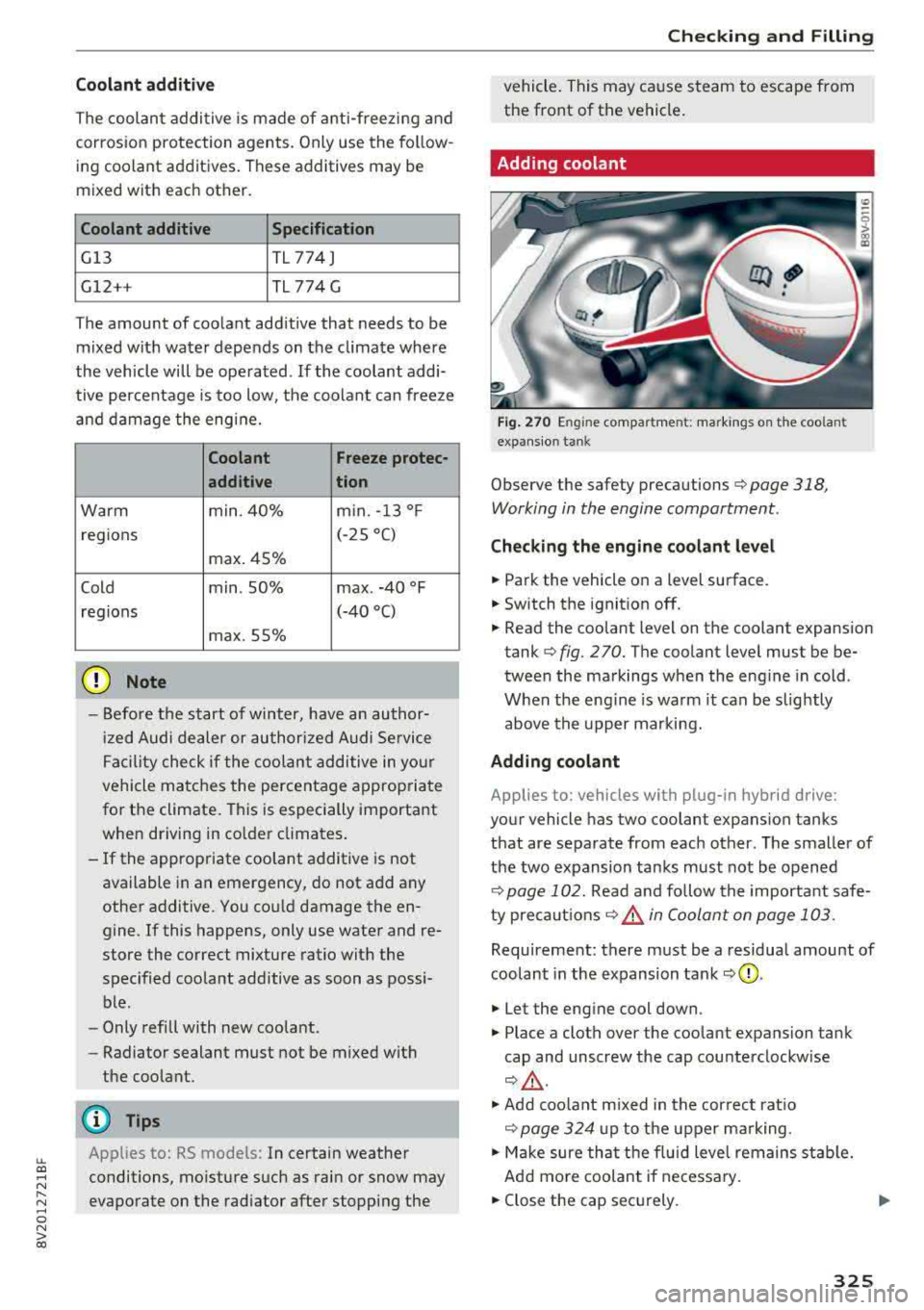
Fig . 270 E ng in e co mpa rtment: ma rkings o n th e coo lant
expansio n
tan k
Observe the safety precautions r:::;, page 318,
Working in the engine compartment .
Checking the engin e coolant level
.,. Park the vehicle o n a level surface.
.,. Switch t he ignit ion off.
.,. Read the coolant level on the coolant expansion
tank
r:::;, fig. 2 70. The coolant level must be be
tween the markings when the eng ine in cold .
W hen the eng ine is warm it can be slig htly
above the upper marking.
Adding coolant
Applies to: vehicles with plug-in hybrid drive:
your vehicle has two coolant expans ion tanks
that are separate from each other. The smaller of
the two expansion tanks must not be opened
r:::;, page 102. Read and follow the important safe
ty preca utions
r:::;, .&. in Coolant on page 103 .
Requirement: there must be a residua l amount of
coolant in the expansion tank
c::> (D .
.,. Let the eng ine cool down.
.,. Place a cloth over the coolant expansion tank
cap and unscrew the cap counterclockw ise
c::> .&_ .
.,. Add coo lant m ixed in the cor rect ra tio
r:::;, page 324 up to the upper m arking .
.,. Make sure that the f lu id leve l remains stab le.
Ad d mo re coolant if necessa ry.
.,. Close the cap securely.
325