with filter change AUDI S4 2008 Owners Manual
[x] Cancel search | Manufacturer: AUDI, Model Year: 2008, Model line: S4, Model: AUDI S4 2008Pages: 342, PDF Size: 15.01 MB
Page 95 of 342
Heating and cooling93
Controls
Safety
Driving tips
General maintenance
Self-help
Technical data
Heating and coolingDeluxe automatic air conditionerApplies to vehicles: with deluxe automatic air conditionerDescription
The air conditioner can be used to set a comfortable inte-
rior temperature in the vehicle.The air conditioner provides heatin g and ventilation and also cools
and dehumidifies the air inside the vehicle.
The air conditioner is fully automatic and will maintain the desired
temperature at a constant level. To achieve this, the temperature of
the air supplied to the interior, the blower speed (volume of air
delivery) and the air distribution are regulated automatically. The
system also allows for the effect of strong sunlight, so there is no
need for manual adjustment. For these reasons it is advisable to use
the automatic mode for the comfort of all the passengers in virtually
all conditions throughout the year ⇒page 95 .
Please note:
The humidity of the air is automatically reduced when the system
cools the interior of the vehicle. This helps to prevent condensation
on the windows.
If the humidity and temperature outside the vehicle are high,
condensation can drip off the evaporator in the air cooling system
and form a pool underneath the vehicle. This is normal and does not
indicate a leak.
If the outside temperature is low, the blower normally only switches
to a higher speed once the coolant has warmed up sufficiently (this
does not apply to the defrost setting).
In order to achieve maximum engine power, the air conditioner
compressor is temporarily switched off when pulling away from a
standstill with full throttle. The compressor also switches of
f if the coolant temperature is
excessively high, to ensure adequate engine cooling under extreme
loads.
Pollution filter
The pollution filter (a particle filt er) serves as a barrier against impu-
rities in the outside air, including dust and pollen, and odours. The
air is also filtered when the air recirculation mode is activated.
For the air conditioner to work with maximum efficiency, the pollu-
tion filter element must be replaced at the intervals specified in the
Service Schedule.
If the vehicle is driven in areas with a high level of air pollution and
the filter is no longer fully effective, it may be necessary to change
the filter element more frequently.
Key-coded settings
The currently selected air conditioner settings are automatically
stored and assigned to the remote control key.
Power management
To prevent the battery from becoming discharged and to maintain
the necessary power level, the syst em will temporarily shut off the
electrical components that are usin g a lot of power, or reduce the
current they are consuming ⇒page 226 . Heating systems in partic-
ular use a large amount of electrical power. If you notice, for
instance, that the rear window heater is not working, it may have
been temporarily switched off by the power management function,
or regulated to a lower heat output. These systems will be available
again as soon as sufficient electrical power is available.
WARNING
For safety reasons it is important that all the windows are kept
free of ice, snow and condensation. These can cause poor visibility
document_0900452a81b1b9de.book Seite 93 Donnerstag, 26. Juli 2007 9:16 09
--4 -
-T
-+ +-
Page 99 of 342
Heating and cooling97
Controls
Safety
Driving tips
General maintenance
Self-help
Technical data
The blower speed will be shown on the screen
⇒page 96, fig. 107
for a few seconds if the sound system or MMI* is switched on.
Note
•
The blower speed may change automatically. This ensures that
the selected temperature is reached as quickly as possible.
•
The blower speed cannot be regulated separately for the driver
and front passenger sides of the vehicle.
Applies to vehicles: with deluxe automatic air conditionerAir recirculation mode
The air recirculation setting prevents fumes etc. from
entering the interior.Switching on the air recirculation mode
– Press the button ⇒.
Switching off the air recirculation mode
– Press the button again, or
– Press the button, or
– Press the button.In this setting, the air is drawn from the interior of the vehicle,
filtered and continuously recirculated. We recommend using the air
recirculation mode in the following circumstances:
When driving through a tunnel or in queues of traffic, to prevent
fumes entering the interior of the vehicle.
WARNING
For reasons of safety you should not leave the air recirculation
switched on for too long. This mode prevents fresh air from entering the vehicle, so the windows can mist over if the air
cooling is switched off. Bad visibility can cause an accident.
Applies to vehicles: with deluxe automatic air conditioner Air distribution
The automatically programmed air distribution can be
altered manually if required.– Press the button for
Distribution
.
– Turn the rotary control to the desired setting.
AUTO
WARNING (continued)
Fig. 108 Air distribu-
tion button and rotary
controlFig. 109 Display: Air
distribution
document_0900452a81b1b9de.book Seite 97 Donnerstag, 26. Juli 2007 9:16 09
--4 -
-T
. I
[I]
•
D
-+
D &
D
+-
~ D
Page 103 of 342
Heating and cooling101
Controls
Safety
Driving tips
General maintenance
Self-help
Technical data
Applies to vehicles: with diesel engineSupplementary heater– Set the Supplementary heater to auto or off .Models with a diesel engine are equipped with a supplementary
heater to help warm up the interior more quickly. At outside temper-
atures below about +5 °C the supple mentary heater is switched on
(and off) automatically when the engine is running, depending on
the coolant temperature, the temperature in the vehicle interior and
the temperature the heater is set to.Deluxe automatic air conditioner plusApplies to vehicles: with deluxe automatic air conditioner plusDescription
The air conditioner is designed to keep the passenger
compartment at the temperature you find most comfort-
able at all times of the year.The air conditioner provides heatin g and ventilation and also cools
and dehumidifies the air inside the vehicle.
The air conditioner is fully automatic, and will maintain the desired
temperature at a constant level. To achieve this, the temperature of
the air supplied to the interior, the blower speed (volume of air
delivery) and the air distribution are regulated automatically. The
system also allows for the effect of strong sunlight, so there is no
need for manual adjustment. For these reasons it is advisable to use
the automatic mode for the comfort of all the passengers in virtually
all conditions throughout the year ⇒page 103 .
Please note:
The humidity of the air is automatically reduced when the system
cools the interior of the vehicle. This helps to prevent condensation
on the windows. If the humidity and temperature outside the vehicle are high,
condensation
can drip off the evaporator in the air cooling system
and form a pool underneath the vehicle. This is normal and does not
indicate a leak.
If the outside temperature is low, the blower normally only switches
to a higher speed once the coolan t has warmed up sufficiently (this
does not apply to the defrost setting).
In order to achieve maximum engine power, the air conditioner
compressor is temporarily switch ed off when pulling away from a
standstill with full throttle.
The compressor also switches of f if the coolant temperature is
excessively high, to ensure adequate engine cooling under extreme
loads.
Pollution filter
The pollution filter (a combined particle filter and activated charcoal
filter) serves as a barrier against impurities in the outside air,
including dust and pollen, and against unpleasant smells. The air is
also filtered when the air recirculation mode is activated.
For the air conditioner to work with maximum efficiency, the pollu-
tion filter element must be replaced at the intervals specified in the
Service Schedule.
If the vehicle is driven in areas with a high level of air pollution and
the filter is no longer fully effective, it may be necessary to change
the filter element more frequently.
Key-coded settings
The currently selected air conditioner settings are automatically
stored and assigned to the remote control key.
Power management
To prevent the battery from becoming discharged and to maintain
the necessary power level, the syst em will temporarily shut off the
electrical components that are usin g a lot of power, or reduce the
current they are consuming ⇒page 226 . Heating systems in partic-
ular use a large amount of electrical power. If you notice, for
document_0900452a81b1b9de.book Seite 101 Donnerstag, 26. Juli 2007 9:16 09
--4 -
-T
•
-+ +-
Page 107 of 342
Heating and cooling105
Controls
Safety
Driving tips
General maintenance
Self-help
Technical data
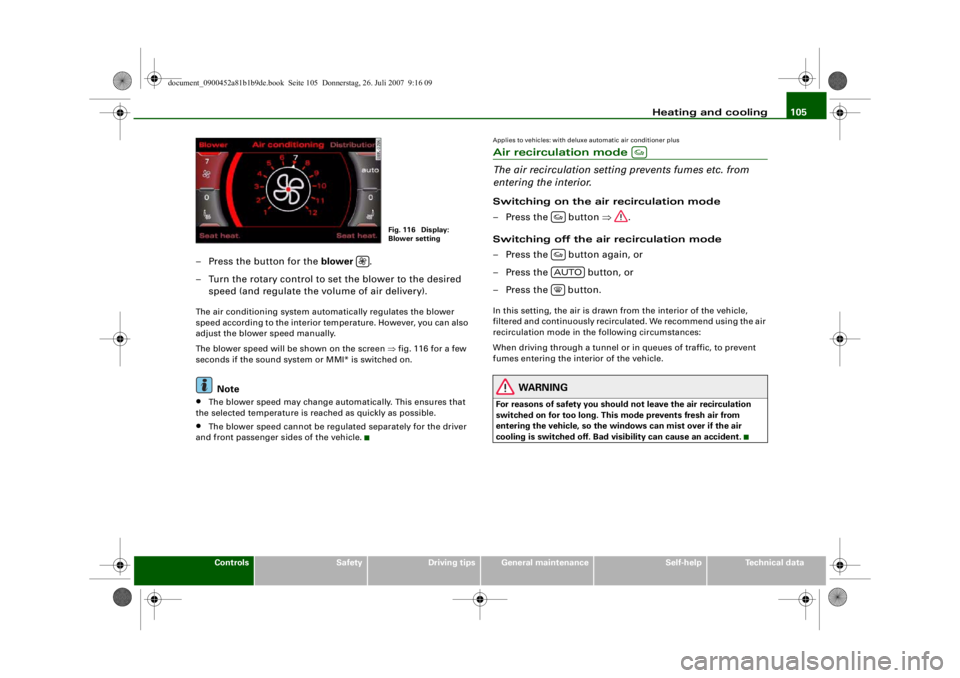
– Press the button for the blower .
– Turn the rotary control to set the blower to the desired speed (and regulate the volume of air delivery).The air conditioning system automatically regulates the blower
speed according to the interior te mperature. However, you can also
adjust the blower speed manually.
The blower speed will be shown on the screen ⇒fig. 116 for a few
seconds if the sound system or MMI* is switched on.
Note
•
The blower speed may change automatically. This ensures that
the selected temperature is reached as quickly as possible.
•
The blower speed cannot be regulated separately for the driver
and front passenger sides of the vehicle.
Applies to vehicles: with deluxe automatic air conditioner plusAir recirculation mode
The air recirculation setting prevents fumes etc. from
entering the interior.Switching on the air recirculation mode
– Press the button ⇒.
Switching off the air recirculation mode
– Press the button again, or
– Press the button, or
– Press the button.In this setting, the air is drawn fr om the interior of the vehicle,
filtered and continuously recirculated. We recommend using the air
recirculation mode in the following circumstances:
When driving through a tunnel or in queues of traffic, to prevent
fumes entering the interior of the vehicle.
WARNING
For reasons of safety you should not leave the air recirculation
switched on for too long. This mo de prevents fresh air from
entering the vehicle, so the windows can mist over if the air
cooling is switched off. Bad visibility can cause an accident.
Fig. 116 Display:
Blower setting
AUTO
document_0900452a81b1b9de.book Seite 105 Donnerstag, 26. Juli 2007 9:16 09
--4 -
-T
D
D
&
D
D C=:J D
-+ +-
(I]
I&
. I
•
Page 231 of 342
Your vehicle and the environment229
Controls
Safety
Driving tips
General maintenance
Self-help
Technical data
Your vehicle and the environmentRunning inA new vehicle should be run in over a distance of 1,500 km. For the
first 1,000 km the engine speed should not exceed 2/3 of the
maximum permissible engine speed – do not use full throttle and do
not tow a trailer or caravan. From 1,000 to 1,500 km you can gradu-
ally increase the engine rpm and road speed.
During its first few hours of running, the internal friction in the
engine is greater than later on when all the moving parts have
bedded down.
How the vehicle is driven for the first 1,500 km also influences the
engine quality. After the first 1,500 km you should continue driving
at moderate engine speeds, in particular when the engine is cold.
This helps to reduce wear and tear on the engine and increases the
potential mileage which can be covered by the engine.
You should also avoid driving with the engine speed too low.
Change down to a lower gear when the engine no longer runs
“smoothly”. Excessively high engine speeds are prevented by an
automatic rev limiter.Emission control systemsCatalytic converter
Applies to vehicles with petrol engine: The vehicle must only be
used with unleaded petrol, otherwise the catalytic converter will be
destroyed.
Never run the tank completely dry. The irregular fuel supply can
cause misfiring, which would allow unburnt fuel to enter the
exhaust system, which could cause overheating and damage the
catalytic converter. Diesel particulate filter
Applies to vehicles
with diesel engine: The diesel particulate filter
can filter out almost all soot particles contained in the exhaust gas.
In normal driving conditions the filter is self-cleaning. Should the
self-cleaning function of the filter not be able to operate, e.g. when
the vehicle is continuously used only for short trips, the filter
becomes obstructed with soot and the symbol
for the diesel
particulate filter lights up ⇒page 38 .
WARNING
•
Because of the high temperatures which can occur in the emis-
sion control system (catalytic converter or diesel particulate
filter), do not park the vehicle where the exhaust can come into
contact with flammable materials under the car (e.g. on grass or
at the forest edge). - Fire hazard!
•
Do not apply any underseal agen ts in the area around the
exhaust system - fire hazard!
How to improve economy and minimise pollutionFuel economy, environmental impact and wear on the engine,
brakes and tyres depend largely on the way you drive the vehicle. By
adopting an economical driving style and anticipating the traffic
situation ahead, you can reduce fuel consumption by 10-15%. The
following section gives you some ti ps on lessening the impact on
the environment and reducing your operating costs at the same
time.
document_0900452a81b1b9de.book Seite 229 Donnerstag, 26. Juli 2007 9:16 09
--4 -
-T
-+
•
+-
•
Page 259 of 342
Checking and topping up fluids257
Controls
Safety
Driving tips
General maintenance
Self-help
Technical data
The positions of the engine oil filler cap and the engine oil dipstick
⇒
page 256, fig. 252 (items and ) may be different on some
engine versions.
Engine oilGeneral notesWe recommend that you have the oil change carried out by an Audi
dealership / qualified workshop according to the intervals stated in
the Service Schedule or according to the service interval display in
the instrument cluster.
Whether your vehicle is serviced at flexible service intervals or fixed
service intervals is shown in the Service Schedule.
The correct oil specifications for your engine are listed in the Te c h -
nical data section ⇒page 323, “Performance, weights and dimen-
sions”.
Check that the specifications quoted (VW standards) appear on the
container either singly or in combination with other specifications.
Flexible service intervals (Audi LongLife Service*)
Special engine oils ⇒page 323, “Performance, weights and dimen-
sions” have been developed as part of the Audi LongLife Service
( ⇒ “Service Schedule”).
This type of oil must be used if you intend to take advantage of the
extended maintenance intervals allowed by the Audi LongLife
Service.•
Do not mix the LongLife oil with oil intended for fixed service
intervals, as the requirements for the extended service intervals are
then no longer guaranteed.
•
In exceptional circumstances, if the engine oil level is too low
⇒ page 258 and you cannot obtain the specified LongLife oil, you
can put in a small quantity of oil for fixed service intervals -
⇒ page 323, “Performance, weights and dimensions”. This should not be done more than once and no more than 0.5 litres should be
used.
Fixed service intervals (Inspection Service)*
If you do not take advantage of th
e LongLife service for your car, you
can use the oils for fixed service intervals - ⇒ page 323, “Perform-
ance, weights and dimensions”. In this case, your car must be serv-
iced after a fixed interval of 1 year / 15,000 km (9,000 miles) – see
Service Schedule.
•
In exceptional circumstances, if the engine oil level is too low
⇒ page 258 and you cannot obtain the oil specified for your vehicle,
you can put in a small quantity of oil conforming to the specification
ACEA A2 or ACEA A3 (petrol engines) or ACEA B3 or ACEA B4 (diesel
engines). This should not be done more than once and no more than
0.5 litres should be used.
Vehicles with diesel particulate filter*
The Service Schedule states whether your vehicle is fitted with a
diesel particulate filter.
•
Vehicles with diesel particulate filter must only be filled with
engine oil VW 507 00. This oil can be used regardless of whether the
vehicle is serviced at flexible service intervals (Audi LongLife
Service) or fixed service intervals.
•
Avoid mixing this oil with other engine oils.
•
In exceptional circumstances, if the engine oil level is too low
⇒ page 258 and you cannot obtain the oil specified for your vehicle,
you can put in a small quantity of oil conforming to the specification
VW 506 00 / VW 506 01 or VW 505 00 / VW 505 01 or ACEA B3 /
ACEA B4. This should not be done more than once and no more than
0.5 litres should be used.
A3
A4
document_0900452a81b1b9de.book Seite 257 Donnerstag, 26. Juli 2007 9:16 09
--4 -
-T
•
-+ +-
•
Page 325 of 342
Performance, weights and dimensions323
Controls
Safety
Driving tips
General maintenance
Self-help
Technical data
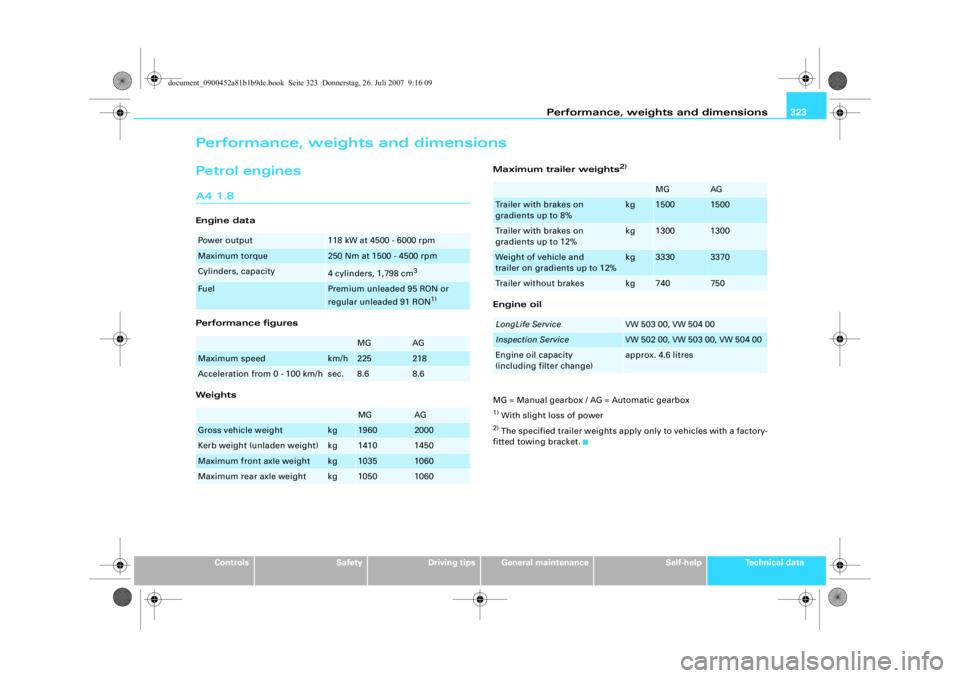
Performance, weights and dimensionsPetrol enginesA4 1.8Engine data
Performance figures
Weights Maximum trailer weights
2)
Engine oil
MG = Manual gearbox / AG = Automatic gearbox1) With slight loss of power2) The specified trailer weights apply only to vehicles with a factory-
fitted towing bracket.
Power output
118 kW at 4500 - 6000 rpm
Maximum torque
250 Nm at 1500 - 4500 rpm
Cylinders, capacity
4 cylinders, 1,798 cm
3
Fuel
Premium unleaded 95 RON or
regular unleaded 91 RON
1)
MG
AG
Maximum speed
km/h
225
218
Acceleration from 0 - 100 km/h
sec.
8.6
8.6
MG
AG
Gross vehicle weight
kg
1960
2000
Kerb weight (unladen weight)
kg
1410
1450
Maximum front axle weight
kg
1035
1060
Maximum rear axle weight
kg
1050
1060
MG
AG
Trailer with brakes on
gradients up to 8%
kg
1500
1500
Trailer with brakes on
gradients up to 12%
kg
1300
1300
Weight of vehicle and
trailer on gradients up to 12%
kg
3330
3370
Trailer without brakes
kg
740
750
LongLife Service
VW 503 00, VW 504 00
Inspection Service
VW 502 00, VW 503 00, VW 504 00
Engine oil capacity
(including filter change)
approx. 4.6 litres
document_0900452a81b1b9de.book Seite 323 Donnerstag, 26. Juli 2007 9:16 09
--4 -
-T
-+ +-
•
Page 326 of 342
Performance, weights and dimensions
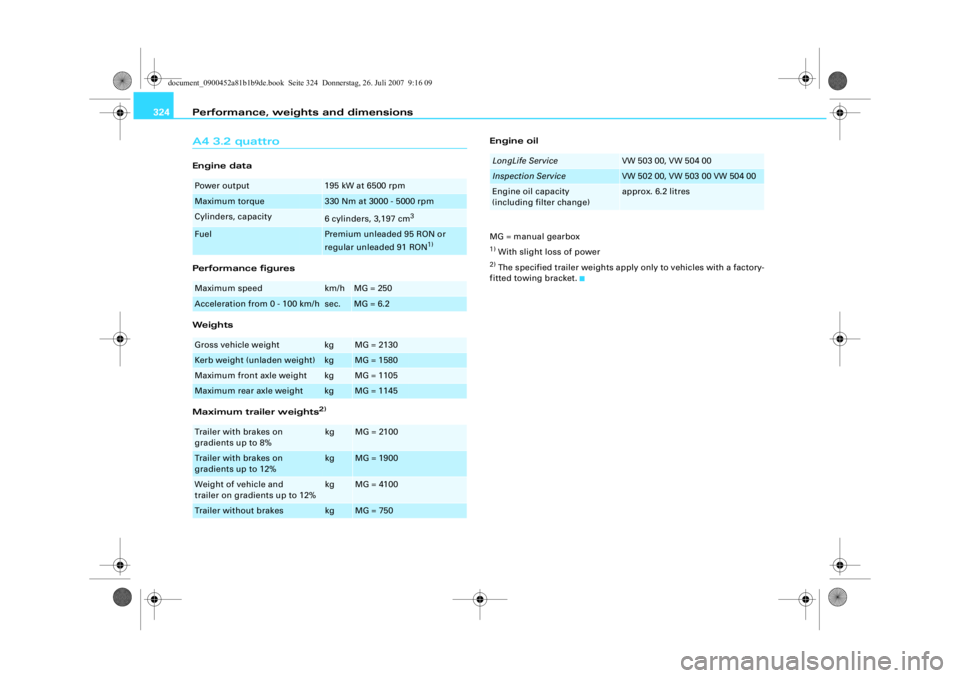
324A4 3.2 quattroEngine data
Performance figures
Weights
Maximum trailer weights
2)
Engine oil
MG = manual gearbox1) With slight loss of power2) The specified trailer weights apply only to vehicles with a factory-
fitted towing bracket.
Power output
195 kW at 6500 rpm
Maximum torque
330 Nm at 3000 - 5000 rpm
Cylinders, capacity
6 cylinders, 3,197 cm
3
Fuel
Premium unleaded 95 RON or
regular unleaded 91 RON
1)
Maximum speed
km/h
MG = 250
Acceleration from 0 - 100 km/h
sec.
MG = 6.2
Gross vehicle weight
kg
MG = 2130
Kerb weight (unladen weight)
kg
MG = 1580
Maximum front axle weight
kg
MG = 1105
Maximum rear axle weight
kg
MG = 1145
Trailer with brakes on
gradients up to 8%
kg
MG = 2100
Trailer with brakes on
gradients up to 12%
kg
MG = 1900
Weight of vehicle and
trailer on gradients up to 12%
kg
MG = 4100
Trailer without brakes
kg
MG = 750
LongLife Service
VW 503 00, VW 504 00
Inspection Service
VW 502 00, VW 503 00 VW 504 00
Engine oil capacity
(including filter change)
approx. 6.2 litres
document_0900452a81b1b9de.book Seite 324 Donnerstag, 26. Juli 2007 9:16 09
--4 -
-T
•
-+ +-
Page 327 of 342
Performance, weights and dimensions325
Controls
Safety
Driving tips
General maintenance
Self-help
Technical data
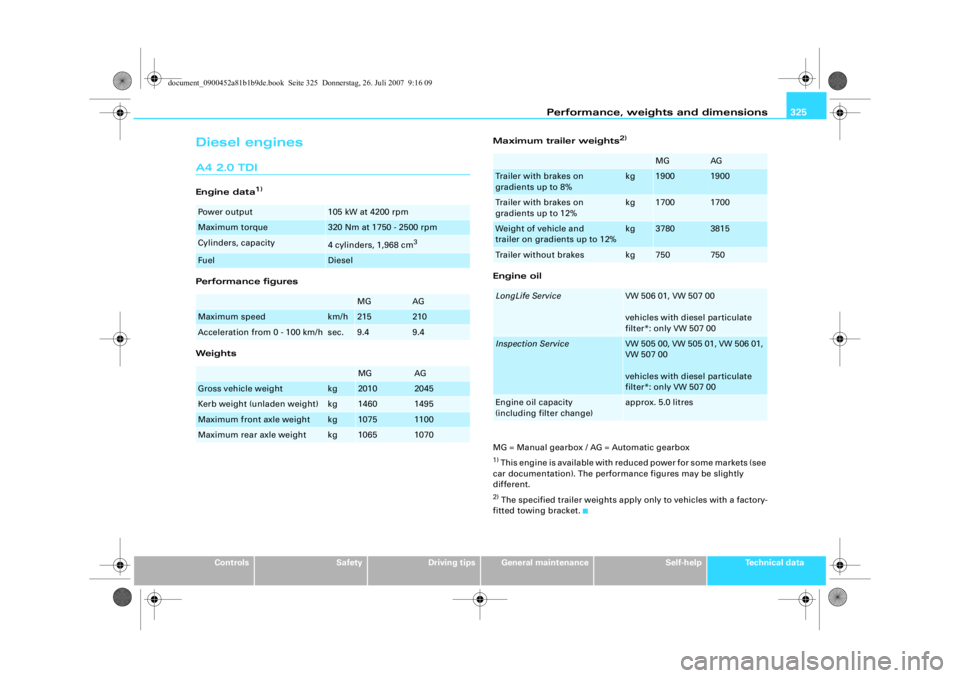
Diesel enginesA4 2.0 TDIEngine data
1)
Performance figures
Weights Maximum trailer weights
2)
Engine oil
MG = Manual gearbox / AG = Automatic gearbox1) This engine is available with reduced power for some markets (see
car documentation). The performance figures may be slightly
different.2) The specified trailer weights apply only to vehicles with a factory-
fitted towing bracket.
Power output
105 kW at 4200 rpm
Maximum torque
320 Nm at 1750 - 2500 rpm
Cylinders, capacity
4 cylinders, 1,968 cm
3
Fuel
Diesel
MG
AG
Maximum speed
km/h
215
210
Acceleration from 0 - 100 km/h
sec.
9.4
9.4
MG
AG
Gross vehicle weight
kg
2010
2045
Kerb weight (unladen weight)
kg
1460
1495
Maximum front axle weight
kg
1075
1100
Maximum rear axle weight
kg
1065
1070
MG
AG
Trailer with brakes on
gradients up to 8%
kg
1900
1900
Trailer with brakes on
gradients up to 12%
kg
1700
1700
Weight of vehicle and
trailer on gradients up to 12%
kg
3780
3815
Trailer without brakes
kg
750
750
LongLife Service
VW 506 01, VW 507 00
vehicles with diesel particulate
filter*: only VW 507 00
Inspection Service
VW 505 00, VW 505 01, VW 506 01,
VW 507 00
vehicles with diesel particulate
filter*: only VW 507 00
Engine oil capacity
(including filter change)
approx. 5.0 litres
document_0900452a81b1b9de.book Seite 325 Donnerstag, 26. Juli 2007 9:16 09
--4 -
-T
-+ +-
•
Page 328 of 342
Performance, weights and dimensions
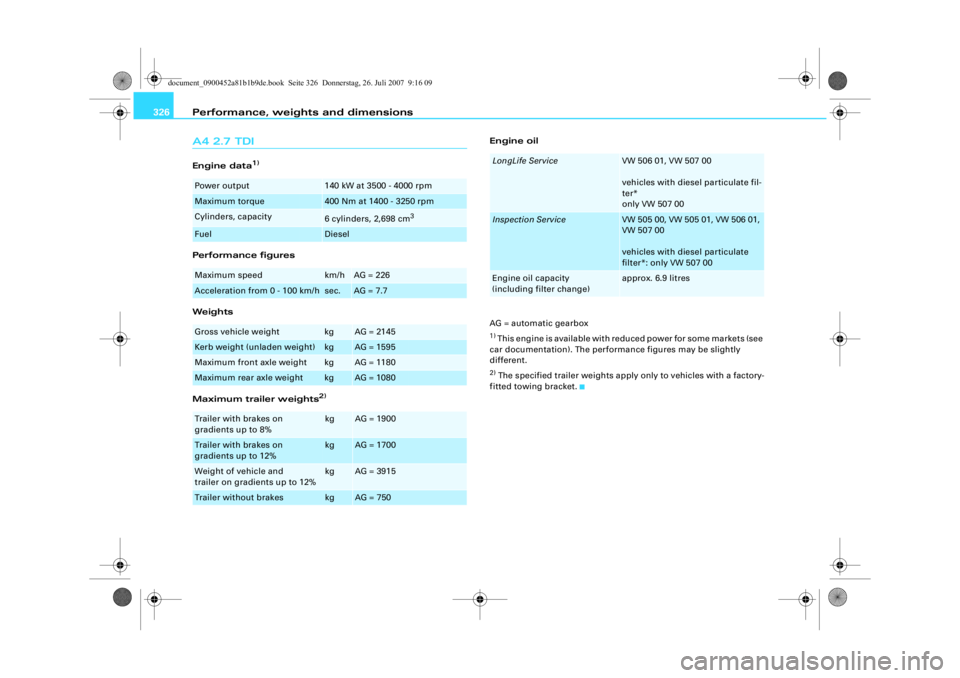
326A4 2.7 TDIEngine data
1)
Performance figures
Weights
Maximum trailer weights
2)
Engine oil
AG = automatic gearbox1) This engine is available with reduced power for some markets (see
car documentation). The performance figures may be slightly
different.2) The specified trailer weights apply only to vehicles with a factory-
fitted towing bracket.
Power output
140 kW at 3500 - 4000 rpm
Maximum torque
400 Nm at 1400 - 3250 rpm
Cylinders, capacity
6 cylinders, 2,698 cm
3
Fuel
Diesel
Maximum speed
km/h
AG = 226
Acceleration from 0 - 100 km/h
sec.
AG = 7.7
Gross vehicle weight
kg
AG = 2145
Kerb weight (unladen weight)
kg
AG = 1595
Maximum front axle weight
kg
AG = 1180
Maximum rear axle weight
kg
AG = 1080
Trailer with brakes on
gradients up to 8%
kg
AG = 1900
Trailer with brakes on
gradients up to 12%
kg
AG = 1700
Weight of vehicle and
trailer on gradients up to 12%
kg
AG = 3915
Trailer without brakes
kg
AG = 750
LongLife Service
VW 506 01, VW 507 00
vehicles with diesel particulate fil-
ter*
only VW 507 00
Inspection Service
VW 505 00, VW 505 01, VW 506 01,
VW 507 00
vehicles with diesel particulate
filter*: only VW 507 00
Engine oil capacity
(including filter change)
approx. 6.9 litres
document_0900452a81b1b9de.book Seite 326 Donnerstag, 26. Juli 2007 9:16 09
--4 -
-T
-+ +-
•