light AUDI S4 2014 Owners Manual
[x] Cancel search | Manufacturer: AUDI, Model Year: 2014, Model line: S4, Model: AUDI S4 2014Pages: 296, PDF Size: 73.56 MB
Page 203 of 296
Trailer towing Driving with a trailer
General information
Your Audi was designed primarily for passen
ger transportation .
If you plan to tow a tra iler, p lease remember
that the addit ional load will affect durab ility,
economy and performance .
T railer towing not on ly places more stress on
the vehicle, it also calls for more concentra
tion from the driver.
F or this reason, a lways fo llow the operating
and driving instructions provided and use
common sense.
Technical requirements
Traile r hitch
Use a weight-carrying hitch conforming to the
gross trailer we ight. The hitch must be suita
b le for your veh icle and trailer and must be
mounted secure ly on t he veh icle's chassis at a
technically sound location . Use only a t railer
h itch w ith a removab le ball moun t. A lways
check with the tr ailer hitch man ufac tur er to
make sure that you are using the correct
hitch.
Do not use a bumper hitch.
T he hitc h must be installed in such a way that
it does not inte rfe re with the impac t-absorb
i ng b umper syst em. No modifica tions should
be made to the vehicle exhaus t and b rake sys
tems . From t ime to time, check that a ll hitch
mo unt ing bolt s remain securely fas tened.
W hen you are not tow ing a trailer, remove the
trai le r hi tch ball moun t. T h is prevents the
hi tch from causing damage sho uld your ve hi
cle be str uck from be hind
¢ &. .
Trailer brakes
If yo ur tra iler is equ ipped w it h a braking sys
tem, check to be su re that it conforms to a ll
r eg ulat io ns.
Trailer towin g 201
The trailer hyd ra ulic bra ke system must not be
direct ly connected to the vehicle's hydraulic
brake system
¢ &. .
Safety chains
Alw ays use s afety chains between your ve hicle
and t he tra ile r.
Trailer lights
Tra ile r lights m ust meet all reg ulations . Be
su re to check w ith your authorized Audi dealer
fo r c orrec t w iri ng, sw itches, and relays.
Mirrors
If you a re unable to see the traffic behind you
u sing the regula r outside m irrors, then you
must insta ll ext ended mir ro rs. It is important
t h at you
always have clea r vis io n to the rear .
.8, WARNING
- If a trai ler has elec trica l br ake s plea se
no te th at t hese bra kes are not activat ed
by the fa ctory -fit ted control unit -risk of
accident!
- After removing the t railer hi tch, do no t
s to re it in yo ur vehicle . In case of sudden
brak ing, the hitch could fly fo rward and
in ju re you or yo ur passenge rs .
Operating instructions
Maximum traile r we ight
-
A trai ler fo r you r vehicle is limited to a typical
class 1 or class 2 tra iler.
Trailer load distribution
B e sure the lo ad in the tra iler is h eld secure ly
i n p lace to p reven t it from shifting fo rward,
backward or sideways.
Never allow a passenger to ride in a trailer
¢ &. in Driving instru ctions on page 20 2.
Engine cooling system
Towing a t railer ma kes t he engine wor k hard
er . It is impo rta nt that the cooling system's
perfo rman ce is up to the additional load.
Make sure tha t the coo ling sys tem h as enough
f lu id . .,..
•
•
Page 204 of 296
202 Trailer towing
Tire pressure
When towing a trailer, inflate the tires of your
vehicle to the cold tire pressure listed under
"Full load" on the label located on the driver's
side B-pillar (visible when the door is open).
Inflate trailer tires to trailer and tire manufac
turers' specifications.
Lights
The headlight settings should be checked with
the trailer attached before driving off. Check
to make sure both vehicle and trailer lights
are working properly.
Safety chains
Be sure trailer safety chains are properly con
nected from the trailer to the hitch on the ve
hicle. Leave enough slack in the chains to per
mit turning corners. When you install safety
chains, make sure they will not drag on the road when you are driving.
The chains should cross under the trailer
tongue to prevent it from dropping in case of
separation from the hitch.
Driving instructions
Driving with a trailer always requires extra
care and consideration.
To obtain the best possible handling of vehicle
and trailer, please note the following:
.,. Do not tow a loaded trailer when your car it
self is not loaded.
.,. Be especially careful when passing other
vehicles.
.,. Observe speed limits .
.,. Do not drive at the maximum permissible
speed.
.,. Always apply brakes early.
.,. Monitor the temperature gauge.
Weight distribution
Towing a loaded trailer with an empty car re
sults in a highly unstable distribution of
weight . If this cannot be avoided, drive at very
low speeds only to avoid the risk of losing
steering control. A "balanced" rig is easier
to operate and con
trol. This means that the tow vehicle should be loaded to the extent possible and permissi
ble, while keeping the trailer as light as possi
ble under the circumstances. Whenever possi
ble, transfer some cargo to the luggage com
partment of the tow vehicle while observing
tongue load requirements and vehicle loading
considerations.
Speed
The higher the speed, the more difficult it be
comes for the driver to control the rig. Do not
drive at the maximum permissible speed. Re
duce your speed even more if load, weather or
wind conditions are unfavorable -particularly
when going downhill.
Reduce vehicle speed
immediately if the trail
er shows the slightest sign of swaying .
Do not
try to stop the swaying by accelerating.
Observe speed limits. In some areas, speeds
for vehicles towing trailers are lower than for
regular vehicles .
Always apply brakes early. When driving downhill, shift into a lower gear to use the en
gine braking effect to slow the vehicle . Use of
the brakes alone can cause them to overheat
and fail.
Coolant temperature
The coolant temperature gauge c> page 10
must be observed carefully . If the needle
moves close to the upper end of the scale, re
duce speed immediately and/or turn off the
air conditioner.
If the coolant temperature warning light •
in the instrument cluster starts flashing, pull
off the road, stop and let the engine
idle for
about two minutes to prevent heat build-up .
_& WARNING
Anyone not properly restrained in a mov
ing vehicle is at a much greater risk in an
accident. Never let anyone ride in your car
who is not properly wearing the restraints
provided by Audi.
-
Page 207 of 296
Vehicl e ca re a nd cl eanin g 205
A WARNING
-Only wash the vehicle when the ignition
is off and follow the instructions from
the car wash operator to reduce the risk of accidents .
- To reduce the r isk of cuts, protect your
self from sharp metal components when
wash ing the underbody or the inside of
t he wheel housings.
- After washing the vehicle, the braking ef
fec t may be delayed due to mo isture on
the brake rotors or ice in the winter. The
brakes must be dried first with a few
careful brake applications.
Q) Note
- If you wash t he vehicle in an automatic
car wash, yo u must fold the exterior m ir
rors in to reduce the r is k of damage to
the mirrors. Power folding exterior mir
rors* must only be folded in and out us
ing the power folding function.
- To prevent paint damage, do not wash
the vehicle in direct sunlight . -
To reduce the risk of damage to the sur
face, do not use insect removing spong
es, kitchen sponges or similar items.
- Matte finish painted vehicle compo
nents:
- To reduce the risk of damage to the surface, do not use polishing agents or hard wax.
- Never use car wash cycles that apply protective wax.
It can destroy the
matte fi nish effect.
- Do not place any stickers or magnet ic
signs on vehicle parts painted w ith
matte fi nish paint. The paint cou ld be
damaged when the stickers o r magnets
are removed.
@ For the sake of the environment
Only wash the vehi cle in facilities spec ial ly
designed for that purpose . This will red uce
the risk of dirty water contam inated with
oil from entering the sewer system.
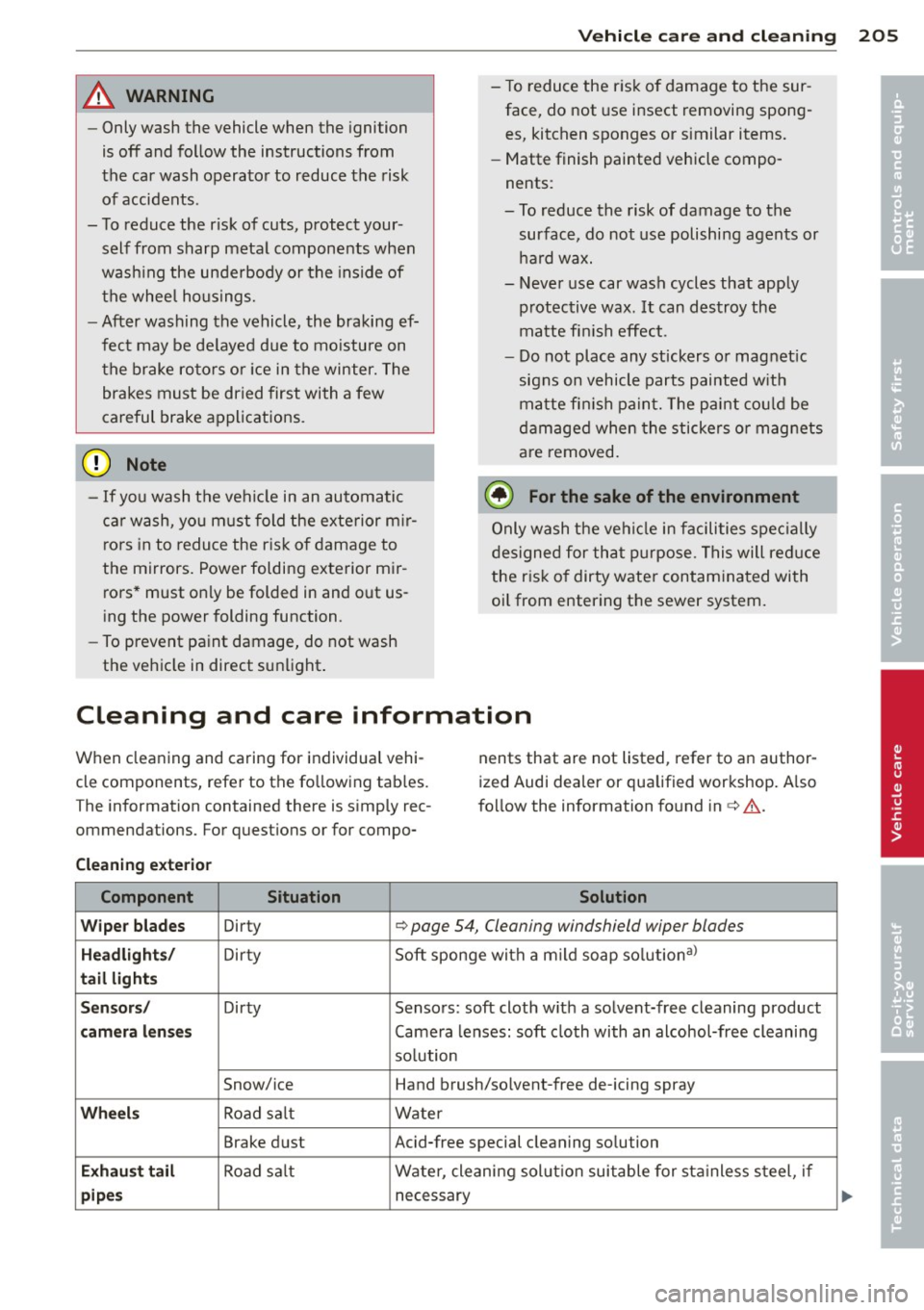
Cleaning and care information
When cleaning and caring for individual vehi
cle components, refer to the fo llow ing tables .
The information contained there is s imply rec
ommendations. For quest ions or for compo- nents
that are not listed, refer to an author
ized Audi dea ler or qualified workshop. A lso
fo llow the information found inc>,& .
Cle anin g exter ior
Component Situation Solution
Wiper b lades
Dirty i=> page 54, Cleaning windshield wiper blades
Headligh ts / Dirty Soft
sponge with a m ild soap solutional
tail light s
S ensor s/
Dirty Sensors: soft cloth with a solvent-free cleaning product
camera l enses Camera lenses: soft cloth with an alcohol-free cleaning
solution
Snow/ice Hand brush/solvent-free de-icing spray
Wheels Road sa lt Water
Brake dust Acid-free special cleaning solution
Exhau st t ail Road sa lt Water, cleaning solut ion suitable for sta inless steel, if
pi pes necessary
•
•
Page 209 of 296
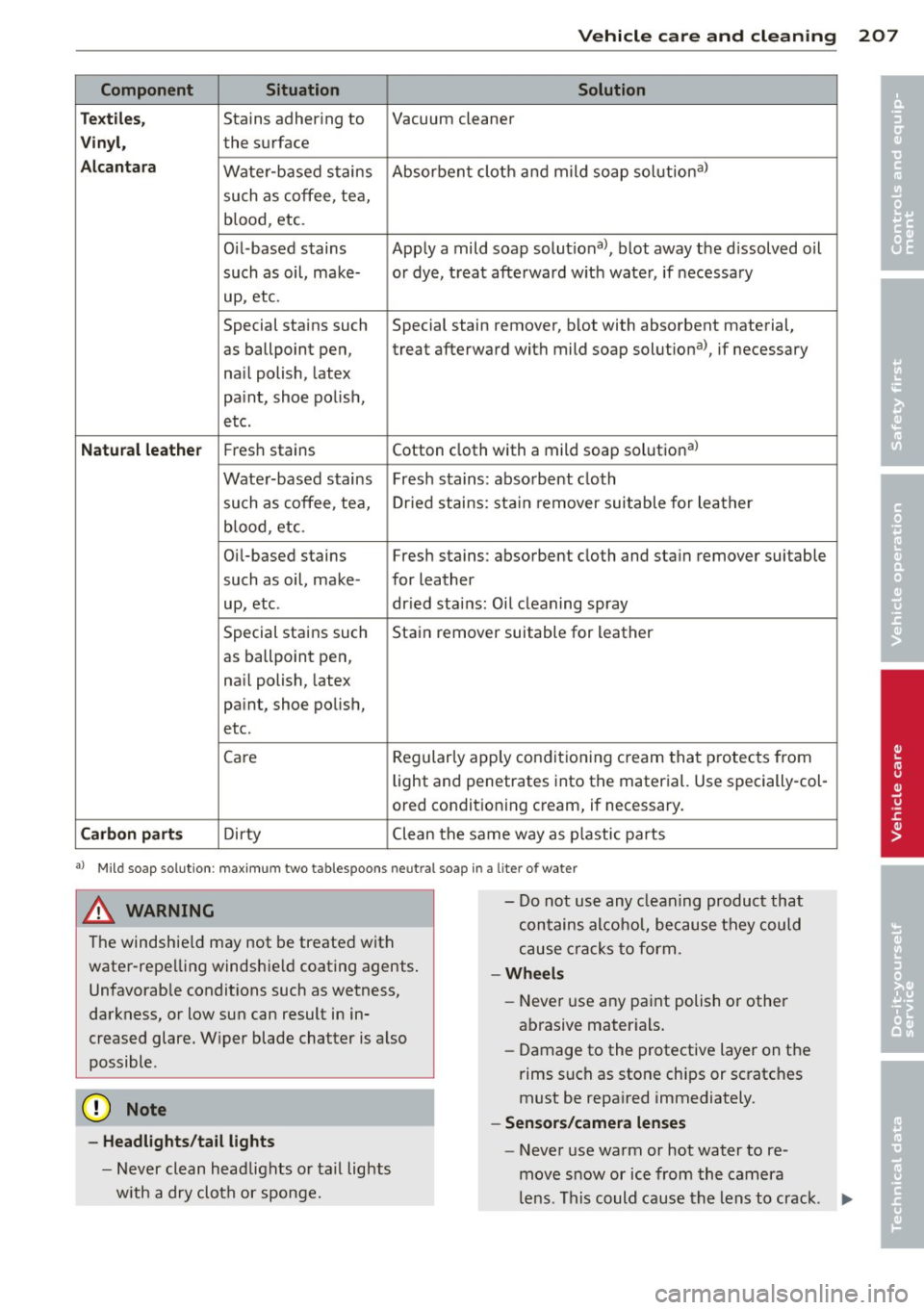
Vehicle care and cleaning 207
Component Situation Solution
Te xtile s,
Stains adhering to Vacuum cleaner
Vinyl, the surface
Alcantara Water-based stains Absorbent cloth and mild soap solutiona>
such as coffee, tea, blood, etc.
Oil-based stains Apply a mild soap solutiona>, blot away the d issolved oil
such as oil, make- or dye, treat afterward w ith water, if necessary
up, etc.
Special stains such Special stain remover, blot with absorbent material,
as ballpoint pen, treat afterward with mild soap solutiona>, if necessary
na il polish, latex
pa int, shoe polish,
etc.
Natural leather Fr es h stains Cotton cloth with a mild soap solutiona)
Water-based stains Fresh sta ins: absorbent cloth
such as coffee, tea, Dr ied stains: sta in remover suitable for leather
blood, etc.
Oil-based stains Fresh sta ins: absorbent cloth and stain remover suitable
such as oil, make- for leather
up, etc . dried sta ins: Oil cleaning spray
Special stains such Stain remover suitable for leather
as ballpo int pen,
na il polish, latex
pa int, shoe polish,
etc .
Care Regularly
apply conditioning cream that protects from
light and penetrates into the material. Use specially-col-
ored conditioning cream, if necessary.
Carbon parts Dirty Clean the same way as plastic parts
al Mild soap solution: maximum two tablespoons neut ral soap in a liter of water
& WARNING
The windshie ld may not be treated with
water-repelling windshie ld coating agents .
Unfavorab le conditions such as wetness,
darkness, or low sun can result in in
creased glare. W iper blade chatter is also
possible.
- Headlights/tail lights
- Never clean headlights or tail lights
w ith a dry cloth or sponge. -
Do not use any cleaning product that
contains alcohol, because they could
cause cracks to form .
-Wheels
-Never use any paint polish or other
abrasive mater ials.
- Damage to the protective layer on the
rims such as stone chips or scratches
must be repaired immediately.
- Sensors/camera lenses
- Never use warm or hot water to re-
move snow or ice from the camera
len s. This could cause the lens to crack .
IJII>
•
•
Page 210 of 296
208 Ve hicl e ca re and cle aning
- Never use abrasive cleaning materials
or alcoho l to clean the camera lens.
T his could cause scratches and cracks .
-Window s
-Remove snow and ice on w indows and
exterior mirrors with a plastic scraper.
To avoid scratches, move the scraper only in one direction and not back and
forth.
- Never remove snow or ice from win
dows and mirrors using warm or hot
wate r be cause this cou ld cause c rac ks
to form .
- To avoid damage to the rear window
defogger, do not apply any stickers on
the heating wires on the inside of the
w indow .
-De co ra tive p arts/tr im
-Never use chrome care or cleaning
products.
- Paint
-To reduce the risk of scratches, the ve-
hicle must be free of dirt and dust be
fore polishing or waxing.
- To prevent paint damage, do not polish
or wax the veh icle in direct sun light.
- To reduce the risk of paint damage, do
not polish away rust film .
-Di spla ys
- To avoid scratches, do not use dry
cleaning methods on displays .
-Controls
- Make s ure that no f lu ids enter the con-
trols, because th is could cause dam
age.
- Sa fet y belts
- Do not remove the safety belts to clean
them.
- Never clean safety belts o r their com
ponents chemically or wi th cor ros ive
fluids or so lvents and never a llow
sharp objects to come into contact
with the safety belts . This cou ld cause
damage to the belt webbing.
- If there is damage to the webbing , the
connections, the retractors or the buc k- Les, have them replaced by an author
ized Audi dealer or qualified workshop
.
-Te xtiles /V in yl/Alc an ta ra
-Never treat V inyl/ Alcantara w ith leath-
er care products, solvents, floor polish,
shoe polish, stain remover or similar products .
- To avoid damage, have stubborn stains
removed by an authorized Aud i dealer
or qua lified workshop .
- Never use steam cleaners, brushes, hard sponges, etc. when cleaning .
- Do not turn on the seat heating* to dry
the seat.
- Objects w ith sharp edges such as zip
pers, rivets on clothing or belts can
cause damage to the surface .
- Open hook and loop fasteners, for ex
ample on cloth ing, can damage seat
covers. Make sure hook and loop fas
tene rs are closed .
-Natural l eath er
- Neve r treat leather with solvents, floo r
polish, shoe polish, stain remover or
similar products.
- Objects with sharp edges such as zip
pers, rivets on clothing or be lts can
cause damage to the surface.
- Neve r use steam cleaners, br ushes,
hard sponges, etc . when cleaning .
- Do not turn on the seat heating* to dry the seat.
- To help prevent the leather from fad
ing, do not leave the vehicle in direct
sunlight for long periods of time. If leaving the vehicle parked for long pe
riods of time, you should cover the
leather to protect it from d irect sun
light .
(D Tips
-Insects are easier to remove from paint
that has been freshly waxed.
- Regular waxing can prevent rust film from forming.
Page 216 of 296
214 Checking and filling
Checking and filling
Engine hood
Releasing and opening the engine hood
The engine hood is released from inside the
vehicle .
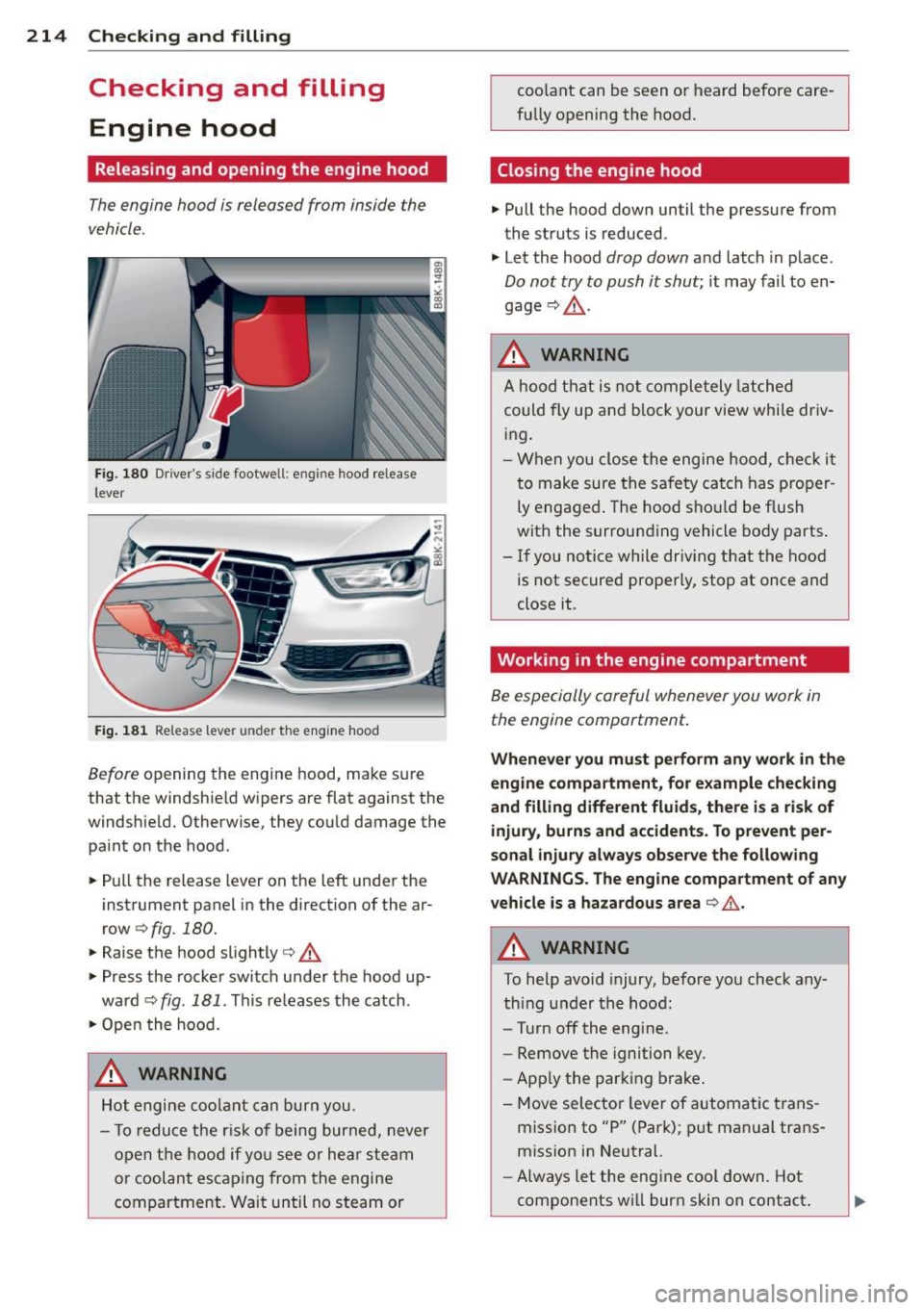
Fig. 180 Driver's side footwe ll: e ngin e hood release
lever
... -- - -=-
Fig. 181 Release lever u nde r the engine hood
Before opening the engine hood, make sure
that the windshield wipers are flat against the
windshield. Otherwise, they could damage the
pa int on the hood.
... Pull the release lever on the left under the
instrument panel in the direction of the ar
row
c;, fig . 180.
... Raise the hood slightly r::;, .&,
... Press the rocker switch under the hood up
ward
c;, fig . 181 . This releases the catch.
... Open the hood.
A WARNING
Hot engine coo lant can burn you.
- T o reduce the risk of being burned, never
open the hood if you see or hear steam
or coolant escaping from the engine
compartment. Wait until no steam or coo
lant can be seen or heard before care
fully opening the hood.
Closing the engine hood
... Pull the hood down until the pressure from
the struts is reduced .
... Let the hood
drop down and latch in place.
Do not try to push it shut; it may fail to en
gage
r::;, .&, .
A WARNING
-
A hood that is not completely latched
could fly up and b lock your view while driv
ing.
- When you close the engine hood, check it
to make sure the safety catch has proper
ly engaged . The hood shou ld be flush
with the surrounding vehicle body parts.
-If you notice while driving that the hood
is not secured properly, stop at once and
close it.
Working in the engine compartment
Be especially careful whenever you work in
the engine compartment.
Whenever you must perform any work in the
engine compartment, for example checking
and filling different fluids , there is a risk of
injury , burns and accidents. To prevent per
sonal injury always observe the following
WARNINGS. The engine compartment of any
vehicle is a hazardous area
r::;, ,&..
A WARNING
-To help avoid injury, before you check any-
thing under the hood:
- Turn off the engine.
- Remove the ignition key.
- Apply the parking brake.
- Move selector lever of automatic trans-
mission to "P" (Park); put manual trans
mission in Neutral.
- Always let the engine cool down. Hot
components will burn skin on contact .
Page 218 of 296
216 Checking and filling
Engine compartment
Engine compartment
These are the most important items that you can check.
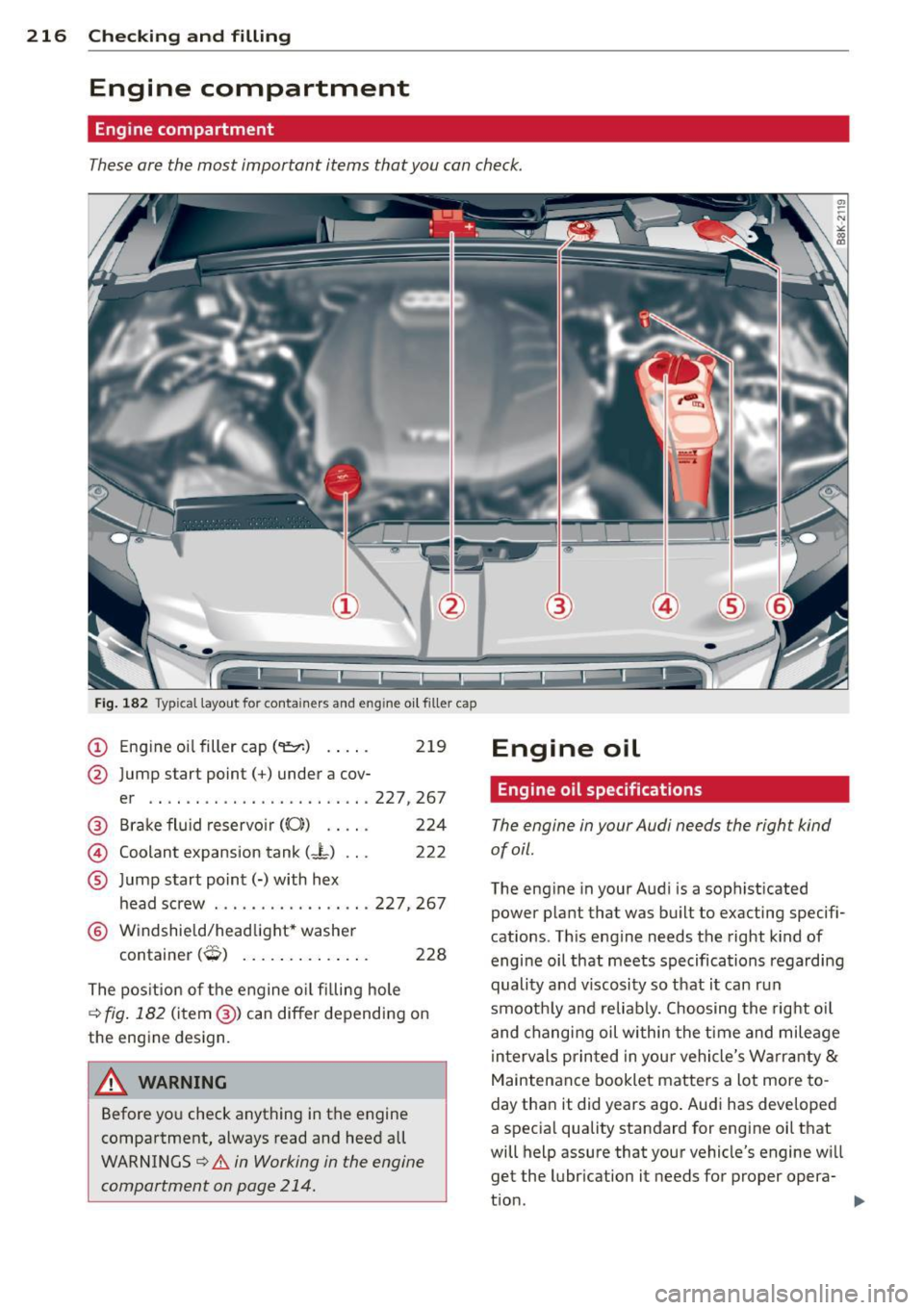
Fig. 182 Typical layout for containers and eng ine o il filler cap
(D Eng ine o il filler cap ("1::::r.) . . . . . 219
@ Jump start point(+) under a cov-
er .. .. .... ... ....... .... ..
227,267
@ Bra ke fluid reservo ir (0)) . . . . . 224
@ Coolant expansion tank (-L) . . . 222
® Jump start point(-) with hex
head sc rew ..... .......... ..
227, 267
® W indshield/headlight* washer
. (" ') container o ....... . ... .. . 228
The pos ition o f the engine o il fi lling hole
¢ fig . 182 (item @) can differ depending on
the eng ine design.
A WARNING
Before yo u check anything in the engine
compartment, always read and heed all
WARNINGS ¢.&. in Working in the engine
compartment on page 214.
-
Engine oil
· Engine oil specifications
The engine in your Audi needs the right kind
of oil.
The eng ine in your Audi is a sophist icated
power plant that was b uilt to exacting specifi
cations . Th is engine needs the right k ind of
engi ne oil that meets specifica tions regard ing
quality a nd v iscosity so that it can run
smooth ly and reliab ly. Choosing the rig ht o il
and changing oil within the t ime and mile age
i n tervals prin ted in you r vehicle's Warr anty
&
Maintenance booklet matters a lot more to
day tha n it did years ago . Aud i has deve loped
a spec ia l quality standard for engine oil that
will help assure that your vehicle 's engine w ill
get the lubr ication it needs for proper opera-
t ion . ..,_
Page 220 of 296
218 Checking and filling
temperatures stay below freezing point for long periods.
Detergent additives in the oil w il l make fresh
oil look dark after the eng ine has been run
ning for a short time . This is norma l and is not
a reason to change the oi l more often than
recommended.
Damage or malfun ctions due to lack of
maintenance
It is essential that you change your oil at the
recommended intervals using only engine o il
that complies with Audi oi l standard
VW 502 00. Your Limited New Vehicle War
ranty does not cover damage or malfunctions
due to fail ure to fo llow recommended mainte
nance and use requ irements as set forth in
the Audi Owner's Manual and Warranty
&
Maintenance booklet . Your dealer will have to
deny warranty coverage unless you present to
the dea ler proof in the form of Service or Re
pa ir Orders that all scheduled ma intenance
was performed in a timely manner.
Eng ine oil consumption
The engine in your vehicle depends on an ade
quate amount of oil to lubricate and cool all
of its moving parts.
In order to provide effective lubrication and
cool ing of internal engine components, all in
ternal combustion eng ines consume a certain
amount of oil. O il consumption varies from
engine to engine and may change significantly
over the life of the engine. Typically, engines
with a specif ied break-in period (see
¢
page 195) consume more oil during the
break-in period than they consume after oil
consumption has stabilized.
Under normal conditions, the rate of oil con
sumption depends on the quality and viscosity
of the oil, the RPM (revolutions per minute) at
which the engine is operated, the ambient
temperature and road condit ions . Further fac
tors are the amount of oil d ilution from water
condensat ion or fuel residue and the oxida
tion level of the oil. As any engine is subject to wear as mi
leage builds up, the oil consump
tion may increase over time until replacement
of worn components may become necessary.
With all these variab les coming into play, no
standard rate of oil consumption can be es
tablished or specified. There is no alternative
to regu lar and frequent check ing of the o il lev
el, see
Note .
If the yellow engine oil leve l warning symbo l
Ill in the instrument cluster lights up, you
shou ld check the oil leve l as soon as possib le
¢
page 219. Top off the oil at your earliest
convenience ¢
page 219.
A WARNING '"---
Before you check anythi ng in the engine
compartment, always read and heed all
WARNINGS¢
A in Working in the engine
compartment on page 214.
(D Note
Driving w ith an insufficient o il level is like
ly to cause severe damage to the engine .
(D Tips
-The oil pressure warning display. is
not an indicator of the oil level. Do not
rely on it. Instead, check the oil level in
your engine at regular intervals, pref erably each time you refuel, and always
before going on a long trip.
- If you have the impression your engine
consumes excessive amounts of oil, we
recommend that you consult an author
ized Audi dealer to have the cause of
your concern properly diagnosed. Keep in
m ind that the accurate measurement of
oil consumption requ ires great care and
may take some time. An authorized Aud i
dea ler has instructions about how to
measure oil consumption accurately.
-
Page 224 of 296
222 Check ing and filling
level should be between the "MIN" and
"MAX" markings. When the engine is warm,
the leve l may be slightly above the "MAX"
marking .
The location of the coolant expansion tank
can be seen in the engine compartment illus
tration
c:> page 216.
To obtain an accurate reading, the engine must be switched
off.
The expansion tank in you r vehicle is equipped
with an e lectric coolant level sensor.
When the coolant level is too low, the warning light in the Auto-Check System
c:> page 17will
b link until you add coo lant and the level has
been restored to no rma l. Even though there is
an electric coolant level sensor, we still rec
ommend you check the coolant leve l from
time to time.
Coolant loss
Coolant loss may indicate a leak in the cool ing
system. In the event of coolant loss, the cool
ing system should be inspected immediately
by your authorized A udi dealer.
It is not
enough merely to add coolant.
I n a sealed system, losses can occur only if
the boiling point of the coolant is exceeded as
a result of overheat ing.
A WARNING
The cooling system is unde r pressure and
can get very hot. Reduce the risk of scald
ing from hot coolant by following these
steps .
- Turn
off the engine and allow it to cool
dow n.
- Protect yo ur face, hands and arms from
escaping fluid and steam by covering the
cap with a large, thick rag .
- Turn the cap slowly and very carefully in
a counter-clockwise direction wh ile ap
plying light, downward pressure on the
top of the cap .
- To avoid be ing burned, do not spill ant i
freeze or coolant on the exhaust system
'
or hot engine parts. Under certa in cond i
tions, the ethylene glycol in engine coo l
ant can catch fire.
(D Note
Do not a dd any type of radiator leak sea l
ant to your veh icle's engine coolant. Add
i ng radiator repa ir fl uid may adverse ly af
fect the funct ion and performance of your
cooling system and could result in damage
not covered by your New Veh icle L imited
War ranty .
Adding coolant
Be very careful when adding engine coolant.
Before you check anyth ing in the eng ine com
partment, always read and heed all WARN
INGS
c:> A in Working in the engine compart
ment on page 214 .
Requirement: There m ust be a res idual
amount of coo lant in the expans ion tank
c:> (]) .
.,.. Turn off the eng ine .
.,.. Let the engin e cool down.
.,.. Place a thick rag over the coo lant expansion
tank
c:> page 221 , fig. 185 and carefully turn
the cap counter-clockwise
c:> .&_ .
.,.. Add coo lant m ixed in the correct rat io
c:> page 221, Coolant up to the MAX ma rk
ing.
.,.. Mak e s ure t hat the fl uid leve l remains sta-
b le. Add more coo lant if necessary.
.,.. Twist the cap on again
tightly .
Replacement engine coo lant must confo rm to
ex act spec ific at ions
c:> page 221, Coolant.
We recommend using only coolant add it ive
G12 ++, G13 or i n an emergency G 12+. Do
not
use a different add it ive. In an emergen cy use
plain wa ter until yo u can ge t the correct addi
tive and can restore t he correct ratio. This
sho uld be done as soon as possib le .
If you have los t a cons iderab le amount o f
coolant, the n you sho uld add cold ant ifree ze
and co ld wate r on ly when the engine is cold.
Always use
n ew engine coo la nt w hen refilling . .,.
Page 225 of 296
Do not fill coolant above the "MAX" mark. Ex
cess coolant will be forced out through the pressure relief valve in the cap when the en
gine becomes hot .
_& WARNING
-The cooling system is under pressure and
can get very hot. Reduce the risk of
scalding from hot coolant by following
these steps .
- Turn
off the engine and allow itto cool
down.
- Protect your face, hands and arms from escaping fluid and steam by covering
the cap with a large, thick rag.
- Turn the cap slowly and very carefully in a counter-clockwise direction while
applying light, downward pressure on
the top of the cap .
- To avoid being burned, do not spill an
tifreeze or coolant on the exhaust sys
tem or hot engine parts . Under certain
conditions, the ethylene glycol in en
gine coolant can catch fire.
- Antifreeze is poisonous. Always store an
tifreeze in its original container and well
out of the reach of children.
- If you drain the coolant, it must be
caught and safely stored in a proper con
tainer clearly marked "poison".
(D Note
- Do not add coolant if the expansion tank
is empty. Air could enter the cooling sys
tem and damage the engine. If this is
the case, do not continue driving . Seek
professional assistance.
- Coolant pollutes the environment and
could cause an engine fire . Excess cool
ant will be forced out through the pres
sure relief valve in the cap when the en
gine becomes hot.
- If, in an emergency, only water can be
added, the correct ratio between water
and antifreeze ¢
page 221 must be re
stored as soon as possible.
Checking and filling 223
'
@) For the sake of the environment
Drained coolant should not be reused. Al
ways dispose of used coolant while observ
ing all environmental regulations.
Radiator fan
The radiator fan switches on automatically by
itself .
The radiator fan is driven by the engine via the
V-belt. The viscous clutch regulates the speed
of the fan according to the temperature of the coolant.
An auxiliary electric radiator fan* switches on
and
off depending on coolant temperature
and other vehicle operating conditions.
After you switch the engine
off, the auxiliary
fan can continue running for up to 10 minutes
- even with the ignition
off. It can even switch
on again later by itself ¢.&. , if
- the temperature of the engine coolant rises
du e to the h eat build-up from th e engin e in
the engine compartment, or
- the engine compartment heats up because
the vehicle is parked in intense sunlight.
_& WARNING ~
-To reduce the risk of personal injury nev-
er touch the radiator fan .
- The auxiliary electric fan is temperature
controlled and can switch on suddenly
even when the engine is not running.
- The auxiliary radiator fan switches on au
tomatically when the engine coolant reaches a certain temperature and will
continue to run until the coolant temper
ature drops. •
•