light AUDI S4 2014 Owners Manual
[x] Cancel search | Manufacturer: AUDI, Model Year: 2014, Model line: S4, Model: AUDI S4 2014Pages: 296, PDF Size: 73.56 MB
Page 226 of 296
224 Checking and filling
Brake fluid
Checking brake fluid level
The brake fluid level can be checked with a
quick glance .
N N ~ N
" (X) (0
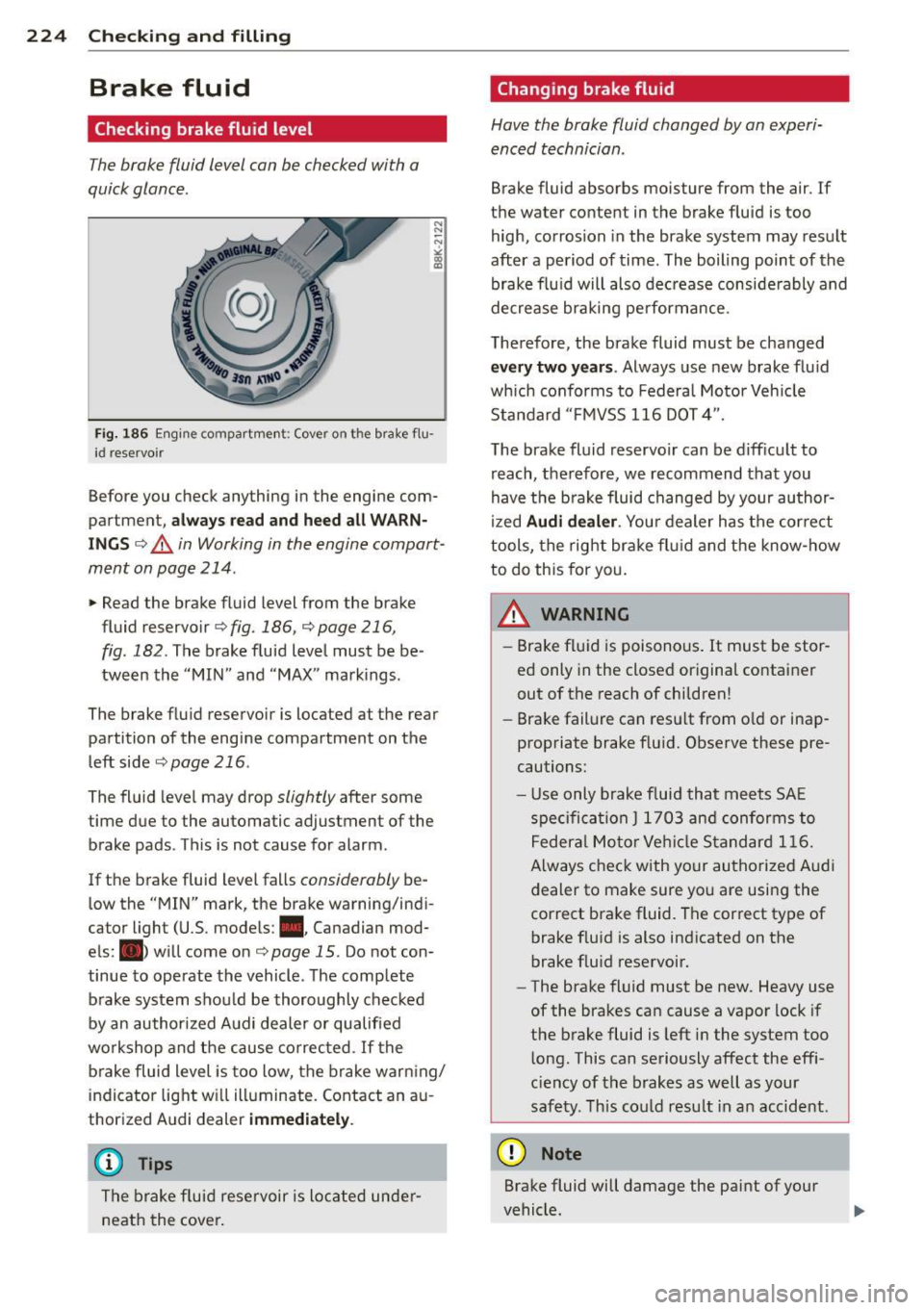
Fig. 186 Engine compart ment: Cover on the brake flu·
id reservo ir
Before you check anything in the engine com
partment,
always read and heed all WARN·
INGS ¢.&._ in Working in the engine compart
ment on page 214 .
.. Read the brake fluid level from the brake
fluid reservoir ¢
fig. 186, ¢ page 216,
fig . 182.
The brake fluid level must be be
tween the "MIN" and
"MAX" markings.
The brake fluid reservoir is located at the rear
partition of the engine compartment on the
left side
¢ page 216.
The fluid level may drop slightly after some
time due to the automatic adjustment of the
brake pads . This is not cause for alarm.
If the brake fluid level falls
considerably be
low the "MIN" mark, the brake warning/indi
cator light (U.S. models: ., Canadian mod
els: .) will come on¢
page 15. Do not con
tinue to operate the vehicle . The complete
brake system should be thoroughly checked
by an authorized Audi dealer or qualified
workshop and the cause corrected .
If the
brake fluid level is too low, the brake warning/
indicator light will illuminate. Contact an au
thorized Audi dealer
immediately .
@ Tips
The brake fluid reservoir is located under
neath the cover.
Changing brake fluid
Have the brake fluid changed by an experi
enced technician .
Brake fluid absorbs moisture from the air. If
t he water content in the brake fluid is too
high, corrosion in the brake system may result
after a period of time . The boiling point of the
brake flu id will also decrease conside rably and
decrease braking pe rformance.
Therefore, the brake fluid must be changed
every two years . Always use new brake flu id
which conforms to Federal Motor Vehicle
Standard "FMVSS 116 DOT 4".
The brake fluid reservoir can be difficult to reach, therefore, we recommend that you
have the brake fluid changed by your author
ized
Audi dealer. Your dealer has the correct
tools, the right brake fluid and the know-how
to do this for you .
A WARNING
- Brake fluid is poisonous . It must be stor
ed only in the closed original container
out of the reach of children!
- Brake failure can resu lt from o ld or inap
propriate brake fluid. Observe these pre
cautions:
- Use only brake fluid that meets SA E
specification
J 1703 and conforms to
Federal Motor Vehicle Standard 116.
Always check with your authorized Audi
dealer to make sure you are using the
correct brake fluid. The correct type of
brake f luid is also indicated on the
brake fluid reservoir.
- The brake fluid must be new. Heavy use
of the brakes can cause a vapor lock if
the brake fluid is left in the system too
long . This can seriously affect the effi
c iency of the brakes as well as your
safety. This could resu lt in an accident.
(D Note
Brake fluid will damage the paint of your
vehicle .
Page 227 of 296
@ For the sake of the environment
Because of the pr oblem of proper d isposa l
of brake flu id as we ll as the special tools
requ ired and the necessary expert ise, we
recommend that you have the brake fluid
changed by your author ized Audi dealer .
Battery
General information
Under normal operating conditions, the bat
tery in your Audi does not need any mainte
nance. With
high outside temperatures or
long daily dr ives we recommend that you have
the electro lyte level checked by an authorized
Aud i dealer or qualified workshop . The elec
trolyte leve l should also be checked each time
the battery is charged ¢
page 22 7.
H ave the battery checked when you take your
ve hicle in for service . Yo u are well adv ised to
replace a battery that is older than 5 yea rs .
W ith certa in types of a irbag deployment, t he
b attery is d isconnected from the vehicle elec
tr ica l system for safety reasons¢.&.
in Re
pair, care and disposal of the airbags on
page 159.
Disconnecting the battery terminals
Some vehicle functions (power w indow regu
lators , for example) are lost if the battery ter
m inals a re d isconnected. These func tions have
to be re lea rned after the batte ry term inals a re
connected agai n. T o prevent this , the bat tery
should only be d isconnec ted from the vehicle
e lec tric al system when absolu tely necessa ry
for repairs .
Vehicles not driven for long periods
If you do not drive you r vehicle over a period
of severa l days or weeks, elec trical compo
nen ts are gr adually cut b ack o r swi tched off .
This redu ces energy cons umption and main
tains starting capab ility over a longer per io d
¢ page 193.
Some o f the conven ience f unctions m ay not
ope rate, su ch as the in ter ior lig hts or t he
Checkin g and fillin g 225
power seat adjus tment. The convenience
funct io ns w ill be available again when yo u
turn o n the ign ition and start the engine.
Winter operation
D ur ing the w inte r mon ths, bat tery capa city
tends to dec rease as tempera tures drop . This
is beca use more power is a lso consumed wh ile
starting, and the headlights, rear window de
fogge r, etc., are used more often.
Avoid unnecessary powe r consumpt ion, pa r
ticular ly in city traffic or when traveling only
sho rt distances. Let yo ur authorized A udi
dealer check the capacity of the vehicle bat
tery before w inter sets in
¢ page 227. A well
charged battery will no t on ly prevent star tin g
problems w hen the weather is cold, but w ill
also last longer .
@ Tips
If your vehicle is left standing for seve ral
weeks at extremely low temperatures, the
vehicle battery s hou ld be removed and
stored where it will not freeze . This will
p revent it from be ing damaged and having
to be repla ced .
Working on the battery
Be especially careful when working on or near
the bat tery.
The battery is located in the luggage compar t
ment under the floor . B efo re you che ck any
thi ng in the luggage compartment,
read and
heed all WARNINGS
¢ ,&. .
Always heed the safety warnings , when work
i ng on the veh icle batte ry or t he vehicle e lec
t rical sys tem to p reven t inju ry.
The following WARNINGS are very
important when working on the battery:
Always heed the following WARNING SYM· BO LS and safety precautions when working
on the battery .
®
Always wear eye protection.
•
•
Page 228 of 296
226 Check ing and filling
&
Batter y acid contain s sulfuric acid . Al ·
wa ys wear glo ves and eye prote ction .
@
No
- spar ks
- flames
- smoking .
~
When a b attery i s ch arged , it p roduce s
h y d rogen ga s whi ch i s ex plosi ve and
c ould cau se per sonal inju ry.
®
Alwa ys keep the battery well out of
r ea ch of children .
A WARNING
Whenever working on the battery or on
the electrical system, there is the risk of
injury , acc ident and even fire. Read and
heed the following WARNINGS:
-Always wear eye protection. Do not let battery acid or any lead part icles get on
your sk in or cloth ing . Sh ield your eyes .
Explosive gases can cause blindness or
other injury .
- Battery acid contains sulfur ic acid . Sulfu
ric acid can cause blindness and severe
burns.
- Always wear gloves and eye protection.
Do not tilt the battery because ac id
could leak out of the vent ilation open
ings.
- If you get battery acid in yo ur eyes or
on your sk in, immediately rinse with
cold water for severa l minutes and get
medical attention .
- If you should ingest any battery acid,
seek medical attention immediately.
- Do not expose the battery to an open
flame, electric sparks or an open light.
- Do not smoke.
- Do not interchange the positive and neg -
ative cab les.
- When working on the battery, be sure
not to short-circuit the terminals with
tools or other metal objects. This would
cause the battery to heat up very quickly,
wh ich could lead to damage or explosion
and personal in jury.
-
- When a battery is charged, it produces
hydrogen gas which is explosive and
could cause personal injury.
- Always keep the battery well out of the
reach of children.
- Before work is done on the electrical sys
tem, disconnect the negat ive ground ca
ble.
- Before performing any work on the e lec
trica l system, switch off the engine and
ignit ion as well as any electrical equip
ment. The negative cable on the battery
m ust be disconnected .
If you are just go
ing to replace a light bulb, then it is
e nough to swi tc h off the lights.
- Before disconnecting the battery, switch
off the anti-theft alarm system! Other
wise you wi ll set off the alarm.
- When disconnecting the battery, f irst
d isconnect the negat ive cab le and then
the posit ive c ab le.
- Before reconnecting the batte ry, ma ke
sure all e lectr ica l consumers are sw itch
ed off . Re conne ct the pos it ive cab le first
and then the negative cable. Never inter
change the cables - this could start a fire!
- Never charge a frozen or a thawed-out
battery. It could exp lode! If a battery has
frozen, then it must be replaced . A dis
charged battery can freeze over at 32°F
(QOC).
- Make sure the vent hose is always attach
ed to the opening on the s ide of the bat
tery.
- Never use batteries which are damaged.
There is the danger of an explosion! Al
ways rep lace a damaged battery.
A WARNING
Ca lifornia Proposition 65 Warning:
- Battery posts, terminals and related ac
cessories conta in lead and lead com
pounds, chem icals known to the State of
California to cause cancer and reproduc
tive problems . Wash hands after han-
dling.
~
Page 230 of 296
228 Check ing and filling
- To r educe the danger of explosion, never
co nnect or disconn ect cha rger cables
wh ile the c harger is operating.
- Fast char ging a battery is dangerous and
shou ld on ly be attempted by a compe
tent technician w ith the proper equip
ment .
- Battery acid that may spill during charg
ing should be washed
off with a solution
of warm water and baking soda to neu
tralize the acid.
(Q) Note
Never use a fast charger as a booster to
start the engine . This will seriously dam
age sensitive electronic components, such
as control units, relays, rad io, etc., as we ll
as the battery charger.
Battery replacement
The new battery must have the same specif/·
cations and dimensions as the original equip
ment battery.
Intell igent energy management in your veh i
cle is respons ible for d istributing the e lectr i
cal energy throughout you r vehicle
~ page 193. The intell igen t energy m anage
men t system w ill keep the engine ba tte ry
charged better then vehicles w ithout this sys
tem . To make sure the additional e lectrica l en
ergy is available once again after you have
changed the battery, we recommend that you install batteries o f the same type and ma nu
facture only (the same as those installed at
the time your vehicle was delivered). Specifi
cations are listed on the battery hous ing. Your
author ized Audi dealer must code the battery
in the ene rgy management system to enable
you to use the ene rgy management functions
correctly after replac ing the battery.
I f it is not poss ible to use a battery of this
type, the new bat tery m ust h ave the s ame ca
pac ity, voltage ( 12-volts), amperage, con
struction and plug sea ling. When installing the battery, make su
re the ig
nition and a ll electrical consumers are turned
off.
(D Note
Make sure the ventilation hose on the side
of the battery is connected, otherwise
fumes or battery acid can leak out .
@ For the sake of the environment
Because o f the p rob lem of p roper disposal
of a battery, we recommend your author
i zed Audi dealer change the battery for
you. Batteries contain sulfur ic acid and
l ead and must always be disposed of prop
erly in comp liance with all environmental
regulations. Dispos ing of veh icle batter ies
i mprope rly is very dange rous to the envi
r o nment .
Windshield/headlight*
washer container
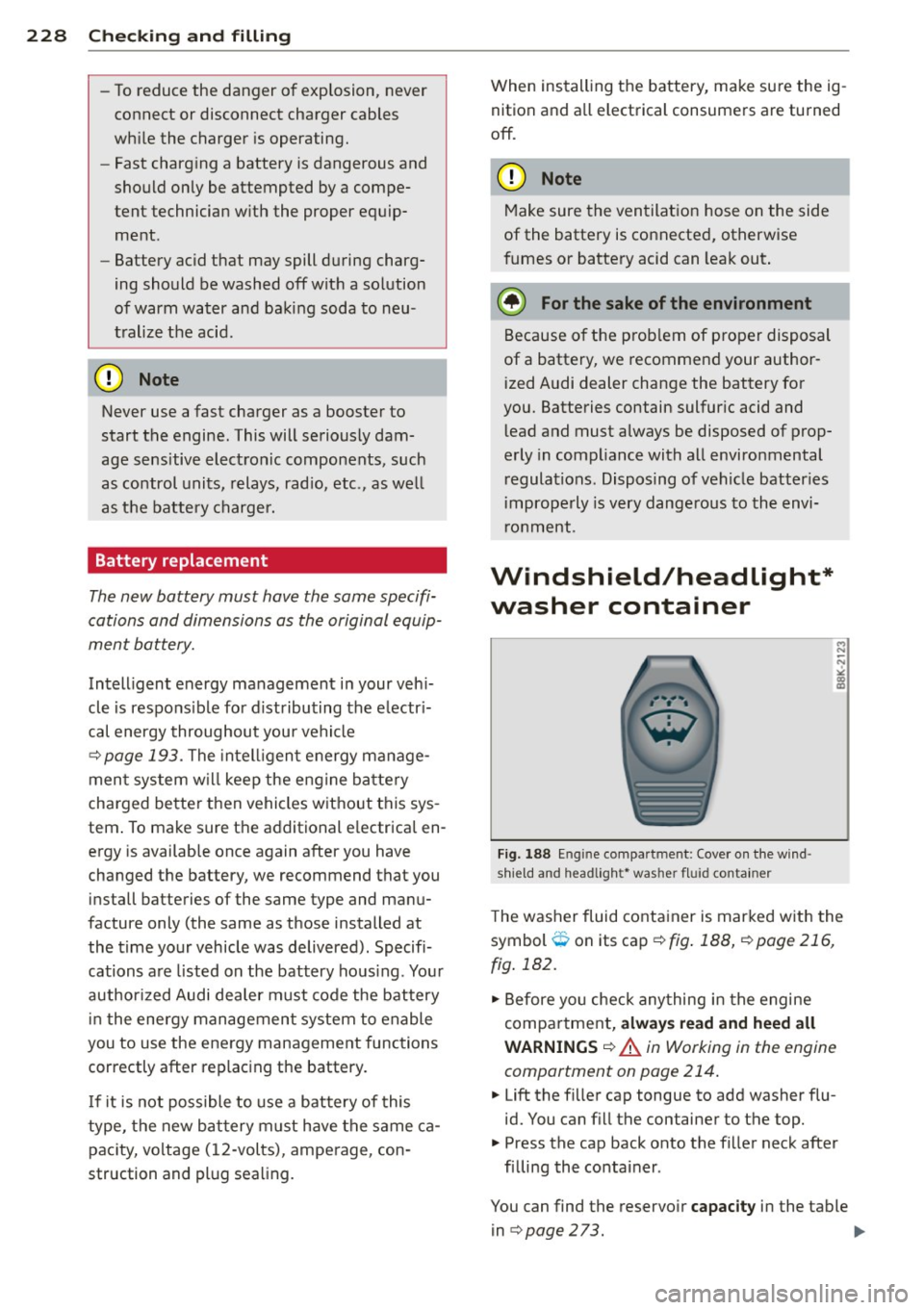
Fig. 188 E ngin e compa rt m en t: Cove r on the w ind·
s h iel d a nd h eadligh t• was her fluid conta in er
.., N
-~ (X) a,
The washer fluid conta iner is marked w ith the
symbol
O on its cap ~ fig . 188, ~page 216,
fig . 182.
.. Before yo u check any thing in the engine
compa rtment,
always read and heed all
WARNINGS q A in Working in the engine
compartm ent on page 214 .
.. Lift the fi ller cap tongue to add washer flu
id. You can f ill the container to the top.
.. Press the cap back onto the filler neck after
fi lling the conta iner .
You can find the reservo ir
capacity in the table
in
q page 273. .,.
Page 239 of 296
-Incorrect tire pressures and/or underin
flation can also lead to sudden tire fa il
ure, including a blowout and sudden de
flation, causing loss of vehicle control.
Checking tire pressure
The correct tire pressure for the tires original
ly installed on your vehicle is listed on the tire
pressure label located on driver's side 8-pil lar .
The recommended t ire pressures are on the
tire pressure label and in the table
c:> page 234, Cold tire inflation pressure . This
means that the pressure must be checked and
adjusted when the tire has not been driven for
mo re tha n a couple of m iles (k ilome ters) at
l ow speeds during t he p revious three hours.
A ir in the tires expands when the ti re heats up
as a result of inte rna l friction as it flexes in
use. The tire press ure is higher when the tire
has warmed up than when it is "cold."
It is the i nflat ion p ressu re in a "cold" tire that
counts . Therefore, you shou ld never let air ou t
of a warm tire to match "Cold tire inflation pressure" recommendations
c:> page 234. The
tires would then be under inflated and could
fa il suddenly.
The tire press ure labe l on yo ur Audi lists the
recommended cold t ire inflat ion pressures at
maximum capacity for the new, origina l
equ ipment tires that were on your vehicle at
the time it was manufactured. For the loca
tion of the label
<=> page 234, fig . 189 .
Most tires lose a ir naturally over time. They
can also lose some a ir if you drive
over a pot
hole or hit a curb while parking. It is usually
not possible to see whether the radial t ires
used today are underi nflated just by looking
at them.
Therefore, be sure to check tire pressures at
least o nce a month and always before going
on a long tr ip . Make sure to take the number
of people and the amount of luggage into ac
coun t when adjusting tire pressure for a t rip -
even one that you would not consider to be
Tire s an d wheel s 237
"long." See c:> page 2 38, Tires and vehicle
load limits
for more important information.
A lways use an acc ura te tire pressu re ga uge
when checking and ad justing infla tion pres
s ur es . Check all o f the tires and be sure not to
forget the spare tire. If the pressure in any t ire
is too h igh when the tire is "cold", let a ir o ut
of the t ire s low ly w ith the edge of the tire
gauge and keep checking the pressure until
you reach the pressure that is correct for the load (passengers and luggage) and k ind of
driv ing you plan to do.
If the pressure in any tire is too low, note the
difference between the pressure in the co ld
t ire a nd the pressure you need and add the air
that you need to reach the correct pressure for
t h e ve hicl e load (passenge rs and luggage) for
the tires on you r veh icle as l isted on the on
yo ur vehicle and in this ma nual and the kind
of driving you plan to do.
Never exc eed the maximum inflation pr es
sure li ste d on the tire sidewall for any re a
s o n.
Remember that the vehicl e manufacture r, not
t h e tire manufact urer, de termines t he cor re ct
t ir e p ress ure fo r th e tires on your ve hicl e.
It is important to check the t ire p ressu re whe n
the tires are co ld.
- Read the required tire pressure from the t ire
pressure labe l. The t ire pressure label is lo
cated o n the dr iver's side 8-pillar. The tire
pressure labe l lists the recommended co ld
tire infla tion pressures for t he vehi cle at its
maxim um capacity weigh t and t he tires that
were on your ve hicle a t the time i t was man
ufactured . For recommende d tire pressures
for normal load conditions, p lease see chap
ter
c:> page 2 34.
- Tu rn the va lve stem cap counter -clockwise
to remove it from the tire
va lve .
-Place t he ai r pressure gauge on the va lve.
- The tire pressu res should o nly be checked
and ad justed when the tires are co ld . The
slightly raised pressures of warm tires must
not be red uced.
Ill>-
•
•
Page 252 of 296
250 Tire s and wheel s
stored. You can find the recommended tire
pressures for your vehicle on the label on driv
er 's side 8-p illar ¢
page 234.
Tire tread c ircumference and vibration charac
teristics can change and ca use a tire pressure
warning if :
- the tire pressure in one or more t ires is too
low,
- the tire has st ructu ral damage,
- the tire pressure was changed, wheels rotat-
ed o r replaced but the TPMS was not reset
¢page 250.
Warning s ymbols
rD] Loss of pressure in at least one tire¢& .
Check the tire or tires and replace or repair if
n ecessary. The
rD] indicato r light in the instru
ment cluster also illuminates
¢ page 13.
Check/correc t the pressures of all four tires
and reset TPMS via radio or
MMI* .
Ill (T ire Pressu re M onitor ing System) Tire
pr essur e: Syst e m malfuncti on!.
Iflll appears after switching the ignit ion on
or while driving and the
rD] i ndicator light in
the instrument cluster blinks for approxi mately one mi nute and the n stays on, the re is
a system ma lfunction.
Attempt to store the correct tire pressure
¢ page 250. If the ind icator light does not
turn
off or if it tu rns o n short ly thereafter, im
mediately drive your veh icle to an autho riz ed
Aud i dea ler or autho rized repair facility to
have the ma lfunction corrected.
A WARNING
- If the tire pressure indicator appears in
the instrument cl uster d isplay, one or
more of your tires is s ignificantly under
inflated. Reduce your speed immediately
and avoid any hard steering or braki ng
maneuvers. Stop as soon as possible and
check the t ires and the ir pressures. In
flate the tire pres sure to the proper p res
s u re as in dic ated on the vehicle 's t ire
pressure label¢
page 234 . Driving on a
significantly under-inf lated tire ca uses the tire to overheat and can
lead to tire
fa ilure. Under-inflation also is likely to
impair the vehicle's handling and stop
ping ability.
- The driver is responsible for maintaining
the correct tire pressures. You must
check the tire pressures regu larly .
- Under certain conditions (such as a spor
ty driving style, winter conditions or un paved roads), the pressure monitor indi
cato r may be delayed .
-Ask your authorized Aud i dea ler if run
flat t ires may be used on you r vehicle.
Your vehicle registration becomes invalid
if you use these t ires when not perm it
ted. Damage to your vehicle or accidents
could a lso result.
(D Tips
- The tire pressure mon itoring system
stops work ing whe n there is an ESC/ABS
m alfu nction.
- Us ing snow chains may result in a system
ma lf u nction.
- The tire pressure mon itoring system on
your Audi was deve loped using tires with
t he "AO" or "R O" ident ifi cat ion on the
tire sidewa ll¢
page 242 . We recom
mend using these tires.
Reset tire pressure monitoring system
Appl ies to vehicles: wit h tire p ressu re mo nito rin g system
If the tire pressure is adjusted, wheels are ro
tated or changed, the TPM5 must be reset via
radio or MMI*.
" Before resetting t he TPM S, the c urrent pres
sures of a ll four tires must correspond to
the specified values . Ad just the tire p ressu re
and reset the pressure in the tire pressure
mon itoring system according to the load
you are carrying
¢ page 234.
"Turn on the ign ition.
" Select: the
I CAR I funct io n button > Tire pr es
sure monitoring
> Store now . Or
" Select: the
I CAR I funct ion button > Car sy s
tem s*
cont ro l button > Servi cing & che ck s > ..,..
Page 254 of 296
252 What do I do now?
What do I do now?
Vehicle tool kit
The tools ore stored underneath the floor
panel in the luggage comportment.
Fig. 195 Sedan Luggage compartment: tool kit
Fig. 196 allroad Luggage compartment: too l kit
When you need access to the vehicle tool kit
or jack*, you will need to take out the spare
tire and cover
Q page 2 52.
Depending on your vehicle's equipment, the
tool kit may also be located under the cargo
floor cover @
Q fig. 196 behind the seat back
rest .
The vehicle tool kit includes:
- Hook for removing wheel covers*
- Alignment pin for changing the wheel
- Screwdriver with reversible blade
- Tool for changing light bulbs
- Reversible bit (reversible Torx bit for chang- ing light bulbs)
- Rod for jack
- Jack*
- Lug wrench
- Towing eye Some of the vehicle
items listed above are
provided on certain mode ls only or are option
al extras.
Before returning the jack* to its p lace, retrac t
the jack arm fully.
A WARNING
-
- Never use the screw driver hex head to
tighten wheel bolts, since the bolts can
not attain the necessary tightening tor
que if you use the hex head, potentially
causing an acc ident.
- The factory-supplied jack is intended on
ly for your vehicle model. Under no cir
cumstances should it be used to lift
heavy vehicles or othe r loads; you risk in
juring yourself.
- Never start the engine when the vehicle
is raised, wh ich could cause an accident.
- Support the vehicle securely with appro priate stands if work is to be performed
underneath the vehicle; otherwise, there
is a potential risk for injury.
Space-saving spare tire
(compact spare tire)
Appl ies to veh icles : w ith space -sav ing spare tire
The spore tire/wheel is located in the luggage
comportment under the cargo floor cover . It
is intended for short-term use only.
Fig . 197 Spare tire
Removing the spare tire
., lift the cargo floor by the plastic handle
Qfig. 197.
., Hook the handle into the luggage compart
ment weather strip.
Page 258 of 296
256 What do I do now?
also c:> page 2 5 6, Decorative wheel cov
ers
or c:> page 256, Wheels with wheel
bolt caps .
2. Loosen the wheel bolts c:> page 2 5 7.
3 . Locate the proper mount ing point for the
jack and align the jack below that point
<=> page 257.
4. Lift the car with the jack c:> pag e 257 .
5. Remove the wheel with the flat tire and
the n in st all the
spare tire c:> poge 258 .
6. Tigh ten all wheel bo lts light ly .
7 .
Lower the ve hicle with the jack .
8 . Use the wheel bolt wrench and
firmly
tighten all whee l bolts in a crisscross pat
tern
<=> page 257.
9. Replace the decorative wheel cover* or
the
wheel bolt caps* .
A WARNING
Always read an d follow all WAR NIN GS and
inf orma tion
c:> .&. in Raising the vehicle on
p age 258
and c:> pa ge 259.
After changing a wheel
A wh eel change is no t complete without th e
doing th e following .
.,. Always store the vehicle tool kit, the jack*,
and the replaced ti re in the l uggage com
partment
c:> page 13 4 .
.,. Check the tire pressure o f the spa re tire as
s oo n as pos sib le .
.,. As so on as possible, have t he
tightening
torques
on a ll w heel bo lts checked wi th a
tor que wrench . The correct tightening t or
que is 90
ft l bs. (120 Nm) .
.,. Have the flat tire
replaced as soo n as poss i
ble .
(j) Tips
-If you notice t hat the whee l bolts are
corroded and difficult to t urn w hile
c hanging a t ire, they should be replaced
be fore yo u ch eck the tighte ning torqu e.
- Driv e at reduc ed s peed unt il you have the
t ig hten ing torques checked .
Decorative wheel covers
Applies to vehicles: with decorative wheel covers
The decorative wheel covers must be removed
first to access the wheel bolts .
Fig. 200 Cha ng in g a w hee l: r em ovi ng t he w hee l cover
Removing
.,. Inse rt th e hook prov ided with the vehicle
t oo l kit in the ho le in the hub.
.,. Pull o ff the
decor ative wheel cover
<=>fig . 20 0.
Wheels with wheel bolt caps
Applies to vehicles: with wheel bolts with caps
The caps mus t be removed firs t from the
wheel bolts before the bolts can be un
screwed .
Fig. 201 Cha ng in g a w hee l: re m ovi ng t he w hee l bo lt
caps
Removing
.,. Pu sh the plastic clip provi ded with t he vehi
cle tool ki t ove r the w heel bolt ca p until it
engage s.
.,. Pull on the
plastic clip to remove the cap
r:!) fig . 201.
Page 260 of 296
2 58 What do I do n ow ?
c:> fig. 203 . Behind the marking, there is a
lifting p oint on the sill for the veh icle jack.
• Turn the
veh icle j ack located under the lift
ing point on the si ll to raise the jack until
the jaw
c:> fig. 204 ® covers the notch on
the vehicle
c:> &_ c:>(D .
• Align t he vehicle jack so the jaw ® covers
the notch and the base plate @ is flat on
the floor. The base plate @ must be
vertical
under the lifti ng point @.
• Install the rod on the vehicle jack: Insert the
rod into the opening on the handwheel. Turn
the rod left or right to secure it .
• Contin ue raising the jack with the rod until
the wheel lifts off the ground slightly.
Position the vehicle jack
onl y under the desig
nated lifting points on the sill
c:> fig. 203 .
There is exactly one location for each wheel.
The jack must not be positioned at any other location
c:> ,&. c:>(D .
Soft ground under the jack can cause the ve
hicle to slip off the jack. Always place the jack
on firm ground. Use a flat, stable support if necessary . Use a non-slip surface such as a
rubber mat on a
slipp ery surfac e such as tile .
A WARNING
-You or your passengers could be injured
wh ile chang ing a wheel if you do not fol
low these safety precautions :
- Position the vehicle jack only at the
des ignated lifting points and align the
jack. Otherwise, the vehicle jack could slip and cause an injury if it does not
have sufficient hold on the veh icle .
- A soft or unstable surface under the
jack may cause the veh icle to slip off
the jack . A lways provide a firm base for
the jack on the ground.
If necessary,
use a sturdy board under the jac k.
- On hard, slippery surface (such as tiles)
use a rubber mat or similar to preven t
the jack from s lipping.
- T o help p revent injury to yourself and
yo ur passengers: -
Do not raise the vehicle until you are
sure the jack is securely engaged.
- Passengers must not remain in the ve
hicle when it is jacked up.
- Make sure that passengers wait in a
safe place away from the veh icle and
well away from the road and traffic .
- Make sure jack pos ition is correct, ad
j ust as necessary and then cont inue to
raise the jack.
(D Note
Do not lift the vehicle by the sill. Position
the veh icle jack only at the designated lift
i ng points on the sill. Otherwise, your vehi
cle will be damaged.
Taking the wheel off/installing the spare
tire
Follow these instructions step-by-step for
changing the wheel .
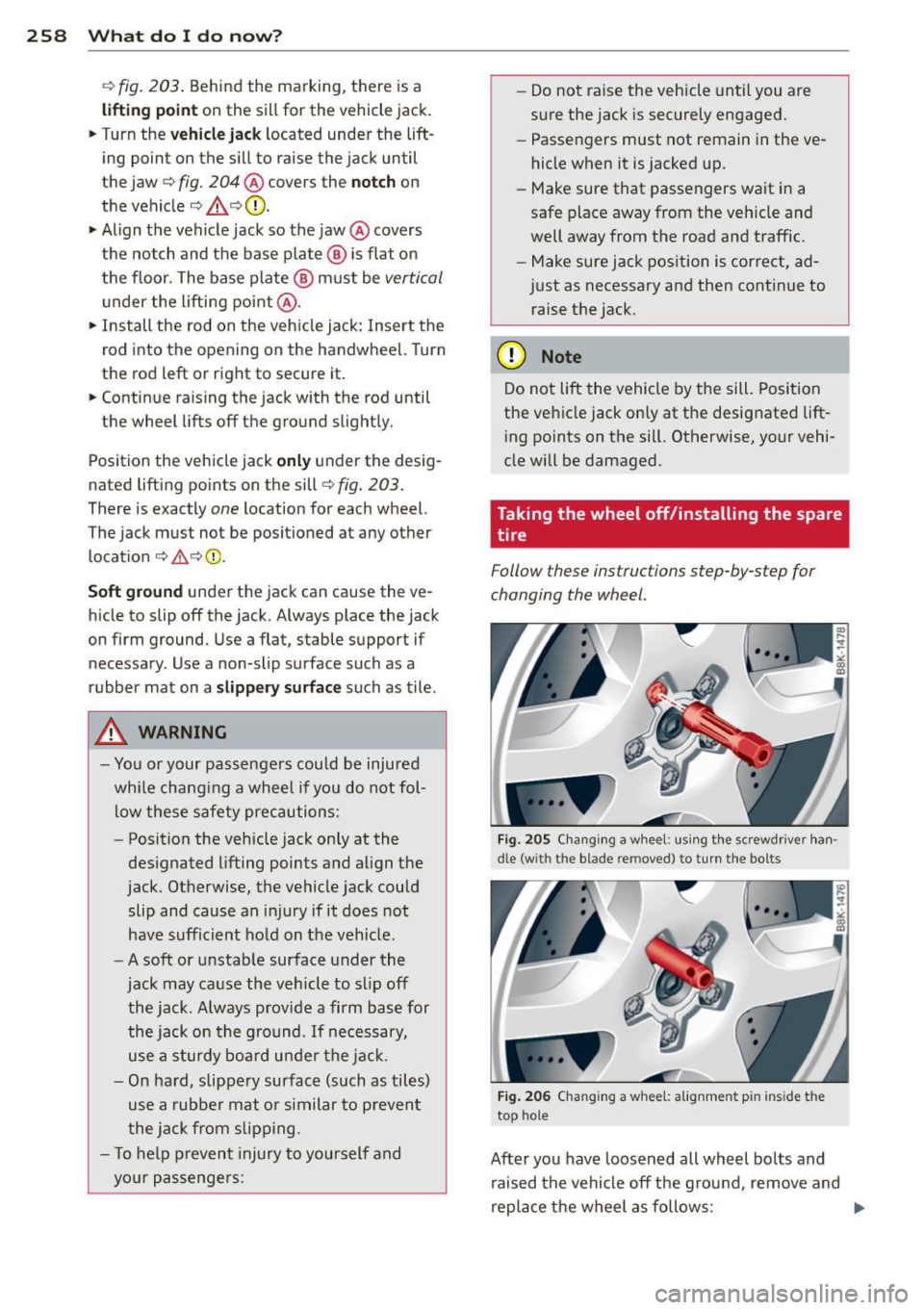
Fig. 205 C ha nging a w hee l: us ing t he screwd rive r han
dle (w it h th e blade re m oved) to turn the bolts
Fig . 206 Ch ang ing a w hee l: alignment p in in side t he
top hole
After you have loosened all wheel bo lts and
raised the vehicle off the g round, remove and
replace the wheel as follows: .,..
Page 261 of 296
Removing the wheel
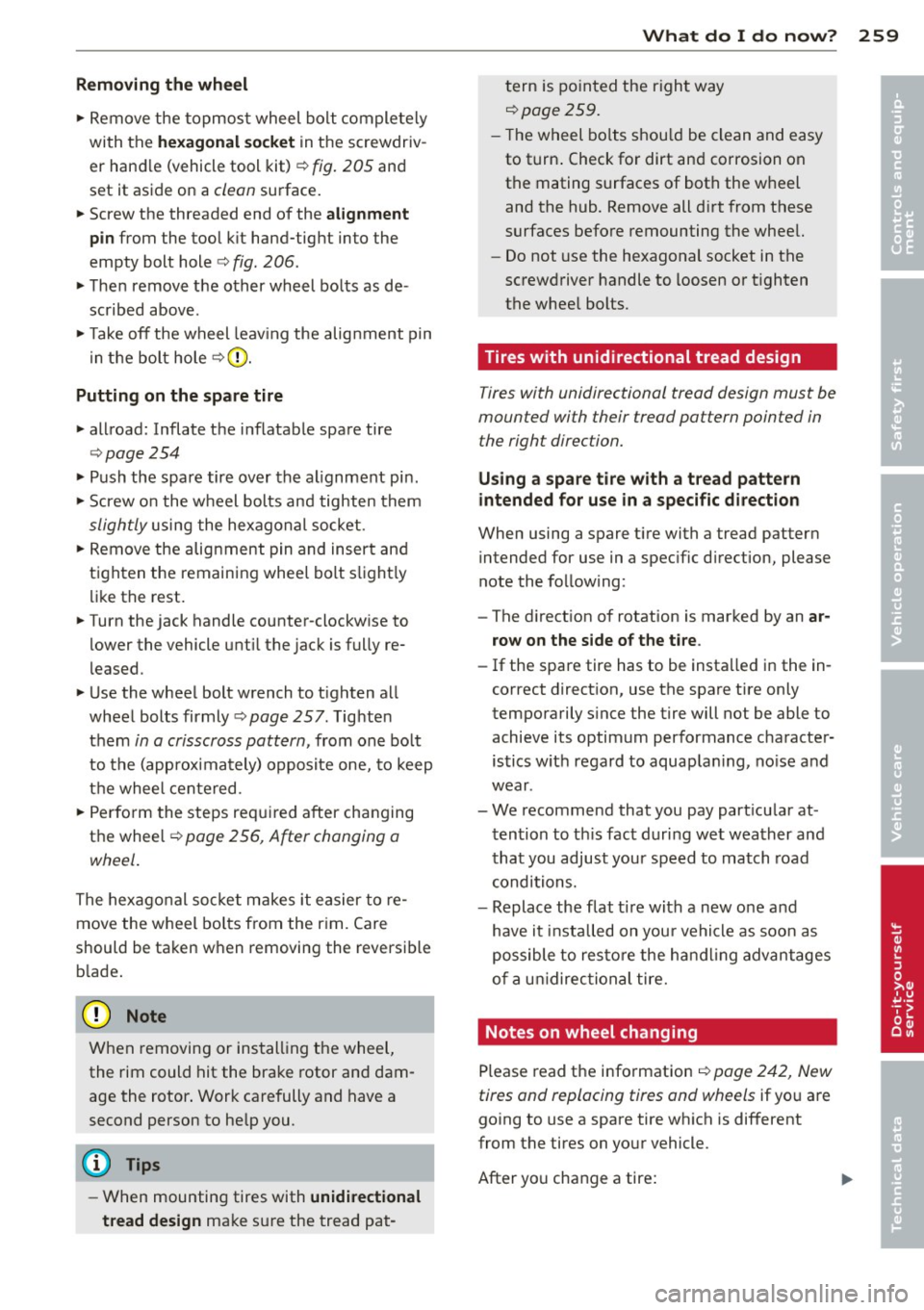
"' Remove the topmos t wheel bolt completely
with the
he xagonal socket in t he screwdriv
er hand le (vehicle tool kit)
c::> fig. 205 and
set it aside on a
clean surface.
"' Screw the threaded end of the
alignment
pin
from the tool k it hand-tight into the
empty bolt hole
c::> fig. 206.
"'T hen remove the other wheel bo lts as de
scribed above .
"'T ake off the wheel leav ing the alig nment pin
i n t he bolt hole
c::> CJ).
Putting on the spare tire
"' allroad : Inflate the inflatable spare tire
c::> page 254
"' Push the spare tire over the a lignment pin.
"' Screw o n the w heel bolts and tighten them
slightly using the hexagonal socket.
"' Remove the alignment pin and insert and
t ighten the remaining whee l bo lt s light ly
Li ke the rest.
"' Turn the jack handle counter-clockw ise to
lower the vehicle unt il the jack is f ully re
l eased .
"' Use the wheel bolt w rench to t ighten all
whee l bolts firmly
c::> page 25 7. Tig hten
them
in a crisscross pattern, from one bo lt
to the (approx imately) opposi te o ne, to keep
t h e whee l cen te red.
"'P erfo rm the steps req uired after changing
t h e whee l
c::> page 256, After changing a
wheel .
The hex agonal so cket m akes it easier to re
move the w heel bo lts from the r im . Care
should be taken when removing the reversible
b lade .
@ Note
When removing or ins tal ling the wheel,
the rim could hit the brake rotor and dam
age the rotor . Wor k carefully and have a
second person to he lp you.
@ Tips
- When mounting tires with unidirectional
tread design
ma ke s ure the tread pat-
What do I do now? 259
'
tern is po inted the righ t way
c::>page 259.
- The w heel bolts shou ld be clean an d easy
to t urn . Check fo r dirt an d corrosion on
the mating surfaces of both the w heel
and the hub. Remove all d irt from these
surfaces before remounting the whee l.
- Do not use the hexagonal socket in the
sc rewd river handle to loosen or t ighten
the whee l bolts.
Tires with unidirectional tread design
Tires with unidirectional tread design must be
mounted with their tread pattern pointed in
the right direction.
U si ng a spa re tire with a tread pattern
intended for use in a specific di rection
When using a spare t ire with a tread patter n
intended for use in a spec ific d irection, please
note the following :
- The d irect ion of rotation is marked by an
ar
row on the side of the t ire .
-If the spare tire has to be insta lled in the in
correct d irect ion, use the spare tire only
temporarily s ince the tire will not be able to
achieve its optimum performance cha racte r
istics w it h regard to aquap la ni ng, no ise and
wear .
- We recommend that you pay part icu lar at
t en tion to th is fact during wet weather and
that you adjust your speed to match road
condi tions.
- Replace the flat t ire wi th a new one a nd
have it insta lled o n you r vehicle as soo n as
pos sible to res to re the hand ling advant ages
o f a u nidirec tional tire.
Notes on wheel changing
Please read t he info rmation c::> page 242 , New
tires and replacing tires and wheels
if yo u a re
going to use a spare tire wh ich is different
from the tires on your vehicle.
After yo u change a tire:
IJI,-
•
•