tire pressure AUDI S4 2014 Owner's Manual
[x] Cancel search | Manufacturer: AUDI, Model Year: 2014, Model line: S4, Model: AUDI S4 2014Pages: 296, PDF Size: 73.56 MB
Page 251 of 296
Tire pressure monitoring system
UJ General notes
Applies to vehicles: with tire pressure monito ring system
Each t ire, i ncluding the spare (if provi ded),
should be chec ked month ly w hen cold and in
flated to the inflation pressure recommended by the vehicle manufacture r o n the vehicle
placar d or tire infla tion pressure label. (If your
veh icle has t ires of a diff erent siz e than the
size ind icat ed on the vehicle p lacard or tir e in
flation pressure label, you should deter mine
the proper tire inflation pressure for those
tires).
As an added safety feature, your vehicle has been equipped with a tire pressure monitor ing
system (TPMS) that illuminates a low tire
pr essu re tellta le when one or mo re of your
tires is significantly under -inflated . Accord ing
l y, when the low tire p ress ure telltale illumi
nates, you should stop and check your tires as
soon as possible, and inflate them to the
proper pressure. Driv ing on a signif icantly un
der-inflated tire causes the tire to overheat
and can lead to tire failure. Under -inflation al
so reduces fuel efficiency and tire t read life,
and may affect the ve hicle's handling and
stopping ab ility.
Please note that the TPMS is not a subst itute
for p roper t ire mainte nance , and it is the dr iv
e r's responsib ility to ma inta in cor re ct t ire
p ress ure, even if under- infla tion has no t
reached the leve l to trigger ill umin ation of the
TPMS low tire pressure telltale.
Your veh icle has also bee n equ ipped with a
TPMS malfunc tion indica to r to indica te when
the system is not opera ting properly. The
TPMS mal function indicato r is combined wi th
the low tire press ure tellta le . When the sys
tem detects a malf unct ion, the te lltale will
flash for approximately one minute and then remain cont inuo usly illuminated. This se
quence will continue upon subsequent vehicle
start-ups as long as the ma lf u nction ex ists .
Tire s an d wheel s 249
When the malfunction indicator is illum inat
ed , the system may not be ab le to detect or
s ignal low tire pressure as intended . TPMS
malfunctions may occur for a var iety of rea
sons, including the insta llation of replace
ment or alternate tires or wheels on the vehi
cle that p revent the TPMS from functioning
proper ly. Always check the TPMS malfunction
te lltale after rep laci ng one or more tires o r
whee ls on you r vehicle to e nsur e th at the re
placement or alterna te t ires and wheels a llow
the TPMS to continue to func tion p roperly.
Tire pressure indicator appears
Applies to vehicles: with tire pressure monitoring system
The tire pressure indica tor in the instrument
cluster informs you if the tire pressure is too
Low or if there is a system malfunction.
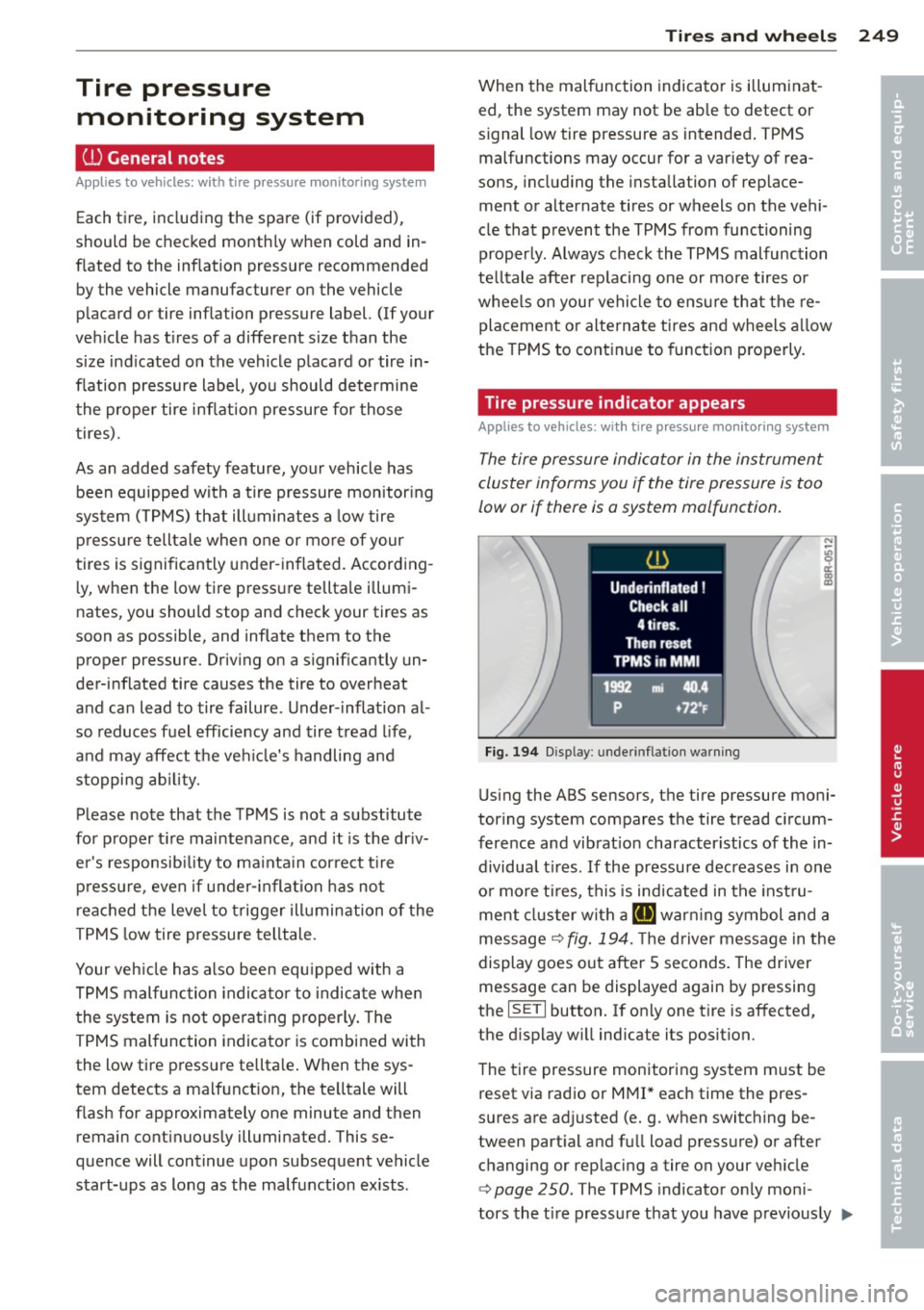
Fi g. 194 D isp lay: un de rin flat io n warni ng
U sing the ABS sensors, the tire pressure mo ni
toring system compares the tire tread c ircum
ference and vib rat ion character istics of the in
dividua l tir es . If the pressure decreases i n one
o r more t ires, this is indicated in the inst ru
ment cluster with a
RI] war ning symbol and a
message ¢
fig. 194. T he d river message in the
display goes o ut afte r 5 seconds . The driver
message can be displayed again by pressing
the
ISE TI button. If only one t ire is affected,
the d isplay w ill indicate its position.
T he tire pressure monitoring system m ust be
reset via radio or M MI* each time the pres
sures are ad justed (e.g. when switc hing be
tween part ial and f ull load pressure) o r after
changing or rep lacing a tire on your ve hicle
¢
page 250. T he TPMS indicato r o nl y mo ni-
tors the t ire p ress ure t hat yo u have p revio usly ..,.
•
•
Page 252 of 296
250 Tire s and wheel s
stored. You can find the recommended tire
pressures for your vehicle on the label on driv
er 's side 8-p illar ¢
page 234.
Tire tread c ircumference and vibration charac
teristics can change and ca use a tire pressure
warning if :
- the tire pressure in one or more t ires is too
low,
- the tire has st ructu ral damage,
- the tire pressure was changed, wheels rotat-
ed o r replaced but the TPMS was not reset
¢page 250.
Warning s ymbols
rD] Loss of pressure in at least one tire¢& .
Check the tire or tires and replace or repair if
n ecessary. The
rD] indicato r light in the instru
ment cluster also illuminates
¢ page 13.
Check/correc t the pressures of all four tires
and reset TPMS via radio or
MMI* .
Ill (T ire Pressu re M onitor ing System) Tire
pr essur e: Syst e m malfuncti on!.
Iflll appears after switching the ignit ion on
or while driving and the
rD] i ndicator light in
the instrument cluster blinks for approxi mately one mi nute and the n stays on, the re is
a system ma lfunction.
Attempt to store the correct tire pressure
¢ page 250. If the ind icator light does not
turn
off or if it tu rns o n short ly thereafter, im
mediately drive your veh icle to an autho riz ed
Aud i dea ler or autho rized repair facility to
have the ma lfunction corrected.
A WARNING
- If the tire pressure indicator appears in
the instrument cl uster d isplay, one or
more of your tires is s ignificantly under
inflated. Reduce your speed immediately
and avoid any hard steering or braki ng
maneuvers. Stop as soon as possible and
check the t ires and the ir pressures. In
flate the tire pres sure to the proper p res
s u re as in dic ated on the vehicle 's t ire
pressure label¢
page 234 . Driving on a
significantly under-inf lated tire ca uses the tire to overheat and can
lead to tire
fa ilure. Under-inflation also is likely to
impair the vehicle's handling and stop
ping ability.
- The driver is responsible for maintaining
the correct tire pressures. You must
check the tire pressures regu larly .
- Under certain conditions (such as a spor
ty driving style, winter conditions or un paved roads), the pressure monitor indi
cato r may be delayed .
-Ask your authorized Aud i dea ler if run
flat t ires may be used on you r vehicle.
Your vehicle registration becomes invalid
if you use these t ires when not perm it
ted. Damage to your vehicle or accidents
could a lso result.
(D Tips
- The tire pressure mon itoring system
stops work ing whe n there is an ESC/ABS
m alfu nction.
- Us ing snow chains may result in a system
ma lf u nction.
- The tire pressure mon itoring system on
your Audi was deve loped using tires with
t he "AO" or "R O" ident ifi cat ion on the
tire sidewa ll¢
page 242 . We recom
mend using these tires.
Reset tire pressure monitoring system
Appl ies to vehicles: wit h tire p ressu re mo nito rin g system
If the tire pressure is adjusted, wheels are ro
tated or changed, the TPM5 must be reset via
radio or MMI*.
" Before resetting t he TPM S, the c urrent pres
sures of a ll four tires must correspond to
the specified values . Ad just the tire p ressu re
and reset the pressure in the tire pressure
mon itoring system according to the load
you are carrying
¢ page 234.
"Turn on the ign ition.
" Select: the
I CAR I funct io n button > Tire pr es
sure monitoring
> Store now . Or
" Select: the
I CAR I funct ion button > Car sy s
tem s*
cont ro l button > Servi cing & che ck s > ..,..
Page 253 of 296
Tire pressure monitoring > Store tire
pres sures .
(D Tips
Do not store the t i re pr ess ure if the re a r e
snow chains on the tire.
Tires and wheels 251
•
•
Page 255 of 296
.. Turn the large screw q fig . 197 counter
clockwise.
.. Take out the spare tire.
.. Always store the vehicle too l kit, the jack *,
and the replaced tire in the luggage com
partment
c:> page 134.
.. Unhook the cargo floor before clos ing the
rear lid .
Using the spa re tire (compact spare tir e)
The compact spare tire is only intended for
emergenc ies until you can reach a repair shop.
Replace it as quickly as possible with a stand
ard wheel and t ire .
There are some restrictions on the use of the
compact spare t ire . The compact spare t ire
has been des igned specifically for your type of
veh icle.
It must not be swapped with a com
pact spare t ire from another type of veh icle.
Snow chain s
For technical reasons, the use of snow chains
on the compact spare tire is
not p erm itted .
If you do have to drive with snow chains and a
front tire fails, mount the spare whee l w ith
tire instead of a rear tire. Install the snow
chains on the rear t ire and use it to replace
the defective front tire.
.,&. WARNING
- Never use the spare tire if it is damaged
or if it is worn down to the tread wear in
dica to rs.
- If the spare tire is mo re tha n 6 years o ld,
use it only in an emerge ncy and w ith e x
t reme cau tion a nd careful d riving .
- T he spare tire is intended only fo r tem
porary and sho rt-term use.
It should be
rep laced as soon as possib le w ith the
normal wheel and t ire.
- After mount ing the compac t spare ti re,
the tire pressu re must be che cked as
soon as possible . The tire pressure of the
compact spa re tire m ust be 4 .2 bar; oth
erwise, you risk hav ing an accident.
- Do not drive faster than 50 mph (80 km/
h) . You risk having an accident.
What do I d o now ? 253
-Avoid full-thrott le acceleration, heavy
brak ing, and fast cornering. You risk hav
ing an accident .
- Never drive using more than one spare
wheel and tire. You r isk having an acci
dent .
- Normal summer or winter t ires must not
be mounted on the compact spare w heel
rim .
- For technical reasons, the use of tire
chains on the spa re tire is not permitted .
If it is necessary to drive with t ire chains,
the spare wheel must be mounted on the
fro nt axle in the event of a flat in a rear
tire. The newly available fron t wheel
m ust then be inst alled in place of the
rear whee l with the flat tire. Installing
the tire chain before mounting the whee l
a nd tire is recommended.
- Loose items in the passenger compart
ment can cause serious personal injury
during hard brak ing or in an accident.
Never store the spare tire or jack and
too ls in the passenger compartment.
Inflatable spare tire
App lies to vehicles: wi th inflatable spa re tire
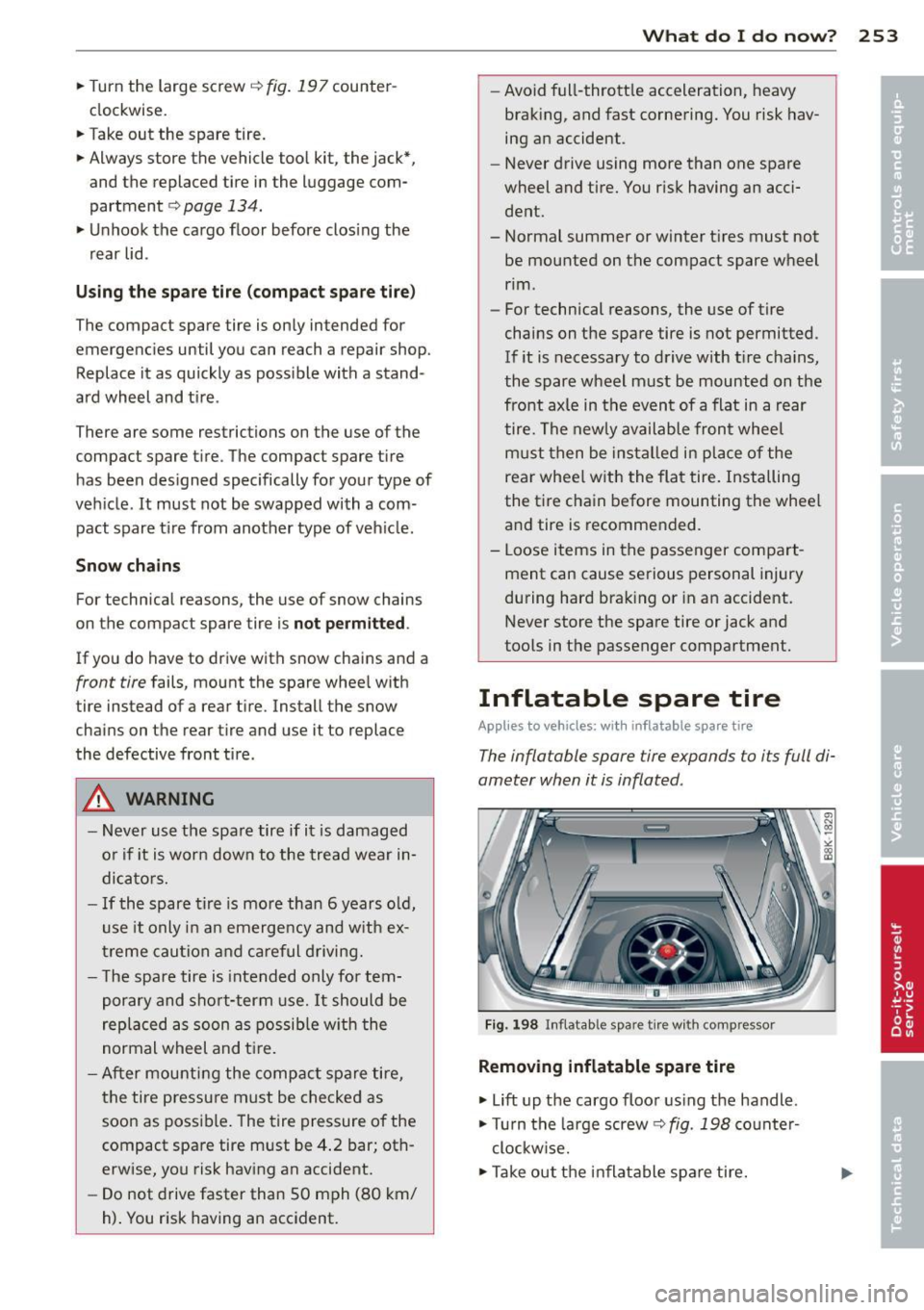
The inflatable spare tire expands to its full di
ameter when it is inflated .
Fig. 19 8 I nflatable spare t ire w it h compressor
Removing inflatable spare tire
.. Lift up the cargo floor us ing the handle .
.. Tur n the large screw ¢
fig. 198 counte r-
clockw ise.
.. Take out the in fla table spare tire.
Page 256 of 296
2 54 Wh at do I d o now ?
• Always store the vehicle tool kit, the jack *
and the replaced tire in the luggage com
partment ¢
page 134.
Stowing the infl ata ble spare tir e
• Release the air by unscrew ing the va lve
stem.
• Screw the valve stem back in afterwards.
• Wait a few hours before p lacing the wheel in
the spare wheel well¢.&_ .
• Secure the wheel with the large screw.
• Fold the cargo floor back down.
Aft er usi ng th e inflat able sp are wh eel
The inflatable spare tire can be re-used as
long as it is not damaged and is not worn
down to the tread wear indicators¢&. .
When you let the air out of the inflatable
spare tire, it does not assume its folded shape
again for several hours . Until then, it cannot
be p laced back in the spare wheel well and
stowed securely .
A WARNING
-Never use the spare tire if it is damaged
or if it is worn down to the tread wear in
dicators.
- If the inflatable spare tire is more than 6
years old, use it only in an emergency and w ith extreme caut ion and carefu l
dr iv ing .
- The inflatable spare tire is intended only
for temporary and short-term use.
It
should be replaced as soon as possible
with the norma l wheel and tire.
- T he tire pressure value for the inflatable
spare t ire is located on the drive r's side
8-pilla r
¢page 234, fig. 190.
-Maximum perm iss ible speed is SO mph
(80 km/h).
- Avoid full-throttle acce le rat ion, heavy
braking, and fast corner ing.
- When the air is let out of the inflatable
spare wheel, it does not assume its fold
ed shape for severa l hours. Until then, it
cannot be placed back in the spare wheel
we ll and stowed securely . -
Never drive with more than one inflata
ble spare tire.
- For technical reasons, the use of tire
chains on the inflatable spare tire is not
perm itted. If it is necessary to drive with
tire chains, the inflatable spare wheel
must be mounted on the rear axle in the
event of a flat in a front tire . The newly
availab le rear whee l must then be instal
led in place of the front whee l with the
f lat t ire. Instal ling the tire chain before
mount ing the wheel and tire is recom
mended .
- L oose items in the passenger compart
ment can cause serious personal injury
during hard braking or in an accident.
Never store the inflatable spare tire or
jack* and too ls in the passenger com
partment.
(D Note
- The inflatable spa re tire has been deve l
oped specifically for this vehicle model.
It must not be exchanged or used for
other vehicle models. Sim ilarly, inflata
ble t ires from other vehicle models must
not be used.
- Normal summer or w inter tires must not
be installed on the inflatable t ire rim.
Inflating inflatable
spare tire
Applies to veh icles: w ith inflatable spare t ire
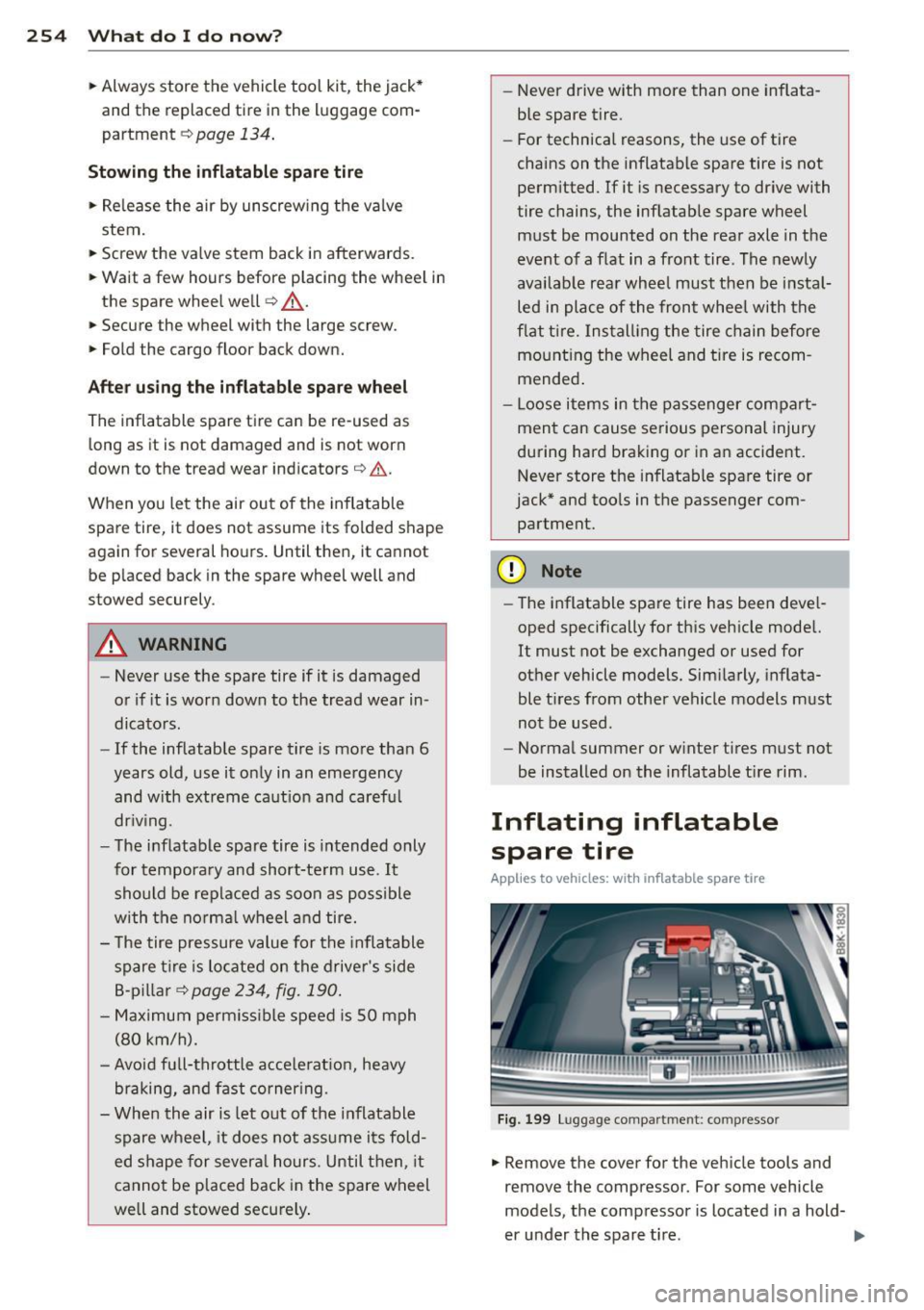
F ig. 199 Lu gg age compart ment: co mpressor
• Remove the cover for the veh icle tools and
remove the compressor. For some vehicle
models, the compressor is located in a hold-
er under the spare tire. .,.
Page 257 of 296
~ Unscrew the va lve stem from the s pare tire .
~ Screw the tire filler hose from the compres
sor firm ly onto the valv e of the spare tire.
~ In se rt the p lug from the compress or into a
socket of the vehicle¢
page 64.
~ Switc h the compressor on .
~ Let the compressor run until the valu e speci
fied on the tire pressure label is reached ¢
page 234, fig . 190. Switch the compres
so r off afte r runn ing for 12 minutes at the
most -danger of overhea ting!
A WARNING
The compressor and the tire filler hose can
become extremely hot while they are run
ning -danger of burns!
(D Note
Switch the compressor off after running
for 12 minutes at the most -danger of
overheating! Allow the compressor to cool
down for a few minutes before you use it
again.
Changing a wheel
Before changing a wheel
Observe the following precautions for your
own and your passenger' s safety when chang
ing a wheel .
~ After you experience a tire fa ilure, pu ll the
ca r well away from moving traffic and try to
r e ach
level gro und before yo u stop ¢ LI)..
~ All p assengers sho uld leave the car and
move to a safe loca tion (for instance, beh ind
the guardrai l) ¢
A .
~ Engage the parking brake to prevent your
vehicle from ro lling un intentionally ¢
A.
~ Shift into 1st gear on vehicles with manua l
transmission, o r move the
selector lever to
the P po sition
on veh icles with au toma tic
t ransmission .
~ If you are tow ing a tra ile r: u nhi tch the trail
er from your veh icle.
~ T ake the jack ¢ page 252 and the spare tire
¢ page 253 out of the luggage compart
ment.
What do I do now? 255
A WARNING
You or your passengers could be injured
while c hanging a wheel if you do not fo l
low these safety precaut ions:
- If you have a flat tire, move a safe d is
tance off the road . T urn off the engine,
tur n the eme rg ency flashers on and use
other wa rn in g devices to a le rt othe r mo
torists.
- Ma ke sur e that passengers wait in a safe
p lace away from the vehicle and well
away from the ro ad and traffic.
- T o help prevent the vehicle from moving
suddenly and possib ly sli pping off the
j a ck, alw ay s full y se t the par king br ake
an d block the wheel d iagonally opposi te
the whee l be ing changed w ith the fol d
ing chocks or other objects. When one
front wheel is lifted off the ground, plac ing the Automatic Transmission in "P"
(Park) will
not prevent the vehicle from
moving .
- Before you change a wheel, be sure the
grou nd is level and firm. I f necessary,
use a sturdy board unde r the jack .
- Always sto re the vehicle tool kit, the
jack* and the replaced tire in the luggage compa rtment
¢page 134.
(D Note
If you are changing the whee l on a steep
i ncline, use a rock or s imilar object to
block the opposite whee l to prevent the
vehicle from moving.
(D Tips
Obey all laws.
Changing a wheel
When you change a wheel , follow these
quence described below step-by-step and in
exactly that order .
l. Remove the decorative wheel cover* or
-
the wheel bolt caps* . For more details see..,.
•
•
Page 258 of 296
256 What do I do now?
also c:> page 2 5 6, Decorative wheel cov
ers
or c:> page 256, Wheels with wheel
bolt caps .
2. Loosen the wheel bolts c:> page 2 5 7.
3 . Locate the proper mount ing point for the
jack and align the jack below that point
<=> page 257.
4. Lift the car with the jack c:> pag e 257 .
5. Remove the wheel with the flat tire and
the n in st all the
spare tire c:> poge 258 .
6. Tigh ten all wheel bo lts light ly .
7 .
Lower the ve hicle with the jack .
8 . Use the wheel bolt wrench and
firmly
tighten all whee l bolts in a crisscross pat
tern
<=> page 257.
9. Replace the decorative wheel cover* or
the
wheel bolt caps* .
A WARNING
Always read an d follow all WAR NIN GS and
inf orma tion
c:> .&. in Raising the vehicle on
p age 258
and c:> pa ge 259.
After changing a wheel
A wh eel change is no t complete without th e
doing th e following .
.,. Always store the vehicle tool kit, the jack*,
and the replaced ti re in the l uggage com
partment
c:> page 13 4 .
.,. Check the tire pressure o f the spa re tire as
s oo n as pos sib le .
.,. As so on as possible, have t he
tightening
torques
on a ll w heel bo lts checked wi th a
tor que wrench . The correct tightening t or
que is 90
ft l bs. (120 Nm) .
.,. Have the flat tire
replaced as soo n as poss i
ble .
(j) Tips
-If you notice t hat the whee l bolts are
corroded and difficult to t urn w hile
c hanging a t ire, they should be replaced
be fore yo u ch eck the tighte ning torqu e.
- Driv e at reduc ed s peed unt il you have the
t ig hten ing torques checked .
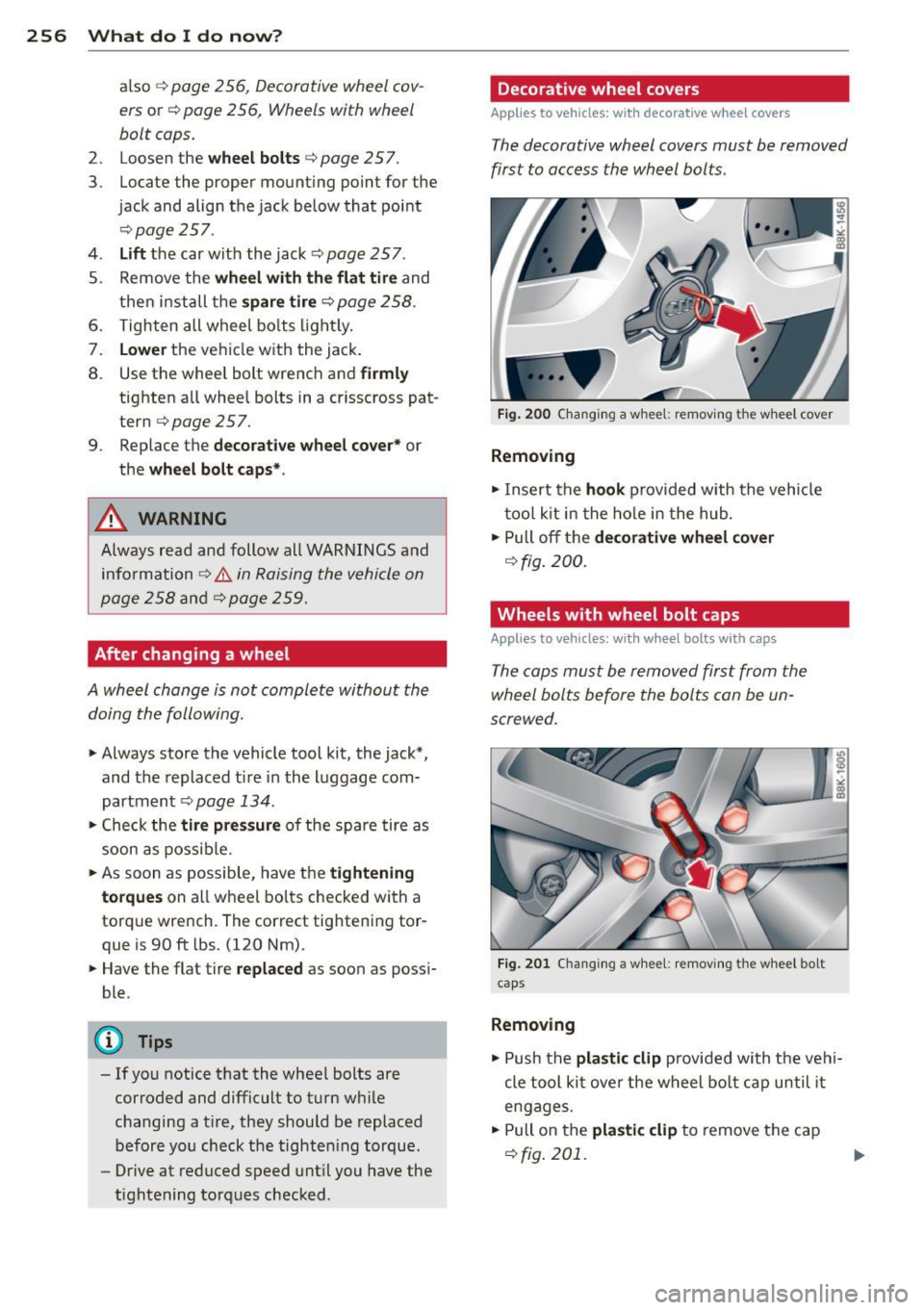
Decorative wheel covers
Applies to vehicles: with decorative wheel covers
The decorative wheel covers must be removed
first to access the wheel bolts .
Fig. 200 Cha ng in g a w hee l: r em ovi ng t he w hee l cover
Removing
.,. Inse rt th e hook prov ided with the vehicle
t oo l kit in the ho le in the hub.
.,. Pull o ff the
decor ative wheel cover
<=>fig . 20 0.
Wheels with wheel bolt caps
Applies to vehicles: with wheel bolts with caps
The caps mus t be removed firs t from the
wheel bolts before the bolts can be un
screwed .
Fig. 201 Cha ng in g a w hee l: re m ovi ng t he w hee l bo lt
caps
Removing
.,. Pu sh the plastic clip provi ded with t he vehi
cle tool ki t ove r the w heel bolt ca p until it
engage s.
.,. Pull on the
plastic clip to remove the cap
r:!) fig . 201.
Page 262 of 296
260 What do I do now?
-Check the tire pressure on the spare imme
diately after installation.
- Have the wheel bolt tightening torque
checked with a torque wrench as soon as possible by your authorized Audi dealer or
qualified workshop.
- With steel and alloy wheel rims , the wheel
bolts are correctly tightened at a torque of
90 ft lbs . (120 Nm).
- If you notice that the wheel bolts are cor
roded and difficult to turn while changing
a tire, they should be replaced before you
check the tightening torque .
- Replace the flat tire with a new one and
have it installed on your vehicle as soon as
possible. Remount the wheel cover.
Until then, drive with extra care and at re
duced speeds .
A WARNING
-If you are going to equip y our veh icle
with t ires or rims w hich diffe r from t hose
w hich w ere facto ry ins talled, th en be
s ure to read the in for mati on ~
pag e 242,
N ew tir es a nd replacing tires and
wheel s.
- Always make su re the damaged w heel or
eve n a fla t tire and the ja ck and to ol kit
a re prop erly secure d in the lug gage com
par tment and are not loose in the pas
senger com partment .
- In an a cciden t or sud den m ane uver they
cou ld fly forwar d, inju ring anyone in the
vehicle.
- Always s tore d amage d w hee l, ja ck a nd
tool s secure ly in the lu g gage com part
me nt. Otherw ise, in an acc ident or sud
den maneuver they cou ld fly fo rward,
causing injury to passenge rs in the veh i
cle .
@ Note
Do not use commerc ia lly available t ire
sea lants. Othe rwise, the elect rical compo
ne nts of the tire pressure mon itor ing sys
tem* will no longer wo rk p roperly and the
sensor for th e tire p ressur e monito rin g system
* wi ll h ave to be repla ced by qu ali
fied workshop .
Page 283 of 296
Automatic climate control Air vents ... .... .. .... ... .. .. .. .... 78
Operation . . . . . . . . . . . . . . . . . . . . . . . . . 77
Setup ... .. ................. .. .... 79
Automatic S hift Lock (ASL) . . . . . . . . . . . . 93
Automatic transmission ......... ... ... 91
Automatic S hift Lock (ASL) . . . . . . . . . . . 93
D riving .. .. ............. .... .. .. .. 9 3
E mergency mode . . . . . . . . . . . . . . . . . . . 97
E me rgency release . . . . . . . . . . . . . . . . . . 98
Kick -down . . . . . . . . . . . . . . . . . . . . . . . . . 96
M anual shift program .. ... .. .. .. .. .. 96
Remova l lock (ignition key) ... .. .. .. .. 80
Selector lever . . . . . . . . . . . . . . . . . . . . . . 92
Automatic wipe rs . . . . . . . . . . . . . . . . . . . . 53
Auto Safety Hotline ............. .... 136
Average speed . . . . . . . . . . . . . . . . . . . . . . . 25
Avoid damag ing the vehi cle .. .. .. .. .. . 195
B
Bag hooks . . . . . . . . . . . . . . . . . . . . . . . . . . 72
Battery . . . . . . . . . . . . . . . . . . . . . . . 17,225
Battery location inside the luggage com -
partment .. .. ........... .. .. .. ... 225
Charging . ................ ... ... .. 227
Important war nings when wo rking on
the battery . ................ ... ... 225
J ump starti ng ............ .... .. .. . 266
L ow . .. .. .. .. .. ........... .. .. ... 193
Replacing the ba ttery .. ... .. .. .. .. . 228
State of charge . ....... ... .. .. .. ... 193
Winter operation . ..... ... .. .. .. .. . 225
Working on the battery .... .. .. .. .. . 225
B efore dr iving ............. .... .. .. . 128
Bio-ethanol (Fuel) ..... ..... .. .. .. .. . 210
Blended gasoline ... .... ... .. .. .. .. . 209
B lower (automatic climate cont rol) . . . . . . 78
Booster seats ............. .... .. .. . 175
B rake fl uid
C hanging the brake fl uid ... .. .. .. .. . 224
Chec king the brake fluid level ... .. .. . 224
Reservoir .. ............. .... .. ... 224
What is the correct brake flu id leve l? . . 224
What should I do if the brake fluid warn-
i ng light comes o n? .. ..... .. .. .. .. . 224
Inde x 281
Brake system . ..... ... .. .. ..... ... .. 224
Anti- lock b raking system ..... ... .. .. . 19
B rake assist system .. .. ..... ... .. .. 186
Brake fluid .. .. .. ................. 224
Brake fluid specifications for refill and re-
placement ...... .. ............... 224
B rake light defective ... .. .. ... ... .. . 21
B ra ke powe r ass ist unit ............ . 189
Br akes .. .. .. .. .. .. . .............. 189
Ce ram ic bra kes . .. .... ........... .. 189
El ec tromechanica l parking brake ... .. . 85
Warning/indicator lights ..... ... .. .. . 15
Wor n brake pads symbo l . . . . . . . . . . . . . 20
B ra kin g
E mergency b ra ki ng f unction ..... .. .. . 87
braking guard . . . . . . . . . . . . . . . . . . . . . . . 99
Messages . . . . . . . . . . . . . . . . . . . . . . . . 107
Settings ........ .. ............... 106
Break -in per iod .. .. .... ............. 195
Tires ... .. .. .. .. .. ............... 195
Bul bs . ... .. .. .... .. . .. .. ..... ... .. 2 64
C
Califor nia Proposition 65 War ning . .. .. 215
B attery spec ifi c .. ............. .. .. 226
Capacities ........ .. ............... 273
Carbon pa rts
Cleaning . . . . . . . . . . . . . . . . . . . . 206, 207
Care ..... .. .. .. .... ... .......... .. 20 4
Cargo a rea
refer to L uggage compartment . . . 68, 134
Catalytic converter ... .. ...... ... .. .. 196
Cen te r armrest . . . . . . . . . . . . . . . . . . . . . . 60
Central lock ing .. .. ................. . 32
Cen tral lock ing switch ............. .. 36
Co nvenience key . . . . . . . . . . . . . . . . . . . . 36
Remote cont ro l key . ........... .... . 35
Ceram ic brake rotors
New brake pads .. ............. .... 189
Ce rtification . ... .... . ... ...... ... .. 278
Chang ing a flat t ire . .. ... ....... .... . 255
Chang ing a wheel .. ............. .... 255
Chang ing engine oil ............. .... 220
Checking Engine coolant level .... ....... .... . 221
Checking t ire pressure ............... 237
•
•
Page 284 of 296
282 Index
Child restraints
Dang er of using child restraints in th e
front seat . .... .... ......... ..... . 147
Where can I get addit ional information
about child restra ints and their use? . . 185
Child restraint system anchors ..... .. . 181
Ch ild safety .. ................ ... ... 167
Conve rtible locking retracto r .. .. .....
177
Important safety instructions fo r using
ch ild safety seats . . . . . . . . . . . . . . . . . . 17 0
I mportant things to know when driving
with chi ldren ........... ... .. .... .
167
Installing a child restraint using the
LATCH system . . . . . . . . . . . . . . . . . . . . . 182
Lower anchorages .......... .. .... . 182
Mounting and releasing the anchorage
hook .. .... .......... ...... ... .. . 182
Tether anchors . . . . . . . . . . . . . . . . . . . . 183
Tether straps .......... .. .. .. .. .. . 183
Child safety locks Power windows . ..... .... .. .. .. .. .. 43
Rear doors . .............. ... .. .. .. 42
Child safety seats .................. .
173
Booster seats . . . . . . . . . . . . . . . . . . . . . 17 5
Convertible child seats .... .. .. .... .
17 4
Convertible locking retracto r .. .. .....
177
Danger of using child restraints in the
front seat .. .......... ...... ... .. . 147
H ow do I properly install a child safety
seat in my vehicle? ...... .. .. .. .. .. .
170
Infant seats ............. .. .. .. .. . 173
I nstalling . .. .... ........ .. .. .... .
177
LATCH system .. .. ...... .. .. .. .... . 182
Safety instructions ................ . 170
Unused safety belts on the rear seat . .
172
C ig are tte lighte r . . . . . . . . . . . . . . . . . . . . . 63
Cleaning .. .. ................ ... .. .
204
Climate controls . . . . . . . . . . . . . . . . . . . . . 76
C limate control system
Automatic recirculation . . . . . . . . . . . . . .
79
Supp lementary heater . . . . . . . . . . . . . . . 79
synchronizing .. ........ .. .. .. .... .. 79
C lock ....... .......... ...... ... .. .. 12
C losing
Power windows .......... .. .. .... .. 43
Sliding/tilting sunroof ...... ..... .. .. 44
Sunshade .. ................ ... ... . 44 Closing/opening
at the lock cylinder . . . . . . . . . . . . . . . . . . 38
by remote control . . . . . . . . . . . . . . . . . . 35
with the centra l locking switch ... .... . 36
wi th the conven ience key . . . . . . . . . . . . . 36
Cold tire inflation pressure ........ .. .. 234
Coming home ..... ................ .. 48
Compact spare ti re .............. .... 252
also refer to Spare tire .......... .. .. 252
Compartments . . . . . . . . . . . . . . . . . . . . . . 66
Compass in the mirror ..... ... ..... .. . 56
Compliance ..... .. .. ... ........ .. .. 278
Consumer Information . . . . . . . . . . 136, 275
Contac ting NHTSA . ... .......... .. .. 136
Controls Cleaning . ..... .. .. ... ........ .. .. 206
Convenience key Indi cator lights .. ... .......... .. .. . 84
Starting engine (S TART ENGINE STOP
button) ... .... .. ... .. ........ .. .. . 83
Stopping the engine (START ENGINE
STOP button) . . . . . . . . . . . . . . . . . . . . . . 84
Switching on ignition ........... .... . 83
unlocking/locking ............. .... . 36
Convenience opening/closing ..... .. .. . 43
Convertib le child safety seats ......... 17 4
Convertib le locking retractor
Activating ... .. .. ............. .. ..
179
Deact ivat ing ... .. ... .... ....... ... 180
Using to secure a child safety seat
1.77, 179
Coolant system .... .. ........... .. .. 221
Cooling mode (automatic climate control) 77
Cooling System Expansion tank . .. .......... ...... . 221
Cornering light .... .. ........... .. .. . 47
Cruise control Changing speed .. ............. .. .. . 89
Presetting your speed .......... .... .
90
Switching off .... ... .......... .. .. . 90
Switching on ... .. ... .......... .. .. . 89
Cruising range ... .. ............. .... . 25
(upholder .. .... .. ............. .... . 65
D
Data recorder . . . . . . . . . . . . . . . . . . . . . . 186
Date display .... .. ............. .... . 12