ECO mode AUDI S4 2014 Owner's Guide
[x] Cancel search | Manufacturer: AUDI, Model Year: 2014, Model line: S4, Model: AUDI S4 2014Pages: 296, PDF Size: 73.56 MB
Page 201 of 296
the engine is at its proper operating tempera
ture and fuel economy has reached a normal
level. So you can see that you should avoid
short trips whenever possib le.
The
outside temperature is also critical in this
regard. Your car consumes more fuel in the
winter than in the summer .
allroad: Driving offroad
General information
Applies to vehicles: atlroad
When driving offroad, the funct ions for the
e lectronic stab ilization control (ESC) are ex
panded. The ESC-Offroad-Mode can be activat
ed in driving situations in which a wheel lock
or a differentia l lock function is needed
c::> page 188. In addit ion, your Audi provides
continuous all wheel drive .
Your Audi is however , not an offroad vehicle.
Never drive the vehicle in terrain which is not
suitable for the vehicle, or which exceeds
your driving skills. Never take any unneces
sary risks!
After driving offroad
-After driving offroad, remove branches and
other debris from the radiator grille, under
body, and wheels. Look especially for objects
(stones) that have been caught in the tire
tread .
- Clean the body and the vehicle underbody
and inspect the vehicle for possible damag
es.
- Clean off the dirty windows, headlights, tail
lights and the license plate.
- Perform a brake test (especially after driving through water).
A WARNING
- Be espec ially aware and attentive when
dr iv ing under diff icult conditions . Dam
ages to the vehicle and injuries may oc
cur when driving at an excess ively high
speed or with incorrect driving maneu
vers.
Driving and environment 199
- Always adjust your speed and handling
to the roads, terrain, traff ic and weather
conditions. Drive especially slow if off road with low visibility.
- Please note that the wheels can spin and
the vehicle can break away when the ESC
Offroad Mode is switched off, especially
when the road is slippery .
- Driving stability is reduced in the ESC
Offroad mode .
® For the sake of the environment
Avoid harming the environment and take
nature into cons ideration.
(D Tips
Only drive where it is allowed and always
stay on the provided roads and paths.
Driver messages
Applies to vehicles : a ll road
There is only one right way to drive in difficult
conditions: slowly and with caution!
When dr iving offroad, observe the following:
... Never drive the vehicle i n terrain which is
not suitab le for the vehicle, or which ex
ceeds your driv ing ski lls. Never take any un
necessary risks!
... Drive slow ly and cautiously!
... Pay attention to the
ground clearance of
your vehicle! This may vary depending on the load and composition of the ground and
the environment. The driver is therefore re
sponsible for deciding whether a veh icle can
handle a specific situation.
... Act ivate the
ESC -Offroad-Mode c::> page 188
as needed.
Difficult terrain
Never dr ive in areas that are not familiar to
you and drive slowly when offroad and be pre
pared and expect the unexpected (e.g. pot
holes, boulders, tree stumps, etc.)
To prevent the vehicle from bottoming and avo id damage to the underbody, you should
drive straight across severe bumps in the
IJII>
•
•
Page 219 of 296
Modern eng ine lubrication has taken a quan
tum leap in the last few years . Many synt hetic
oils ava ilable today provide better engine lu
brication that can outlast traditional pet role
um-based o ils, making them a smart choice
for use throughout the life o f your Audi .
W hether you use synthetic or petroleum
based engine oil, the oil that you use must
c o nform to Audi's oil quality standard
VW 502 00 to help keep your vehicle's engine running smoothly and help prevent the for
mat ion of harmfu l deposits, sometimes called
"sludge", that ove r time can lead to expensive
r epairs .
At the time of pri nting, engine o ils available in
the U .S . and Canada that meet the exacting
specifications of Audi oi l standard VW 502 00
are synthetic engine oils. This does not mean, h owever, that every synthetic engine oil w ill
meet Audi oil standard VW 502 00. So always
be sure that you use an approved oi l.
To help prevent the format ion of harmful de
posits use only oi l with the fo llowing spec ifi
cations printed on the oil container:
Audi oil standard VW 502 00
O il conta iner labels may carry the specif ica
tion s ingly or in comb inat ion w ith other des ig
nations and oil qua lity standards .
Viscosity
Engine oi ls are graded according to their vis
cosity. The proper v iscosity grade oi l for your
engine depends on cl imactic or seasonal con
d itions where you dr ive. You can use oil with a
viscosity grade of SAE SW40 across all tem
pe rature ranges for normal d riving conditions .
However, if eng ine oi l viscosity grade SAE
SW40 is not avai lab le, you can also use viscos
ity grade SAE SW-30 or SAE OW-40 as long as
it meets Audi o il quality standard VW 502 00
specifications.
Because engine oil that meets the Audi oil
standard may not be available everywhere
when you need it, we st rongly recomme nd
that you always carry with you a n ext ra quart
Checkin g and fillin g 217
(li ter) of oil that exp ress ly con forms to the
VW 502 00 specification, in case you have to
top
off the o il while on the road.
Only if the level of the o il is at or be low the
minimum mark -and no oi l that expressly
confo rms to Audi oil standard VW 502 00
spec ifications is available -may you top
off
with a h igh quality engine o il, preferab ly syn
thet ic-based, that meets ACEA A3 or API SM
specifications, but even then, only in v iscosity
grades SAE SW-40, SA E SW-30, o r SAE
OW-40. However, dur ing the entire time be
tween o il cha nge inte rva ls, never top
off with
more than a tota l of 0. 5 q t/liter engine o il
that does not con form to A udi oil specification
vw 502 00.
Fo r more information about eng ine oi l tha t
has been approved for your veh icle, ple ase
contac t either yo ur a uthorized Aud i dea le r or
Audi C ustomer Re lations at 1 (800) 822 -2834
or visit our web site at www .audiusa.com or
www.aud icanada .ca. Here you w ill also find a
current list of oils (manufacturers, brand
names etc.) that conform to Audi oil standard
vw 502 00.
Changing the engine oil
T he eng ine oi l and o il f ilter m ust be changed
according to the mileage (kilometers) and
time intervals specified i n your vehicle's War
ranty
& Maintenance booklet. Do not exceed
these interva ls - harmful deposits from old
engine oil can reduce engine performance and
can lead to expensive engine repairs.
Changi ng the oil at the recommended inter
vals is so very important beca use the lubricat
ing propert ies of oil decrease gradually during
norma l veh icle use . If you a re not sure when
you have your o il cha nged, ask your author
ized Audi Se rv ice Adv isor.
Under some circumstances the engine oil
shou ld eve n be changed more frequent ly.
Change oil more often if you dr ive most ly
sho rt distances, operate the veh icle in dusty
areas o r most ly under stop-and-go traff ic con-
di tions, o r when you use your vehi cle where .,..
•
•
Page 223 of 296
Engine cooling system
Coolant
The engine coolant performs two functions: it
keeps the engine from overheating and it pro
tects the engine from freezing in the winter .
The cooling system is sealed and generally re
qu ires little attention .
The cooling system has been filled at the fac
tory with a permanent coolant which does not need to be changed. The coolant consists of a
mixture of specially conditioned water and the
manufacturer's glycol-based coolant addi-
tive G13 antifreeze with anticorros ion addi
tives (50% for USA models; 60% for Canadian
models) . This mixture both assures the neces
sary frost protection and protects metal com
ponents in the engine's cooling system from
corrosion and scaling.
It also raises the boil
ing point of the coolant.
Do not reduce the concentration of the coo l
ant in the summer by adding plain water .
The
proportion of coolant additive must be at
least 50% but not more than 60%
to main
tain antifree ze protection and cooling efficien
cy. If the coolant frost protection is too low,
the coolant could freeze and damage the vehi
cle heating and eng ine cooling system .
For year-round driving, antifree ze is added at
the factory for temperatures down to:
- -31°F(-35°C)USA
- -40 ° F ( - 40 °C) Canada.
I f you must add coo lant, use a mixture of wa
ter and coolant addit ive. Mixing the coolant
additive with distilled water is recommended.
& WARNING
Before you check anything in the engine
compartment, always read and heed all
WARNINGS
c::;, .&. in Working in the engine
compartment on page 214.
(D Note
- Before winter sets in, have the coolant
checked to see if the coolant additive in
Checkin g and fillin g 221
your vehicle is sufficient to meet the cli
mate conditions. This is especia lly impor
tant if you live in a region where the win
ter is extremely co ld. If necessary, in
crease the proportion of coolant additive
to 60% .
- When adding coolant additive to your
cooling system, remember :
- We recommend using only coolant ad
ditive G12++ or G13 for your vehicle .
This coolant additive is available at au
thorized Audi dealers. Other types of
antifreeze can significantly reduce cor
rosion protection. The resulting corro
sion can cause a loss of coolant and se rious engine damage.
- Do not add any type of radiator leak seal
ant to your vehicle's engine coolant.
Adding radiator repair fluid may adverse
ly affect the function and performance of
your cooling system and could result in
damage not covered by your New Veh icle
Limited Warranty.
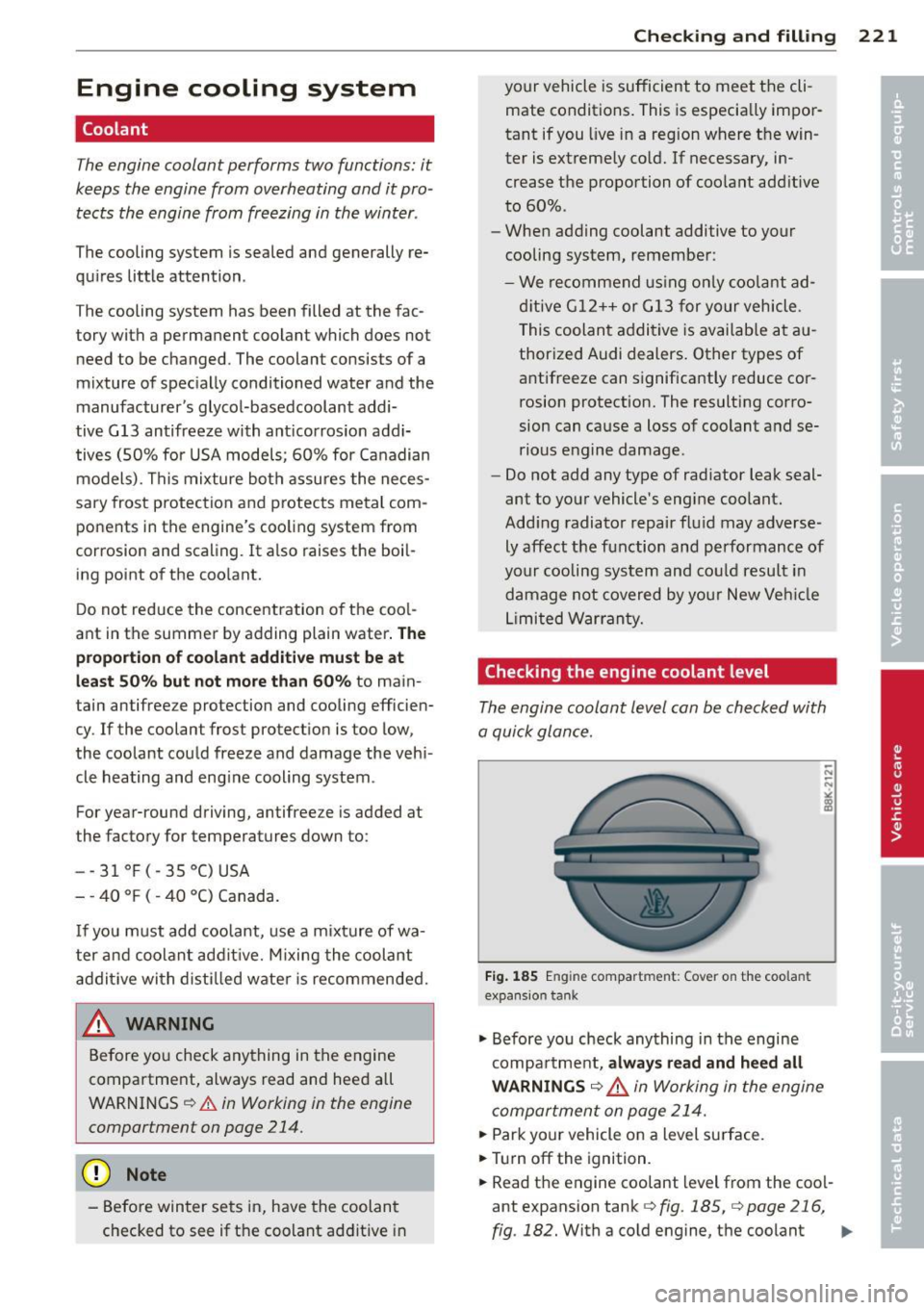
Checking the engine coolant level
The engine coolant level can be checked with
a quick glance.
Fig. 185 En gin e compar tment: Cover on the coo la n t
expansio n tan k
"' Before you check anything in the engine
compa rtme nt,
always read and heed all
WARNINGS c::;, .&, in Working in the engine
compartment on page 214.
"'Park your vehicle on a level su rface .
.,. Turn off the ignition .
.,. Read the engine coolant level from the cool
ant expansion tank
i=> fig . 185, c::;, page 216,
fig . 182. With a cold engine, the coolant Iii>
Page 226 of 296
224 Checking and filling
Brake fluid
Checking brake fluid level
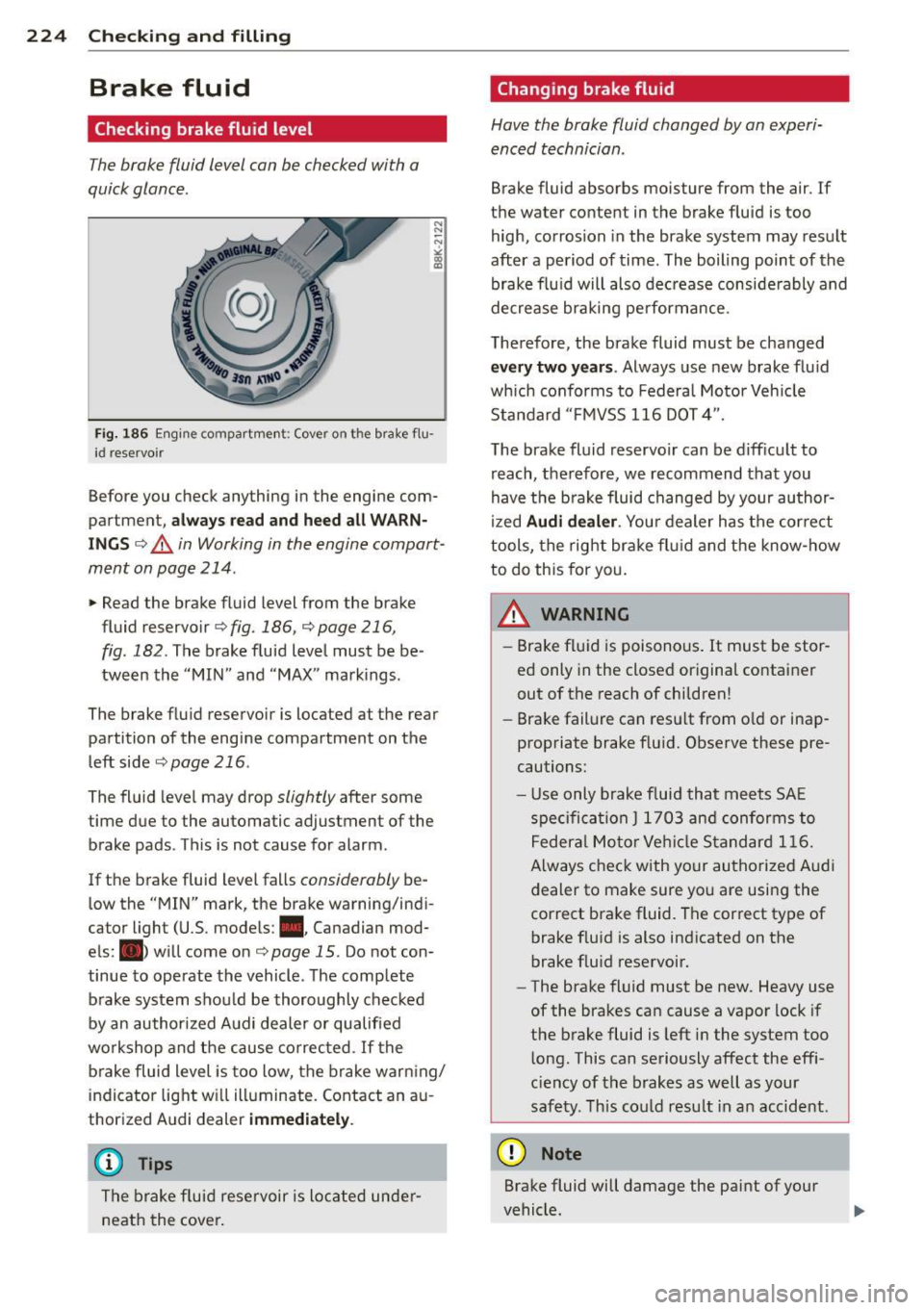
The brake fluid level can be checked with a
quick glance .
N N ~ N
" (X) (0
Fig. 186 Engine compart ment: Cover on the brake flu·
id reservo ir
Before you check anything in the engine com
partment,
always read and heed all WARN·
INGS ¢.&._ in Working in the engine compart
ment on page 214 .
.. Read the brake fluid level from the brake
fluid reservoir ¢
fig. 186, ¢ page 216,
fig . 182.
The brake fluid level must be be
tween the "MIN" and
"MAX" markings.
The brake fluid reservoir is located at the rear
partition of the engine compartment on the
left side
¢ page 216.
The fluid level may drop slightly after some
time due to the automatic adjustment of the
brake pads . This is not cause for alarm.
If the brake fluid level falls
considerably be
low the "MIN" mark, the brake warning/indi
cator light (U.S. models: ., Canadian mod
els: .) will come on¢
page 15. Do not con
tinue to operate the vehicle . The complete
brake system should be thoroughly checked
by an authorized Audi dealer or qualified
workshop and the cause corrected .
If the
brake fluid level is too low, the brake warning/
indicator light will illuminate. Contact an au
thorized Audi dealer
immediately .
@ Tips
The brake fluid reservoir is located under
neath the cover.
Changing brake fluid
Have the brake fluid changed by an experi
enced technician .
Brake fluid absorbs moisture from the air. If
t he water content in the brake fluid is too
high, corrosion in the brake system may result
after a period of time . The boiling point of the
brake flu id will also decrease conside rably and
decrease braking pe rformance.
Therefore, the brake fluid must be changed
every two years . Always use new brake flu id
which conforms to Federal Motor Vehicle
Standard "FMVSS 116 DOT 4".
The brake fluid reservoir can be difficult to reach, therefore, we recommend that you
have the brake fluid changed by your author
ized
Audi dealer. Your dealer has the correct
tools, the right brake fluid and the know-how
to do this for you .
A WARNING
- Brake fluid is poisonous . It must be stor
ed only in the closed original container
out of the reach of children!
- Brake failure can resu lt from o ld or inap
propriate brake fluid. Observe these pre
cautions:
- Use only brake fluid that meets SA E
specification
J 1703 and conforms to
Federal Motor Vehicle Standard 116.
Always check with your authorized Audi
dealer to make sure you are using the
correct brake fluid. The correct type of
brake f luid is also indicated on the
brake fluid reservoir.
- The brake fluid must be new. Heavy use
of the brakes can cause a vapor lock if
the brake fluid is left in the system too
long . This can seriously affect the effi
c iency of the brakes as well as your
safety. This could resu lt in an accident.
(D Note
Brake fluid will damage the paint of your
vehicle .
Page 237 of 296
you have stored. The system does not recog
nize the load condition of your vehicle.
The effectiveness of the ti re pressu re monitor
ing sys tem* will be impaired if you store nor
mal load pressures but then operate the vehi
cle at its maximum load¢,& .
See the illustration ¢
fig. 189 for the location
of the label on dr iver's side B-pillar (color of
the actual labe l and exact location on the ve
hicle wi ll vary slig htly) .
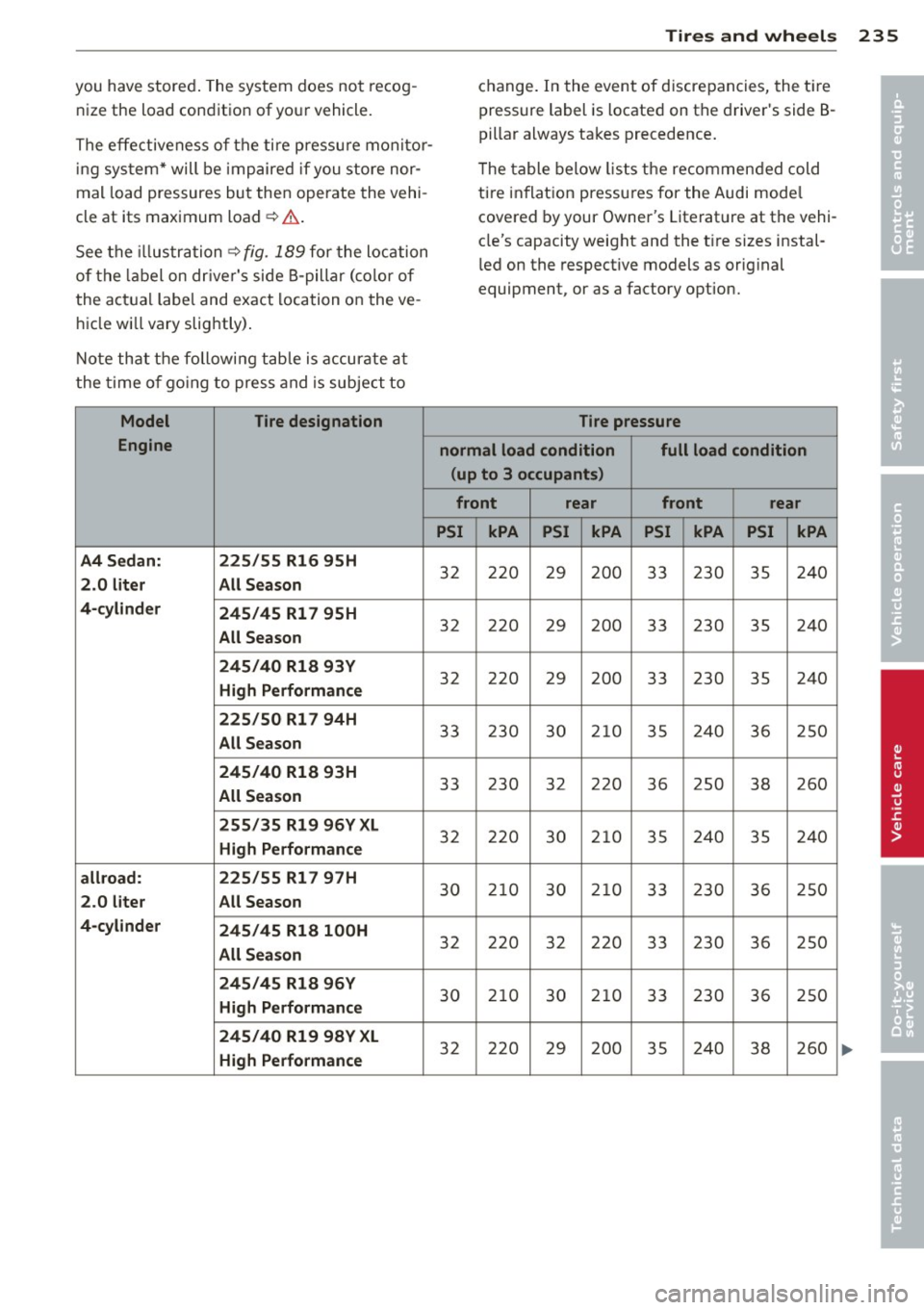
Note that the fo llowing tab le is accurate at
the t ime o f go ing to press and is subject to
Model Tire designation
Engine
A4 Sedan: 225/55 Rl6 95H
2 .0 lit er All Se ason
4 -cy linder
245/45 Rl 7 95H
All Se ason
2 4 5/ 40 Rl8 93Y
Hi gh P erf or mance
2 25/5 0 Rl 7 94H
All Sea son
2 4 5/ 40 Rl 8 93H
All Se ason
2 55 /35 Rl9 96Y XL
Hig h Perf ormanc e
a llro ad: 225/55 Rl 7 97 H
2.0 l it e r All Season
4 -cy lind er
245 /45 Rl 8 l00H
All Sea so n
2 45 /45 Rl8 96 Y
Hig h Perf or mance
245 /40 Rl9 98Y XL
High P erf or mance
Tire s an d wheel s 235
change. In the event of discrepancies, the ti re
pressure label is located on the driver's side B
pillar always takes precedence .
T he table below lists the recommended cold
ti re inflation pressures for the Audi mode l
covered by your Owner's Literature at the vehi
cle's capacity weight and the t ire sizes instal
l ed on the respective models as orig inal
equipment, or as a factory option.
Tire pressure
normal load condition full load condition
( up to 3 occupants )
f r ont rear front rear
PSI kPA PSI kPA PSI kPA PSI kPA
32 220 29 200 33 230 35 240
32 220 29 200 33 230 35 240
32 220 29 200 33 230 35 240
33 230 30 210 35 240 36 250
33 230
32 220
36 250
38 260
32 220 30 210 35 240 35 240
30 2 10 30 2 10 33 230 36 250
32 220 32 220 33 230 36 250
30 210 30 2 10 33 230 36 250
32 220 29 200 35 240
38 260
•
•
Page 249 of 296
Snow chains
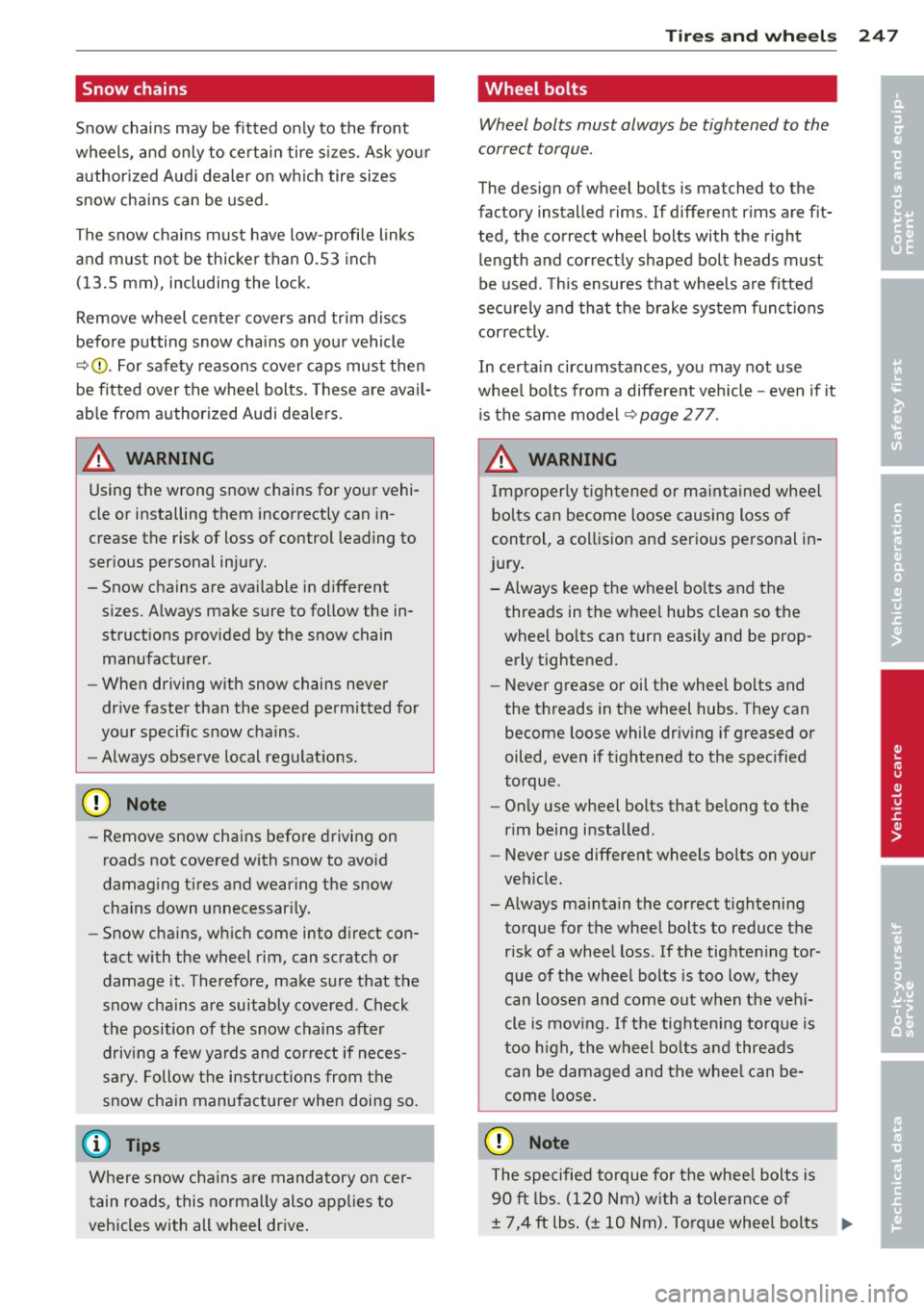
Snow chains may be fitted only to the front
wheels, and only to certain tire sizes. Ask your
authorized Audi dealer on which tire sizes
snow chains can be used.
The snow chains must have low-profile links
and must not be thicker than 0.53 inch
(13.5 mm), including the lock .
Remove wheel center covers and trim discs
before putting snow chains on your vehicle
~ 0. For safety reasons cover caps must then
be fitted over the wheel bolts. These are avail
able from authorized Audi dealers.
~ WARNING
Using the wrong snow chains for your vehi
cle or installing them incorrectly can in
crease the risk of loss of control leading to
serious personal injury.
- Snow chains are available in different sizes. Always make sure to follow the in
structions provided by the snow chain
manufacturer .
- When driving with snow chains never
drive faster than the speed permitted for
your specific snow chains.
- Always observe local regulations.
(D Note
- Remove snow chains before driving on
roads not covered with snow to avoid
damaging tires and wearing the snow
chains down unnecessarily.
- Snow chains, which come into direct con
tact with the wheel rim, can scratch or
damage it . Therefore, make sure that the
snow chains are suitably covered . Check
the position of the snow chains after
driving a few yards and correct if neces
sary. Follow the instructions from the
snow chain manufacturer when doing so.
(j) Tips
Where snow chains are mandatory oncer
tain roads, this normally also applies to
vehicles with all wheel drive.
Tires and wheels 24 7
Wheel bolts
Wheel bolts must always be tightened to the
correct torque.
The design of wheel bolts is ma tched to the
factory inst alled rims. If different rims are fit
ted, the correct wheel bolts with the right length and correctly shaped bolt heads must
be used. This ensures that wheels are fitted
securely and that the brake system functions
correctly.
In certain circumstances, you may not use
wheel bolts from a different vehicle -even if it
is the same model~
page 2 77.
&_ WARNING
Improperly tightened or maintained wheel
bolts can become loose causing loss of
control , a collision and serious personal in
jury.
- Always keep the wheel bolts and the
threads in the wheel hubs clean so the
wheel bolts can turn easily and be prop
erly tightened.
- Never grease or oil the wheel bolts and
the threads in the wheel hubs. They can become loose while driving if greased or
oiled, even if tightened to the specified
torque .
- Only use wheel bolts that belong to the
rim being installed .
- Never use different wheels bolts on your
vehicle.
-Always maintain the correct tightening torque for the wheel bolts to reduce the risk of a wheel loss. If the tightening tor
que of the wheel bolts is too low, they
can loosen and come out when the vehi
cle is moving.
If the tightening torque is
too high, the wheel bolts and threads
can be damaged and the wheel can be
come loose.
(I} Note
The specified torque for the wheel bolts is
90 ft lbs . (120 Nm) with a tolerance of
± 7,4 ft lbs. (± 10 Nm). Torque wheel bolts .,..
•
•
Page 250 of 296
248 Tires and wheels
diagonally. After changing a wheel, the
torque must be checked as soon as possi
ble with a torque wrench -preferably by an
authorized Audi dealer or qualified work
shop.
Low aspect ratio tires
Your Audi is factory-equipped with low aspect
ratio tires. These tires have been thoroughly
tested and been selected specifically for your
model for their superb performance, road feel
and handling under a variety of driving condi
tions. Ask your authorized Audi dealer for more details.
The low aspect ratio of these tires is indicated
by a numeral of
55 or less in the tire's size
designation. The numeral represents the ratio
of the tire's sidewall height in relation to its
tread width expressed in percentage. Conven
tional tires have a height/width ratio of 60 or
more.
The performance of low-aspect-ratio tires is
particularly sensitive to improper inflation
pressure. It is therefore important that low
aspect ratio tires are inflated to the specified pressure and that the inflation pressure is
regularly checked and maintained. Tire pres
sures should be checked at least once a
month and always before a long trip
~ page 23 7, Checking tire pressure.
What you can do to avoid tire and rim
damage
Low aspect ratio tires can be damaged more
easily by impact with potholes, curbs, gullies
or ridges on the road, particularly if the tire is
underinflated.
In order to minimize the occurrence of impact
damage to the tires of your vehicle, we recom
mend that you observe the following precau
tions:
- Always maintain recommended inflation
pressures. Check your tire pressure every
2,000 miles (3,000 km) and add air if neces
sary. -
Drive carefully on roads with potholes, deep
gullies or ridges. The impact from driving
through or over such obstacles can damage
your tires. Impact with a curb may also cause damage to your tires.
- After any impact, immediately inspect your
tires or have them inspected by the nearest
authorized Audi dealer. Replace a damaged
tire as soon as possible .
- Inspect your tires every 2,000 miles (3,000
km) for damage and wear. Damage is not al
ways easy to see . Damage can lead to loss of
air and underinflation, which could eventu
ally cause tire failure.
If you believe that a
tire may have been damaged, replace the
tire as soon as possible.
- These tires may wear more quickly than oth
ers.
- Please also remember that, while these tires
deliver responsive handling, they may ride
less comfortably and make more noise than
other choices.
Reduced performance in winter/cold
season conditions
All tires are designed for certain purposes.
The low aspect ratio, ultra high performance
tires originally installed on your vehicle are in
tended for maximum dry and wet road per
formance and handling. They are not suitable
for cold, snowy or icy weather conditions. If
you drive under those circumstances, you
should equip your vehicle with all-season or
winter tires, which offer better traction under
those conditions. We suggest you use the rec
ommended snow or all-season tires specified
for your vehicle , or their equivalent.
Refer to
~ page 246 for more detailed infor
mation regarding winter tires.
Page 256 of 296
2 54 Wh at do I d o now ?
• Always store the vehicle tool kit, the jack *
and the replaced tire in the luggage com
partment ¢
page 134.
Stowing the infl ata ble spare tir e
• Release the air by unscrew ing the va lve
stem.
• Screw the valve stem back in afterwards.
• Wait a few hours before p lacing the wheel in
the spare wheel well¢.&_ .
• Secure the wheel with the large screw.
• Fold the cargo floor back down.
Aft er usi ng th e inflat able sp are wh eel
The inflatable spare tire can be re-used as
long as it is not damaged and is not worn
down to the tread wear indicators¢&. .
When you let the air out of the inflatable
spare tire, it does not assume its folded shape
again for several hours . Until then, it cannot
be p laced back in the spare wheel well and
stowed securely .
A WARNING
-Never use the spare tire if it is damaged
or if it is worn down to the tread wear in
dicators.
- If the inflatable spare tire is more than 6
years old, use it only in an emergency and w ith extreme caut ion and carefu l
dr iv ing .
- The inflatable spare tire is intended only
for temporary and short-term use.
It
should be replaced as soon as possible
with the norma l wheel and tire.
- T he tire pressure value for the inflatable
spare t ire is located on the drive r's side
8-pilla r
¢page 234, fig. 190.
-Maximum perm iss ible speed is SO mph
(80 km/h).
- Avoid full-throttle acce le rat ion, heavy
braking, and fast corner ing.
- When the air is let out of the inflatable
spare wheel, it does not assume its fold
ed shape for severa l hours. Until then, it
cannot be placed back in the spare wheel
we ll and stowed securely . -
Never drive with more than one inflata
ble spare tire.
- For technical reasons, the use of tire
chains on the inflatable spare tire is not
perm itted. If it is necessary to drive with
tire chains, the inflatable spare wheel
must be mounted on the rear axle in the
event of a flat in a front tire . The newly
availab le rear whee l must then be instal
led in place of the front whee l with the
f lat t ire. Instal ling the tire chain before
mount ing the wheel and tire is recom
mended .
- L oose items in the passenger compart
ment can cause serious personal injury
during hard braking or in an accident.
Never store the inflatable spare tire or
jack* and too ls in the passenger com
partment.
(D Note
- The inflatable spa re tire has been deve l
oped specifically for this vehicle model.
It must not be exchanged or used for
other vehicle models. Sim ilarly, inflata
ble t ires from other vehicle models must
not be used.
- Normal summer or w inter tires must not
be installed on the inflatable t ire rim.
Inflating inflatable
spare tire
Applies to veh icles: w ith inflatable spare t ire
F ig. 199 Lu gg age compart ment: co mpressor
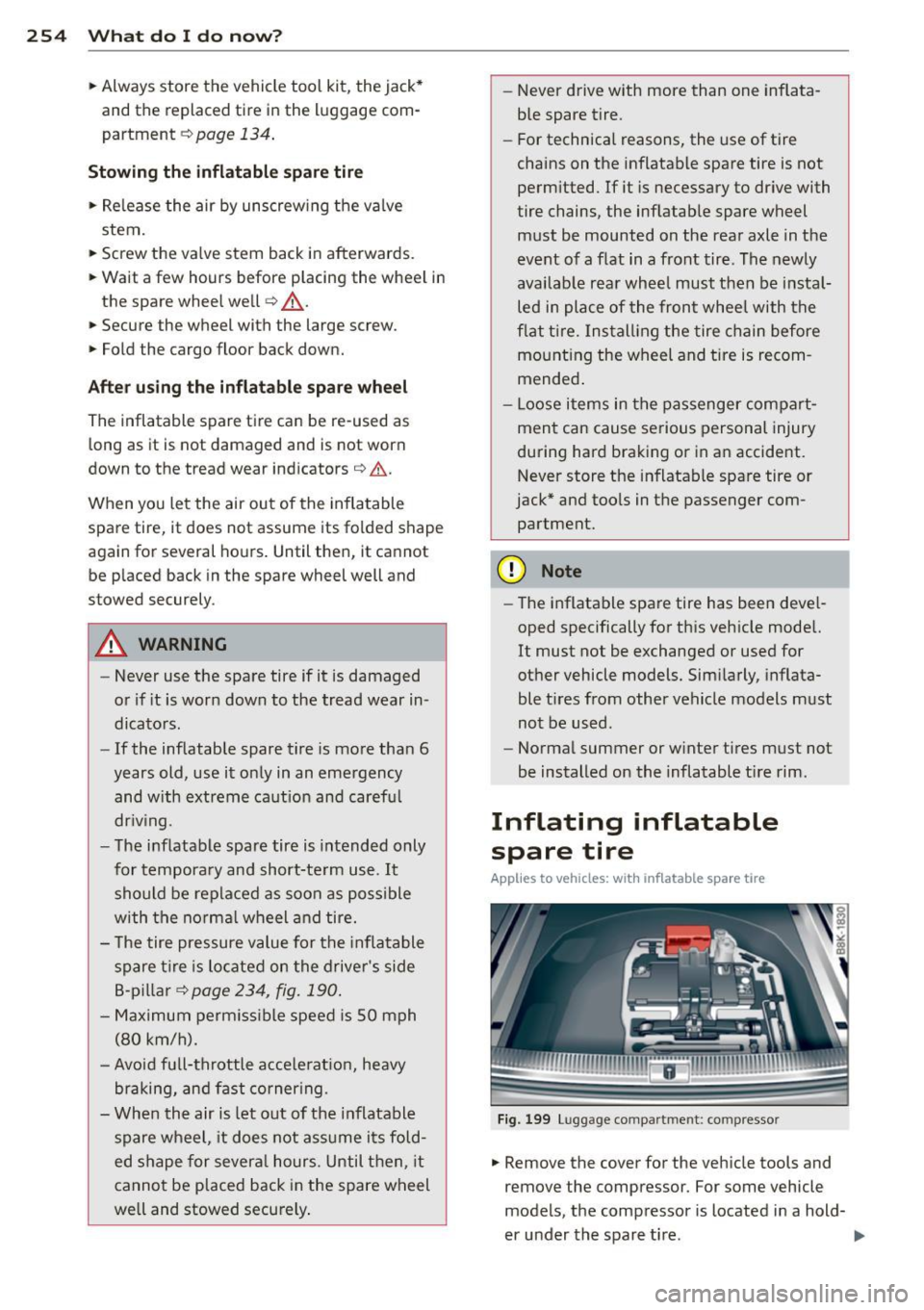
• Remove the cover for the veh icle tools and
remove the compressor. For some vehicle
models, the compressor is located in a hold-
er under the spare tire. .,.
Page 266 of 296
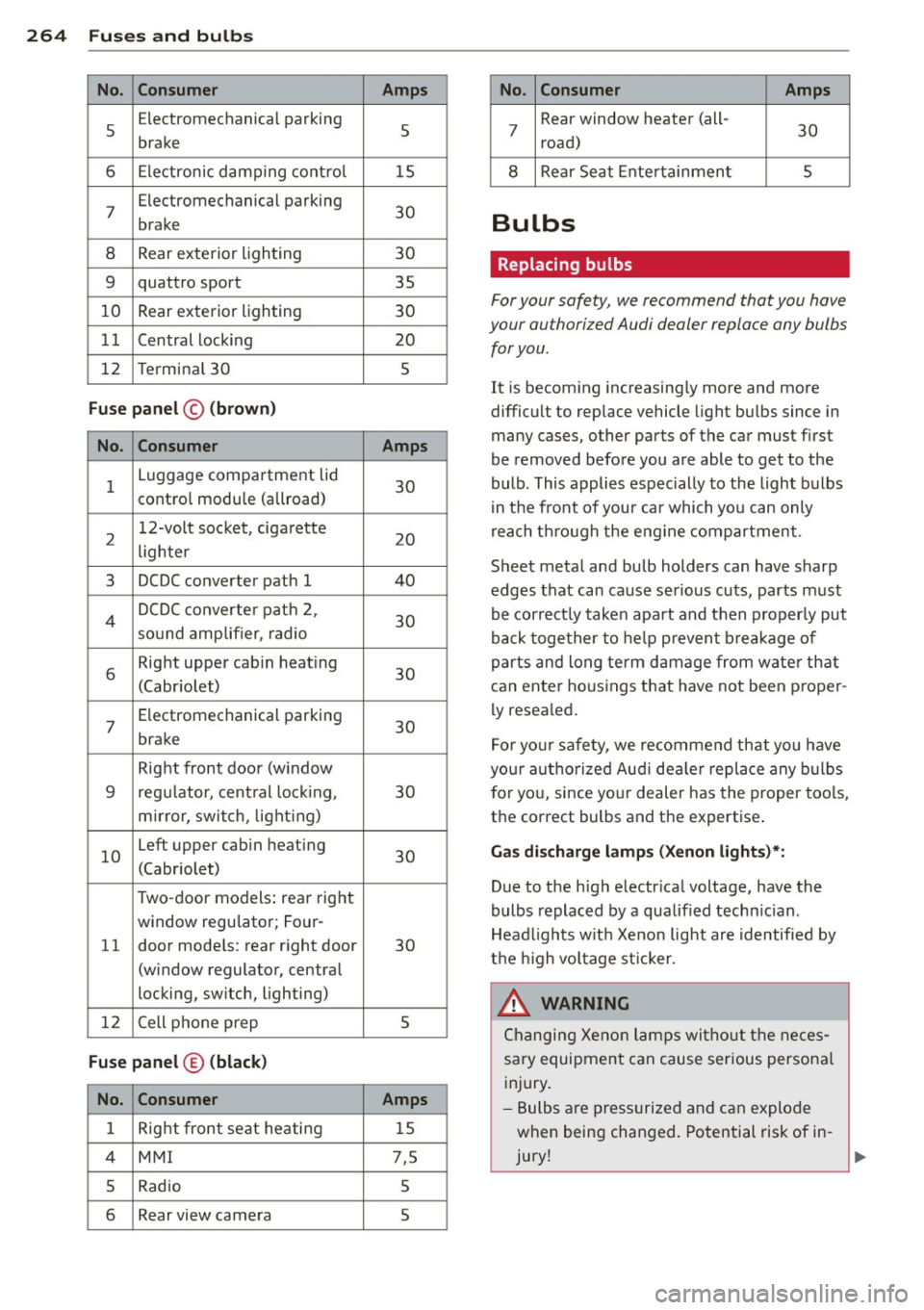
264 Fuses and bulbs
No. Consumer
5 Electromechanical parking
brake
6 Electronic damping control
7
Electromechanical parking
brake
8 Rear exterior lighting
9 quattro sport
10 Rear exterior lighting
11 Central locking
12 Terminal
30
Fuse panel © (brown)
No. Consumer
1 Luggage compartment lid
contro l module (allroad)
2 12-volt
socket, cigarette
lighter
3 DCDC converter path 1
4 DCDC
converter path 2,
so und amp lifier, radio
6
Right upper cab in heat ing
(Cabr iolet)
7
Electromechanical parking
brake
Right front door (w indow
9 regu lator, central locking,
mirror, switch, lighting)
1 0 Left upper cabin
heating
(Cabr iolet)
T wo -door models : rear right
window regu lator; Four-
11 door models: rear
right door
(window regulator, central
locking, sw itch, lighting)
12 Cell phone prep
Fuse panel © (black)
No. Consumer
1 Right front seat heating
4
MMI
5 Radio
6 Rear view camera
Amps
5
15
30
30
35
30
20 5
Amps
30
20
40
30
30
30
30
30
30
5
Amps
15
7,5
5
5
No . Consumer Amps
7 Rear window heater (all-
30
road)
8 Rear Seat Entertainment s
Bulbs
Replacing bulbs
For your safety, we recommend that you hove
your authorized Audi dealer replace any bulbs
for you.
It is becoming increasingly more and more
difficult to replace vehicle light bulbs since in
many cases, other parts of the car must first
be removed before you are able to get to the
bulb. This applies especially to the light bulbs
in the front of your car which you can only
reach through the engine compartment .
Sheet metal and bulb holders can have sharp
edges that can cause serious cuts, parts must
be correctly taken apart and then properly put
back together to help prevent breakage of
parts and long term damage from water that
can enter housings that have not been p roper
l y resea led.
For your safety, we recommend that you have
you r authorized Aud i dea ler replace any bulbs
for you, since yo ur dealer has the proper tools,
the correct bulbs and the expertise .
Gas discharge lamps (Xenon lights)*:
Due to the high electr ical voltage, have the
bulbs replaced by a qualif ied technician .
Headlights wit h Xenon light are identified by
the high voltage sticker .
_&. WARNING
Changing Xenon lamps witho ut the neces
sa ry equipment can cause serious personal
injury.
- Bulbs are pressurized and can explode
when being changed. Potential risk of in
jury!
-
Page 269 of 296
@ Tips
The discharged battery must be properly
connected to the vehicle's electrical sys
tem. When jump starting or charg ing the
battery, never connect the negative
ground cable to the battery negat ive post
because the ba ttery manager system must
be ab le to detect the battery's state of
charge. Always connect the negative
g round cab le to the negative ground pos t
of t he battery manager cont ro l unit.
Use of jumper cables
Make sure to connect the jumper coble
clomps in exactly the order described b elow!
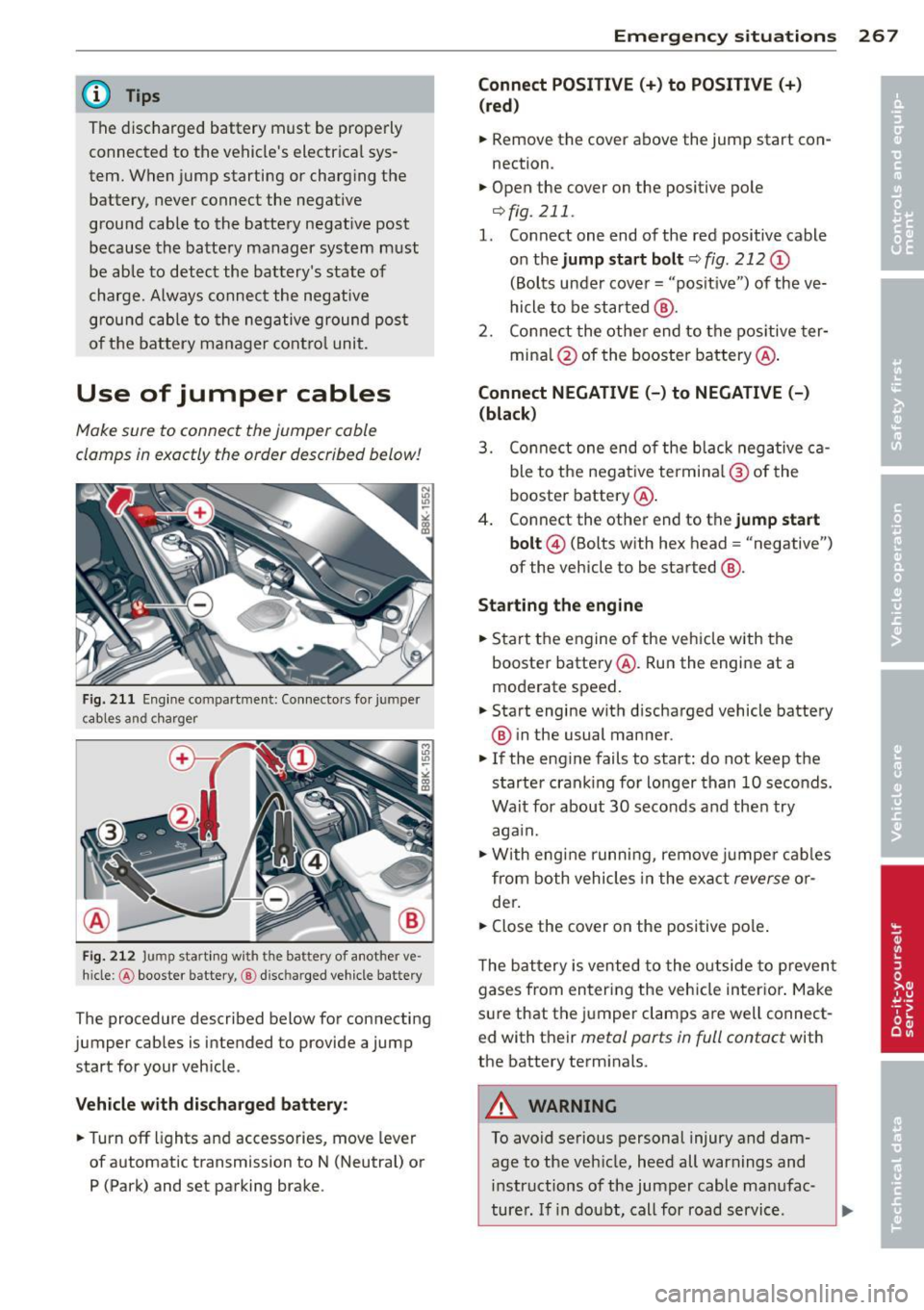
Fi g. 21 1 Eng ine co mpar tment: Co nnecto rs fo r jum per
c ab les a nd c har ge r
F ig. 212 Jump start in g w ith t he ba ttery of a not her ve ·
hi cle :@ booster battery, @ disc harged veh icle battery
The procedure described below for connecting
jumper cables is intended to provide a jump
start for your veh icle .
Vehicle with di scharged battery :
~Turnoff lights and accessories , move lever
of automatic transmission to N (Neutral) or P (Park) and set parking brake .
Emergency situ ation s 267
Connect POSITIVE(+) to POSITIVE(+ )
(red )
~ Remove the cover above the jump start con
nection .
~ Open the cover on the positive pole
¢fig . 211 .
1. Connect one end of the red positive cable
on the
jump sta rt bolt c::;, fig. 212 (D
(Bolts under cove r= "posit ive ") of the ve
hicle to be started @.
2 . Conne ct the othe r end to the pos itive ter -
mina l@ of the booster battery @.
Connect NEGATIVE (-) to NEGATIVE (-)
(black )
3. Co nnect one end o f the b lack neg ative c a
ble to the nega tive te rmi na l@ of the
booster battery @.
4 . Connect the other end to the
jump start
bolt @
(Bolts with hex head = "negative")
of the vehicle to be started @.
Starting the engine
~ Start the engine of the ve hicle with the
booste r batte ry @ . Run the engine at a
moderate speed.
~ Start engine with d ischarged vehicle battery
® in the usual manner .
~ If the engine fails to start: do not keep t he
s tarter cran king for lo nger than 10 seconds .
Wait for about 30 seco nds and the n try
aga in.
~ W ith engi ne runni ng, remove jumpe r cab les
from both vehicles in the exa ct
reverse o r
der .
~ Close the cover on the positive pole .
T he b attery is vented to the o utside to p reven t
gases from en tering the veh icle in ter ior . Ma ke
s ur e that the j umper clamps a re well connect
ed with their
metal ports in full contact with
the batte ry term inals.
A WARNING
To avoid serious personal injury and dam
age to the vehicle, heed all warnings and
in structions of the jumper cable ma nufac-
turer . If i n dou bt, call for road servic e.
Ill>