stop start AUDI S4 2014 Owner's Guide
[x] Cancel search | Manufacturer: AUDI, Model Year: 2014, Model line: S4, Model: AUDI S4 2014Pages: 296, PDF Size: 73.56 MB
Page 206 of 296
204 Vehicle care and cleaning
Vehicle care and
cleaning
General information
Regular, proper care helps to maintain your
ve hicle 's value. It can also be a requirement
when subm itting warranty claims for corro
sion damage and paint defects on the body .
The required cleaning and care prod ucts can
be obtained from your authorized Audi dea ler
or qualified workshop . Read and follow t he in
structions fo r use on the pac kaging .
A WARNING
-Us ing cleaning and care products incor
rect ly can be dange rous to your he alth.
- Always store cleaning and care products
o ut of rea ch of children to redu ce the r is k
of po ison ing.
@) For the sake of the environment
- Preferably use environmentally-friendly
products when buying cleaning agents .
- Do not d ispose of leftover cleaning and
ca re p rod ucts with household trash .
Car washes
-
The longer that depos its suc h as insects, bird
d roppings , tree sap o r road salt rema in on the
ve hicl e, the more the su rface can be dam
aged. High tempe ra tur es such as those
c a used by s unligh t increase the cor rosive ef
fect.
B efore was hing, wet heavy deposits w ith p le n
ty of water.
A lso , wash the underside of your vehicle once
r oad salt stops be ing used fo r th e season .
Pressure wa shers
When washing your veh icles w ith a pressure
washer, always follow the operating instruc
tions provided w ith the pressure washe r. Th is
i s especially important in rega rd to t he pres
sure and spray ing distance . Do not aim the
spray d irectly at seals o n side w indows, doors, the
hood, the rear lid o r the sunroo f* or at
t ir es , rub ber hoses, insu lating mate rial, sen
sors * or camera lenses *. Keep a d istance o f at
l east 16 inches (40 cm).
Do not remove snow and ice wi th a p ressu re
washe r.
Never use rota ry no zzle s or high pressure noz
z les.
T he wate r temperature must not be above
140
° F (60 °() .
Automatic car washes
Spray off the ve hicle before washing.
Make sure that the w indows and roof * are
closed and the winds hield wipers are off . Fo l
l ow instructions from the car wash operator,
especially if there are accessories attached to
your vehicle.
If possible, use car washes that do not have
brushes .
Washing by hand
Clean the ve hicl e starting from the top and
working down using a soft sponge or cleaning
brush . Use solvent-f ree cleaning products.
Washing vehicles with matte finish paint
by hand
To avoid damaging the paint when washing,
first remove dust and la rge particles from
yo ur vehicle. Insects, grease spots and finger
pri nts are best removed with a special cleaner
for matte finish paint .
Apply the p rod uct us ing a microfiber cloth . To
avo id damag ing the pa int surface, do not use
too much pressure.
Rinse the ve hicl e thoro ughly with water . Then
clean usi ng a neutral shampoo and a soft mi
crof iber cloth.
Rinse t he vehi cle thoroughly again and le t it
air dry . Remove any wa ter residue using a
shammy.
Stubborn dep osit s su ch as b ird drop pin gs o r
t ree sap are best remove d with p le nty o f wa -
te r and a microfiber cloth . ..,.
Page 240 of 296
238 Tire s and whee ls
- Adjust the tire pressure to the load you are
carrying.
- Reinsta ll the va lve stem cap on the valve .
When should I ch eck the tire pres sur e?
The correct tire pressure is especially impor
tant at high speeds. The pressure should
therefore be checked at least once a month
and a lways before starting a journey. Do not
forget to check the tire pressure for the spare
wheel.
When should I adj ust the tire p re ss ures?
Adjust the tire pressure to the load you are
carry ing . After changing a wheel
o r replacing
wheels you have to adjust the tire pressures
on all wheels . In addition, you must then initi
alize the new tire pressures in the tire pres
sure monitoring system*~
page 249.
A WARNING
Incorrect tire pressures and/or underinf la
tion can lead sudden tire failure, loss of
control, collision, ser ious personal injury
or even death.
- When the
RI] warning symbol appears in
the instrument cluster, stop and inspect
the tires .
- Incorrect tire pressure and/or underinfla
t ion can cause increased t ire wear and
can affect the handling of the veh icle and
stopp ing ability.
- Incorrect tire pressures and/or underin
flation can also lead to sudden tire fa il
ure, including a blowout and sudden de
flation, causing loss of vehicle control.
- The driver is responsible for the correct
t ire pressures fo r all tires on the vehicle .
T he applicable p ressure va lues are locat
ed on a sticker on the driver's side B-pil
lar.
- Only when a ll ti res on the vehicle are fi l
led to the correct pressure, the tire pres
sure monitoring system* can work cor
rect ly.
- The use of incorrect tire pressure values
can lead to accidents or other damage.
Therefore it is essential that the driver observe the specified t
ire pressure values
for the tires and the correct pressures for
the function of the ti re pressure monitoring system*.
- Always inflate tires to the recommended
and correct t ire pressure before dr iv ing
off.
- Driving with underinflated tires bend
more, letting them get too hot resulting
in tread separation, sudden tire failure
and loss of control.
- Excessive speed and/overloading can
cause heat build-up, sudden tire failure
and loss of cont rol.
- If the tire pressure is too low or too high,
the t ires will wear prematurely and the
veh icle w ill not handle well.
- If the tire is not flat and you do not have
to change a wh eel immediately, drive at
reduced speed to the nearest service sta
tion to check the t ire p ressure and add
air as required.
Q) Note
D riving without valve stem caps can cause
damage to the tire valves. To prevent this,
a lways make sure tha t factory insta lled
valve stem caps on all whee ls are sec urely
mounted on the valve.
@ For the sake of the environment
U nderinflated tires w ill also incre ase the
fuel consumption .
Tires and vehicle load limits
There are limits to the amount of load or
weight that any veh icle and any tire can carry.
A vehicle that is over loaded will not handle
well and is more d iff icult to stop. Overloading
can not only lead to loss of vehicle control,
but can also damage important parts of the
vehicle and can lead to sudden tire fa ilure, in
clud ing a b lowout and sudden deflation tha t
can cause the vehicle to crash.
Your safety and that of your passengers also depends on making sure that load limits are .,..
Page 251 of 296
Tire pressure monitoring system
UJ General notes
Applies to vehicles: with tire pressure monito ring system
Each t ire, i ncluding the spare (if provi ded),
should be chec ked month ly w hen cold and in
flated to the inflation pressure recommended by the vehicle manufacture r o n the vehicle
placar d or tire infla tion pressure label. (If your
veh icle has t ires of a diff erent siz e than the
size ind icat ed on the vehicle p lacard or tir e in
flation pressure label, you should deter mine
the proper tire inflation pressure for those
tires).
As an added safety feature, your vehicle has been equipped with a tire pressure monitor ing
system (TPMS) that illuminates a low tire
pr essu re tellta le when one or mo re of your
tires is significantly under -inflated . Accord ing
l y, when the low tire p ress ure telltale illumi
nates, you should stop and check your tires as
soon as possible, and inflate them to the
proper pressure. Driv ing on a signif icantly un
der-inflated tire causes the tire to overheat
and can lead to tire failure. Under -inflation al
so reduces fuel efficiency and tire t read life,
and may affect the ve hicle's handling and
stopping ab ility.
Please note that the TPMS is not a subst itute
for p roper t ire mainte nance , and it is the dr iv
e r's responsib ility to ma inta in cor re ct t ire
p ress ure, even if under- infla tion has no t
reached the leve l to trigger ill umin ation of the
TPMS low tire pressure telltale.
Your veh icle has also bee n equ ipped with a
TPMS malfunc tion indica to r to indica te when
the system is not opera ting properly. The
TPMS mal function indicato r is combined wi th
the low tire press ure tellta le . When the sys
tem detects a malf unct ion, the te lltale will
flash for approximately one minute and then remain cont inuo usly illuminated. This se
quence will continue upon subsequent vehicle
start-ups as long as the ma lf u nction ex ists .
Tire s an d wheel s 249
When the malfunction indicator is illum inat
ed , the system may not be ab le to detect or
s ignal low tire pressure as intended . TPMS
malfunctions may occur for a var iety of rea
sons, including the insta llation of replace
ment or alternate tires or wheels on the vehi
cle that p revent the TPMS from functioning
proper ly. Always check the TPMS malfunction
te lltale after rep laci ng one or more tires o r
whee ls on you r vehicle to e nsur e th at the re
placement or alterna te t ires and wheels a llow
the TPMS to continue to func tion p roperly.
Tire pressure indicator appears
Applies to vehicles: with tire pressure monitoring system
The tire pressure indica tor in the instrument
cluster informs you if the tire pressure is too
Low or if there is a system malfunction.
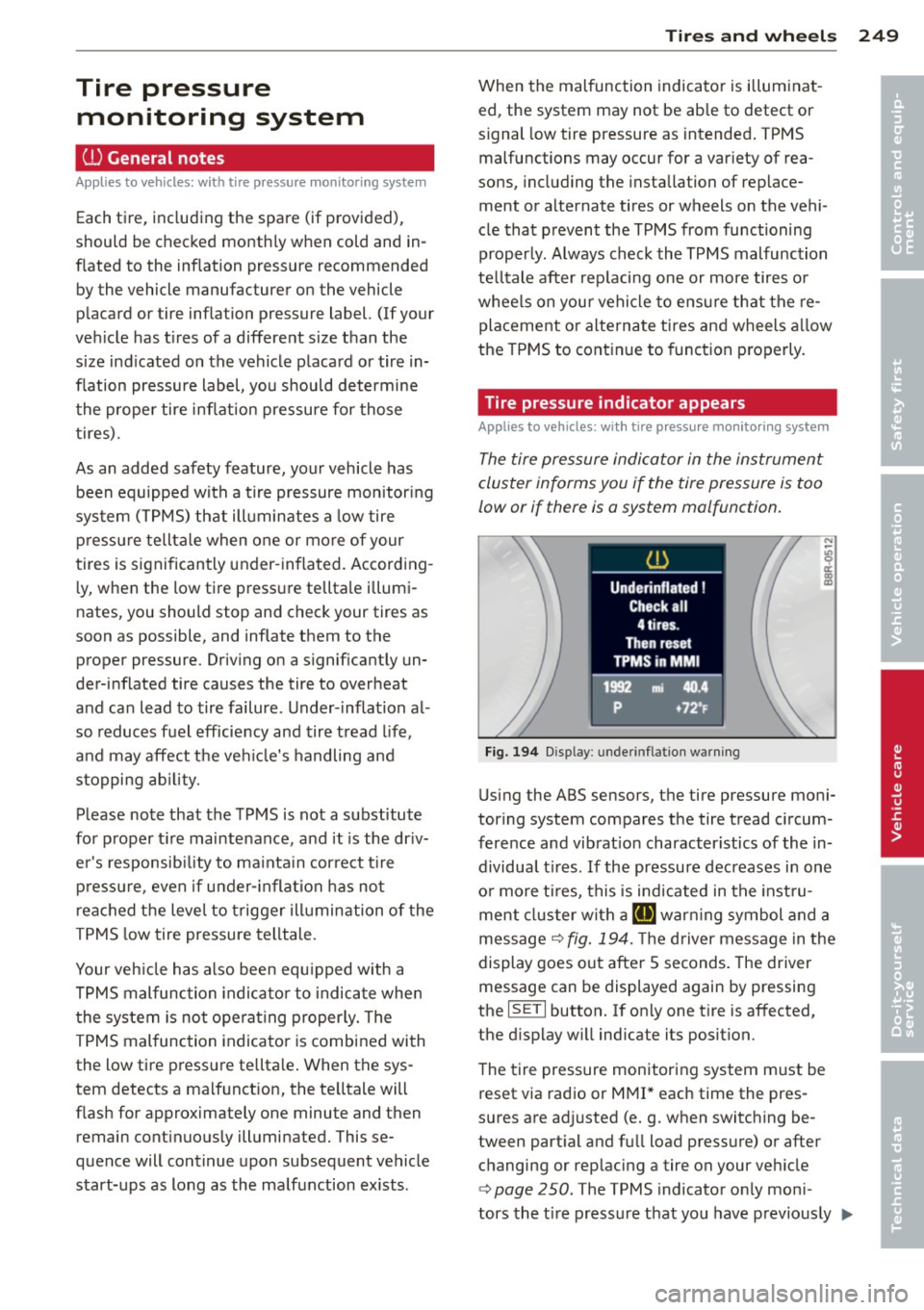
Fi g. 194 D isp lay: un de rin flat io n warni ng
U sing the ABS sensors, the tire pressure mo ni
toring system compares the tire tread c ircum
ference and vib rat ion character istics of the in
dividua l tir es . If the pressure decreases i n one
o r more t ires, this is indicated in the inst ru
ment cluster with a
RI] war ning symbol and a
message ¢
fig. 194. T he d river message in the
display goes o ut afte r 5 seconds . The driver
message can be displayed again by pressing
the
ISE TI button. If only one t ire is affected,
the d isplay w ill indicate its position.
T he tire pressure monitoring system m ust be
reset via radio or M MI* each time the pres
sures are ad justed (e.g. when switc hing be
tween part ial and f ull load pressure) o r after
changing or rep lacing a tire on your ve hicle
¢
page 250. T he TPMS indicato r o nl y mo ni-
tors the t ire p ress ure t hat yo u have p revio usly ..,.
•
•
Page 284 of 296
282 Index
Child restraints
Dang er of using child restraints in th e
front seat . .... .... ......... ..... . 147
Where can I get addit ional information
about child restra ints and their use? . . 185
Child restraint system anchors ..... .. . 181
Ch ild safety .. ................ ... ... 167
Conve rtible locking retracto r .. .. .....
177
Important safety instructions fo r using
ch ild safety seats . . . . . . . . . . . . . . . . . . 17 0
I mportant things to know when driving
with chi ldren ........... ... .. .... .
167
Installing a child restraint using the
LATCH system . . . . . . . . . . . . . . . . . . . . . 182
Lower anchorages .......... .. .... . 182
Mounting and releasing the anchorage
hook .. .... .......... ...... ... .. . 182
Tether anchors . . . . . . . . . . . . . . . . . . . . 183
Tether straps .......... .. .. .. .. .. . 183
Child safety locks Power windows . ..... .... .. .. .. .. .. 43
Rear doors . .............. ... .. .. .. 42
Child safety seats .................. .
173
Booster seats . . . . . . . . . . . . . . . . . . . . . 17 5
Convertible child seats .... .. .. .... .
17 4
Convertible locking retracto r .. .. .....
177
Danger of using child restraints in the
front seat .. .......... ...... ... .. . 147
H ow do I properly install a child safety
seat in my vehicle? ...... .. .. .. .. .. .
170
Infant seats ............. .. .. .. .. . 173
I nstalling . .. .... ........ .. .. .... .
177
LATCH system .. .. ...... .. .. .. .... . 182
Safety instructions ................ . 170
Unused safety belts on the rear seat . .
172
C ig are tte lighte r . . . . . . . . . . . . . . . . . . . . . 63
Cleaning .. .. ................ ... .. .
204
Climate controls . . . . . . . . . . . . . . . . . . . . . 76
C limate control system
Automatic recirculation . . . . . . . . . . . . . .
79
Supp lementary heater . . . . . . . . . . . . . . . 79
synchronizing .. ........ .. .. .. .... .. 79
C lock ....... .......... ...... ... .. .. 12
C losing
Power windows .......... .. .. .... .. 43
Sliding/tilting sunroof ...... ..... .. .. 44
Sunshade .. ................ ... ... . 44 Closing/opening
at the lock cylinder . . . . . . . . . . . . . . . . . . 38
by remote control . . . . . . . . . . . . . . . . . . 35
with the centra l locking switch ... .... . 36
wi th the conven ience key . . . . . . . . . . . . . 36
Cold tire inflation pressure ........ .. .. 234
Coming home ..... ................ .. 48
Compact spare ti re .............. .... 252
also refer to Spare tire .......... .. .. 252
Compartments . . . . . . . . . . . . . . . . . . . . . . 66
Compass in the mirror ..... ... ..... .. . 56
Compliance ..... .. .. ... ........ .. .. 278
Consumer Information . . . . . . . . . . 136, 275
Contac ting NHTSA . ... .......... .. .. 136
Controls Cleaning . ..... .. .. ... ........ .. .. 206
Convenience key Indi cator lights .. ... .......... .. .. . 84
Starting engine (S TART ENGINE STOP
button) ... .... .. ... .. ........ .. .. . 83
Stopping the engine (START ENGINE
STOP button) . . . . . . . . . . . . . . . . . . . . . . 84
Switching on ignition ........... .... . 83
unlocking/locking ............. .... . 36
Convenience opening/closing ..... .. .. . 43
Convertib le child safety seats ......... 17 4
Convertib le locking retractor
Activating ... .. .. ............. .. ..
179
Deact ivat ing ... .. ... .... ....... ... 180
Using to secure a child safety seat
1.77, 179
Coolant system .... .. ........... .. .. 221
Cooling mode (automatic climate control) 77
Cooling System Expansion tank . .. .......... ...... . 221
Cornering light .... .. ........... .. .. . 47
Cruise control Changing speed .. ............. .. .. . 89
Presetting your speed .......... .... .
90
Switching off .... ... .......... .. .. . 90
Switching on ... .. ... .......... .. .. . 89
Cruising range ... .. ............. .... . 25
(upholder .. .... .. ............. .... . 65
D
Data recorder . . . . . . . . . . . . . . . . . . . . . . 186
Date display .... .. ............. .... . 12
Page 286 of 296
284 Index
Starting with jumper cab les . ....... . 266
Stopping . . . . . . . . . . . . . . . . . . . . . . 82, 84
E ng ine compartment
Safety instructions ...... .. .. .. .. .. . 214
Working the engine compartment 214
Eng ine coolant
Indicator light . . . . . . . . . . . . . . . . . . . . . 17
E ngine coolant system ...... .. .. .... . 221
Adding coolant ........... .. .. .. .. . 222
Checking coolant level ..... .. .. .. .. . 221
Check ing the eng ine coolant level .. .. . 221
Radiator fan .............. ... .. .. . 223
E ngine coolant temperature
Temperature gauge ....... .. .. .... .. 10
Engine hood
C losing ......... ......... ... .... . 214
How to release the hood ............ 214
E ng ine oil . .... ........... ........ . 216
Adding .. .. ............. .. .. .. .. . 219
Addit ives ... ................ ..... . 219
Changing . ................. ..... . 220
Check oil level ............ ... .... . 219
Consumption ............ .. .. .. .. . 219
Indicator light . . . . . . . . . . . . . . . . . 17, 21
Oil consumption ............ .. .... . 218
Oil grades .. ................ ... .. . 216
Pressure malfunction ...... .. .. .. .. . . 17
Sensor defective . . . . . . . . . . . . . . . . . . . . 21
Specification and viscos ity .. .. .. .... . 216
Engine speed limitation . . . . . . . . . . . . . . . 21
Environment Break- in period ............ ... .... . 195
Cata lytic converter ............ .. .. . 196
Disposing of your vehicle battery ..... 228
Driving at high speeds ..... .. .. .. .. . 197
Driving to minimize pollution and noise 197
Fuel ..... .. ..... ........... ... .. . 212
Fuel economy ............. ... .. .. . 197
L eaks under your veh icle . .. .. .. .. .. . 214
L ett ing the vehicle stand and wa rm up . 198
Proper disposal of drained brake fluid . 224
Proper disposal of drained engine coo l-
ant ..... .. ................ ..... . 222
Proper disposal of dra ined engine
oil . . . . . . . . . . . . . . . . . . . . . . . . . 219, 220
Recycling used engine oil ... .. .. .. .. . 219
Roof rack .. ... .... ...... .. .. .. .. .. 68 Unleaded fuel
.... ................ . 209
What shou ld I do with an o ld battery? . 228
EPC
refer to E lectronic power control . . . . . . 20
Ethyl alcohol (Fuel) . .. .. ...... ... .. .. 210
Event Data Recorder (EDR) ............ 186
Exhaust tail pipes
Cleaning .. .... .. ............. .... 205
Expansion tank .... ............. .... 221
Exterior lighting ... ................ .. 47
Exterior m irrors
Adjust ing . .. .. .. .. ........... .. .. . SO
Dimming .. .... .. ............. ..... 51
Heating . .. .. .. . .............. .. .. . SO
F
Fan
Radiator 223
Fastening Booster seats . . . . . . . . . . . . . . . . . . . . . 17 5
Convertib le child safety seats .. ... ... 174
Infant seats ... .. ... .......... .... 173
Fa stening eye s
refer to Tie-downs . . . . . . . . . . . . . . . . . . 72
Flat tire Changing ..... .. ................ . 255
flexib le fue l ....... ............. .... 210
Floor .. .... .... .. ................. . 74
Floor mats . ..... .. ................ . 133
Fog lights/rear fog light(s) ......... ... . 47
Folding the rear seats ............ .... . 69
Foot pedals . .... .. ............. .... 133
For the sake of the environment Gasoline fumes and the env ironment .. 212
Letting the engine warm up . . . . . . 80, 83
Refueling . .. .. .. ... .......... .... 212
Sav ing fuel by early upshifting . .. .. .. . 11
Front airbags Description .. .. .. .......... ...... . 150
How they work . .. .......... ...... . 155
Frontal collisions and the laws of physics 139
Front passenger's door emergency lock ing 38
Front seats Adjusting ... .. .. ....... ...... .. .. 130
Child restraints in the front seat .. .. .. 147
Page 292 of 296
290 Index
Selector lever ..... ........ .. .. .... .. 92
Emergency release . . . . . . . . . . . . . . . . . . 98
Selector leve r eme rgency release . . . . . . . 98
Service and disposal Safety belt pretens ioner . .. .. .. .. .. . 145
Service interval display ................ 29
Service position
refer to Replac ing wiper blades . .... .. 55
SET button . . . . . . . . . . . . . . . . . . . . . . . . . 11
Shift indicator (eff iciency p rog ram) . ... .. 28
Shutting down vehicle .......... .. ... 197
Side airbags Descript ion .............. .. .. .. .. . 161
H ow they work . . . . . . . . . . . . . . . . . . . . 162
side assist Adjusting the brightness ............ 111
Sensor range . . . . . . . . . . . . . . . . . . . . . 110
Side assist Activating and deactivating .......... 111
C leaning the sensors .............. . 205
Description .... ........ ...... .... . 109
Side curta in airbags ........ .... .... . 164
Description . ........... .. .. .. .. .. . 164
Ho w they work ............ ... .... . 165
Safety instructions ................. 166
Side marker lights ............. .. ... . 47
Ski sack ... ............... ........ .. 73
Sliding/tilting sunroof Convenience opening/closing ..... .. .. 43
Emergency closing ............ .... .. 45
Opening and closing ....... ... .. ... . 44
Sunshade . . . . . . . . . . . . . . . . . . . . . . . . . 44
Snow chains ............ .. .. .. .. .. . 247
Socket 12-volt .. .. ... .... ...... .. .. .. .. .. 64
Sound system display . . . . . . . . . . . . . . . . . 24
Sources of information about child re-
straints and their use ......... .. .... . 185
Spare tire .. .. ................ ... ... 252
Speedometer .............. ... .... .. 12
Speed rating letter code ..... .... .... . 243
Speed warning system ........ .. .... .. 87
Sport differential ................... 113
Ind icator lamp ............ ... .... .. 22
START ENGINE STOP button (convenience
key) .. .. .. .... ........... .. .. .. .. .. 84 START ENGINE STOP
button (Convenience
key) ............................... 83
Starting from rest ............... .... . 86
Starting
off with a trailer ......... .... . 87
Starting the engine . . . . . . . . . . . . . . 80, 83
Steering Locking the steering ............ ... . 80
also refer to Electro-mechanical power
ass ist .. .. .. .. .. .. ........... .. .. 191
Steering wheel Adjusting steering column ...... .. .. . 80
Indicator light . . . . . . . . . . . . . . . . 18, 191
Steps for determining correct load limit . 239
Stopping the engine . . . . . . . . . . . . . . 82, 84
Storage ........ .. .. ........ ...... .. 64
Storage compartments . . . . . . . . . . . 66, 74
S tronic .. .. .. .. . .............. .. .. . 91
Selector lever .... ... .......... .. .. . 92
S tronic transmission Emergency release ....... ...... .. .. . 98
Launch Control Program ........... .. 97
Sunroof .... .. .. .. .. ........... .... . 44
also refer to Sliding/tilting sunroof 44, 45
Sun shades
Rear doors . ..... .............. 52,53
Rear window . . . . . . . . . . . . . . . . . . . . . . . 53
Sun visors .. .. .. .. .... ......... .... . 52
Symbols
refer to Warning/indicator lights ...... 13
T
Tachometer . . . . . . . . . . . . . . . . . . . . . . . . . 11
T ail lights
Cleaning .. .... .. ................ . 205
Tec hnical modifications .............. 278
Tether anchors .... ............. .... 183
T ether strap . . . . . . . . . . . . . . . . . . . . . . . 183
Textiles Cleaning .. .. .. .. .. ..... ...... .. .. 207
The first 1,000 miles (1,500 km) and after-
wards ...... .... .. .. ........... .... 195
T ie-downs . . . . . . . . . . . . . . . . . . . . . 72, 135
t ip tron ic .... ... .. .. ........ ...... .. 91
Automatic Shift Lock (ASL) . . . . . . . . . . . 93
Driving ..... .. .. .. ........... .... . 93
Emergency mode .............. .. .. . 97