warning AUDI S4 2015 Workshop Manual
[x] Cancel search | Manufacturer: AUDI, Model Year: 2015, Model line: S4, Model: AUDI S4 2015Pages: 304, PDF Size: 74.86 MB
Page 72 of 304
70 Seat s a nd s tor ag e
damage to the load and even the vehicle
itse lf.
- Make sure that the open rear lid and the
sunroof do not come into contact with
objects on the roof.
Loading the roof rack
Always distribute loads evenly. J\llake sure
anything on the roof rock is securely tied
down.
.. Always dist ribute the loads on the roof rack
evenly .
.. Always attach items to the roof rack securely
before you drive off.
The maximum permissible roof weight is
2 00 lb (90 kg ). The roof weight is the total of
the we ight of the roof rack, the attachments
and the cargo you are carry ing. You must also
not exceed the maximum load weight for the
roof rack you are using .
When us ing a roof rack system which has a
lower load carry ing capac ity , you must not use
up the total max imum perm issible load carry
ing capacity specified above. Instead, you
should load the roof rack system only to the maximum capacity spec ified by the manufac
turer of the roof rack system.
A WARNING
Weak, damaged or improper straps used
to secure items to the roof rack can fail
during hard braking or in a co llision and
cause serious personal injury.
- Make sure the roo f rack is insta lled exact
ly as specified above
,=;,page 69.
- Always use suitable mounting straps for
sec uring items to the roof rack to help
prevent items from shifting or flying for
ward.
- Items on the roof rack must always be
sec urely mo unted.
- T he use of a roof rack can negative ly af
fect the way a vehicle handles . Cargo
that is large, heavy, bulky, long or flat
will have a greater negative influence on
.
the vehicle's aerodynamics, center of
grav ity and overall handling. Always
drive s lowly, avoid sudden braking and
maneuvers when transporting cargo on
the roof of your vehicle.
- Never exceed the maximum permissible
load carrying capacity of the roof of your
veh icle, the permissible axle weights and
the permissible total weight of you r vehi
cle~
page 280, Weights.
(D Note
Make sure that the opened rear lid does
not come in contact with the cargo on the
r oof.
@ For the sake of the environment
As a result of the increased wind resist
ance created by a roof rack, you r vehicle is
us ing fuel unnecessarily . So remove the
r oof rack after using it.
Luggage compartment
General information
A WARNING
Read and follow t he important safety pre
cautions o n
~ page 132, S towing lug
gage.
Page 73 of 304
M N
~ co
rl I.O
"' rl
"' rl
Luggage compartment cover
Applies to vehicles: with luggage compartment cover
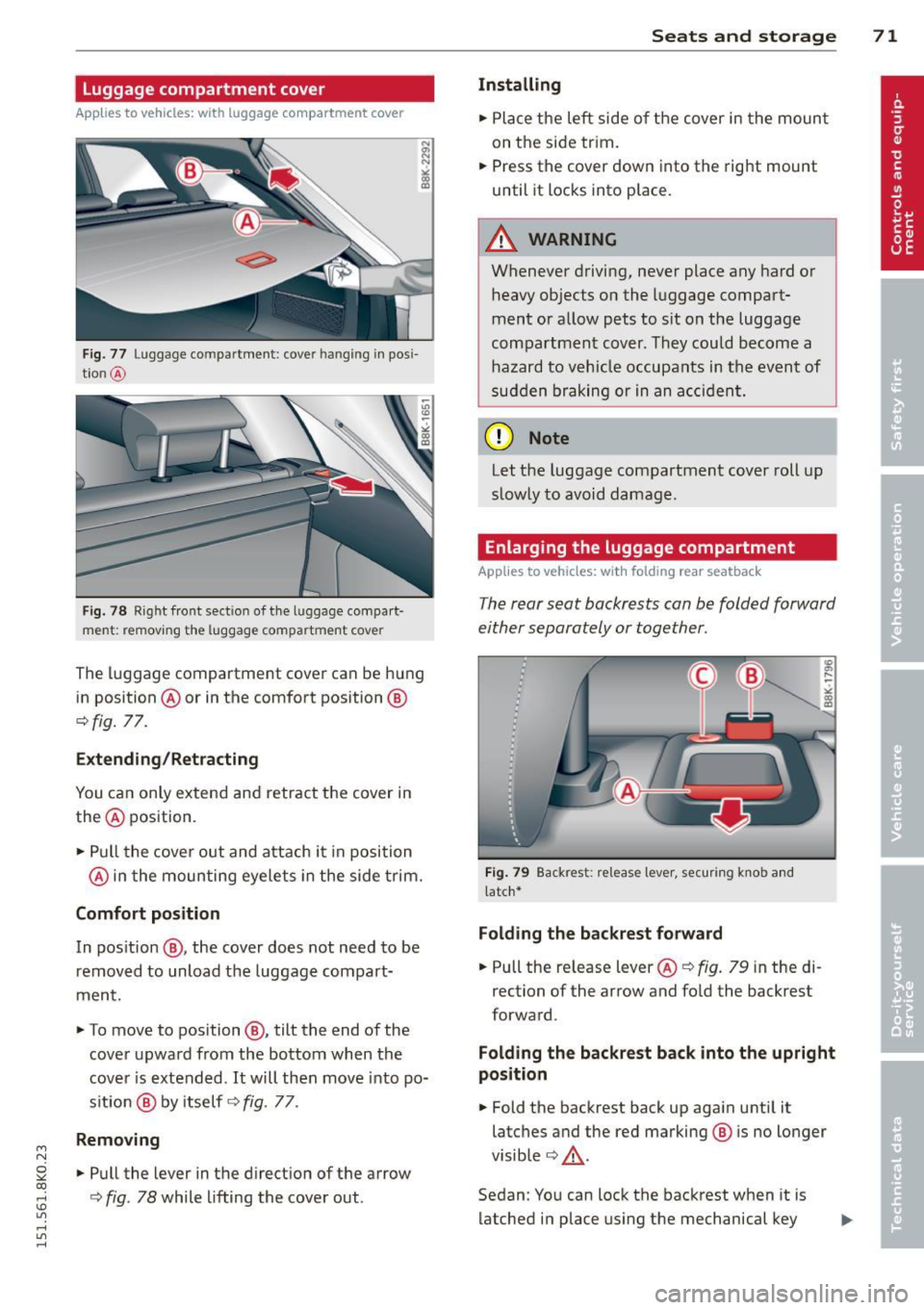
Fig. 77 Luggage compartment: cover hanging in pos i
t ion @
Fig. 78 R ight front section of the luggage compart
ment: remov ing the luggag e compartment cover
The luggage compartment cover can be hung
in position @or in the comfort position @
¢fig. 77.
Extending/Retracting
You can only extend and retract the cover in
the @ position .
• Pull the cover out and attach it in position
@ in the moun ting eyelets in the side trim.
Comfort position
In pos ition @, the cover does not need to be
removed to unload the luggage compart·
ment.
• To move to position @, tilt the end of the
cover upward from the bottom when the
cover is extended. It will then move into po·
s ition @ by itself ¢
fig. 77 .
Removing
• Pull the lever in the direction of the arrow
¢
fig . 78 while lifting the cover out .
Seats and storage 71
Installing
• Place the left side of the cover in the mount
on the side trim.
• Press the cover down into the rig ht mount
until it locks into place.
A WARNING
=
Whenever driving, never place any hard or
heavy objects on the luggage compart·
mentor allow pets to sit on the luggage
compartment cover . They could become a
hazard to vehicle occupants in the event of
sudden braking or in an accident.
ffi Note
Let the luggage compartment cover roll up
slow ly to avoid damage.
Enlarging the luggage compartment
Applies to vehicles: wit h fo lding rear seatback
The rear seat backrests can be folded forward
either separately or together.
Fig. 79 Backrest : relea se lever, securing knob and
l a tc h*
Folding the backrest forward
• Pull the release lever @¢ fig. 79 in the di
rection of the arrow and fold the backrest
forward.
Folding the backrest back into the upright
position
• Fold the backrest back up again until it
latches and the red marking @ is no longer
visible ¢
_&..
Sedan: You can lock the backrest when it is
latched in place using the mechanical key
Page 74 of 304
7 2 Seats and storage
.::> page 33 ©.::>fig. 79 . This prevents any ac
cess to the luggage compartment from the
vehicle interior.
You can on ly enlarge the luggage compar t
ment if the backrest is not locked .
~ WARNING
-
-The backrest must a lways be securely
latched so that the safety belt of the cen
ter seating pos ition can work properly to
help protect the occupant .
- The backrest must be secure ly latched in
posit ion so that no items contained in
the luggage compartment can slide for
ward upon sudden braking .
- Always check whether the latch is f ully
engaged by pu lling the seatback for
wa rd.
- Never allow safety belts to become dam
aged by being caught in doo r o r seat
hardware.
- Torn or frayed safety belts can tear and
damaged belt ha rdware can break in a
c rash. Inspect the be lts periodica lly.
B elt s showing damage to webbing, bind
ings, buckles, or retractors must be re
placed.
(D Note
- If you move the front seat back when the
r ear seat ba ckrest is fo lded fo rward, yo u
could d amage t he head res tra ints on the
rear sea t.
- Slide the belt guide on the outside safety
belt all the way up before folding the
backrest back forward. Make su re the
seat belt is not pinched o r damaged
when the rear seat backrest if folded back. Other objects shou ld be removed
from the rear seat bench to protect the seatback from damage. Partition net (seatback in upright
position)
Applies to vehicles: with partition net
The partition net is designed to pr event loose
objects from flying forward into the passen
ger compartment (e.g. under sudden brak
ing).
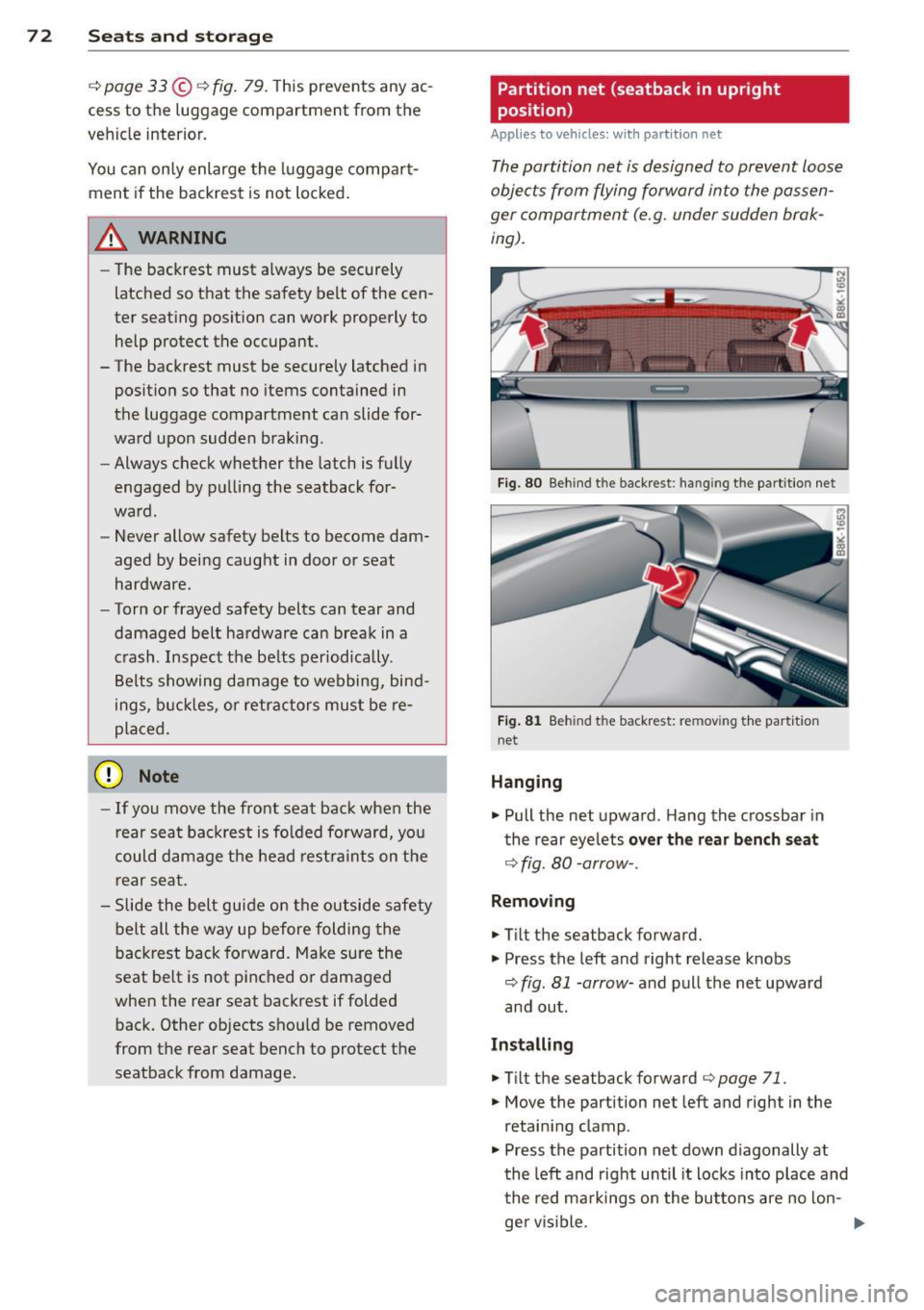
Fi g. 80 Beh ind t he backrest : hang ing t he part itio n net
Fi g. 8 1 Beh ind t he backrest: re m ov ing the part it ion
ne t
Hanging
.,. Pull the net upward . Hang the c rossbar in
the rear eye lets
over th e re ar bench seat
¢ fig. 80 -arrow-.
Removing
.,. Ti lt the seatback forward.
.,. Press the left and right release knobs
¢ fig. 81 -arrow-and pull the net upward
and out.
Installing
• Ti Lt the seatback forward
¢ page 71 .
.,. Move the partition net left and right in the
retain ing clamp .
.,. Press the partition net down diagonally at
t he left and right until it locks into place and
t he red ma rkings o n the bu ttons are no lon-
ger v is ible. ..,.
Page 76 of 304
7 4 Seats and storage
If nothing is hung on the hooks, they will fold
back in by themselves.
In a collision, the laws of physics mean that
even smaller items that are loose in the vehi
cle will turn into heavy missiles that can cause
serious injury. Items in the vehicle p ick up ki
netic energy which varies with the vehicle and
the weight of the item . Vehicle speed is the
most significant factor .
For example, in a frontal collision at a speed
of 30 mph (48 km/h), the forces acting on a 10-lb (5 kg) object a re about
20 times the
normal weight of the item. This means that
the weight of the item would suddenly be the
equ ivalent of about 200 lbs (90 kg). One can
easily imagine the injuries that an item of that
weight flying freely through the passenger
compartment can cause in a collision at a
speed considered relatively low .
8_ WARNING
Weak, damaged or improper straps used
to secure items to tie-downs can fail dur ing hard braking or in a collision and cause
serious personal injury.
- Always use suitable retaining straps and
properly secure items to the tie-downs in
the luggage compartment to help pre
vent items from shifting or flying for
ward .
- Never attach a child seat tether strap to
a tie -down.
- For strength-related reasons, the mount
ing hooks can only be used to secure ob
jects weighing up to 10 lb. (5 kg) . Heavi
er objects will not be adequately secured
- there is a r isk of injury.
Tie-downs
Applies to vehicles: with tie-downs
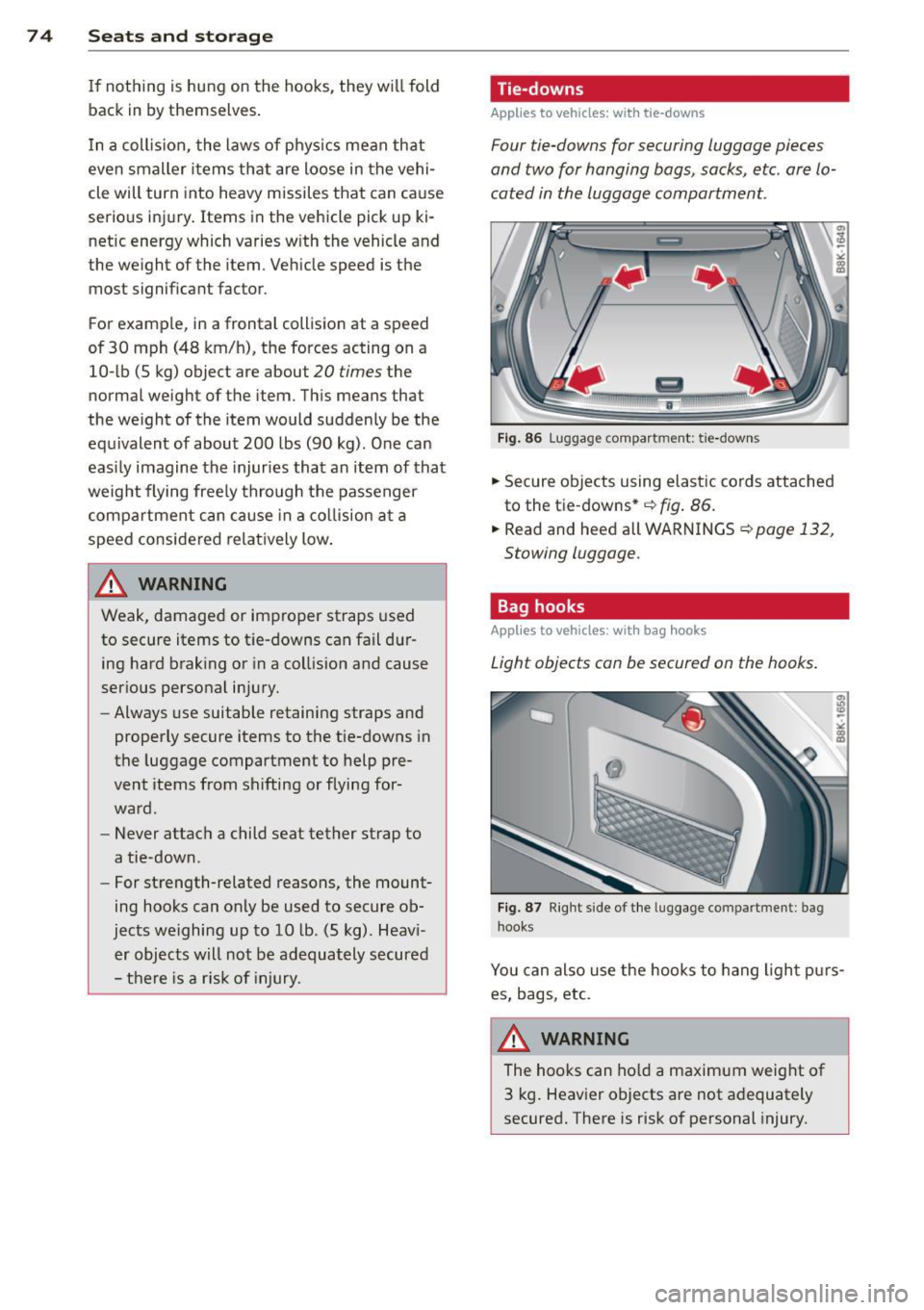
Four tie-downs for securing luggage pieces
and two for hanging bags , sacks, etc. are
lo
cated in the luggage compartment.
Fig. 86 Lugg age compart ment: tie-down s
,.. Secure objects using elastic cords attached
to the tie-downs* ¢
fig. 86.
,.. Read and heed all WARNINGS ¢ page 132,
Stowing luggage .
· Bag hooks
Applies to vehicles: with bag hooks
Light objects can be secured on the hooks.
Fig. 87 Right side of the luggage compar tment : bag
hook s
You can also use the hooks to hang light purs
es, bags, etc.
_&. WARNING
The hooks can hold a maximum weight of
3 kg. Heavier objects are not adequately
secured. There is risk of personal injury.
Page 77 of 304
M N
~ co
rl I.O
"' rl
"' rl
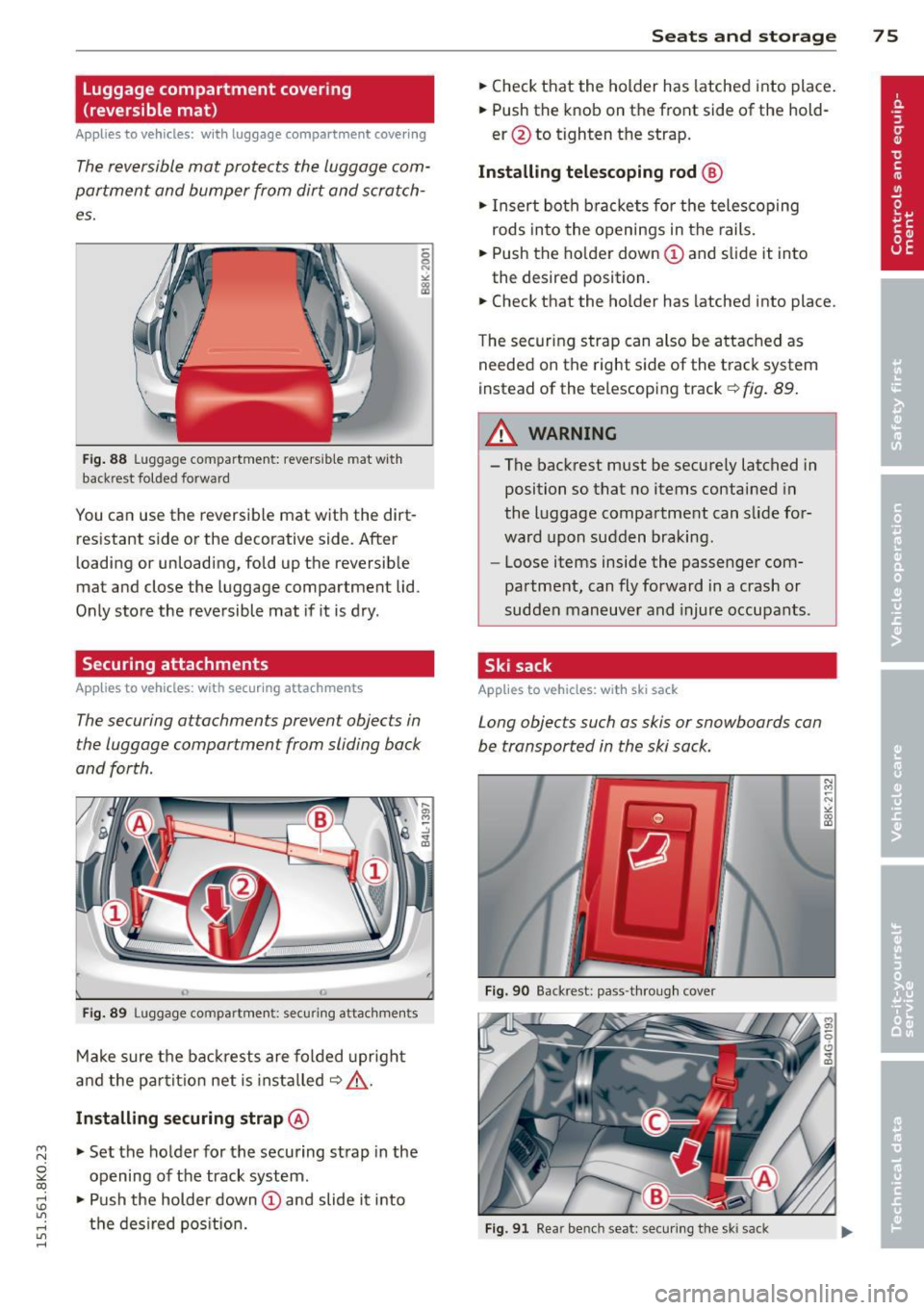
Luggage compartment covering (reversible mat )
Applies to vehicles: w it h lugg ag e compart men t cove ring
The reversi ble mat protects the luggage com
partment and bumper from dirt and scratch es.
Fig. 88 Luggage compartment: reversible mat wit h
backrest folded forward
You can use the reversible mat with the dirt
resistant side or the decorative side. After
loading or unloading, fold up the reversible
mat and close the luggage compartment lid.
Only store the reversible mat if it is dry .
Securing attachments
Applies to vehicles: with sec uring attachments
The securing attachments prevent objects in
the luggage comportment from sliding bock
and forth.
,.
Fig. 89 Luggage compart men t: securi ng attachments
Make sure the backrests are folded upright
and the partition net is installed¢.&_ .
Installing securing strap @
.,. Set the holder for the securing strap in the
opening of the track system.
.,. Push the holder down
(D and slide it into
the desired position.
Seats and storage 75
.,. Check that the holder has latched into place.
.,. Push the knob on the front side of the hold
er @ to tighten the strap.
Installing telescoping rod @
.,. Insert both brackets for the telescoping
rods into the openings in the rails .
.,. Push the holder down
(D and slide it into
the desired position .
.,. Check that the holder has latched into place.
The securing strap can also be attached as
needed on the right side of the track system
instead of the telescoping track¢
fig. 89.
&_ WARNING ~
-The backrest must be securely latched in
position so that no items contained in
the luggage compartment can slide for
ward upon sudden braking.
- Loose items inside the passenger com
partment, can fly forward in a crash or
sudden maneuver and injure occupants.
, Ski sack
App lies to vehicles: wit h ski sack
Long objects such as skis or snowboards con
be transported in the ski sock.
Fig. 90 Backrest: pass-through cover
Fig. 91 Rear bench seat: sec uring the sk i sack
Page 78 of 304
76 Seats and storage
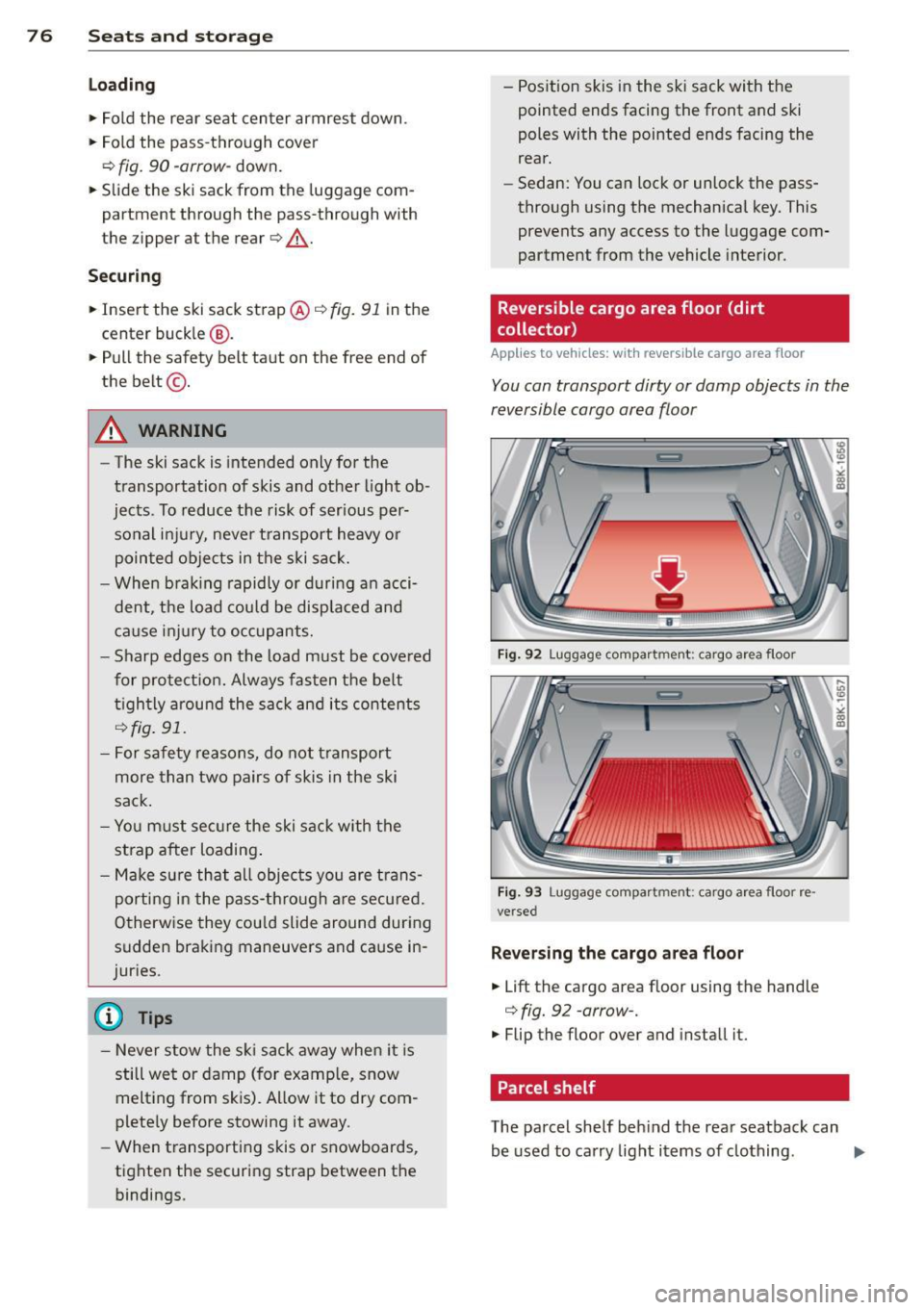
Loading
.,. Fold the rear seat center armrest down .
.,. Fold the pass-through cover
¢
fig. 90 -arrow -down.
.,. Slide the ski sack from the luggage com
partment through the pass-through with
the z ipper at the rear ¢.&. -
Securing
.,. Insert the ski sack strap @ ¢fig. 91 in the
center buckle @.
.,. Pull the safety belt taut on the free end of
the belt @.
A WARNING
-The ski sack is intended only for the
transportation of skis and other light ob
jects . To reduce the risk of serious per
sonal injury, never transport heavy or
pointed objects in the ski sack.
- When braking rapidly or during an acci
dent, the load could be displaced and
cause injury to occupants.
- Sharp edges on the load must be covered
for protection. Always fasten the belt
tightly around the sack and its contents
¢fig. 91.
- For safety reasons, do not transport
more than two pairs of skis in the ski
sack.
- You must secure the ski sack with the
strap after loading.
- Make sure that all objects you are trans
porting in the pass-through are secured.
Otherwise they could slide around during
sudden braking maneuvers and cause in
juries.
(D} Tips
- Never stow the ski sack away when it is
still wet or damp (for example, snow
melting from skis). Allow it to dry com
pletely before stowing it away.
- When transporting skis or snowboards,
tighten the securing strap between the
bindings. -
Position skis in the ski sack with the
pointed ends facing the front and ski
poles with the pointed ends facing the
rear.
- Sedan: You can lock or unlock the pass
through using the mechanical key. This
prevents any access to the luggage com
partment from the vehicle inte rior.
Reversible cargo area floor (dirt
collecto r)
Applies to vehicles: with reversible cargo area floor
You con transport dirty or damp objects in the
reversible cargo area floor
Fig. 92 Luggage compart ment : cargo area floor
Fig. 93 Luggage compartment: cargo area floor re·
versed
Reversing the cargo area floor
.,. Lift the cargo area floo r using the handle
¢ fig. 92 -arrow- .
.,. Flip the floor over and install it.
Parcel shelf
., U1 .,
-><
~
The parcel shelf behind the rear seatback can
be used to carry light items of clothing .
ll>-
Page 79 of 304
"" N
0 ::.,: co ,...., \!) 1.1'1 ,...., 1.1'1 ,....,
A WARNING ,~
No heavy or hard objects should be placed
on the pa rcel she lf. They are a hazard to
th e vehicle occupants duri ng sudden b rak
ing. Th e is a r is k of injury .
(D Note
Please make s ure that the heat ing wires
for the rear window defogger are not dam
age by abras ive objects.
(D Tips
To ensure problem-free vent ilation, the
ve ntilation s lots between the rear w indow
and the parce l shelf must not be cove red.
Seats and storage 77
Page 80 of 304
78 Warm and cold
Warm and cold Climate controls
Description
The climate control system warms, cools and
adds humidity to the air in the vehicle interior.
It is the most effect ive when the windows and
sunroof are closed . If there is a build-up of
heat inside the vehicle, ventilation can help to
speed up the cooling process.
I n all heating mode functions except
defrost,
the blower on ly switches to a higher speed
once the engine coolant has reached a certain
temperature.
Condensat ion from the cooling system can
drip and form a puddle of water under the ve
hicle. This is normal and does not mean there
is a leak.
Pollutant filter
The pollutant filter removes pollutants s uch
as dust and pollen from the air.
The air pollutants filter must be changed at
the intervals spec ified in you r Warranty
&
Maintenance booklet, so that the air condi
tioner can properly work.
If you drive your vehicle in an area with h igh
a ir po llution, the fi lter may need to be
changed more frequent ly than specified in
your Aud i Wa rranty
& Ma intenance booklet. If
in doubt, ask your authorized Audi Service Ad
visor for advice .
Key coded settings
The climate control settings are automat ically
stored and assigned to the remote control key
that is in use.
A WARNING
Reduced visibility is dangerous and can
cause accidents.
-
- For safe driving it is very important that
all windows be free of ice, snow and con
densation.
- Comp letely familiarize yourself with the
proper use and function of the heating
and ventilation system and especially how to defog and defrost the windows.
- Never use the windshield wiper/washer
system in freez ing weather unt il you
have warmed the windshield first, using
the heating and ventilation system. The
washer solution may freeze on the wind shie ld and reduce visib ility.
(D Note
- If you suspect that the air conditioner
has been damaged, switch the system
off to avoid further damage and have it
inspected by a qualified dealership.
- Repairs to the Audi air conditioner re
quire special technical know ledge and
special tools. Contact an authorized Aud i
dea ler fo r assistance.
@ For the sake of the environment
By reducing the amount of fuel you use,
you also reduce the amount of pollutants
emitted into the air.
(D Tips
-Keep the air intake s lots (in fro nt of the
w indshield) free from ice, snow and de
bris in order to maintain the proper func
tion of the climate control system.
- T he energy management system may
switch the seat heating* or rear window
defroster off temporarily . These systems
are available again as soon as the energy
balance has been restored.
- Air escapes through vents under the rear
window. When placing items of clothing
on the luggage compartment cover, en
sure that the openings are not covered.
Page 82 of 304
80 Warm and cold
switching recirculation mode on when driving
through a tunnel or when sitting in traffic
c:::> &. .
The IAU TO I button or I@ FRON T I butt on
switches recircu lation mode off .
IAUTO I Switching automatic mode on
Automatic mode mainta ins a constant tem
perature inside the vehicle. Air temperature,
airflow and air distribution are controlled au
tomatically.
Adjusting the temperature
Temperatures between 60 °F (+16 °C) and
84 °F ( +28 °C) can be set . Outside of this
range,
LO or HI will appea r in the climate con
trol system disp lay. At both of these settings,
the climate control system runs continuously
at maximum cooling or heating power . There
is no temperature regu lation.
~ Adjusting the airflow
You can adjust the airflow manually to su it
your needs . To have the airflow regulated au
tomatically , press the
!AUTO ! button.
~ Adjusting the air distribution
You can manually select the vents where the
a ir will flow . To have the air d istribution regu
lated automatically, press the
IAUTOI button .
~ Adjusting seat heating*
Pressing the button switches the seat heating
on at the highest sett ing (level 3) . The LEDs
indicate the temperature leve l. To reduce the
temperature, press the button again . To
switch the seat heating off , press the button
repeatedly until the LED turns off .
After 10 minutes , the seat heating automati
cally switches from level 3 to leve l 2.
I@ FR ON T I Switch the defroster on/off
The windshield and s ide windows are defrost
ed or cleared of condensation as quickly as
possible . The max imum amount of air flows
mainly from the vents below the windshield.
Recirculation mode switches off . Th e tempera- tu
re should be set to 72 °F (22 °C) or higher.
The temperature is contro lled automatically.
T he
!AU TO I button switches the defroster off.
lliill REAR ! Switching rear window heater
on/off
T he rear window heate r only operates w hen
the engine is running.
It sw itches off auto
matically after a few minutes, depending on
the outside temperature .
T o p revent the rea r window heater from
switching off automatically , press and hold
the
l lil REA RI button for more than 2 seconds.
T his remains stored until the ignition is
switched off.
Air vents
You can open and close the center and rear air
vents using the thumbwheels. The levers ad
just the direction of the airflow from the
vents.
In veh icles with a 3-zone deluxe automatic cli
mate control system*, you can adjust the air
temperature in the rear by turning the thumb
whee l toward the red side to make it warmer
or toward the b lue side to make it coo ler.
A WARNING
-- Do not use the recirc ulation for extended
periods of time. The windows could fog
up since no fresh a ir can enter the vehi
cle . If the windows fog up, press the air
recirc ulation butto n again immediately
to switch off the air recirculation func
tion o r se lect defrost.
- Individuals with reduced sensitivity to
pa in or temperature could develop burns
when using the seat heating function . To
reduce the risk of injury, these indiv idu
als shou ld not use seat heating.
(D Note
To avoid damage to the heating elements
in the seats, do not kneel on the seats or
place heavy loads on a small area of the
seat.
Page 84 of 304
82 On the road
On the road
Steering
Manually adjustable steering wheel
The steering wheel position is fully adjustable
up and down and forward and bock .
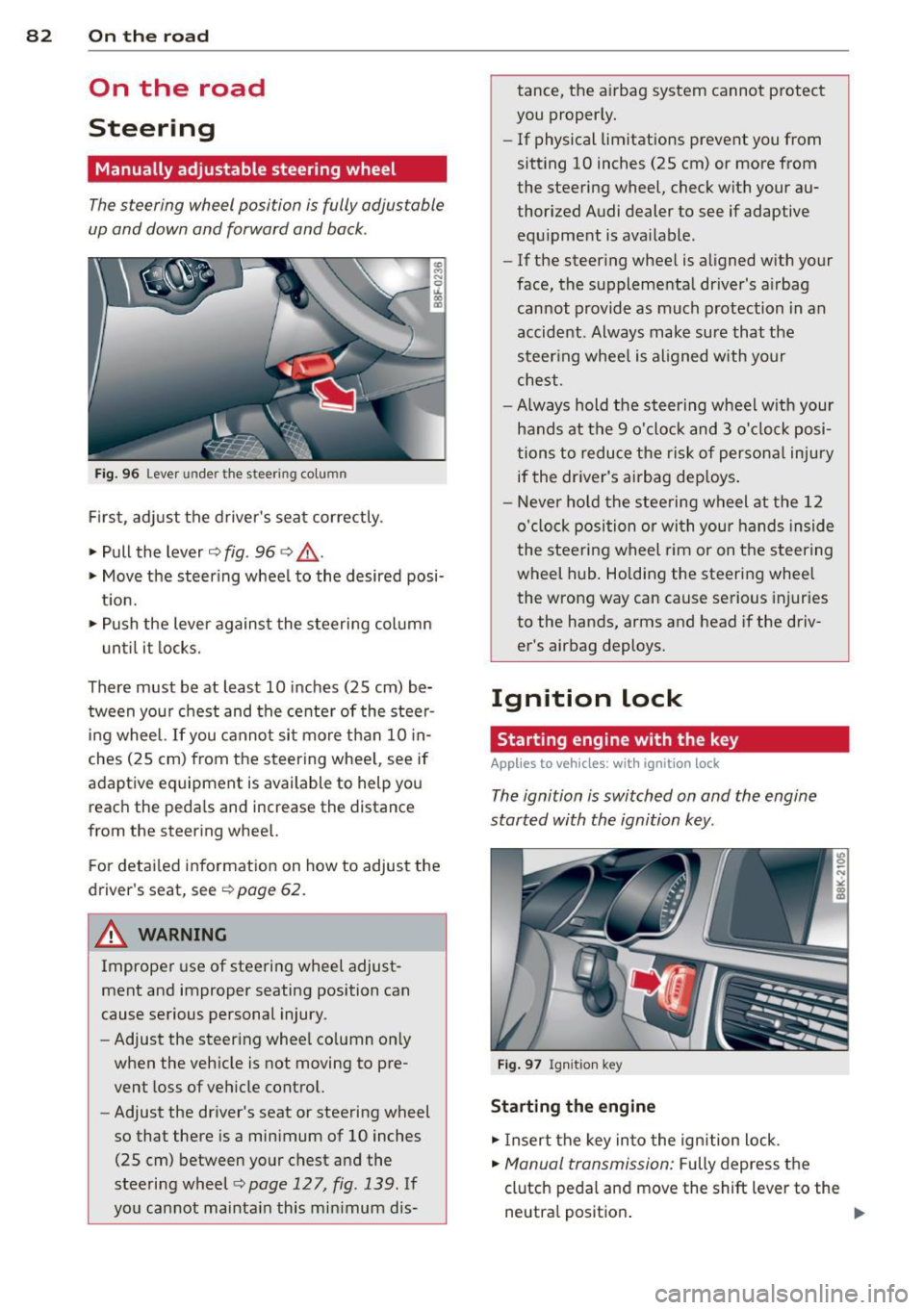
Fig. 96 Lever under the steering column
First, adjust the driver's seat correctly .
• Pull the lever
c> fig . 96 <=> &_ .
• Move the steer ing whee l to the desired posi
t ion.
• Push the lever against the steering column
until it locks.
There must be at least 10 inches (25 cm) be tween your chest and the center of the steer
ing wheel. If you cannot sit more than 10 in
ches (25 cm) from the steering whee l, see if
adaptive equipment is available to help you
reach the pedals and increase the distance
from the steering wheel.
F or detai led information on how to adjust the
driver's seat, see
c> page 62.
A WARNING
Improper use of steeri ng wheel adjust
ment and improper seating position can
cause serious personal injury.
- Adjust the steering whee l co lumn on ly
when the veh icle is not moving to pre
vent loss of veh icle control.
- Adjust the driver's seat or steering wheel
so that there is a minimum of 10 inches
(25 cm) between your chest and the
steering wheel
¢ page 127, fig . 139. If
yo u cannot mainta in this min imum dis- tance, the airbag system cannot protect
you proper ly.
- If physical limitations prevent you from
sitting 10 inches (25 cm) or more from
the steering wheel, check with your au
thorized Audi dealer to see if adaptive
equ ipment is ava ilable .
- If the steer ing wheel is aligned with your
face, the supplementa l driver's a irbag
cannot provide as much protection in an
accident . Always make sure that the
steer ing wheel is aligned with your
chest.
- Always hold the steering wheel w ith your
hands at the 9 o'clock and 3 o'clock posi
tions to reduce the risk of persona l injury
if the driver's airbag dep loys .
- Never hold the stee ring wheel at the 12
o'clock position or with your hands inside
the steeri ng wheel rim or on the steering
wheel hub . Holding the steering wheel
the wrong way can cause serious injuries
to the hands, arms and head if the driv
er's airbag deploys.
Ignition lock
Starting engine with the key
Applies to vehicles : w ith ign ition lock
The ignition is switched on and the engine
started with the ignition key .
Fig. 97 Ignit ion key
Sta rting th e engine
• Insert the key into the ignition lock .
• Manual transmission: Fully depress the
clutch pedal and move the shift lever to the
neutra l position .