lock AUDI S4 CABRIOLET 2009 Owners Manual
[x] Cancel search | Manufacturer: AUDI, Model Year: 2009, Model line: S4 CABRIOLET, Model: AUDI S4 CABRIOLET 2009Pages: 340, PDF Size: 77.32 MB
Page 293 of 340
_______________________________________________ W_ h_ a _ t_d_ o_ l _d _o_ n_ o_ w_ ? _ __,_
- Se curely en gage the han dle in th e lu ggage com partm ent
se al as illust rate d to k eep th e flo or panel up.
- Take o ut tool case and/or jack .
- Dise ngage and lower the floo r panel befo re yo u close the
luggage compa rtment lid again .
The onboard tool kit inc ludes:
• Hook for re moving whee l cove rs*
• Plastic hook to remove wheel bolt covers
• Wheel bolt wrench
• Alignment pin for changing wheels
• Screwdriver with reversible b lade
• Tow ing eye
Before storing the jack, make sure it is wound back down as far as it
wi ll g o.
After use , the jack and tools must be put back in place underneath
the floor panel in the luggage compartment .
Note : some o f the o n board i te m s liste d abo ve are provi ded on
certain models on ly or are optional extras .
& WARNING
Improper use of the vehicle ja ck can cause serious personal inju
ries .
• Using a bumpe r jack to raise the vehicle will damage the
bumper system . The jack may slip , causing injury .
• Never support your vehicle on cinder blocks , bricks or other
objects . These may not be able to support the load and could
c ause injury when they fail.
• Never start o r run the engine while the vehicle is supported by
the jack.
& WARNING (continued )
• If you must work under the vehicle, always use safety stands
specifically designed for this purpose .
• Never try and use the hexagonal socket in the handle of the
screwdriver to loosen or tighten the wheel bolts.
• Always make sure the spare tire and even a flat tire are secured
in pla ce and not loose , otherwise they could fly forward , causing
personal injury to passengers in the vehicle in an accident or
s udden maneuver .
• Never use the jack supplied with your Audi on another vehicle,
particularly on a heavier one. The jack i s only suitable for use on
the vehicle it came with. •
App lie s to ve hic les : w ith a reg ular sp are whee l
Spare wheel
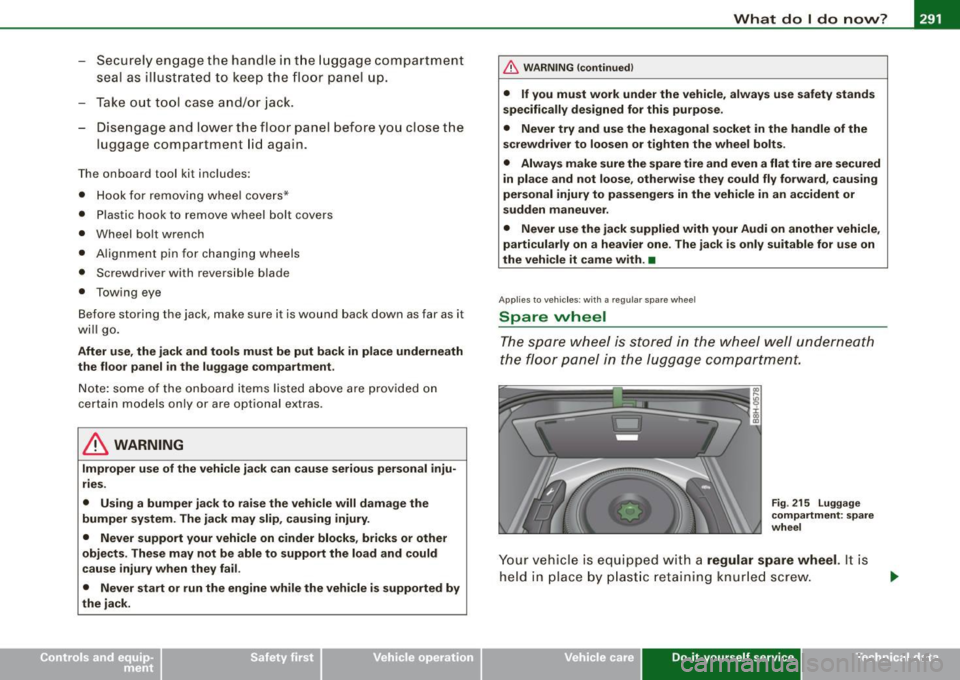
Th e s pare whe el i s stor ed in th e wh eel w ell unde rneath
the fl oor pan el in th e lugg age c omp artme nt.
Fig . 21 5 luggage
compartment: spa re
w heel
Yo ur v ehi cle is equi pped wi th a regular spare wheel. It i s
h eld in pla ce by pla stic re tainin g knur le d sc re w .
~ehicle care Do-it-yourse lf service irechnical data
Page 294 of 340
11111.___W_ h_ a_ t_d_ o_ l _d _o_ n_ o_ w_ ? ______________________________________________ _
Taking out the spare wheel
- Raise the floor panel at the plastic handle.
- Securely engage the handle in the luggage compartment
seal as illustrated to keep the floor panel up.
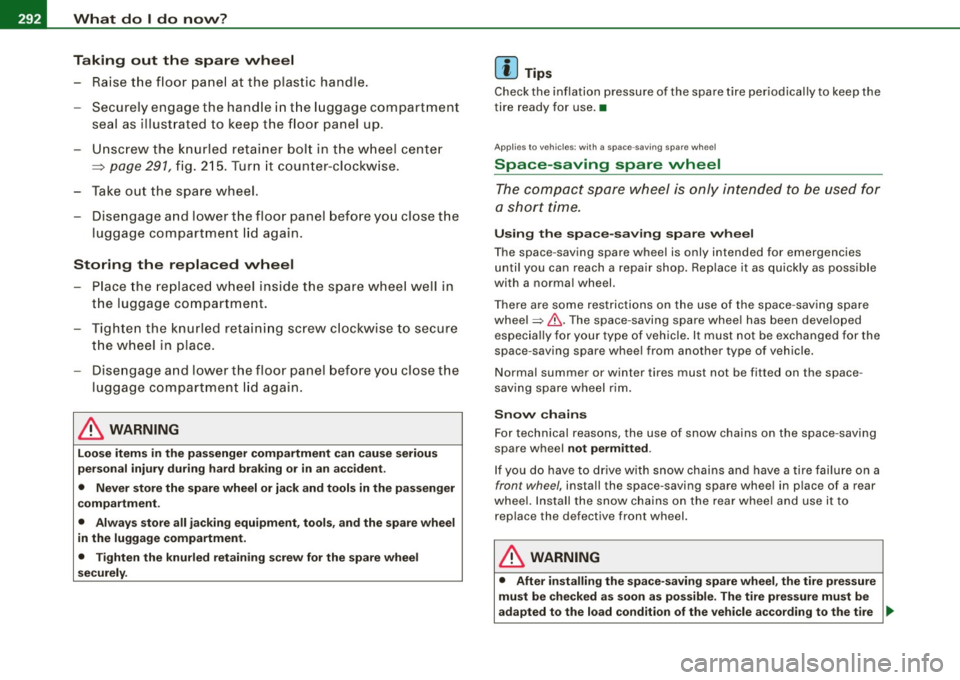
- Unscrew the knurled retainer bolt in the wheel center
==> page 291, fig. 215. Turn it counter-clockwise.
- Take out the spare wheel.
- Disengage and lower the floor panel before you close the
luggage compartment lid again.
Storing the replaced wheel
-Place the replaced wheel inside the spare wheel well in
the luggage compartment.
- Tighten the knurled retaining screw clockwise to secure
the wheel in place.
- Disengage and lower the floor panel before you close the
luggage compartment lid again.
& WARNING
Loose items in the passenger compartment can cause serious
personal injury during hard braking or in an accident .
• Never store the spare wheel or jack and tools in the passenger
compartment.
• Always store all jacking equipment, tools, and the spare wheel
in the luggage compartment.
• Tighten the knurled retaining screw for the spare wheel
securely.
[ i] Tips
Check the inflation pressure of the spare tire periodically to keep the
tire ready for use. •
Applies to vehic les: w ith a space -saving spare wheel
Space-saving spare wheel
The compact spare wheel is only intended to be used for
a short time.
Using the space-saving spare wheel
The space -saving spare wheel is only intended for emergencies
until you can reach a repair shop. Replace it as quickly as possible
with a normal wheel.
There are some restrictions on the use of the space -saving spare
wheel
=> ,&. . The space-saving spare wheel has been developed
especially for your type of vehicle. It must not be exchanged for the
space-saving spare wheel from another type of vehicle.
Normal summer or winter tires must not be fitted on the space
saving spare wheel rim.
Snow chains
For technical reasons, the use of snow chains on the space-saving
spare wheel
not permitted .
If you do have to drive with snow chains and have a tire failure on a
front wheel, install the space-saving spare wheel in place of a rear
wheel. Install the snow chains on the rear wheel and use it to
replace the defective front wheel.
& WARNING
• After installing the space-saving spare wheel, the tire pressure
must be checked as soon as possible. The tire pressure must be
adapted to the load condition of the vehicle according to the tire .,_
Page 295 of 340
_____________________________________________ W_ h _a_t _ d_ o_ l _d _o _ n_o_ w_ ?_ . _ ..... 19111
•
& WARNING (continued)
pressure table - risk of accident! Use the highest tire pressure in
the table.
• Do not drive faster than 50 mph (80 km/h) - risk of accident!
• Avoid full-throttle acceleration, sharp braking, and fast
cornering - risk of accident!
• Never drive using more than one space-saving spare wheel -
risk of accident!
• Normal summer or winter tires must not be fitted on the space
saving spare wheel rim. •
Wheel change
Before changing a wheel
Follow these points for your own and your passenger's
safety when replacing a wheel.
-After you experience a tire failure, pull the car well away
from moving traffic and try to reach level ground before
you stop => & .
- All passengers should leave the car and move to a safe
location (for instance, behind the guardrail)=>& .
- Apply the parking brake firmly=>&.
- Move selector lever to position Pon an automatic trans-
mission; put manual transmission in first gear =>& .
- If you are towing a trailer: unhitch the trailer from your
vehicle.
- Take the tool case and the spare tire=>
page 290 out of
the luggage compartment.
& WARNING
You or your passengers could be injured while changing a wheel if
you do not follow these safety precautions:
• If you have a flat tire, move a safe distance off the road. Turn off
the engine, turn the emergency flasher on and use other warning devices to alert other motorists .
• Make sure that passengers wait in a safe place away from the
vehicle and well away from the roadway and traffic.
• To help prevent the vehicle from moving suddenly and possibly
slipping off the jack, always fully set the parking brake and block
the wheel diagonally opposite the wheel being changed. When one
front wheel is lifted off the ground, placing the Automatic Trans
mission in "P" (Park), or engaging a gear in a manual transmission
will
not prevent the vehicle from moving .
• Before you change a wheel, be sure the ground is level and firm.
If necessary, use a sturdy board under the jack.
• After installing the spare wheel, make sure that you remount
the flat tire/wheel in its storage area properly and tighten the
knurled retaining screw securely. •
Changing a wheel
When you change a wheel, follow the sequence described
below step-by -step and exactly in that order.
1. Remove the decorative wheel cover*. For more details
see also =>
page 294, "Decorative wheel covers" or
=>
page 295, "Wheels with cap-covered wheel bolts".
2. Loosen the wheel bolts=>
page 295.
3. Locate the proper mounting point for the jack and align
the jack below that point=>
page 296.
4. Lift the car with the jack=> page 296. _,..
Do-it-yourself service
Page 297 of 340
_______________________________________________ W_ h_ a _ t_d_ o_ l _d _o_ n_ o_ w_ ? _ __.1111
Ap plies to vehic les: with cap-covered wheel bolts
Wheels with cap-covered wheel bolts
The caps must be removed first from the wheel bolts
before the bolts can be unscrewed.
Removing
Fig . 217 Wheel
change : removing the
wheel bolt caps
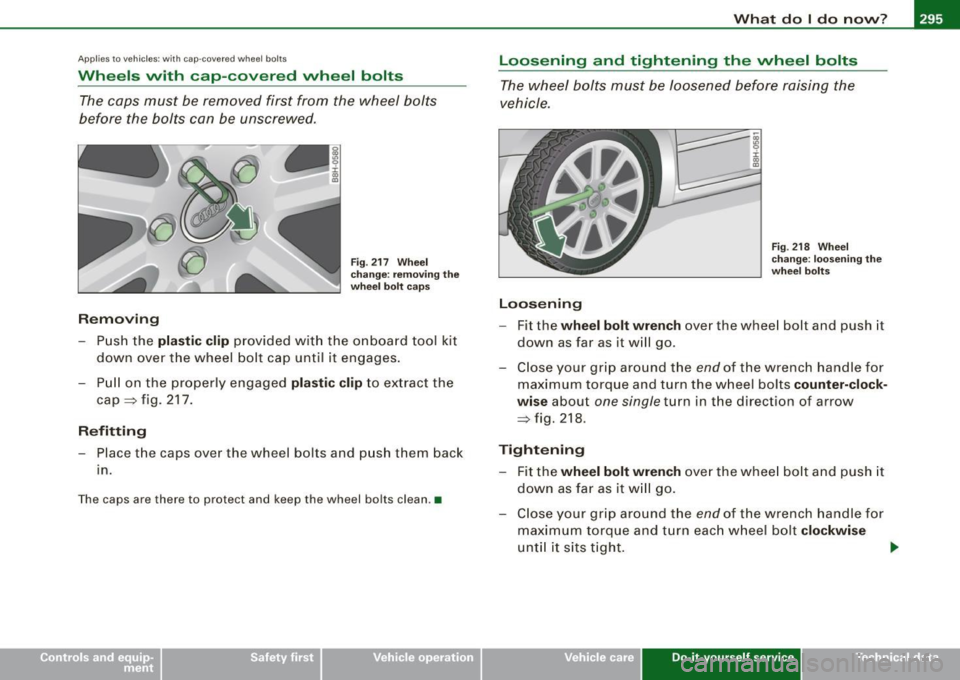
- Push the plastic clip provided with the onboard tool kit
down over the wheel bolt cap until it engages.
- Pull on the properly engaged plastic clip to extract the
cap:::> fig. 217.
Refitting
- Place the caps over the wheel bolts and push them back
1n.
The caps are there to protect and keep the wheel bolts clean.•
Loosening and tightening the wheel bolts
The wheel bolts must be loosened before raising the
vehicle.
Loosening
Fig . 218 Wheel
change : loosening the
wheel bolts
-Fit the wheel bolt wrench over the wheel bolt and push it
down as far as it will go.
- Close your grip around the end of the wrench handle for
maximum torque and turn the wheel bolts counter-clock
wise about one single turn in the direction of arrow
:::> fig. 218 .
Tightening Fit the wheel bolt wrench over the wheel bolt and push it
down as far as it will go.
- Close your grip around the end of the wrench handle for
maximum torque and turn each wheel bolt clockwise
until it sits tight. .,
~ehicle care Do-it-yourse lf service irechnical data
Page 298 of 340
11111...__W_ h_ a_ t_d_ o_ l _d _o_ n_ o_ vv_ ? ______________________________________________ _
& WARNING
• Using force without control to speed the wheel change up can
cause the vehicle to slip off the jack and cause serious personal
injuries.
• Do not loosen the wheel bolts more than one turn before you
raise the vehicle with the jack. -Risk of injury!
[ i ] Tips
• Never try and use the hexagonal socket in the handle of the
screwdriver to loosen or tighten the wheel bolts.
• If a wheel bolt sits very tight, you may find it easier to loosen by
carefully pushing down on the end of the wheel bolt wrench with
one foot only . As you do, hold on to the car to keep yourself stable
and take care not to slip.•
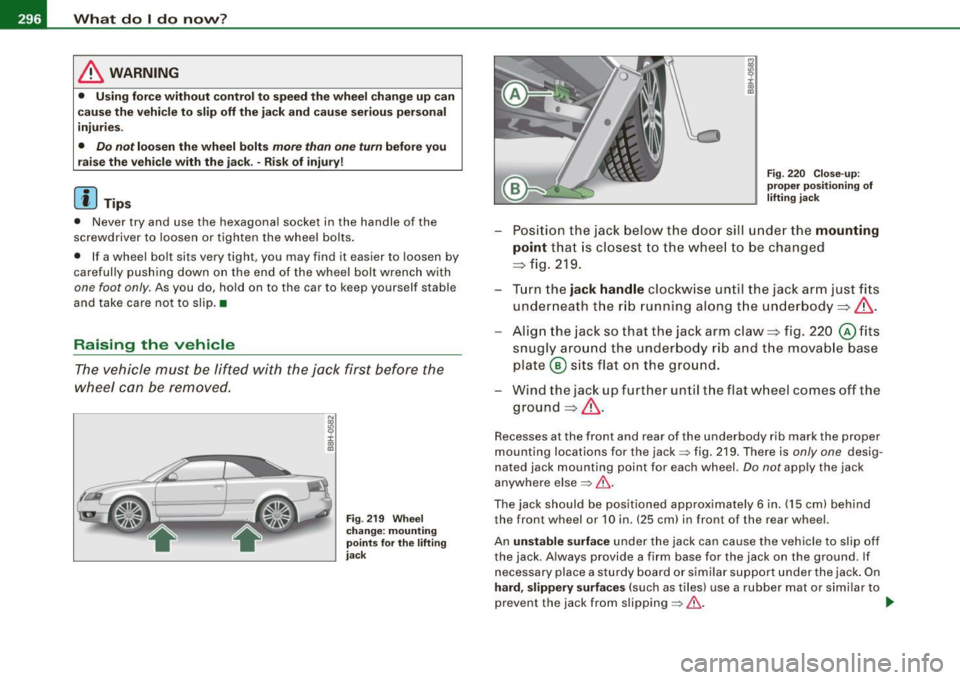
Raising the vehicle
The vehicle must be lifted with the jock first before the
wheel con be removed.
N
"' ~ I
"' al
Fig . 219 Wheel
change : mounting
points for the lifting
jack Fig
. 220 Close-up:
proper positioning of
lifting jack
- Position the jack below the door sill under the mounting
point
that is closest to the wheel to be changed
~ fig. 219.
- Turn the
jack handle clockwise until the jack arm just fits
underneath the rib running along the underbody
~ &,.
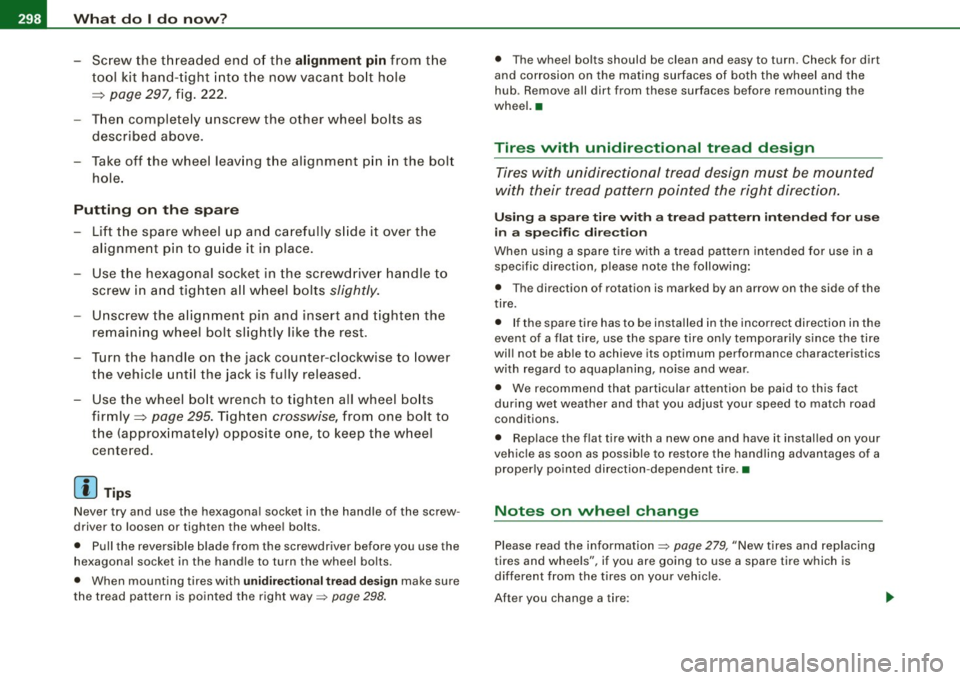
- Align the jack so that the jack arm claw~ fig. 220 @fits
snugly around the underbody rib and the movable base
plate ® sits flat on the ground.
- Wind the jack up further until the flat wheel comes off the
ground~ &-
Recesses at the front and rear of the underbody rib mark the proper
mounting locations for the jack => fig. 219. There is only one desig
nated jack mounting point for each wheel. Do not apply the jack
anywhere else=>& .
The jack should be positioned approximately 6 in. (15 cm) behind
the front wheel or 10 in. (25 cm) in front of the rear wheel.
An
unstable surface under the jack can cause the vehicle to slip off
the jack . Always provide a firm base for the jack on the ground. If
necessary place a sturdy board or similar support under the jack. On
hard, slippery surfaces (such as tiles) use a rubber mat or similar to
prevent the jack from slipping=>& . .,,
Page 300 of 340
1111.___W_ h_ a_ t_d_ o_ l _d _o_ n_ o_ w_ ? ______________________________________________ _
-Screw the threaded end o f the alignment pin from the
tool kit hand -tight into t he now vacant bo lt hole
=>
page 297, fig . 222.
- Then completely unscrew the other wheel bolts as
described above .
- Take off the wheel leaving the alignment p in in the bolt
hole.
Puttin g on th e sp are
- Lift the spare wheel up and carefu lly s lide it over the
alignment pin to gu ide it in place .
- Use t he hexagonal socket in the screwd river handle to
screw in and tighten all w heel bolts
slightly.
- Unscrew the alignment pin and insert and tighten the
remaining w heel bolt slightly like the rest.
- Turn the handle on the jack counter-clockwise to lower
the vehicle until the jack is fully released.
- Use the wheel bo lt wrench to tighten all wheel bo lts
firmly=>
page 295. Tighten crosswise, from one bolt to
the (approx imately) oppos ite one, to keep the wheel
centered.
[ i ] Tip s
Never try and use the hexagona l socket in the handle of the screw
driver to loosen or tighten the wheel bolts.
• Pull the reversible b lade from the screwdriver before you use the
hexagonal socket in the handle to turn the wheel bo lts.
• When mounting tires with
uni dire cti on al tread desig n make sure
the tread pattern is pointed the right way~
page 298.
• The whee l bolts should be clean and easy to turn. Check for dirt
and corrosion on the ma ting surfaces of both the wheel and the
hub. Remove all dirt from these surfaces before remounting the
wheel. •
Tires with unidirectional tread design
Tires with unidirectional tread design must be mounted
with their tread pattern pointed the right direction.
U sin g a spa re tire wit h a tre ad p atte rn int ended for u se
i n a sp ec ific dir ection
When using a spare tire with a tread pattern intended for use in a
specific direction, please note the following:
• The direction of rotation is marked by an arrow on the side of the
tire.
• If the spare tire has to be installed in the incorrect direction in the
event of a flat tire, use the spare tire on ly temporarily since the tire
will not be able to achieve its optimum performance characteristics
with regard to aquaplaning, noise and wear.
• We recommend that particular attention be paid to this fact
dur ing wet weather and that you adjust your speed to match road
conditions.
• Replace the flat tire with a new one and have it instal led on your
vehic le as soon as possible to restore the handling advantages of a
proper ly pointed direction-dependent tire. •
Notes on wheel change
Please read the information~ page 279, "New tires and replacing
tires and whee ls", if you are going to use a spare tire which is
different from the tires on your veh ic le.
After you change a tire: .,_
Page 308 of 340
111!1.___E_ m __ e_r -=g :...e_ n_ c-=y _ s_ i_t _u _a _t_ i_o _n_ s _______________________________________________ _
-With en gine run ning, r em ove jum per ca bles from both
v ehi cle s in exact
reve rs e o rd er.
T he battery is ve nted t o th e outs ide to preve nt gases from enter ing
the vehicle interior.
M ake s ure t hat th e jum per cla m ps are well co nnecte d with th eir
metal parts in full contact with the battery t erminals .
& WARNING
To avoid serious personal injury and damage to the vehicle , heed
all warnings and instructions of the jumper cable manufacturer. If
in doubt , call for road service .
• Jumper cables must be long enough so that the vehicles do not
touch .
• When connecting jumper cables , make sure that they cannot
get caught in any moving parts in the engine compartment .
• Before you check anything in the engine compartment, always
read and heed all WARNINGS=>
page 242, "Engine compartment ".
0 Note
Improper hook -up of jumper cables can ruin the generator.
• Always connec t POSIT IVE( +) to POS ITIVE ( +J, and NEG ATIV E (- J to
N EGAT IVE(-) te rminal.
• C heck that a ll screw plugs on the battery cel ls are screwed in
firm ly . I f not, tighten plugs prior to connec ting cla m p on nega tive
battery te rminal.
• P lease no te tha t th e procedure fo r con nec ting a ju mp er ca ble as
described above app lies specifical ly to t he case of your vehicle
b eing j ump st arted. When yo u are g iv in g a jum p start to another
veh ic le, do
not conn ect the minus(-) ca ble to the m inus( -) te rmina l
on the discha rge d battery ©=>
page 305, fig. 225. In stead , secu rely
co nnect the m inus(-) cable to e ither a m ass ive metal compone nt
that is firmly bo lted to the engine bloc k or to the engine b lock itse lf. I
f th e battery that is b ein g charged does not vent to the outside,
escapi ng battery ga s cou ld ignit e a nd ex plod e!•
Emergency towing with commercial
tow truck
General hints
Yo ur A udi requires s pecial handl in g f or t owing.
The fol lowing information i s to be used by commercial tow truck
operators who know how to operat e their equ ipment safe ly.
• Never tow your Audi, towing will cause damage to the engine
and transmission.
• Never wrap the safety chains or winch cables around the brake
lines.
• To prevent unnecessary damage , your Audi must be transported
with a car carrier (flat bed truck ).
• To load the vehicle on to the flat bed , use the towing loop found
in the vehicle tools and attach to the front or rear anchorage
=> page 3 07 and => page 307.
& WARNING
A vehicle being towed is not safe for passengers. Never allow
anyone to ride in a vehicle being towed , for any reason. •
Page 311 of 340
________________________________________________ E _m_ e_r.:g :;,. e_ n_c ...: y:.- s_ i_ t _u _a_ t_ i_ o _ n_ s ____ fflll
•
- In se rt a rubber pad betwee n th e floor jack/ wo rk sh op
h oi st and the li ftin g p oin ts .
If you must lift your vehicle with a floor jack to work underneath , be
sure the vehicle is safely supported on stands intended for this
purpose .
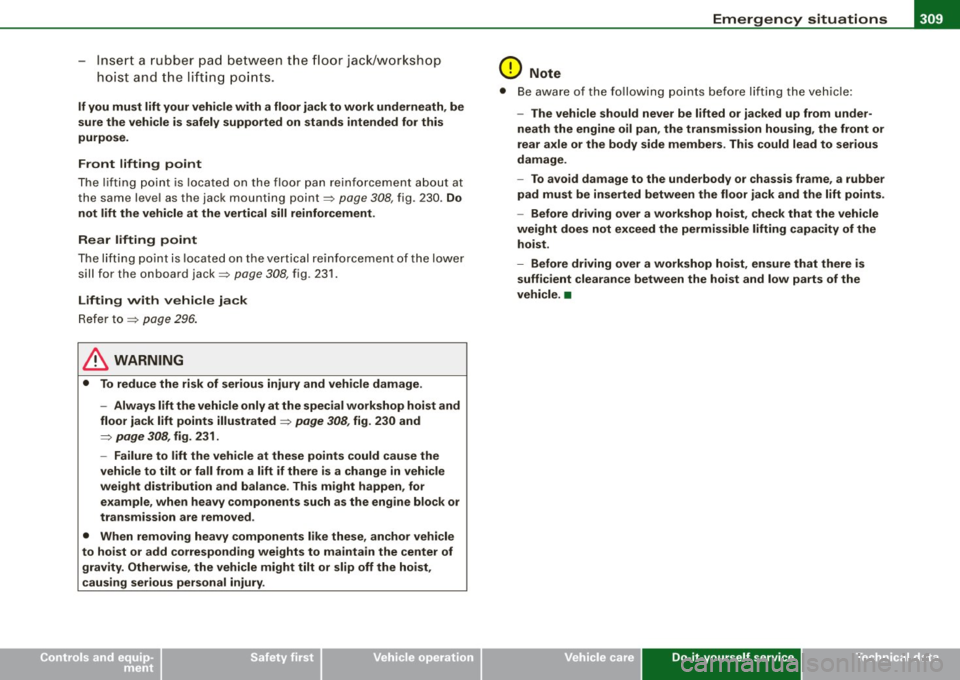
Fr ont lifting point
The lifting poi nt is located on the floo r pan rei nforceme nt about at
the same leve l as the jack mounting point~ page
308, fig. 230. Do
not lift the vehicle at the vertical sill reinforcement.
Rear lifting point
The li ftin g point is locate d on t he vert ical re inforceme nt of th e low er
sil l for the on board jack~ page
30 8, fig. 23 1.
Lifting with vehi cle ja ck
Refer to
~ page 296.
& WARNING
• To reduce the ri sk of serious injury and vehicle damage.
- Always l ift the vehicle only at the special workshop hoist and
floor jack lift points illustrated
~ page 308 , fig. 230 and
~ page 308, fig. 231.
- Failure to lift the vehicle at these points could cause the
vehicle to tilt or fall from a lift if there is a change in vehicle
weight distribution and balan ce . This might happen , for
e xample , when heavy components such as the engine block or
transmission are removed .
• When removing heavy components like these, anchor vehicle
to hoist or add correspond ing we ights to maintain the center of
gravity. Otherwise , the vehicle might tilt or slip off the hoist ,
causing ser ious personal injury .
0 Note
• Be aware of the fo llowing po ints be fore l ifting the ve hicle:
- The vehicle should never be lifted o r ja cked up from under
neath the engine oil pan , the tran smis sion housing , the front or
rear a xle or the body side members. This could lead to serious
damage.
- To avoid damage to the underbody or chassis frame , a rubber
pad must be inserted between the floor jack and the lift points .
- Before dr iving over a workshop hoist , check that the vehicle
weight does not exceed the permis sible lifting capacity of the
hoist .
- Before driving over a workshop hoist , en sure that there i s
sufficient clearance between the hoist and low parts of the
vehicle. •
Do-it-yourself service
Page 315 of 340
General information -________________ ,,..
vehicle identification number of your vehicle (perforation) as well as
t he Gross Vehicle Weight Rating (GVWR) and the Gross Axle Weight
Rating (GAWR).
Th e high voltage warning label
is located on the lock carrier .
The s pa rk ign iti on syst em compl ies with th e Canadi an
s tandard ICES-002 . •
Weights
G ross V ehicl e W eight R atin g
The Gross Vehic le Weight Rating (GVWR), and the Gross Axle Weigh t
Rating (GAWR) for front and rear are listed on a sticker on the left
door ja mb.
The Gross Vehicle Weight Rating includes the weight of the basic
vehicle pl us fu ll f uel tank, oil and coolant, plus maximum load,
wh ic h inc ludes passenger weight (150 lbs/68 kg per designated
seating position) and luggage weight.
Gross Axle We ight Rating
The Gross Axle Weight Rating is the maximum load that can be
app lied at each axle of the vehicle~ &.
Vehicle capacity weight
The vehicle capacity weigh t (max. load) is listed ei ther on the
driver's side B -p illar or inside the fuel filler flap .
& WARNING
• The actual Gro ss Axle Weight Rating at the front and rear axles
s h ould not e xceed the permi ssible weight s, and their comb in ation
mu st not exceed the Gro ss Vehicle Wei ght Rating.
Controls . and equip
ment . Safety first Vehicle operation
& W
ARNING (conti nued )
• Exceeding pe rmi ssible weight ratings can result in vehicle
d am age , ac ciden ts a nd per sonal inj ury .
0 Note
• The vehicle capacity weight figures apply when the load is
distributed even ly in the vehicle (passengers and luggage) . When
transporting a heavy load in the luggage compartment, carry the
load as near to the rear axle as possib le so that the vehicle 's
handl ing is not impai red.
• Do not exceed the maximum permiss ib le axle loads or the
maximum gross vehicle weight . Always remember tha t the veh ic le's
handling wil l be affected by the extra load. Therefore, adjust your
speed according ly .
• Always observe local regulations. •
Dimensions
The specifications refer to the basic model. Differences may occur
depending on the mode l type and op tions o rdered, for example, tire
sizes.
0 Note
When driving up steep ramps, on rough roads, over curbs , etc . it is
important to remember that some parts of your vehic le, such as
spoilers or exhaust system components, may be close to the
g round. Be ca reful not to damage them. •
Vehicle care Do-it-yourself service Tec hn ica l da ta
Page 320 of 340
___ C_ o_n_ s_ u_m _ e_ r_ ln_ f_o _r_m _ a_ t_ i_o _n ______________________________________________ _
& WARN ING (continued )
• The engine compartment of any motor vehicle is a potentially
hazardous area . Never reach into the area around or touch the
radiator fan . It is temperature controlled and can sw itch on
suddenly -even when the engine is off and the ignition key has
been removed . The radiator fan switches on automatically when
the coolant reaches a certain temperature and will continue to run until the coolant temperature drops .
• Always remove the ignition key before anyone gets under the
vehi cle .
• Always support your vehicle with safety stands if it is neces
sary to work underneath the vehicle . The jack suppl ied with the
vehicle is not adequate for this purpose and could collapse causing serious personal injury .
• If you must work underneath the vehicle with the wheels on
the ground, always make sure the veh icle is on level ground , that
the wheels are always securely blocked and that the engine
cannot be sta rted .
• Always make sure the transmission selector lever (automatic
transmission) is in "P " (Park position ) or Neutral (manual transm is
sion) and the park brake is firmly applied.
W For the sake of the environment
• Cha ng ing t he e ngine sett ings will adverse ly aff ect em iss ion
l eve ls. This is detrimenta l to the environment and increases fuel
co nsu mp tio n .
• Always observe environmental regu lations when disposing of
ol d eng ine oil, u sed br ake fluid , d irty e ngin e coo la nt , spe nt batter ies
or worn out tires.
• Undeployed airba g modu les and prete nsioners might be classi
fied as Perchlorate Material -specia l handling may apply, see
www .dtsc.ca .gov/ hazar douswaste/perc hlorat e. When the vehic le o r
parts of the restraint system including airbag modules safety be lts
w it h pr eten sion ers ar e sc ra p pe d, a ll ap pli cab le la w s and reg ula- tions must be observed. Your authorized Audi dealer is familiar with
t
hese requi re m ents and we re co m mend th at you h ave your dealer
perform this service for you .•
Additional accessories,
modifications and parts replacement
Additional accessories and parts
replacement
Always consult an author ized Audi dealer before
pu rchasin g acc ess ori es.
Your vehicle incorporates the latest safety design features ensuring
a high standa rd o f act ive and passiv e safety .
T his saf ety coul d be compromised by non -approved changes to the
vehic le . F or t his reason, if parts have to be replace d, p lease obse rve
t h e f ollow ing po ints when i nsta lling addi tio na l acc essor ies:
App roved Aud i accessories and genuine Audi pa rts a re avai lab le
fr om autho rize d Aud i dea lers.
T hese dealers also have the necessary fac ilities, tools and trained
spec ia lists t o ins tal l the part s and accessor ie s pr oper ly .
& WARNING
Using the wrong spare parts or using non -approved accessories
can cause serious personal injury.
• Use only accessorie s expressly approved by Audi and genuine
Audi spare parts.
• These parts and accessories have been specially designed to
be used on your vehicle .
• Never install accessories such as telephone cradles or
beverage holders on airbag covers or within the airbag deploy-