lock AUDI S4 CABRIOLET 2009 Repair Manual
[x] Cancel search | Manufacturer: AUDI, Model Year: 2009, Model line: S4 CABRIOLET, Model: AUDI S4 CABRIOLET 2009Pages: 340, PDF Size: 77.32 MB
Page 131 of 340
_______________________________________________________ T_ ra_ n_s_ m __ is_s_ io_ n ____ llJIII
- Tur n t he ignition on.
- Step on the brake pedal.
At the same time press and hold
the interlock butto n on the side of the gear selector knob
=> page 128, fig. 141 with your thumb until you have
moved the selector lever to the desi red posi tion .
Autom atic s elect or l ever l ock 53
The se lector lever is locked in the
P and N positions when the igni
tion is turned on. To move the lever from these positions the driver must depress the brake pedal. As a reminder to the driver, the
f ollow ing warning appears in the instrument c luster display when
the selector is in
P and N :
When sta tionary apply footbr ake whil e selecting gear
In addition, the symbol 53 will light up on the shift gate at the base
of the selector lever.
A time delay e lement prevents the selecto r lever from locking when
it is moved through the
N position (going from R to Dl. The locking
element will lock the selector lever if the lever is left in N (Neutral)
for more than approx imately 1 second, without the brake pedal
being pressed .
At speeds above about 3 mph (5 km/h) t he Automatic Shif t Lock is
automatically deactivated in the
N position.
Int erlock button
The lock button on the selector lever prevents the lever from be ing
accidentally shifted into certain positions . Pressing this bu tton
deactivates the selector lever lock . Depending on the direction of
the shift, the se lec tor lever locks at different posi tions. The positions
are highlighted in the illustration~
page 128, fig. 141 .
Ignition key safety int erlo ck
The key cannot be removed from the ignition un less the selector
lever is in the
P park position. When the ignitio n key is re moved, the
selector lever wil l be locked in the
P position. •
Controls and equip
ment
App lies to veh icles: with 6-speed automatic transmission
Kick-down
T he kick-down feature allows the vehicle to generate
ma ximum acceler ati on.
When you press the accelerator peda l beyond the resistance point
that is reached at ful l throttle, the transmission will select a lower
gear ratio based o n vehicle speed and engine RPM. The engine RP M
wil l be control led to produce maximum vehicle acceleration as long
as you continue to press the acce lerato r pedal beyond this resis
tance point.
& WARNING
Be care ful when using the ki ck-down feature on slippery road s.
Rapid acceleration may cause the vehicle to skid . •
App lies to vehicles: with 6-speed automatic transm iss ion
Dynamic shift program (DSP)
T he aut omatic transmission is electronically controlle d.
The transmission is se lf adapting and will auto matically se lect the
best sh ift program suited to the driving conditions and driving style.
The transmission wil l select one of the
e conomy programs when
you drive at a steady speed or a gradually changing speed without
heavy acceleration. This achieves optimum fuel efficiency, with early
upshifting and delayed downshifting.
The transmiss ion w ill automatically select the
s porty shift programs
when you drive at higher speeds, or with heavy acceleration and
frequently changing speeds . Upshifts are delayed to make full use
of engine power. Downshifting takes place at higher engine speeds
than in the economy p rog rams . _,.
Page 133 of 340
Transmi ssio n -_______________ ___,
[ i J Tip s
• When you shi ft into the next lower gear, the transmission wi ll
downshi ft only when there is no poss ibi lity of over -rew ing the
engine.
• When the kick -down com es on, the transmission will shift down
to a lower gear, depending on vehicle and engine speeds .
• The tiptronic® is inoperative when the transmission is in the fail
sa fe mode .•
A pplies to vehicles : wit h 6-s pee d aut om ati c tra nsm is si on
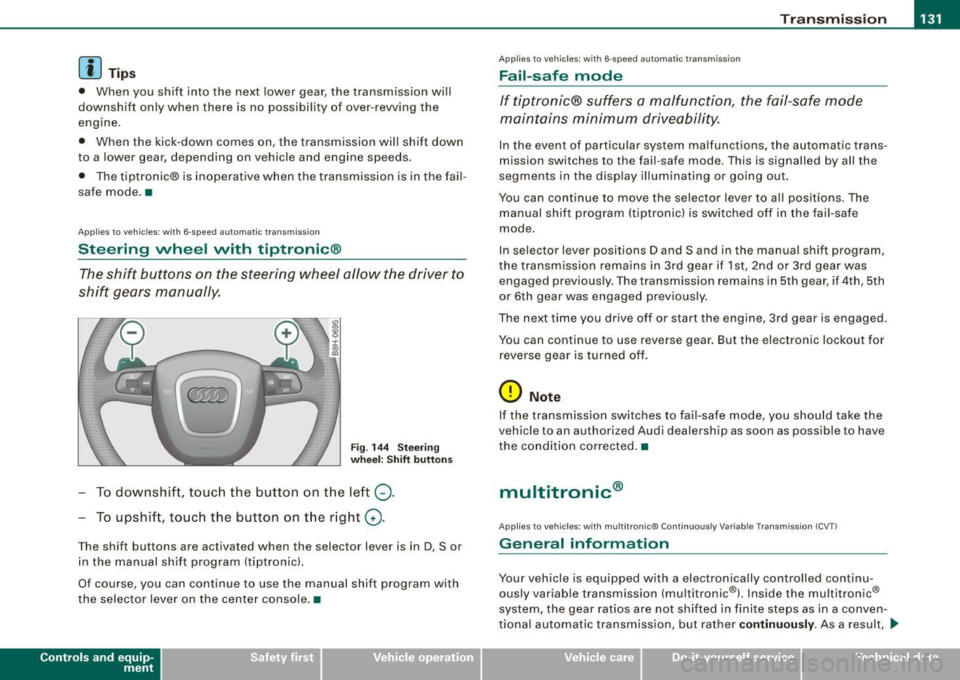
Steering wheel with tiptronic ®
The shift buttons on the steering wheel allow the driver to
shift gears manually.
F ig . 14 4 Steer ing
w heel: Shi ft button s
-To downshif t, touch the button on the left Q .
To upshift, touch the button on the right G) .
The shift buttons are activated when the selector lever is in D, Sor
in the manual shift program (tiptronic).
Of course, you can continue to use the manual shift program with
the selector lever on the center console .•
Contro ls and eq uip
ment
A pp lies to vehicles: w ith 6-speed automat ic tra nsmission
Fail -safe mode
If tiptronic® suffers a malfunction, the fail-safe mode
maintains minimum drive ability .
In the event of particular system malfunct ions, the automatic trans
m ission switches to th e fail -saf e mode. This is signalled by all the
seg ments in the display illuminating or going out .
You can continue to move the selec tor lever to all positions . The
manual shift program (tiptronic) is switched off in the fail -safe
mode .
In selector lever posi tions D and Sand in the manual shift program,
the transmission remains in 3rd gear if 1st, 2nd or 3rd gear was engaged previous ly. The transmission remains in 5th g ear, if 4th , 5th
or 6 th gear was engaged previous ly .
The next time you drive off o r start the engine , 3rd gear is engaged .
You can continu e to use reverse gear . But the electron ic lockout for
reverse gear is turned off.
0 Note
If the transmission sw itches to fail -sa fe mo de, you should take the
vehicle to an authori zed Audi dea le rship as soon as possib le to have
the condition corrected .•
multitronic ®
Applies t o vehic les: w it h mu lt itr on ic® Co nti nuous ly V aria ble Trans mission (CVT )
General information
Your vehicle is equipped with a electron ically controlled continu
ously variable transmission (mult itronic ®l. Inside the multitronic ®
system, the gear ratios are not shifted in finite steps as in a conven
tional automatic transm ission, but rath er
contin uousl y. As a result, ...
~ehicle care Technical data
Page 135 of 340
Tra nsmission -
----------------
Your vehicle is equipped with a starting assis t that a llows for easier
starting on inclines. The system is activated when the brake pedal is
depressed for a few sec onds. After releasing the brake pedal, the
brake power is he ld for a moment to prevent the vehicle from rol ling
back when starting .
The se lector lever must be in Nor
P. If one of the driv ing positions
is engaged a safety switch will prevent the eng ine from being
star ted. See also=>
page 120.
Before you move the selector lever from the P position, you must
a lways apply the brake peda l before and while depressing the
button in the handle of the selecto r lever.
& WARNING
• Unint ended vehicle movement can cau se seriou s injury.
- When the select or lever i s
in a dri ving p osition , th e vehi cle
may cre ep , even at idle speed . Ther efore do not release the
parking br ake or foot br ake until you are r eady to move ,
because powe r is tran smitted to the wheel s as soon as a
driving po sition i s engaged.
- Do not acce lerate while sele cting a driving po sition. At thi s
time th e engine mu st be at idle spe ed so th at undu e stre ss is
not pla ced on the c lut che s in the transmis sion .
- Remember : - even when stopp ed briefly with the automatic
tran smi ssion in "D ", "S " or "R ", eng ine power is being tran s
mitted to the wheel s. Your vehicle could "creep " forw ard or
b ac kw ard . Wh en stopped , keep th e brake pedal full y depre ssed
a nd u se the parking br ake if nece ssary to keep the vehicle from
rolling.
- If the selector lev er i s unintentionally moved into N while you
are dr iv ing , take your foot off the accelerator ped al and wait for
the eng ine to return to idle speed before selecting a driving
p osition .
- Never shift into "R " or ''P " when the vehicle is in motion .
- Never get out of the dr iver 's seat when the engine is running.
Controls and equip
ment
& WAR NING (conti nued )
- If yo u mu st get out of the vehicle , move the selector lever
s ecurel y into the P po sition and apply the pa rking br ake fir mly.
- If the engine mu st remain running , never have any driving
po sition eng aged when che cking under the h ood. M ake sure
t he selector lever ha s secure ly engaged and i s lo cked in "P "
w ith the parkin g brake firmly set =>
page 242, "Engine
c ompartment ". Otherwise , any incre ase in eng ine speed may
s et the vehicle in motion , e ven with the parking brake
a ppl ied.•
Ap plies to vehic les : wit h mu lt itro nic® Conti nuous ly Va riab le Tra nsmissi on (CVT )
Selector lever positions
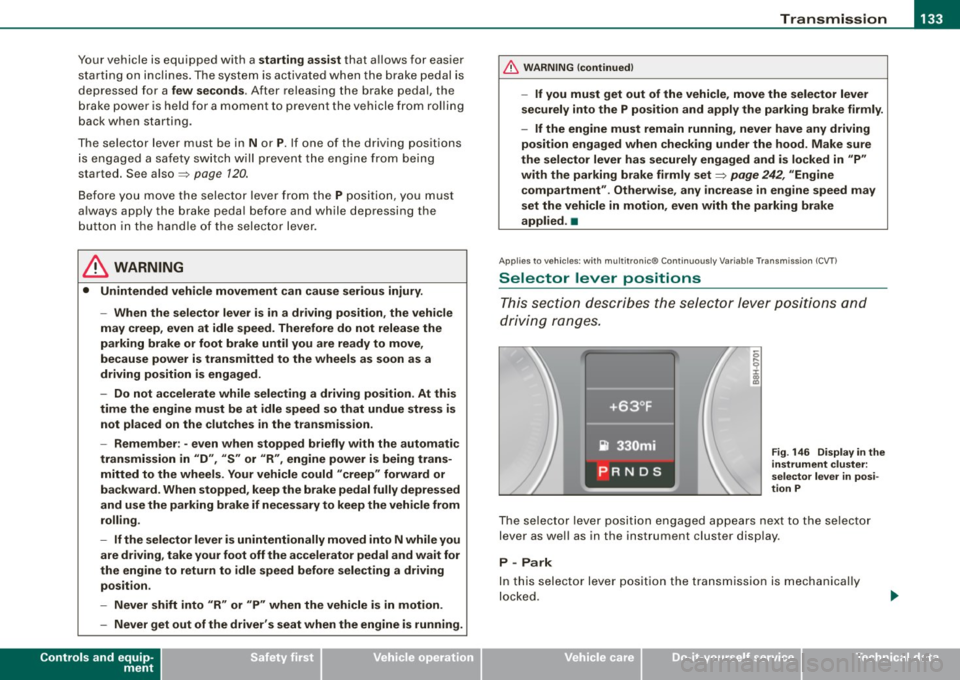
This section describes the selector lever positi ons and
drivi ng r anges.
Fig . 1 46 Dis pl ay in th e
in strum ent c lust er:
s el ector le ver in po si
tion P
The se lector lever posit ion engaged appears next to the se lector
lever as w ell as in the instrum ent clust er display .
P -Pa rk
In this selector lever position the transmission is mechanica lly
locked .
Page 137 of 340
Transmission -
----------------
Applies to vehi cles : wit h m ultit r o ni c® Con tin uous ly Variab le Tra nsmi ssion (CVTl
Automatic Shift Lock (ASL)
The Automatic Shift Lock safeguards you against acciden
tally shifting into a forward or the reverse gear and
causing the vehicle to move unintentionally.
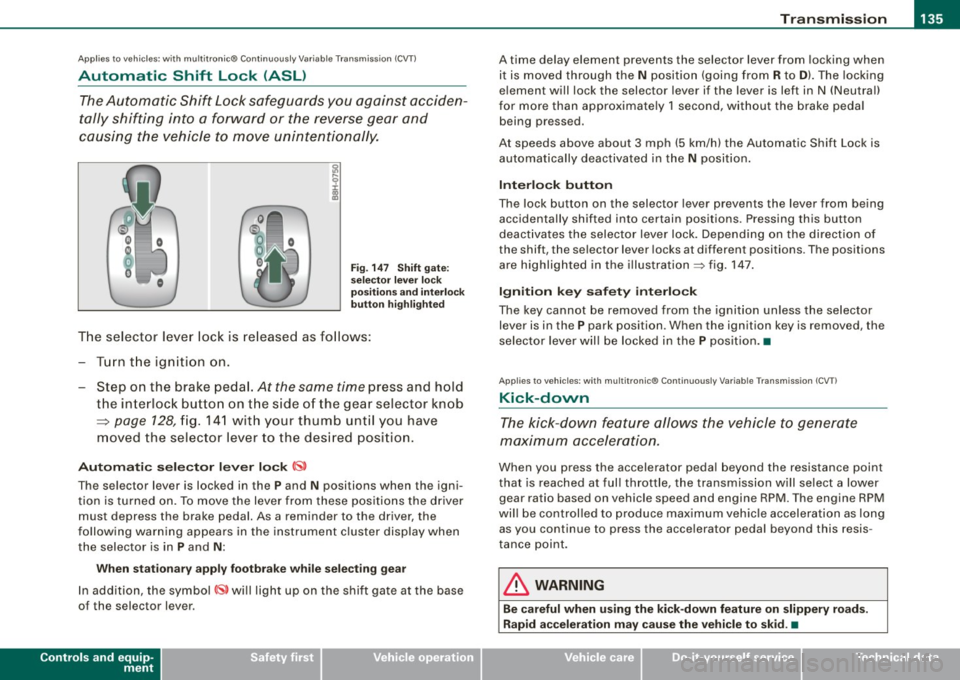
Fig. 147 Shift gate:
selector lever lock
positions and interlock
button highlighted
The selector lever lock is released as follows:
-Turn the ignition on.
- Step on the brake pedal.
At the same time press and hold
the interlock button on the side of the gear selector knob
=> page 128, fig. 141 with your thumb until you have
moved the selector lever to the desired position.
Automatic selector lever lock CS,
The selector lever is lock ed in the P and N positions when the igni
tion is turned on. To move the lever from these positions the driver
must depress the brake pedal. As a reminder to the driver, the
following warning appears in the instrument cluster display when
the selec tor is in
P and N :
When stationary apply footbrake while selecting gear
In addition, the symbol~ will light up on the shift gate at the base
of the selector l ever.
Controls and equip
ment
A time delay element prevents the selector lever from locking when
it is moved through the
N position (going from R to D). The locking
element will lock the selector lever if the lever is left in N (Neutral)
for more than approximately 1 second, without the brake pedal
being p ressed .
At speeds above about 3 mph (5 km/h) the Automatic Shift Lock is
automatically deactivated in the
N position.
Interlock button
The lock button on the selecto r lever prevents the lever from being
acc identally sh ifted into certain positions. Pressing this button
deactivates the selector lever lock. Depending on the direction of
the shift, the sel ector lever locks at different positions . Th e positions
are highlighted in the illustration=> fig. 147.
Ignition key safety interlock
The key cannot be removed from the ignition unless the selector
lever is in the
P park posit ion . Wh en the ignition key is removed , th e
selector lever will be locked in the P position. •
Applies to vehicl es : wit h mu lt itro nic® Co nti nuous ly V ariab le Tra nsmi ssion ( CVTl
Kick-down
The kick-down feature allows the vehicle to generate
maximum acceleration.
Wh en you press the accel erator pedal beyond the res istance point
that is reached at full throttle , the transmission will select a lower
gear ra tio based on veh icle speed and engin e RPM . The eng ine RPM
will be controlled to produce maximum vehicle acceleration as long as you cont inu e to press the accelerator pedal beyond this resis
tance point.
& WARNING
Be careful when using the kick-down feature on slippery roads.
Rapid acceleration may cause the vehicle to skid . •
Page 140 of 340
....... _T _r_a _ n_ s_m _ i_s _s _i_o _n ______________________________________________________ _
You can continue to move the selector lever to all positions. The
manual shift program (tiptronic) is switched off in the fail -safe
mode.
You can continue to use reverse gear . But the electronic lockout for
reverse gear is turned off.
0 Note
If the transmission switches to fail-safe mode, you shou ld take the
vehicle to an authorized Audi dealership as soon as possible to have
the condition corrected. •
Page 151 of 340
__________________________________________________ D _r_iv _ in_ g=- S_ a_f _e _l..:.. Y _ ....... 911
& WARNING (continued)
• Always adjust the driver's seat and the steering wheel so that
there are at least 4 inches 110 cm) between the knees and the
lower part of the instrument panel.
• Always hold the steering wheel on the outside of the steering
wheel rim with your hands at the 9 o'clock and 3 o'clock positions
to help reduce the risk of personal injury if the driver's airbag inflates .
• Never hold the steering wheel at the 12 o'clock position or with
your hands at other positions inside the steering wheel rim or on
the steering wheel hub. Holding the steering wheel the wrong way can cause serious injuries to the hands, arms and head if the
driver's airbag inflates
• Pointing the steering wheel toward your face decreases the
ability of the supplemental driver's airbag to protect you in a colli
sion .
• Always sit in an upright position and never lean against or
place any part of your body too close to the area where the airbags
are located.
• Before driving, always adjust the front seats and head
restraints properly and make sure that all passengers are properly
restrained.
• Never adjust the seats while the vehicle is moving. Your seat
may move unexpectedly and you could lose control of the vehicle.
• Never drive with the backrest reclined or tilted far back! The
farther the backrests are tilted back, the greater the risk of injury
due to incorrect positioning of the safety belt and improper
seating position.
• Children must always ride in child seats
=> page 190. Special
precautions apply when installing a child seat on the front
passenger seat
=> page 168. •
Controls and equip
ment Safety first
Vehicle operation
Proper seating position for the front
passenger
The proper front passenger seating position is important
for safe, relaxed driving.
For your own safety and to reduce the risk of injury in the
event of an accident, we recommend that you adjust the
seat for the front passenger to the following pos ition:
- Move the front passenger seat back as far as possible.
There must be a minimum of 10 inches (25 cm) between
the breastbone and the instrument panel =>
&.
- Adjust the angle of the seatback so that it is in an upright
position and your back comes in full contact with it
whenever the vehicle is moving.
- Adjust the head restraint so that the upper edge is as
even with the top of your head as possible but not lower
than eye level and so that it is as close to the back of your
head as possible =>
page 151.
-Keep both feet flat on the floor in front of the front
passenger seat.
- Fasten and wear safety belts correctly=>
page 163.
For detailed information on how to adjust the front passenger's
seat, see => page 92.
LJ}. WARNING
Front seat passengers who are unbelted, out of position or too
close to the airbag can be seriously injured or killed by the airbag
as it unfolds. To help reduce the risk of serious personal injury :
jll,,
Vehicle care Do-it-yourself service Technical data
Page 156 of 340
___ D_ ri_v _i_n ..::g::;.._ S_ a_ f _e__, ly'---------------------------------------------------
- Alw ay s place an d prop erly secure h eavy items in the
luggage com partm en t as fa r fo rwa rd as possi ble.
& WARNING
Improperly stored luggage or other items can fly through the
vehicle causing ser ious personal injury in the event of hard br aking
or an a ccident. To help reduce the risk of serious personal injury :
• Always put objects , for e xample , luggage or other heavy items
in the luggage compartment.
& WARNING
Heavy loads will influence the way your vehicle handles. To help
reduce the risk of a loss of control leading to serious personal
injury :
• Always keep in mind when transporting heavy objects , that a
change in the center of gravity can also cause changes in vehicle
handling:
-Always distribute the load as e venly as possible .
- Place heavy objects as far forward in the luggage compart -
ment as possible .
• Never exceed the Gross Axle Weight Rating or the Gros s
Vehicle Weight Rating specified on the safety compliance sti cker
on the left door jamb. Exceeding permis sible weight standards
c an cau se the veh icle to slide and handle differently .
• Please ob serve information on safe driving:::::,
page 146.
& WARNING
To help prevent poisonous exhaust gas from being dra wn into the
vehicle , always keep the rear l id clo sed while driv ing.
• Ne ver t ransport obje cts larger than those fitting completely
into the luggage area because the rear lid cannot be fully closed.
& W ARNING (continued )
• If you absolutely must drive with the rear lid open, observe the
following notes to reduce the risk of poisoning :
- Close all windows ,
- Close the power top ,
- Open all air outlets in the instrument panel ,
- Switch off the air recirculation ,
- Set the fre sh air fan to the highest speed .
& WARNING
Always make sure that the doors, all windows , the power roof and
the rear lid are securely closed and locked to reduce the ri sk of
injury when the vehicle is not being used.
• After closing the rear lid , always make sure that it i s properly
closed and locked .
• Never leave your vehicle unattended especially with the rear lid
left open. A child could crawl into the vehicle through the luggage
compartment and close the rear lid becoming trapped and unable
to get out . Being trapped in a vehi cle can le ad to serious personal
injury.
• Never let ch ildren play in or around the vehicle.
• Never let pa ssengers ride in the luggage compartment . Vehicle
occupants must always be properly restrained in one of the
vehicle's seating po sition s.
[ i ] Tips
• Air circu lat io n helps to reduce window fogg in g when the power
top is c losed. Stale air escapes to the outside through slots in the
t rim pa nels o n both sides of the luggage co mpartment. Make sure
that these s lots are not b locked. _.
Page 166 of 340
-Safety belts ___ .:,__ _____________________________________ _
Automatic safety belt retractors
Every safety belt is equipped with an automatic belt retractor on the
shoulder bel t. This featu re locks the bel t when the belt is pulled out
fast, during hard braking and in an accident. The belt may also lock
when you drive up or down a steep hill or through a sharp curve. During normal driving the bel t lets you move freely.
Safety belt pretensioners
The safety belts are equipped with a belt pretension er that helps to
tighten the safety belt and remove slack when the pretensioner is
activated. The function of the pretensioner is monitored by a
warning light:::::, page
20, "Airbag system @;".
Switchable locking feature
Every safe ty belt except the one on the driver seat is equipped with
a switchable locking feature that must be used when the safety belt
is used to attach a child seat . Be sure to read the important informa
tion about this feature:::::, page
200.
& WARNING
Improperly positioned safety belts can cause serious injury in an
accident :::::,
page 164, "Safety belt position" .
• Safety belts offer optimum protection only when the seat back
is upright and belts are properly positioned on the body.
• Never attach the safety belt to the buckle for another seat.
Attaching the belt to the wrong buckle will reduce safety belt
effectiveness and can cause serious personal injury.
• A passenger who is not properly restrained can be seriously
injured by the safety belt itself when it moves from the stronger
parts of the body into critical areas like the abdomen.
• Always lock the convertible locking retractor when you are
securing a child seat in the vehicle :::::,
page 202. •
Safety belt position
Correct belt position is the key to getting maximum
protection from safety belts.
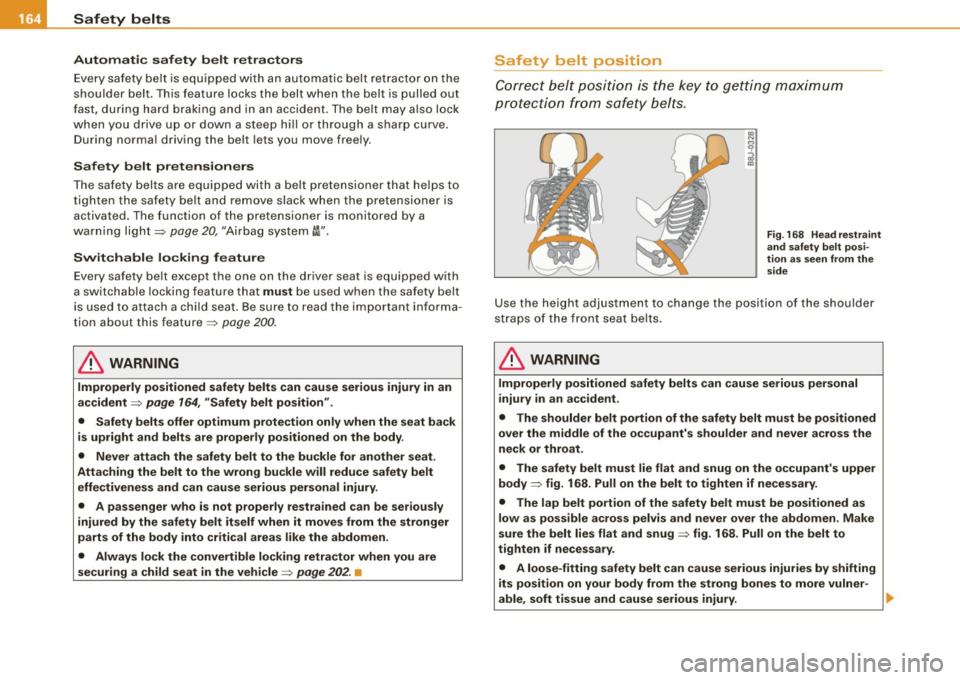
Fig . 168 Head restraint
and safety belt posi
tion as seen from the
side
Use the height adjustmen t to change the position of the shoulder
straps of the front seat belts.
in. WARNING
Improperly positioned safety belts can cause serious personal
injury in an accident .
• The shoulder belt portion of the safety belt must be positioned
over the middle of the occupant's shoulder and never across the
neck or throat.
• The safety belt must lie flat and snug on the occupant's upper
body
:::::> fig. 168. Pull on the belt to tighten if necessary.
• The lap belt portion of the safety belt must be positioned as
low as possible across pelvis and never over the abdomen. Make
sure the belt lies flat and snug :::::, fig. 168. Pull on the belt to
tighten if necessary.
• A loose-fitting safety belt can cause serious injuries by shifting
its position on your body from the strong bones to more vulner-
able, soft tissue and cause serious injury. ..,.
Page 182 of 340
___ A_ ir_b_ a..::g =-- s__,y:.... s_ t _e_ m ___________________________________________________ _
PASSENGER AIR BAG OFF light
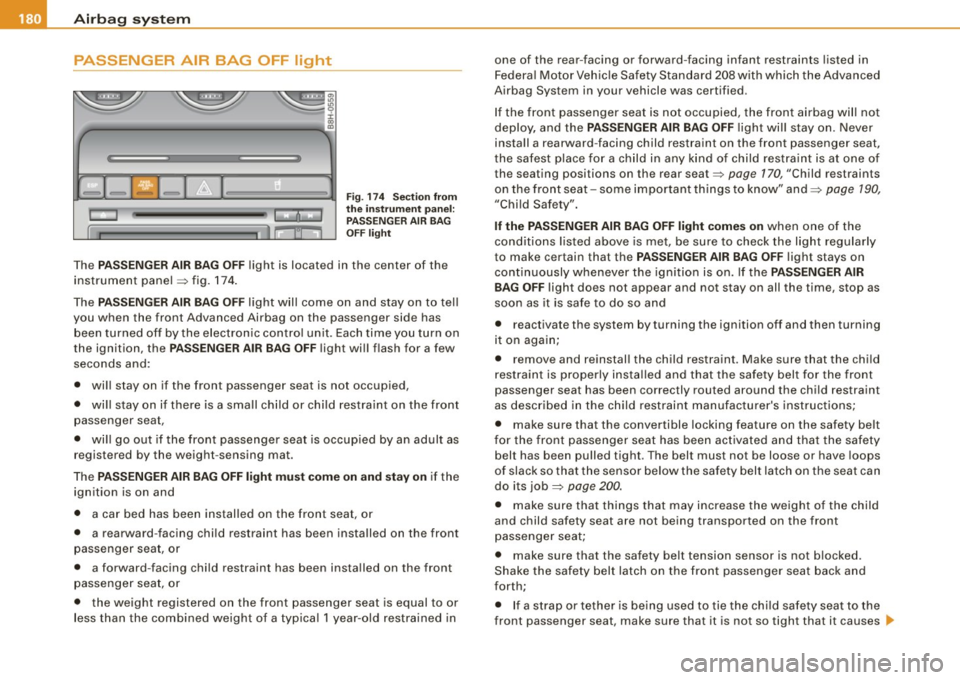
............. Fig. 174 Section from
the instrument panel:
PASSENGER AIR BAG
OFF light
The PASSENGER AIR BAG OFF light is located in the center of the
instrument panel
~ fig. 174.
The
PASSENGER AIR BAG OFF light will come on and stay on to tell
you when the front Advanced Airbag on the passenger side has
been turned off by the electronic control unit . Each time you turn on
the ignition , the
PASSENGER AIR BAG OFF light will flash for a few
seconds and :
• will stay on if the front passenger seat is not occupied,
• will stay on if there is a small child or child restraint on the front
passenger seat,
• will go out if the front passenger seat is occupied by an adult as
registered by the weight -sensing mat .
The
PASSENGER AIR BAG OFF light must come on and stay on if the
ignition is on and
• a car bed has been installed on the front seat, or
• a rearward-facing child restraint has been installed on the front
passenger seat, or
• a forward-facing child restraint has been installed on the front
passenger seat, or
• the weight registered on the front passenger seat is equal to or
less than the combined weight of a typical 1 year-old restrained in one of the rear-facing or forward-facing infant restraints
listed in
Federal Motor Vehicle Safety Standard 208 with which the Advanced
Airbag System in your vehicle was certified .
If the front passenger seat is not occupied, the front airbag will not
deploy, and the
PASSENGER AIR BAG OFF light will stay on. Never
install a rearward -facing child restraint on the front passenger seat,
the safest place for a child in any kind of child restraint is at one of
the seating positions on the rear seat~
page 170, "Child restraints
on the front seat- some important things to know" and~
page 190,
"Child Safety".
If the PASSENGER AIR BAG OFF light comes on when one of the
conditions listed above is met, be sure to check the light regularly
to make certain that the
PASSENGER AIR BAG OFF light stays on
continuously whenever the ignition is on. If the
PASSENGER AIR
BAG OFF
light does not appear and not stay on all the time, stop as
soon as it is safe to do so and
• reactivate the system by turning the ignition off and then turning
it on again;
• remove and reinstall the child restraint. Make sure that the child
restraint is properly installed and that the safety belt for the front
passenger seat has been correctly routed around the child restraint
as described in the child restraint manufacturer's instructions;
• make sure that the convertible locking feature on the safety belt
for the front passenger seat has been activated and that the safety
belt has been pulled tight . The belt must not be loose or have loops
of slack so that the sensor below the safety belt latch on the seat can
do its job
~ page 200.
• make sure that things that may increase the weight of the child
and child safety seat are not being transported on the front
passenger seat;
• make sure that the safety belt tension sensor is not blocked.
Shake the safety belt latch on the front passenger seat back and
forth;
• If a strap or tether is being used to tie the child safety seat to the
front passenger seat, make sure that it is not so tight that it causes _,,
Page 195 of 340
_______________________________________________ C_h _i_ld _ S_ a_ f_ e_ t...:; y ______ lllll
C . Forward-facing convertible child restraint systems,
manufactured on or after September 1, 2004:
• Britax Roundabout 161
• Britax Expressway
• Century Encore 4612
• Century STE 1000 4416
• Cosco Olympian 02803
• Cosco Touriva 02519
• Evenflo Horizon V 425
• Evenflo Medallion 254
• Safety First Comfort Ride 22-400
& WARNING
To reduce the risk of serious injury, make sure that the PASSENGER
AIR BAG OFF light comes on and stays on whenever a child restraint is installed on the front passenger seat and the ignition
is switched on.
• Take the child restraint off the front passenger seat and install
it properly at one of the rear seat positions if the PASSENGER AIR
BAG OFF light does not stay on.
• Have the airbag system inspected by your authorized Audi
dealer immediately .
[ i] Tips
The child seats listed in categories A to C have been tested by Audi
only for the Advanced Airbag function. •
Controls and equip
ment Safety first Vehicle operation
Important safety instructions for using child
safety seats
Correct use of child safety seats substantially reduces the
risk of injury in an accident!
As the driver, you are responsible for the safety of every
body in the vehicle, especially children:
- Always use the right child safety seat for each child and
always use it properly~
page 195.
-Always carefully follow the child safety seat manufac
turer's instructions on how to route the safety belt prop
erly through the child safety seat.
- When using the vehicle safety belt to install a child safety
seat , you must first activate the convertible locking
retractor on the safety belt to prevent the child safety
seat from moving~
page 200.
-Push the child safety seat down with your full weight to
get the safety belt really tight so that the seat cannot
move forward or sideways more than one inch (2.5 cm).
- If a strap or tether is being used to tie the child safety
seat to the front passenger seat, make sure that it is not
so tight that it causes the weight-sensing mat to
measure more weight than is actually on the seat.
Always remember: Even though your vehicle is equipped with an
Advanced Airbag system, all children, especially those 12 years and
younger, should always ride in the back seat properly restrained for
their age and size. •
Vehicle care Do-it-yourself service Technical data