ECU AUDI S4 CABRIOLET 2009 Owner's Manual
[x] Cancel search | Manufacturer: AUDI, Model Year: 2009, Model line: S4 CABRIOLET, Model: AUDI S4 CABRIOLET 2009Pages: 340, PDF Size: 77.32 MB
Page 159 of 340
To provide extra safety, the rollover protection system is also acti
vated in head -on, side and rear -end collisions if the impact is severe
enough. •
Lowering the rollover protection bars after
deployment
Lower the rollover protection bars only if the bars were
automatically deployed without the vehicle actually
colliding or overturning.
0
9 :,:
"' m
~
"' 0 ±
"' m
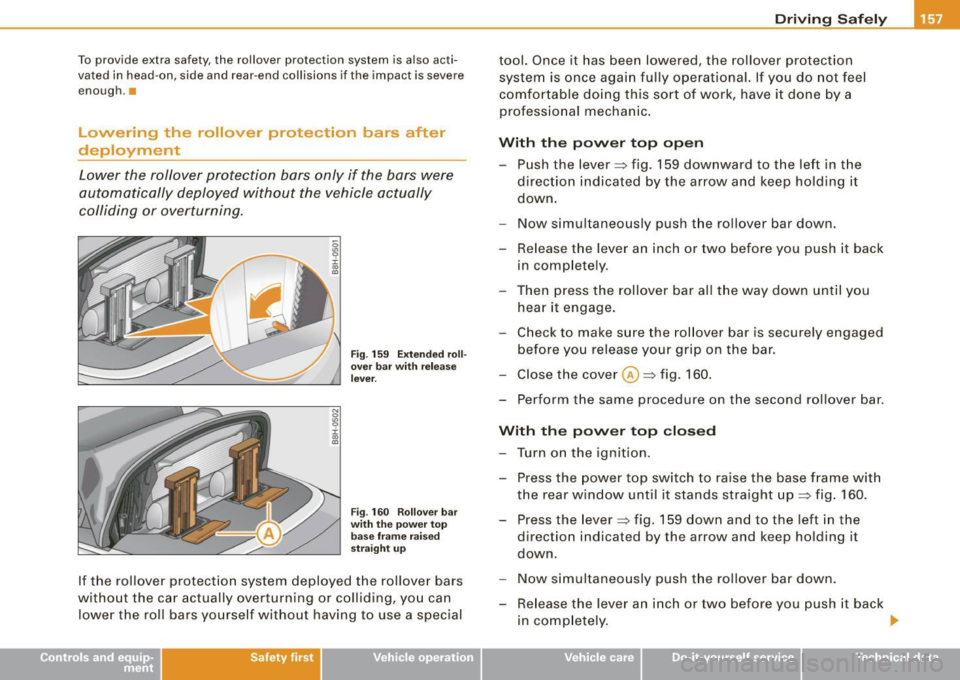
Fig . 159 Extended roll
over bar with release
lever.
Fig. 160 Rollover bar
with the power top
base frame raised
straight up
If the rollover protection system deployed the rollover bars
without the car actually overturning or colliding, you can
lower the roll bars yourself without having to use a special
Safety first
Driving Safely
tool. Once it has been lowered, the rollover protection
system is once again fully operational. If you do not feel
comfortable doing this sort of work, have it done by a
professional mechanic.
With the power top open
- Push the lever=> fig. 159 downward to the left in the
direction indicated by the arrow and keep holding it
down.
- Now simultaneously push the rollover bar down.
Release the lever an inch or two before you push it back
in completely.
- Then press the rollover bar all the way down until you
hear it engage.
- Check to make sure the rollover bar is securely engaged
before you release your grip on the bar.
- Close the cover@=> fig. 160.
- Perform the same procedure on the second rollover bar.
With the power top closed
-Turn on the ignition .
- Press the power top switch to raise the base frame with
the rear window until it stands straight up=> fig. 160.
- Press the lever=> fig. 159 down and to the left in the
direction indicated by the arrow and keep holding it
down.
- Now simultaneously push the rollover bar down.
- Release the lever an inch or two before you push it back
in completely. .._.
~ehicle care irechnical data
Page 160 of 340
___ D_ r _i_v _i_n ..;;:g ::;,._ S_ a_ f_ e---= ly'----------------------------------------------------
- Then press the rollover bar all the way down until you
hear it engage.
Check to make sure the rollover bar is securely engaged
before you release your grip on the bar.
Close the cover @~ page
157, fig. 160 .
- Perform the same procedure on the second rollover bar.
- You can now open and close the power top again.
& WARNING
• If there is a problem in the rollover protection system, the
system must be checked by a professional mechanic as soon as
possible.
If this is not done, there is a risk that the rollover protec
tion system may not be activated in the event of an accident.
• No modifications of rollover protection system components
are permitted.
• Work on the rollover protection system must only be done by a
professional mechanic . Improperly performed work can cause the
system to fail or release unintentionally, possibly causing an
injury!
• Always have your vehicle serviced whenever the service
interval display indicates that it is time for service . This will ensure
that the system will operate properly over the long term. The roll over protection system must be checked by a professional
mechanic every two years or sooner. •
Page 165 of 340
& WARNING (continued)
• Never let any person ride with feet on the instrument panel or
sticking out the window or on the seat.
• Never remove a safety belt while the vehicle is moving. Doing
so will increase your risk of being injured or killed.
• Never wear belts twisted .
• Never wear belts over rigid or breakable objects in or on your
clothing, such as eye glasses, pens, keys , etc. , as these may cause
injury .
• Never wear the shoulder part of the belt under your arm or
otherwise out of position .
• Several layers of heavy clothing may interfere with correct posi
tioning of belts and reduce their effectiveness.
• Always keep belt buckles free of anything that may prevent the
buckle from latching securely.
• Never use comfort clips or devices that create slack in the
shoulder belt. However , special clips may be required for the
correct use of some child restraint systems.
• Never allow safety belts to become damaged by being caught
in door or seat hardware .
• Torn or frayed safety belts can tear and damaged belt hardware
can break in an accident . Inspect belts regularly. If webbing, bind
ings, buckles , or retractors are damaged , have belts replaced by an
authorized Audi dealer or qualified workshop.
• Safety belts that have been worn and loaded in an accident
must be replaced with the correct replacement safety belt by an
authorized Audi dealer or qualified workshop. Replacement may
be necessary even if damage cannot be clearly seen. Anchorages
that were loaded must also be inspected.
• Never remove, modify, disassemble, or try to repair the safety
belts yourself .
Safety first
Safety belts
& WARNING (continued)
• Always keep the belts clean. Dirty belts may not work properly
and can impair the function of the inertia reel
~ page 242, "Safety
belts" .•
Safety belts
Fastening safety belts
Seat first -everybody buckle up!
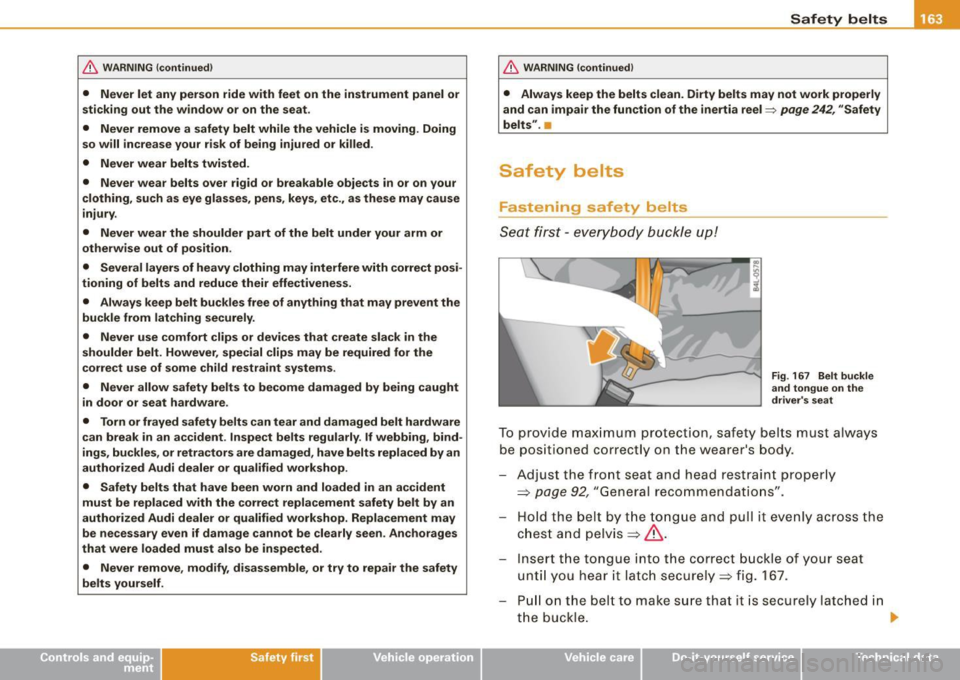
Fig. 167 Belt buckle
and tongue on the
driver 's seat
To provide maximum protection, safety belts must always
be positioned correctly on the wearer's body .
Adjust the front seat and head restraint properly
=> page 92, "General recommendations".
Hold the belt by the tongue and pull it evenly across the
chest and pelvis=>& .
Inse rt the tongue into the correct buckle of your seat
until you hear it latch securely=> fig. 167.
Pull on the belt to make sure that it is securely latched in
the buckle. ..,
~ehicle care irechnical data
Page 166 of 340
-Safety belts ___ .:,__ _____________________________________ _
Automatic safety belt retractors
Every safety belt is equipped with an automatic belt retractor on the
shoulder bel t. This featu re locks the bel t when the belt is pulled out
fast, during hard braking and in an accident. The belt may also lock
when you drive up or down a steep hill or through a sharp curve. During normal driving the bel t lets you move freely.
Safety belt pretensioners
The safety belts are equipped with a belt pretension er that helps to
tighten the safety belt and remove slack when the pretensioner is
activated. The function of the pretensioner is monitored by a
warning light:::::, page
20, "Airbag system @;".
Switchable locking feature
Every safe ty belt except the one on the driver seat is equipped with
a switchable locking feature that must be used when the safety belt
is used to attach a child seat . Be sure to read the important informa
tion about this feature:::::, page
200.
& WARNING
Improperly positioned safety belts can cause serious injury in an
accident :::::,
page 164, "Safety belt position" .
• Safety belts offer optimum protection only when the seat back
is upright and belts are properly positioned on the body.
• Never attach the safety belt to the buckle for another seat.
Attaching the belt to the wrong buckle will reduce safety belt
effectiveness and can cause serious personal injury.
• A passenger who is not properly restrained can be seriously
injured by the safety belt itself when it moves from the stronger
parts of the body into critical areas like the abdomen.
• Always lock the convertible locking retractor when you are
securing a child seat in the vehicle :::::,
page 202. •
Safety belt position
Correct belt position is the key to getting maximum
protection from safety belts.
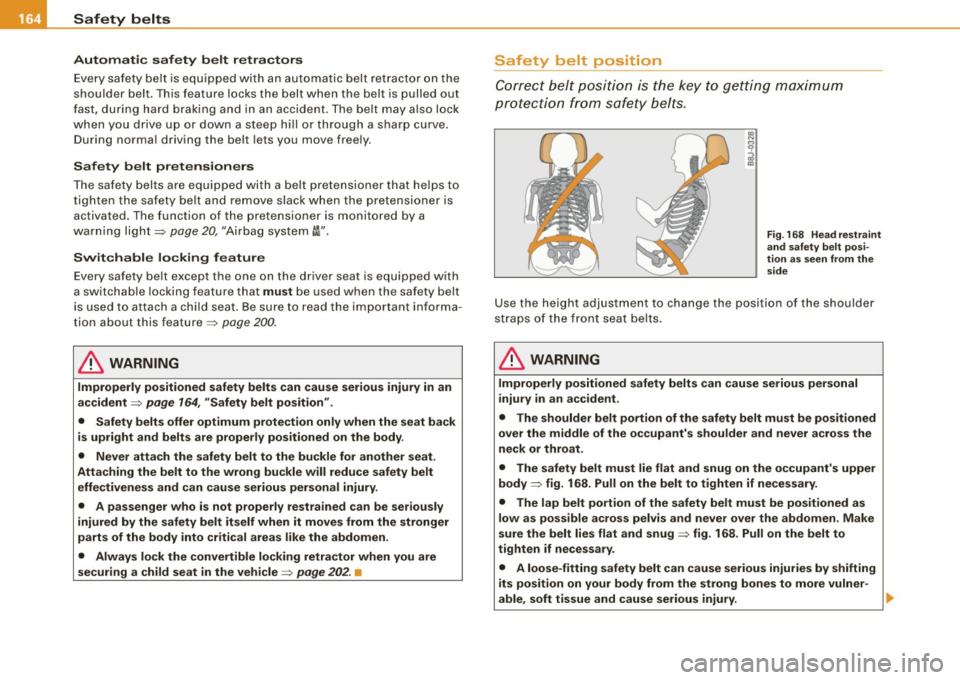
Fig . 168 Head restraint
and safety belt posi
tion as seen from the
side
Use the height adjustmen t to change the position of the shoulder
straps of the front seat belts.
in. WARNING
Improperly positioned safety belts can cause serious personal
injury in an accident .
• The shoulder belt portion of the safety belt must be positioned
over the middle of the occupant's shoulder and never across the
neck or throat.
• The safety belt must lie flat and snug on the occupant's upper
body
:::::> fig. 168. Pull on the belt to tighten if necessary.
• The lap belt portion of the safety belt must be positioned as
low as possible across pelvis and never over the abdomen. Make
sure the belt lies flat and snug :::::, fig. 168. Pull on the belt to
tighten if necessary.
• A loose-fitting safety belt can cause serious injuries by shifting
its position on your body from the strong bones to more vulner-
able, soft tissue and cause serious injury. ..,.
Page 167 of 340
& WARNING (continued)
• Always read and heed all WARNINGS and other important infor
mation
=> page 162. •
Pregnant women must also be correct ly
restrained
The best way to protect the fetus is to make sure that
expectant mothers always wear safety belts correctly·
throughout the pregnancy.
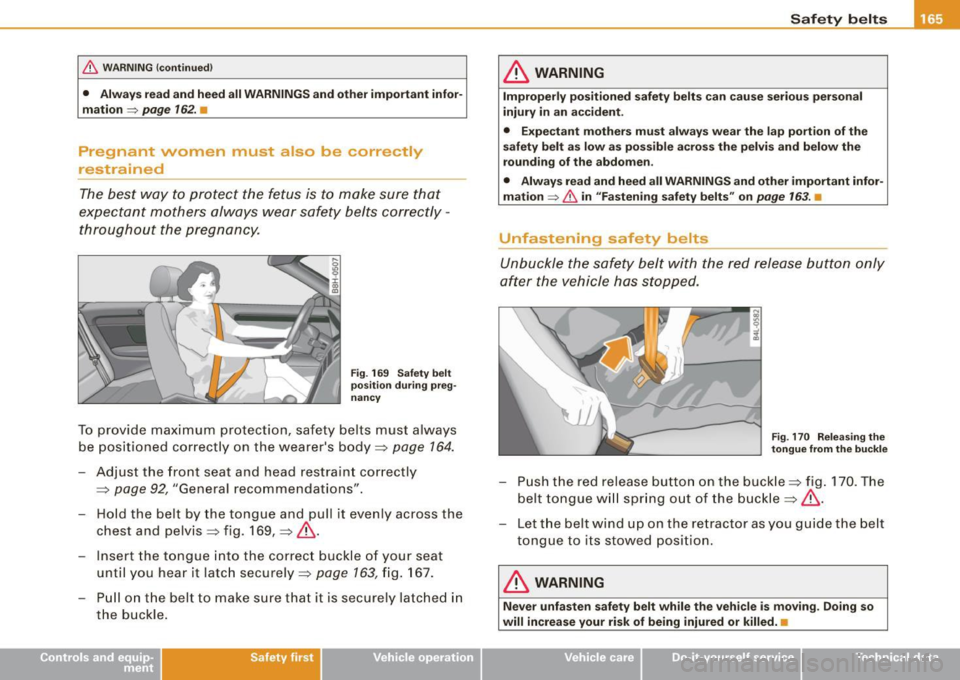
Fig . 169 Safety belt
position during preg
nancy
To provide maximum protection, safety belts must always
be posit ioned correctly on the wearer's body=>
page 164.
-Adjust the front seat and head restraint correctly
=>
page 92, "General recommendations".
- Hold the belt by the tongue and pull it evenly across the
chest and pelvis=> fig. 169, =>
&.
- Insert the tongue into the correct buckle of your seat
until you hear it latch securely=>
page 163, fig. 167.
- Pull on the belt to make sure that it is securely latched in
the buck le.
Safety first
Safety belts
& WARNING
Improperly positioned safety belts can cause serious personal
injury in an accident.
• Expectant mothers must always wear the lap portion of the
safety belt as low as possible across the pelvis and below the
rounding of the abdomen.
• Always read and heed all WARNINGS and other important infor
mation =>
& in "Fastening safety belts" on page 163. •
Unfastening safety belts
Unbuckle the safety belt with the red release button only
after the vehicle has stopped.
Fig . 170 Releasing the
tongue from the buckle
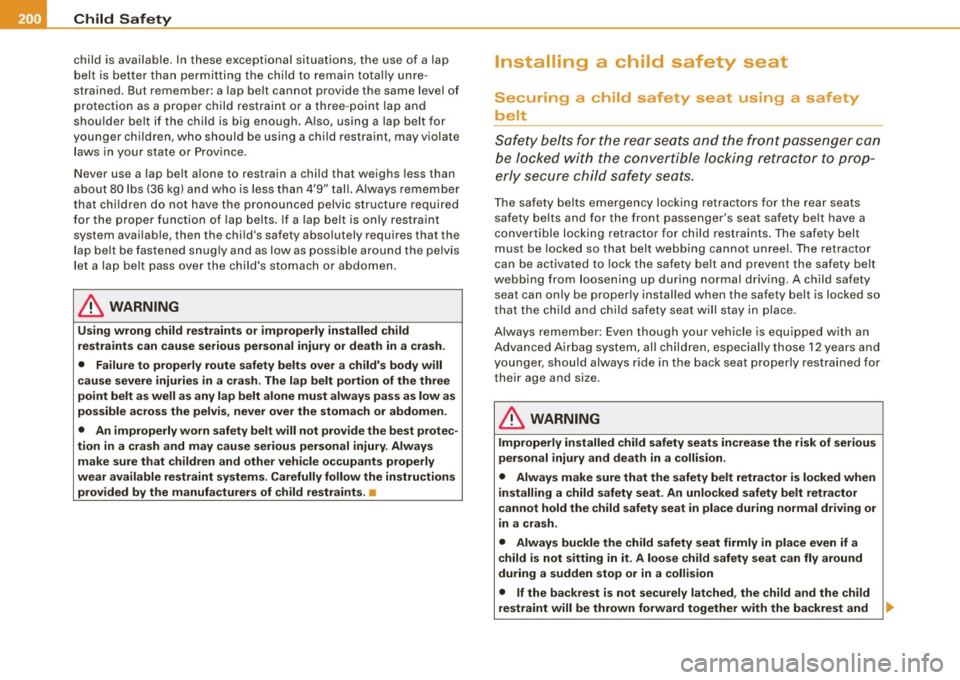
- Push the red release button on the buckle=> fig. 170. The
belt tongue will spring out of the buckle =>
&.
- Let the belt wind up on the retractor as you guide the belt
tongue to its stowed position.
& WARNING
Never unfasten safety belt while the vehicle is moving. Doing so
will increase your risk of being injured or killed. •
~ehicle care irechnical data
Page 202 of 340
___ C_h_ i_ld _ S_ a_ f_ e_ t_ y ______________________________________________ _
child is available. In these exceptional situations, the use of a lap
belt is better than permitting the chi ld to remain totally unre
strained . But remember: a lap belt cannot provide the same level of
protec tion as a proper child restraint or a t hree -point lap and
shoulder belt if the child is big enough . Also, using a lap belt for
younger child ren, who should be using a chi ld restraint, may violate
l aws in your state or Prov ince .
Never use a lap belt alone to restrain a chi ld that weighs less than
about 80 lbs (36 kg) and who is less than 4'9" ta ll. A lways remember
that chi ldren do not have the pronounced pelvic structure required
for the proper function of lap belts. If a lap belt is only restraint
system available, then the child's safety absolutely requires that the
l ap be lt be fastened snug ly and as low as possible around the pelv is
let a lap belt pass over the chi ld's stomach or abdomen .
& WARNING
Using wrong child restraints or improperly in stalled child
restraint s can cau se serious personal inju ry or death in a cr ash.
• Fa ilure to properl y route safety belts over a child's body will
c au se severe injurie s in a crash . The lap belt portion of the three
point belt a s well a s any l ap belt alone mu st al way s pass as low as
po ssible acros s the pelvi s, never over the stom ach or abdomen.
• An improperl y worn saf ety belt will not pr ovide the best prote c
tion in a cra sh and may cau se ser iou s personal injury . Alwa ys
m ake sure that childr en and other vehicle occ upant s properl y
wear available restraint sy ste m s. Carefully follow the in struction s
pro vided by the manuf acturer s of child re strai nts. •
Installing a child safety seat
Securing a child safety seat using a safety
belt
Safe ty belts for the rear seats and the fr ont passenger can
be locked with the c onvertible locking retractor to prop
erly secure child safety seats.
The safety belts emergency locking retractors fo r the rear seats
safety be lts and for the front passenger's seat safety belt have a
conve rtible locking ret ractor for child restraints . The safety belt
must be locked so that belt webbing cannot unreel. The retractor
can be activated to lock the safety be lt and prevent the safety belt
webbing from loosening up during normal dr iving. A child safety
seat can only be properly instal led when the safety belt is locked so
that t he child and child safety seat w ill s tay i n place .
Always remember: Even though your vehicle is equipped with an
Advanced Airbag system, al l children, especially those 12 years and
younger, should always ride in the back seat p roperly restra ined for
their age and size.
& WARNING
Improperly in stalled child safety seat s increa se the risk of s erious
per sonal inju ry a nd death in a colli sion .
• Alway s m ake sure that the safe ty belt retrac tor is locked wh en
i nstalling a child safety seat . An unl ocked safety be lt retra ctor
cannot hold the ch ild safety seat in pla ce during normal driv ing or
in a cras h.
• Alway s buckle the child safety seat firml y in place even if a
c hild i s not sitting in it. A loo se child safet y seat can fl y around
during a sudden stop or in a coll ision
• If the b ackre st i s not se cu rely l atched , the ch ild and the ch ild
restraint will be thrown forward together with the bac krest and .,
Page 204 of 340
___ C_h_ i_ld _ S_ a_ f_ e_ t_ y ______________________________________________ _
& WARNING (continued)
• A child in a rearward-facing child safety seat installed on the
front passenger seat will be seriously injured and can be killed if
the front airbag inflates -even with an Advanced Airbag System.
• The inflating airbag will hit the child safety seat or infant
carrier with great force and will smash the child safety seat and
child against the backrest, center arm rest, door or roof.
• Always be especially careful if you must install a rearward
facing child safety seat on the front passenger seat in exceptional
circumstances.
• A tight tether strap on a rearward-facing child restraint
attached to the front passenger seat can put too much pressure
on the weight -mat in the seat and register a heavier weight in the
Advanced Airbag System. The heavier weight registered can make
the system work as though an adult were on the seat and deploy
the Advanced Airbag when it must be suppressed causing serious
or even fatal injury to the child.
• Make sure that the PASSENGER AIR BAG OFF light comes on
and stays on all the time whenever the ignition is switched on.
• If the PASSENGER AIR BAG OFF light does not come on and stay
on, immediately install the rear-facing child safety seat in a rear
seating position and have the airbag system inspected by your
Audi dealer. •
Activating the convertible locking retractor
Use the convertible locking retractor to secure a child
restraint.
Always heed the child safety seat manufacturer's instruc
tions when installing a child restraint in your vehicle. To
activate the convertible locking retractor:
- Place the child restraint on a seat, preferably on the rear
seat. -
Slowly pull the belt
all the way out.
- Route it around or through the child restraint belt path
=> &.
- Push the child safety seat down with your full weight to
get the safety belt really tight.
- Insert the belt tongue into the buckle for that seating position.
- Guide the safety belt back into the retractor until the belt
lies flat and snug on the child safety seat.
- You should hear a "clicking" noise as the belt winds back
into the inertia reel. Test the convertible locking retractor
by pulling on the belt. You should no longer be able to
pull the belt out of the retractor. The convertible locking
retractor is now act ivated .
- Make sure that the red release button is facing away from
the child restraint so that it can be unbuckled quickly.
- Pull on the belt to make sure the safety belt is properly
tight and fastened so that the seat cannot move forward
or sideways more than one inch (2.5 cm).
& WARNING
Using the wrong child restraint or an improperly installed child
restraint can cause serious personal injury or death in a crash.
• Always make sure that the safety belt retractor is locked when
installing a child safety seat. An unlocked safety belt retractor
cannot hold the child safety seat in place during normal driving or
in a crash.
• Always buckle the child safety seat firmly in place even if a
child is not sitting in it. A loose child safety seat can fly around
during a sudden stop or in a crash.
Page 205 of 340
Child Safety IJ!III _________________________________ __:::...:....:...:..::.:......:__ ___ ....:.!.-__
& WARNING (continued )
• Always make sure the seat backrest to which the child restraint
is installed is in an upright position and securely latched into place
and cannot fold forward . Otherwise , the seat back with the child
safety seat attached to it could fly forward in the event of an acci
dent or other emergency situation .
• Always read and heed all WARNINGS whenever using a child
restrained in a vehicle is being used
=> page 190 . Special precau
tions apply when installing a child safety seat on the front passenger seat=>
page 170 , "Child restra ints on the front seat -
some important things to know ".•
Deactivating the convertible locking retractor
The c onver tib le l ocking retrac tor for ch ild res tra in ts will
be d ea ctivat ed automat ically wh en the belt i s wound all
th e way ba ck in to the retractor .
-Pre ss th e red bu tton o n the sa fety be lt bu ckle . Th e b elt
t o ngue will pop out of the b uck le .
- Guide the be lt all the w ay b ack in to i ts s to w ed p osition.
A lways l et t he safety belt retract complet ely into its stowed pos itio n.
T he safety belt can now be used as an ord inary safety be lt w ithout
t he conve rtibl e locking retractor for chi ld restrain ts.
I f the converti ble locking retractor should be activated inadvert
en tly, the safet y belt must be unf astened and guid ed completel y
back into its stowed pos ition to deactivat e th is feature. If the
c o nver tible loc kin g re tractor is n ot deac tiva te d , th e safe ty be lt wi ll
g radua lly becom e tighter and uncomfortab le to w ear .
Controls and equip
ment Safety first Vehicle operation
& WARNING
Improperly installed
child safety seats in crease the risk of serious
personal injury and death in a collision.
• Never unfasten the safety belt to deactivate the convertible
locking retractor for child restraints while the vehicle is moving .
You would not be restrained and could be seriously injured in an
accident.
• Always read and heed all WARNINGS whenever using a child
restrained in a vehicle is being used=>
page 190. Special precau
tions apply when installing a child safety seat on the front
passenger seat=>
page 170 , "Child restraints on the front seat -
some important things to know ".•
Additional Information
What types of child restraint anchors are
available and how are they related to child
safety?
F or years, chil d restraints have been installed using the safety belts
a lre ady pre s en t in ev ery ve hicle .
Sinc e Septem ber 1, 1999, c hild restraint manufactur ers have b een
providing tether straps that attach the top of the chi ld rest raint to
th e veh icles structure, on most of t heir forward -facin g syst ems in
order to com ply with U.S. Federal regulations for child restraint
per formanc e in a cras h. V ehi cle m anu fac tur ers a re r equi red to
phase -i n tether ancho rages for attach ment of the tether st rap in
their U.S. veh icles beginni ng Septem ber 1, 1999.
The combi nation of the t ether anc horag es and t he lower anchor
age s is now gene ra lly calle d th e
LATCH system f or "Lo w er An chors
and Tether for Children ". ..,
Vehicle care Do-it-yourself service Technical data
Page 206 of 340
___ C_h_ i_ld _ S_ a_ f_ e_ t_ y ______________________________________________ _
(T he term "ISOFIX" regarding lower anchorages had been used by
Audi and other man ufacturers in the past, but LATC H is now the
standard name for the new child restraint anchorage system.)
Some chi ld restraint system manufacturers have been providing
t e th er straps on certain mode ls of their child restraint systems,
either as standard equipment or as a retrofit, for several years .
Check w ith the manu facturer of the ch ild restra int syste m for tether
strap availabili ty .
T o provide a simpler and more p racticab le way to a ttach the child
restraint system on the vehicle seat, U .S . Federal regulations require
the phase -in of lower anchorages in vehicles and devices on new
child restraint systems to attach to the vehicle anchora ges.
Child restraint system manufacturers will probab ly offer two kinds
o f lower a nchorages on their child safety seats
T hey could come with:
• hook-on o r push-on connectors attached to adjus tab le straps or
• rigid latches on bars that extend out the back of the ch ild
r est raint and are re leased w ith release but tons a t the bottom of the
child restra int.
I n addition to the LATCH lower anchorages, both of th ese child
r estra int syst ems use tether straps to help keep the c hild restrai nt
system firmly in p lace .
Tether an chorages
Your Audi Cabriolet is not equipped with a
LATCH system. It is not
equ ipp ed with top tether anchorages . It is equ ipped wit h lo wer
anchorages on ly.
Your Ca briolet is equipped with the Ac tive Rollover Protect ion
System, which is integrated into the backrest of the rear seat. The
Active Rollove r Protection System deploys upwards to help provide
additional protection in certain coll isions a nd cras h situations. For
this reason, your vehicle is not equipped with top tether anchorages
f or use with forward -facing child restra ints . In Canada
, provincia l law requires that forward -facing child
res tra ints use both t op tethe r anc horages and l owe r an ch orages;
therefore, it is not possible to insta ll a forward -facing chi ld restraint
i n t his vehicle.
In the United States , ch ild restraint installation mus t con form with
the child restraint manufacturer's instructions . Check the instruc
t ions that co me w ith the chi ld rest raint or co ntact the manufactu rer
to determine if the child restraint may be instal led facing forward
w it h out securing the top tether strap .
& WARNING
• Improper installation of child restraints will increa se the risk of
injur y in a crash .
• Alway s carefully follow the child restraints manuf acturer' s
instructions for proper installation of the child restraint and
proper use of the lower anchorages or safety belts in your vehicle .
• Never secure or attach any luggage or other items to the LATCH
lower anchorages. •
Where can I get additional information about
child restraint application and usage?
T here are a number of sources of add itiona l information about child
restra int se lection, i nstallati on a nd usage :
NH TSA advises that the best chi ld safety seat is the one that fits
you r ch ild and fit s in yo ur vehicle, and that you will use co rrectly and
consis tently.
T ry be fore you buy!
National Highway Traffic Safety Admin istratio n
Tel. : (888) DAS H-2- DOT
www.nhtsa.dot .gov
National SAFE KIDS Campaign
Page 208 of 340
___ C_h_ i_ld _ S_ a_ f_ e_ t-= y'------------------------------------------------
Lower anchorages
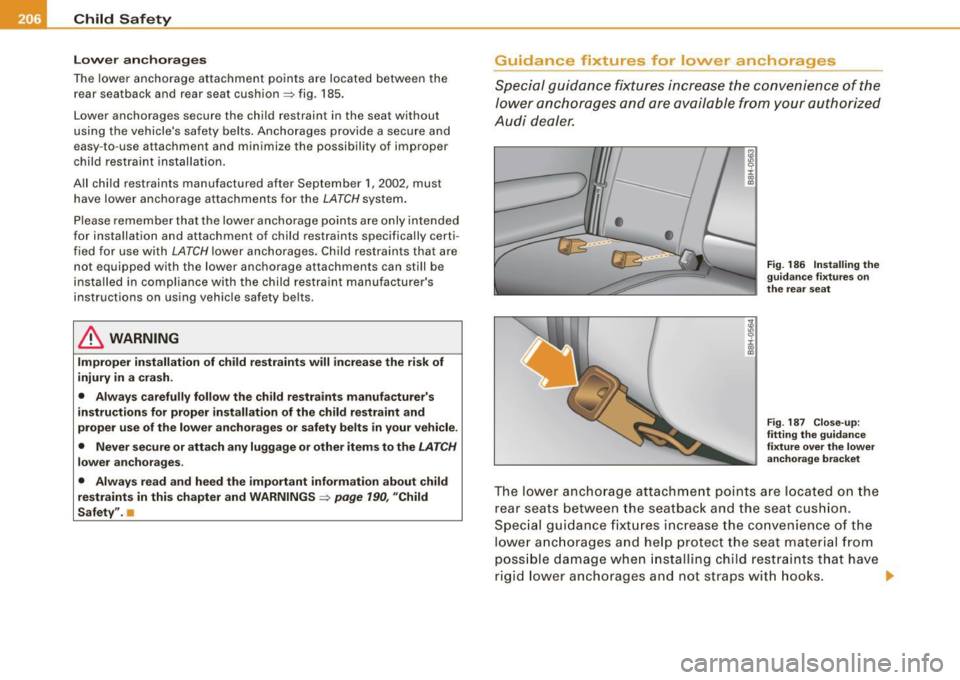
The lower anchorage attachment points are located between the
rear seatback and rear seat cushion=> fig. 185.
Lower anchorages secure the child restraint in the seat without
using the vehicle's safety belts. Anchorages provide a secure and
easy -to -use attachment and minimize the possibility of improper
child restraint installation.
All child restraints manufactured after September 1, 2002, must have lower anchorage attachments for the
LATCH system.
Please remember that the lower anchorage points are only intended
for installation and attachment of child restraints specifically certi
fied for use with
LATCH lower anchorages. Child restraints that are
not equipped with the lower anchorage attachments can still be
installed in compliance with the child restraint manufacturer's
instructions on using vehicle safety belts.
& WARNING
Improper installation of child restraints will increase the risk of
injury in a crash.
• Always carefully follow the child restraints manufacturer's
instructions for proper installation of the child restraint and
proper use of the lower anchorages or safety belts in your vehicle.
• Never secure or attach any luggage or other items to the LATCH
lower anchorages.
• Always read and heed the important information about child
restraints in this chapter and
WARNINGS :::> page 190, "Child
Safety".•
Guidance fixtures for lower anchorages
Special guidance fixtures increase the convenience of the
lower anchorages and are available from your authorized
Audi dealer.
!6
"' 0 ± .,
"'
Fig. 186 Installing the
guidance fixtures on
the rear seat
Fig . 187 Close-up:
fitting the guidance
fixture over the lower
anchorage bracket
The lower anchorage attachment points are located on the
rear seats between the seatback and the seat cushion.
Special guidance fixtures increase the convenience of the
lower anchorages and help protect the seat material from
possible damage when installing child restraints that have
rigid lower anchorages and not straps with hooks. .,