ECU AUDI S4 CABRIOLET 2009 User Guide
[x] Cancel search | Manufacturer: AUDI, Model Year: 2009, Model line: S4 CABRIOLET, Model: AUDI S4 CABRIOLET 2009Pages: 340, PDF Size: 77.32 MB
Page 101 of 340
Adjusting the angle of the head restraint
-Grasp the head restraint on t he side with both hands and
t il t it forward or backward.
The height and angle of the head restraints are adjustable. They
should be adjusted to f it the occ upan t's body size. Correc tly
adjusted head restraints and safety be lts are an extremely effective
safety feature ~
page 151.
& WARNING
Read and heed all WARNINGS~ page 151, "Proper ad justment of
head restraint s".
[ i ] Tips
The powered head restraints on power seats should never be
removed by anyone other than a p rofessional mechanic. •
Applies t o vehicles: with power seats
Folding the front seatback forward
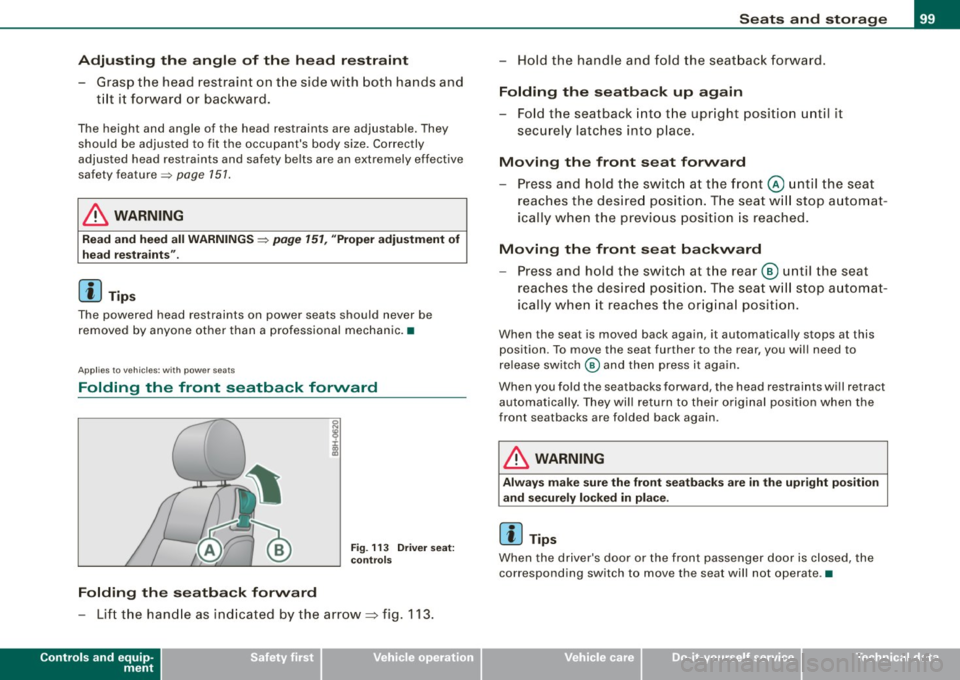
Folding the seatba ck forward
Fig . 11 3 Driv er seat :
co ntr ols
- Lift t he hand le as ind icated by the arrow~ fig. 113.
Controls and equip
ment
S eats and storage
- Ho ld the handle and fold t he seat back fo rwa rd .
Folding the seatback up again
- Fo ld the seatback into t he upr ight position until it
securely latches into place.
Moving the front seat forward
- Press and h old t he swi tc h at th e fr ont @ un til th e sea t
reach es the des ire d posit ion. T he s eat w ill stop a uto mat
ically when the previo us position is reached.
Moving the front seat backward
- Press and hold t he swi tc h at t he rear ® until the se at
reaches the des ire d posit ion . Th e seat w ill stop a utomat
icall y whe n it reac hes the or ig ina l posi tion .
When the seat is moved back again, it automatica lly stops at this
position. To move the seat further to the rear, you wil l need to
re lease switch @ and then press it again.
When you fold the seatbacks forward, the head restraints will retract
automatica lly. They will return to their o riginal positio n when the
front seatbacks are folded back again.
& WARNING
Always make sure the front se atbacks are in the upright po sition
and securely locked in place .
[ i ] Tips
When the driver's door or the fr ont passenger door is closed, the
corresponding switch to move the seat will not operate .•
Page 105 of 340
__________________________________________________ S_ e_ a_t _s _ a_n _ d_ s_ t _ o_ r_a ...;:g ::.. e _ ___,_
Luggage compartment
Ski sack
Use the ski sack to transport and protect skis and other
long , light items in the passenger compartment.
Loading
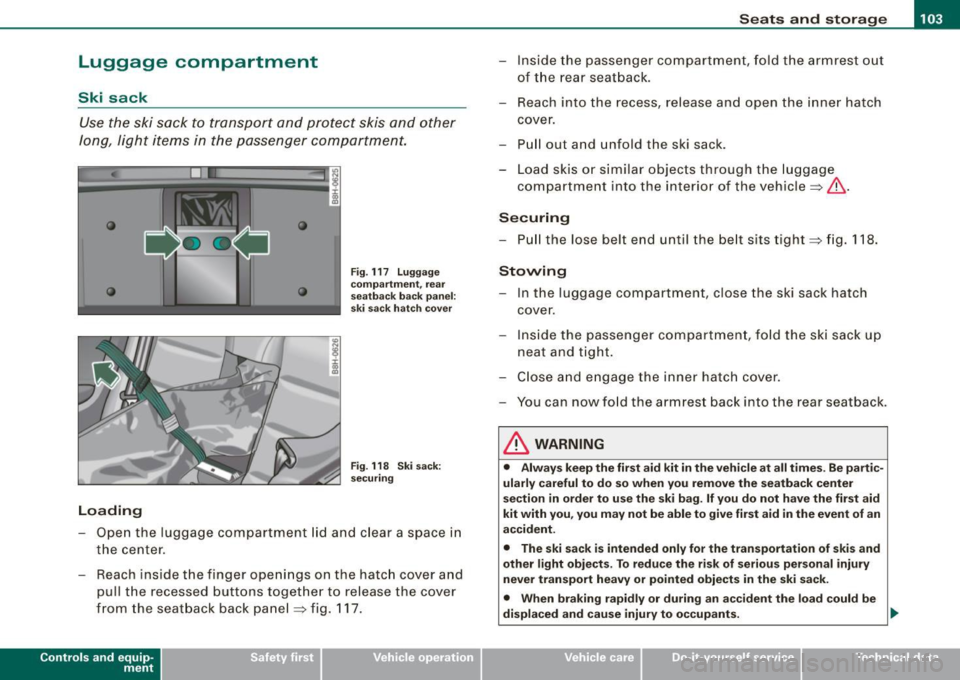
Fig . 117 Luggage
compartment, rear
seatback back panel:
ski sack hatch cover
Fig . 118 Ski sack:
securing
- Open the luggage compartment lid and clear a space in
the center.
- Reach ins ide the finger openings on the hatch cover and
pull the recessed buttons together to release the cover
from the seatback back panel :::;, fig. 117.
Contro ls and eq uip
ment
- Inside the passenger compartment, fold the armrest out
of the rear seatback.
- Reach into the recess, release and open the inner hatch
cover.
- Pull out and unfold the ski sack .
- Load skis or similar objects through the luggage
compartment into the interior of the vehicle :::;,,& .
Securing
-Pull the lose belt end until the belt sits tight :::;, fig. 118.
Stowing
- In the luggage compartment, close the ski sack hatch
cover .
- Inside the passenger compartment, fold the ski sack up
neat and tight.
- Close and engage the inner hatch cover.
- You can now fold the armrest back into the rear seat back.
& WARNING
• Always keep the first aid kit in the vehicle at all times . Be partic
ularly careful to do so when you remove the seatback center
section in order to use the ski bag. If you do not have the first aid
kit with you, you may not be able to give first aid in the event of an
accident.
• The ski sack is intended only for the transportation of skis and
other light objects . To reduce the risk of serious personal injury
never transport heavy or pointed objects in the ski sack.
• When braking rapidly or during an accident the load could be
displaced and cause injury to occupants. .,
~ehicle care irechnical data
Page 120 of 340
• .___O_ n_ t_h _e _ r_o _a_ d __________________________________________________ _
On the road
Steering
Adjusting the steering wheel column
The height and reach of the steering wheel can be
adjusted.
First, adjust the driver's seat correctly.
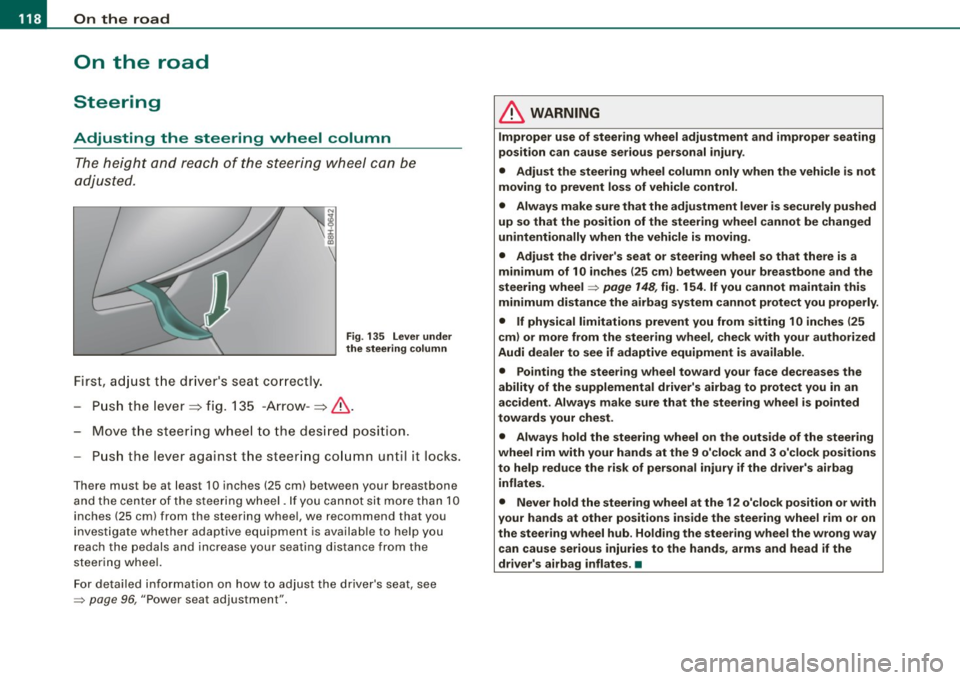
Fig . 135 Lever under
the steering column
-Push the lever~ fig. 135 -Arrow- ~& .
- Move the steering wheel to the desired position.
- Push the lever against the steering column unt il it locks.
Th ere mus t be at least 10 inches (25 cm) betw een your br eastbone
and the center of the steering wheel. If you cannot sit more than 10
inches (25 cm) from the steering wheel, we recommend that you
investigate whether adaptive equipment is available to help you
reach the pedals and increase your seating distance from the
steering wheel.
For detailed information on how to adjust the driver's seat, see
=> page 96, "Power seat adjustment" .
& WARNING
Improper use of steering wheel adjustment and improper seating
position can cause serious personal injury .
• Adjust the steering wheel column only when the vehicle is not
moving to prevent loss of vehicle control.
• Always make sure that the adjustment lever is securely pushed
up so that the position of the steering wheel cannot be changed
unintentionally when the vehicle is moving.
• Adjust the driver's seat or steering wheel so that there is a
minimum of 10 inches
125 cm) between your breastbone and the
steering wheel=> page 148, fig.
154. If you cannot maintain this
minimum distance the airbag system cannot protect you properly.
• If physical limitations prevent you from sitting 10 inches
125
cm) or more from the steering wheel, check with your authorized
Audi dealer to see if adaptive equipment is available.
• Pointing the steering wheel toward your face decreases the
ability of the supplemental driver's airbag to protect you in an
accident. Always make sure that the steering wheel is pointed
towards your chest.
• Always hold the steering wheel on the outside of the steering
wheel rim with your hands at the 9 o'clock and 3 o'clock positions
to help reduce the risk of personal injury if the driver's airbag
inflates.
• Never hold the steering wheel at the
12 o'clock position or with
your hands at other positions inside the steering wheel rim or on
the steering wheel hub. Holding the steering wheel the wrong way
can cause serious injuries to the hands, arms and head if the
driver's airbag inflates. •
Page 129 of 340
_______________________________________________________ T_ ra_ n_s_ m __ is_s_ io_ n ____ !II
The se lector lever must be in Nor P. If one of the driving positions
is engaged a safety switch w ill preven t the eng ine from being
started. See also=> page 120 .
Before you move the selector lever from the P position, you must
a lways apply the brake peda l before and wh ile de press ing the
button in the hand le of the selector lever.
& WARNING
• Unintended vehicle movement can cause serious injury .
- When the selector lever is in a driving position , the vehicle
may creep , even at idle speed . Therefore do not release the
parking brake or foot brake until you are ready to move,
because power is transmitted to the wheels as soon as a
driving position is engaged.
- Do not accelerate while selecting a driving position . At this
time the engine must be at idle speed so that undue stress is
not placed on the clutches in the transmission .
- Remember: -even when stopped briefly with the automatic
transmission in "D ", "S " or "R ", engine power is being trans
mitted to the wheels. Your vehicle could "creep" forward or
ba ckward . When stopped , keep the brake pedal fully depressed
and use the parking brake if necessary to keep the vehicle from
rolling .
• If the selector lever is unintentionally moved into N while you
are driving , take your foot off the accelerator pedal and wait for
the engine to return to idle speed before selecting a driving posi
tion .
• Never shift into "R " or "P " when the vehicle is in motion .
• Never get out of the driver 's seat when the engine is running .
• If you must get out of the vehicle , move the selector lever
securely into the P pos ition and apply the parking brake firmly .
• If the engine must remain running , never have any dr iving posi
tion engaged when checking under the hood . Make sure the
selector lever has securely engaged and is locked in "P " with the
Controls and equip
ment
& W ARNING (continued )
park ing brake firmly set=> page 242, "Engine compartment ".
Otherwi se , any increase in engine speed may set the vehi cle in
motion , even w ith the parking brake appl ied . •
App lies to veh icles: wi th 6-speed automatic transm ission
Selector lever positions
T his sec tion d escri be s th e sel ector le ver po sitio ns an d
d ri vin g rang es.
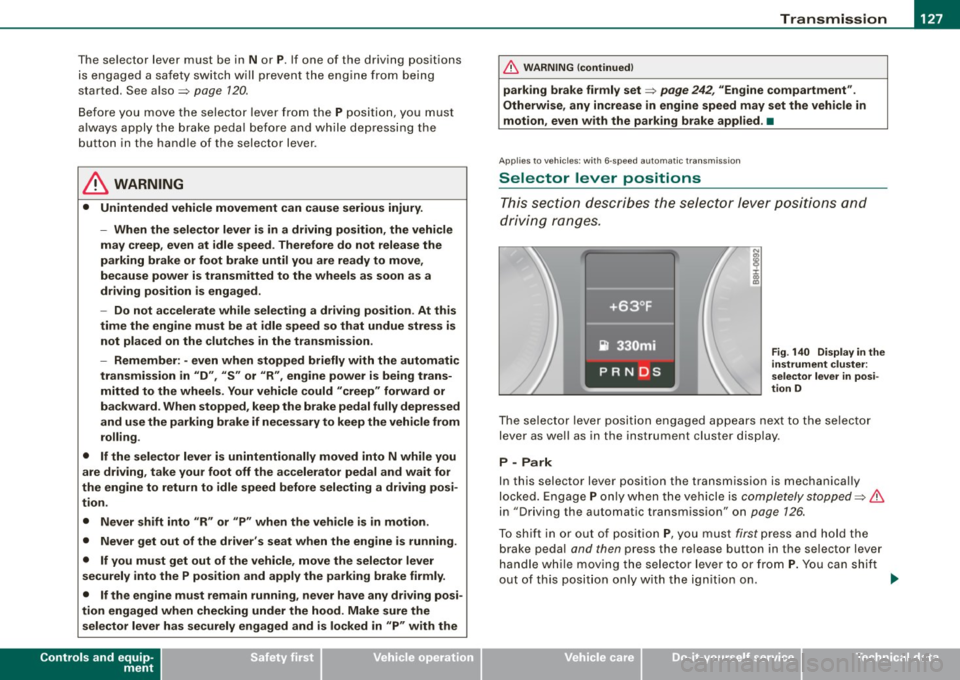
Fig. 140 D ispl ay in the
in strument c luster:
se lector lever in posi
tion D
The se lecto r lev er p ositi on engage d ap pears next to t he se lec to r
leve r as well as in the instrument cluster display .
P -Park
In this selecto r lever position the transmission is mechanica lly
l oc ked. Engage P only whe n th e ve hicle is completely stopped=>
&
in "Dr iving the automatic transmission" on page 126.
To shift in or out o f po sition P, yo u m ust firs t pr ess an d hol d th e
brake pedal and then press the re lease button in the se lector lever
handle w hile mov ing the se lector leve r to or from P. Yo u can shif t
out o f this pos it io n onl y wit h th e i gn it ion on. _..,
Page 135 of 340
Tra nsmission -
----------------
Your vehicle is equipped with a starting assis t that a llows for easier
starting on inclines. The system is activated when the brake pedal is
depressed for a few sec onds. After releasing the brake pedal, the
brake power is he ld for a moment to prevent the vehicle from rol ling
back when starting .
The se lector lever must be in Nor
P. If one of the driv ing positions
is engaged a safety switch will prevent the eng ine from being
star ted. See also=>
page 120.
Before you move the selector lever from the P position, you must
a lways apply the brake peda l before and while depressing the
button in the handle of the selecto r lever.
& WARNING
• Unint ended vehicle movement can cau se seriou s injury.
- When the select or lever i s
in a dri ving p osition , th e vehi cle
may cre ep , even at idle speed . Ther efore do not release the
parking br ake or foot br ake until you are r eady to move ,
because powe r is tran smitted to the wheel s as soon as a
driving po sition i s engaged.
- Do not acce lerate while sele cting a driving po sition. At thi s
time th e engine mu st be at idle spe ed so th at undu e stre ss is
not pla ced on the c lut che s in the transmis sion .
- Remember : - even when stopp ed briefly with the automatic
tran smi ssion in "D ", "S " or "R ", eng ine power is being tran s
mitted to the wheel s. Your vehicle could "creep " forw ard or
b ac kw ard . Wh en stopped , keep th e brake pedal full y depre ssed
a nd u se the parking br ake if nece ssary to keep the vehicle from
rolling.
- If the selector lev er i s unintentionally moved into N while you
are dr iv ing , take your foot off the accelerator ped al and wait for
the eng ine to return to idle speed before selecting a driving
p osition .
- Never shift into "R " or ''P " when the vehicle is in motion .
- Never get out of the dr iver 's seat when the engine is running.
Controls and equip
ment
& WAR NING (conti nued )
- If yo u mu st get out of the vehicle , move the selector lever
s ecurel y into the P po sition and apply the pa rking br ake fir mly.
- If the engine mu st remain running , never have any driving
po sition eng aged when che cking under the h ood. M ake sure
t he selector lever ha s secure ly engaged and i s lo cked in "P "
w ith the parkin g brake firmly set =>
page 242, "Engine
c ompartment ". Otherwise , any incre ase in eng ine speed may
s et the vehicle in motion , e ven with the parking brake
a ppl ied.•
Ap plies to vehic les : wit h mu lt itro nic® Conti nuous ly Va riab le Tra nsmissi on (CVT )
Selector lever positions
This section describes the selector lever positi ons and
drivi ng r anges.
Fig . 1 46 Dis pl ay in th e
in strum ent c lust er:
s el ector le ver in po si
tion P
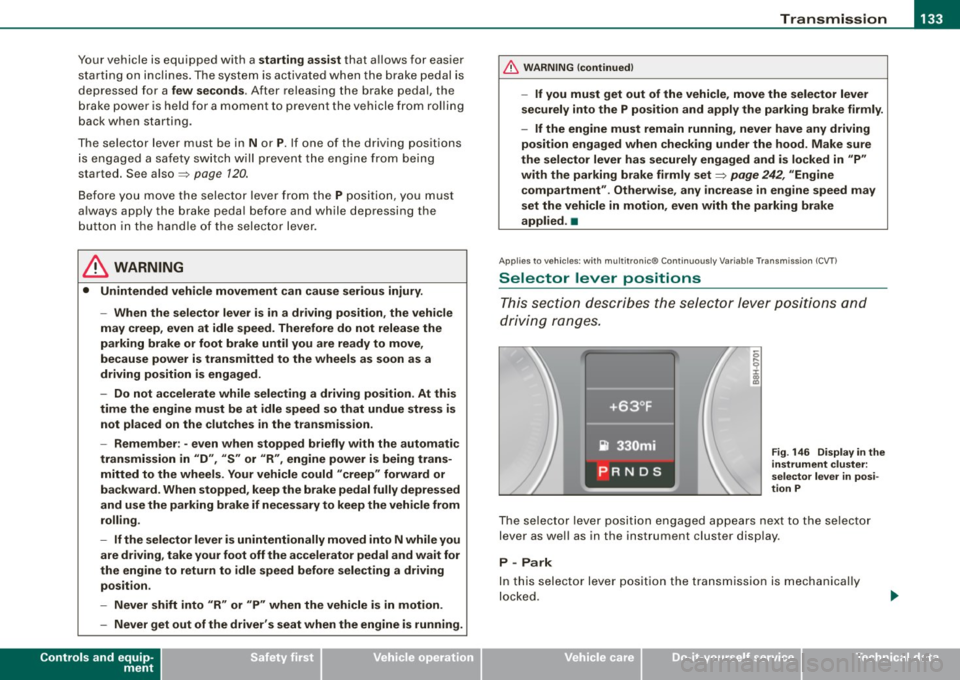
The se lector lever posit ion engaged appears next to the se lector
lever as w ell as in the instrum ent clust er display .
P -Pa rk
In this selector lever position the transmission is mechanica lly
locked .
Page 144 of 340
• .___H_ o_m_ e_ L_ · _,n _k_ ® __________________________________________________ _
- Press the appropriate programmed button 0,@ or@
to activate the desired remote control function~
& in
"General information" on
page 139. •
Applies to vehicles: with Homelink® universal remote contro l
Reprogramming a single button
A HomeLink® button can be reprogrammed individually without affecting the other button a/locations.
Programming the overhead keypad
- Press the appropriate Homelink® button until the indi
cator light begins flashing slowly.
Programming the bumper mounted transmitter 1. Hold t he
original remote control at a distance between 0-
5 in. (0-13 cm) from the bumper below the appropriate
headlight for your vehicle (use the shortest distance
possible).
2. Aim the remote control just below the
driver side head
light.
3. Press and hold the activation button on the remote control.
4. The emergency flashers will flash
three times (after
about
15-60 seconds) when the programming is
successful. Now release the button on the remote
control.
- If the device utilizes a rolling code, please follow phase 3
of ~
page 140, "Programming the Homelink® trans
mitter" for rolling code programming.
This procedure will cause the existing programming on the
Homelink ® button to be erased! •
App lies to vehicles: with Homelink® unive rsa l remote contro l
Erasing the programming of the Homelink ®
transmitter
When you erase the programming, the programming on
all three of the transmitter channels with be lost!
- Perform steps 1 to 4 as described on~ page 140, "Phase
1: programming the overhead keypad".
When completed , the Homelink® system will be in the prog ram
ming mode and is then ready to learn the codes for remote
controlled devices.
[I) Tips
• Programmed buttons cannot be erased individually.
• For security reasons you are advised to erase the programming
of the Homelink ® system befo re you sell your vehicle.•
Page 149 of 340
________________________________________________ D_r_iv _ i _n...: g=--- S_ a_ fe--= ly'---------"'
- Make sure that all lights and signals are operating
correctly.
- Make sure that the tire pressure is correct.
- Make sure that all windows are clean and afford good
visibility to the outside.
- Secure all luggage and other items carefully~
page 107.
-Make sure that nothing can interfere with the pedals.
- Adjust front seat, head restraint and mirrors correctly for
your height.
- Instruct passengers to adjust the head restraints
according to their height.
- Make sure to use the right child restraint correctly to
protect children~
page 190, "Child Safety".
- Sit properly in your seat and make sure that your passen
gers do the same
~ page 92, "General recommenda
t ions" .
- Fasten your safety belt and wear it properly. Also instruct
your passengers to fasten their safety belts properly
~ page 159. •
What impairs driving safety?
Safe driving is directly related to the condition of the
vehicle, the driver as well as the driver's ability to concen
trate on the road without being distracted.
The driver is responsible for the safety of the vehicle and all
of its occupants. If your ability to drive is impaired, safety
risks for everybody in the vehicle increase and you also
Controls and equip
ment Safety first Vehicle operation
become a
hazard to everyone else on the road ~& .There
fore:
- Do not let yourself be distracted by passengers or by
using a cellular telephone.
- NEVER drive when your driving ability is impaired (by
medications, alcohol, drugs, etc.I.
- Observe all traffic laws, rules of the road and speed limits
and plain common sense.
- ALWAYS adjust your speed to road, traffic and weather
conditions.
- Take frequent breaks on long trips. Do not drive for more
than two hours at a stretch.
- Do NOT drive when you are tired, under pressure or when
you are stressed.
& WARNING
Impaired driving safety increases the risk of serious personal
injury and death whenever a vehicle is being used. •
Vehicle care Do-it-yourself service Technical data
Page 152 of 340
___ D_ r _i_v _i_n ..;;:g ::;,._ S_ a_ f_ e---= ly'----------------------------------------------------
& WARNING (continued)
• Passengers must always sit in an upright position and never
lean against or place any part of their body too close to the area
where the airbags are located.
• Passengers who are unbelted, out of position or too close to the
airbag can be seriously injured by an airbag as it unfolds with
great force in the blink of an eye.
• Always make sure that there are at least 10 inches (25 cm)
between the front passenger's breastbone and the instrument
panel.
• Always make sure that there are at least 4 inches (10 cm)
between the front passenger's knees and the lower part of the
instrument panel.
• Each passenger must always sit on a seat of their own and
properly fasten and wear the safety belt belonging to that seat.
• Before driving, always adjust the front passenger seat and
head restraint properly.
• Always keep your feet on the floor in front of the seat. Never
rest them on the seat, instrument panel, out of the window, etc .
The airbag system and safety belt will not be able to protect you properly and can even increase the risk of injury in a crash.
• Never drive with the backrest reclined or tilted far back! The
farther the backrests are tilted back, the greater the risk of injury
due to incorrect positioning of the safety belt and improper
seating position.
• Children must always ride in child seats~
page 190. Special
precautions apply when installing a child seat on the front
passenger seat~
page 168. •
Proper seating positions for passengers in
rear seats
Rear seat passengers must sit upright with both feet on
the floor consistent with their physical size and be prop
erly restrained whenever the vehicle is in use.
To reduce the risk of injury caused by an incorrect seating
position in the event of a sudden braking maneuver or an
accident, your passengers on the rear bench seat must
always observe the follow ing :
- Make sure that the seatback of the front seats are securely latched in the upright position~
page 99.
Keep both feet flat in the footwell in front of the rear seat .
Fasten and wear safety belts properly ~
page 163.
-Make sure that children are always properly restrained in
a child restraint that is appropriate for their size and age
~ page 190.
& WARNING
Passengers who are improperly seated on the rear seat can be
seriously injured in a crash.
• Each passenger must always sit on a seat of their own and
properly fasten and wear the safety belt belonging to that seat.
• Safety belts only offer maximum protection when the seatback
is securely latched in the upright position and the safety belts are
properly positioned on the body . By not sitting upright, a rear seat
passenger increases the risk of personal injury from improperly
positioned safety belts! •
Page 155 of 340
________________________________________________ D_r_iv _ i _n_, g,::._ S_ a_ fe__, ly'-------.J"'
Only use floor mats that leave the pedal area free and can be
secured with floor mat fasteners.
If a brake circuit fails, increased brake pedal travel is required to
bring the vehicle to a full stop.
& WARNING
Pedals that cannot move freely can cause loss of vehicle control
and increase the risk of serious injury.
• Never place any objects in the driver's footwell. An object could
get into the pedal area and interfere with pedal function . In case
of sudden braking or an accident, you would not be able to brake
or accelerate!
• Always make sure that nothing can fall or move into the
driver's footwell. •
Floor mats on the driver side
Always use floor mats that can be securely attached to
the floor mat fasteners and do not interfere with the free
movement of the pedals.
-Make sure that the floor mats are properly secured and
cannot move and interfere with the pedals~&.
Use only floor mats that leave the pedal area unobstructed and that
are firmly secured so that they cannot slip out of position. You can
obtain suitable floor mats from your authorized Audi Dealer.
Floor mat fasteners are installed in your Audi.
Floor mats used in your vehicle must be attached to these fasteners.
Properly securing the floor mats will prevent them from sliding into
positions that could interfere with the pedals or impair safe opera
tion of your vehicle in other ways .
Controls and equip
ment Safety first Vehicle operation
& WARNING
Pedals that cannot move freely can result in a loss of vehicle
control and increase the risk of serious personal injury.
•
Always make sure that floor mats are properly secured .
• Never place or install floor mats or other floor coverings in the
vehicle that cannot be properly secured in place to prevent them
from slipping and interfering with the pedals or the ability to control the vehicle.
• Never place or install floor mats or other floor coverings on top
of already installed floor mats. Additional floor mats and other
coverings will reduce the size of the pedal area and interfere with
the pedals.
• Always properly reinstall and secure floor mats that have been
taken out for cleaning .
• Always make sure that objects cannot fall into the driver foot
well while the vehicle is moving. Objects can become trapped
under the brake pedal and accelerator pedal causing a loss of
vehicle control . •
Stowing luggage
Loading the luggage compartment
All luggage and other objects must be properly stowed
and secured in the luggage compartment.
Loose items in the luggage compartment can shift
suddenly, changing vehicle handling characteristics. Loose
items can also increase the risk of serious personal injury in
a sudden vehicle maneuver or in a collision.
- Distribute the load evenly in the luggage compartment . ..,
Vehicle care Do-it-yourself service Technical data
Page 156 of 340
___ D_ ri_v _i_n ..::g::;.._ S_ a_ f _e__, ly'---------------------------------------------------
- Alw ay s place an d prop erly secure h eavy items in the
luggage com partm en t as fa r fo rwa rd as possi ble.
& WARNING
Improperly stored luggage or other items can fly through the
vehicle causing ser ious personal injury in the event of hard br aking
or an a ccident. To help reduce the risk of serious personal injury :
• Always put objects , for e xample , luggage or other heavy items
in the luggage compartment.
& WARNING
Heavy loads will influence the way your vehicle handles. To help
reduce the risk of a loss of control leading to serious personal
injury :
• Always keep in mind when transporting heavy objects , that a
change in the center of gravity can also cause changes in vehicle
handling:
-Always distribute the load as e venly as possible .
- Place heavy objects as far forward in the luggage compart -
ment as possible .
• Never exceed the Gross Axle Weight Rating or the Gros s
Vehicle Weight Rating specified on the safety compliance sti cker
on the left door jamb. Exceeding permis sible weight standards
c an cau se the veh icle to slide and handle differently .
• Please ob serve information on safe driving:::::,
page 146.
& WARNING
To help prevent poisonous exhaust gas from being dra wn into the
vehicle , always keep the rear l id clo sed while driv ing.
• Ne ver t ransport obje cts larger than those fitting completely
into the luggage area because the rear lid cannot be fully closed.
& W ARNING (continued )
• If you absolutely must drive with the rear lid open, observe the
following notes to reduce the risk of poisoning :
- Close all windows ,
- Close the power top ,
- Open all air outlets in the instrument panel ,
- Switch off the air recirculation ,
- Set the fre sh air fan to the highest speed .
& WARNING
Always make sure that the doors, all windows , the power roof and
the rear lid are securely closed and locked to reduce the ri sk of
injury when the vehicle is not being used.
• After closing the rear lid , always make sure that it i s properly
closed and locked .
• Never leave your vehicle unattended especially with the rear lid
left open. A child could crawl into the vehicle through the luggage
compartment and close the rear lid becoming trapped and unable
to get out . Being trapped in a vehi cle can le ad to serious personal
injury.
• Never let ch ildren play in or around the vehicle.
• Never let pa ssengers ride in the luggage compartment . Vehicle
occupants must always be properly restrained in one of the
vehicle's seating po sition s.
[ i ] Tips
• Air circu lat io n helps to reduce window fogg in g when the power
top is c losed. Stale air escapes to the outside through slots in the
t rim pa nels o n both sides of the luggage co mpartment. Make sure
that these s lots are not b locked. _.