ECU AUDI S4 CABRIOLET 2009 Owner's Guide
[x] Cancel search | Manufacturer: AUDI, Model Year: 2009, Model line: S4 CABRIOLET, Model: AUDI S4 CABRIOLET 2009Pages: 340, PDF Size: 77.32 MB
Page 209 of 340
_______________________________________________ C_h _i_ld _ S_ a_ f_ e_ t...: Y _ _____.1!1111
Installing the guidance fixtures
- Push down on the seat cushion so that the lower anchor
ages are visible.
- Hold the guidance fixture with the part number facing downward and push it in the direction of the arrow onto
the anchorage :::::, fig. 187.
- Make sure that each of the two guidance fixtures per seat
snaps into place.
Removing the guidance fixtures
- Remove the child restraint according the child restraint
manufacturer's instructions.
- Push down on the seat cushion so that the lower anchor
ages are visible.
- Pull off the guidance fixtures from the lower anchorages.
- Always remove the guidance fixtures and keep them in a
safe place when not in use.
You may find it easier to install child restraints equipped with hooks
attached to straps without the guidance fixtures in place. If this is
the case, remove the guidance fixtures by pulling them off the
anchorages . However, the guidance fixtures can help you to locate
the
LATCH anchorages.
& WARNING
Improper use of tether anchorages or lower anchorages can cause
serious personal injury in a crash.
• Always carefully follow the child restraint manufacturer's
instructions for proper installation and use of child restraint
systems.
Controls and equip ment Safety first Vehicle operation
& WARNING (continued)
•
Never use the LATCH or tether anchorages to attach safety
belts or other kinds of occupant restraints.
• Child restraint tether attachments and lower attachments are
only designed to secure a child restraint that has been equipped
to use these anchorages.
• Tether anchorages and lower anchorages are designed to with
stand only those loads imposed by correctly fitted child restraints.
Under no circumstances can they be used safely for adult or child
safety belts or harnesses.
• Never mount more than one child restraint to a single tether or
to a lower anchorage point. Attaching two child restraints to a
single anchorage point can cause the anchorage to fail and cause
serious personal injury in a crash.
0 Note
If you leave the guidance fixtures installed for several days, they
could leave a mark on the upholstery on the seat cushion and back
rest in the area that the guidance fixtures were installed. The uphol
stery would also be permanently stretched around the guidance
fixtures. This applies especially to leather seats.
[ i] Tips
• Always remove the guidance fixtures when not in use.
• Please keep the guidance fixtures in a safe place with the vehicle
when not in use .•
Vehicle care Do-it-yourself service Technical data
Page 210 of 340
___ C_h_ i_ld _ S_ a_ f_ e_ t-= y'------------------------------------------------
Install ing a child restraint using the lower
anchorages of the LA TC H system
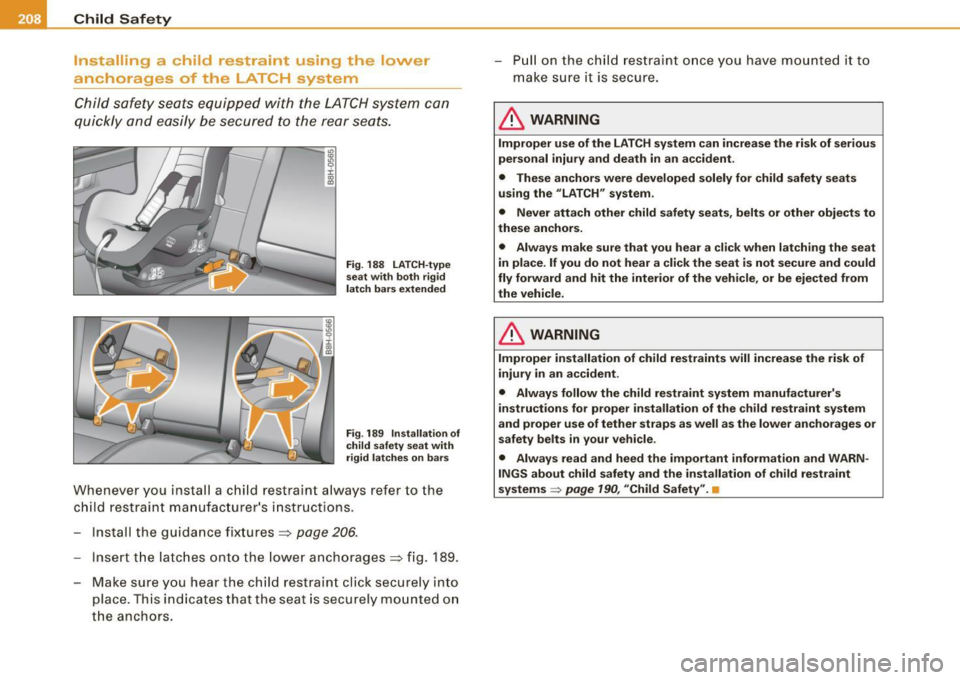
Child safety seats equipped with the LATCH system can
quickly and easily be secured to the rear seats.
Fig. 188 LATCH-type
seat with both rigid
latch bars extended
Fig. 189 Installation of
child safety seat with
rigid latches on bars
Whenever you install a child restraint always refer to the
child restraint manufacturer's instructions.
- Install the guidance fixtures=:>
page 206.
-Insert the latches onto the lower anchorages=:, fig. 189.
Make sure you hear the child restraint click securely into
place. This indicates that the seat is securely mounted on
the anchors. -
Pull on the child restraint once you have mounted it to
make sure it is secure.
& WARNING
Improper use of the LATCH system can increase the risk of serious
personal injury and death in an accident.
• These anchors were developed solely for child safety seats
using the "LATCH" system.
• Never attach other child safety seats, belts or other objects to
these anchors.
• Always make sure that you hear a click when latching the seat
in place. If you do not hear a click the seat is not secure and could
fly forward and hit the interior of the vehicle, or be ejected from
the vehicle.
& WARNING
Improper installation of child restraints will increase the risk of
injury in an accident .
• Always follow the child restraint system manufacturer's
instructions for proper installation of the child restraint system
and proper use of tether straps as well as the lower anchorages or
safety belts in your vehicle.
• Always read and heed the important information and WARN
INGS about child safety and the installation of child restraint
systems ~
page 190, "Child Safety". •
Page 211 of 340
_______________________________________________ C_h _i_ld _ S_ a_ f_ e_ t...:; y ______ __
Mounting and releasing the anchorage hook
If you use a child restraint system with hook-on or push-
on connectors attached to adjustable straps.
Mounting
- Press the anchorage hook with the spring catch release
onto the lower anchorage so that the anchorage hook
locks into place .
- Pull on the anchorage hook to make sure that it has
securely engaged the lower anchorage.
- Tighten the strap following the child restraint manufac
turer's instructions.
Releasing
- Loosen the tension on the strap following the child
restraint manufacturer's instructions .
- Depress the spring catch on the hook or push button to
release the push -on connector catch.
- Hold the spring catch in depressed position.
- Move the hook in the direction of the vehicle floor so that
there is enough space to release the anchorage hook
from the lower anchorage.
& WARNING
• Improper installation of child restraints will increase the risk of
injuries in a crash.
• Always refer to the child restraints manufacturer's instructions
for proper installation of the child restraint and proper use of the
lower anchorages or safety belts in your vehicle. •
Controls and equip ment Safety first Vehicle operation
Vehicle care Do-it-yourself service Technical data
Page 226 of 340
___ T_ r _a_ il_e _r_ t_ o_ vv_ in__... g,_ __________________________________________________ _
Trailer towing
Driving with a trailer
General information
Your Audi was designed primarily for passenger transpor
tation.
If you plan to tow a trailer, please remember that the additional load
will affect durability, economy and performance.
Trailer towing not on ly p laces more stress on the vehicle, it a lso calls
for more concentration from the driver.
For this reasons, always fo llow the operating and driving instruc
tions provided and use common sense. •
Technical requirements
Trailer hitch
Use a weight -carrying hitch conforming to the gross trailer weight.
The hitch must be suitab le for your veh ic le and tra iler and must be
mounted securely on the vehicle's chass is at a technically sound
l ocation. Use only a trailer hitch with removable bal l mount. A lways
check with the trailer hitch manufacturer to make sure that you are
using the correct hitch .
Do not u se a bumper hit ch .
The hitch must be installed in such a way that it does not interfere
with the impact-absorbing bumper system . No modifications
should be made to the vehicle exhaust and brake systems . From
time to time, check that all hitch mount ing bo lts re main securely
fastened.
When you are not towing a trai ler, remove the trailer hitch ball
mount. This prevents the hitch from causing damage shou ld your
vehic le be struck from behind
=:, & .
Tire pre ssur e
When towing a trailer, inflate the tires of your vehic le to the cold tire
pressure listed under "Full load"on the s ticker on the right door
jamb . Inflate trai ler tires to trai ler and tire manufacturers' specifica
tions.
Lights
The head ligh t sett ings should be checked with the trai ler attached
before driving off. Have the head lights adjusted as necessary so
that you can see the road ahead but not blind oncoming traffic.
Check to make sure both vehicle and trailer lights are working prop
erly .
Engine cooling sy stem
Towing a trailer makes the engine work harder. It is important tha t
the cooling system's performance stands up to the additional
strain. Make sure that the coo ling sys tem has enough fluid .
Trailer brakes
If your traile r is equipped wi th a braking system, check to be sure
that it conforms to all regu lations .
The trailer hydraul ic brake system must not be direct ly connected to
the vehic le's hydraulic brake system .
Safety chains
Be sure trailer safety chains are properly connected from the trai ler
to the hitch on the vehicle. Leave enough slack in the chains to
permit turning corners. When you install safety chains, make sure
they will not drag on the road when you are driving.
The chains shou ld cross under the trailer tongue to prevent it from
dropping in case of separation from the hitch.
~
Page 227 of 340
Trailer lights
Trailer lights must meet all regulations. Be sure to check with your autho rized Audi dealer for correct wiring , switches and relays .
Mirrors
If you are unable to see the traffic behind you using the regular
outside mirrors, then you
must install extended mirrors. It is impor
tant that you always have clear vision to the rear .
& WARNING
After removing the trailer hitch, do not store it in your vehicle. In
case of sudden braking, the hitch could fly forward and injure you
or your passengers .
.1
Operating instructions
Maximum trailer weight
A trailer for your vehicle is limited to a typical class 1 or class 2
trailer .
Trailer load distribution
Be sure the load in the trailer is held securely in place to guard
against shifting, be it forward, backward or sideways.
Never allow a passenger to ride in a trailer~&, in "Driving instruc
tions".
Tire pressure
When towing a trailer, inflate the tires of your vehicle to the cold tire
pressure listed under "Full load" on the sticker on the right door
jamb. Inflate trailer tires to trailer and tire manufacturers' specifica
tions.
Controls and equip ment Safety first Vehicle operation
Trailer towing
Lights
The
headlight settings should be checked with the trailer attached
before driving off. Adjust as necessary so that you can see the road
ahead but not blind on -coming traffic.
Check proper working of vehicle and trailer lights .
Safety chains
Be sure trailer safety chains are properly connected from the trailer
to the hitch on the vehicle. Leave enough slack in the chains to
permit turning corners. When you install safety chains, make sure
they will not drag on the road when you are driving.
The chains should cross under the trailer tongue to prevent it from
dropping in case of separation from the hitch .•
Driving instructions
Driving with a trailer always requires extra care and
consideration.
To obtain the best possible handling of vehicle and trailer,
please note the following:
Do not tow a loaded trailer when your car itself is not
loaded.
- Be especially careful when passing other vehicles.
Observe speed limits.
Do not drive at the maximum permissible speed.
- Always apply brakes early.
Monitor the temperature gauge.
Vehicle care Do-it-yourself service Technical data
Page 252 of 340
-~_C_ h_e _c _ k_ i_ n ...:::g:;..._ a_n_ d_ f_ i_ll _in ....;g:::;.._ ___________________________________________ _
Closing the engine hood
-Pull t he hood down until the pressure from the strut is
reduced.
- Let t he hood
drop down and latch in place. Do not try to
push it shut;
it may fai l to engage ~& .
& WARNING
A hood that is not completely latched could fly up and block your
view while driving.
• When you close the engine hood, check it to make sure the
safety catch has properly engaged. The hood should be flush with
the surrounding vehicle body parts.
• If you notice while driving that the hood is not secured prop
erly, stop at once and close it. •
Working in the engine compartment
Be especially careful whenever you work in the engine
compartment.
Whenever you must perform any work in the engine compartment,
for example checking and filling different fluids, there is a risk of injury, burns and accidents. To prevent personal injury always
observe the following WARNINGS. The engine compartment of any
vehicle is a hazardous area
~ 6 .
& WARNING
To help avoid injury, before you check anything under the hood :
• Turn off the engine.
• Remove the ignition key.
• Apply the parking brake.
& WARNING (continued)
• Move selector lever of automatic transmission to "P" (Park);
put manual transmission in Neutral.
• Always let the engine cool down. Hot components will burn
skin on contact.
• To reduce the risk of being burned, never open the hood if you
see or hear steam or coolant escaping from the engine compart
ment. Wait until no steam or coolant can be seen or heard before
carefully opening the hood .
• Keep children away from the engine compartment.
• Never spill fluids on hot engine components. They can cause a
fire.
• Never touch the radiator fan. The auxiliary electric fan is
temperature controlled and can switch on suddenly.
• Never open the coolant reservoir cap when the engine is still
warm. The coolant system is pressurized and hot coolant could
spray out.
• Protect your face, hands and arm from steam or hot engine
coolant by placing a thick rag over the cap when you open the
coolant reservoir.
• If work on the fuel system or the electrical system is necessary :
- Always disconnect the battery .
- Never smoke or work near heaters or open flames. Fluids in
the engine compartment could start a fire.
- Keep an approved fire extinguisher immediately available.
• To avoid electrical shock and personal injury while the engine
is running or being started, never touch :
- Ignition cables
- Other components of the high voltage electronic ignition
system.
• If you must perform a check or repair with the engine running:
~
Page 258 of 340
-~_C_ h_e _c _ k_ i_ n ...:::g:;..._ a_n_ d_ f_ i_ll _in ....;g:::;.._ ___________________________________________ _
Before yo u check a nything in the e ngine compartmen t,
always read and heed all WARNINGS~
& in "Working in
the eng ine compartment" on
page 250.
Unscrew the ca p~ to the e ngine oil filling hole
~ page 255, fig . 200 or~ page 255, fig. 20 1.
- Carefully top off wi th the appropriate o il in 0.5 liter doses.
- C heck the oil level aga in afte r two minutes ~
page 254.
-Top off t he oi l aga in, if necessary .
- Sc rew the ca p back on the fi lling h ole a nd s lide the o il
d ips tic k in as far as i t will go .
& WARNING
• While topping off , the oil must not come in contact with hot
eng ine part s -fi re hazard!
• The oil filler cap mu st be prope rly secured to prevent o il from
being spra yed on the hot engine and exhaust sy stem when the
engine i s runnin g -fire hazard!
• If your skin has come in conta ct with the engine oil , you mu st
s ub sequently clean se it thoroughly .
0 Note
• The oil level must not be above range@-danger of converter or
engine damage! Contact an authorized dealership to draw off oi l, if
necessary.
• Audi do es not recommend the use of oil additives . They may
d amage the engine and adver sely affe ct your New Vehicle Warr anty.
ffi For th e sake of the environment
• Under no circumstances can the oi l come in contact w ith t he
sewage network or the soil. •
Observe and follow legal regulations when disposing of empty
o il con tainers .•
Changing the engine oil
We recommend that have your oil changed by an autho
rize d Audi de aler or a qualified service s tation.
Before you check any thi ng in the engine compartment, alway s read
and heed all WARNINGS =>
& in "Working in the engine compart
ment" on
page 250.
The engine oil must be changed according to the intervals specified in you r War ranty
& Main tenance booklet . This is very important
because the lubricating properties of oil diminish gradually during
normal vehicle use .
Under some circumstances the engine oil shou ld be changed more
frequently . Change oil more often if you drive mostly short
distances, opera te the ve hicle in dusty areas or under predom i
nant ly stop -and -go traffic conditions, or have your vehicle where
t emperatures remai n below freezing fo r extended periods .
Detergent add it ives i n the oil wi ll make fresh oil look dark after the
engine has been running for a short time . This is norma l and is not
a reason to change the oi l more of ten than recommended.
Because of the problem of proper disposal, along with the special
t ools and necessa ry expert ise required, we strong ly recommend
that you have your oil changed by an authorized
Audi dealer or a
qual ified se rvice sta tion .
If you choo se to change your oil yourself , please note the follow ing
important information :
& WARNING
To reduce the risk of personal injury if you must change the engine
oil in your vehicle you rself:
• We ar eye protection . _.,
Page 264 of 340
-~_C_ h_e _c _ k_ i_ n ...,,g,:...._ a_n_ d_ f_ i_ll _in ....;g=---------------------------------------------
Have the battery checked when you take your vehicle in for service .
You are well advised to replace a battery that is older than 5 years.
Disconnecting the battery terminals
Some vehicle functions (power window regulators, for example) are
lost if the battery terminals are disconnected . Th ese functions have
to be relearned after the battery terminals are connected again. To
prevent this, the battery should only be disconnected from the
vehicle electrical system when absolutely necessary for repairs .
Vehicles not driven for long periods
If you are going to let your vehicle stand for a long time and not
drive it, you should remember there are electrical components
which are still functioning and they will draw energy from the
battery and drain it, for example, the engine immobilizer. To prevent
this, you can either charge the battery occasionally to keep it in
good working condition or you can disconnect the negative cable
on the battery.
Winter operation
During the winter months, battery capacity tends to decrease as
temperatures drop. This is because more power is also consumed
while starting, and the headlights, rear window defogger, etc., are
used more often.
Avoid unnecessary power consumption, particularly in city traffic or
when traveling only short distances . Let your authorized Audi dea ler
check the capacity of the vehicle battery before winter sets in
=>
page 265 . A we ll charged battery wil l not only prevent starting
problems when the weather is cold, but will also last longer.
Replacing battery
The new battery must have the same capacity, voltage (12 volts),
amperage, construction and plug sea ling, as the origina l battery.
Specifications are listed on the battery housing. Batteries specially
developed by Audi fulfill the maintenance, output, and safety
requirements. When installing the battery, make sure the ignition and all electrical
consumers are switched off=>
0.
We recommend that you use maintenance -free or cyc le-resis
tant/leak-proof
batteries according to the standards TL 825 06 (from
December 1997) and VW 7 50 73 (from August 2001).
Replacing the battery should be carried by a qualified workshop.
Please follow the instructions on the battery cover.
0 Note
• All work on the battery requires technical knowledge. Please
contact an Audi dealership or another authorized facility for ques
tions about the battery -danger of acid burns and exp losion hazard!
• Make sure the ventilation hose on the side of the battery is
connected, otherwise fumes or battery acid can leak out.
• Battery holder and terminals always have to be secured correctly.
• Before all work on the battery follow the
warnings below=> & in
"Working on the battery" on
page 263.
mend your authorized Audi dealer change the battery for you.
Batteries contain sulfuric acid and lead and must always be
disposed of properly in compliance with all environmental regula
tions . Disposing of vehicle batteries improperly is very dangerous to
the environment . Make sure that the removed battery cannot over
balance, otherwise sulfuric acid might escape!
[ i ] Tips
If your vehicle is left standing for several weeks at extremely low
temperatures, the vehicle battery should be removed and stored
where it will not freeze. This will prevent it from being damaged and
having to be replaced.•
Page 277 of 340
Tires and wheels -
----------------
•
• The tire pressures should only be checked and adjusted when
t he t ires are co ld . The s lightly raised press ures of warm tires must
not be reduced .
• Adjust t he tire p re ssure to the load you are carrying.
• Reinstall the va lve stem cap on the valve.
When should I check the tire pressure?
The correc t tire p re ssur e is espec ially i mportant at high speeds. The
pressure should there fore be c hecked at least once a month and
a lways before starting a journey. Do not forget to check the tire pres
su re for t he spare whee l::::>
page 291.
When should I adjust the tire pressures?
Adjust the ti re pressur e to the load you are carrying. A fter chang in g
a wheel
or replacing whee ls you have to adj ust t he t ire pressure s on
a ll whee ls. In addition, o n ve hicles w ith t ire pressure monito ring
system * you must then store the new tire pressures in the system
=> page 41.
& WARNING
Incorrect tire pres sures and /or underinflation can lead sudden tire
failure, loss of control , collision, serious personal injury or even
death .
• When the warning symbol ( appears in the instrument
cluster , stop and inspect the tires .
• Incorrect tire pressure and /or underinflation can cause
increased tire wear and can affe ct the handling of the vehicle and
stopping ability .
• Incorre ct tire pressures and /or underinflat ion can also lead to
sudden tire failure, including a blowout and sudden deflation,
causing loss of vehi cle control.
• The driver is responsible for the correct tire pressures for all
tires on the vehicle . The appli cable pre ssure values are located on
a sticker on the driver 's side 8-pillar or on the inside of the fuel
filler flap .
& WARNING (continued )
• Only when all tires on the veh icle are filled to the correct pres
s ure, the tire pressure monitoring system * can work correctly .
• The use of incorrect tire pressure values can lead to accidents
or other damage . Therefore it is essential that the driver observe
the specified tire pressure values for the tires and the correct pres
sures for the function of the tire pressure monitoring system*.
• Alway s inflate tires to the recommended and corre ct tire pres
sure before driving off.
• Driving with underinflated tires bend more , letting them get
too hot resulting in tread separation , sudden tire failure and loss
of control.
• Excessive speed and /overloading can cause he at build -up ,
sudden tire failure and loss of control.
• If the tire pressure is too low or too high , the tires will wear
prematurely and the vehicle will not handle well.
• If the tire is not flat and you do not have to change a wheel
immediately, drive at reduced speed to the nearest service station
to che ck the tire pressure and add air as required .
0 Note
Driving without valve stem caps can cause damage to the tire
valves. To p revent this, a lways make sure tha t factory installe d va lve
stem caps on al l wheels are securely mounted on the va lve .
<£> For the sake of the environment
Underinflated tires wi ll a lso increase the fue l consumption. •
Tires and vehicle load limits
There are limits to the amount of load or weight that any vehic le and
any tire can carry. A vehicle that is overloa ded wil l n o t handle well _,.
Vehic le care
Page 284 of 340
-~_T_ ir_e_ s_ a_ n_d _ w_ h_ e_e _l_s _________________________________________________ _
toring system* would not be able to monitor the tire pressure or
warn you if it is necessa ry.
• T he battery inside of the tire pressure sensor has a limited
service life.
• Always drive with the valve stem caps securely mounted. We
r ecommend us ing facto ry insta lled va lve stem caps. Ask you r autho
rized Audi dealer to replace lost va lve stem caps.
T he installation of rep lacement tires with steel cord body p lies in
t he tire sidewall may cause mal functi on of the tir e pressure mo ni
toring system , and is not recommended (cord material information
in mo lded o n th e ti re sid ewa ll) .
Always check your tire pressure monitoring system * indicator after
r eplacing one or mo re ti res on your veh ic le . I f the ti re p ress ure
m onito ring syste m* ind icator flashes, or is o n, your s ystem is not
wo rking properly . Your replacement t ire might be incompatible with
yo ur tir e pressure mon ito ring system* , o r so me compo nen t of th e
tire p ressure monitoring system * may be damaged .
& WARNING
• Using incorrect or unmatched tires and I or wheels or improper
tire and wheel combinations can lead to loss of control , collision
and serious personal injury .
• Always use t ires , rims and wheel bolts that meet the specifica
tions of original factory-installed tires or other combinations that
have been specifically approved by the vehicle manufacturer.
• Tires age even if they are not being used and can fa il suddenly,
espe cially at high speeds . Tires that are more than 6 years old can
only be used in an emergency and then with special care and at
lower speed s.
• Never mount used tire s on your vehicle if you are not sure of
their "previous history ." Old used tire s may have been damaged
even though the damage cannot be seen that can lead to sudden
tire f ailure and loss of vehicle control.
& W ARNING (continued )
• All four wheels mu st be fitted with radial tires of the same type,
size (rolling circumference ) and the same tread pattern. Driv ing
with different tires redu ces vehicle h andling and can lead to a loss
of control.
• If the spare tire is not the same as the tires that are mounted
on the vehicle - for e xample with winter tire s - only u se the spare
tire for a short period of time and drive with extra care . Refit the
normal road wheel as soon as safely possible.
• Never drive faster than the maximum speed for which the tires
on your vehicle are rated because tires that are driven faster than
the ir rated speed can fail suddenly .
• Overloading tires cause heat build-up, sudden tire failure ,
including a blowout and sudden deflation and loss of control .
• Temperature grades apply to tires that are properly inflated and
not over or underinflated .
• For te chnical reasons it is not always possible to use wheels
from other vehicle s -in some cases not even wheels from the
same vehicle model.
• If you install wheel trim discs on the vehicle wheels, make sure
that the air flow to the brakes is not blocked. Redu ced airflow to
the brakes can them to overheat , increasing stopping distances
and causing a collision.
• Run flat tire s may only be used on vehicle s that were equipped
with them at the fa ctory . The vehicle must have a cha ssis designed
for run flat tires and a factory -installed tire pressure monitoring
s ystem that indicate s a loss of tire pressure . Incorre ct use of run
flat tires can lead to vehicle damage or accidents . Check with an
autho rized Audi dealer or t ire specialist to see if your vehicle can
be equipped with run flat tires .
If run flat tires are used , they mu st
be installed on all four wheels . Mixing tire types is not permitted. .,