warning AUDI S6 2008 Owners Manual
[x] Cancel search | Manufacturer: AUDI, Model Year: 2008, Model line: S6, Model: AUDI S6 2008Pages: 390, PDF Size: 88.42 MB
Page 241 of 390
& WARNING !continued)
-Always move the front passenger seat into the rearmost
position of the passenger seat's fore and aft adjustment range,
and as far away from the airbag as possible before installing
the child restraint.
- Always make sure that nothing prevents the front
passenger's seat from being moved to the rearmost position in
its fore and aft adjustment range.
- Always make sure that the backrest is in the upright posi
tion.
• Always buckle the child safety seat firmly in place even if a
child is not sitting in it. A loose child safety seat can fly around
during a sudden stop or in a collision.
• Always read and heed all WARNINGS whenever using a child
restrained in a vehicle is being used
=> page 202, "Safety belts",
~ page 212, "Airbag system" and~ page 234, "Child Safety".
& WARNING
To reduce the risk of serious injury, make sure that the PASSENGER
AIR BAG OFF light comes on and stays on whenever a child
restraint is installed on the front passenger seat and the ignition
is switched on.
• Take the child restraint off the front passenger seat and install
it properly at one of the rear seat positions if the PASSENGER AIR
BAG OFF light does not stay on.
• Have the airbag system inspected by your authorized Audi
dealer immediately. •
Safety first
Child Safety
Child safety seats
tnfant seats
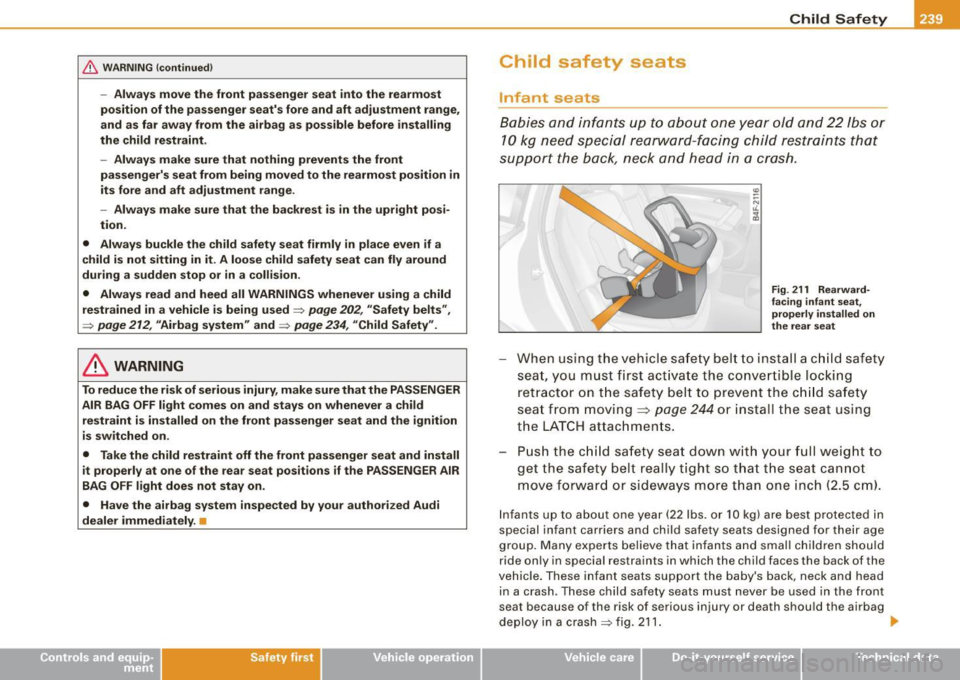
Babies and infants up to about one year old and 22 lbs or
10 kg need special rearward-facing child restraints that
support the back, neck and head in a crash.
Fig . 211 Rearward
facing infant seat,
properly installed on
the rear seat
-When using the vehicle safety belt to install a child safety
seat, you must first activate the convertible locking retractor on the safety belt to prevent the child safety
seat from moving
~ page 244 or install the seat using
the LATCH attachments.
- Push the child safety seat down with your full weight to
get the safety belt really tight so that the seat cannot
move forward or sideways more than one inch (2.5 cm).
Infants up to about one year (22 lbs. or 10 kg) are best protected in
special infant carriers and child safety sea ts designed for their age
group. Many experts believe that infants and small children should
ride only in special restraints in which the child faces the back of the
vehicle. These infant seats support the baby's back, neck and head
in a crash. These child safety seats must never be used in the front
seat because of the risk of serious injury or death should the airbag
deploy in a crash
=> fig. 211. ._
•
Vehicle care I I irechnical data
Page 242 of 390
___ C_h_ i_ ld _ S_ a_ f_ e_ t--= y'------------------------------------------------
& WARNING
Not using a child safety seat, using the wrong child safety seat or
improperly installing a child restraint increases the risk of serious
personal injury and death in a crash.
• Never install rear-facing child safety seats or infant carriers on
the front passenger seat -even with an Advanced Airbag System.
A child will be seriously injured and can be killed when the
inflating airbag hits the child safety seat or infant carrier with
great force and smashes the child safety seat and child against the
backrest, center arm rest, or door=>
page 214, "Child restraints on
the front seat -some important things to know".
• Always install rear-facing child safety seats or infant carriers on
the rear seat.
• Never install a rear-facing child restraint
in the forward-facing
direction. Such restraints are designed for the special needs of
infants and very small children and cannot protect them properly
if the seat is forward-facing.
• If you must install a rearward facing child safety seat on the
front passenger seat because of exceptional circumstances and
the PASSENGER AIR BAG OFF light does not come on and stay on,
immediately install the rear-facing child safety seat in a rear
seating position and have the airbag system inspected by your
Audi dealer.
• Always read and heed all WARNINGS whenever using a child
restrained in a vehicle is being used =>
page 202, "Safety belts",
=> page 212, "Airbag system" and=> page 234, "Important things
to know". •
Convertible chi ld safety seats
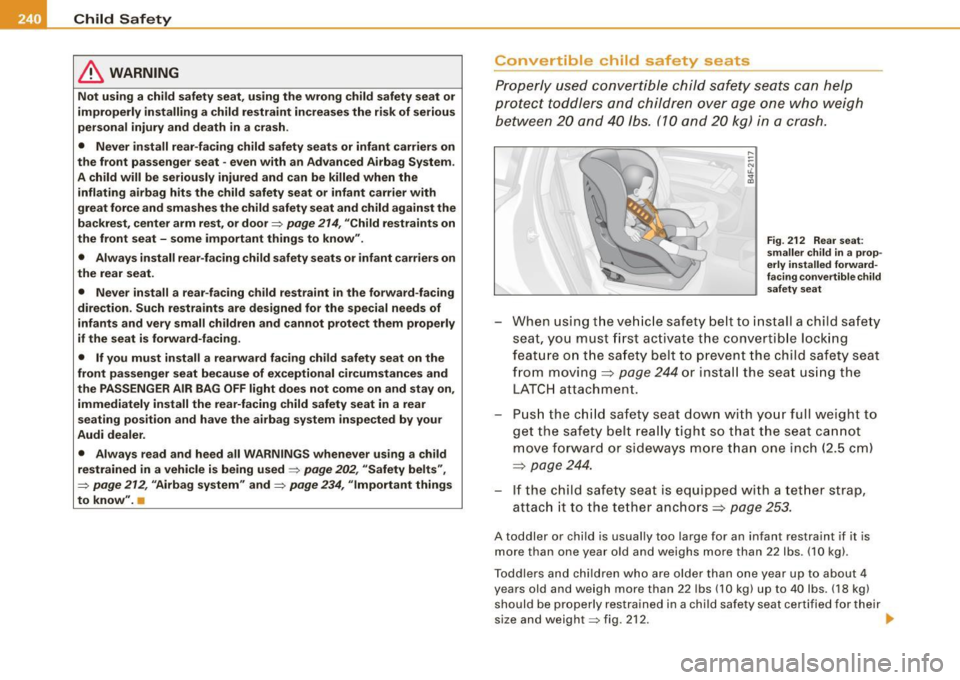
Properly used convertible child safety seats can help
protect toddlers and children over age one who weigh between 20 and 40 lbs. (10 and 20 kg) in a crash.
Fig . 212 Rear seat:
smaller child
in a prop
erly installed forward
facing convertible chi Id
safety seat
- When using the vehicle safety belt to install a child safety
seat, you must first activate the convertible locking
feature on the safety belt to prevent the child safety seat
from moving =>
page 244 or insta ll the seat using the
LATC H attachment.
- Push the child safety seat down with your full weight to
get the safety belt really tight so that the seat cannot
move forward or sideways more than one inch (2.5 cm)
=> page 244.
-If the child safety seat is equipped with a tether strap,
attach it to the tether anchors =>
page 253.
A toddler or chi ld is usually too large for an infant restraint if it is
more than one year old and weighs more than 22 lbs. (10 kg).
Toddlers and children who are older than one year up to about 4
years old and weigh more than 22 lbs (10 kg) up to 40 lbs . (18 kg)
should be properly restrained in a child safety seat certified for their
size and weight=> fig. 212. ..,_
Page 243 of 390
_______________________________________________ C_h _ i_ld _ S_ a_ f_ e_ t..,:c y __ __
The airbag on th e passe nger s id e makes th e front seat a pot entially
d a ngerou s place for a child to ride. The fr ont sea t is n ot the safest
p lace for a chi ld in a forward -facin g child safety seat . It is a v ery
da ngero us place f or an infa nt or a la rge r child i n a rearwa rd -facing
seat.
& WARNING
Not using a child safety seat , using the wrong child safety seat or
improperly installing a child restraint increases the risk of serious
personal injury and death in a collision or other emergency situa
tion .
• Children on the front seat of any car, even with Advanced
Airbags, can be seriously injured or even killed when an airbag inflates . A child in a rearward -facing child safety seat installed on
the front passenger seat will be seriously injured and can be killed
if the front airbag inflates -even with an Advanced Airbag System .
• The inflating airbag will hit the child safety seat or infant
carrier with great force and will smash the child safety seat and
child against the backrest, center arm rest , or door .
• Always install rear -facing child safety seats on the rear seat .
• If you must install a rearward facing child safety seat on the
front passenger seat because of exceptional circumstances and
the PASSENGER AIR BAG OFF light does not come on and stay on ,
immediately install the rear -facing child safety seat in a rear
seating position and have the airbag system inspected by your
Audi dealer .
• Always read and heed all WARNINGS whenever using a child
restrained in a vehicle is being used
=> page 202 , "Safety belts ",
=> page 212, "Airbag system" and => page 234 , "Important things
to know ".
Controls and equip ment Safety first
Vehicle operation
& WARNING
If exceptional circumstances require the use of a forward -facing
child restraint on the front passenger's seat , the child's safety and
well -being require that the following special precautions be taken :
• Make sure the forward-facing seat has been designed and certi
fied by its manufacturer for use on a front seat with a passenger
front and side airbag.
• Always follow the manufacturer's instructions prov ided with
the child safety seat or carrier .
• Always move the front passenger seat into the rearmost posi
tion of the passenger seat's fore and aft adjustment range, and as
far away from the airbag as poss ible before installing the child
restraint.
• Always make sure that nothing prevents the front passenger's
seat from being moved to the rearmost position in its fore and aft
adjustment range .
• Always make sure the backrest is in an upright position.
• Make sure that the PASSENGER AIR BAG OFF light comes on
and stays on all the time whenever the ignition is switched on.
• If the light does not stay on, perform the checks
=> page 223,
" Monitoring the Advanced Airbag System ".
• Take the child restraint off the front passenger seat and install
it properly at one of the rear seat positions if the PASSENGER AIR
BAG OFF light does not stay on whenever the ignition is switched
on .•
Vehicle care Do-it-yourself service Technical data
Page 245 of 390
& WARNING
Not using a booster seat , us ing the booster seat improperly , in cor
rectly installing a booster seat or u sing the vehicle safety belt
improperly increa ses the risk of serious personal injury and death
in a collision or other emergency situation . To help reduce the risk
of serious personal injury and /or death :
• Always make sure to position the shoulder portion of the three
po int belt over the middle of ch ild's shoulder .
• Never let the shoulder portion of the belt rest against or across
the neck , face , chin , or throat of the child .
• Alway s make sure the lap belt portion of the three -point belt is
worn snug and passes as low as possible across the child's pelvis .
Never let the belt pas s over the soft abdomen.
• Failure to properly route safety belts over a child's body will
cause severe injuries in an accident or other emergency situation
=> page
202.
• Children on the front seat of any car , even with Advanced
Airbags, can be seriously injured or even killed when an airbag
inflates . A child in a rearward -facing child safety seat installed on
the front passenger seat will be seriously injured and can be killed
if the front airbag inflates.
• Never let a child stand or kneel on any seat , for example the
front seat.
• Never let a child ride in the cargo area of your vehicle .
• Always remember that a child leaning forward , sitting side
ways or out of position in any way during an accident can be
struck by a deploying airbag. This will re sult in seriou s per sonal
injury or death .
• If you must install a rearward facing child safety seat on the
front passenger seat because of exceptional circumstances the
PASSENGER AIR BAG OFF light must come on and stay on , when
ever the ignition is swit ched on .
Safety first
Child Safety
& WARNING !continued )
• If the PASSENGER AIR BAG OFF light does not come on and stay
on , perform the checks described => page
223, " Monitoring the
Adv anced Airbag System ".
• Take the child restraint off the front pa ssenger se at and install
it properly at one of the rear seat positions if the PASSENGER AIR
BAG OFF light does not stay on whenever the ignition is switched
on .
• Always read and heed all WARNINGS whenever using a child
restrained in a vehicle is being used => page
202 , "Safety belts ",
=> page
212 , "Airbag system " and => page 234, "Important things
to know" .•
Safety belts and older children
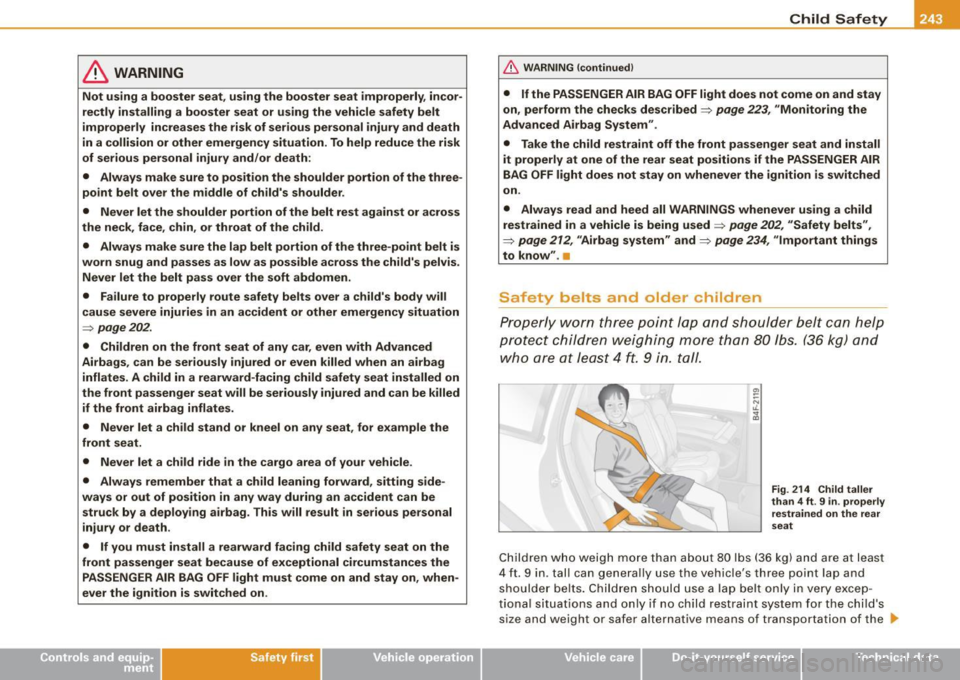
P ro perly worn three p oin t lap and s houl der belt can help
protect chi ldren w eighing more than 8 0 lbs. ( 36 kg) an d
w ho are at l eas t 4
ft. 9 in. ta ll.
Fig . 214 Child taller
th an 4
ft . 9 in . properly
re strained on the rear
s e at
Ch ildr en w ho weig h more tha n ab o ut 80 l bs (36 kg) and are a t leas t
4 ft . 9 in . ta ll can genera lly use the vehicle's three point lap and
shoulder belts . Child ren sh ould u se a la p belt only in very e xce p
tiona l situat ions and on ly if no child restrain t syste m for t he chi ld 's
s ize and weight or safer alternat ive means of transportation of the •
Vehicle care
I I irechnical data
Page 246 of 390
___ C_h_ i_ ld _ S_ a_ f_ e_ t_y ____________________________________________ _
child is available. In these exceptional situations, the use of a lap
belt is better than permitting the child to remain total ly unre
strained . But remember: a lap belt cannot provide the same level of
protection as a proper child restraint or a three -point lap and
shoulder belt if the child is big enough . Also, using a lap belt for
younger child ren, who should be using a chi ld restraint, may violate
laws in your state or Province.
Never use a lap belt a lone to restrain a chi ld that weighs less than
about 80 lbs (36 kg) and who is less than 4'9" tall. A lways remembe r
that chi ldren do not have the pronounced pelvic structure required
for the proper function of lap belts. If a lap belt is only res traint
system available , then the child's safety absolutely requires that the
lap be lt be fastened snug ly and as low as possible around the pe lvis
let a lap belt pass over the chi ld's stomach or abdomen .
& WARNING
Using wrong child re straints or improperly in stalled child
restr aint s can cause serious personal injury or death in a cr ash .
• Failure to properly route safety belts over a child's body will
c au se severe injurie s in a crash . The lap belt portion of the three
point belt as well as any lap belt alone must alway s pass as low as
p os sible acros s the pelvis, n ever ov er the stoma ch or abdomen.
• An impr ope rly worn s afet y belt will not pr ovide the best prote c
tion in a cra sh and may cau se seriou s personal injury . Alway s
make sure that children and other veh icle o ccupant s properl y
wear available r estraint system s. Carefully follow the in struction s
p ro vi ded by the manufa cturer s of child re straint s.•
Installing a child safety seat
Securing a child safety seat using a safety
belt
S afety belts for the rear seats and the fr ont passenger can
be locked with the c onvertible locking retr actor to pr op
erly secure child safety seats.
The safety belts emergency locking retractors for the rear seats
safety be lts and for the front passenge r's seat safety belt have a
convertible locking retractor for child restraints . The safety belt
must be locked so that belt webbing cannot unreel. The retractor
can be activated to lock the safety be lt and prevent the safety belt
webbing from loosen ing up dur ing normal driving. A child safety
seat can only b e properly instal led when the safety belt is locked so
t hat the child and chi ld safety seat w ill stay i n place .
Always remember: Even though your vehicle is equipped with an
Advanced Airbag system, al l children, especially those 12 years and
younger , shou ld always ride in the back seat proper ly restrained for
their age and size.
& WARNING
Improperly in stalled child safety seat s increa se the risk of serious
pe rsonal injury and death in a collision.
• Alway s ma ke sure that the safety belt retractor is locked when
i nstall ing a child safety seat . An unlo cked safety be lt retra ctor
cannot hold the child safety seat in pla ce during normal driving or
in a cra sh .
• Alway s buckle the child saf ety seat firml y in pl ace even if a
c hild i s not s itting in it. A loo se child saf ety seat can fl y around
during a sudden stop or in a colli sion
• Alway s make sure th at the rear se at backre st to which the
center rear s afety belt i s attached is securely latched whenever
the rear cent er safety belt is being u sed to se cur e a ch ild re straint . .,_
Page 247 of 390
_______________________________________________ C_h _ i_ld _ S_ a_ f_ e_ t..,:c y __ lftlll
& WARNING (continued )
• If the backrest is not securely latched, the child and the child
restraint will be thrown forward together with the backrest and
will strike parts of the vehicle interior . The child can be seriously
injured or killed .
• Never install rear-facing child safety seats or infant carriers on
the front passenger seat. A child will be seriously injured and can be killed when the passenger airbag inflates .
• The inflating airbag will hit the child safety seat or infant
carrier with great force and will smash the child safety seat and
child against the backrest , center arm rest , door or roof.
• Always install rear-facing child safety seats or infant carriers on
the rear seat.
• Forward-facing child safety seats or infant carriers installed on
the front passenger's seat may interfere with the deployment of
the airbag and cause serious injury to the child .
• It is safer to install a forward -fac ing child safety seat on the rear
seat.
• Always read and heed all WARNINGS whenever using a child
restrained in a vehicle is being used
=> page 234 . Special precau
tions apply when installing a child safety seat on the front
passenger seat
=> page 214 , "Child restraints on the front seat -
some important things to know ".
& WARNING
Always take special precautions if you must install a forward or
rearward-facing child restraint on the front passenger's seat in
exceptional situations:
• Whenever a forward or rearward -facing child restraint is
installed on the front passenger seat, the PASSENGER AIR BAG
OFF light must come on and stay on whenever the ignition is
switched on .
Controls and equip ment Safety first
Vehicle operation
& WARNING (continued )
• If the PASSENGER AIR BAG OFF light does not come on and stay
on, perform the checks described
=> page 223, ''Monitoring the
Advanced Airbag System ".
• Take the child restraint off the front passenger seat and install
it properly at one of the rear seat positions if the PASSENGER AIR
BAG OFF light does not stay on whenever the ignition is switched
on .
• Improper installation of child restraints can reduce their effec
tiveness or even prevent them from providing any protection.
• An improperly installed child restraint can interfere with the
airbag as it deploys and seriously injure or even kill the child.
• Always carefully follow the manufacturer's instructions
provided with the child safety seat or carrier.
• Never place additional items on the seat that can increase the
total weight registered by the weight-sensing mat and can cause injury in a crash.
& WARNING
Forward-facing child restraints:
• Always make sure the forward -facing seat has been designed
and certified by its manufacturer for use on a front seat with a
passenger front and side airbag.
• Never put the forward-facing child restraint up, against or very
near the instrument panel .
• Always move the passenger seat into its rearmost position in
the seat's fore and aft adjustment range , as far away from the
airbag as possible before installing the forward-facing child
restraint . The backrest must be adjusted to an upright position .
• Make sure that the PASSENGER
AIR BAG OFF light comes on
and stays on all the time whenever the ignition is switched on . .,,,_
Vehicle care Do-it-yourself service Technical data
Page 248 of 390
•L-----=C::..: h:...:..:..:. il-= d ~S=-= a~fe =-=- ty!.._ _____________________________________________ _
& WARNING
Rearward-facing child restraints:
• A child in a rearward-facing child safety seat installed on the
front passenger seat will be seriously injured and can be killed if
the front airbag inflates -even with an Advanced Airbag System.
• The inflating airbag will hit the child safety seat or infant
carrier with great force and will smash the child safety seat and
child against the backrest, center arm rest, door or roof.
• Always be especially careful if you must install a rearward
facing child safety seat on the front passenger seat in exceptional
circumstances.
• A tight tether strap on a rearward-facing child restraint
attached to the front passenger seat can put too much pressure
on the weight-mat in the seat and register a heavier weight in the
Advanced Airbag System. The heavier weight registered can make
the system work as though an adult were on the seat and deploy
the Advanced Airbag when it must be suppressed causing serious or even fatal injury to the child.
• Make sure that the PASSENGER AIR BAG OFF light comes on
and stays on all the time whenever the ignition is switched on.
• If the PASSENGER AIR BAG OFF light does not come on and stay
on, immediately install the rear-facing child safety seat in a rear
seating position and have the airbag system inspected by your
Audi dealer. •
Activating the convertible locking retractor
Use the convertible locking retractor to secure a child
restraint.
Always heed the child safety seat manufacturer's instruc
tions when installing a ch ild restraint in your vehicle. To
activate the convertible locking retractor: -
Place the child restraint on a seat, preferably on the rear
seat.
- Slowly pull the belt
all the way out.
-Route it around or through the child restraint belt path
=>& .
- Push the child safety seat down with your full weight to
get the safety belt really tight.
- Insert the belt tongue into the buckle for that seating
position.
- Guide the safety belt back into the retractor until the belt
lies flat and snug on the child safety seat.
- You should hear a "clicking" noise as the belt winds back
into the inertia reel. Test the convertible locking retractor
by pulling on the belt. You should no longer be able to
pull the belt out of the retractor. The convertible locking
retractor is now activated.
- Make sure that the red release button is facing away from
the child restraint so that it can be unbuckled quickly.
- Pull on the belt to make sure the safety belt is properly
tight and fastened so that the seat cannot move forward
or sideways more than one inch (2.5 cm).
& WARNING
Using the wrong child restraint or an improperly installed child
restraint can cause serious personal injury or death in a crash.
• Always make sure that the safety belt retractor is locked when
installing a child safety seat. An unlocked safety belt retractor
cannot hold the child safety seat in place during normal driving or
in a crash.
~
Page 249 of 390
Child Safety 111111
-------------------------------------------------=---
& WARNIN G (continu ed )
• Alway s buckle the child safety s eat firmly in place even if a
child i s not sitting in it . A loose child safet y sea t ca n fly a round
during a sudden stop or in a cra sh .
• Alway s make sure the se at ba ckr es t to which the child re str ai nt
i s in stalled i s in an upright po sition and se curely latched into place
a nd cannot fold forw ard . Otherwi se, the seat back with the child
s a fety seat atta ched to it could fly forw ard in the event of an a cci
d ent o r other emergency situat ion .
• Alwa ys read and heed all WARNINGS wh enever u sing a child
re str ained in a vehicle is being u sed
=> page 234. Spe cial precau
tio ns appl y when install ing a child safety se at o n th e front
p ass enger seat =>
page 214 , "Ch ild re str ai nt s on t he front sea t -
s ome important t hings to know ".•
Deactivating the convertible locking retractor
The convertible locking retractor for child restraints will
be deactivated automatically when the belt is wound all
the way back into the retractor.
- Press the red button on the safety belt buck le . Th e belt
tongue will pop out of the buckle.
- Guide t he belt a ll the way back into its stowed position .
Always let the safety belt retract complete ly into its stowed posit ion .
The safety belt can now be used as an ordinary safety be lt without
the conve rtible locking retractor for child restra ints.
I f the convertible locking retractor should be activated inadvert
ently, the safety belt must be unfastened and guided comp lete ly
back into its stowed position to deactivate th is feature . If the
convertible locking retractor is not deactivated, the safety be lt will
gradually become tighte r and unc omf ortab le to wear .
Controls and equip
ment Safety first Vehicle operation
& WARNING
Impr
operly in stalled chi ld safety seat s in crea se th e ris k o f ser iou s
per sonal injury and death in a collision.
• Never unfaste n th e safety belt to dea ctivate the con vertib le
lockin g retractor for child re straint s while the veh icle i s moving .
You wou ld not be r estra ined a nd co uld be seriou sly inj ured in an
accident.
• Always re ad and heed all WARNING S whenever using a child
re str ained in a vehicle is be ing u sed
=> page 2 34. Spe cial pre cau
tion s appl y when in stalling a chi ld safet y seat on the front
pas senger seat =>
page 214 , "Child re straint s on the front seat -
so me important thing s to know ".•
Additional Information
What types of child restraint anchors are
available and how are they related to child
safety?
For years, child restraints have been installed using the safety belts
a lready present in every vehicle.
Since September 1, 1999, child restraint manufacturers have been
providing tether straps that attach the top of the chi ld restraint to
the vehic les structure, on most of their forward -facing systems in
order to comply with U.S. Federal regulations for child restraint
performance in a crash. Vehic le manufacturers are required to
phase -in tether anchorages for attachment of the tether strap in
t heir U.S. vehic les beginn ing September 1, 1999 .
The combination of the tether anchorages and the lower anchor
ages is now generally called the
LATCH system for " Lowe r Anchor
and Tether for Chi ldren ". ..,
Vehicle care Do-it-yourself service Technical data
Page 252 of 390
___ C_h_ i_ld _ S_ a_ f_ e_ t-= y'------------------------------------------------
easy-to-use attachment and minimize the possibility of improper
child restraint installation.
All child restraints manufactured after September 1, 2002, must have lower anchorage attachments for the LATCH system.
Please remember that the lower anchorage points are only intended
for installation and attachment of child restraints specifically certi
fied for use with LATCH lower anchorages. Child restraints that are
not equipped with the lower anchorage attachments can still be
installed in compliance with the child restraint manufacturer's
instructions on using vehicle safety belts.
& WARNING
Improper installation of child restraints will increase the risk of
injury in a crash.
• Always carefully follow the child restraints manufacturer's
instructions for proper installation of the child restraint and
proper use of the lower anchorages or safety belts in your vehicle.
• Never secure or attach any luggage or other items to the
LATCH
lower anchorages.
• Always read and heed the important information about child
restraints in this chapter and WARNINGS
~ page 234, "Child
Safety". •
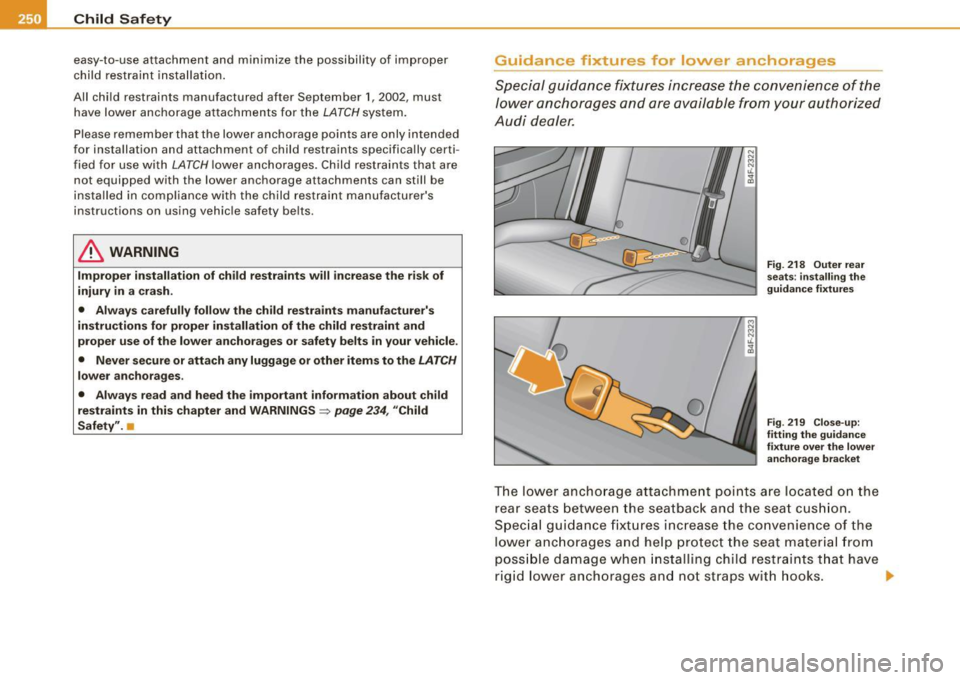
Guidance fixtures for lower anchorages
Special guidance fixtures increase the convenience of the
lower anchorages and are available from your authorized
Audi dealer.
Fig. 218 Outer rear
seats : installing the
guidance fixtures
Fig. 219 Close-up:
fitting the guidance
fixture over the lower
anchorage bracket
The lower anchorage attachment points are located on the
rear seats between the seatback and the seat cushion.
Special guidance fixtures increase the convenience of the
lower anchorages and help protect the seat material from
possible damage when installing child restraints that have
rigid lower anchorages and not straps with hooks. _,.
Page 253 of 390
--------------------------------------------~C=-- h :....:..:..:. il..:.:d _S.:... a _ fe_t~ Y:,___ _1111
Inst alling th e guidan ce fixtur es
- Push down on the seat cushion so t hat the lower anchor
ages are v isib le.
- Hold t he guidance fixt ure with the part number facing
downward and push it in the direction of the arrow on to
the anchorage => page
250, fig. 2 19.
- Make sure that each of the two guidance fixtures per seat
snaps into place.
Removing the guidance fixtures
- Remove the child restrai nt according the c hild restraint
m an ufacturer's instr uctions.
- Pu sh down on the seat cushion so t hat the lower anchor
ages are v isible.
- Pu ll off the gu idance fixtures from the lowe r anc horages.
- Always remove the guidance fixt ure s an d keep them in a
safe p lace when not in use.
You may find it easier to insta ll chi ld restraints equipped with hooks
attached to straps without the guidance fixtures in place. If this is
the case, remove the guidance fixtures by pu lling them off the
anchorages . However, the guidance fix tures can he lp you to locate
the
LATCH anchorages.
& WARNING
Improper use of teth er anchorage s or lowe r anchorages can caus e
s erio us personal inju ry
in a cra sh .
• Alway s carefully follow the child re straint manufa cturer' s
in struct ions for proper inst allati on a nd u se of ch ild restraint
sy stems .
Controls and equip ment Safety first Vehicle operation
& W
AR N IN G ( continued )
• Never use the LATCH or tether an chorage s to att ach safety
b elt s or other kinds of o ccup ant re str aints .
• Child restraint tether attachment s and lower atta chments are
onl y designed to secure a child re str aint th at h as been equipped
to u se these anchorages.
• Tether anchor age s a nd lower an chorages are de signed to with
s tand only those loads impos ed by correctly fitted child r estraints.
Unde r no circum stan ces can they be u sed safel y for adult or child
safety belt s or harne sses .
• Neve r mount more than one ch ild rest raint to a single tether or
to a lower anchorage point . Atta ching two child r estraints to a
s ingle an chorage point can cause the anchorage to fail and cause
s erio us per sonal injury in a crash .
0 Note
• Remove the guidance fixtures before folding the rear seatback to
prevent damaging the seat cushion.
• I f you leave the guidance fixtures insta lled for several days, they
cou ld leave a mark on the upholstery on the seat cushion and back
rest in the area that the guidance fi xtures were insta lled . The uphol
stery would also be permanently stretched around the guidance
fixtures. This applies especially to leather seats.
[ i ] Tip s
• Always remove the guidance fixtures when not in use.
• Please keep the guidance fixtures in a safe place with the vehicle
when not in use .•
Vehicle care Do-it-yourself service Technical data