seats AUDI S6 2008 User Guide
[x] Cancel search | Manufacturer: AUDI, Model Year: 2008, Model line: S6, Model: AUDI S6 2008Pages: 390, PDF Size: 88.42 MB
Page 97 of 390
Refer to=> page 197 , "Proper a djustment of head restraints" for
guidelines on how to adjust the height of the outer head restraints
to fit the occupant's body size .
& WARNING
• Driving without head restra ints or with he ad restraints that are
not properly adju sted increa ses the ri sk of seriou s or fatal neck
inj ury dram ati call y.
• Read and heed all WARNING S=>
page 197
[ i J Tip s
Correctly adjusted head restraints and safety belts are an extremely
effective combination of safety fea tures .•
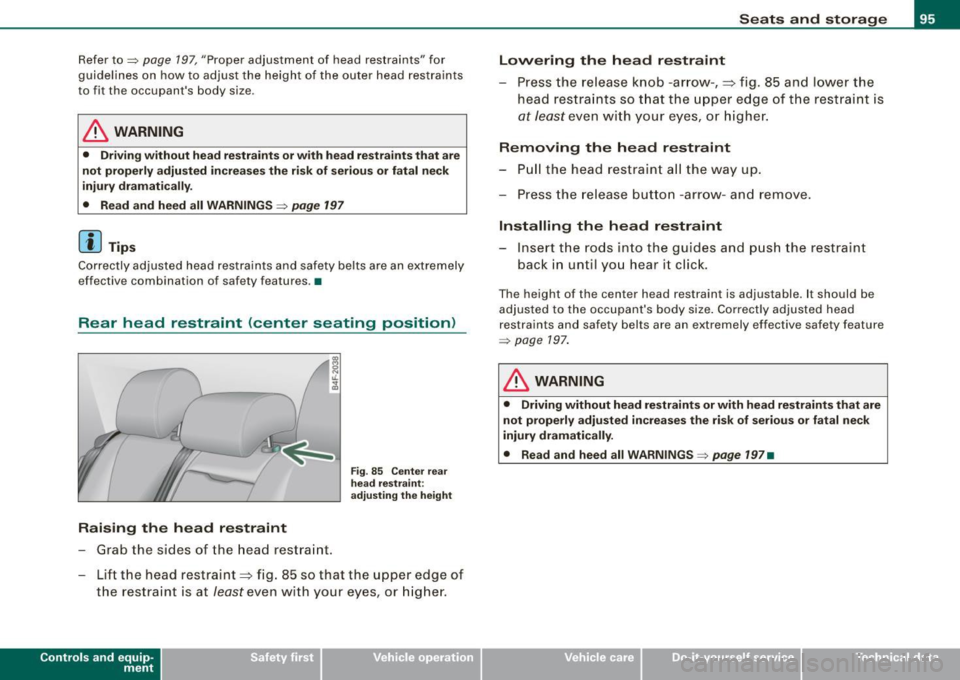
Rear head restraint (center seating position)
I
Raising the head restraint
- Grab the sides of the head restraint .
Fig. 85 C enter rea r
he ad re stra in t:
adjust ing th e height
- Lift the head restraint=:> fig . 85 so that the u pper edge of
the restraint is at feast even with your eyes, or higher .
Contro ls and eq uip
ment
Seats and storag e
Lowering the head r estraint
- Press the release knob -ar row -, =:> fig. 85 and lowe r the
head restraints so t hat the uppe r edge of the restraint is
at feast even with your eyes, or higher .
Removing the head restraint
-Pull the head restraint a ll the way up .
- Press the re lease b utton -arrow- and remove .
Installing the head restraint
-Insert the rods into the guides and p ush the restraint
back in unt il you hear it clic k.
Th e height of th e center head restraint is adjustable . It should be
adjus ted to the occupant's body size . Correct ly adjusted head
restraints and safety belts are an extremely effective safety feature
=> page 197 .
& WARNING
• Driving without head re straint s or with head re straint s that are
not properly adj usted in cre ases the ris k of seriou s or fatal neck
injury dramaticall y.
• Read and heed all WARNINGS=>
page 197 •
Vehicle care I I irechnical data
Page 98 of 390
Seats and storage
Applies to vehic les: with front arm rest
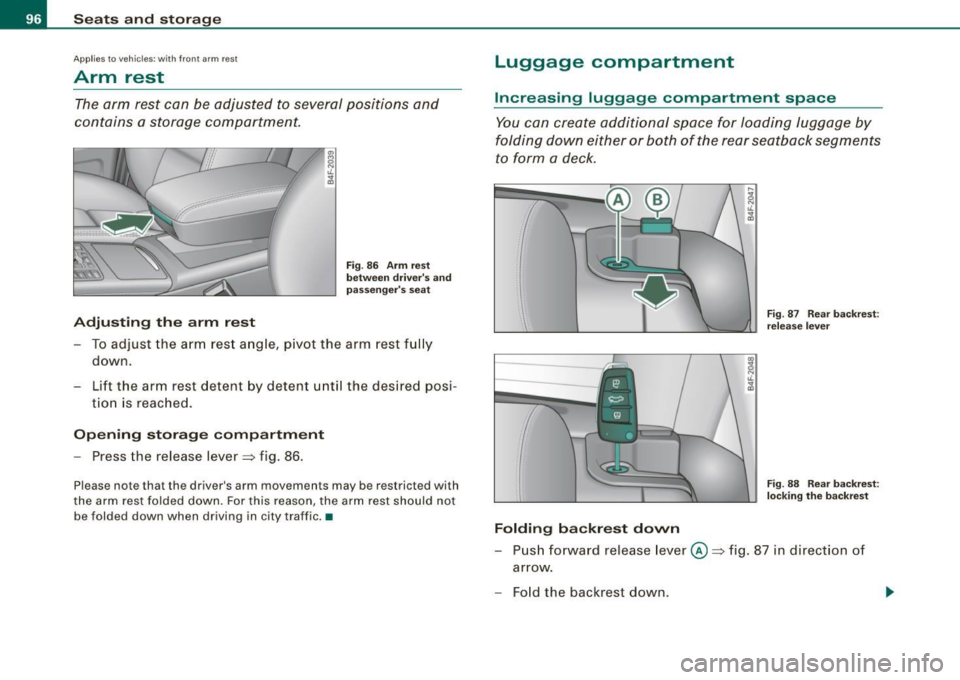
Arm rest
The arm rest can be adjusted to several positions and
contains a storage compartment.
Adjusting the arm rest
Fig. 86 Arm rest
between driver's and
passenger's seat
-To adjust the arm rest angle, pivot the arm rest fully
down.
- Lift the arm rest detent by detent until the desired posi-
tion is reached.
Opening storage compartment
-Press the release lever=> fig. 86.
Please note that the driver's arm movements may be restricted with
the arm rest folded down. For this reason, the arm rest should not
be folded down when driving in city traffic . •
Luggage compartment
Increasing luggage compartment space
You can create additional space for loading luggage by
folding down either or both of the rear seatback segments
to form a deck.
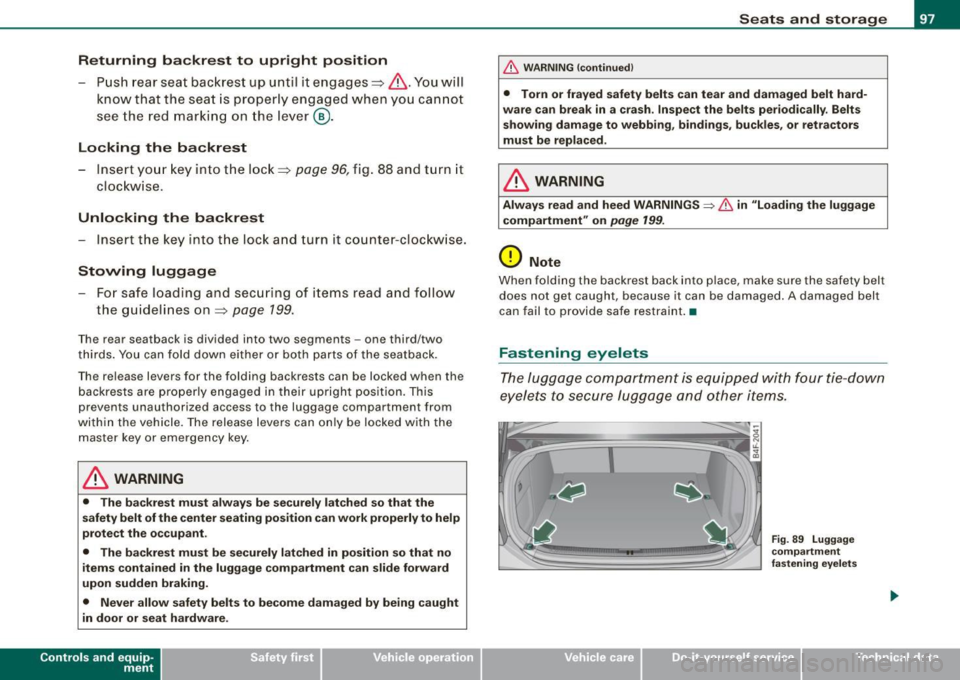
Folding backrest down
F ig. 87 Rear backrest :
release lever
Fig. 88 Rear backrest:
locking the backrest
- Push forward release lever@=> fig. 87 in direction of
arrow .
- Fold the backrest down .
Page 99 of 390
Returning backrest to upright position
-Pu sh rear seat back rest up until it engages~ &. You will
know that the sea t is proper ly engaged when you can not
see the red marki ng on the lever ®·
Locking the backrest
- Insert yo ur key into t he lock~ page 96, fig. 88 and t urn it
cloc kwise.
Unlocking the backrest
- Inse rt th e key i nto the lock a nd tu rn it co unter-cloc kw ise.
Stowing luggage
- For safe loading and securing of i tems read and follow
the guidelines on~ page 199.
The rear seatback is divided into two segments -one thi rd/two
thirds . You can fold down either or both parts o f the seatback.
T he release levers for the fold ing backrests can be locked when the
backrests are pro pe rly engaged in their up right pos itio n. This
prevents unauthorized access to the luggage compartment from
with in the veh icle. The release levers can on ly be locked with the
master key or emer gency key.
& WARNING
• The ba ck rest must al ways be securely lat ched so that the
safety b elt of the center seating position can work properly to help
protect the o ccupant .
• The backre st must be securely latched in po sition so that no
items contained in the luggage compartment can slide forward
upon sudden brak ing .
• Never allow safety belt s to be come damaged by being caught
in door or seat hardware .
Con tro ls and eq uip
ment
Seats and storag e
& WARNING !continued )
• Torn or frayed safety belts can tear and damaged belt hard
ware can b reak in a cra sh . Inspect the belts periodically . B elt s
showing damage to webbing , bindings, buckles , or retractor s
must be replaced .
& WARNING
Always read and heed WARNINGS ::::;, & in "Loading the luggage
c ompartment " on
page 199.
(D Note
When fo lding the backrest back into p lace, make sure the safety belt
does not get caught, because it can be damaged. A damaged belt
can fail to provide safe restraint . •
Fastening eyelets
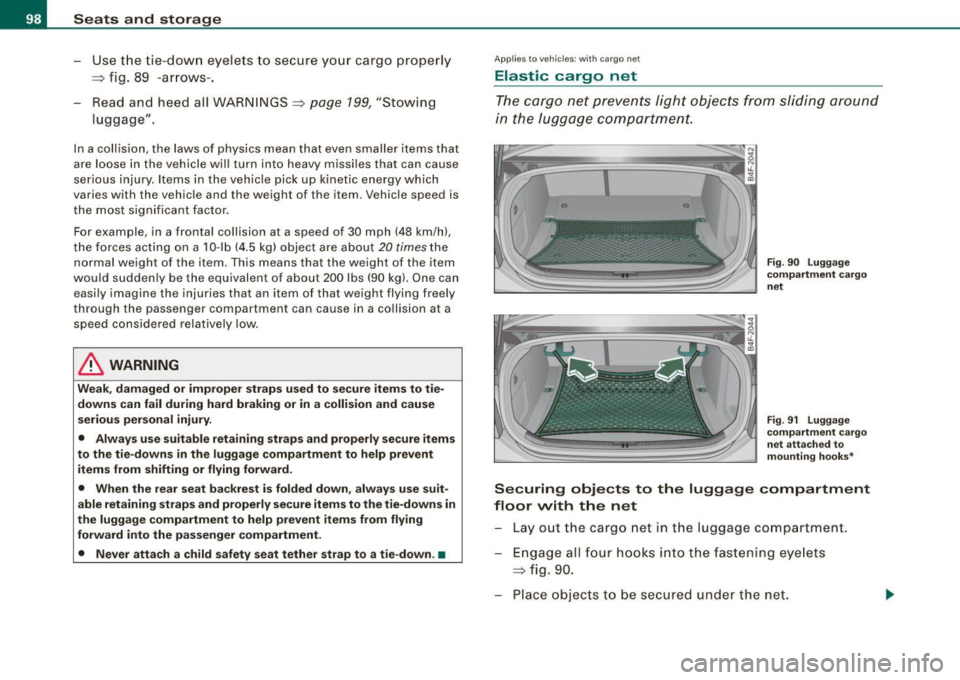
T he luggage compartment is equipped with four tie -down
eyelets to secure lugga ge and other items.
Vehicle care I I
Fig . 8 9 Luggage
co mp artment
fastening eye lets
irechnical data
Page 100 of 390
Seats and storage
- Use the tie-down eyelets to secure your cargo properly
=> fig. 89 -arrows-.
Read and heed all WARNINGS=>
page 199, "Stowing
luggage".
In a collision, the laws of physics mean that even smaller items that
are loose in the vehicle will turn into heavy missiles that can cause
serious injury. Items in the vehicle pick up kinetic energy which
varies w ith the vehicle and the weight of the item. Vehicle speed is
the most significant factor.
For example , in a frontal collision a t a speed of 30 mph (48 km/h),
the forces acting on a 10 -lb (4.5 kg) object are about
20 times the
normal weight of the item . This means that the weight of the item
would suddenly be the equivalent of about 200 lbs (90 kg). One can
easily imagine the injuries that an item of that weight flying freely
through the passenger compartment can cause in a collision at a
speed considered relatively low .
& WARNING
Weak, damaged or improper straps used to secure items to tie
downs can fail during hard braking or in a collision and cause
serious personal injury.
• Always use suitable retaining straps and properly secure items
to the tie-downs in the luggage compartment to help prevent
items from shifting or flying forward.
• When the rear seat backrest is folded down, always use suit
able retaining straps and properly secure items to the tie-downs in
the luggage compartment to help prevent items from flying
forward into the passenger compartment.
• Never attach a child safety seat tether strap to a tie-down. •
App lies to veh ic les: with cargo net
Elastic cargo net
The cargo net prevents light objects from sliding around
in the luggage compartment.
Fig . 90 Luggage
compartment cargo
net
Fig. 91 Luggage
compartment cargo
net attached to
mounting hooks*
Securing objects to the luggage compartment
floor with the net
Lay out the cargo net in the luggage compartment .
Engage all four hooks into the fastening eyelets
=> fig. 90.
Place objects to be secured under the net.
Page 101 of 390
Configuring the net to restrain small objects
-Lay out the cargo net in the luggage compartment.
- Engage the hooks on the cargo net in the fastening eyelets in the floor at the rear of the luggage compart
ment =>
page 98 , fig. 91.
Pull down the mounting hooks -arrows- located below
the base of the rear window.
- Connect each loop on the net to the corresponding hook
as illustrated.
- Place items inside the net.
Mounting hooks*
There are two mounting hooks under the base of the rear window
inside the luggage compartment. You can attach the cargo net as
well as
light objects to these hooks.
The mounting hooks are spring -loaded and will return to their
normal position when not in use .
& WARNING
For strength-related reasons, the mounting hooks can only be
used to secure objects weighing up to 10 lb. (5 kgl. Heavier objects
will not be adequately secured -there is a risk of injury. •
Con tro ls and eq uip
ment
Seats and storage
Left-side compartment
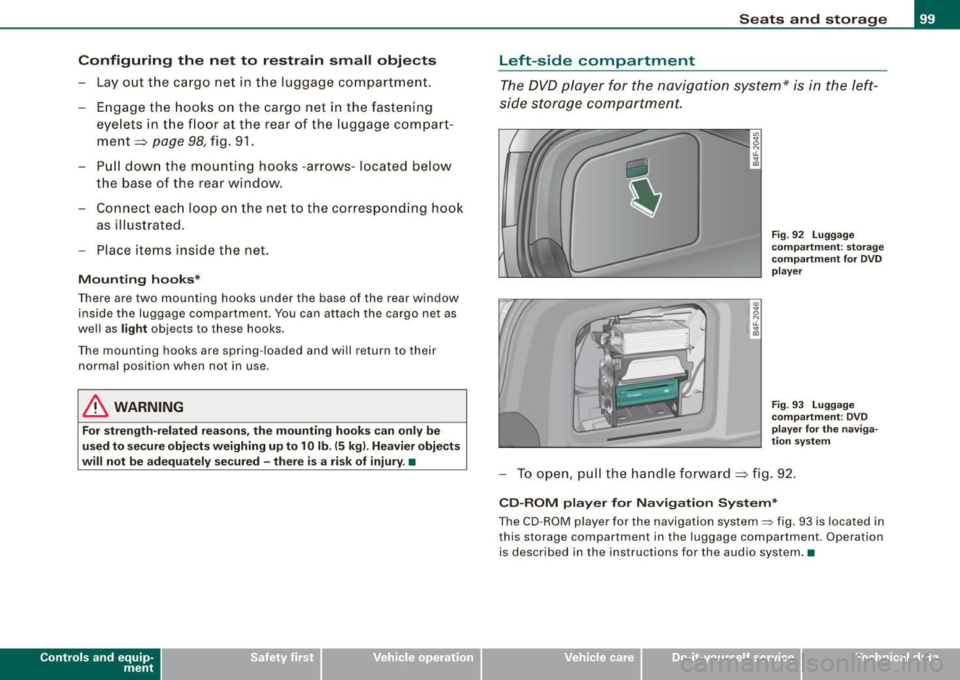
The DVD player for the navigation system* is in the left
side storage comportment.
• •
Fig . 92 Luggage
compartment : storage
compartment for DVD
player
Fig . 93 Luggage
compartment : DVD
player for the naviga
tion system
-To open, pull the handle forward => fig. 92.
CD-ROM player for Navigation System*
The CD-ROM playe r for the navigation system~ fig. 93 is located in
this storage compartment in the luggage compartment. Operation
is described in the instructions for the audio system. •
Vehicle care I I irechnical data
Page 114 of 390
-Warm
and cold
L.-.:....:..-=..:..:..:....:.:.:...::....:... ____________ _
Controls
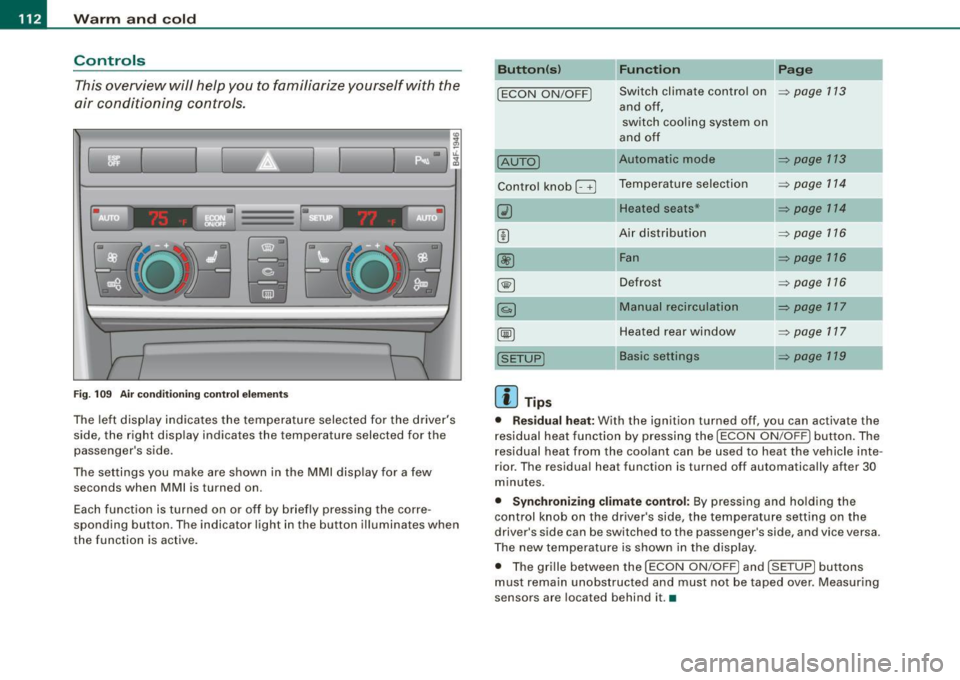
This overview will help you to familiarize yourself with the
air conditioning controls.
I I
Fig. 109 Air conditioning control elements
The left display indicates the temperature selected for the driver's
side, the right display indicates the temperature selected for the
passenger's side.
The settings you make are shown in the MMI display for a few seconds when MMI is turned on.
Each function is turned on or off by briefly pressing the corre
spond ing button. The indicator light in the button illuminates when
the function is active.
Button(s) Function Page
!ECON ON/OFFJ Switch climate control on ~ page 1 13
and off,
switch cooling system on
and off
IAUTOJ Automatic mode ~ page 113
Control knob G Temperature selection ~ page 114
Heated seats* ~ page 114
Air distribution ~ page 116
@ Fan ~ page 116
~ Defrost ~ page 116
Manual recirculation ~ page 117
Heated rear window ~ page 117
Basic settings ~ page 119
[ i] Tips
• Residual heat: With the ignition turned off, you can activate the
residual heat function by pressing the
!ECON ON/OFFJ button. The
residual heat from the coolant can be used to heat the vehicle inte
rior. The residual heat function is turned off automatically after 30
minutes.
• Synchronizing climate control: By pressing and holding the
control knob on the driver's side, the temperature setting on the
driver's side can be switched to the passenger's side, and vice versa.
The new temperature is shown in the display .
• The grille between the
!ECON ON/OFF] and !SETUP ] buttons
must remain unobstructed and must not be taped over. Measuring
sensors are located behind it.•
Page 116 of 390
• ..__w_ a_ r_m _ a_ n_d_ c_ o_ ld __________________________________________________ _
Setting the temperature
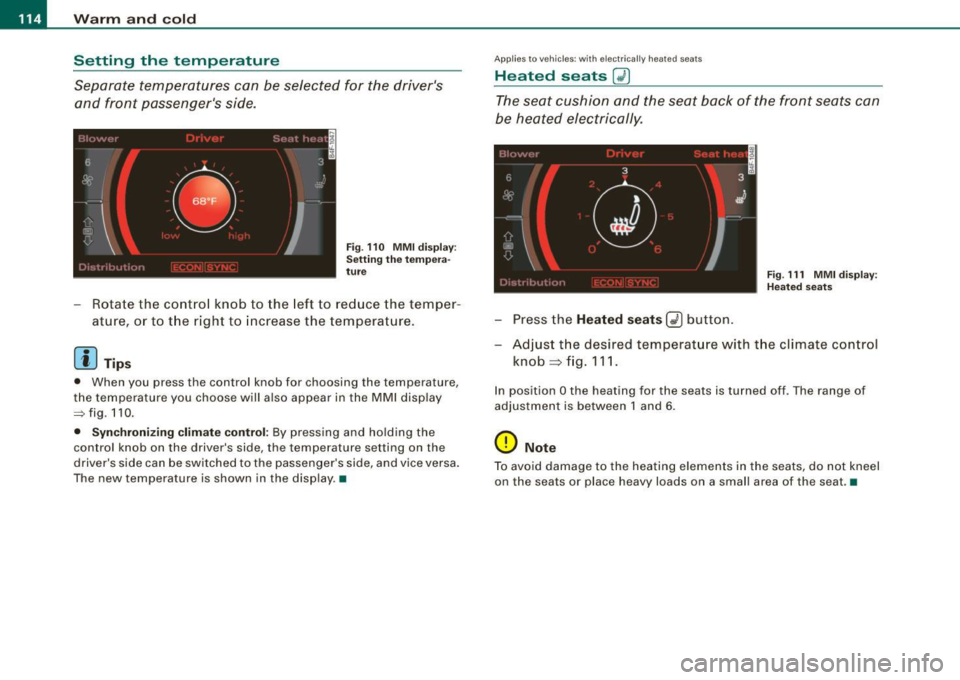
Separate temperatures can be selected for the driver's and front passenger's side.
F ig . 110 MMI display:
Se tting the tem per a
tu re
- Rotate the contro l knob to the left to reduce the temper-
ature, or to t he r ight to increase the temperature .
[ i ] Tip s
• When you press the control knob for choosing the temperature,
the temperature you choose w ill also appear in the MMI disp lay
~fig .110 .
• Synchr oni zing cl imate control: By pressing and ho lding the
control knob on the driver's side, the temperature setting on the
driver's side can be switched to the passenger 's side, and vice versa .
The new temperature is shown in the disp lay .•
Ap plies to vehicles : wi th electr ic a lly h eated seats
Heated seats G2)
The seat cushion and the seat back of the front seats can
b e heated electrically.
Fi g. 111 MMI di spl ay:
Hea te d sea ts
- Press the Heated seats Q) button.
- Adjust t he desi red temperat ure with t he climate con trol
knob=> fig. 111 .
In position O the heating for the seats is turned off . The range of
adjustment is between 1 and 6.
0 Note
T o avo id damage to the hea ting elements in the seats, do not kneel
on the seats or place heavy loads on a small area of the seat. •
Page 117 of 390
Warm and cold 1111
-------------------'
Applies to vehicles: with heated rear se ats
Heated rear seats
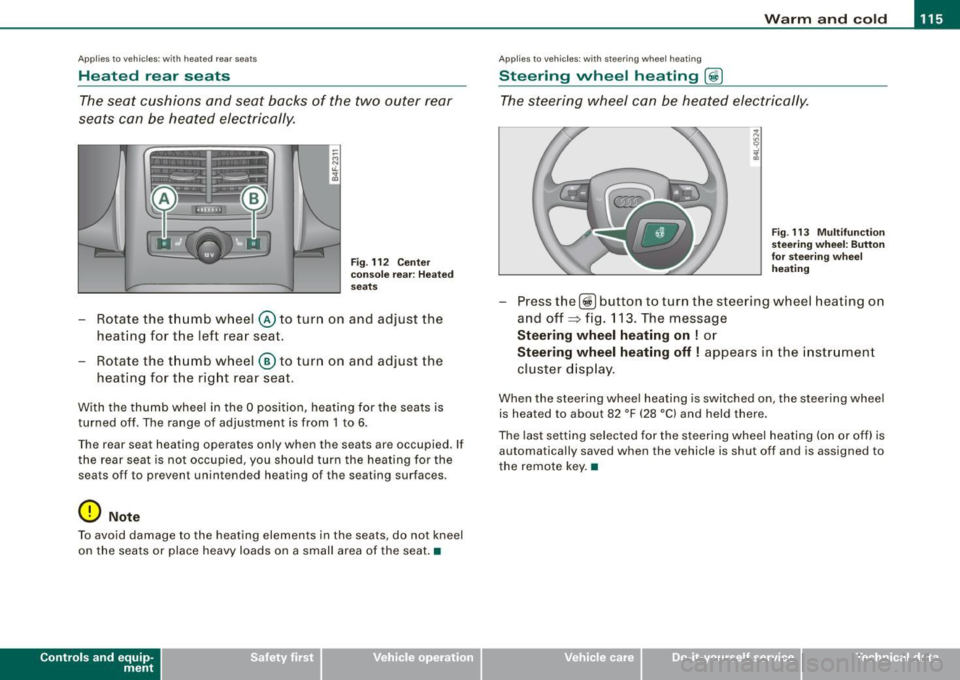
The seat cushions and seat backs of the two outer rear
seats can be heated electrically.
Fig . 112 Center
console rear : Heated
seats
- Rotate the thumb wheel @ to turn on and adjust the
heating for the left rear seat.
- Rotate the thumb wheel
® to turn on and adjust the
heating for the right rear seat.
With the thumb wheel in the O position, heating for the seats is
turned off . The range of adjustment is from 1 to 6.
The rear seat heating operates only when the seats are occupied. If
the rear seat is not occupied, you should turn the heating for the
sea ts off to preven t unintended heating of the seating sur faces .
0 Note
To avoid damage to the heating elements in the seats , do not kneel
on the seats or place heavy loads on a small area of the seat. •
Contro ls and eq uip
ment
Ap plies to vehi cle s: with ste erin g w heel heatin g
Steering wheel heating @
The steering wheel can be heated electrically.
Fig . 113 Multifunction
steering wheel: Button
for steering wheel
heating
Press the[@!] button to turn the steer ing wheel heating on
and off~ fig. 113. The message
Steering wheel heating on ! or
Steering wheel heating off! appears in the instrument
cluster display.
When the steering wheel heating is switched on , the steering wheel
is heated to about 82 °F (28 °Cl and held there.
The last setting selected for the steering wheel heating (on or off) is
automatically saved when the vehicle is shut off and is assigned to
the remote key. •
Vehicle care I I irechnical data
Page 121 of 390
_________________________________________________ w_ a_ r_ m __ a_n_ d_ c_ o_ld __ llll
The air outlets are actuated either automatically or manually
depending on the operating mode selected. Heated or unheated
fresh air, or cooled air flows from the vents.
The air outlets to heat the rear footwell are located under the front
seats .
[ i] Tips
If the climate control system is operating in cooling mode, air flows
primarily from the outlets in the center console and in the door
pillars. To achieve adequate cooling, you should never close the
outlets completely. •
Using climate control economically
Using the climate controls prudently can help save fuel.
When you use the air conditioner, engine power is reduced
and fuel consumption increases. To save fuel, you should use the air conditioner only when necessary. Also please
note the following points:
- If you want to save fuel, activate ECON.
- If you are going to drive with the windows open, use
ECON.
If the vehicle is extremely hot due to the heat of the sun,
briefly open doors and windows.
~ For the sake of the environment
By reducing the amount of fuel you use, you also reduce the amount
of pollutants emitted into the air. •
Controls and equip
ment
App lies to vehic les: with solar sliding/ti lt ing sunroof
Solar blower fan /solar roof
With sufficient sunlight, the blower fan continues to
operate with solar energy to bring in fresh air after the
ignition has been switched off.
The blower fan motor is operated by solar energy through the solar
roof after the ignition is turned off. Please make certain that vents
© and © are open to achieve optimal ventilation=>
page 118.
The v entilation operates only with the sunroof closed or in the tilted
position.
If the vehicle was switched off in the recirculation mode, the air
conditioning automatically switches to fresh air operation.
Solar operation is not activated at low outside temperatures. •
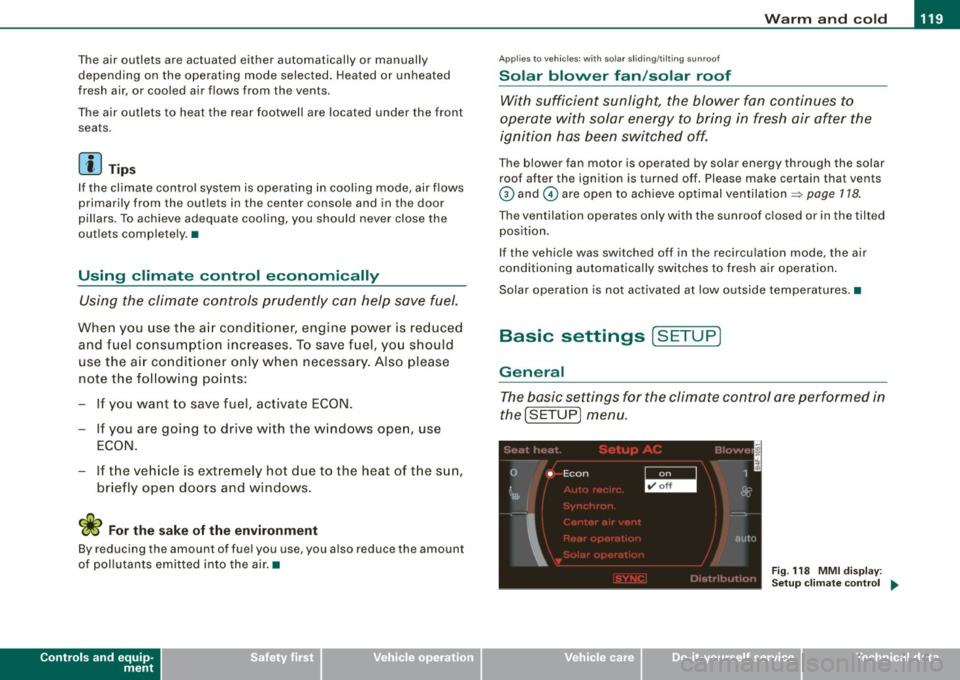
Basic settings [SETUP ]
General
The basic settings for the climate control are performed in
the[SETUP] menu.
''I
0 • Econ 1
~ &
I
autu
Fig. 118 MMI display :
Setup climate control
~
I • •
Page 122 of 390
_L-_W.:..:.. a:.:.:.; rm:..:..:....: a::.: n..:..:: d:....:: c..:o :..;.l..:d ;__ _______________________________________________ _
The basic settings for the air conditioning can only be ma de
with MM I turned on.
Press the !SETUP] button in the controls to access the
menu.
Select the desired function using the control knob (driver
or passenger) in t he air condi tioning contro ls .
The fol lowing functions can be selected:
• ECON =>
page 120
• Auto recirc . => page 120
• Synchron . => page 120
• Center air vent=> page 121
• Solar operation*=> page 121 •
ECON
The ECON mode helps to save fuel.
The air conditioning is turned off in ECON mode. "ECON" means
"Economy" . By switching off the air conditioning (compressor), you
save fuel.
Please note that vehic le interior temperature cannot be lower than
the outs ide temperature in the ECON mode . The air is not cooled or
dehumidified.
If the vehic le interior becomes too hot or if the windows fog up,
ECON mode should be turned off . As soon as the !AUTO
I button in
the air conditioning controls is p ressed, the system automatically
leaves the ECON mode, and the air conditioning compressor is
turned on again .•
Automatic recirculation mode
An air quality sensor detects incre ased concentratio ns of
pollutants in the outside air and aut omatically switches
to recirculation mode.
We recommend that you always keep automatic air recirculation ON
to prevent polluted outside air from entering the vehicle interior .
I f the
air qualit y sensor located in the air conditioning system
detects po lluted outside air, the sensor decides whether the air
pol lution can be reduced by the factory -installed po llutant filter or
whe ther it is necessary to swi tch to air recirculatio n. With heavy
concentrations of pol lutants, the air conditioning system is
sw itched automatically to rec irculation mode and the supp ly of
outside air is blocked . As soon as the concentration of pollutants in
the outside a ir drops, fresh air is supp lied to the vehic le inte rior
aga in.
I n the event that the windows fog up during automatic air recircu la
t ion, you must press the® button immed iately.
Under certain operating conditions , automatic air recircu lation is
sw itched off automatically. With outside temperatures be low about
+10 °C , automatic air recirculation is limited to 30 seconds. With
outside temperatures below about -1 °C and in the ECO N mode,
automatic air recirculation is limited to 15 seconds .•
Synchronization
One climate control se tting f or all seats.
With synchronization active, the driver 's or the passenger's settings
are adopted for the other seats . Al l the other settings that were
made are trans ferred to the other seats. This includes all the c limate
control settings right down to the heated seats.
I f a differen t setting is selected at a "synchronized seat", synchroni
z ation is cancelled .•