ECU AUDI S6 2008 Owner's Manual
[x] Cancel search | Manufacturer: AUDI, Model Year: 2008, Model line: S6, Model: AUDI S6 2008Pages: 390, PDF Size: 88.42 MB
Page 202 of 390
........ _o_ r_iv _i_ n""' g::;._ S_ a_f _e _ly =---------------------------------------------------
& WARNING
Improperly stored luggage or other items can fly through the
vehicle causing serious personal injury in the event of hard braking or an accident. To help reduce the risk of serious personal injury:
• Always put objects, for example, luggage or other heavy items
in the luggage compartment.
• Always secure objects in the luggage compartment using the
tie-down eyelets and suitable straps.
& WARNING
Heavy loads will influence the way your vehicle handles. To help
reduce the risk of a loss of control leading to serious personal
injury :
• Always keep in mind when transporting heavy objects, that a
change in the center of gravity can also cause changes in vehicle
handling:
-Always distribute the load as evenly as possible.
- Place heavy objects as far forward in the luggage compart-
ment as possible.
• Never exceed the Gross Axle Weight Rating or the Gross
Vehicle Weight Rating specified on the safety compliance sticker on the left door jamb. Exceeding permissible weight standards
can cause the vehicle to slide and handle differently.
• Please observe information on safe driving~
page 192.
& WARNING
To help prevent poisonous exhaust gas from being drawn into the
vehicle, always keep the rear lid closed while driving.
• Never transport objects larger than those fitting completely
into the luggage area because the rear lid cannot be fully closed.
& WARNING (continued)
• If you absolutely must drive with the rear lid open, observe the
following notes to reduce the risk of poisoning :
- Close all windows,
- Close the power roof*,
- Open all air outlets in the instrument panel,
- Switch off the air recirculation,
- Set the fresh air fan to the highest speed.
& WARNING
Always make sure that the doors , all windows, the power roof*
and the read lid are securely closed and locked to reduce the risk
of injury when the vehicle is not being used.
• After closing the rear lid, always make sure that it is properly
closed and locked .
• Never leave your vehicle unattended especially with the rear lid
left open. A child could crawl into the vehicle through the luggage
compartment and close the rear lid becoming trapped and unable
to get out . Being trapped in a vehicle can lead to serious personal
injury.
• Never let children play in or around the vehicle.
• Never let passengers ride in the luggage compartment. Vehicle
occupants must always be properly restrained in one of the
vehicle's seating positions.
[ i] Tips
• Air circulation helps to reduce window fogging. Stale air escapes
to the outside through vents in the trim panel, on the left side of the
luggage compartment. Be sure to keep these slots free and open.
• The tire pressure must correspond to the load -see the tire pres
sure sticker on the fuel filler door.•
Page 203 of 390
________________________________________________ D_r_iv _ i _n_ g~ S_ a_ fe_ ly __ _
Tie-downs
The luggage compartment is equipped with four tie
downs to secure luggage and other items.
Use the tie -downs to secure your cargo properly~ page 199,
"Loading the luggage compartment".
In a collision, the laws of physics mean that even smaller items that
are loose in the vehicle will become heavy missiles that can cause
serious injury. Items in the vehicle possess energy which vary with
vehicle speed and the weight of the item. Vehicle speed is the most
significant factor.
For example, in a frontal collision at a speed of 30 mph (48 km/h),
the forces acting on a 10-lb (4.5 kg) object are about 20 times the
normal weight of the item. This means that the weight of the item
would suddenly be about 200 lbs. (90 kg). You can imagine the inju
ries that a 200 lbs. (90 kg) item flying freely through the passenger
compartment could cause in a collision like this.
& WARNING
Weak, damaged or improper straps used to secure items to tie
downs can fail during hard braking or in a collision and cause
serious personal injury.
• Always use suitable mounting straps and properly secure
items to the tie-downs in the luggage compartment to help
prevent items from shifting or flying forward as dangerous
missiles.
• When the rear seat backrest is folded down, always use suit
able mounting straps and properly secure items to the tie-downs
in the luggage compartment to help prevent items from flying
forward as dangerous missiles into the passenger compartment.
• Never attach a child safety seat tether strap to a tie-down. •
Controls and equip ment Safety first Vehicle operation
Reporting safety defects
If you believe that your vehicle has a defect
which could cause a crash or could cause
injury or death, you should immediately inform
the National Highway Traffic Safety Adminis
tration (NHTSA) in addition to notifying Audi of
America, Inc. If NHTSA receives similar complaints, it may open an investigation, and
if it finds that a safety defect exists in a group
of vehicles, it may order a recall and remedy
campaign. However, NHTSA cannot become involved in individual problems between you,
your dealer, or Audi of America, Inc.
To contact NHTSA, you may call the Vehicle
Safety Hotline toll-free at 1-888-327-4236 (TTY: 1-800-424-9153);
go to
http://www.safercar.gov;
or write to: Administrator, NHTSA, 400 Seventh Street, SW., Washington, DC 20590.
You can also obtain other information about motor vehicle safety from
http://www.safercar.gov. •
Vehicle care Do-it-yourself service Technical data
Page 208 of 390
___ S_a_ f_ e_ t-= y_ b_e_ l_ t _s _______________________________________________ _
& WARNING (continued)
• Never let any person ride with their feet on the instrument
panel or sticking out the window or on the seat.
• Never remove a safety belt while the vehicle is moving. Doing
so will increase your risk of being injured or killed.
• Never wear belts twisted.
• Never wear belts over rigid or breakable objects in or on your
clothing, such as eye glasses, pens, keys, etc., as these may cause
injury.
• Never allow safety belts to become damaged by being caught
in door or seat hardware.
• Do not wear the shoulder part of the belt under your arm or
otherwise out of position.
• Several layers of heavy clothing may interfere with correct posi
tioning of belts and reduce the overall effectiveness of the system.
• Always keep belt buckles free of anything that may prevent the
buckle from latching securely.
• Never use comfort clips or devices that create slack in the
shoulder belt. However, special clips may be required for the
proper use of some child restraint systems .
• Torn or frayed safety belts can tear, and damaged belt hard
ware can break in an accident. Inspect belts regularly. If webbing,
bindings, buckles, or retractors are damaged, have belts replaced
by an authorized Audi dealer or qualified workshop.
• Safety belts that have been worn and loaded in an accident
must be replaced with the correct replacement safety belt by an
authorized Audi dealer. Replacement may be necessary even if
damage cannot be clearly seen. Anchorages that were loaded
must also be inspected.
• Never remove, modify, disassemble, or try to repair the safety
belts yourself.
& WARNING (continued)
• Always keep the belts clean. Dirty belts may not work properly
and can impair the function of the inertia reel
=> page 289, "Safety
belts". •
Safety belts
Fastening safety belts
Seat first -everybody buckle up!
Fig . 198 Belt buckle
and tongue on the
driver's seat
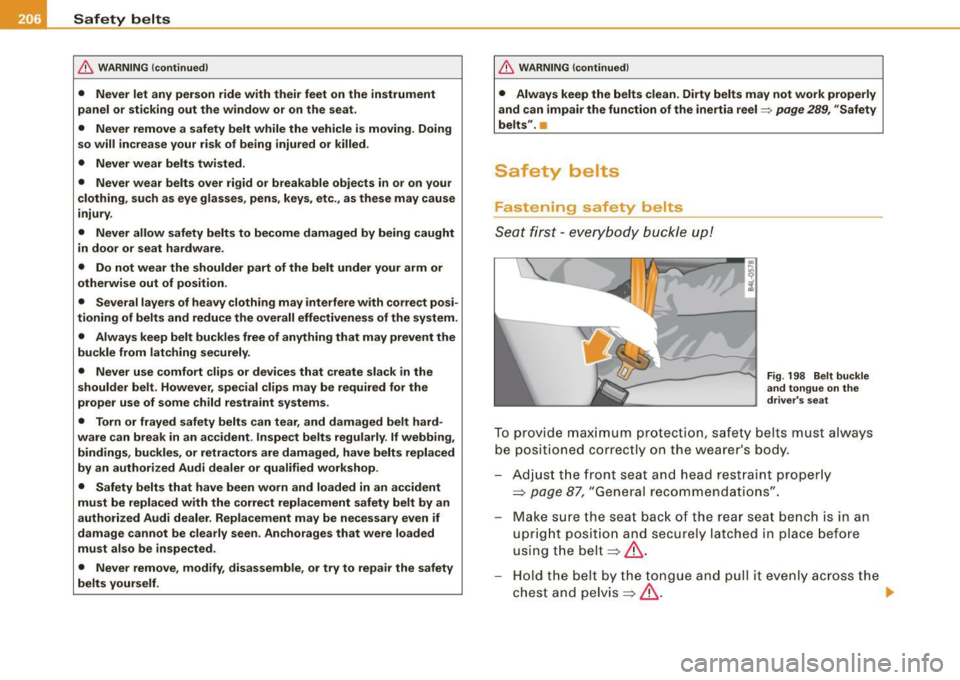
To provide maximum protection, safety belts must always
be positioned correctly on the wearer's body.
Adjust the front seat and head restraint properly
=> page 87, "General recommendations".
Make sure the seat back of the rear seat bench is in an
upright position and secu rely latched in place before
using the belt~&.
Hold the belt by the tongue and pull it evenly across the
chest and pelvis~& .
~
Page 209 of 390
- Insert the t ongue into the corre ct buckle of your seat
unt il you hear it la tc h securely=> fig. 198.
- Pu ll on t he belt to make su re t hat it is securely latc hed i n
the buckle.
Automati c safet y belt r etracto rs
Eve ry safety belt is equipped with an automatic belt retractor on the
shou lder belt. This feature locks the belt when the belt is pulled out
fast, during hard braking and in an accident . T he belt may also lock
when you drive up or down a steep hill or through a sharp curve .
During normal driving the belt lets you move free ly.
S afety belt pretensi oners
The safety belts are equipped with a belt pretensioner that helps to
tighten the safety belt and remove slack when the prete nsioner is
activat ed . The function of the pretension er is monitored by a
warning light=>
page 20.
Switchable locking feature
Every safety belt except the one on the d river seat is equipped with
a switchable locking feature that
must be used when the safety belt
is used to attach a ch ild sa fety sea t. Be sure to read the important
information about this feature=>
page 244.
& WARNING
Improperly po sitioned safety belts can cau se seriou s injury in an
accident =>
page 207 , "Safety belt po sition ".
• Safet y belts offer optimum prote ction onl y when the seat bac k
i s upright and belt s are proper ly po sit ioned on the bod y.
• Alway s make sure that the rear seat backrest to which the
c ent er re ar safet y belt i s att ached i s se curely l atched whene ver
the re ar center safety b elt is being us ed. If the b ackre st is not
se curely latched , the p asseng er will mo ve forw ard with the back
rest d uring sudde n br aking, in a sudden maneu ver and especi ally
in a crash.
Safety first
Safety belts
& WARNING !continued )
• Never attach the safety belt to th e buckle for another seat.
Atta ch ing the belt to the wrong b uckle will reduce safety belt
effe ct iv eness and c an cause ser ious person al injury .
• A p assenger who i s not p roperly re str ained c an be ser iously
injur ed by the saf ety belt itself when it move s from the stronger
p art s of the b ody into critic al are as like the abdomen .
• Alway s lock the convertible locking retractor when you are
s e cu ring a child safet y seat in the vehi cle
=> page 246. •
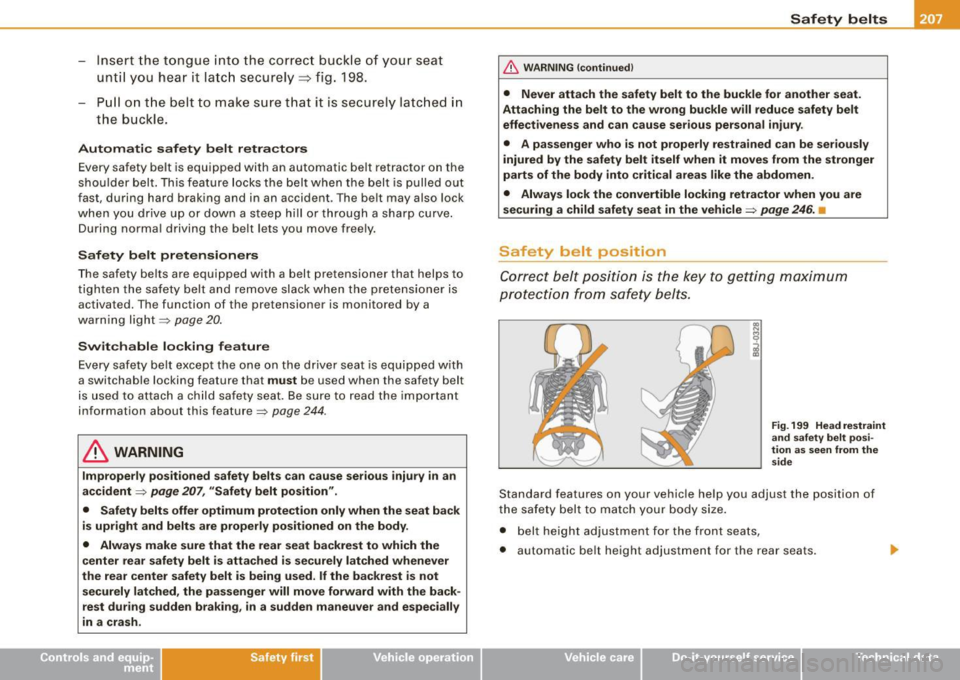
Safety be lt position
Cor rect bel t position is the key to getting maximum
protec tio n from s afety belts.
Fig . 199 He ad r estrain t
a n d sa fe ty b elt p osi
tion as seen from th e
s ide
Standard features on your vehicle he lp you adjust the position of
the safety belt to match your body size.
• belt height adjustment for the front seats,
• automatic be lt height adjustment for the rear seats .
Vehicle care I I irechnical data
Page 210 of 390
___ S_a_ f_ e_ t-= y_ b_e_ l_ t _s _______________________________________________ _
& WARNING
Improperly positioned safety belts can cause serious personal
injury in an accident.
• The shoulder belt portion of the safety belt must be positioned
over the middle of the occupant's shoulder and never across the
neck or throat .
• The safety belt must lie flat and snug on the occupant's upper
body
=> page 207, fig . 199. Pull on the belt to tighten if necessary .
• The lap belt portion of the safety belt must be positioned as
low as possible across pelvis and never over the abdomen. Make
sure the belt lies flat and snug
=> page 207, fig. 199. Pull on the belt
to tighten if necessary .
• A loose-fitting safety belt can cause serious injuries by shifting
its position on your body from the strong bones to more vulner
able, soft tissue and cause serious injury.
• Always read and heed all WARNINGS and other important infor
mation
=> page 205. •
Pregnant women must also be correctly
restrained
The best way to protect the fetus is to make sure that
expectant mothers always wear safety belts correctly -
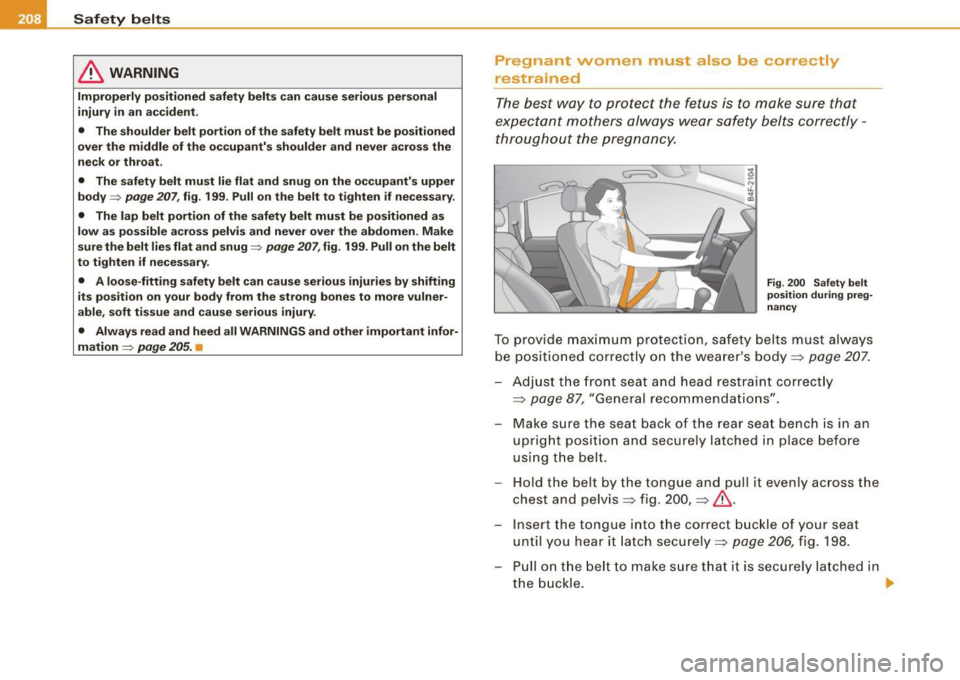
throughout the pregnancy.
Fig. 200 Safety belt
position during preg
nancy
To provide maximum protection, safety belts must always
be positioned correctly on the wearer's body=>
page 207.
-Adjust the front seat and head restraint correctly
=> page 87, "General recommendat ions".
- Make sure the seat back of the rear seat bench is in an
upright position and securely latched in place before
using the belt.
- Hold the belt by the tongue and pull it evenly across the
chest and pelvis => fig . 200, =>
&,.
- Insert the tongue into the correct buckle of your seat
until you hear it latch securely =>
page 206, fig. 198.
- Pull on the belt to make sure that it is securely latched in
the buckle .
~
Page 246 of 390
___ C_h_ i_ ld _ S_ a_ f_ e_ t_y ____________________________________________ _
child is available. In these exceptional situations, the use of a lap
belt is better than permitting the child to remain total ly unre
strained . But remember: a lap belt cannot provide the same level of
protection as a proper child restraint or a three -point lap and
shoulder belt if the child is big enough . Also, using a lap belt for
younger child ren, who should be using a chi ld restraint, may violate
laws in your state or Province.
Never use a lap belt a lone to restrain a chi ld that weighs less than
about 80 lbs (36 kg) and who is less than 4'9" tall. A lways remembe r
that chi ldren do not have the pronounced pelvic structure required
for the proper function of lap belts. If a lap belt is only res traint
system available , then the child's safety absolutely requires that the
lap be lt be fastened snug ly and as low as possible around the pe lvis
let a lap belt pass over the chi ld's stomach or abdomen .
& WARNING
Using wrong child re straints or improperly in stalled child
restr aint s can cause serious personal injury or death in a cr ash .
• Failure to properly route safety belts over a child's body will
c au se severe injurie s in a crash . The lap belt portion of the three
point belt as well as any lap belt alone must alway s pass as low as
p os sible acros s the pelvis, n ever ov er the stoma ch or abdomen.
• An impr ope rly worn s afet y belt will not pr ovide the best prote c
tion in a cra sh and may cau se seriou s personal injury . Alway s
make sure that children and other veh icle o ccupant s properl y
wear available r estraint system s. Carefully follow the in struction s
p ro vi ded by the manufa cturer s of child re straint s.•
Installing a child safety seat
Securing a child safety seat using a safety
belt
S afety belts for the rear seats and the fr ont passenger can
be locked with the c onvertible locking retr actor to pr op
erly secure child safety seats.
The safety belts emergency locking retractors for the rear seats
safety be lts and for the front passenge r's seat safety belt have a
convertible locking retractor for child restraints . The safety belt
must be locked so that belt webbing cannot unreel. The retractor
can be activated to lock the safety be lt and prevent the safety belt
webbing from loosen ing up dur ing normal driving. A child safety
seat can only b e properly instal led when the safety belt is locked so
t hat the child and chi ld safety seat w ill stay i n place .
Always remember: Even though your vehicle is equipped with an
Advanced Airbag system, al l children, especially those 12 years and
younger , shou ld always ride in the back seat proper ly restrained for
their age and size.
& WARNING
Improperly in stalled child safety seat s increa se the risk of serious
pe rsonal injury and death in a collision.
• Alway s ma ke sure that the safety belt retractor is locked when
i nstall ing a child safety seat . An unlo cked safety be lt retra ctor
cannot hold the child safety seat in pla ce during normal driving or
in a cra sh .
• Alway s buckle the child saf ety seat firml y in pl ace even if a
c hild i s not s itting in it. A loo se child saf ety seat can fl y around
during a sudden stop or in a colli sion
• Alway s make sure th at the rear se at backre st to which the
center rear s afety belt i s attached is securely latched whenever
the rear cent er safety belt is being u sed to se cur e a ch ild re straint . .,_
Page 247 of 390
_______________________________________________ C_h _ i_ld _ S_ a_ f_ e_ t..,:c y __ lftlll
& WARNING (continued )
• If the backrest is not securely latched, the child and the child
restraint will be thrown forward together with the backrest and
will strike parts of the vehicle interior . The child can be seriously
injured or killed .
• Never install rear-facing child safety seats or infant carriers on
the front passenger seat. A child will be seriously injured and can be killed when the passenger airbag inflates .
• The inflating airbag will hit the child safety seat or infant
carrier with great force and will smash the child safety seat and
child against the backrest , center arm rest , door or roof.
• Always install rear-facing child safety seats or infant carriers on
the rear seat.
• Forward-facing child safety seats or infant carriers installed on
the front passenger's seat may interfere with the deployment of
the airbag and cause serious injury to the child .
• It is safer to install a forward -fac ing child safety seat on the rear
seat.
• Always read and heed all WARNINGS whenever using a child
restrained in a vehicle is being used
=> page 234 . Special precau
tions apply when installing a child safety seat on the front
passenger seat
=> page 214 , "Child restraints on the front seat -
some important things to know ".
& WARNING
Always take special precautions if you must install a forward or
rearward-facing child restraint on the front passenger's seat in
exceptional situations:
• Whenever a forward or rearward -facing child restraint is
installed on the front passenger seat, the PASSENGER AIR BAG
OFF light must come on and stay on whenever the ignition is
switched on .
Controls and equip ment Safety first
Vehicle operation
& WARNING (continued )
• If the PASSENGER AIR BAG OFF light does not come on and stay
on, perform the checks described
=> page 223, ''Monitoring the
Advanced Airbag System ".
• Take the child restraint off the front passenger seat and install
it properly at one of the rear seat positions if the PASSENGER AIR
BAG OFF light does not stay on whenever the ignition is switched
on .
• Improper installation of child restraints can reduce their effec
tiveness or even prevent them from providing any protection.
• An improperly installed child restraint can interfere with the
airbag as it deploys and seriously injure or even kill the child.
• Always carefully follow the manufacturer's instructions
provided with the child safety seat or carrier.
• Never place additional items on the seat that can increase the
total weight registered by the weight-sensing mat and can cause injury in a crash.
& WARNING
Forward-facing child restraints:
• Always make sure the forward -facing seat has been designed
and certified by its manufacturer for use on a front seat with a
passenger front and side airbag.
• Never put the forward-facing child restraint up, against or very
near the instrument panel .
• Always move the passenger seat into its rearmost position in
the seat's fore and aft adjustment range , as far away from the
airbag as possible before installing the forward-facing child
restraint . The backrest must be adjusted to an upright position .
• Make sure that the PASSENGER
AIR BAG OFF light comes on
and stays on all the time whenever the ignition is switched on . .,,,_
Vehicle care Do-it-yourself service Technical data
Page 248 of 390
•L-----=C::..: h:...:..:..:. il-= d ~S=-= a~fe =-=- ty!.._ _____________________________________________ _
& WARNING
Rearward-facing child restraints:
• A child in a rearward-facing child safety seat installed on the
front passenger seat will be seriously injured and can be killed if
the front airbag inflates -even with an Advanced Airbag System.
• The inflating airbag will hit the child safety seat or infant
carrier with great force and will smash the child safety seat and
child against the backrest, center arm rest, door or roof.
• Always be especially careful if you must install a rearward
facing child safety seat on the front passenger seat in exceptional
circumstances.
• A tight tether strap on a rearward-facing child restraint
attached to the front passenger seat can put too much pressure
on the weight-mat in the seat and register a heavier weight in the
Advanced Airbag System. The heavier weight registered can make
the system work as though an adult were on the seat and deploy
the Advanced Airbag when it must be suppressed causing serious or even fatal injury to the child.
• Make sure that the PASSENGER AIR BAG OFF light comes on
and stays on all the time whenever the ignition is switched on.
• If the PASSENGER AIR BAG OFF light does not come on and stay
on, immediately install the rear-facing child safety seat in a rear
seating position and have the airbag system inspected by your
Audi dealer. •
Activating the convertible locking retractor
Use the convertible locking retractor to secure a child
restraint.
Always heed the child safety seat manufacturer's instruc
tions when installing a ch ild restraint in your vehicle. To
activate the convertible locking retractor: -
Place the child restraint on a seat, preferably on the rear
seat.
- Slowly pull the belt
all the way out.
-Route it around or through the child restraint belt path
=>& .
- Push the child safety seat down with your full weight to
get the safety belt really tight.
- Insert the belt tongue into the buckle for that seating
position.
- Guide the safety belt back into the retractor until the belt
lies flat and snug on the child safety seat.
- You should hear a "clicking" noise as the belt winds back
into the inertia reel. Test the convertible locking retractor
by pulling on the belt. You should no longer be able to
pull the belt out of the retractor. The convertible locking
retractor is now activated.
- Make sure that the red release button is facing away from
the child restraint so that it can be unbuckled quickly.
- Pull on the belt to make sure the safety belt is properly
tight and fastened so that the seat cannot move forward
or sideways more than one inch (2.5 cm).
& WARNING
Using the wrong child restraint or an improperly installed child
restraint can cause serious personal injury or death in a crash.
• Always make sure that the safety belt retractor is locked when
installing a child safety seat. An unlocked safety belt retractor
cannot hold the child safety seat in place during normal driving or
in a crash.
~
Page 251 of 390
Lower anchorages and tether for
children (LATCH)
Location
LATCH is the acronym for Lower Anchor and Tethers for
Children and designates a special child safety seat
restraint system. In Canada, the terms "top tether" with
"lower universal anchorages" (or "lower universal
anchorage bars") are used to describe the system.
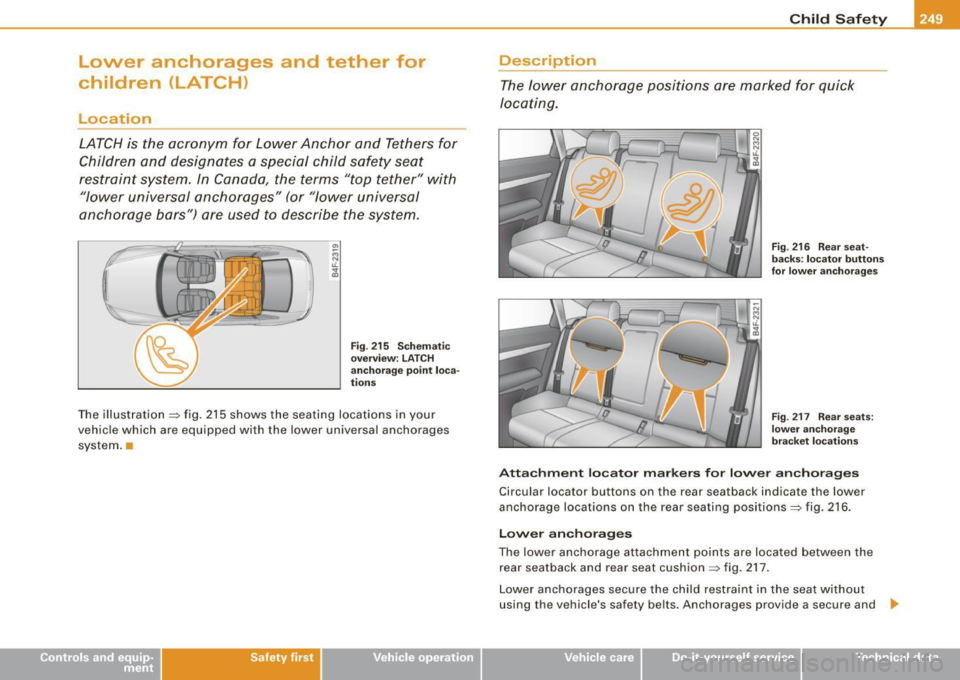
Fig . 215 Schematic
overview: LATCH
anchorage point loca
tions
The illustration =:> fig. 215 shows the seating locations in your
vehicle which are equipped with the lower universal anchorages
system. •
Safety first
Child Safety
Description
The lower anchorage positions are marked for quick
locating.
Fig . 216 Rear seat
backs: locator buttons
for lower anchorages
Fig . 217 Rear seats:
lower anchorage
bracket locations
Attachment locator markers for lower anchorages
Circular locator buttons on the rear seatback indicate the lower
anchorage locations on the rear seating positions=:> fig. 216.
Lower anchorages
The lower anchorage attachment points are located between the
rear seatback and rear seat cushion=:> fig. 217.
Lower anchorages secure the child restraint in the seat without
using the vehicle's safety belts. Anchorages provide a secure and
~
Vehicle care I I Technical data
Page 252 of 390
___ C_h_ i_ld _ S_ a_ f_ e_ t-= y'------------------------------------------------
easy-to-use attachment and minimize the possibility of improper
child restraint installation.
All child restraints manufactured after September 1, 2002, must have lower anchorage attachments for the LATCH system.
Please remember that the lower anchorage points are only intended
for installation and attachment of child restraints specifically certi
fied for use with LATCH lower anchorages. Child restraints that are
not equipped with the lower anchorage attachments can still be
installed in compliance with the child restraint manufacturer's
instructions on using vehicle safety belts.
& WARNING
Improper installation of child restraints will increase the risk of
injury in a crash.
• Always carefully follow the child restraints manufacturer's
instructions for proper installation of the child restraint and
proper use of the lower anchorages or safety belts in your vehicle.
• Never secure or attach any luggage or other items to the
LATCH
lower anchorages.
• Always read and heed the important information about child
restraints in this chapter and WARNINGS
~ page 234, "Child
Safety". •
Guidance fixtures for lower anchorages
Special guidance fixtures increase the convenience of the
lower anchorages and are available from your authorized
Audi dealer.
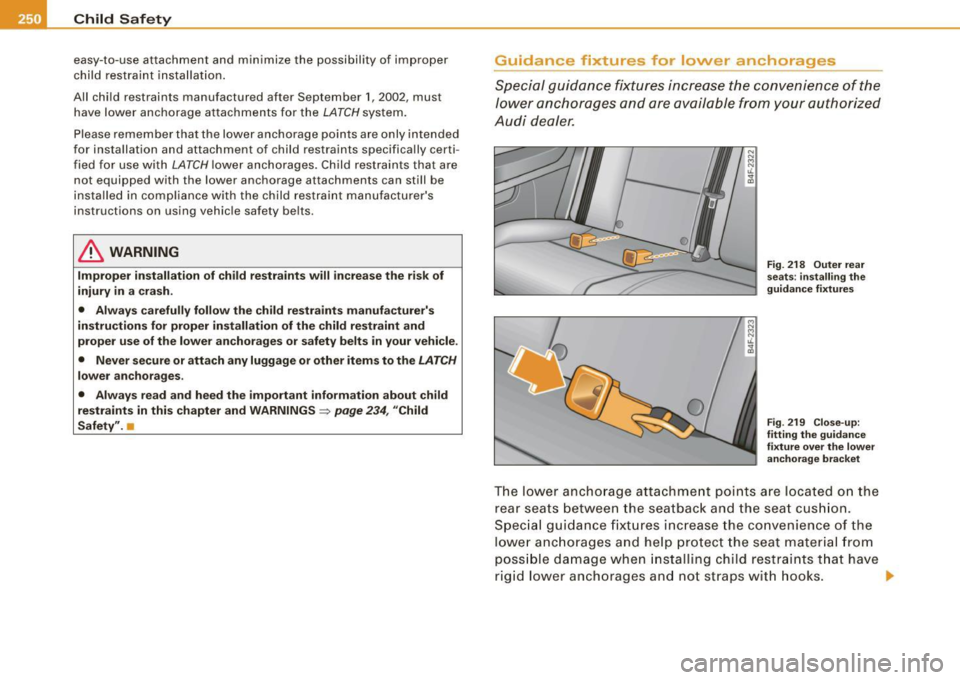
Fig. 218 Outer rear
seats : installing the
guidance fixtures
Fig. 219 Close-up:
fitting the guidance
fixture over the lower
anchorage bracket
The lower anchorage attachment points are located on the
rear seats between the seatback and the seat cushion.
Special guidance fixtures increase the convenience of the
lower anchorages and help protect the seat material from
possible damage when installing child restraints that have
rigid lower anchorages and not straps with hooks. _,.