belt AUDI S6 2008 Owner's Manual
[x] Cancel search | Manufacturer: AUDI, Model Year: 2008, Model line: S6, Model: AUDI S6 2008Pages: 390, PDF Size: 88.42 MB
Page 206 of 390
__ .....::S-=a ::..;f _:e :..:t :.!..y _ b::.....:: e..:..lt :.:s::..._ _____________________________________________ _
Because the passengers of this vehicle are not using safety belts
~ page 203, fig. 193, they will keep moving at the same speed the
vehicle was moving just before the crash, until something stops
them -here, the wall~
page 203, fig. 194.
The same principles apply to people sitting in a vehicle that is involved in a frontal collision. Even at city speeds of 20 to 30 mph
(30 to 50 km/h), the forces acting on the body can reach one ton
(2,000 lbs. or 1,000 kg) or more. At greater speeds, these forces are
even higher.
People who do not use safety belts are also not attached to their
vehicle. In a frontal collision they will also keep moving forward at
the speed their vehicle was travelling just before the crash. Of course, the laws of physics don't just apply to frontal collisions, they
determine what happens in all kinds of accidents and collisions. •
What happens to occupants not wearing
safety be lts?
In crashes unbelted occupants cannot stop themselves
from flying forward and being injured or killed. Always
wear your safety belts!
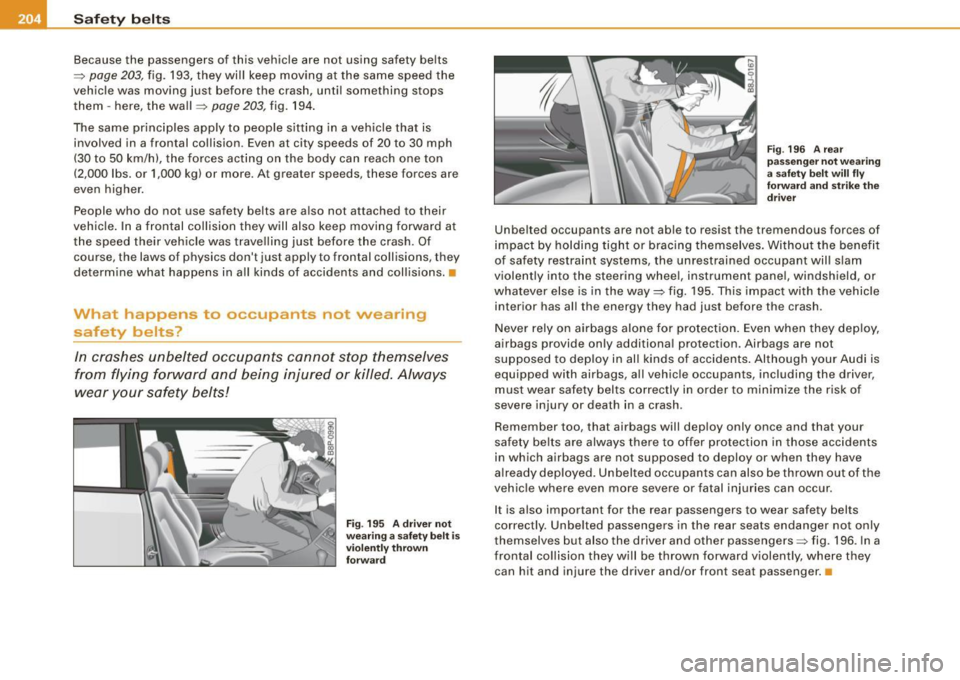
Fig . 195 A driver not
wearing a safe ty belt is
violently thrown
forward Fig. 196
A rear
passenger not wearing
a safety belt will fly
forward and strike the
driver
Unbelted occupants are not able to resist the tremendous forces of
impact by holding tight or bracing themselves. Without the benefit
of safety restraint systems, the unrestrained occupant will slam
violently into the steering wheel, instrument panel, windshield, or
whatever else is in the way~ fig. 195. This impact with the vehicle
interior has all the energy they had just before the crash.
Never rely on airbags alone for protection. Even when they dep loy,
airbags provide only additional protection. Airbags are not
supposed to deploy in all kinds of accidents . Although your Audi is
equipped with airbags, all vehicle occupants, including the driver,
must wear safety belts correctly in order to minimize the risk of
severe injury or death in a crash .
Remember too, that airbags will deploy only once and that your
safety belts are always there to offer protection in those accidents
in which airbags are not supposed to deploy or when they have
a lready deployed. Unbelted occupants can also be thrown out of the
vehicle where even more severe or fatal injuries can occur.
It is also important for the rear passengers to wear safety belts
correctly . Unbelted passengers in the rear seats endanger not only
themselves but also the driver and other passengers~ fig. 196. In a
frontal collision they will be thrown forward violently, where they
can hit and injure the driver and/or front seat passenger. •
Page 207 of 390
Safety belts protect
People think it's possible to use the hands to brace the
body in a minor collision . It's simply not true!
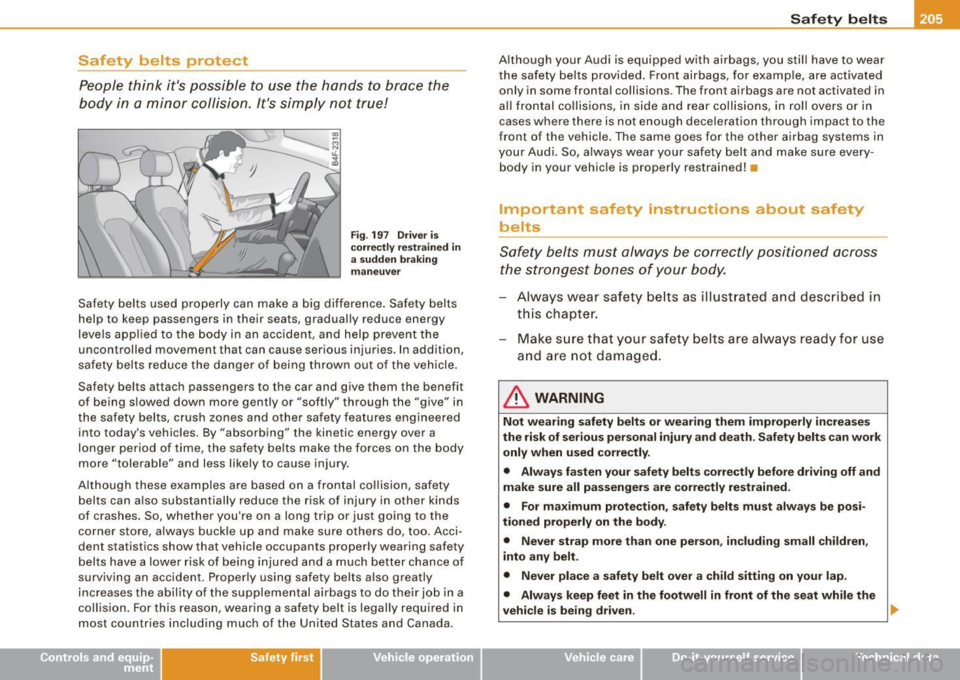
Fig . 19 7 Driv er is
co rre ctl y r est rai ned in
a sud den braki ng
m an eu ver
Safety belts used pr operly can make a b ig di fference . Safety belts
help to keep passengers in their seats, gradually reduce energy
levels app lied to the body in an accident, and help prevent the
uncontrolled movemen t that can cause serious injuries . In addition ,
safety belts reduce the danger of being thrown out of the vehicle .
Safety belts attach passengers to the car and give them the benefit
of being s lowed down more gent ly or "softly" through the "give" in
the safety belts, crush zones and other safety features engineered into today's vehicles. By "absorbing" the kinetic energy over a
longer period of time, the safety belts make the forces on the body
more "tolerable" and less likely to cause injury .
Although these examples are based on a fro ntal co llision, sa fety
belts can also substantially reduce the risk of injury in other kinds
of crashes . So, whether you're on a long trip or just going to the
corner s tore , a lways buckle up and make sure others do , too . Acci
dent statistics show that vehic le occupants properly wearing safety
belts have a lower risk of being injured and a much better chance o f
surviving an accident. Properly using safety belts also greatly
increases the ability of the supplemen tal airbags to do their job i n a
collision . For this reason, wearing a safety belt is legally required in
most coun tries including much of the United States and Canada.
Safety first
Safety b elts
Although your Audi is equipped with airbags, you sti ll have to wear
t he safety belts provided. Front airbags, for examp le, are activa ted
only in some fronta l collisions . The front airbags are not ac tiva ted in
a ll fron tal collisions, in side and rear collisions, in roll overs o r in
cases where there is not enough deceleration through impact to the
front of the vehicle. The same goes for the other airbag systems in
your Audi. So, always wear your safety belt and make sure every
body in your vehic le is properly restrained! •
Important safety instructions about safety
belts
Safety belts must always be correctly posi tioned across
the strongest bones of your body.
Always wear safety be lts as illustrated and described in
th is chapter .
Mak e su re that your s afety belts ar e always r eady for use
a n d a re not damaged .
& WARNING
Not wearing safety belt s or wear ing them improperl y increases
the ri sk of ser ious per so nal injury a nd de ath . S afety belt s ca n work
only when used corre ctl y.
• Alway s fasten your safety belts correctly before dri ving off and
make sure all passengers are correctly restrained .
• For ma ximum prote ction , safety belts mu st always be posi
tioned properly on the body .
• Never str ap more than one pe rson, includ ing small ch ildr en ,
into any belt .
• Never pla ce a safety belt over a child sitting on your lap .
• Alway s keep feet in the footwell in front of the seat while the
vehicle is being driven . .,
Vehicle care
I I irechnical data
Page 208 of 390
___ S_a_ f_ e_ t-= y_ b_e_ l_ t _s _______________________________________________ _
& WARNING (continued)
• Never let any person ride with their feet on the instrument
panel or sticking out the window or on the seat.
• Never remove a safety belt while the vehicle is moving. Doing
so will increase your risk of being injured or killed.
• Never wear belts twisted.
• Never wear belts over rigid or breakable objects in or on your
clothing, such as eye glasses, pens, keys, etc., as these may cause
injury.
• Never allow safety belts to become damaged by being caught
in door or seat hardware.
• Do not wear the shoulder part of the belt under your arm or
otherwise out of position.
• Several layers of heavy clothing may interfere with correct posi
tioning of belts and reduce the overall effectiveness of the system.
• Always keep belt buckles free of anything that may prevent the
buckle from latching securely.
• Never use comfort clips or devices that create slack in the
shoulder belt. However, special clips may be required for the
proper use of some child restraint systems .
• Torn or frayed safety belts can tear, and damaged belt hard
ware can break in an accident. Inspect belts regularly. If webbing,
bindings, buckles, or retractors are damaged, have belts replaced
by an authorized Audi dealer or qualified workshop.
• Safety belts that have been worn and loaded in an accident
must be replaced with the correct replacement safety belt by an
authorized Audi dealer. Replacement may be necessary even if
damage cannot be clearly seen. Anchorages that were loaded
must also be inspected.
• Never remove, modify, disassemble, or try to repair the safety
belts yourself.
& WARNING (continued)
• Always keep the belts clean. Dirty belts may not work properly
and can impair the function of the inertia reel
=> page 289, "Safety
belts". •
Safety belts
Fastening safety belts
Seat first -everybody buckle up!
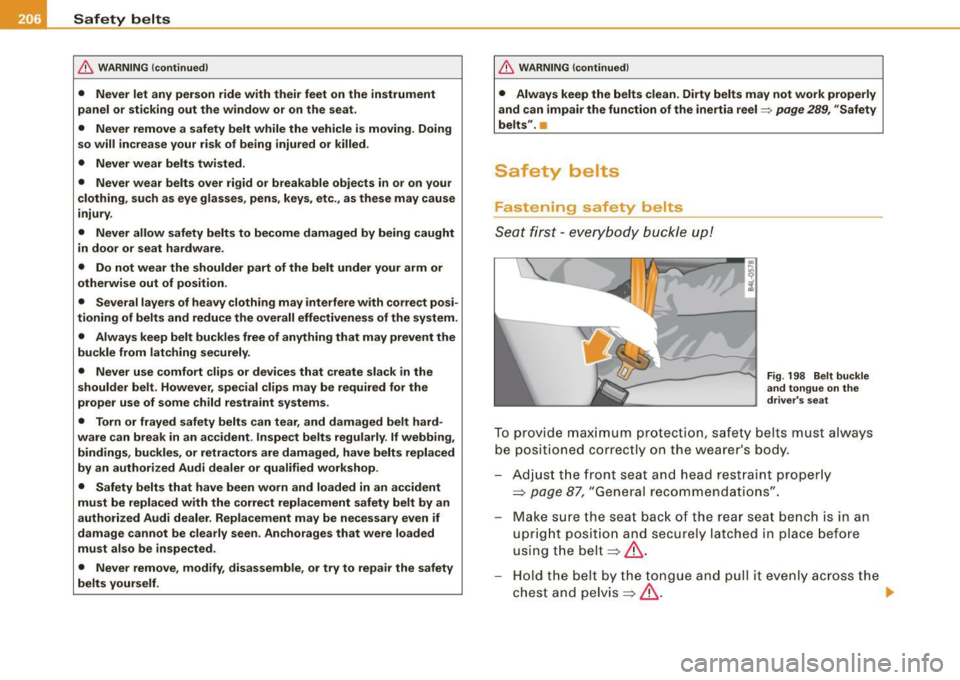
Fig . 198 Belt buckle
and tongue on the
driver's seat
To provide maximum protection, safety belts must always
be positioned correctly on the wearer's body.
Adjust the front seat and head restraint properly
=> page 87, "General recommendations".
Make sure the seat back of the rear seat bench is in an
upright position and secu rely latched in place before
using the belt~&.
Hold the belt by the tongue and pull it evenly across the
chest and pelvis~& .
~
Page 209 of 390
- Insert the t ongue into the corre ct buckle of your seat
unt il you hear it la tc h securely=> fig. 198.
- Pu ll on t he belt to make su re t hat it is securely latc hed i n
the buckle.
Automati c safet y belt r etracto rs
Eve ry safety belt is equipped with an automatic belt retractor on the
shou lder belt. This feature locks the belt when the belt is pulled out
fast, during hard braking and in an accident . T he belt may also lock
when you drive up or down a steep hill or through a sharp curve .
During normal driving the belt lets you move free ly.
S afety belt pretensi oners
The safety belts are equipped with a belt pretensioner that helps to
tighten the safety belt and remove slack when the prete nsioner is
activat ed . The function of the pretension er is monitored by a
warning light=>
page 20.
Switchable locking feature
Every safety belt except the one on the d river seat is equipped with
a switchable locking feature that
must be used when the safety belt
is used to attach a ch ild sa fety sea t. Be sure to read the important
information about this feature=>
page 244.
& WARNING
Improperly po sitioned safety belts can cau se seriou s injury in an
accident =>
page 207 , "Safety belt po sition ".
• Safet y belts offer optimum prote ction onl y when the seat bac k
i s upright and belt s are proper ly po sit ioned on the bod y.
• Alway s make sure that the rear seat backrest to which the
c ent er re ar safet y belt i s att ached i s se curely l atched whene ver
the re ar center safety b elt is being us ed. If the b ackre st is not
se curely latched , the p asseng er will mo ve forw ard with the back
rest d uring sudde n br aking, in a sudden maneu ver and especi ally
in a crash.
Safety first
Safety belts
& WARNING !continued )
• Never attach the safety belt to th e buckle for another seat.
Atta ch ing the belt to the wrong b uckle will reduce safety belt
effe ct iv eness and c an cause ser ious person al injury .
• A p assenger who i s not p roperly re str ained c an be ser iously
injur ed by the saf ety belt itself when it move s from the stronger
p art s of the b ody into critic al are as like the abdomen .
• Alway s lock the convertible locking retractor when you are
s e cu ring a child safet y seat in the vehi cle
=> page 246. •
Safety be lt position
Cor rect bel t position is the key to getting maximum
protec tio n from s afety belts.
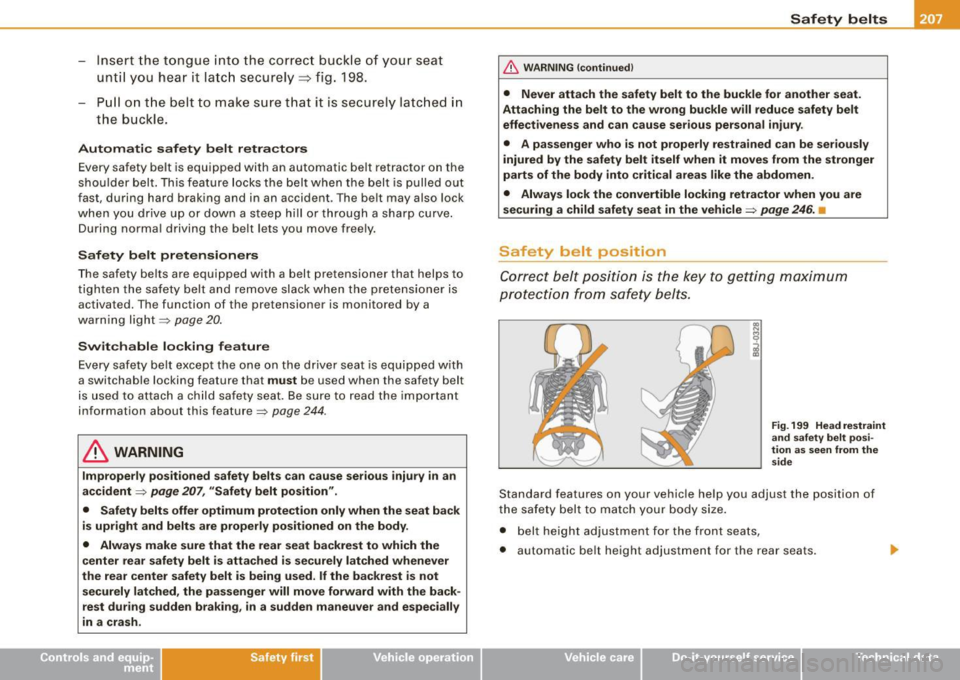
Fig . 199 He ad r estrain t
a n d sa fe ty b elt p osi
tion as seen from th e
s ide
Standard features on your vehicle he lp you adjust the position of
the safety belt to match your body size.
• belt height adjustment for the front seats,
• automatic be lt height adjustment for the rear seats .
Vehicle care I I irechnical data
Page 210 of 390
___ S_a_ f_ e_ t-= y_ b_e_ l_ t _s _______________________________________________ _
& WARNING
Improperly positioned safety belts can cause serious personal
injury in an accident.
• The shoulder belt portion of the safety belt must be positioned
over the middle of the occupant's shoulder and never across the
neck or throat .
• The safety belt must lie flat and snug on the occupant's upper
body
=> page 207, fig . 199. Pull on the belt to tighten if necessary .
• The lap belt portion of the safety belt must be positioned as
low as possible across pelvis and never over the abdomen. Make
sure the belt lies flat and snug
=> page 207, fig. 199. Pull on the belt
to tighten if necessary .
• A loose-fitting safety belt can cause serious injuries by shifting
its position on your body from the strong bones to more vulner
able, soft tissue and cause serious injury.
• Always read and heed all WARNINGS and other important infor
mation
=> page 205. •
Pregnant women must also be correctly
restrained
The best way to protect the fetus is to make sure that
expectant mothers always wear safety belts correctly -
throughout the pregnancy.
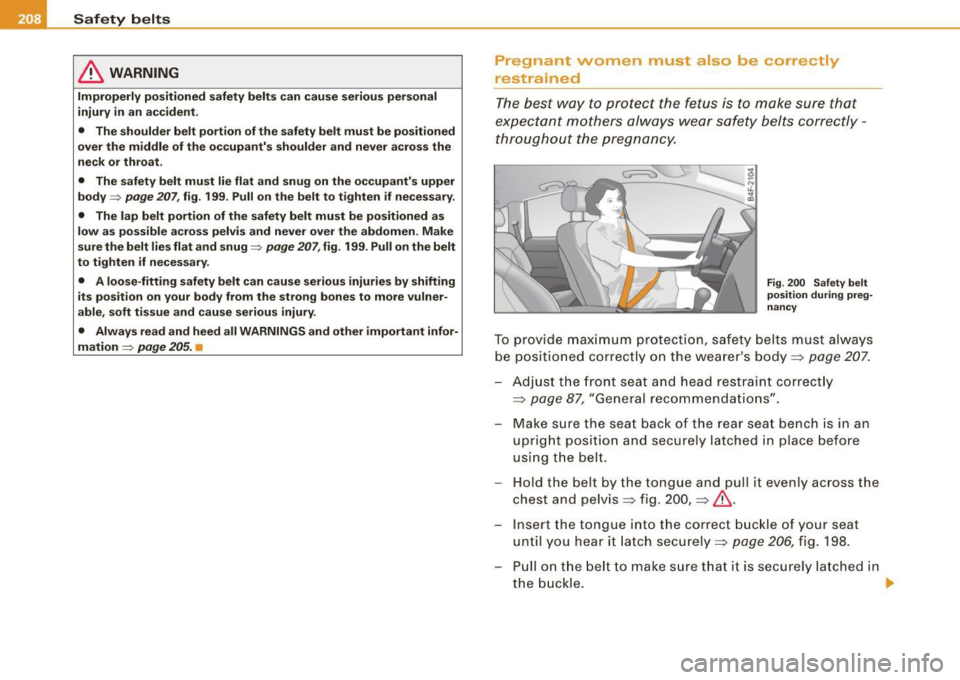
Fig. 200 Safety belt
position during preg
nancy
To provide maximum protection, safety belts must always
be positioned correctly on the wearer's body=>
page 207.
-Adjust the front seat and head restraint correctly
=> page 87, "General recommendat ions".
- Make sure the seat back of the rear seat bench is in an
upright position and securely latched in place before
using the belt.
- Hold the belt by the tongue and pull it evenly across the
chest and pelvis => fig . 200, =>
&,.
- Insert the tongue into the correct buckle of your seat
until you hear it latch securely =>
page 206, fig. 198.
- Pull on the belt to make sure that it is securely latched in
the buckle .
~
Page 211 of 390
& WARNING
Improperly positioned safety belts can cause serious personal
injury in an accident.
• Expectant mothers must always wear the lap portion of the
safety belt as low as possible across the pelvis and below the
rounding of the abdomen.
• Always read and heed all WARNINGS and other important infor
mation
=> & in "Fastening safety belts" on page 206. •
Unfastening safety belts
Unbuckle the safety belt with the red release button only
after the vehicle has stopped.
~ .. a,
Fig . 201 Releasing the
tongue from the buckle
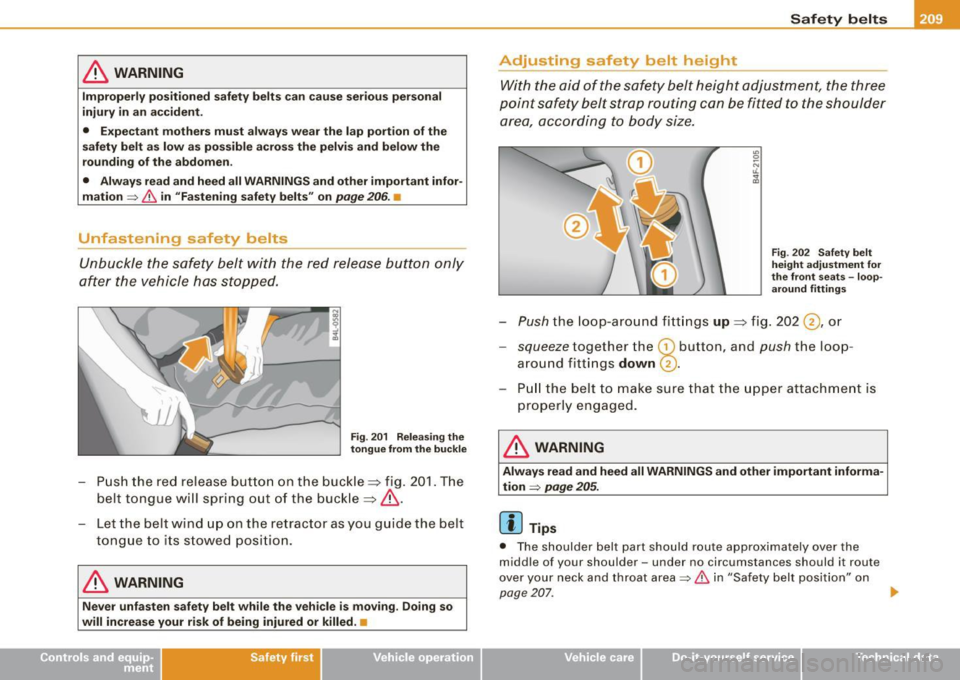
- Push the red release button on the buckle~ fig. 201. The
belt tongue will spring out of the buckle
~ & .
- Let the belt wind up on the retractor as you guide the belt
tongue to its stowed position.
& WARNING
Never unfasten safety belt while the vehicle is moving. Doing so
will increase your risk of being injured or killed. •
Safety first
Safety belts
Adjusting safety belt height
With the aid of the safety belt height adjustment, the three
point safety belt strap routing can be fitted to the shoulder
area, according to body size.
Fig . 202 Safety belt
height adjustment for
the front seats -loop
around fittings
Push the loop -around fittings up ~ fig. 202 @, or
- squeeze together the G) button, and push the loop
around fittings
down @.
- Pull the belt to make sure that the upper attachment is
properly engaged.
& WARNING
Always read and heed all WARNINGS and other important informa
tion
=> page 205.
[ i ] Tips
• The shoulder belt part should route approximately over the
middle of your shoulder -under no circumstances should it route
over your neck and throat area=>
& in "Safety belt position" on
page~Z •
•
Vehicle care I I Technical data
Page 212 of 390
• ....__S_ a_ fe_ t _y=-- b_ e_ lt_s ________________________________________________ _
• With the front sea ts, the height adjustment of the seat can also
be used to adjust the position of the safety belts. •
Improperly worn safety belts
Incorrectly positioned safety belts can cause severe inju
nes.
Wearing safety belts improperly can cause serious injury or
death. Safety belts can only work when they are correctly positioned on the body. Improper seating positions reduce
the effectiveness of safety belts and w ill even increase the
risk of injury and death by moving the safety belt to critical
areas of the body. Improper seating positions also increase
the risk of serious injury and death when an airbag deploys
and strikes an occupant who is not in the correct seating
position. A driver is responsible for the safety of all vehicle
occupants and especially for children. Therefore:
-Never permit anyone to assume an incorrect sitting pos i
tion in the vehicle while traveling ~& .
& WARNING
Improperly worn safety belts increase the risk of serious personal
injury and death whenever a vehicle is being used.
• Always make sure that all vehicle occupants are correctly
restrained and stay in a correct seating position whenever the
vehicle is being used.
• Always read and heed all WARNINGS and other important infor
mation
~ page 205. •
Safety belt tensioners
How safety belt pretensioners work
In front, side and rear collisions above a particular
severity, safety belts are tensioned automatically.
The safety belts are equipped with safety belt pretensioners . The
system is activated by sensors in front, side and rear collisions of
great severity . This tightens the belt and takes up belt slack~
& in
"Service and disposal of safety belt pretensioner" on
page 211.
Taking up the slack helps to reduce forward occupant movemen t
during a collision.
0 Note
Never let the belt remain over a rear seat back that has been folded
forward .
[ i] Tips
The safety belt pretensioner can only be activated once.
• In minor frontal, side and rear -end collisions, in a rollover and in
accidents involving very little impact force, the safety belt preten
sioner are not activated .
• When the safety belt pretensioners are activated, a fine dust is
released. This is normal and is not caused by a fire in the vehicle.
• The relevant safety requirements must be observed when the
vehicle or components of the system are scrapped. A qualified deal
ership is familiar with these regulations and will be pleased to pass
on the information to you.
• Be sure to observe all safety, environmental and other regula
tions if the vehicle or individual parts of the system, particularly the
safety belt or airbag , are to be disposed . We recommend you have
your authorized Audi dealer perform this service for you. •
Page 213 of 390
Safety b elts -----------------=------
Service and disposal of safety belt
pretension er
The safety belt pretensioners are parts of the safety belts on your
Audi. Installing, remov ing, servic ing or repair ing of belt preten
sioners can damage the safety be lt system and prevent it from
working correctly in a coll ision.
T here are some important things you have to know to make sure
that the effectiveness of the system will not be impaired and that
discarded components do not cause injury or po llute the environ
ment .
& WARNING
Improper car e, servicing and repair proc edure s can incr ease the
ri sk of p ers onal injury and d eat h by pre venting a safety b elt
pret ensioner from activating whe n ne eded o r activating it un ex
p ec tedly :
• The belt preten sioner sy stem can be activated only once. If belt
p reten sion ers ha ve been activated , the syste m mu st be repl aced.
• Never repair , adju st, or chan ge any parts o f the safet y belt
s y stem .
• Safety belt sy stem s includin g safety belt preten sion ers cannot
be r epaired . Spe cial pro cedure s are requ ired for r emoval , in sta lla
tion and di spo sal of t his sys tem .
• For an y wor k on the safet y be lt sy stem , we strongl y rec om
mend that you see your authori zed Audi de aler or qua lifi ed techni
cian w ho has an Aud i appro ved rep air m anu al, t ra ining a nd spe cial
equipment n ece ssa ry.
W For the sake of the environm ent
Undeployed airbag modu les and pretensioners might be c lassified
as Perchlorate Material -special handling may apply, see
www .dtsc .ca .gov/hazardouswaste/perchlorate. When the vehicle or
Controls and equip ment Safety first Vehicle operation parts of the restraint system including airbag modules safety belts
with pretensioners are scrapped, a ll applicable laws and regu la
tions must be observed. Your authorized Audi dealer is familiar with
these requirements and we recommend that you have your dea ler
perform this service for you. •
Vehicle care Do-it-yourself service Technical data
Page 214 of 390
-Airbag s yste m Ptrf _______________ _
Airbag system
Important things to know
Importance of wearing safety belts and
sitting properly
Airbags are only supplemental restraints. For airbags to
do their job, occupants must always properly wear their
safety belts and be in a proper seating position.
For your safe ty a nd the safety of your passengers, before
driving o ff, a lways:
- Adjust the driver's seat and steering wheel properly
~ page 194,
-Adjust the front passenger's seat properly~ page 88,
- Wear safety belts properly~ page 205,
-Always properly use the proper child restraint to pro tect
children~
page 234 .
In a col lision airbags must inflate within the blink of an eye and with
considerable force. The supplemental airbags can cause injuries if
the driver or the front seat passenger is not seated properly. There
fore in order to help the airbag to do its job, it is important, both as
a driver and as a passenger to sit properly at a ll times.
By keep ing room between your body and the steering wheel and the
front of the passenger compartment, the airbag can inflate fu lly and
comp letely and prov ide supplementa l protection in certain frontal
collisions =>
page 194, "Proper occupant seating positions". For
detai ls on the operation of the seat adjustment controls=>
page 88.
It's especially important that children are properly restrained
=>
page 234 .
There is a lot that the driver and the passengers can and must do to
help the individual safety features installed in your Audi work
together as a system.
P roper seating position is important so that the front airbag on the
driver side can do its job. I f you have a physical impairment or
condition that prevents you from sitting properly on the driver seat
with the safety belt properly fastened and reaching the pedals, o r if
you have concerns with regard to the function or operation of the
Advanced Airbag System, p lease contact your authorized Audi
dea ler or qua lif ied workshop, or call Audi Customer CARE at 1-800-
822 -2834 for possib le modifications to your vehicle.
When the airbag system deploys, a gas generator wi ll fill the
airbags, break open the padded covers, and inflate between the
steering wheel and the driver and be tween the instrument panel
and the front passenger. The airbags wil l deflate immediate ly after
deployment so that the front occupants can see through the wind
shield again without interruption .
A ll of this takes p lace in the b link of an eye, so fast that many people
don't even rea lize that the airbags have dep loyed . The airbags also
inflate with a great deal of force and nothing should be in their way
when they dep loy. Fron t airbags in combination wi th properly worn
safety belts slow down and limit the occupant's forward movement.
T ogether they help to prevent the driver and front seat passenger
from hitting parts of the inside the vehicle while reducing the forces act ing on the occupant during the crash . In this way they he lp to
reduce the r isk of injury to the head and upper body in the crash.
Airbags do not protect the arms or the lower parts of the body .
Both front airbags will not in flate in al l fro ntal col lisions . The trig
gering of the airbag system depends on the vehic le decelerat ion
r ate caused by the colli sion and registe red by the electronic contro l
unit. If this rate is below the reference value programmed into the
cont rol unit, the airbags w ill not be t riggered, even though the car
may be bad ly damaged as a result of the collision. Vehicle damage, .,,,.
Page 215 of 390
Airbag syst em -----------------=~-
repair costs or even the lack of vehicle damage is not necessari ly an
indication of whether an airbag should inflate or not.
It is not possible to define a range of vehicle speeds that will cover
every possible kind and ang le of impact that wil l always trigger the
airbags, since the circumstances wil l vary considerab ly between
one collision and another. Important factors include, for example,
the nature (hard or so ft) of the object which the car hits, the angle
of impact, vehicle speed, etc. The front airbags wi ll also not inflate
in side or rear co llisions, or in roll -overs .
Al way s rem ember : Airbags wi ll deploy only once, and on ly in certain
kinds of coll isions . Your safety belts are always there to offer protec
tion in those situat ions in wh ich airbags are not supposed to deploy,
or when they have already deployed; for example, when your vehic le
strikes or is struck by another a fter the first coll ision.
T his is just one of the reasons why an airbag is a supplementary
restraint and is not a substitute for a sa fety be lt. The airbag system
works most effectively when used with the safety be lts. Therefore ,
a lways prope rly wea r your safety belt s =>
page 202 .
& WARNING
Sitting too clo se to the steering wheel or in strument panel will
de crease the effect ivene ss of the airbags and will incr ease the risk
of personal injury in a collision.
• Never sit closer than 10 in ches (25 cm) to the steering wheel or
in strument panel.
• If you c annot sit more than 10 in ches (25 cm ) from the steering
wheel , inve stiga te whether adaptive equipment may be available
to held you reach the pedal s and in crease your se ating dist ance
from the steering wheel.
• If you are unrestra ined , leaning forward , sittin g side ways or out
of position in any way , your risk of injury i s much higher .
• You will also receive serious injur ies and could even be killed if
you are up again st the airba g or too clo se to it when it infl ates -
ev en with an Advanced Airbag .
Controls and equip ment Safety first
Vehicle operation
& WAR N IN G ( continued )
• To reduce the ri sk of injury when an airbag inflate s, alw ays
wear safety belt s prope rly~
page 20 6, "S afet y belt s".
• Always make certain that ch ildren age 12 or younger alway s
ride in the rear seat. If children are not p rope rly re str ained , they
may be severely injured or killed when an airbag inflate s.
• Never let children ride unre str ained or impr operly rest rained in
the vehicl e. Adju st the front seat s properly .
• Never ride with the b ackrest r eclined .
• Alway s sit a s far as possible from the steering wheel or the
instrument panel ~
pag e 194.
• Alway s sit upright with your back again st the backre st of your
seat .
• Ne ver pla ce your feet on the instrument panel or on the seat .
Always keep both feet on the floor in front of the seat to help
prevent seriou s injurie s to the leg s and hips if the airbag inflate s.
• Nev er r ecline th e front passenger 's seat to transpo rt obje cts .
Item s can al so mo ve into the area of the side a irbag or the front
airbag during braking or in a sudden m aneuver . Obje cts near the
a irbags can become pro je ctile s and cau se injury when an airbag
inflates .
& WARNING
Airbags that have deployed in a crash must be repla ced.
• U se only original equipment airbags approved by Audi and
in stalled by a trained technician who ha s the neces sary tool s and
diagnostic equipment to properly r epla ce any airb ag in your
vehicle and as sure sy stem effectivenes s in a crash .
• Never perm it salvag ed or re cy cled airb ag s to be i nstall ed in
your vehicle. •
Vehicle care Do-it-yourself service Technical data