belt AUDI S6 2008 Repair Manual
[x] Cancel search | Manufacturer: AUDI, Model Year: 2008, Model line: S6, Model: AUDI S6 2008Pages: 390, PDF Size: 88.42 MB
Page 252 of 390
___ C_h_ i_ld _ S_ a_ f_ e_ t-= y'------------------------------------------------
easy-to-use attachment and minimize the possibility of improper
child restraint installation.
All child restraints manufactured after September 1, 2002, must have lower anchorage attachments for the LATCH system.
Please remember that the lower anchorage points are only intended
for installation and attachment of child restraints specifically certi
fied for use with LATCH lower anchorages. Child restraints that are
not equipped with the lower anchorage attachments can still be
installed in compliance with the child restraint manufacturer's
instructions on using vehicle safety belts.
& WARNING
Improper installation of child restraints will increase the risk of
injury in a crash.
• Always carefully follow the child restraints manufacturer's
instructions for proper installation of the child restraint and
proper use of the lower anchorages or safety belts in your vehicle.
• Never secure or attach any luggage or other items to the
LATCH
lower anchorages.
• Always read and heed the important information about child
restraints in this chapter and WARNINGS
~ page 234, "Child
Safety". •
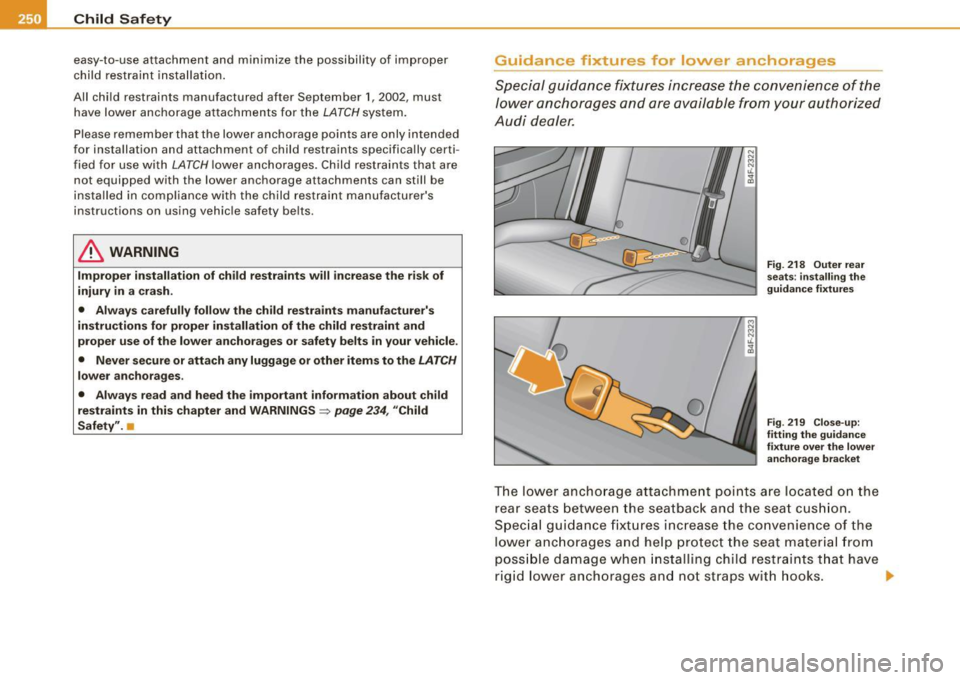
Guidance fixtures for lower anchorages
Special guidance fixtures increase the convenience of the
lower anchorages and are available from your authorized
Audi dealer.
Fig. 218 Outer rear
seats : installing the
guidance fixtures
Fig. 219 Close-up:
fitting the guidance
fixture over the lower
anchorage bracket
The lower anchorage attachment points are located on the
rear seats between the seatback and the seat cushion.
Special guidance fixtures increase the convenience of the
lower anchorages and help protect the seat material from
possible damage when installing child restraints that have
rigid lower anchorages and not straps with hooks. _,.
Page 253 of 390
--------------------------------------------~C=-- h :....:..:..:. il..:.:d _S.:... a _ fe_t~ Y:,___ _1111
Inst alling th e guidan ce fixtur es
- Push down on the seat cushion so t hat the lower anchor
ages are v isib le.
- Hold t he guidance fixt ure with the part number facing
downward and push it in the direction of the arrow on to
the anchorage => page
250, fig. 2 19.
- Make sure that each of the two guidance fixtures per seat
snaps into place.
Removing the guidance fixtures
- Remove the child restrai nt according the c hild restraint
m an ufacturer's instr uctions.
- Pu sh down on the seat cushion so t hat the lower anchor
ages are v isible.
- Pu ll off the gu idance fixtures from the lowe r anc horages.
- Always remove the guidance fixt ure s an d keep them in a
safe p lace when not in use.
You may find it easier to insta ll chi ld restraints equipped with hooks
attached to straps without the guidance fixtures in place. If this is
the case, remove the guidance fixtures by pu lling them off the
anchorages . However, the guidance fix tures can he lp you to locate
the
LATCH anchorages.
& WARNING
Improper use of teth er anchorage s or lowe r anchorages can caus e
s erio us personal inju ry
in a cra sh .
• Alway s carefully follow the child re straint manufa cturer' s
in struct ions for proper inst allati on a nd u se of ch ild restraint
sy stems .
Controls and equip ment Safety first Vehicle operation
& W
AR N IN G ( continued )
• Never use the LATCH or tether an chorage s to att ach safety
b elt s or other kinds of o ccup ant re str aints .
• Child restraint tether attachment s and lower atta chments are
onl y designed to secure a child re str aint th at h as been equipped
to u se these anchorages.
• Tether anchor age s a nd lower an chorages are de signed to with
s tand only those loads impos ed by correctly fitted child r estraints.
Unde r no circum stan ces can they be u sed safel y for adult or child
safety belt s or harne sses .
• Neve r mount more than one ch ild rest raint to a single tether or
to a lower anchorage point . Atta ching two child r estraints to a
s ingle an chorage point can cause the anchorage to fail and cause
s erio us per sonal injury in a crash .
0 Note
• Remove the guidance fixtures before folding the rear seatback to
prevent damaging the seat cushion.
• I f you leave the guidance fixtures insta lled for several days, they
cou ld leave a mark on the upholstery on the seat cushion and back
rest in the area that the guidance fi xtures were insta lled . The uphol
stery would also be permanently stretched around the guidance
fixtures. This applies especially to leather seats.
[ i ] Tip s
• Always remove the guidance fixtures when not in use.
• Please keep the guidance fixtures in a safe place with the vehicle
when not in use .•
Vehicle care Do-it-yourself service Technical data
Page 254 of 390
Ill Child Safety ___ ,.__ ____________ _
Installing a chi ld restraint using the lower
anc horages of the LA TCH system
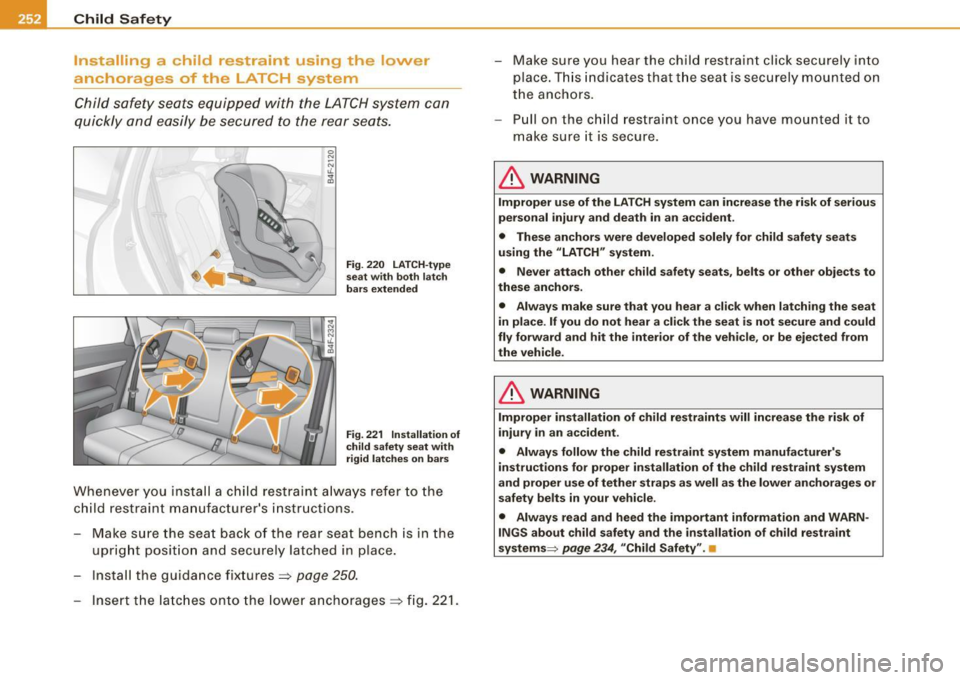
Child safety seats equipped with the LATCH system can
quickly and easily be secured to the rear seats.
0 N ;::; ,L
i
Fig. 220 LATCH-type
seat with both latch
bars extended
Fig. 221 Installation of
child safety seat with
rigid latches on bars
Whenever you install a child restraint always refer to the
child restraint manufacturer's instructions.
Make sure the seat back of the rear seat bench is in the
upright position and securely latched in place.
I nstall the guidance fixtures==>
page 250.
- Insert the latches onto the lower anchorages ==> fig. 221 . - Make sure you hear the child restra
int click securely into
place. This indicates that the seat is securely mounted on
the anchors.
- Pull on the child restraint once you have mounted it to
make sure it is secure .
& WARNING
Improper use of the LATCH system can increase the risk of serious
personal injury and death in an accident.
• These anchors were developed solely for child safety seats
using the "LATCH" system.
• Never attach other child safety seats, belts or other objects to
these anchors.
• Always make sure that you hear a click when latching the seat
in place. If you do not hear a click the seat is not secure and could
fly forward and hit the interior of the vehicle, or be ejected from
the vehicle.
& WARNING
Improper installation of child restraints will increase the risk of
injury in an accident.
• Always follow the child restraint system manufacturer's
instructions for proper installation of the child restraint system
and proper use of tether straps as well as the lower anchorages or
safety belts in your vehicle.
• Always read and heed the important information and WARN
INGS about child safety and the installation of child restraint
systems :::> page
234, "Child Safety". •
Page 255 of 390
Mounting and releasing the anchorage hook
If you use a child restraint system with hooks or other
latches attached to adjustable straps.
Mounting
- Press the anchorage hook wit h the spring catch re lease
onto the lower anchorage so that the anchorage hook locks into place .
- Pull on the anchorage hook to make sure that it has
securely engaged the lower anchorage.
- Tighten the strap following the child restraint manufac
turer 's instructions.
Releasing
- Loosen the tens ion on the strap following the child
restraint manufacturer's instructions .
- Depress the spring catch on the hook. - Hold the spring catch in depressed posit ion .
- Move the hook in the direction of the vehicle floor so that
there is enough space to release the anchorage hook
from the lower anchorage.
& WARNING
• Improper installation of child restraints will increase the risk of
injuries in a crash.
• Always refer to the child restraints manufacturer's instructions
for proper instaHation of the child restraint and proper use of the
lower anchorages or safety belts in your vehicle. •
Safety first
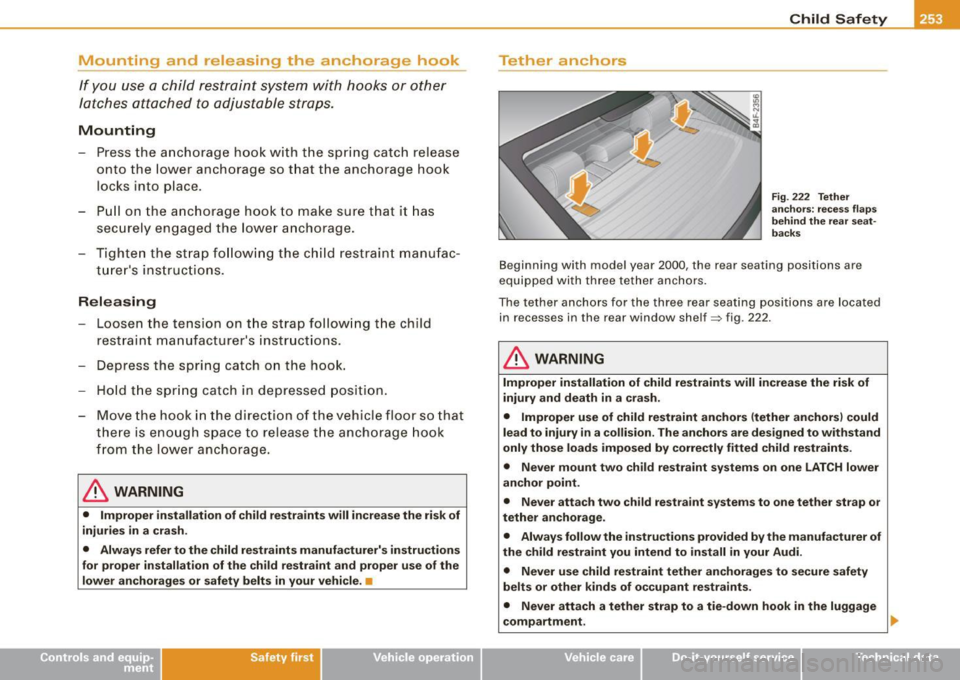
Tether anchors
Child Safety
Fig. 222 Tether
anchors: recess flaps
behind the rear seat
backs
B eginning with mod el year 2000 , th e re ar sea ting posi tions are
equipped with three tether anchors.
The tether anchors for the three rear seating positions are located in r ecess es in the r ear window shelf~ fig . 222.
& WARNING
Improper installation of child restraints will increase the risk of
injury and death in a crash.
• Improper use of child restraint anchors (tether anchors) could
lead to injury in a collision. The anchors are designed to withstand
only those loads imposed by correctly fitted child restraints.
• Never mount two child restraint systems on one LATCH lower
anchor point.
• Never attach two child restraint systems to one tether strap or
tether anchorage.
• Always follow the instructions provided by the manufacturer of
the child restraint you intend to install in your Audi.
• Never use child restraint tether anchorages to secure safety
belts or other kinds of occupant restraints.
• Never attach a tether strap to a tie-down hook in the luggage
compartment.
Vehicle care I I irechnical data
Page 260 of 390
llffl __ ln_ t _e_ ll-'"ig ...,_ e_ n_t _t_ e_ c_ h _ n_o _ l_o _,.g= y,_ __________________________________________ _
Intelligent technology
Notice about data recorded by
vehicle control modu les
Your vehicle is not equipped with an Event Data Recorder (EDR),
installed by some manufacturers for the express purpose of
capturing data for retrieval after an accident or crash event . EDR's
are sometimes called "crash recorders" .
Some state laws restrict the retrieva l or downloading of data stored
by EDR's that were insta lled in a vehicle for the express purpose of
retrieving data after an accident or crash event without the owner's
consent.
Although your vehicle is not equipped with an EDR, it is equipped
with a number of electronic control modules for various vehicle systems such as, for example, engine function, emission control, as
well as for the airbags and safety belts.
These electronic control modules also record vehicle-related data during norma l vehicle operation for diagnost ic and repair purposes .
The recording capacity of the electronic control modules is limited
to data (no sound is recorded) and only a small amount of data is
actually recorded over a very limited period of time and stored when
a system fault or other condition is sensed by a control unit. Some
of the data then stored may relate to vehicle speed, direction, braking as well as restraint system use and performance in the
event of a crash or other condition . Stored data can only be read and
down loaded with special equipment .•
Electron ic Stabilizat ion Program (ESP)
General =nformation
The ESP improves the vehicle stability.
(
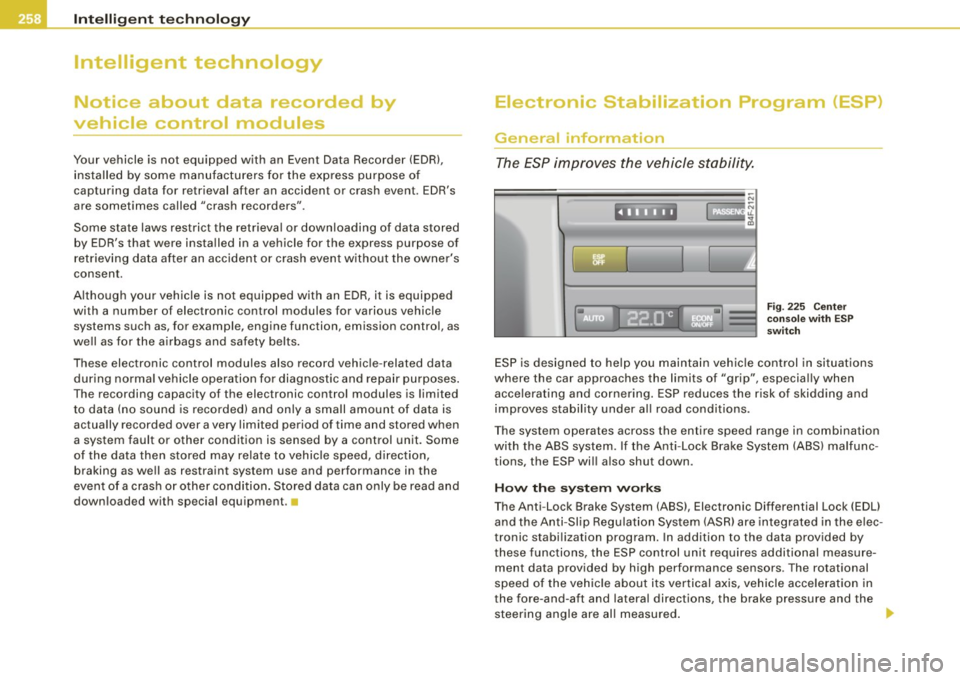
Fi g. 225 C ente r
co nso le w it h ES P
swi tch
ESP is designed to he lp you maintain vehic le control in situations
where the car approaches the limits of "grip", especia lly when
accelerating and cornering. ESP reduces the risk of skidding and
improves stabil ity under all road conditions .
T he system operates across the entire speed range in combination
with the ABS system. If the Anti-Lock Brake System (ABS) malfunc
tions, the ESP wil l also shut down .
How th e sys te m w ork s
The Anti -Lock Brake System (ABS) , Electronic Differential Lock (EDU
and the Anti-Slip Regulation System (ASR) are integrated in the e lec
tronic stabi lization program . In addition to the data provided by
these functions, the ESP control unit requires additional measure ment data provided by high performance sensors . The rotational
speed of the vehic le about its vertical axis, vehicle acce leration in
the fore-and-aft and lateral directions, the brake pressure and the steering angle are al l measured .
Page 289 of 390
_____________________________________________ C_ l_ e _a_ n_ in_ g_a _ n_d_ p_ r_ o_ t _e_ c_t _io _ n __ lll
•
consider if children, anima ls or other factors m ight prove to be
partic ularly hard on the leather.
By contrast, leather types that are covered by a colored finish layer
are more durable. This has a positive effect on the leather 's resis
tance to wear and soiling in da ily use. On the ot her hand, the typica l
characteristics of natural leather are barely or not apparent.
However, this does not mean that the leather itself is of inferior
quality .
Care and h andling
Because of the exclusive nature of the types of leather that Audi
uses and their unique properties (such as sensitivity to oils, grease,
soiling, etc.l, you will need to be somewhat careful with these
lea thers, and a cer tain type of care is requ ired . For example, dark
clothing materials can discolor leather seats (especial ly if such
clothing is damp and was not dyed correctly). Dust and dirt par ticles
in pores , folds, and seams can have an abrasive effect and can
damage the leather surface as well as weaken seams .
The leather shou ld be c leaned regularly as needed . After having
been used for a relatively long time , your leather seats will acquire
a rich aged finish . This is a characteristic of natural leather and a
sign of true qua lity.
I n order to maintain the value of this natural p roduc t over the life of
your vehic le, you should fo llow the recommendations below :
0 Note
• To keep your leather from b leaching out, do not allow it to be
exposed to bright sun light for long per iods of time . If you have to
leave the vehicle parked outside for long periods, cover the leather
to protect it from direct exposure to sunlight.
• Sharp ob jects on c lothing, such as zippers, rivets or sharp pieces
on belts can leave permanent scratches or sc rape marks on the
surface of t he leather.
[ i ] Tip s
• After each time you clean the leathe r and at regular intervals, use
a leather preservative creme that contains UV -blockers and that
works into the leather . This creme wil l nour ish and moisturize the
leather, helping it to breathe and stay supple . It a lso helps to build
up a protect ive coating on the sur face .
• Clean the leather every 2 -3 months, and c lean any areas that get
soiled.
• Remove fresh marks made by ballpoint pens, ink, lipstick, shoe
polish, etc . as soon as possible .
• Preserve the co lor of the leather as needed by using a special
colored leather care creme to touch up areas of uneven co lor. •
App lies to ve hic les : w ith n atura l le at he r
Cleaning and caring for leather upholstery
and trim
Natural leather requires special care and atten tion .
Normal cleaning
Clean so iled areas wi th a slightly mo is tened cot to n or
woole n cloth.
More stubborn dirt
- More stub born dirt can be removed using a cloth satu
rated wi th a mild soap solut io n (2 tab lespoons mild
liq uid soap) .
- Neve r allow the soap solution to sa turate the leathe r, and
make certain that no water soaks i nto the seams .
Wipe off the soap solution with a soft, dry cloth. .,,
Vehicle care I t •
Page 291 of 390
_____________________________________________ C_ l_ e _a_ n_ in_ g_a _ n_d_ p_ r_ o_ t _e_ c_t _io _ n __ lR
•
from fading. Slight color variations will develop in normal use and
are not an indication of material deterioration.
0 Note
• Never use chemical solvents (e.g. lighter fluid, turpentine),
waxes, shoe polish or similar products on Alcantara ® surfaces.
• To avoid damage, have stubborn stains removed by a commer
cial cleaning specialist.
• Do not use brushes, stiff sponges or similarly abrasive cleaning
aids .•
Safety belts
Only well-maintained safety belts work reliably when
needed.
- Keep belts clean.
- For cleaning, use a mild soap and water solution . Let
belts dry thoroughly and away from direct sunlight .
- Do not allow inertia reel safety belts to retract before
they are completely dry.
- Check the condition of your safety belts
regularly.
Heavily soiled safety belts may not retract properly.
& WARNING
Damaged safety belts can break in a crash.
• Anything that might damage your safety belts could mean that
you and your passengers would not be adequately protected in an
accident.
• Safety belt performance depends on correct installation. Never
remove belts from the vehicle to clean them.
& WARNING (continued)
• Do not use chemical cleaning agents, bleach or dyes. They have
corrosive properties which weaken the webbing.
• When cleaning your safety belts, inspect them for damage. If
you discover damage, see your Audi dealer.
• Always read and heed all WARNINGS and other information
~ page278. a
Engine compartment
Be especially careful when cleaning the engine compart
ment.
Always switch off the ignition before cleaning the engine ~ &.
Plenum panel
Remove leaves from the plenum panel in front of the windshield
under the engine hood. This prevents the water drain holes from
becoming blocked, and it prevents debris from entering the vehicle
interior through the heating and ventilation ducts.
Corrosion protection
The engine compartment and transmission have been corrosion
protected at the factory.
Good anti -corrosion treatment is very important, particularly in the
winter. If the vehicle is frequently driven on salt treated roads, the
entire engine compartment and plenum panel should be thor
oughly cleaned at the end of winter and retreated to prevent salt
damage. At the same time, the underside of the vehicle should be
washed as well.
If the engine compartment is cleaned at any time with grease
removing solutions
1 l, or if you have the engine washed, the anti
corrosion treatment is almost always removed as well. It is therefore .,_
11 Use only th e correct cleaning solut ions. N ev er use gasolin e or di ese l fu el.
Vehicle care I t •
Page 300 of 390
___ C_h_ e_ c_k _in --== g'-- a_n _d_ f_il _li _n ..:::g:::..- ___________________________________________ _
& WARNING (continued )
-Always u se extreme caution to prevent cloth ing , jewelry, or
long hair from getting caught in the radiator fan , V-belt s or
other moving parts , or from contacting hot parts . Tie back hair
before starting , and do not wear clothing that will hang or
droop into the engine .
• Minimize exposure to emis sion and chemical hazards
::::> & .
& WARNING
California Proposition 65 W arn ing :
• Engine exhaust , some of its constituents , and certain vehicle
c omponents cont ain or emit chemicals known to the State of Cali
fornia to cause cancer and birth defects and reproductive harm. In addition , certain fluids contained in vehi cles and certa in products
of component wear contain or emit chemicals known to the State
of California to cause cancer and birth defect s or other reprodu c
tive harm.
• Battery posts , terminals and related ac cessories conta in lead
and lead compounds , chemicals known to the State of California
to cause cancer and reproductive harms. Wash hands after
handling.
0 Note
When adding f luids, always make sure that they are poured into the
proper container or filler ope ning, otherwise serious damage to
vehic le systems wi ll occur.
ci> For the sake of the environment
To detect leaks in time, inspect the vehicle floor pan from under
n eath regu larly. If you see spots fro m oil o r o th e r v eh icle flu ids, hav e
your vehicle inspected by an author ized Audi dea ler. •
Engine compartment
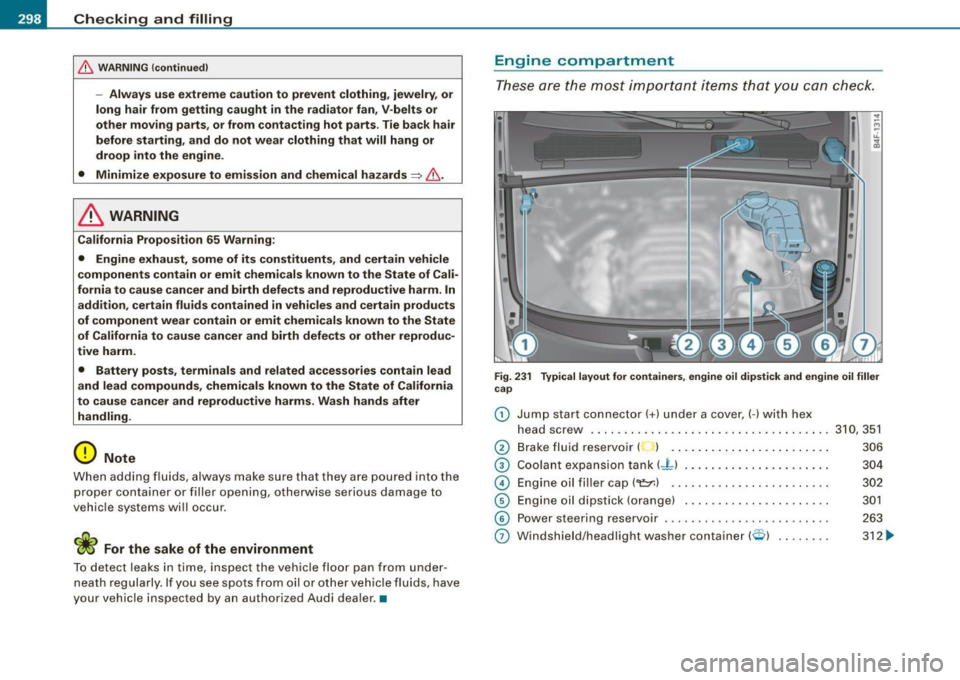
These are th e m ost im porta nt items th at you can ch ec k.
Fig. 231 Typical layout for containe rs, engine oi l d ipstick and engine oil filler
cap
0 Jum p star t connector( +) under a cover,( -) w ith hex
head screw .... ... .... ..... ... .. .. ........... .. 310, 351
@ B rake fluid reservoir ( ) . . . . . . . . . . . . . . . . . . . . . . . . 3 06
© Coo lant e xpansio n tank (- L ) . . . . . . . . . . . . . . . . . . . . . . 304
© Eng in e oil fill er cap ('l=:11) . . . . . • . . . . . . • . . . • . . . . . . . 30 2
© E ng ine oil d ipstick (orange) .............. ....... .
©
0
Power steering reservoir ....................... •.
Windshield/ headlight washer container( ~) ....... . 3
01
263
312 ~
Page 323 of 390
Tires and wheels -________________ lf:HIIII
•
& WARNING (continu ed )
• Only when all tires on the veh icle are filled to the correct pres
s ure , the tire pre ssure monitoring sy stem can work correctly .
• The use of incorrect tire pressure values can lead to accidents
or other damage. Therefore it i s es sential that the driver observe
the specified tire pre ssure values for the tires and the correct pres
s ures for the function of the tire pressure monitoring system.
• Alway s inflate tires to the recommended and correct tire pres
sure before driving off .
• Driving with underinflated tires bend more , letting them get
too hot re sulting in tread separation , sudden ti re failure and loss
of control.
• Ex cessive speed and /overloading can cause heat build -up ,
sudden tire failure and loss of control.
• If the tire pressure is too low or too high, the tires will wear
prematurely and the vehicle will not handle well .
• If the tire is not flat and you do not have to change a wheel
immediately , drive at reduced speed to the nearest service stat ion
to che ck the tire pressure and add air as required .
0 Note
Driving without valve stem caps can cause damage to the tire
valves. To preven t this, a lways make su re t hat facto ry instal led
va lve
stem caps on a ll whee ls are securely mounted on the va lve .
'£> For the sake of the environment
Underinflated t ires will a lso increase the fuel consumption. •
Tires and vehicle load limits
There are limits to the amount of load or weight that any vehicle and
any t ire can car ry. A vehicle that i s ove rlo aded wil l n ot hand le well and
is more difficu lt to stop . Overloading can not only lead to loss
o f ve h ic le control, but ca n also damage impor ta nt parts o f the
vehic le and can lead to sudden tire fa ilure, inc luding a blowout and
sudden defla tion that ca n cause the vehic le to cra sh .
Your sa fety and that o f your passe ngers also depe nds on mak ing
sure that load limits are not exceeded . Vehicle load includes every
b ody and everyth ing in and on t he veh ic le . T hese load lim its a re
technica lly referred to as the vehicle's
Gross Vehi cle We ight Rating
(" GVWR"l .
The "GVWR" includes the weight of the basic veh ic le, all factory
insta lled accesso rie s, a ful l tank of fuel , oil, coolant an d other fluids
p lus max imum load. T he ma xim um load inc ludes the number o f
passe ngers that the veh icle is intended to carry ("seat ing capacity")
w ith a n assu med we ight of 150 l bs (68 kg) fo r each passen ger at a
designated seating position and the total weight of any luggage in
the v ehicle. I f you tow a trailer, the we ig ht o f the tra ile r hi tch and t he
tongue weight of the loaded trailer must be includ ed as part of the
ve hicle l oad.
The
Gross Axle Weight Rating ("GAWR"l is t he maximum load that
can be applied at each of the vehicle's two ax le s.
The Gross Ve hicle We ig ht Rat ing and t he G ross A xle Weig ht Rat ing
are listed on the safety comp liance stic ker label located either on
t he d rive r's side 8 -p illar or on th e inside of the fuel fil ler fla p. You r
Audi has 5 seating positions, 2 in the front and 3 in the rear for total
seating ca paci ty of 5 . Each seating p ositi on has a safe ty be lt
=> page 202, "Safety belts" .
The fact that there is an upper limit to your veh icle's Gross Vehicle
W eight Rating m eans tha t the to tal weight o f whateve r is bein g
carried in the vehicle (including the weight of a trailer hitch and the
to ngue we igh t of the l oad ed trai ler) is li mit ed . The m ore passe ng ers
in the vehicle or passengers who are heavie r than the standard
we ig ht s assum ed mean that les s we ight ca n be ca rri ed as luggage.
The tire pressure labe l on your Audi also lists the maximum
com bined we ig ht of a ll of t he occ upa nts and luggage or other ca rg o
~
Vehicle care I t •
Page 370 of 390
___ C_ o_n_ s_ u_m _ e_ r_ ln_ f_ o _r _m _ a_ t_ i_o _n ______________________________________________ _
• Always observe environmental regulations when disposing of
o ld engine oil, used brake fluid, d irty engine coo lant, spent batteries
or worn out tires .
• Undeployed airbag modules and pretensioners might be classi
fied as Perchlorate Material -special handling may apply , see
www .dtsc.ca.gov/hazardouswaste/perchlorate. When the vehicle or
parts of the restraint system including ai rbag modules safety belts
with pretensioners are scrapped, all applicable laws and regula
tions must be observed . Your authorized Audi dealer is familia r with
these requirements and we recommend that you have your dea ler
perform this service for you .•
Additional accessories,
modifications and parts replacement
Additional accessories and parts
replacement
Always consult an authorized Audi dealer before
purchasing ac cessories.
Your vehicle incorporates the latest safety design features ensuring
a high standard of active and passive safety .
This safety could be compromised by non-approved changes to the
vehic le. For this reason, if parts have to be replaced , please observe
the follow ing po ints when installing addit ional accessories:
Approved Audi accessories and genuine Audi parts are availab le
from authorized Audi dealers.
These dealers also have the necessary faci lities , too ls and trained
specialists to install the parts and accessories properly .
& WARNING
Usi ng the wron g spar e p art s or usi ng non-a ppr ove d accessor ies
c a n cau se seri ous pers onal injur y.
• Use onl y acc essorie s ex pr ess ly a ppr oved by A udi and genuine
Audi spare p art s
• These par ts a nd acces sorie s have been sp ecially de sig ne d to
be u sed on your v ehic le .
• Nev er in sta ll a ccesso ries s uch a s tel ephon e cra d le s or
b ev era ge h older s on airb ag cove rs o r w ithin th e air b ag d eploy
me nt zone s. D oing so will in crea se the risk of inju ry if airb ags a re
tri gger ed in an acciden t!
• Befor e you che ck anyt hing in the eng in e comp artment , alwa ys
re ad and heed all W ARNIN GS
=> page 28 9.
0 Note
• If items other than genuine Audi spare parts, add-on equipment
and accessory items are used or if repair work is not performed
according to specified methods, this can result in severe damage to
your vehic le's engine and body (such as corrosion) and adversely
affect your vehicle's warranty .
• If emergency repairs must be performed e lsewhere , have the
vehicle examined by an authorized Audi dea lership as soon as
possible .
• The manufacturer cannot be held liable for damage wh ich occurs
due to failure to comply with these stipu lations .•
Technical Modifications
Our guidelines must be complied with when technical
modifications are made.
A lways consult an authorized Audi dealer before starting work on
any modifications . .,