tire pressure AUDI S6 2008 Owner's Guide
[x] Cancel search | Manufacturer: AUDI, Model Year: 2008, Model line: S6, Model: AUDI S6 2008Pages: 390, PDF Size: 88.42 MB
Page 329 of 390
________________________________________________ T_ i _r_e _s_ a_n_ d_ w_ h_ e_e _ l_s __ ,n
•
ture . For example, the numbers 2207 mean that the tire was
produced in the 22th week of 2007. The other numbers are
marketing codes that may or may not be used by the tire manufac
turer. This information is used to contact consumers if a tire defect
requires a recall.
Tire ply composition and materials used
The number of plies indicates the number of layers of rubber-coated
fabric in the tire. In general, the greater the number of plies, the
more weight a tire can support . Tire manufacturers also must indi
cate the materials in the tire, which include steel, nylon, polyester,
and others .
Maximum Load Rating
This number indicates the maximum load in kilograms and pounds
that can be carried by the tire.
Tire quality grading for treadwear, traction, and
temperature resistance
Tread wear, traction and temperature grades~ page 328.
Maximum Permissible Inflation Pressure
This number is the greatest amount of air pressure that should ever
be put in the tire under normal driving conditions.
Replacing tires or rims on vehicles equipped with tire
pressure monitoring system
The wheels on your vehicle are equipped with a sensor which
constantly monitors the air pressure inside the tire, and then trans
mits this information to the tire pressure monitoring system. If you
are going to replace the wheel rims on your vehicle, make sure the
new rims also have these sensors . The sensors must be compatible
with the tire pressure monitoring system on your vehicle.
If you install rims, which do not have the sensors, or have sensors
which are not compatible, then the tire pressure monitoring system
will not work properly. In this case, the tire pressure monitoring system would not be able to monitor the
tire pressure or warn you
if it is necessary.
• The battery inside of the tire pressure sensor has a limited
service life.
• Always drive with the valve stem caps securely mounted. We
recommend using factory installed valve stem caps. Ask your autho
rized Audi dealer to replace lost valve stem caps .
The installation of replacement tires with steel cord body plies in
the tire sidewall may cause malfunction of the tire pressure moni
toring system, and is not recommended (cord material information
in molded on the tire sidewall).
Always check your tire pressure monitoring system indicator after replacing one or more tires on your vehicle. If the tire pressure
monitoring system indicator flashes, or is on, your system is not
working properly. Your replacement tire might be incompatible with
your tire pressure monitoring system, or some component of the
tire pressure monitoring system may be damaged.
& WARNING
• Using incorrect or unmatched tires and/ or wheels or improper
tire and wheel combinations can lead to loss of control, collision
and serious personal injury.
• Always use tires, rims and wheel bolts that meet the specifica
tions of original factory-installed tires or other combinations that
have been specifically approved by the vehicle manufacturer.
• Tires age even if they are not being used and can fail suddenly,
especially at high speeds. Tires that are more than 6 years old can
only be used in an emergency and then with special care and at
lower speeds.
• Never mount used tires on your vehicle if you are not sure of
their "previous history." Old used tires may have been damaged
even though the damage cannot be seen that can lead to sudden
tire failure and loss of vehicle control.
~
Vehicle care I t •
Page 330 of 390
lllffll,.___T_ ir_e _ s_ a_ n_ d _ w __ h_e _e_ l_ s _______________________________________________ _
& WARN ING (continued )
• All four wheels mu st be fitted with radial tires of the same type,
si ze (rolling cir cumference ) and the same tread pattern. Driving
with different tires redu ces vehicle handling and can le ad to a loss
of control.
• If the spare tire is not the same as the tires that are mounted
on the vehi cle -for e xample with winter tires -only use the spare
t ire for a short period of time and drive w ith extra care . Refit the
normal road wheel as soon as safely possible.
• Never drive faster than the maximum speed for whi ch the tires
on your vehicle are rated becau se t ires that are driven faster than
their rated speed c an fail suddenly .
• Overload ing tires cause heat build-up , sudden tire failure,
including a blowout and sudden deflation and loss of control .
• Tempe rature grades apply to t ires that are properly inflated and
not over or underinflated.
• Fo r techni cal reasons it is not always possible to use wheels
from other vehicles -in some cases not even wheels from the
same vehicle model .
• If you install wheel trim discs on the vehicle wheels , make sure
that the air flow to the brakes is not blo cked . Reduced airflow to
the brakes can them to overheat , increasing stopping distances
and causing a collision .
• Run flat tires may only be u sed on vehicles that were equipped
with them at the factory . The vehicle must have a chas sis designed
for run flat tires and a factory -installed tire pressure monitoring
system that indi cates a loss of tire pressure . In corre ct u se of run
flat tires can lead to vehicle damage or accidents . Check with an
authori zed Audi dealer or tire specialist to see if your vehicle can
be equipped w ith run flat tires . If run flat tires are used , they must
be installed on all four wheels . Mi xing tire types is not permitted.
0 Note
• For technical reasons, it is not ge nerally poss ible to use the
whee l rims from other vehicles. This can ho ld t rue for whee ls of the
same ve hic le type.
• I f the s pa re tire is diffe rent from the tires that you have mo unted
o n your veh icle ( for e xample w inter t ires or w ide pro file t ires), the n
use the spare tire for a short period of time on ly and drive with extra
ca re. R ep lace the flat t ire w ith th e ti re m atc hin g the o thers o n your
vehic le as soon as possib le.
• I f you should put different w hee ls and t ires o n you r ve hicle (e.g.
winter wheels and tires), you must be certain that the wheels and
t ires are co mpat ible w ith the tire pressure monit oring syst em.
Otherwise the system will register a ma lfunction and a fau lt
m essage w ill be d isplayed . For more info rmatio n, con tact your Aud i
dea ler.
0 Note
• When insta lling new tires, be carefu l not to damage the va lves or
t ire pressu re m oni toring sys te m sensors .
• N ever drive without the valve stem cap. The va lves could get
damaged.
• I f the sensors must be replaced, then the valve must also be
r ep laced at t he same t ime .
~ For the sake of the environment
Dispose of o ld tires i n acco rdance wit h the local requ ire men ts .•
Uniform tire quality grading
• Tr ead wear
• Tr action AA A B C
• T emperature A B C
Page 334 of 390
-Tires and wheels
PW-------------------
possible with a torque wrench -preferably by an authorized Audi
dealer or qualified workshop. •
Low aspect ratio tires
Your Audi is factory-equipped with low aspect ratio tires . These tires
have been thoroughly tested and been selected specifically for your
model for their superb performance, road feel and hand ling under
a variety of driving conditions . Ask your authorized Audi dealer for
more details.
The low aspect ratio of these tires is indicated by a numeral of
55 or
less
in the tire's size designation. The numeral represents the ratio
of the tire's sidewa ll height in relat ion to its tread width expressed
in percentage. Conventional tires have a height/width ratio of 60 or
more.
The performan ce of low -aspect-ratio tires is particularly sensitive to
improper inflation pressure. It is therefore important that low
aspect ratio tires are inflated to the specified pressure and that the
inflation pressure is regularly checked and maintained. T ire pres
s ures should be checked at least once a month and always before a
long trip => page 379,
"Checking tire pressure".
What you can do to avoid tire and rim damage
Low aspect ratio tires can be damaged more easily by impact with
potho les, curbs, gullies or ridges on the road, particularly if the tire
is underinflated.
In order to minimize the occurrence of impact damage to the tires
of your vehicle, we recommend that you observe the following precautions:
• Always ma inta in recommended inflation pressures. Check your
tire pressure every 2,000 miles (3,000 km) and add air if necessary.
• Drive carefully on roads with potholes, deep gu llies or ridges.
The impact from driving through or over such obstacles can
damage your tires. Impact with a curb may also cause damage to
your tires . •
After any impact, immediately inspect your tires or have them
inspected by the nearest authorized Audi dealer. Replace a
damaged tire as soon as possible.
• Inspect your tires every 2,000 miles (3,000 km) for damage and
wear. Damage is not always easy to see. Damage can lead to loss of
air and underinflation, which could eventually cause tire failure. If
you believe that a tire may have been damaged, replace the tire as
soon as possib le.
• T hese tires may wear more quickly than others .
• Please also remember that, whi le these tires deliver respons ive
handling, they may ride less comfortably and make more noise than
other choices .
Reduced performance in winter /cold season
conditions
A ll tires are designed for certain purposes. The low aspect ratio,
u ltr a high performance tires originally installed on your vehic le are
intended for maximum dry and wet road performance and handling.
They are not suitable for cold, snowy or icy weather conditions. If
you drive under those circumstances, you should equip your vehic le
with all -season or winter tires , wh ich offer better traction under
those conditions. We suggest you use the recommended snow or all -season tires specified for your vehicle, or their equivalent .
Refer to=>
page 329for more detailed information regarding winter
tires. •
Page 340 of 390
11111.___W_ h_ a_ t_ d_o_ l_ d_ o _ n_ o_w _ ? ____________________________________________ _
- Disengage and lower the floor panel before you close the
luggage compartment lid again.
Storing the replaced wheel
- Place the replaced wheel inside the spare wheel well in
the luggage compartment .
Tighten the knurled retaining screw clockwise to secure the wheel in place.
- Disengage and lower the floor panel before you close the
luggage compartment lid again.
& WARNING
Loose items in the passenger compartment can cause serious
personal injury during hard braking or in an accident .
• Never store the spare wheel or jack and tools in the passenger
compartment.
• Always store all jacking equipment, tools, and the spare wheel
in the luggage compartment.
• Tighten the knurled retaining screw for the spare wheel
securely.
[ i] Tips
Check the inflation pressure of the spare tire periodically to keep the
tire ready for use. •
Changing a wheel
Before changing a wheel
Observe the following precautions for your own and your
passenger's safety when changing a wheel.
- After you experience a tire failure, pull the car well away
from moving traffic and try to reach level ground before
you stop :::;. & .
- All passengers should leave the car and move to a safe
location (for instance, behind the guardrail) :::;,& .
- Engage the parking brake to prevent your vehicle from
rol ling unintentionally :::;.& .
- Move selector lever to position P :::;. & .
-If you are towing a trailer: unhitch the trailer from your
vehicle.
- Take the jack and the spare tire out of the luggage
compartment:::;.
page 336.
& WARNING
You or your passengers could be injured while changing a wheel if
you do not follow these safety precautions:
• If you have a flat tire, move a safe distance off the road. Turn off
the engine, turn the emergency flashers on and use other warning
devices to alert other motorists.
• Make sure that passengers wait
in a safe place away from the
vehicle and well away from the road and traffic.
• To help prevent the vehicle from moving suddenly and possibly
slipping off the jack, always fully set the parking brake and block
the wheel diagonally opposite the wheel being changed. When one ...
Page 341 of 390
-------------------------------------------~W~h~a~t~d~o~l ~d~o~n~o~w~ ?::__fflll
•
& WARNING (continued)
front wheel is lifted off the ground, placing the Automatic Trans
mission in "P" {Park) will
not prevent the vehicle from moving.
• Before you change a wheel, be sure the ground is level and firm.
If necessary, use a sturdy board under the jack.
• After installing the spare wheel, make sure that you replace the
flat tire/wheel in its storage area properly and tighten the knurled
retaining screw securely. •
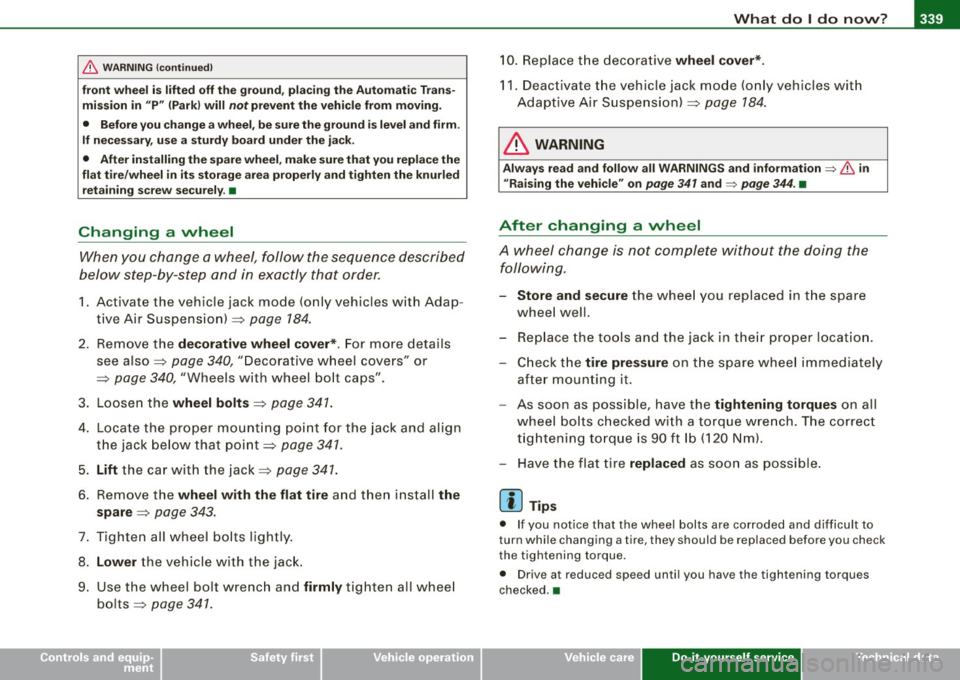
Changing a wheel
When you change a wheel, follow the sequence described
below step-by-step and in exactly that order.
1. Activate the vehicle jack mode (only vehicles with Adap
tive Air Suspension)~
page 184.
2. Remove the decorative wheel cover*. For more details
see also ~
page 340, "Decorative wheel covers" or
~ page 340, "Wheels with wheel bolt caps".
3. Loosen the
wheel bolts~ page 341.
4. Locate the proper mounting point for the jack and align
the jack below that point~
page 341.
5. Lift the car with the jack ~ page 341.
6. Remove the wheel with the flat tire and then install the
spare
~ page 343.
7. Tighten all wheel bolts lightly.
8.
Lower the vehicle with the jack.
9. Use the wheel bolt wrench and
firmly tighten all wheel
bolts~
page 341 .
10. Replace the decorative wheel cover*.
11. Deactivate the vehicle jack mode (only vehicles with
Adaptive Air Suspension)~
page 184.
& WARNING
Always read and follow all WARNINGS and information => & in
uRaising the vehicle" on
page 341 and=> page 344. •
After changing a wheel
A wheel change is not complete without the doing the
following.
- Store and secure the wheel you replaced in the spare
wheel well.
- Replace the tools and the jack in their proper location.
- Check the tire pressure on the spare wheel immediately
after mounting it.
- As soon as possible, have the
tightening torques on all
wheel bolts checked with a torque wrench. The correct
tightening torque is 90 ft lb (120 Nm).
- Have the flat tire
replaced as soon as possible.
[ i] Tips
• If you notice that the wheel bolts are corroded and difficult to
turn while changing a tire, they should be replaced before you check
the tightening torque.
• Drive at reduced speed until you have the tightening torques
checked .•
Do-it -yourself service
Page 346 of 390
-L___:W:..:..:. h.:.: a::.. t:...:: d:.:o:::....:. l..: d::. O ::::....: n:..:.:: O:..:W :.:..:. ? ____________________________________________ _
hub. Remove all dirt from these surfaces before remounting the
wheel. •
Tires with unidirectional tread design
Tires with unidirectional tread design must be mounted
with their tread pattern pointed in the right direction.
Using a spare tire with a tread pattern intended for use
in a specific direction
When using a spare tire with a tread pattern intended for use in a
specific direction, please note the following:
• The direction of rotation is marked by an arrow on the side of the
tire .
• If the spare tire has to be installed in the incorrect direction, use
the spare tire only temporarily since the tire will not be able to
achieve its optimum performance characteristics with regard to
aquaplaning, noise and wear.
• We recommend that you pay particular attention to this fact
during wet weather and that you adjust your speed to match road
conditions.
• Replace the flat tire with a new one and have it installed on your
vehicle as soon as possible to restore the handling advantages of a
unidirectional tire. •
Notes on wheel changing
Please read the information~ page 325, "New tires and replacing
tires and wheels " if you are going to use a spare tire which is
different from the tires on your vehicle.
After you change a tire:
• Check the tire pressure on the spare immediately after installa
tion . •
Have the wheel bolt tightening torque checked with a torque
wrench as soon as possible by your authorized Audi dealer or a qualified service station .
• With steel and alloy wheel rims, the wheel bolts are correctly
tightened at a torque of 90 ft lb (120 Nml.
• If you notice that the wheel bolts are corroded and difficult to
turn while changing a tire, they should be replaced before you check
the tightening torque.
• Replace the flat tire with a new one and have it installed on your
vehicle as soon as possible. Remount the wheel cover.
Until then, drive with extra care and at reduced speeds .
& WARNING
• If you are going to equip your vehicle with tires or rims which
differ from those which were factory installed, then be sure to read
the information
~ page 325, "New tires and replacing tires and
wheels".
• Always make sure the damaged wheel or even a flat tire and
the jack and tool kit are properly secured in the luggage compart ment and are not loose in the passenger compartment.
• In an accident or sudden maneuver they could fly forward,
injuring anyone in the vehicle .
• Always store damaged wheel, jack and tools securely in the
luggage compartment . Otherwise, in an accident or sudden
maneuver they could fly forward, causing injury to passengers in
the vehicle .
0 Note
Do not use commercially available tire sealants. Otherwise, the elec
trical components of the tire pressure monitoring system* will no
longe r work properly and the sensor for the tire pressure moni
toring system will have to be replaced by a qualified workshop. •
Page 348 of 390
llft!I Fuses and bulbs ..._ __________________________________________ _
[ i J Tip s
You are wel l advised to keep a supply of spare fuses in your vehicle .
Fuses with the proper ampere ratings are availab le at your Audi
dea ler. •
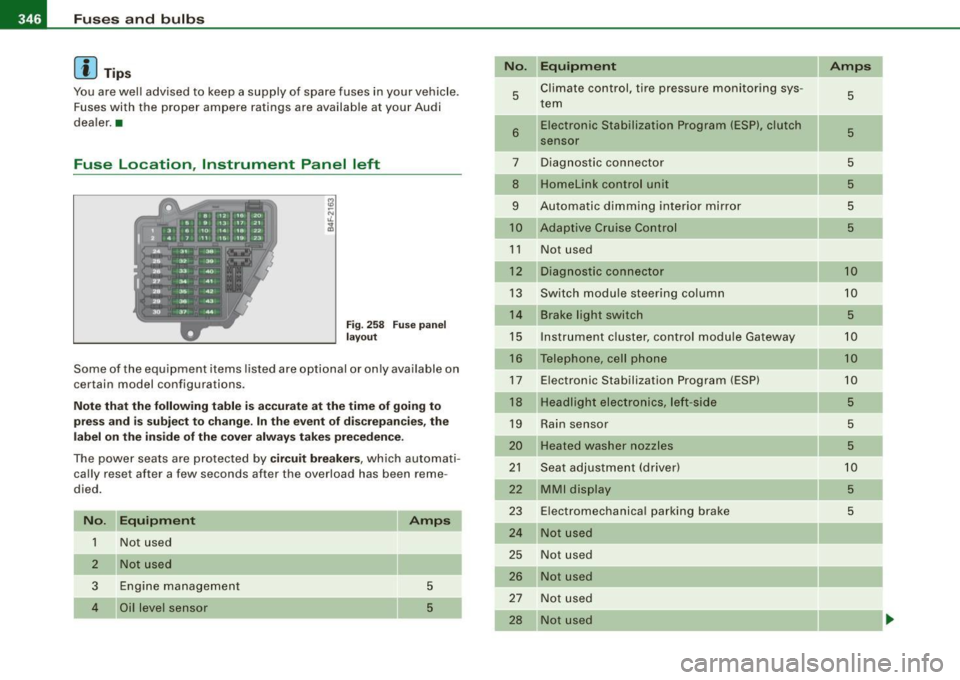
Fuse Location , Instrument Panel left
Fig . 258 Fuse pa nel
l ayo ut
Some of the equipment items listed are optional or only ava ilable on
certain model configurations .
Note th at t he fo llo wi ng t able i s acc urat e at th e time of goin g to
pr ess and is subject t o ch ang e. In th e eve nt of d iscrep ancie s, th e
labe l on th e in side of th e cover always ta kes prece de nce .
The power seats are protected by cir cuit br eaker s, which automati
cally reset after a few seconds after the overload has been reme
died.
N o. Equipm ent
1 Not used
2
3
4
Not used
Engine management
Oil level sensor Amps
5
5
No
.
5
6
..
7
8
9
10
1 1
12
13
14
15
16
17
18
19
20
21
22
23
24
25
26
27
28
Equipm ent
Climate cont rol , tire pressure monitoring sys
tem
Electronic Stabilization Program (ESP), clutch
sensor
Diagnostic connector
Homelink control unit
Automa tic dimming interior mirror
Adaptive Cruise Control
Not used
Diagnostic connector
Switch modu le steering column
Brake light switch
I nstrument c luster, control module Ga teway
Telephone, cell phone E lectronic Stabilization Program (ESP)
Headlight electronics, left -side
Rain sensor
Heated washer nozzles
Seat adjustment (driver)
MMI display
E lectromechanica l parking brake
Not used
Not used
Not used
N ot used
Not used Amps
5
5
5
5
5
5
10
10
5
10
10
10
5
5
5
10
5
5
-
Page 349 of 390
_______________________________________________ F_ u_ s...:....... e...;.s _ a_ n_d :.:.....:.: b:...: u:...: l:.:.: b :...:s:...___,J
No . Equipm ent
29 Not used
30 Not used
31 Back-up light swi
tch, transmission , engine
components
Intelligent power mo dule driver (footwell l ight
32 and front headlights , horn, wiper system, elec
tr ically adjusta ble steering wheel)
33 I
ntelligent power modu le driver
(lights left -side)
---,--
34
35
36
37
38
39 I
nte lligent power modu le driver
(lights right -side)
Not used
Headlight washer system
E lectronic Stabilization Program (ESP)
Wip er system
Door control module left -side
Horn
41 Heater fan
42 Control module electronic ignition lock/electri
cally adjustable steering wheel
43 Rear windsh iel d wiper (Avant)
4 4 Power window opener (left-side)
Amps
15
30
25
25
30 25
30
15
25
40
30
15
35
-
•
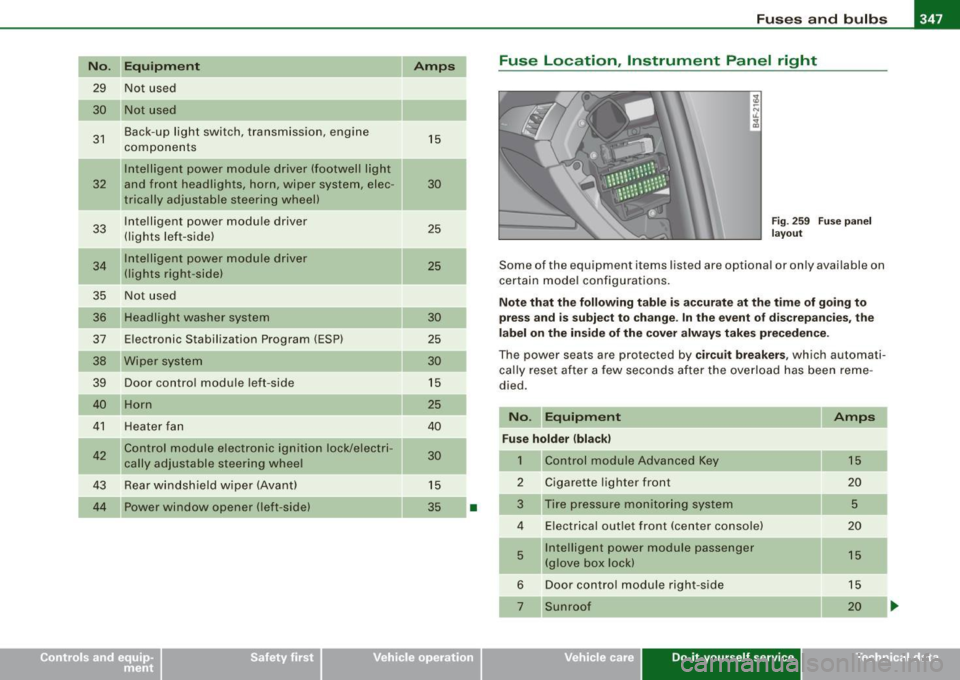
Fuse Location , Instrument Panel right
Fig . 2 59 F use p an el
la yo ut
Some of the equipm ent items lis ted are op tional or on ly available on
certain m ode l configu rations.
Note that the following table is ac curate at the time of g oing to
press and is subject t o change . In the ev ent of d iscrepan cies , th e
l a b el on t he in side of the cover alw ay s take s prec eden ce.
Th e power seats are pr otected by circuit breaker s, which automa ti
ca lly reset after a few seconds a fter the ove rload has been reme
died .
No. Equipment Amps
Fu se holder (bla ck )
1 Control module Advanced Key 15
2 Cigarette
lighter front
20
3 Tire pressure moni tor ing system
5
4 E lectrica l outlet front (center conso le) 20
5 Intellige
nt power module passenger
15
(glove box lock)
6 Door control module right -side 15
Sunroof 20
Vehicle care Do-it-yourself service irechnical data
Page 376 of 390
llffl __ A_ l..:,. p _ h_ a_ b_e _t_ic _ a_l _in _ d_e_ x ____________________________________________ _
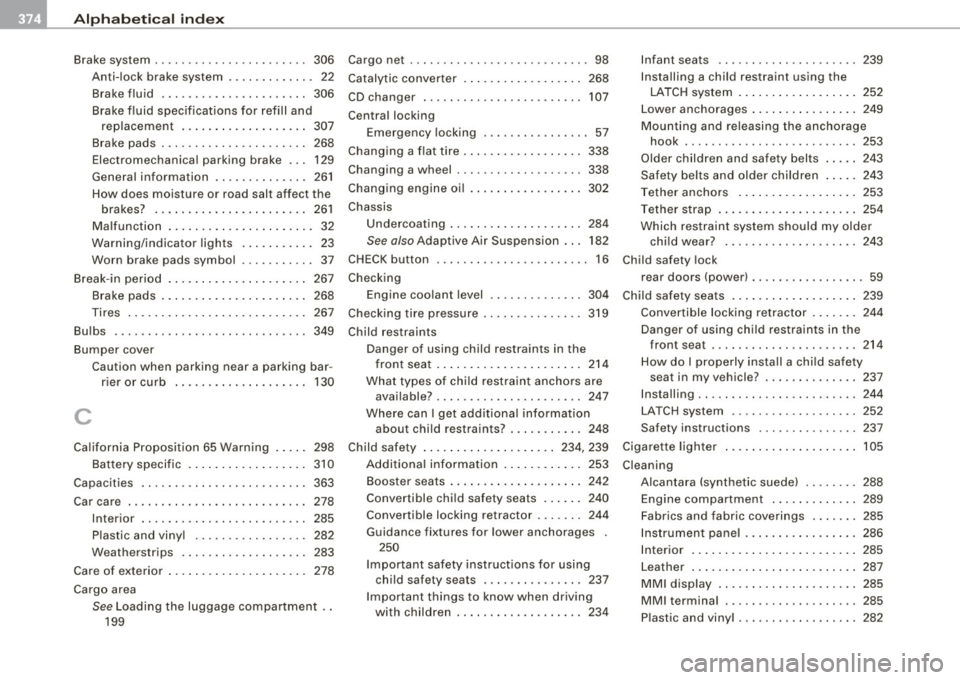
Brake system . . . . . . . . . . . . . . . . . . . . . . . 306
Anti-lock brake system . . . . . . . . . . . . . 22
Brake fluid . . . . . . . . . . . . . . . . . . . . . . 306
Brake fluid specifications for refill and replacement . . . . . . . . . . . . . . . . . . . 307
Brake pads . . . . . . . . . . . . . . . . . . . . . . 268
Electromechanical parking brake ... 129
General information .............. 261
How does moisture or road salt affect the brakes? ....................... 261
Malfunction ........ ... ...... .... . 32
Warning/indicator lights ........... 23
Worn brake pads symbol . . . . . . . . . . . 37
Break -in period . . . . . . . . . . . . . . . . . . . . . 267
Brake pads . . . . . . . . . . . . . . . . . . . . . . 268
Tires .... ... .. .... .... .......... 267
Bu lbs ... .... .. ... ...... ....... .... 349
Bumper cover Caution when parking near a parking bar -
rier or curb ...... ... .... .... ... 130
C
Ca lifornia Proposition 65 Warning 298
Battery specific . . . . . . . . . . . . . . . . . . 310
Capacities ......................... 363
Car care ................. .... .... .. 278
Interior .......... .... .... ...... . 285
Plastic and vinyl .. .... ........... 282
Weatherstrips ....... ........ .... 283
Care of exterior .... ....... .......... 278
Cargo area
See Loading the luggage compartment ..
199 Cargo net
.... .... ... ........ ...... .. 98
Catalytic converter . ........ .... .... . 268
CD changer . . . . . . . . . . . . . . . . . . . . . . . . 107
Central locking Emergency locking . . . . . . . . . . . . . . . . 57
Changing a flat tire ........ .... ... ... 338
Changing a wheel .... .. ..... .. .. .... 338
Changing engine oi l ....... .... ... ... 302
Chassis Undercoating ... .. .... .... .... ... 284
See also Adaptive Aar Suspension . . . 182
CHECK button . . . . . . . . . . . . . . . . . . . . . . . 16
Checking Engine coolant level .............. 304
Checking tire pressure .. ........... .. 319
Child restraints Danger of using child restraints in the front seat ......... ... .... ...... 214
What types of chi ld restraint anchors are
available? . .... ..... ...... .... .. 247
Where can I get additional information
about child restraints? ...... ... .. 248
Child safety ...... ...... .... ... . 234, 239
Additional information ............ 253
Booster seats ................. ... 242
Convertible chi ld safety seats .. .... 240
Convertible locking retractor ....... 244
Guidance fixtures for lower anchorages
250
Important safety instructions for using
child safety seats .... ...... ... .. 237
Important things to know when driving with children ................... 234 Infant
seats ... .... .... ....... .. . 239
Install ing a child restraint using the
LATCH system .. ...... ..... .. ... 252
Lower anchorages ... .. .... .... ... 249
Mounting and releasing the anchorage
hook . ............ ....... .... .. 253
Older children and safety belts ..... 243
Safety belts and older children ..... 243
Tether anchors .. ...... .... ...... 253
Tether strap ... .... .... ...... .... 254
Which restraint system should my older
chi ld wear? ....... ........... .. 243
Child safety lock
rear doors {power) . .... ........ .... 59
Child safety seats .. .... ...... .... ... 239
Convertible locking retractor .. ..... 244
Danger of using child restraints in the
front seat ...................... 214
How do I properly install a child safety
seat in my vehicle? .... ... .... ... 237
Installing .. .. .. .... .... ... .... ... 244
LATCH system ....... ........ .... 252
Safety instructions ............... 237
Cigarette I ig hter . . . . . . . . . . . . . . . . . . . . 105
Cleaning Alcantara {synthetic suede) . ....... 288
Engine compartment ...... .... ... 289
Fabrics and fabric coverings . ...... 285
Instrument panel ....... ........ .. 286
Interior ........... .... .......... 285
Leather ... .... .................. 287
MMI display .............. .... ... 285
MMI terminal .. .... .... ... .... ... 285
Plastic and vinyl ... .... .... .... ... 282
Page 377 of 390
Alphab eti ca l ind ex -
--------------------------'-----
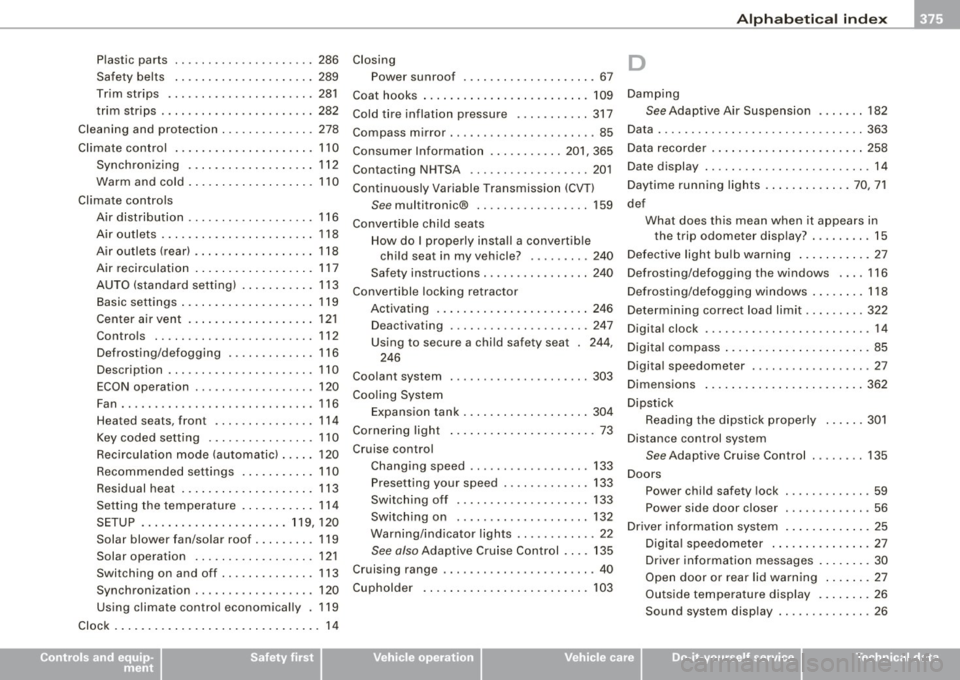
Plastic parts
Safety belts 286
289
Trim strips .... ... ....... ..... .. . 281
trim strips .... ........... ........ 282
Cleaning and protection .. .... ... ..... 278
Climate control ... .... .... .... .... .. 110
Synchronizing .. .... .... .... ..... 112
Warm and cold ........ .... .... ... 110
Climate controls Air distribution ........... .... .... 116
Air outlets ..... .. .... .... ...... .. 118
Air outlets (rear) ...... ....... .... . 118
Air recirculation .... .... .... .... .. 117
AUTO (standard setting) . .... .... .. 113
Basic settings . . . . . . . . . . . . . . . . . . . . 119
Center air vent ...... .... ....... .. 121
Controls ............. .... ....... 112
Defrosting/defogging . .... ... .... . 116
Description ... ..... .. .... ...... .. 110
ECON operation . . . . . . . . . . . . . . . . . . 120
Fan . .......... ...... .... ...... .. 116
Heated seats, front .... ... .... .... 114
Key coded setting ................ 110
Recirculation mode (automatic) ... .. 120
Recommended settings . .... .... .. 110
Residual heat .. ...... .... ...... .. 113
Setting the temperature . .... .... .. 114
SETUP ......... .... ... .. .... 119, 120
Solar blower fan/solar roof .. ...... . 119
Solar operation ... ........... .... 121
Switching on and off .. .... ...... .. 113
Synchronization .. .... ........... . 120
Using climate control economically . 119
Clock ......... ........ .... ... .... ... 14
Controls and equip
ment Safety first
Closing D
Power sun roof
. . . . . . . . . . . . . . . . . . . . 67
Coat hooks ... .... .... .... .... ... ... 109 Damping
Cold tire inflation pressure ....... .... 317
See Adaptive Air Suspension ...... . 182
Compass mirror .. ... ..... ... .... ... .. 85 Data ..
... .... .... .... ... .... .... ... 363
Consumer Information ......... .. 201, 365 Data recorder ..
...... .... ...... .... . 258
Contacting NH TSA .. .. .. ... ... .... .. 201 Date display
........... ........ ...... 14
Continuously Variable Transmission (CVT) Daytime
running lights ... .... .... .. 70, 71
See multitronic® .. .... .... .... ... 159 def
Convertible chi ld seats What does this mean when it appears in
How do I properly install a convertib le the trip odometer display? .
.... .... 15
child seat in my vehicle? ......... 240 Defective light bu
lb warning .... .... ... 27
Safety instructions ................ 240 Defrosting/defogging the windows .... 116
Convertible locking retractor Defrosting/defogging windows ..... ... 118
Activating .......... .... .... .... . 246
Determin ing correct load limit ........ . 322
Deactivating . .... .... ... ..... ... . 247
Digital clock ..... ..... ...... .... .... . 14
Using to secure a chi ld safety seat . 244,
246
Coolant system ..................... 303 Digital compass
... .. .... .... .... ..... 85
Digita l speedometer ........... ....... 27
Dimensions .... .... .... ........... . 362
Coo ling System
Expansion tank .. .... .... ... .. .... 304
Cornering light .... ... .... .... ... .. .. 73
Cruise control
Changing speed .................. 133
Presetting your speed ............. 133
Switching off .................... 133
Switching on .................... 132
Warning/indicator lights .. .... ...... 22
See also Adaptive Cruise Control . ... 135
Cruising range ......... ...... .... ... . 40
Cupholder . ... .. ...... ....... .... .. 103 Dipstick
Reading the dipstick properly .... .. 301
Distance control system
See Adaptive Cruise Control ........ 135
Doors Power child safety lock . ........ .... 59
Power side door closer ............. 56
Driver information system ...... .... . .. 25
Digita l speedometer . .. .. . ... .... .. 27
Driver information messages . .... ... 30
Open door or rear lid warning .... ... 27
Outside temperature display ...... .. 26
Sound system display .. .... .... .... 26
Vehicle operation Vehicle care Do-it-yourself service Technical data