child seat AUDI S6 2008 Workshop Manual
[x] Cancel search | Manufacturer: AUDI, Model Year: 2008, Model line: S6, Model: AUDI S6 2008Pages: 390, PDF Size: 88.42 MB
Page 251 of 390
Lower anchorages and tether for
children (LATCH)
Location
LATCH is the acronym for Lower Anchor and Tethers for
Children and designates a special child safety seat
restraint system. In Canada, the terms "top tether" with
"lower universal anchorages" (or "lower universal
anchorage bars") are used to describe the system.
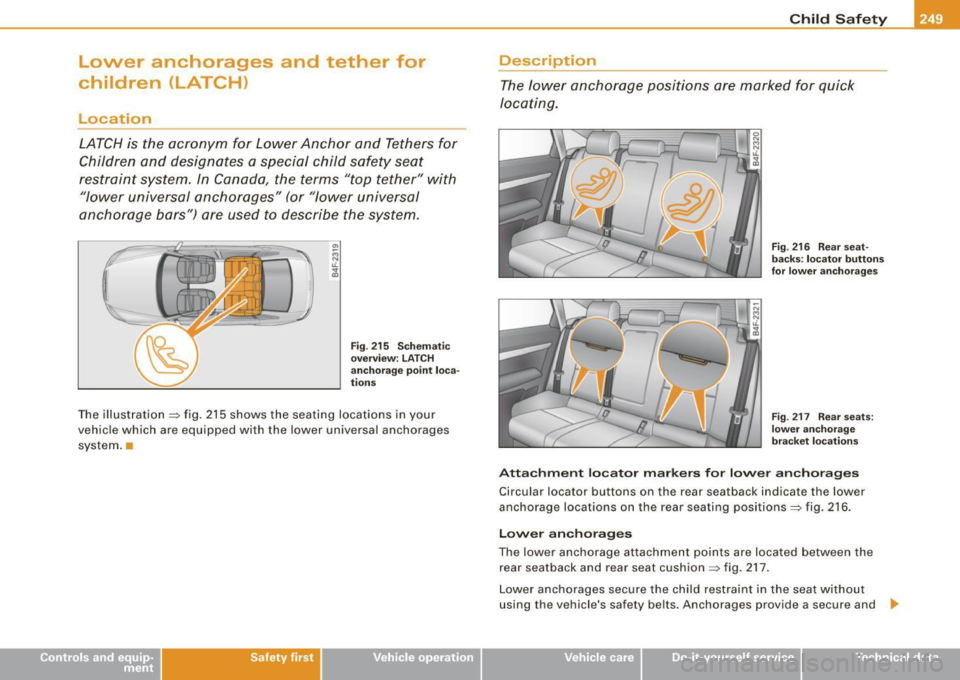
Fig . 215 Schematic
overview: LATCH
anchorage point loca
tions
The illustration =:> fig. 215 shows the seating locations in your
vehicle which are equipped with the lower universal anchorages
system. •
Safety first
Child Safety
Description
The lower anchorage positions are marked for quick
locating.
Fig . 216 Rear seat
backs: locator buttons
for lower anchorages
Fig . 217 Rear seats:
lower anchorage
bracket locations
Attachment locator markers for lower anchorages
Circular locator buttons on the rear seatback indicate the lower
anchorage locations on the rear seating positions=:> fig. 216.
Lower anchorages
The lower anchorage attachment points are located between the
rear seatback and rear seat cushion=:> fig. 217.
Lower anchorages secure the child restraint in the seat without
using the vehicle's safety belts. Anchorages provide a secure and
~
Vehicle care I I Technical data
Page 252 of 390
___ C_h_ i_ld _ S_ a_ f_ e_ t-= y'------------------------------------------------
easy-to-use attachment and minimize the possibility of improper
child restraint installation.
All child restraints manufactured after September 1, 2002, must have lower anchorage attachments for the LATCH system.
Please remember that the lower anchorage points are only intended
for installation and attachment of child restraints specifically certi
fied for use with LATCH lower anchorages. Child restraints that are
not equipped with the lower anchorage attachments can still be
installed in compliance with the child restraint manufacturer's
instructions on using vehicle safety belts.
& WARNING
Improper installation of child restraints will increase the risk of
injury in a crash.
• Always carefully follow the child restraints manufacturer's
instructions for proper installation of the child restraint and
proper use of the lower anchorages or safety belts in your vehicle.
• Never secure or attach any luggage or other items to the
LATCH
lower anchorages.
• Always read and heed the important information about child
restraints in this chapter and WARNINGS
~ page 234, "Child
Safety". •
Guidance fixtures for lower anchorages
Special guidance fixtures increase the convenience of the
lower anchorages and are available from your authorized
Audi dealer.
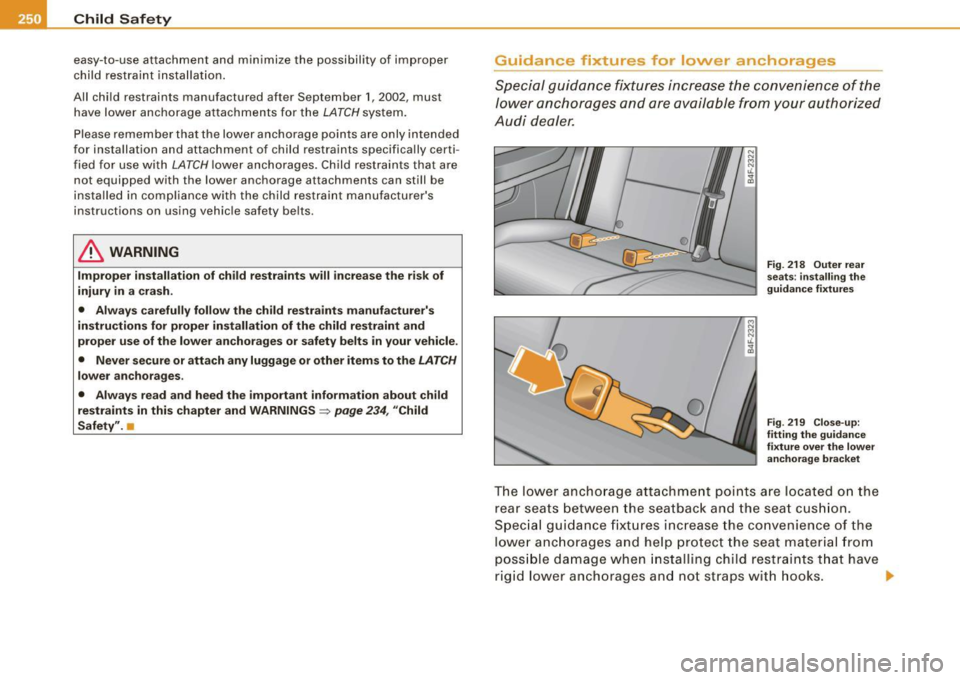
Fig. 218 Outer rear
seats : installing the
guidance fixtures
Fig. 219 Close-up:
fitting the guidance
fixture over the lower
anchorage bracket
The lower anchorage attachment points are located on the
rear seats between the seatback and the seat cushion.
Special guidance fixtures increase the convenience of the
lower anchorages and help protect the seat material from
possible damage when installing child restraints that have
rigid lower anchorages and not straps with hooks. _,.
Page 253 of 390
--------------------------------------------~C=-- h :....:..:..:. il..:.:d _S.:... a _ fe_t~ Y:,___ _1111
Inst alling th e guidan ce fixtur es
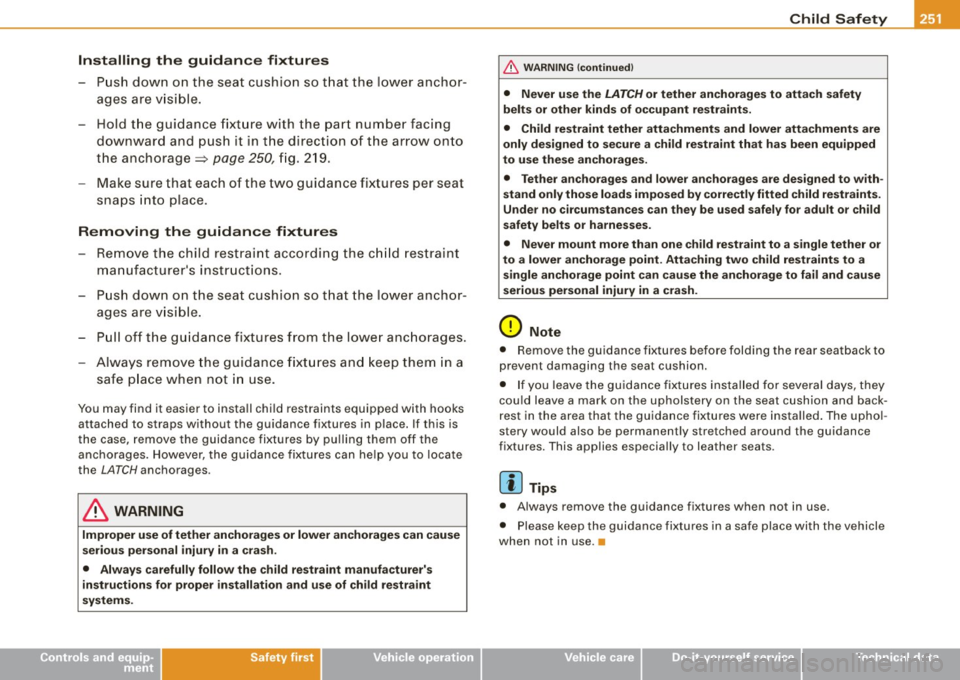
- Push down on the seat cushion so t hat the lower anchor
ages are v isib le.
- Hold t he guidance fixt ure with the part number facing
downward and push it in the direction of the arrow on to
the anchorage => page
250, fig. 2 19.
- Make sure that each of the two guidance fixtures per seat
snaps into place.
Removing the guidance fixtures
- Remove the child restrai nt according the c hild restraint
m an ufacturer's instr uctions.
- Pu sh down on the seat cushion so t hat the lower anchor
ages are v isible.
- Pu ll off the gu idance fixtures from the lowe r anc horages.
- Always remove the guidance fixt ure s an d keep them in a
safe p lace when not in use.
You may find it easier to insta ll chi ld restraints equipped with hooks
attached to straps without the guidance fixtures in place. If this is
the case, remove the guidance fixtures by pu lling them off the
anchorages . However, the guidance fix tures can he lp you to locate
the
LATCH anchorages.
& WARNING
Improper use of teth er anchorage s or lowe r anchorages can caus e
s erio us personal inju ry
in a cra sh .
• Alway s carefully follow the child re straint manufa cturer' s
in struct ions for proper inst allati on a nd u se of ch ild restraint
sy stems .
Controls and equip ment Safety first Vehicle operation
& W
AR N IN G ( continued )
• Never use the LATCH or tether an chorage s to att ach safety
b elt s or other kinds of o ccup ant re str aints .
• Child restraint tether attachment s and lower atta chments are
onl y designed to secure a child re str aint th at h as been equipped
to u se these anchorages.
• Tether anchor age s a nd lower an chorages are de signed to with
s tand only those loads impos ed by correctly fitted child r estraints.
Unde r no circum stan ces can they be u sed safel y for adult or child
safety belt s or harne sses .
• Neve r mount more than one ch ild rest raint to a single tether or
to a lower anchorage point . Atta ching two child r estraints to a
s ingle an chorage point can cause the anchorage to fail and cause
s erio us per sonal injury in a crash .
0 Note
• Remove the guidance fixtures before folding the rear seatback to
prevent damaging the seat cushion.
• I f you leave the guidance fixtures insta lled for several days, they
cou ld leave a mark on the upholstery on the seat cushion and back
rest in the area that the guidance fi xtures were insta lled . The uphol
stery would also be permanently stretched around the guidance
fixtures. This applies especially to leather seats.
[ i ] Tip s
• Always remove the guidance fixtures when not in use.
• Please keep the guidance fixtures in a safe place with the vehicle
when not in use .•
Vehicle care Do-it-yourself service Technical data
Page 254 of 390
Ill Child Safety ___ ,.__ ____________ _
Installing a chi ld restraint using the lower
anc horages of the LA TCH system
Child safety seats equipped with the LATCH system can
quickly and easily be secured to the rear seats.
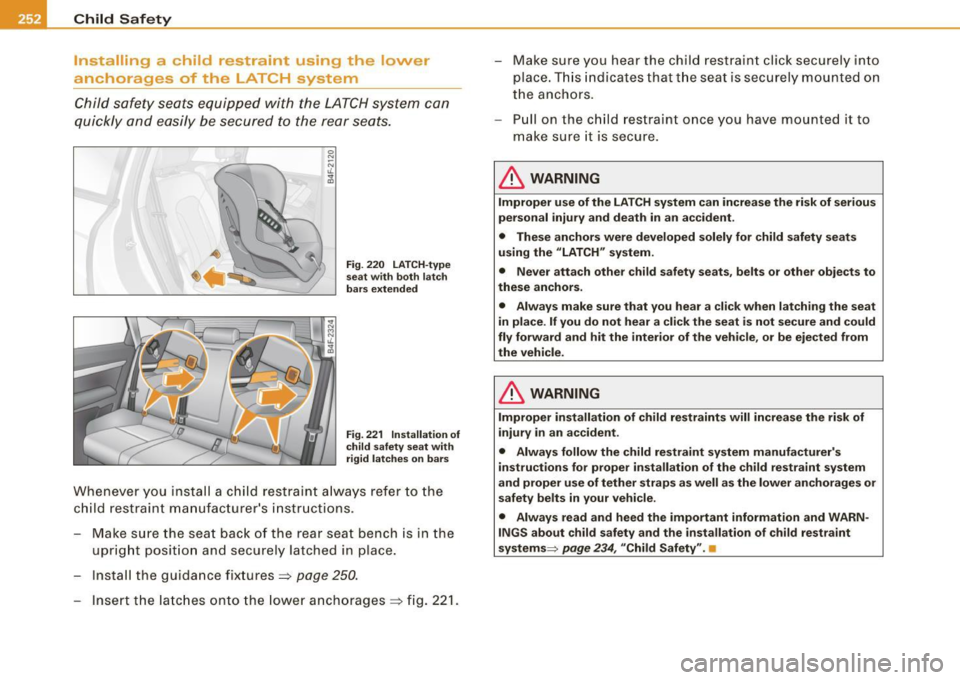
0 N ;::; ,L
i
Fig. 220 LATCH-type
seat with both latch
bars extended
Fig. 221 Installation of
child safety seat with
rigid latches on bars
Whenever you install a child restraint always refer to the
child restraint manufacturer's instructions.
Make sure the seat back of the rear seat bench is in the
upright position and securely latched in place.
I nstall the guidance fixtures==>
page 250.
- Insert the latches onto the lower anchorages ==> fig. 221 . - Make sure you hear the child restra
int click securely into
place. This indicates that the seat is securely mounted on
the anchors.
- Pull on the child restraint once you have mounted it to
make sure it is secure .
& WARNING
Improper use of the LATCH system can increase the risk of serious
personal injury and death in an accident.
• These anchors were developed solely for child safety seats
using the "LATCH" system.
• Never attach other child safety seats, belts or other objects to
these anchors.
• Always make sure that you hear a click when latching the seat
in place. If you do not hear a click the seat is not secure and could
fly forward and hit the interior of the vehicle, or be ejected from
the vehicle.
& WARNING
Improper installation of child restraints will increase the risk of
injury in an accident.
• Always follow the child restraint system manufacturer's
instructions for proper installation of the child restraint system
and proper use of tether straps as well as the lower anchorages or
safety belts in your vehicle.
• Always read and heed the important information and WARN
INGS about child safety and the installation of child restraint
systems :::> page
234, "Child Safety". •
Page 255 of 390
Mounting and releasing the anchorage hook
If you use a child restraint system with hooks or other
latches attached to adjustable straps.
Mounting
- Press the anchorage hook wit h the spring catch re lease
onto the lower anchorage so that the anchorage hook locks into place .
- Pull on the anchorage hook to make sure that it has
securely engaged the lower anchorage.
- Tighten the strap following the child restraint manufac
turer 's instructions.
Releasing
- Loosen the tens ion on the strap following the child
restraint manufacturer's instructions .
- Depress the spring catch on the hook. - Hold the spring catch in depressed posit ion .
- Move the hook in the direction of the vehicle floor so that
there is enough space to release the anchorage hook
from the lower anchorage.
& WARNING
• Improper installation of child restraints will increase the risk of
injuries in a crash.
• Always refer to the child restraints manufacturer's instructions
for proper instaHation of the child restraint and proper use of the
lower anchorages or safety belts in your vehicle. •
Safety first
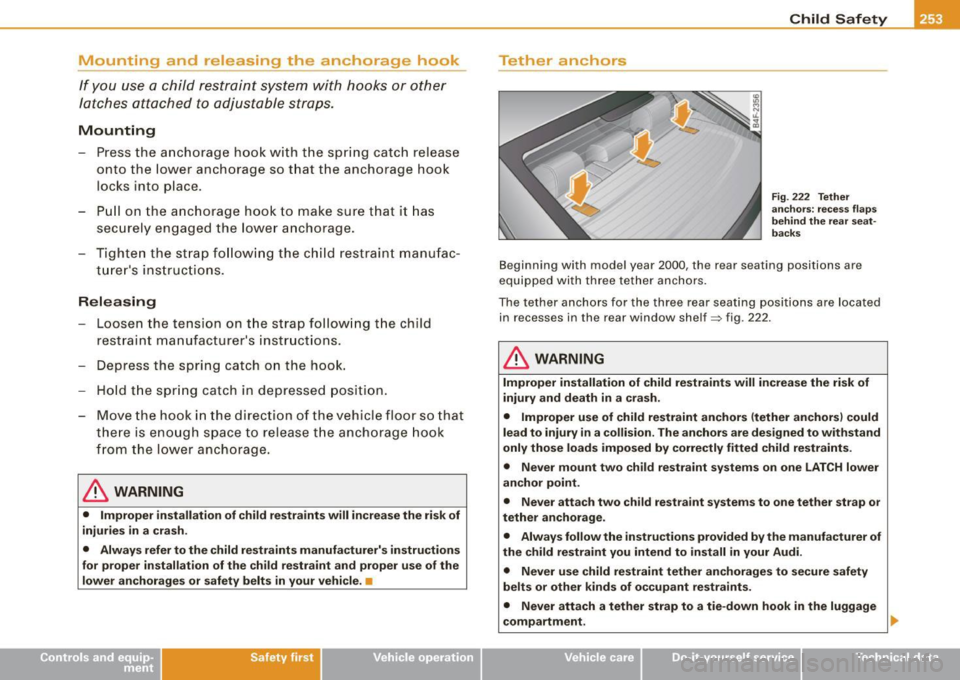
Tether anchors
Child Safety
Fig. 222 Tether
anchors: recess flaps
behind the rear seat
backs
B eginning with mod el year 2000 , th e re ar sea ting posi tions are
equipped with three tether anchors.
The tether anchors for the three rear seating positions are located in r ecess es in the r ear window shelf~ fig . 222.
& WARNING
Improper installation of child restraints will increase the risk of
injury and death in a crash.
• Improper use of child restraint anchors (tether anchors) could
lead to injury in a collision. The anchors are designed to withstand
only those loads imposed by correctly fitted child restraints.
• Never mount two child restraint systems on one LATCH lower
anchor point.
• Never attach two child restraint systems to one tether strap or
tether anchorage.
• Always follow the instructions provided by the manufacturer of
the child restraint you intend to install in your Audi.
• Never use child restraint tether anchorages to secure safety
belts or other kinds of occupant restraints.
• Never attach a tether strap to a tie-down hook in the luggage
compartment.
Vehicle care I I irechnical data
Page 256 of 390
___ C_h_ i_ld _ S_ a_ f_ e_ t-= y'------------------------------------------------
& W ARNING (continued )
• Never secure or attach any luggage or other items to the LATCH
lower anchorages or to the tether anchors.
• If a tether or other strap is used to attach a child restraint to the
front passenger seat, make sure that it is not so tight, that it
causes the weight-sensing mat to measure more weight than is
actually on the seat .
• The heavier weight registered can make the system work as
though an adult were on the seat and deploy the Advanced Airbag
when it must be suppressed causing serious or even fatal injury to
the child .•
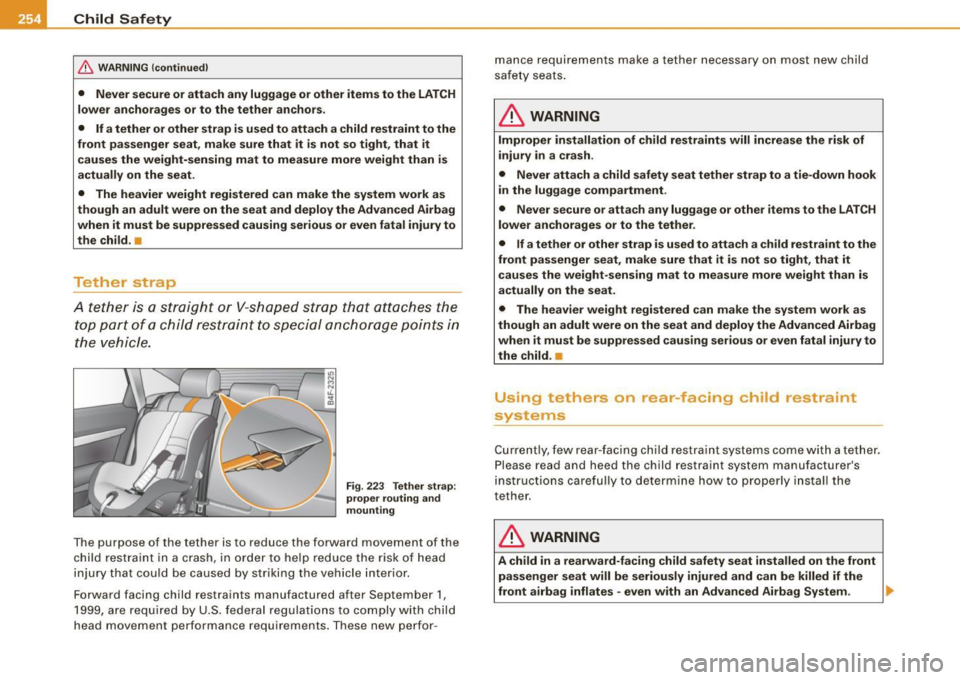
T et her strap
A tether is a stra ig h t or V-shape d strap that atta ches the
top part of a ch ild restraint to sp ecial anchorage po ints in
th e v ehicl e.
Fig . 223 Tether strap :
prope r routing and
mounting
T he purpose of the tether is to reduce the forward movement of t he
ch ild res trai nt in a cras h, in or der t o help re duce t he risk o f head
injury that cou ld b e caused by striking t he vehicle interior.
Forward facing child rest raints manufactured after September 1,
19 99, are require d b y U.S . f edera l reg ulatio ns to comp ly with c hild
head movement performance requirements . These new pe rfor- mance requirements ma
ke a tether necessary on most new child
sa fe ty seats .
& WARNING
Improper installation of child restraints will increase the risk of
injury in a crash .
• Never attach a child safety seat tether strap to a tie -down hook
in the luggage compartment .
• Never secure or attach any luggage or other items to the LATCH
lower anchorages or to the tether.
• If a tether or other strap is used to attach a child restraint to the
front passenger seat , make sure that it is not so tight , that it
causes the weight-sensing mat to measure more weight than is
actually on the seat.
• The heavier weight registered can make the system work as
though an adult were on the seat and deploy the Advanced Airbag
when it must be suppressed causing serious or even fatal injury to
the child .•
Us ing tethe rs on rear.facing chi ld restra int
systems
C ur ren tly , few r ear-faci ng child re stra int s ystems co me with a tether.
P lease read and heed the ch ild restra int system manufactur er's
i n str uct ions care full y to d ete rmin e ho w to prop erly i nsta ll th e
tether.
& WARNING
A child in a rearward-facing child safety seat installed on the front
passenger seat will be seriously injured and can be killed if the
front airbag inflates -even w ith an Advanced Airbag System . ._
Page 257 of 390
& WARNING !continued)
• The inflating airbag will hit the child safety seat or infant
carrier with great force and will smash the child safety seat and
child against the backrest, center arm rest, or door .
• A tight tether or other strap on a rearward-facing child restraint
attached to the front passenger seat can put too much pressure
on the weight -mat in the seat and register a heavier weight in the
Advanced Airbag System. The heavier weight registered can make
the system work as though an adult were on the seat and deploy
the Advanced Airbag when it must be suppressed causing serious
or even fatal injury to the child.
• If you must install a rearward facing child safety seat on the
front passenger seat because of exceptional circumstances and
the PASSENGER AIR BAG OFF light does not come on and stay on,
immediately install the rear-facing child safety seat in a rear
seating position and have the airbag system inspected by your
Audi dealer. •
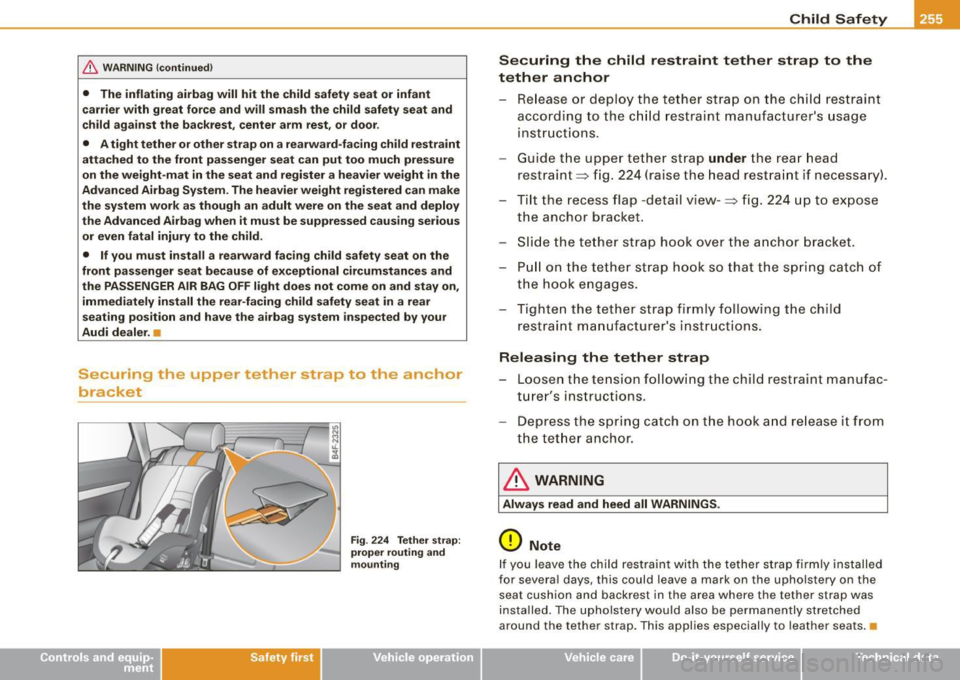
Securing the upper tether strap to the anchor
bracket
Safety first
Fig. 224 Tether strap:
proper routing and
mounting
Child Safety
Securing the child restraint tether strap to the
tether anchor
- Release or deploy the tether strap on the child restraint
according to the child restraint manufacturer's usage
instructions.
Guide the upper tether strap
under the rear head
restraint ~ fig. 224 (raise the head restraint if necessary) .
- Tilt the recess flap -detail view-:::;, fig. 224 up to expose
the anchor bracket .
- Slide the tether strap hook over the anchor bracket.
- Pull on the tether strap hook so that the spring catch of
the hook engages.
- Tighten the tether strap f irmly following the child
restraint manufacturer's instructions.
Releasing the tether strap
- Loosen the tension following the child restraint manufac
turer's instructions.
- Depress the spring catch on the hook and release it from
the tether anchor.
& WARNING
Always read and heed all WARNINGS.
0 Note
If you leave the child restraint with the tether strap firmly installed
for several days, this could leave a mark on the upholstery on the seat cushion and backrest in the area where the tether strap was
installed. The upholstery would also be permanently stretched
around the tether strap. This applies especially to leather seats.•
Vehicle care
I I irechnical data
Page 289 of 390
_____________________________________________ C_ l_ e _a_ n_ in_ g_a _ n_d_ p_ r_ o_ t _e_ c_t _io _ n __ lll
•
consider if children, anima ls or other factors m ight prove to be
partic ularly hard on the leather.
By contrast, leather types that are covered by a colored finish layer
are more durable. This has a positive effect on the leather 's resis
tance to wear and soiling in da ily use. On the ot her hand, the typica l
characteristics of natural leather are barely or not apparent.
However, this does not mean that the leather itself is of inferior
quality .
Care and h andling
Because of the exclusive nature of the types of leather that Audi
uses and their unique properties (such as sensitivity to oils, grease,
soiling, etc.l, you will need to be somewhat careful with these
lea thers, and a cer tain type of care is requ ired . For example, dark
clothing materials can discolor leather seats (especial ly if such
clothing is damp and was not dyed correctly). Dust and dirt par ticles
in pores , folds, and seams can have an abrasive effect and can
damage the leather surface as well as weaken seams .
The leather shou ld be c leaned regularly as needed . After having
been used for a relatively long time , your leather seats will acquire
a rich aged finish . This is a characteristic of natural leather and a
sign of true qua lity.
I n order to maintain the value of this natural p roduc t over the life of
your vehic le, you should fo llow the recommendations below :
0 Note
• To keep your leather from b leaching out, do not allow it to be
exposed to bright sun light for long per iods of time . If you have to
leave the vehicle parked outside for long periods, cover the leather
to protect it from direct exposure to sunlight.
• Sharp ob jects on c lothing, such as zippers, rivets or sharp pieces
on belts can leave permanent scratches or sc rape marks on the
surface of t he leather.
[ i ] Tip s
• After each time you clean the leathe r and at regular intervals, use
a leather preservative creme that contains UV -blockers and that
works into the leather . This creme wil l nour ish and moisturize the
leather, helping it to breathe and stay supple . It a lso helps to build
up a protect ive coating on the sur face .
• Clean the leather every 2 -3 months, and c lean any areas that get
soiled.
• Remove fresh marks made by ballpoint pens, ink, lipstick, shoe
polish, etc . as soon as possible .
• Preserve the co lor of the leather as needed by using a special
colored leather care creme to touch up areas of uneven co lor. •
App lies to ve hic les : w ith n atura l le at he r
Cleaning and caring for leather upholstery
and trim
Natural leather requires special care and atten tion .
Normal cleaning
Clean so iled areas wi th a slightly mo is tened cot to n or
woole n cloth.
More stubborn dirt
- More stub born dirt can be removed using a cloth satu
rated wi th a mild soap solut io n (2 tab lespoons mild
liq uid soap) .
- Neve r allow the soap solution to sa turate the leathe r, and
make certain that no water soaks i nto the seams .
Wipe off the soap solution with a soft, dry cloth. .,,
Vehicle care I t •
Page 374 of 390
-Alphabetical index ..,,,_.:_.__ ____ _...::.:...::..;.:___ ________________ _
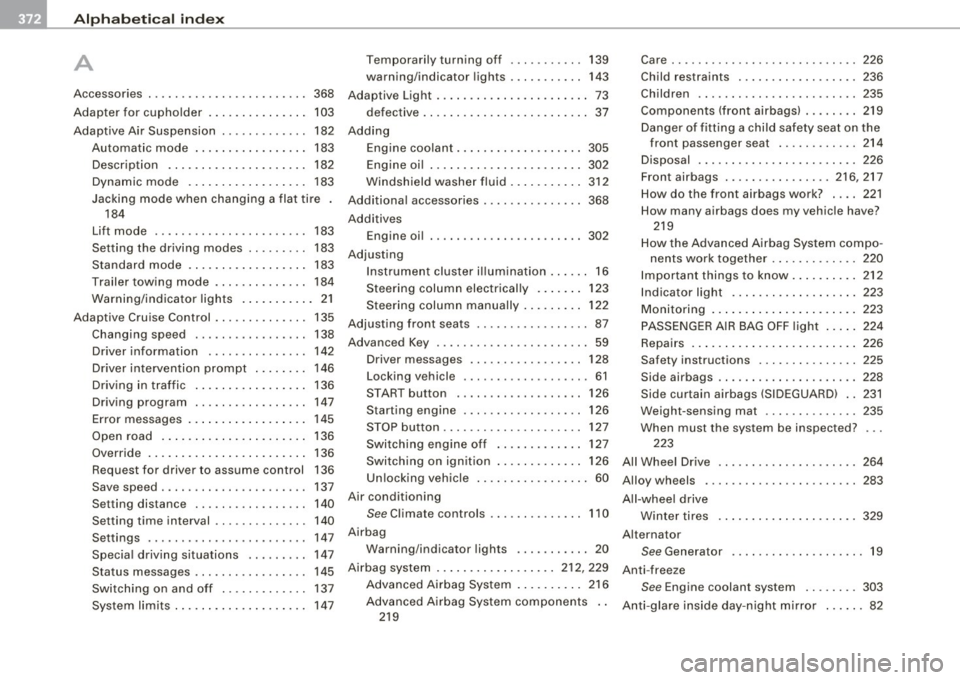
A
A . ccessones ............. .... .... .. .
Adapter for cupholder ..... ...... ... . 368
103
Ad . A' S .
apt1ve 1r uspens1on .. .... ... .... 182
Automatic mode . . . . . . . . . . . . . . . . . 183
Description . . . . . . . . . . . . . . . . . . . . . 182
Dynamic mode . . . . . . . . . . . . . . . . . . 183
Jacking mode when changing a flat tire .
184
Lift mode . . . . . . . . . . . . . . . . . . . . . . . 183
Setting the driving modes .. .... ... 183
Standard mode . . . . . . . . . . . . . . . . . . 183
Trailer towing mode ... .... .... ... 184
Warning/indicator lights ....... .... 21
Adaptive Cruise Control . . . . . . . . . . . . . . 135
Changing speed .. ........... .... 138
Driver information ............... 142
Driver interven tion prompt ........ 146
Driving in traffic ...... .... ...... . 136
Driving program ...... .... .... ... 147
Error messages . . . . . . . . . . . . . . . . . . 145
Open road . . . . . . . . . . . . . . . . . . . . . . 136
Override . . . . . . . . . . . . . . . . . . . . . . . . 136
Request for driver to assume control 136
Save speed . . . . . . . . . . . . . . . . . . . . . . 137
Setting distance . . . . . . . . . . . . . . . . . 140
Setting time interval .. .. .......... 140
Settings . . . . . . . . . . . . . . . . . . . . . . . . 147
Specia l driving situations ......... 147
Status messages . . . . . . . . . . . . . . . . . 145
Switching on and off .. .... ... .... 137
System limits ...... .... .......... 147
Tempor arily turning off ... ...... .. 139
warning/indicator lights .... ...... . 143
Adaptive Light ......... ... .... .... ... 73
defective .......... .... ..... .. .... 37
Adding
Engine coolant ......... ... .... ...
305
Engine oil ... .. ...... ....... ..... 302
Windshield washer fluid .... .... ... 312
Additional accessories .... .... .... ... 368
Additives
Engine oil ... .. ..... .. ...... .....
302
Adjusting
Instrument cluster i llumination ......
16
Steering column electrically .... ... 123
Steering column manually ...... ... 122
Ad' . f Justing ront seats .. .... .... .... ... 87
Advanced Key ...... .. .... ........... 59 Care
........ ..... ....... ... .. ...
226
Child restraints .................. 236
Children ....... ....... .... ..... . 235
Components (front airbags) ........ 219
Danger of fitting a chi ld safety seat on the
front passenger seat .. ..... .. ...
214
Disposal ............ .. .... ...... 226
Fron t airbags ...... .... .... .. 216, 217
How do the front airbags work? . ... 221
How many airbags does my vehicle have?
219
How the Advanced Airbag System compo -
nents work together . . . . . . . . . . . . .
220
Important things to know ... ..... .. 212
Indicato r light ...... ... .. .... .... 223
Monitoring .... .... .... ...... .... 223
PASSENGER AIR BAG OFF light ..... 224
Repairs ..... .. .... .... ... ... ... . 226
Driver messages . . . . . . . . . . . . . . . . .
128 Safety instructions .... .... .... ... 225
Locking vehicle ................. .. 61 Side airbags ... .... .... ... ... ... . 228
START button ................... 126 Side curtain airbags (SIDEGUARD) .. 231
Starting engine ........ ..... .. ... 126 Weight-sensing mat .. ....... ..... 235
STOP button .... ... .... .... ...... 127 When must the system be inspected? .. .
Switching engine off ...... .... ...
127 223
Switching on ignition ...... .... ... 126 All Whee l Drive ... .... .... .......... 264
Unlocking vehicle ........... ...... 60 Alloy wheels . .... .... ....... .... ... 283
Air conditioning
See Climate controls ... .......... . 11 O
Airbag
Warning/indicator lights ..... ......
20
Airbag system ... ... .. .... .... .. 212, 229
Advanced Airbag System ...... .... 216
Advanced Airbag System components
219
All- whee l drive
Winter tires .... ........... .... ..
329
Alternator
See Generator . . . . . . . . . . . . . . . . . . . . 19
Anti -freeze
See Engine coolant system ...... .. 303
Anti-glare inside day-night mirror .... .. 82
Page 376 of 390
llffl __ A_ l..:,. p _ h_ a_ b_e _t_ic _ a_l _in _ d_e_ x ____________________________________________ _
Brake system . . . . . . . . . . . . . . . . . . . . . . . 306
Anti-lock brake system . . . . . . . . . . . . . 22
Brake fluid . . . . . . . . . . . . . . . . . . . . . . 306
Brake fluid specifications for refill and replacement . . . . . . . . . . . . . . . . . . . 307
Brake pads . . . . . . . . . . . . . . . . . . . . . . 268
Electromechanical parking brake ... 129
General information .............. 261
How does moisture or road salt affect the brakes? ....................... 261
Malfunction ........ ... ...... .... . 32
Warning/indicator lights ........... 23
Worn brake pads symbol . . . . . . . . . . . 37
Break -in period . . . . . . . . . . . . . . . . . . . . . 267
Brake pads . . . . . . . . . . . . . . . . . . . . . . 268
Tires .... ... .. .... .... .......... 267
Bu lbs ... .... .. ... ...... ....... .... 349
Bumper cover Caution when parking near a parking bar -
rier or curb ...... ... .... .... ... 130
C
Ca lifornia Proposition 65 Warning 298
Battery specific . . . . . . . . . . . . . . . . . . 310
Capacities ......................... 363
Car care ................. .... .... .. 278
Interior .......... .... .... ...... . 285
Plastic and vinyl .. .... ........... 282
Weatherstrips ....... ........ .... 283
Care of exterior .... ....... .......... 278
Cargo area
See Loading the luggage compartment ..
199 Cargo net
.... .... ... ........ ...... .. 98
Catalytic converter . ........ .... .... . 268
CD changer . . . . . . . . . . . . . . . . . . . . . . . . 107
Central locking Emergency locking . . . . . . . . . . . . . . . . 57
Changing a flat tire ........ .... ... ... 338
Changing a wheel .... .. ..... .. .. .... 338
Changing engine oi l ....... .... ... ... 302
Chassis Undercoating ... .. .... .... .... ... 284
See also Adaptive Aar Suspension . . . 182
CHECK button . . . . . . . . . . . . . . . . . . . . . . . 16
Checking Engine coolant level .............. 304
Checking tire pressure .. ........... .. 319
Child restraints Danger of using child restraints in the front seat ......... ... .... ...... 214
What types of chi ld restraint anchors are
available? . .... ..... ...... .... .. 247
Where can I get additional information
about child restraints? ...... ... .. 248
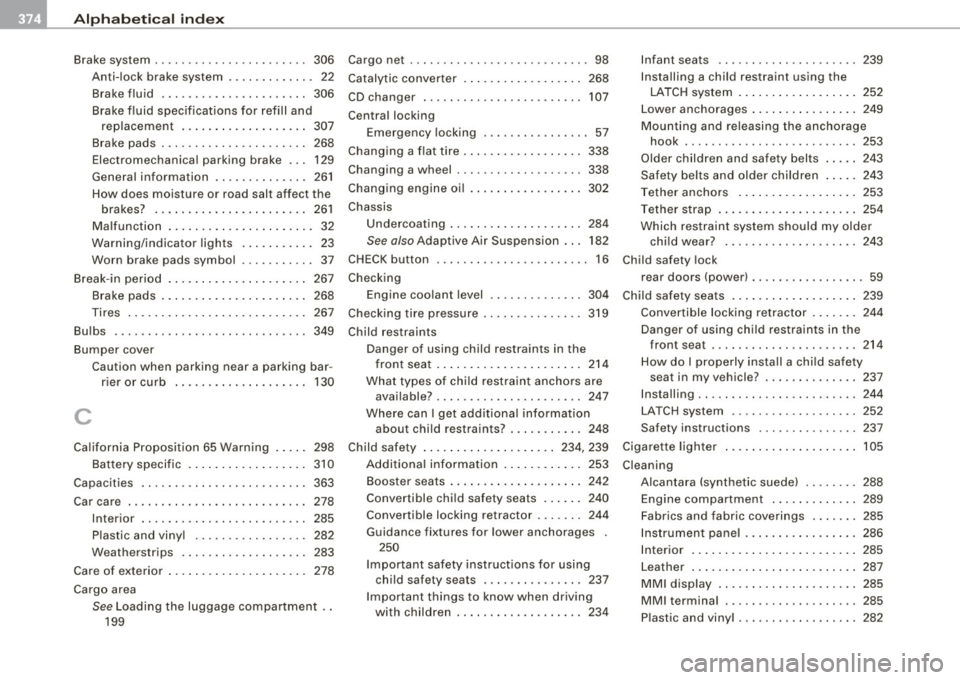
Child safety ...... ...... .... ... . 234, 239
Additional information ............ 253
Booster seats ................. ... 242
Convertible chi ld safety seats .. .... 240
Convertible locking retractor ....... 244
Guidance fixtures for lower anchorages
250
Important safety instructions for using
child safety seats .... ...... ... .. 237
Important things to know when driving with children ................... 234 Infant
seats ... .... .... ....... .. . 239
Install ing a child restraint using the
LATCH system .. ...... ..... .. ... 252
Lower anchorages ... .. .... .... ... 249
Mounting and releasing the anchorage
hook . ............ ....... .... .. 253
Older children and safety belts ..... 243
Safety belts and older children ..... 243
Tether anchors .. ...... .... ...... 253
Tether strap ... .... .... ...... .... 254
Which restraint system should my older
chi ld wear? ....... ........... .. 243
Child safety lock
rear doors {power) . .... ........ .... 59
Child safety seats .. .... ...... .... ... 239
Convertible locking retractor .. ..... 244
Danger of using child restraints in the
front seat ...................... 214
How do I properly install a child safety
seat in my vehicle? .... ... .... ... 237
Installing .. .. .. .... .... ... .... ... 244
LATCH system ....... ........ .... 252
Safety instructions ............... 237
Cigarette I ig hter . . . . . . . . . . . . . . . . . . . . 105
Cleaning Alcantara {synthetic suede) . ....... 288
Engine compartment ...... .... ... 289
Fabrics and fabric coverings . ...... 285
Instrument panel ....... ........ .. 286
Interior ........... .... .......... 285
Leather ... .... .................. 287
MMI display .............. .... ... 285
MMI terminal .. .... .... ... .... ... 285
Plastic and vinyl ... .... .... .... ... 282