driver seat adjustment AUDI S6 2009 User Guide
[x] Cancel search | Manufacturer: AUDI, Model Year: 2009, Model line: S6, Model: AUDI S6 2009Pages: 398, PDF Size: 43 MB
Page 212 of 398
___ S_a_ f_ e_ t-= y_ b_e_ l_ t _s _______________________________________________ _
-Insert t he tongue into the correct b uckle of y our seat
unt il you h ea r it la tc h securely~ fig. 205.
Pull on t he belt to make sure that it is securely latched in
the buckle.
Aut om ati c sa fe ty belt re tra cto rs
Eve ry safety be lt is equipped with an automatic belt retractor on the
shoulder belt. This feature locks the belt when the belt is pulled out
fast, during hard braking and in an accident. The belt may a lso lock
when you drive up or down a steep hill or through a sharp curve .
During normal driving the belt lets you move free ly.
Safety belt prete nsi oners
The safety belts are equipped with a be lt pretensioner that he lps to
tighten the sa fety be lt and remove slack when the pretensioner is
activated. The function of the pretensioner is monitored by a
warning light=>
page 18 .
Swit chable locking fe ature
Every safety belt except the one on the driver sea t is equipped with
a switchab le locking feature that
must be used when the safety belt
is used to a ttach a chi ld safe ty sea t. Be sure to read the important
information about this feature=>
page 248.
& WARNING
Improper ly positioned safet y belts can cause seriou s inj ury in an
accident =>
page 210 , "S afety belt po sitio n".
• Safet y belts offer opt imum protection on ly when the seat back
i s upright and belt s are properly po sition ed on t he bod y.
• Always make sure that the rear seat backrest to whi ch the
c enter r ear sa fet y belt i s atta ched i s sec ure ly lat ched whe nev er
the rear center saf ety belt i s being us ed. If the ba ckrest is not
s ecu rely lat ched, the pas senge r will mo ve fo rward with the back
rest dur ing sudden braking , in a sudden maneu ver and e spec iall y
in a cra sh.
& W AR N ING (continu ed )
• Never attach the safety belt to the buck le for anothe r seat .
Atta ch ing th e be lt to the wrong buckle will reduce safety belt
e ffe cti venes s and can ca use seriou s per son al injur y.
• A p assenger who i s not prope rly re str ained can be s eriousl y
injured by the saf ety belt it self wh en it m ove s from the stronger
p art s of the body into criti ca l area s like the abd omen .
• Alway s lock the convert ible lo ck ing retractor when you are
s ecu ring a ch ild safety se at in the v ehi cle
=> page 2 50. •
Safety belt position
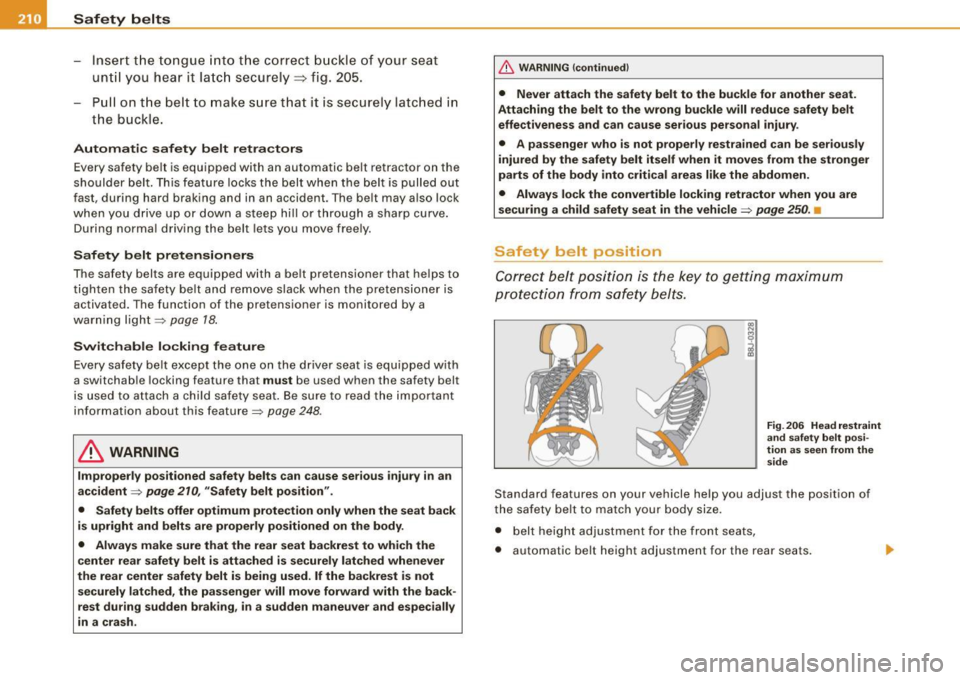
Correct belt posi ti o n is the key to getting maximum
protecti on f rom safety be lts.
Fig . 2 06 He ad r est ra in t
an d sa fe ty b elt p osi
tion a s seen from th e
sid e
Standard features on your vehicle help you adjust the position of
the safety belt to match your body size .
• belt height adjustment for the front seats,
• automatic belt height adjustment for the rear seats.
Page 215 of 398
Safety belts -----------------=------
• With the front seats, the height adjustment of the seat can also
be used to adjust the position of the safety belts. •
Improperly worn safety belts
Incorrectly positioned safety belts can cause severe inju
ries.
Wearing safety belts improperly can cause serious injury or
death. Safety belts can only work when they are correctly positioned on the body. Improper seating posit ions reduce
the effectiveness of safety belts and w ill even increase the
risk of injury and death by moving the safety belt to critical
areas of the body . Improper seating positions also increase
the r isk of serious injury and death when an airbag deploys
and strikes an occupant who is not in the correct seating position. A driver is responsible for the safety of all vehicle
occupants and especially for children. Therefore:
-Never permit anyone to assume an incorrect sitting posi
tion in the vehicle while traveling~& .
& WARNING
Improperly worn safety belts increase the risk of serious personal
injury and death whenever a vehicle is being used.
• Always make sure that all vehicle occupants are correctly
restrained and stay in a correct seating position whenever the
vehicle is being used.
• Always read and heed all WARNINGS and other important infor
mation ::::;,
page 208. •
Controls and equip
ment Safety first Vehicle operation
Safety be
lt pretensioners
How safety belt pretensioners work
In front, side and rear -end collisions above a particular
severity, safety belts are tensioned automatically.
The safety belts are equipped with safety belt pretensioners . The
system is activated by sensors in front, side and rear -end collisions
of great severity . This tightens the belt and takes up belt slack::::;,
6
in "Service and disposal of safety belt pretensioner" on page 214.
Taking up the slack helps to reduce forward occupant movement
during a collision.
0 Note
Never let the belt remain over a rear seat back that has been folded
forward.
[ i] Tips
The safety belt pretensioner can only be activated once.
• In minor frontal, side and rear -end collisions, in a rollover and in
accidents involving very little impact force, the safety belt preten
sioner are not activated .
• When the safety belt pretensioners are activated, a fine dust is
released. This is normal and is not caused by a fire in the vehicle.
• The relevant safety requirements must be observed when the
vehicle or components of the system are scrapped . A qualified deal
ership is familiar with these regulations and will be pleased to pass
on the information to you.
• Be sure to observe all safety, environmental and other regula
tions if the vehicle or individual parts of the system, particularly the
safety belt or airbag, are to be disposed . We recommend you have
your authorized Audi dealer perform this service for you. •
Vehicle care Do-it-yourself service Technical data
Page 217 of 398
Airbag system -----------------=~-rm-I
Airbag system
Important things to know
Importance of wearing safety belts and
sitting properly
Airbags are only supplemental restraints. For airbags to
do their job, occupants must always properly wear their
safety belts and be in a proper seating position.
For your safety and the safety of your passengers, before
driving off, always:
- Adjust the driver's seat and steering wheel properly
~ page 196,
-Adjust the front passenger's seat properly~ page 81,
-Wear safety belts properly~ page 208,
- Always properly use the proper child restraint to protect
children~
page 238.
In a collision, airbags must inflate within the blink of an eye and with
considerable force . The supplemental airbags can cause injuries if
the driver or the front seat passenger is not seated properly. There
fore in order to help the airbag to do its job, it is important, both as
a driver and as a passenger to sit properly at all times.
By keeping room between your body and the steering wheel and the
front of the passenger compartment, the airbag can inflate fully and
completely and provide supplemental protection in certain frontal
collisions =>
page 196, "Proper occupant seating positions". For
details on the operation of the seat adjustment controls=>
page 81.
It's especially important that children are properly restrained
=>
page 238.
Controls and equip ment Safety first Vehicle operation
There is a lot that the driver and the passengers can and must do to
help the individual safety features installed in your Audi work
together as a system .
Proper seating position is important so that the front airbag on the
driver side can do its job. If you have a physical impairment or
condition that prevents you from sitting properly on the driver seat
with the safety belt properly fastened and reaching the pedals, or if
you have concerns with regard to the function or operation of the
Advanced Airbag System, please contact your authorized Audi dealer or qualified workshop, or call Audi Customer CARE at 1-800-
822 -2834 for possible modifications to your vehicle.
When the airbag system deploys, a gas generator will fill the
airbags, break open the padded covers, and inflate between the
steering wheel and the driver and between the instrument panel
and the front passenger. The airbags will deflate immediately after
deployment so that the front occupants can see through the wind
shield again without interruption .
All of this takes place in the blink of an eye, so fast that many people don't even realize that the airbags have deployed. The airbags also
inflate with a great deal of force and nothing should be in their way
when they deploy. Front airbags in combination with properly worn
safety belts slow down and limit the occupant's forward movement .
Together they help to prevent the driver and front seat passenger
from hitting parts of the inside of the vehicle while reducing the
forces acting on the occupant during the crash. In this way they help
to reduce the risk of injury to the head and upper body in the crash.
Airbags do not protect the arms or the lower parts of the body.
Both front airbags will not inflate in all frontal collisions. The trig
gering of the airbag system depends on the vehicle deceleration
rate caused by the collision and registered by the electronic control
unit. If this rate is below the reference value programmed into the
control unit, the airbags will not be triggered, even though the car
may be badly damaged as a result of the collision. Vehicle damage,
9J),
Vehicle care Do-it-yourself service Technical data
Page 224 of 398
-Airbag system P'll:f _______________ _
& WARNING (continued)
• If you must install a rearward facing child safety seat on the
front passenger seat because of exceptional circumstances and
the PASSENGER AIR BAG OFF light does not come on and stay on,
immediately install the rear-facing child safety seat in a rear
seating position and have the airbag system inspected by your
Audi dealer.
& WARNING
If, in exceptional circumstances, you must install a forward-facing
child restraint on the front passenger's seat:
• Always make sure the forward -facing seat has been designed
and certified by its manufacturer for use on a front seat with a
passenger front and side airbag.
• Never put the forward-facing child restraint up against or very
near the instrument panel.
• Always move the passenger seat into its rearmost position in
the seat's fore and aft adjustment range, as far away from the
airbag as possible, before installing the forward-facing child
restraint . The backrest must be adjusted to an upright position.
• Make sure that the PASSENGER AIR BAG OFF light comes on
and stays on all the time whenever the ignition is switched on. •
Advanced Airbag System components
The front passenger seat in your vehicle has a lot of very important
parts of the Advanced Airbag System in it. These parts include the
weight-sensing mat, sensors, wiring, brackets, and more. The func
tion of the system in the front passenger seat is checked by the elec
tronic control unit when the ignition is on. The control unit monitors
the Advanced Airbag System and turns the airbag indicator light on
when a malfunction in the system components is detected. The
function of the airbag indicator light is described in greater detail below
. Because the front passenger seat contains important parts
of the Advanced Airbag System, you must take care to prevent it
from being damaged. Damage to the seat may prevent the
Advanced Airbag for the front passenger seat from doing its job in
a crash .
The front Advanced Airbag System consists of the
following:
• Crash sensors in the front of the vehicle that measure vehicle
acceleration/deceleration to provide information to the Advanced
Airbag System about the severity of the crash.
• An electronic control unit, with integrated crash sensors for front
and side impacts. The control unit "decides" whether to fire the
front airbags based on the information received from the crash
sensors. The control unit also "decides" whether the safety belt
pretensioners should be activated.
• An Advanced Airbag with gas generator for the driver inside the
steering wheel hub .
• An Advanced Airbag with gas generator inside the instrument
panel for the front passenger.
• A weight-sensing mat under the upholstery padding of the front
passenger seat cushion that measures the total weight on the seat.
The information registered is sent continuously to the electronic
control unit to regulate deployment of the front Advanced Airbag on
the passenger side.
• An airbag monitoring system and indicator light in the instru
ment cluster ~
page 226.
• The PASSENGER AIR BAG OFF light comes on and stays on in the
center of the instrument panel~
page 227, fig. 213 and tells you
when the front Advanced Airbag on the passenger side has been
turned off.
• A sensor below the safety belt latch for the front seat passenger
to measure the tension on the safety belt. The tension on the safety
belt and the weight registered by the weight -sensing mat help the
control unit "decide" whether the front airbag for the front ..
Page 354 of 398
-Fuses and bulbs Pffl..._ _____________________ _
[ i J Tip s
You are wel l advised to keep a supply of spare fuses in your vehicle .
Fuses with the proper ampere ratings are availab le at your Audi
dea ler. •
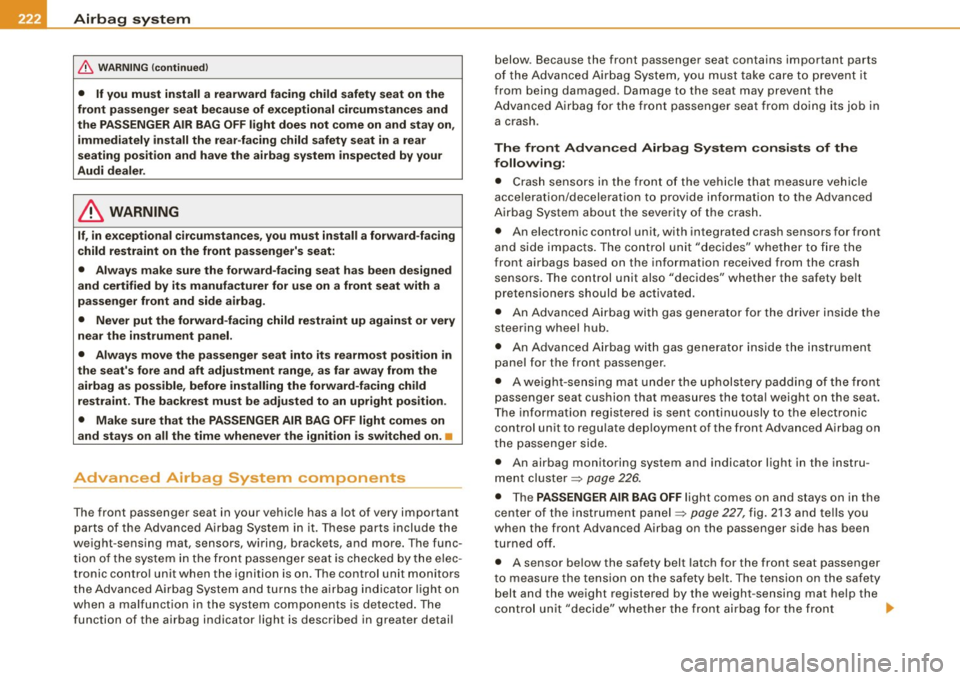
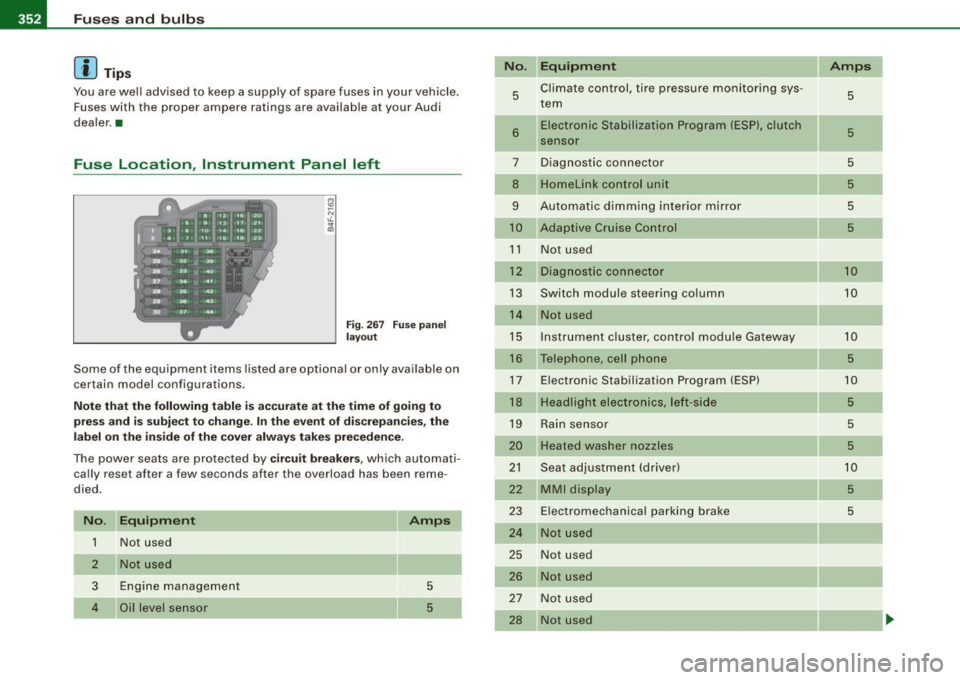
Fuse Location , Instrument Panel left
Fig . 267 Fuse pa nel
l ayo ut
Some of the equipment items listed are optional or only ava ilable on
certain model configurations .
Note th at t he fo llo wi ng t able i s acc urat e at th e time of goin g to
pr ess and is subject t o ch ang e. In th e eve nt of d iscrep ancie s, th e
labe l on th e in side of th e cover always ta kes prece de nce .
The power seats are protected by cir cuit br eaker s, which automati
cally reset after a few seconds after the overload has been reme
died.
N o. Equipm ent
1 Not used
2
3
4
Not used
Engine management
Oil level sensor Amps
5
5
No
.
5
6
..
7
8
9
10
1 1
12
13
14
15
16
17
18
19
20
21
22
23
24
25
26
27
28
Equipm ent
Climate cont rol , tire pressure monitoring sys
tem
Electronic Stabilization Program (ESP), clutch
sensor
Diagnostic connector
Homelink control unit
Automa tic dimming interior mirror
Adaptive Cruise Control
Not used
Diagnostic connector
Switch modu le steering column
Not used
I nstrument c luster, control module Ga teway
Telephone, cell phone E lectronic Stabilization Program (ESP)
Headlight electronics, left -side
Rain sensor
Heated washer nozzles
Seat adjustment (driver)
MMI display
E lectromechanica l parking brake
Not used
Not used
Not used
N ot used
Not used Amps
5
5
5
5
5
5
10
10
10
5
10
5
5
5
10
5
5
-
Page 386 of 398
___ A_l.:,. p _h_ a_ b_e _t _ic _ a_l _in _ d_e _x ____________________________________________ _
Doors
Power child safety lock .... .... .... . 51
Power side door closer . . . . . . . . . . . . . 48
Driver information system .... .... .... . 23
Digital speedometer .. ............ . 25
Driver information messages .. .... . 28
Open door or rear lid warning ... .... 25
Outside temperature disp lay .. . .... . 24
Sound system display . .... ...... .. 24
Driver seat
See Seating position . . . . . . . . . . . . . . 196
Driver's seat . . . . . . . . . . . . . . . . . . . . . . . . 81
Driver's seat memory . . . . . . . . . . . . . . . . . 84
Activating remote control key .. ... .. 85
Recalling a seat position .. .... .... . 84
Storing a seat position ..... ... .... . 84
Driving messages .... .... .... ... .... . 28
Driving safely .. .............. ...... 194
Driving time ........ .... ... ........ .. 38
Duplicate key ........................ 41
DVD player for navigation system . . . . . . 91
Dynamic shift program ... .... ... .... 165
E
Easy entry feature 116
Electric seat adjustment
See Power seat . . . . . . . . . . . . . . . . . . . 81
Electromechanica l parking brake
Emergency braking .... ....... .... 123
Malfunction ...... .... .... ...... . 123
Operation . . . . . . . . . . . . . . . . . . . . . . . 121
Parking . . . . . . . . . . . . . . . . . . . . . . . . . 122 Releasing and app
lying ... .. .. .... 121
Starting off with a trailer .. ........ 123
Warning/indicator lights ... .... .... 21
Electronic differential lock (EDU How the system works . .... ....... 263
Warning/indicator lights ....... .... 21
Electronic immobilizer .......... ... 14, 44
Electronic power control (EPC) warning/indicator light ... .... . 18
Electronic speed limiter ..... ....... ... 27
Electronic stabi lization program (ESP)
How the system works ............ 262
Warning/indicator lights ....... .... 18
Emergency braking . . . . . . . . . . . . . . . . . 123
Emergency closing Power sunroof . ... ..... ... .... . 60, 61
Emergency flasher . . . . . . . . . . . . . . . . . . . 67
Warning/indicator lights ........... 19
Emergency locking of doors .. ........ . 50
Emergency starting ........ .... ... .. 357
Emergency towing ... .... .... .... ... 360
Energy management . ....... ... .. ... 269
Battery power . . . . . . . . . . . . . . . . . . . 270
Driver notification 270
Engine Compartment . .... .... .... .... .. 302
Coolant ....... .... ... .... ....... 307
Hood ..... .... .... .... ........ .. 300
Starting .. .... ... .... .... ... 116,117
Starting with jumper cables ... .... 357
Stopping .. .... .... .... .... ...... 118 Engine compartment
Safety instructions . ....... .... ... 301
Working the engine compartment .. 301
Engine coolant system .. ...... ....... 307
Adding coolant .... ....... ....... 309
Checking coo lant level . .... .... ... 308
Checking the engine coo lant level .. 308
Malfunction .. .. .. .. .. .... .... .. . . 31
Radiator fan . .... .... .... .... .... 310
Engine coolant temperature
Temperature gauge ....... .... .... 12
Engine data ...... .... .... ...... .... 369
Engine hood Closing .... .. ... ..... ....... .... 301
How to release the hood . . . . . . . . . . 300
Engine oi l .......................... 303
Adding ... .... .... .... .... ...... 306
Additives .. .... .... .... ... .... ... 306
Changing .. .... .... ... ........ .. 306
Checking the engine oil level ....... 305
Indications and conditions requiring extra
checking .. ...... .... ...... .... 305
Oil consumption . ...... .... .... .. 304
Oil grades .. .... .... ... .... ...... 303
Recommended oil check intervals .. 305
Specification and viscosity .. ..... .. 303
Engine oi l leve l ... .... .... .... ...... . 35
Engine oil pressure
Malfunction ....... ....... ........ 32
Engine oil sensor defective .... .... ... . 35
Engine speed limitation ... .... .... .... 36
Page 390 of 398
___ A_l.:. p _h_ a_ b_e _t _ic _ a_l _in _ d_e _x ____________________________________________ _
NHTSA
Contacting 203
Number of seats ...... .... ... ....... 205
0
Occupant seating positions . ...... ... 196
Octane rating . . . . . . . . . . . . . . . . . . . . . . 295
Odometer . . . . . . . . . . . . . . . . . . . . . . . . . . 14
Oil
See Engine oi l .. .. .... .... ...... . 303
Older children and safety belts . . . . . . . . 247
On -Board Diagnostic System (OBD)
Data Link Connector (DLC) .. ..... ... 27
Electronic speed limiter ... ..... ... . 27
Malfunction Indicator Lamp (MIU .. .. 27
Open door or rear lid warning ... .. .... 25
Opening Power sunroof . .... ....... .... .... 59
Operate your vehicle economically and mini- mize po llution ... .... .... .... ... 273
Optional equipment Marked with an asterisk .... ...... ... 6
Outlets ...... ... .. .. .... .... ........ 98
Outside air pol lution
How to prevent from entering the vehicle
107
Outside mirrors . ... .. .... .... ...... .. 76
Outside temperature disp lay .. ... ... .. 24
Owner 's manual
How the Owner's Manua l is organized . 6
p
Paint
Touch-up 286
Paint No. . .... ....... .... .... .... .. 366 Rear
lid/trunk lid ... .... ...... .. ... 50
Remote control key . ....... ..... .. . 42
Selective unlock feature ........ .... 48
Settings ... ......... .. .... .... ... 48
Un locking and locking vehicle .... ... 46
Park assist . . . . . . . . . . . . . . . . . . . . . . . . . 169 Pow er outlets ....... .... ........ .... 98
rear . ........ .... ... .. .... .... .. 169
Parking . . . . . . . . . . . . . . . . . . . . . . . . . . . . 122
Automatic transmission .... .... ... 155
Caution when parki ng near a parking bar -
rier or curb ... .. ............ ... 122
Low bumper cover, spoilers and suspens ion 122
multitronic® .......... .... ... ... 162
Parking brake
See Electromechanical parking brake 121
Parking on a decline (downhill) ........ 122
Parking on an incl ine (uphill) . ...... ... 122
Parts replacement ...... .. .... .... .. 374
PASSENGER A IR BAG OFF light ... .. ... 227
Passenger's seat . . . . . . . . . . . . . . . . . . . . . 81
Passive safety system . . . . . . . . . . . . . . . 194
Pedals . ........ ....... ...... .... .. 200
Perimeter lighting ...... .. .......... .. 66
Physica l principles of a frontal collision 206
Polishing ......... ... .... .... ...... 285
Power locking switch .. ........ ....... 49
Power locking system ..... .... .... ... 45
Convenience close/open feature ..... 57
Locking and unlocking the vehicle from
inside ..... .. ... ... .. .... .... ... 49
Opening and closing the windows ... 57
Power sunroof . ....... .... .... .... 60 Power roof
. . . . . . . . . . . . . . . . . . . . . . . . . . 58
Power seat Contro ls ......................... 81
Seat adjustment ... .... ... .... .... 82
Pow er side door closer . .... ... .... .... 48
Power steering ... .... .... .... ...... 267
Power sunroof Emergency closing .... .... .... . 60, 61
Power window switches . ...... ..... .. . 55
In the driver's door . ............ ... 56
In the front passenger's door ... ....
57
Reactivating the system .... ..... ... 58
Pregnant women Special considerations when wearing a safety belt .... ... .... ...... .... 211
Programming the Homelink® universal re -
mote control .... .... .... ..... .. 188
Proper occupant seating positions .. ... 196
Proper safety be lt position ........... 210
Proper seating position Front passenger ... .... ... .... ... 197
Occupants ...................... 196
Rear passengers 198
a
Quartz clock . . . . . . . . . . . . . . . . . . . . . . . . . 13
Page 392 of 398
-Alphab eti ca l ind ex
-----=-------------------------------------
Safety instructions
Engine compartment ... .. .... .... 301
for booster seats . . . . . . . . . . . . . . . . . 246
for side curtain airbags .... ....... 236
for using child safety seats . ... .... 241
for us ing convertible child seats .... 244
for using infant seats ... .. .... .... 243
for using safety be lts . .... ... .... . 208
Monitoring the Advanced Airbag System 228
Safety lock Ignition key, automatic transmission 117
Seat adjustment Adjusting the seatback ... .... .... .. 82
Adjusting upper thigh support ...... 83 Driver's seat . . . . . . . . . . . . . . . . . . . . . . 80
D .
' t 84
river s sea memory . .... ...... .. .
Front passenger's seat . . . . . . . . . . . . . 81
Front seats . . . . . . . . . . . . . . . . . . . . . . . 80
Head restraints ... .... .... ... . 86, 199
Lumbar support ............. ..... 83
Seat belts
See Safety be lts . .... ... .. .... .... 205
Seat memory . . . . . . . . . . . . . . . . . . . . . . . . 84
Seating capacity . .... .... .... ... .... 205
Seating position Driver ...... ... .. .... ...... .... . 196
Front passenger . . . . . . . . . . . . . . . . . 197
How to adjust the front seats . . . . . . 197
Incorrect seat position . . . . . . . . . . . . 199
Occupants ...................... 196
Rear passengers . . . . . . . . . . . . . . . . . 198 Seats
Number of seats ..... .... .... .... 205
Selective unlock feature .... ....... ... 48
Selector lever . . . . . . . . . . . . . . . . . . . . . . 156
Se lector lever mu ltitronic® ........... 163
Service and disposal Safety be lt pretensioner ...... .... . 214
Service interval display . . . . . . . . . . . . . . . 26
Service position Windshield wipers . . . . . . . . . . . . . . . . 73
Servotron ic Power steering ...... .... .... .... 267
Shift buttons ...... .. ........... 160, 167
Side airbags
Description .............. ...... .. 231
How they work . . . . . . . . . . . . . . . . . . . 232
Side assist Activating and deactivating ... .... . 146
Description .......... ........ .... 146
Informationa l and alert stage signals 148
Messages in instrument cluster display ..
153
MM I settings ... .... ... .. ...... .. 152
Operation . . . . . . . . . . . . . . . . . . . . . . . 148
Safety tips . . . . . . . . . . . . . . . . . . . . . . 154
Sensor detection area . . . . . . . . . . . . 148
Side curtain airbags .. ........ ....... 234
Description ...................... 234
How they work . . . . . . . . . . . . . . . . . . . 235
Safety instructions .......... .... . 236
Side marker lights . . . . . . . . . . . . . . . . . . . 63
Ski sack ... .. .... ...... .... ... .... .. 92
Snow chains . .... ....... ........... 334 Sockets
.. ...... .... .... .... ... .. . 97, 98
Solar blower fan/solar roof ....... ... . 113
Sound system disp lay
Driver information disp lay .......... 24
Spare wheel ........................ 343
Speed control system
See Adaptive Cruise Control .. .... .. 127
Speed rating letter code ... ... .... ... 330
Speed warning system ................ 36
Speedometer .... .... .... ....... .... . 14
Starting off with a trailer .. .... .... ... 123
Starting the engine .. .... ... .. ... 116, 117
What should I do if the engine does not
start? ........................ . 117
Steering . ........... ....... ... .. ... 114
Easy entry feature ................ 116
Electrically adjusting the steering wheel .
115
Locking the steering ... .... .... ... 116
Malfunction . ... .. .... .... .... .... 32
Manually adjusting the steering whee l
114
Steering wheel column Adjusting electrically ... .... ...... 115
Adjusting manual ly ............... 114
Steering wheel heating .. ........ .... 111
Steps for determining correct load limit 326
Stopping the engine .... ... .......... 118
Storage .... ... .. .... ..... .. ... ..... 99
Cupholder ... .. ...... .... .... ... .. 95
Cupholder rear center armrest ... .. . 96
Glove compartment ... .... .... .... 99