seat adjustment AUDI S6 2009 Owner's Manual
[x] Cancel search | Manufacturer: AUDI, Model Year: 2009, Model line: S6, Model: AUDI S6 2009Pages: 398, PDF Size: 43 MB
Page 251 of 398
_______________________________________________ C_h _ i_ld _ S_ a_ f_ e_ t..,:c y __ ffllll
& WARNING (continued )
• If the backrest is not securely latched, the child and the child
restraint will be thrown forward together with the backrest and
will strike parts of the vehicle interior . The child can be seriously
injured or killed .
• Never install rear-facing child safety seats or infant carriers on
the front passenger seat. A child will be seriously injured and can be killed when the passenger airbag inflates .
• The inflating airbag will hit the child safety seat or infant
carrier with great force and will smash the child safety seat and
child against the backrest , center arm rest , door or roof.
• Always install rear-facing child safety seats or infant carriers on
the rear seat.
• Forward-facing child safety seats or infant carriers installed on
the front passenger's seat may interfere with the deployment of
the airbag and cause serious injury to the child .
• It is safer to install a forward -fac ing child safety seat on the rear
seat.
• Always read and heed all WARNINGS whenever using a child
restrained in a vehicle is being used =>
page 238. Special precau
tions apply when installing a child safety seat on the front
passenger seat=>
page 217 , "Child restraints on the front seat -
some important things to know ".
& WARNING
Always take special precautions if you must install a forward or
rearward-facing child restraint on the front passenger's seat in
exceptional situations:
• Whenever a forward or rearward -facing child restraint is
installed on the front passenger seat, the PASSENGER AIR BAG
OFF light must come on and stay on whenever the ignition is
switched on .
Controls and equip ment Safety first
Vehicle operation
& WARNING (continued )
• If the PASSENGER AIR BAG OFF light does not come on and stay
on, perform the checks described =>
page 226, ''Monitoring the
Advanced Airbag System ".
• Take the child restraint off the front passenger seat and install
it properly at one of the rear seat positions if the PASSENGER AIR
BAG OFF light does not stay on whenever the ignition is switched
on .
• Improper installation of child restraints can reduce their effec
tiveness or even prevent them from providing any protection.
• An improperly installed child restraint can interfere with the
airbag as it deploys and seriously injure or even kill the child.
• Always carefully follow the manufacturer's instructions
provided with the child safety seat or carrier.
• Never place additional items on the seat that can increase the
total weight registered by the weight-sensing mat and can cause injury in a crash.
& WARNING
Forward-facing child restraints:
• Always make sure the forward -facing seat has been designed
and certified by its manufacturer for use on a front seat with a
passenger front and side airbag.
• Never put the forward-facing child restraint up, against or very
near the instrument panel .
• Always move the passenger seat into its rearmost position in
the seat's fore and aft adjustment range , as far away from the
airbag as possible before installing the forward-facing child
restraint . The backrest must be adjusted to an upright position .
• Make sure that the PASSENGER
AIR BAG OFF light comes on
and stays on all the time whenever the ignition is switched on . .,,,_
Vehicle care Do-it-yourself service Technical data
Page 271 of 398
Energy management
Starting ability is optimized
Energy management controls the distribution of electrical
energy and thus optimizes the availability of electrical
energy for starting the engine.
If a vehicle with a conventional energy system is not driven for a
long period of time, the battery is discharged by idling current
consumers (e.g. immobilizer). In certain circumstances it can resu lt
in there being insufficient energy available to start the engine .
Intelligent energy management in your vehicle handles the distribu
tion of electrical energy . Starting ability is markedly improved and
the life of the battery is extended.
Basical ly, energy management consists of
battery di agn osis, idling
current mana gement
and dynami c en ergy management .
Batter y diagn osis
Battery diagnosis continuously deter min es the state of the battery.
Sensors determine battery vo ltage, battery current and battery
temperature . This determines the cu rrent state of charge and the
power of the battery .
Idling c urrent man ag em en t
Idling current management reduces energy consumption while the
vehicle is standing. With the ign it ion switched off, it controls the
energy supply to the various electrical components. Data from
battery diagnos is is considered .
Depending on the battery's state of charge, individual consumers
are gradually turned off to prevent excessive discharge of the
battery and thus maintain starting capability.
Dynamic energ y managem ent
While the vehic le is being driven, dynamic energy management
distributes the energy gene rated acco rding to the needs of the indi -
Controls and equip
ment Safety first Vehicle operation
In
te llig ent tec hn olo gy
vidual components . It regulates consumption, so that more e lec
trical energy is not being used than is being ge nerated and ensures
an optimal state of charge for the battery.
[ i ] Tips
• But even energy management cannot negate the limits of
physics. Consider that the power and life of a battery are limited .
• I f starting ability is threatened, you are informed by a warning
=> page 270, "Drive r notifica tion i n the instrument cluster
display" .•
What you should know
The highes t pri ority is given to main tain ing starting capa
bility.
The battery is severe ly taxed in short-distance driving, in city traffic
and during the co ld time of year. Abundant electrical energy is
required, but only a little is generated. It is also critical if the engine
is not running and elect rica l components are turned on. In this
instance energy is being consumed but none is being generated .
I t is in precisely these situations that you will notice energy manage
ment active ly regula ting the distr ibut ion of energy.
Vehicle stands fo r an extended period
If you do not drive your vehicle over a period of several days or
weeks, electrical components are gradually cut back or switched off.
This reduces energy consumption and maintains starting capability
over a longer period.
Take into considerat ion that when you un lock your veh icle, some
convenience functions, such as the remote key or power seat
adjustment, may not be availab le . T he conven ience functions will be
available again when you turn on the ignition and start the engine.
Vehicle care Do-it-yourself service Technical data
Page 314 of 398
-Checking
and filling
---=---------------
checked by a service facility . The electrolyte level should also be
checked each time the battery is charged
~ page 314.
Have the battery checked when you take your vehicle in for service.
You are well advised to replace a battery that is older than 5 years.
With certain types of airbag deployment, the battery is discon nected from the vehicle electrical system for safety reasons~
& in
"Repair, care and disposal of the airbags" on
page 229.
Disconnecting the battery terminals
Some vehicle functions (power window regulators, for example) are
lost if the battery terminals are disconnected . These functions have
to be relearned after the battery terminals are connected again . To
prevent this, the battery should only be disconnected from the
vehicle electrical system when absolutely necessary for repairs.
Vehicles not driven for long periods
If you do not drive your vehicle over a period of several days or
weeks, electrical components are gradually cut back or switched off.
This reduces energy consumption and maintains starting capability
over a longer period
~ page 269.
Take into consideration that when you unlock your vehicle, some
convenience functions , such as the master key remote function or
power seat adjustment, may not be available. The convenience
functions will be available again when you turn on the ignition and
start the engine.
Winter operation
During the winter months, battery capacity tends to decrease as
temperatures drop . This is because more power is also consumed
while starting, and the headlights, rear window defogger, etc., are
used more often.
Avoid unnecessary power consumption, particularly in city traffic or
when traveling only short distances. Let your authorized Audi dealer
check the capacity of the vehicle battery before winter sets in
~ page 314. A well charged battery will not only prevent starting
problems when the weather is cold , but will also last longer .
[ i] Tips
If your vehicle is left standing for several weeks at extremely low
temperatures, the vehicle battery should be removed and stored
where it will not freeze. This will prevent it from being damaged and
having to be replaced. •
Working on the battery
Be especially careful when working on or near the battery.
Fig. 244 Luggage
compartment : Battery
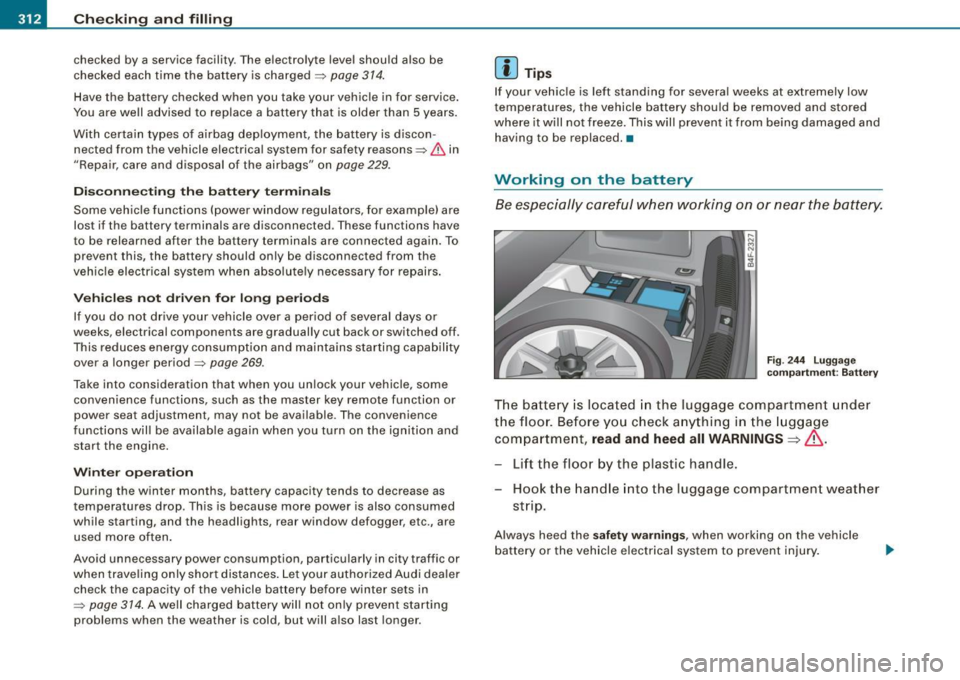
The battery is located in the luggage compartment under
the floor. Before you check anything in the luggage
compartment,
read and heed all WARNINGS=>& .
Lift the floor by the plastic handle.
Hook the handle into the luggage compartment weather
strip.
Always heed the safety warnings, when working on the vehicle
battery or the vehicle electrical system to prevent injury.
Page 354 of 398
-Fuses and bulbs Pffl..._ _____________________ _
[ i J Tip s
You are wel l advised to keep a supply of spare fuses in your vehicle .
Fuses with the proper ampere ratings are availab le at your Audi
dea ler. •
Fuse Location , Instrument Panel left
Fig . 267 Fuse pa nel
l ayo ut
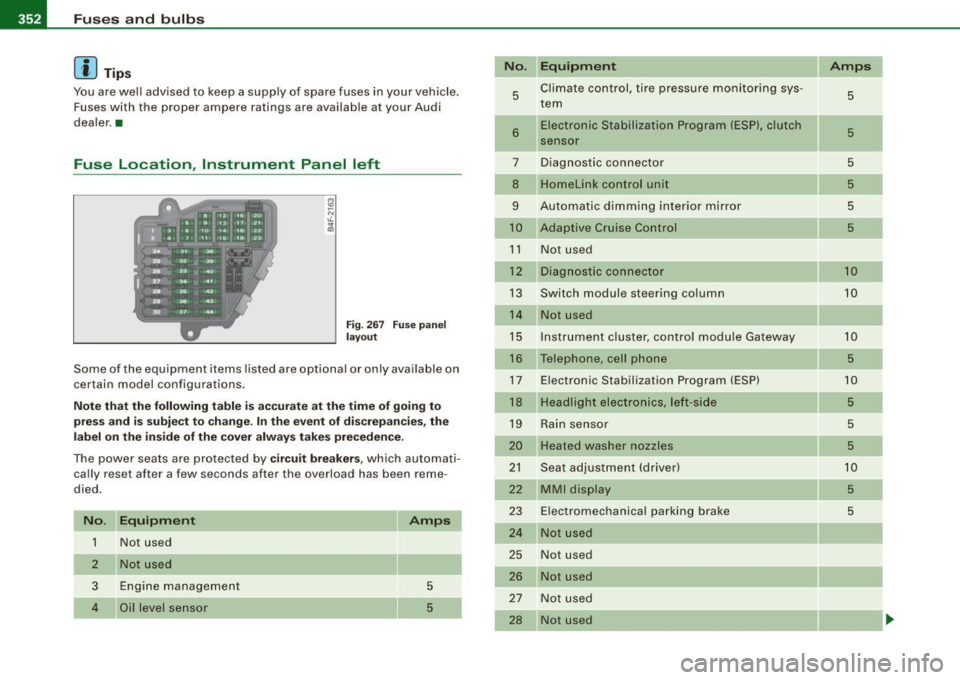
Some of the equipment items listed are optional or only ava ilable on
certain model configurations .
Note th at t he fo llo wi ng t able i s acc urat e at th e time of goin g to
pr ess and is subject t o ch ang e. In th e eve nt of d iscrep ancie s, th e
labe l on th e in side of th e cover always ta kes prece de nce .
The power seats are protected by cir cuit br eaker s, which automati
cally reset after a few seconds after the overload has been reme
died.
N o. Equipm ent
1 Not used
2
3
4
Not used
Engine management
Oil level sensor Amps
5
5
No
.
5
6
..
7
8
9
10
1 1
12
13
14
15
16
17
18
19
20
21
22
23
24
25
26
27
28
Equipm ent
Climate cont rol , tire pressure monitoring sys
tem
Electronic Stabilization Program (ESP), clutch
sensor
Diagnostic connector
Homelink control unit
Automa tic dimming interior mirror
Adaptive Cruise Control
Not used
Diagnostic connector
Switch modu le steering column
Not used
I nstrument c luster, control module Ga teway
Telephone, cell phone E lectronic Stabilization Program (ESP)
Headlight electronics, left -side
Rain sensor
Heated washer nozzles
Seat adjustment (driver)
MMI display
E lectromechanica l parking brake
Not used
Not used
Not used
N ot used
Not used Amps
5
5
5
5
5
5
10
10
10
5
10
5
5
5
10
5
5
-
Page 356 of 398
IIJII Fuses and bulbs ..._ ____ .;__...;_;,;_ _______________________________ _
No. Equipment
8 A/C controls
9 Heated seats, front
10 MMI
11 Seat adjustment (passenger)
12 Communication
Fuse holder (brown)
1
2
3
4
5
6
7
8
9
10
11
12
Electric fuel pump
Adaptive Air Suspension Lane assist
Audi side assist
Adaptive Air Suspension Shift gate automatic transmission/clutch
switch
Acoustic Parking System Control module Gateway
Automatic headlight range control (auxiliary driving lights), headlight electronics, right-side
Airbag
Heated rear seats
Telephone Amps
10
30
7,5
10
5
20/30
15
10
5
5
5
-
5
5
5
5
5
5
•
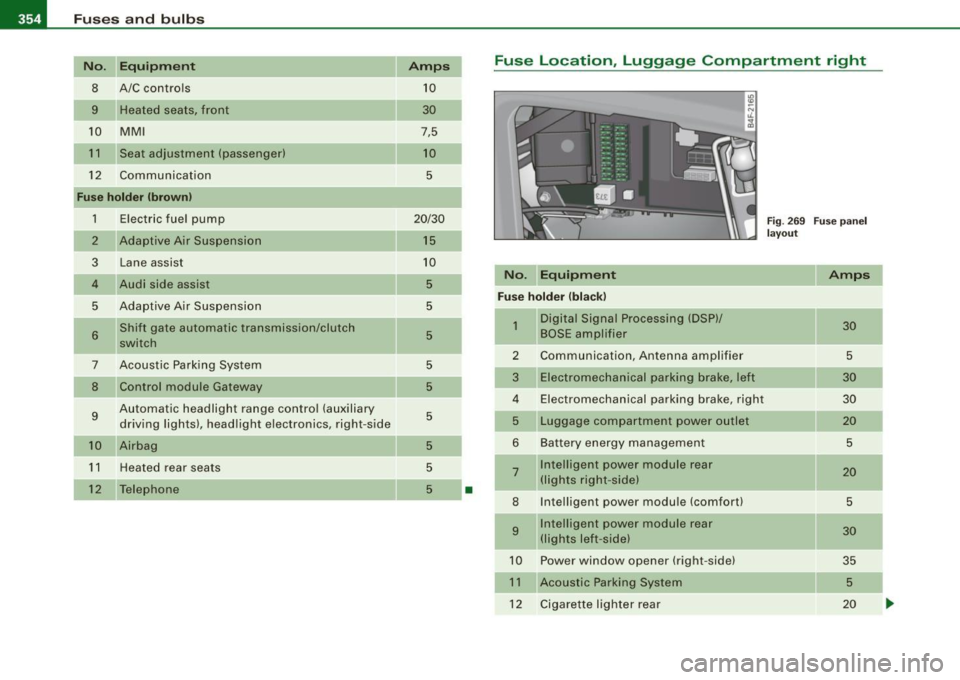
Fuse Location, Luggage Compartment right
Fig. 269 Fuse panel
layout
No. Equipment Amps
Fuse holder (black)
-
1 Digital Signal Processing (DSP)/ 30 BOSE ampl ifier
2 Communication, Antenna amplifier 5
3
Electromechanical parking brake, left 30
4 Electromechanical parking brake, right 30
5
Luggage compartment power outlet 20
6 Battery energy management 5
7 Intelligent power module rear 20 (lights right -side)
8 Intelligent power module (comfort) 5
9 Intelligent power module rear 30 (lights left -side)
10 Powe r window opener (right-side) 35
11
Acoustic Parking System 5
12 Cigarette lighter rear 20
Page 386 of 398
___ A_l.:,. p _h_ a_ b_e _t _ic _ a_l _in _ d_e _x ____________________________________________ _
Doors
Power child safety lock .... .... .... . 51
Power side door closer . . . . . . . . . . . . . 48
Driver information system .... .... .... . 23
Digital speedometer .. ............ . 25
Driver information messages .. .... . 28
Open door or rear lid warning ... .... 25
Outside temperature disp lay .. . .... . 24
Sound system display . .... ...... .. 24
Driver seat
See Seating position . . . . . . . . . . . . . . 196
Driver's seat . . . . . . . . . . . . . . . . . . . . . . . . 81
Driver's seat memory . . . . . . . . . . . . . . . . . 84
Activating remote control key .. ... .. 85
Recalling a seat position .. .... .... . 84
Storing a seat position ..... ... .... . 84
Driving messages .... .... .... ... .... . 28
Driving safely .. .............. ...... 194
Driving time ........ .... ... ........ .. 38
Duplicate key ........................ 41
DVD player for navigation system . . . . . . 91
Dynamic shift program ... .... ... .... 165
E
Easy entry feature 116
Electric seat adjustment
See Power seat . . . . . . . . . . . . . . . . . . . 81
Electromechanica l parking brake
Emergency braking .... ....... .... 123
Malfunction ...... .... .... ...... . 123
Operation . . . . . . . . . . . . . . . . . . . . . . . 121
Parking . . . . . . . . . . . . . . . . . . . . . . . . . 122 Releasing and app
lying ... .. .. .... 121
Starting off with a trailer .. ........ 123
Warning/indicator lights ... .... .... 21
Electronic differential lock (EDU How the system works . .... ....... 263
Warning/indicator lights ....... .... 21
Electronic immobilizer .......... ... 14, 44
Electronic power control (EPC) warning/indicator light ... .... . 18
Electronic speed limiter ..... ....... ... 27
Electronic stabi lization program (ESP)
How the system works ............ 262
Warning/indicator lights ....... .... 18
Emergency braking . . . . . . . . . . . . . . . . . 123
Emergency closing Power sunroof . ... ..... ... .... . 60, 61
Emergency flasher . . . . . . . . . . . . . . . . . . . 67
Warning/indicator lights ........... 19
Emergency locking of doors .. ........ . 50
Emergency starting ........ .... ... .. 357
Emergency towing ... .... .... .... ... 360
Energy management . ....... ... .. ... 269
Battery power . . . . . . . . . . . . . . . . . . . 270
Driver notification 270
Engine Compartment . .... .... .... .... .. 302
Coolant ....... .... ... .... ....... 307
Hood ..... .... .... .... ........ .. 300
Starting .. .... ... .... .... ... 116,117
Starting with jumper cables ... .... 357
Stopping .. .... .... .... .... ...... 118 Engine compartment
Safety instructions . ....... .... ... 301
Working the engine compartment .. 301
Engine coolant system .. ...... ....... 307
Adding coolant .... ....... ....... 309
Checking coo lant level . .... .... ... 308
Checking the engine coo lant level .. 308
Malfunction .. .. .. .. .. .... .... .. . . 31
Radiator fan . .... .... .... .... .... 310
Engine coolant temperature
Temperature gauge ....... .... .... 12
Engine data ...... .... .... ...... .... 369
Engine hood Closing .... .. ... ..... ....... .... 301
How to release the hood . . . . . . . . . . 300
Engine oi l .......................... 303
Adding ... .... .... .... .... ...... 306
Additives .. .... .... .... ... .... ... 306
Changing .. .... .... ... ........ .. 306
Checking the engine oil level ....... 305
Indications and conditions requiring extra
checking .. ...... .... ...... .... 305
Oil consumption . ...... .... .... .. 304
Oil grades .. .... .... ... .... ...... 303
Recommended oil check intervals .. 305
Specification and viscosity .. ..... .. 303
Engine oi l leve l ... .... .... .... ...... . 35
Engine oil pressure
Malfunction ....... ....... ........ 32
Engine oil sensor defective .... .... ... . 35
Engine speed limitation ... .... .... .... 36
Page 390 of 398
___ A_l.:. p _h_ a_ b_e _t _ic _ a_l _in _ d_e _x ____________________________________________ _
NHTSA
Contacting 203
Number of seats ...... .... ... ....... 205
0
Occupant seating positions . ...... ... 196
Octane rating . . . . . . . . . . . . . . . . . . . . . . 295
Odometer . . . . . . . . . . . . . . . . . . . . . . . . . . 14
Oil
See Engine oi l .. .. .... .... ...... . 303
Older children and safety belts . . . . . . . . 247
On -Board Diagnostic System (OBD)
Data Link Connector (DLC) .. ..... ... 27
Electronic speed limiter ... ..... ... . 27
Malfunction Indicator Lamp (MIU .. .. 27
Open door or rear lid warning ... .. .... 25
Opening Power sunroof . .... ....... .... .... 59
Operate your vehicle economically and mini- mize po llution ... .... .... .... ... 273
Optional equipment Marked with an asterisk .... ...... ... 6
Outlets ...... ... .. .. .... .... ........ 98
Outside air pol lution
How to prevent from entering the vehicle
107
Outside mirrors . ... .. .... .... ...... .. 76
Outside temperature disp lay .. ... ... .. 24
Owner 's manual
How the Owner's Manua l is organized . 6
p
Paint
Touch-up 286
Paint No. . .... ....... .... .... .... .. 366 Rear
lid/trunk lid ... .... ...... .. ... 50
Remote control key . ....... ..... .. . 42
Selective unlock feature ........ .... 48
Settings ... ......... .. .... .... ... 48
Un locking and locking vehicle .... ... 46
Park assist . . . . . . . . . . . . . . . . . . . . . . . . . 169 Pow er outlets ....... .... ........ .... 98
rear . ........ .... ... .. .... .... .. 169
Parking . . . . . . . . . . . . . . . . . . . . . . . . . . . . 122
Automatic transmission .... .... ... 155
Caution when parki ng near a parking bar -
rier or curb ... .. ............ ... 122
Low bumper cover, spoilers and suspens ion 122
multitronic® .......... .... ... ... 162
Parking brake
See Electromechanical parking brake 121
Parking on a decline (downhill) ........ 122
Parking on an incl ine (uphill) . ...... ... 122
Parts replacement ...... .. .... .... .. 374
PASSENGER A IR BAG OFF light ... .. ... 227
Passenger's seat . . . . . . . . . . . . . . . . . . . . . 81
Passive safety system . . . . . . . . . . . . . . . 194
Pedals . ........ ....... ...... .... .. 200
Perimeter lighting ...... .. .......... .. 66
Physica l principles of a frontal collision 206
Polishing ......... ... .... .... ...... 285
Power locking switch .. ........ ....... 49
Power locking system ..... .... .... ... 45
Convenience close/open feature ..... 57
Locking and unlocking the vehicle from
inside ..... .. ... ... .. .... .... ... 49
Opening and closing the windows ... 57
Power sunroof . ....... .... .... .... 60 Power roof
. . . . . . . . . . . . . . . . . . . . . . . . . . 58
Power seat Contro ls ......................... 81
Seat adjustment ... .... ... .... .... 82
Pow er side door closer . .... ... .... .... 48
Power steering ... .... .... .... ...... 267
Power sunroof Emergency closing .... .... .... . 60, 61
Power window switches . ...... ..... .. . 55
In the driver's door . ............ ... 56
In the front passenger's door ... ....
57
Reactivating the system .... ..... ... 58
Pregnant women Special considerations when wearing a safety belt .... ... .... ...... .... 211
Programming the Homelink® universal re -
mote control .... .... .... ..... .. 188
Proper occupant seating positions .. ... 196
Proper safety be lt position ........... 210
Proper seating position Front passenger ... .... ... .... ... 197
Occupants ...................... 196
Rear passengers 198
a
Quartz clock . . . . . . . . . . . . . . . . . . . . . . . . . 13
Page 391 of 398
______________________________________________ A_ l_,_ p _h_ a_ b_e _t_i c_ a _ l _in _ d_e _ x __ lll
quattro®
See All Wheel Drive ... .... ........ 268
Question
R
What happens to unbelted occupants? .
207
Why safety belts? ... .... .... .... .. 205
Radiator fan .. . .... .. .. .... ....... .. 310
Rain sensor ... .... .... .... .......... 71
Rain sensor defective 34
Reading lights
Front .... ... .... .... .... ..... ... .
68
Rear ..... .. .. ...... .. ... .. ... ... . 69
Rear ashtray . .... .... .... ... .... ... .. 97
Rear fog ligh ts .... .... ... .... ..... ... 65
Rear lid
Escape handle .... .... ... .... ....
342
Open ing and c losing . .... ... ..... .. 50
Valet key function .. ..... .... .... .. 44
Rear light
Defective . .... .... ... .... .. .. .... .
25
Rear seat bench ...... .... ..... .... ... 88
Rear View
See Rear-view camera . ... .... .... . 171
Rear view mirror
Inside rear view mirror . ............
75
Rear window blind
Settings ..... .... .... ... .. .. .... .
71
Rear window defogger .. .... .... .... . 108
Rear window shelf ... .... ...... ...... 86
Controls and equip
ment Safety first
Rear
-view camera .. . .. .. .... .. .. 171, 173 Safety belt position . ... .. .... .. .. .... 210
Parking mode 1 .. .... ...... ..... . 175 Safety belt height adjustment . .... . 212
Parking mode 2 .. .. ........ .... .. 177 Safety belts worn by pregnant women
Red symbols .... .... .... .... .... ... .
29 21
1
Refuel ling ... .... .... .... .... .... ... 297 Safety belt prete nsioner
Release lever for hood .. ... ......... .
300 Service and disposal . ...... .... ... 214
Remote control garage door opener Sa
fety b elt pretensioners . .... .... .... 213
(Homelink®) ...... .... .... ... .. 188 Safety belt warning light ... .. .... . 19,205
Remote control key ... .... .... .... .... 42 Safety belts . .... .... .... ... .... .... 209
Un locking and locking ... .... .... .. 46 clea ning .. .... .... ... .... .... ... 293
Remote rear lid re leas ,e ... .... .... .... . 50 Danger to passengers who do not wear a
Repair manua ls .... ... ............ ..
372
Repa irs
Airbag system .. ...... .... .... ...
229
Replacing a fuse .... .... .... .... .... 351
safety belt .. ........ .... .... ... 207
Fastening ...... ..... .. .. ... ... .. 209
height adjustment . .... ... .... .... 212
Improper ly worn ..... ... . .. .. .... 213
Not worn . .... .... .... .... ...... . 207
Replacing light bulbs ...... ... ... .... 355 Safety belt position ... .... .... .... 210
Replaci ng tires and wheels . ...... .... 329 Safety instructions .... .... .... ... . 208
Reporting Safety Defe cts . ........ 203, 204 Securing child sa fety sea ts ..... ... . 248
Reset button . ...... .. .. .... .... .... . 14 Specia l considera tions fo r preg nant
Res idual heat . .... .... ... .... .... ...
104 women . ........ .... .. .... .... . 211
Retractor .. ... ... .. ...... .... .... .. 209 Unfastening ........ ........ ..... 212
Rims Warning/indicator light
....... ... .. 205
Cast alloy .. ...... .... .... ... .... 287
Roof rack .. ..... ... .... ... ... ... ... . 93
Why YOU MUST wear them . ..... .. 205
Worn properly . .... ... ... .. ...... 208
Loading ... ... .... .... .... ... .... . 94 Safety comp liance sticker .... .... .... 366
Mounting locat ions . ...... .... .... . 94 Safety equipmen t ... .... .... .... ... . 194
Roof weight .... .... ... ..... .... ... .. 94 Safety features for occupant restraint and
protection ...... .... .... .... ... .
194
s Sa fety guide lines
Seat adjus tment ...... .... .... .. . ..
80
SA FE .... ... .... ...... ...... .... ... . 14
Safe driving hab its ...... .... .... .... 194
Vehicle operation Vehicle care Do-it-yourself service Technical data
Page 392 of 398
-Alphab eti ca l ind ex
-----=-------------------------------------
Safety instructions
Engine compartment ... .. .... .... 301
for booster seats . . . . . . . . . . . . . . . . . 246
for side curtain airbags .... ....... 236
for using child safety seats . ... .... 241
for us ing convertible child seats .... 244
for using infant seats ... .. .... .... 243
for using safety be lts . .... ... .... . 208
Monitoring the Advanced Airbag System 228
Safety lock Ignition key, automatic transmission 117
Seat adjustment Adjusting the seatback ... .... .... .. 82
Adjusting upper thigh support ...... 83 Driver's seat . . . . . . . . . . . . . . . . . . . . . . 80
D .
' t 84
river s sea memory . .... ...... .. .
Front passenger's seat . . . . . . . . . . . . . 81
Front seats . . . . . . . . . . . . . . . . . . . . . . . 80
Head restraints ... .... .... ... . 86, 199
Lumbar support ............. ..... 83
Seat belts
See Safety be lts . .... ... .. .... .... 205
Seat memory . . . . . . . . . . . . . . . . . . . . . . . . 84
Seating capacity . .... .... .... ... .... 205
Seating position Driver ...... ... .. .... ...... .... . 196
Front passenger . . . . . . . . . . . . . . . . . 197
How to adjust the front seats . . . . . . 197
Incorrect seat position . . . . . . . . . . . . 199
Occupants ...................... 196
Rear passengers . . . . . . . . . . . . . . . . . 198 Seats
Number of seats ..... .... .... .... 205
Selective unlock feature .... ....... ... 48
Selector lever . . . . . . . . . . . . . . . . . . . . . . 156
Se lector lever mu ltitronic® ........... 163
Service and disposal Safety be lt pretensioner ...... .... . 214
Service interval display . . . . . . . . . . . . . . . 26
Service position Windshield wipers . . . . . . . . . . . . . . . . 73
Servotron ic Power steering ...... .... .... .... 267
Shift buttons ...... .. ........... 160, 167
Side airbags
Description .............. ...... .. 231
How they work . . . . . . . . . . . . . . . . . . . 232
Side assist Activating and deactivating ... .... . 146
Description .......... ........ .... 146
Informationa l and alert stage signals 148
Messages in instrument cluster display ..
153
MM I settings ... .... ... .. ...... .. 152
Operation . . . . . . . . . . . . . . . . . . . . . . . 148
Safety tips . . . . . . . . . . . . . . . . . . . . . . 154
Sensor detection area . . . . . . . . . . . . 148
Side curtain airbags .. ........ ....... 234
Description ...................... 234
How they work . . . . . . . . . . . . . . . . . . . 235
Safety instructions .......... .... . 236
Side marker lights . . . . . . . . . . . . . . . . . . . 63
Ski sack ... .. .... ...... .... ... .... .. 92
Snow chains . .... ....... ........... 334 Sockets
.. ...... .... .... .... ... .. . 97, 98
Solar blower fan/solar roof ....... ... . 113
Sound system disp lay
Driver information disp lay .......... 24
Spare wheel ........................ 343
Speed control system
See Adaptive Cruise Control .. .... .. 127
Speed rating letter code ... ... .... ... 330
Speed warning system ................ 36
Speedometer .... .... .... ....... .... . 14
Starting off with a trailer .. .... .... ... 123
Starting the engine .. .... ... .. ... 116, 117
What should I do if the engine does not
start? ........................ . 117
Steering . ........... ....... ... .. ... 114
Easy entry feature ................ 116
Electrically adjusting the steering wheel .
115
Locking the steering ... .... .... ... 116
Malfunction . ... .. .... .... .... .... 32
Manually adjusting the steering whee l
114
Steering wheel column Adjusting electrically ... .... ...... 115
Adjusting manual ly ............... 114
Steering wheel heating .. ........ .... 111
Steps for determining correct load limit 326
Stopping the engine .... ... .......... 118
Storage .... ... .. .... ..... .. ... ..... 99
Cupholder ... .. ...... .... .... ... .. 95
Cupholder rear center armrest ... .. . 96
Glove compartment ... .... .... .... 99