technical data AUDI S6 2009 Owner's Manual
[x] Cancel search | Manufacturer: AUDI, Model Year: 2009, Model line: S6, Model: AUDI S6 2009Pages: 398, PDF Size: 43 MB
Page 215 of 398
Safety belts -----------------=------
• With the front seats, the height adjustment of the seat can also
be used to adjust the position of the safety belts. •
Improperly worn safety belts
Incorrectly positioned safety belts can cause severe inju
ries.
Wearing safety belts improperly can cause serious injury or
death. Safety belts can only work when they are correctly positioned on the body. Improper seating posit ions reduce
the effectiveness of safety belts and w ill even increase the
risk of injury and death by moving the safety belt to critical
areas of the body . Improper seating positions also increase
the r isk of serious injury and death when an airbag deploys
and strikes an occupant who is not in the correct seating position. A driver is responsible for the safety of all vehicle
occupants and especially for children. Therefore:
-Never permit anyone to assume an incorrect sitting posi
tion in the vehicle while traveling~& .
& WARNING
Improperly worn safety belts increase the risk of serious personal
injury and death whenever a vehicle is being used.
• Always make sure that all vehicle occupants are correctly
restrained and stay in a correct seating position whenever the
vehicle is being used.
• Always read and heed all WARNINGS and other important infor
mation ::::;,
page 208. •
Controls and equip
ment Safety first Vehicle operation
Safety be
lt pretensioners
How safety belt pretensioners work
In front, side and rear -end collisions above a particular
severity, safety belts are tensioned automatically.
The safety belts are equipped with safety belt pretensioners . The
system is activated by sensors in front, side and rear -end collisions
of great severity . This tightens the belt and takes up belt slack::::;,
6
in "Service and disposal of safety belt pretensioner" on page 214.
Taking up the slack helps to reduce forward occupant movement
during a collision.
0 Note
Never let the belt remain over a rear seat back that has been folded
forward.
[ i] Tips
The safety belt pretensioner can only be activated once.
• In minor frontal, side and rear -end collisions, in a rollover and in
accidents involving very little impact force, the safety belt preten
sioner are not activated .
• When the safety belt pretensioners are activated, a fine dust is
released. This is normal and is not caused by a fire in the vehicle.
• The relevant safety requirements must be observed when the
vehicle or components of the system are scrapped . A qualified deal
ership is familiar with these regulations and will be pleased to pass
on the information to you.
• Be sure to observe all safety, environmental and other regula
tions if the vehicle or individual parts of the system, particularly the
safety belt or airbag, are to be disposed . We recommend you have
your authorized Audi dealer perform this service for you. •
Vehicle care Do-it-yourself service Technical data
Page 217 of 398
Airbag system -----------------=~-rm-I
Airbag system
Important things to know
Importance of wearing safety belts and
sitting properly
Airbags are only supplemental restraints. For airbags to
do their job, occupants must always properly wear their
safety belts and be in a proper seating position.
For your safety and the safety of your passengers, before
driving off, always:
- Adjust the driver's seat and steering wheel properly
~ page 196,
-Adjust the front passenger's seat properly~ page 81,
-Wear safety belts properly~ page 208,
- Always properly use the proper child restraint to protect
children~
page 238.
In a collision, airbags must inflate within the blink of an eye and with
considerable force . The supplemental airbags can cause injuries if
the driver or the front seat passenger is not seated properly. There
fore in order to help the airbag to do its job, it is important, both as
a driver and as a passenger to sit properly at all times.
By keeping room between your body and the steering wheel and the
front of the passenger compartment, the airbag can inflate fully and
completely and provide supplemental protection in certain frontal
collisions =>
page 196, "Proper occupant seating positions". For
details on the operation of the seat adjustment controls=>
page 81.
It's especially important that children are properly restrained
=>
page 238.
Controls and equip ment Safety first Vehicle operation
There is a lot that the driver and the passengers can and must do to
help the individual safety features installed in your Audi work
together as a system .
Proper seating position is important so that the front airbag on the
driver side can do its job. If you have a physical impairment or
condition that prevents you from sitting properly on the driver seat
with the safety belt properly fastened and reaching the pedals, or if
you have concerns with regard to the function or operation of the
Advanced Airbag System, please contact your authorized Audi dealer or qualified workshop, or call Audi Customer CARE at 1-800-
822 -2834 for possible modifications to your vehicle.
When the airbag system deploys, a gas generator will fill the
airbags, break open the padded covers, and inflate between the
steering wheel and the driver and between the instrument panel
and the front passenger. The airbags will deflate immediately after
deployment so that the front occupants can see through the wind
shield again without interruption .
All of this takes place in the blink of an eye, so fast that many people don't even realize that the airbags have deployed. The airbags also
inflate with a great deal of force and nothing should be in their way
when they deploy. Front airbags in combination with properly worn
safety belts slow down and limit the occupant's forward movement .
Together they help to prevent the driver and front seat passenger
from hitting parts of the inside of the vehicle while reducing the
forces acting on the occupant during the crash. In this way they help
to reduce the risk of injury to the head and upper body in the crash.
Airbags do not protect the arms or the lower parts of the body.
Both front airbags will not inflate in all frontal collisions. The trig
gering of the airbag system depends on the vehicle deceleration
rate caused by the collision and registered by the electronic control
unit. If this rate is below the reference value programmed into the
control unit, the airbags will not be triggered, even though the car
may be badly damaged as a result of the collision. Vehicle damage,
9J),
Vehicle care Do-it-yourself service Technical data
Page 219 of 398
__________________________________________________ A_ i_ r _b _a...; g::- s_ y=--- s_t _e _m __ fflllll
Child restraints on the front seat -some
important things to know
- Be sure to read the important information and head the
WARNINGS for important details about children and
Advanced Airbags :=>
page 238.
Even though your vehicle is equipped with an Advanced Airbag
System, make certain that all children, especially those 12 years and
younger, always ride in the back seat properly restrained for their age and size . The airbag on the passenger side makes the front seat
a potentially dangerous place for a child to ride . The front seat is not
the safest place for a child in a forward -facing child safety seat. It
can be a very dangerous place for an infant or a child in a rearward
facing seat.
The Advanced Airbag System in your vehicle has been certified to
comply with the requirements of United States Federal Motor
Vehicle Safety Standard 208 as applicable at the time your vehicle
was manufactured.
The Standard requires the front airbag on the passenger side to be
turned off ("suppressed") if a child up to about one year of age
restrained in one of the rear-facing or forward-facing infant
restraints listed in Federal Motor Vehicle Safety Standard 208 with
which the Advanced Airbag System in your vehicle was certified has been installed on the front passenger seat. For a listing of the child
restraints that were used to certify compliance with the US Safety
Standard =>
page 240.
The PASSENGER AIR BAG OFF light in the instrument panel tells you
when the front Advanced Airbag on the passenger side has been
turned off by the electronic control unit.
Each time you turn on the ignition, the
PASSENGER AIR BAG OFF
light will come on for a few seconds and:
• will stay on if the front passenger seat is not occupied,
Controls and equip
ment Safety first Vehicle operation
•
will stay on if there is a small child or child restraint on the front
passenger seat,
• will go off if the front passenger seat is occupied by an adult as
registered by the weight-sensing mat=>
page 226, "Monitoring the
Advanced Airbag System" .
The
PASSENGER AIR BAG OFF light comes on when the control unit
detects a total weight on the front passenger seat that requires the
front airbag to be turned off.
If the total weight on the front passenger seat is more than that of
a typical 1 year-old child but less than the weight of a small adult,
the front airbag on the passenger side can deploy (the
PASSENGER
AIR BAG OFF
light does not come on). If the PASSENGER AIR BAG
OFF
light does not come on, the front airbag on the passenger side
has not been turned off by the electronic control unit and can
deploy if the control unit senses an impact that meets the condi
tions stored in its memory.
For example, the airbag may deploy if:
• a small child that is heavier than a typical 1 year -old child is on
the front passenger seat (regardless of whether the child is in one
of the child safety seats listed=>
page 240), or
• a child who has outgrown child restraints is on the front
passenger seat.
If the front passenger airbag is turned off, the
PASSENGER AIR BAG
OFF
light comes on in the instrument cluster and stays on.
The front airbag on the passenger side may
not deploy (the
PASSENGER AIR BAG OFF light does not illuminate and stay lit) even
if a small adult or teenager, or a passenger who is not sitting upright
with their back against a non-reclined backrest with their feet on the
vehicle floor in front of the seat is on the front passenger seat
=>
page 196, "Proper seating position for the driver".
If the front passenger airbag deploys, the Federal Standard requires
the airbag to meet the "low risk" deployment criteria to reduce the risk of injury through interaction with the airbag . "Low risk" deploy
ment occurs in those crashes that take place at lower decelerations
I),
Vehicle care Do-it-yourself service Technical data
Page 223 of 398
Airbag syst em -----------------=~-
When a person is detected on the front passenger seat, weighing
more than the to tal weight of a child t hat is about 1 year old
restrained in one of the rear-facing or forward -facing infant
restraints (listed in Federa l Motor Vehicle Safety Standard
208 with
which the Advanced Airbag System in your vehicle was certified), the front airbag on the passenger side may or may not deploy .
The
PA SSENGER AIR BAG OFF light comes on when the e lectronic
control unit detects a total weight on the front passenger seat that
requires the front a irbag to be turned off . If the
PA SSENGER AIR BAG
O FF
light does not come on, the front airbag on the passenger side
has not been tu rned off by the contro l u nit and can dep loy if the
control unit senses an impact that meets the conditions stored in its
memory .
I f the total weight on the front passenger seat is more than that o f
a typical
1 year -old, but less than the we ight of a small adult, the
front airbag on the passenger side may dep loy (the
PA SS ENGER AIR
BAG OFF
l ight does not come on).
For example , the airbag may deploy if :
• a small ch ild that is heavier than a typ ical 1 year-o ld child is on
the front passenger seat (regardless of whether the child is in one
of the child sa fety seats listed ~
page 240),
• a child who has outgrown child res traints is on the front
passenger seat.
I f the front passenger airbag is turned off, the
PASSENGER AIR BAG
O FF
light in the cen ter of the instrument panel wi ll co me on and stay
on .
T he front airbag on the passenge r side may
not deploy (the
PAS SEN GER AIR BAG OFF light does not illuminate and stay lit) if:
• a small adult or teenager is on the front passenger seat
• a passenger who is not sitting upright with their back against a
non -reclined backrest with their feet on the vehicle floor in front of
the seat is on the front passenger seat.
I f the front passenger airbag dep loys, the Federal Standard requires
the airbag t o meet the "low risk" deployment criteria to help reduce
Controls and equip
ment Safety first Vehicle operation
the risk of injury through interaction with the airbag
. "Low risk"
dep loyment occurs in those crashes that ta ke place at l ower decel
erations as defined in the electronic contro l unit .~
page 226
Al way s remembe r:
Even though your vehicle is equipped with
Advanced Airbags, the safes t place for chi ldren is properly
restrained on the back seat. Please be sure to read the important
informat ion in t he sections tha t follow a nd be sure to heed a ll of the
WARNINGS.
& WARNING
To reduce the risk of injury when an airbag inflates , always wear
s afety belts prope rly.
• If you are unrestrained , leaning forward , sitt ing s ideways or out
of position in any w ay, your risk of injury i s mu ch higher .
• You will al so receive se riou s injurie s and could even be killed if
you are up against the airbag or too clo se t o it when it inflate s -
even with an Advanced Airbag=>
page 215 .
& WARNING
A child in a rearward -facing child safety seat in stalled on the front
pa ssenge r seat will be ser iou sly injured and can be killed if the
front airb ag inflate s -even with an Advanced Airbag System .
• Although the Advan ced Airbag S ystem in your vehicle is
de signed to turn off the front airbag when a rearward -fa cing child
restraint h as been in stalled on the front pa ssenger seat , nobod y
c an ab solutely guarantee that deployment i s impo ssible in all
c onceivable situations that may happen during the useful life of
your vehicle .
• The inflating airbag will hit the ch ild s afety seat or inf ant
c arrier with great force and will smash the chi ld safety seat and
c hild ag ain st the ba ckre st, center a rm re st, door , or roof .
• Alway s in stall rearward -facing child re straint s on the b ack
seat .
Vehicle care Do-it-yourself service Technical data
Page 225 of 398
Airbag system -----------------=--=--------
passenger seat should be turned off or not~ page 217, "Child
res traints o n the fr ont sea t - som e impo rtant t hin gs t o know".
• A sensor in the safety belt latch fo r the drive r and for the front
s e at passe nger that s enses wh ether th at safe ty belt i s la tch ed o r not
and transmits this information to the e lectronic contro l unit.
& WARNING
Damage to the front passenger seat can prevent the front airbag
from working properly .
• Improper repair or disassembly of the front passenger and
driver seat will prevent the Advanced Airbag System from func
tioning properly .
• Repairs to the front passenger seat must be performed by qual
ified and properly trained workshop personnel .
• Never remove the front passenger or dr iver seat from the
vehicle.
• Never remove the upholstery from the front passenger seat .
• Never disa ssemble or remove parts from the seat or disconnect
wires from it.
• Never carry sharp objects in your pockets or place them on the
seat . If the weight-sensing mat in the passenger seat is punctured
it cannot work properly.
• Never carry things on your lap or carry objects on the
passenger seat . Such items can increase the weight registered by
the weight-sensing mat and send the wrong information to the
airbag control unit .
• Never store items under the front passenger seat . Parts of the
Advanced Airbag System under the pa ssenger seat could be
damaged , preventing them and the airbag system from work ing
properly.
• Never place seat covers or replacement upholstery that have
not been specifically approved by Audi on the front seats.
Controls and equip ment Safety first
Vehicle operation
& WARNING (continued )
• Seat covers can prevent the Advanced Airbag System from
recognizing child restraints or occupants on the front passenger
seat and prevent the side airb ag in the seat backrest from
deploying properly.
• Never use cushions, pillows, blankets or similar items on the
front passenger seat. The additional padding will prevent the
weight-sens ing mat in the seat from accurately registering the
child re straint or person on the seat and prevent the Advanced
Airbag System from functioning properly .
• If you must use a child restraint on the front passenger seat
and the child restraint manufa cturer's instru ctions requ ire the use
of a towel , foam cushion or something else to properly position
the child restraint, make certain that the PASSENGER AIR BAG OFF
light comes on and stays on whenever the child restraint is
installed on the front passenger seat.
• If the PASSENGER AIR BAG OFF light does not come on and stay
on , immediately install child restraint in a rear seating position
and have the airbag system inspected by your Audi dealer. •
How the Advanced Airbag System
components
work together
The front Advanced Airbag System and the side airbags supplement
the protection offered by the front t hree -point safety belts with
pretens ioners and load limiters and the adjustable head restraints
to help reduce the risk of in jury in a wide range of accident and
c ras h situati ons . Be sure to read t he impo rtant informatio n abou t
safety and heed the WARNI NGS in th is chapter.
Dep loyme nt of the A dva nced Ai rbag Sys tem a nd the activati on of
the safety be lt pretensioners depend on the deceleration measured
by the c ra s h sens ors and regis te red by the electronic control unit.
Crash severity depends on speed and deceleration as we ll as the
mass and s tiff ness of the veh ic le or object invo lved in the crash.
9J.
Vehicle care Do-it-yourself service Technical data
Page 227 of 398
Airbag system -----------------=---=---
or the lower parts of the body. Front airbags suppl em ent the three
poi nt s afet y be lts o nly in s ome fro ntal c oll isi ons i n whi ch the v ehicl e
deceleration is hi gh enough to d eploy the airbags .
Front airbags will not deploy:
• if the ignition is switched off when a crash occurs,
• i n sid e collisi ons,
• in r ear- e nd collisions ,
• in ro llovers,
• when the cras h de celer ation me asured b y th e a ir bag sy stem i s
l ess than the minimum threshold nee ded for airbag dep loyment as
r egi stere d by t he ele ctronic control un it.
The front passenger airbag also will not deploy :
• when the front pa ssen ger s eat i s not o cc up ied,
• wh en the weig ht on th e front pass enger seat as se nsed by t he
Advan ced A irb ag System indi cate s that the fr ont air b ag on the
p as se n ge r sid e h as to be turned off b y the e lectronic cont rol unit
(the PASSENGER AIR BAG OFF l ig ht co me s on and sta y s on ).
& WARNING
Sitting in the wrong position can increase the risk of serious injury
in crashes .
• To reduce the risk of injury when the airbags inflate , the driver
and passengers must always sit in an upright position , must not
lean against or place any part of their body too close to the area
where the airbags are located .
• Occupants who are unbelted , out of position or too close to the
airbag can be seriously injured by an airbag as it unfolds with
great force in the blink of an eye
~ page 217.
Controls and equip ment Safety first
Vehicle operation
& WARNING
A child in a rearward-facing child safety seat installed on the front
passenger seat will be seriously injured and can be killed if the
front airbag inflates - even with an Advanced Airbag System .
• The inflating airbag will hit the child safety seat or infant
carrier with great force and will smash the child safety seat and
child against the backrest , center arm rest , door or roof.
• Always install rear-facing child safety seats on the rear seat .
• If you must install a rearward facing child safety seat on the
front passenger seat because of exceptional circumstances and
the PASSENGER AIR BAG OFF light does not come on and stay on, immediately install the rear-facing child safety seat in a rear
seating position and have the airbag system inspected by your
Audi dealer .
& WARNING
Objects between you and the airbag will in crease the risk of injury
in a crash by interfering with the way the airbag unfolds or by
being pushed into you as the airbag inflates .
• Never hold things in your hands or on your lap when the vehicle
is in use.
• Never transport items on or in the area of the front passenger
seat. Objects could move into the area of the front airbags during
braking or other sudden maneuvers and become dangerous
projectiles that can cause serious personal injury if the airbags
inflate .
• Never place or attach accessories or other objects (such as
cupholders , telephone brackets, large, heavy or bulky objects) on
the doors, over or near the area marked "AIRBAG " on the steering
wheel , instrument panel , seat backrests or between those areas
and yourself . These objects could cause injury in a crash , espe-
cially when the airbags inflate . ...
Vehicle care Do-it-yourself service Technical data
Page 229 of 398
__________________________________________________ A_ i_ r _b _a...; g::- s_ y=--- s_t _e _m __ lll
PASSENGER AIR BAG OFF light
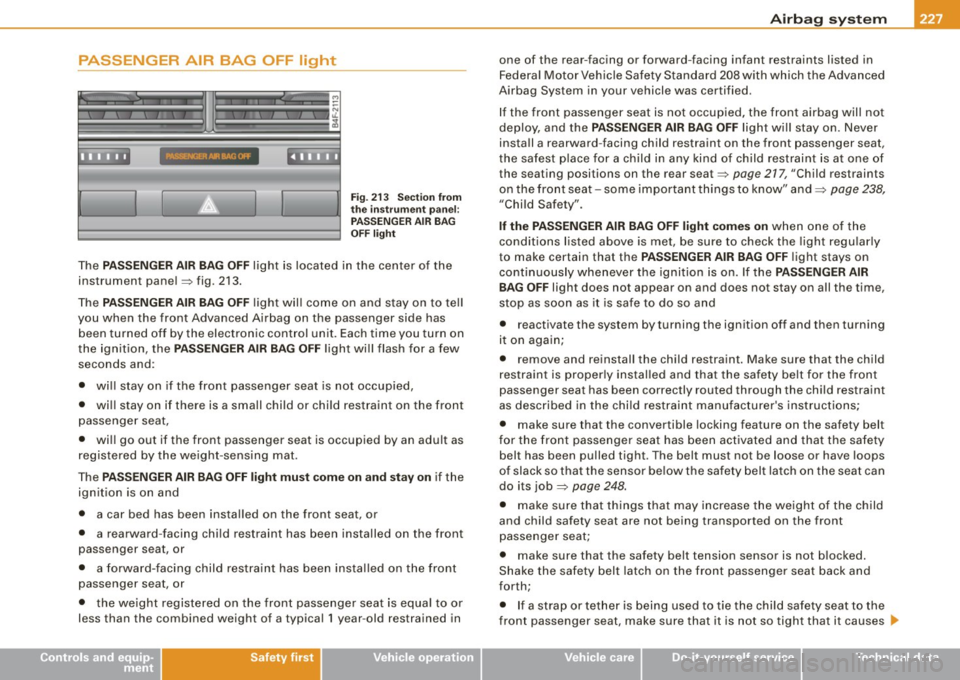
Fig. 21 3 S ectio n from
th e in str ume nt pane l:
PA SS ENGER AIR B AG
O FF light
The PA SS ENGER AIR BAG OFF light is located in the center of the
instrument pane l
~ fig. 213.
The
PA SSENGER AIR BAG OFF light wil l come on and stay on to te ll
you when the front Advanced Airbag on the passenger side has been turned off by the electron ic control unit. Each time you turn on
the ign it ion, the
PA SSEN GER AIR BA G OFF light wi ll flash for a few
seconds and:
• will stay on if the front passenger seat is not occupied,
• will stay on if there is a small child or chi ld restraint on the front
passenge r seat,
• will go out if the front passenger seat is occupied by an adult as
registered by the we ight-sensing mat .
T he
PA SS ENGER AIR BAG OFF light mu st come on and stay on if the
ign ition is on and
• a car bed has been insta lled on the front seat, or
• a rearward -f acing chi ld restraint has been installed on the front
passenger seat, or
• a forwa rd-facing child restra int has been installed on the front
passenger seat, or
• t he we ight registered on the front passenger seat is equa l to or
less than the combined weight of a typica l 1 year -old restrained in
Controls and equip
ment Safety first
Vehicle operation
one of the rear-facing or forward -facing infant restraints listed in
Federa l Motor Veh icle Safe ty S tandard 208 with which the Advanced
Airbag System in your vehicle was certified.
I f the front passenger seat is not occupied, the front airbag will not
deploy, and the
PA SS ENGER AIR BAG OFF light will stay on . Never
insta ll a rearward -facing child restraint on the front passenger seat,
the sa fest place for a child in any kind of child restraint is at one of
the seating positions on the rear seat~
page 217, "Child restraints
on the front seat -so me important things to know" and~
page 238,
"Chi ld Safety" .
If the PASSENGER AIR BAG OFF light com es on when one of the
conditions listed above is met, be sure to check the light regu lar ly
to make certa in that the
PA SS ENGER AIR BAG OFF light stays on
continuously whenever the ignition is on. If the
PA SSENGER AIR
BAG OFF
light does not appear on and does not stay on all the time,
stop as soon as it is safe to do so and
• reactivate the system by turning the ignition off and then turning
it on aga in;
• remove and reinstall the child restraint. Make sure that the child
restrain t is proper ly installed and t hat the safety be lt for the front
passenger seat has been correctly routed through the child restraint
as described in the chi ld restraint manufacturer's instructions;
• make sure that the convertible locking feature on the safety belt
for the front passenger sea t has been activated a nd that the safety
belt has been pulled tight . The belt must not be loose or have loops
of slack so that the sensor be low t he safety belt latch on the sea t can
do its job
~ page 248.
• make su re that things that may inc rease the we ight of the child
and child safety seat are not being transported on the front
passenger seat;
• make sure that the safety belt tension sensor is not blocked.
Shake the safety belt latch on the front passenger seat back and
forth;
• I f a strap or te ther is being used to tie the child sa fety seat to the
front passenger seat, make sure that it is not so tight that it causes .,
Vehicle care Do-it-yourself service Technical data
Page 231 of 398
__________________________________________________ A_ i_ r _b _a...; g::- s_ y=--- s_t _e _m __ fllll
& W ARNING (continued )
seating position and have the airbag system inspected by your
Audi dealer .
• A tight tether or other str ap on a rearward-fac ing child restr aint
attached to the front pas senger seat can put too much pressure
on the weight-sensing mat in the seat and reg ister more weight
than i s actually on the seat. The heavier weight registered can
make the system work as though an adult were on the seat and
deploy the Advanced Airbag when it must be suppressed causing
s erious or even fatal injury to the child .
• If, in exceptional circumstance s, you mu st in stall a forward
fac ing child restra int on the front passenger seat , always move the
seat into its rearmost position in the seat 's fore and aft ad just
ment range , as far away from the airbag a s possible . The backrest
must be adjusted to an upright position . Make sure that the
PASSENGER AIR BAG OFF light comes on and stay s on all the time
whenever the ignition is switched on .
& WARNING
• If the PASSENGER AIR BAG OFF light does not go out when an
adult is sitting on the front passenger seat after taking the steps
described above, make sure the adult is properly seated and
restrained at one of the rear seating positions .
• Have the airbag system inspected by your Audi dealer before
transporting anyone on the front passenger seat .
[ i ] Tips
If the weight -sensing mat in the front passenger seat detects an
e mp ty seat, the fro nt air b ag on the pa ssenge r sid e will be t urned
off, and the PASSENGER AIR BAG OFF l ight will stay on .
a
Controls and equip
ment Safety first
Vehicle operation
Repair, care and disposal of the airbags
Parts of the airbag system are insta lled at many different places on
your Au di. In sta ll in g, re moving, ser vic in g or re pair in g a part in an
area of the vehicle can damage a part of an a irbag system and
pre ven t that system fro m wo rki ng p rope rly in a co llision .
There are some important things you have to know to make sure
that the effectiveness of the system will not be impai red an d that
d iscarded components do not cause inju ry or po llute t he e nv iron
ment .
& WARNING
Improper care , servicing and repair procedures can increase the
risk of personal injury and death by preventing an airbag from
deploying when needed or deploying an airbag unexpectedly:
• Never cover , obstruct , or change the steering wheel horn pad
or airbag cover or the instrument panel or modify them in any way .
• Never attach any objects such as cupholders or telephone
mountings to the surfaces covering the airbag units.
• For cleaning the horn pad or instrument panel, use only a soft ,
dry cloth or one moi stened with plain water . Solvents or cleaners
c ould damage the airbag cover or change the stiffness or strength
of the material so that the airbag cannot deploy and protect prop
erly .
• Never repair , adjust , or change any parts of the airbag system.
• All work on the steering wheel , instrument panel , front seats or
electrical system (including the installation of audio equipment ,
c ellular telephones and CB radios , etc .I must be performed by a
qualified technician who has the training and special equipment
necessary .
• For any work on the airbag system , we strongly recommend
that you see your authorized Audi dealer or qualified workshop .
• Never modify the front bumper or parts of the vehicle body .
Vehicle care Do-it-yourself service Technical data
Page 235 of 398
Airbag syst em -----------------=~-
When the system is triggered , the airbag is f ill ed with propel lant gas
and br eaks t hroug h a seam in the seat surface area marked
" AIRBAG ". It expands between the side trim panel and the
passenger . In order to he lp provide this additional protection, the
side airbag must inflate within a frac tion of a second at very high
speed and w ith great force . The supplemental side airbag could
injure you i f your seating position is not proper or upright or i f items
are located in the area where the supplemental side airbag expands .
This app lies especia lly to children ~ page
238 , "Child Safety".
Suppl em ental sid e airbags inflate betw een the occupant and the
door panel on the s ide of the veh ic le that is struck in certain side
collision
~ page 232, fig. 215 .
A lthough they are not a soft pi llow, they can "cus hion" the impact
and in this way they can he lp to reduce the risk of injury to the upper
part of the body.
A fine dust may develop when the airbag deploys. This is normal and does not m ean there is a fire in the vehicle . •
Important safety instructions on the side
airbag system
Airbags are only supplemental restraints . Always prop
erly wear safety belts and ride in a proper seating posi
tion .
There is a lo t t ha t you and you r passengers mus t know a nd act
according ly to he lp th e sa fety belts and airbags do th eir job to
prov ide supp lemental pro tec tion .
& WARNING
An inflating side airbag can cause seriou s or fatal injury. Improp
erly wearing safety belts and improper seating posit ions increa se
the ri sk of serious personal injury and death whenever a vehicle is
being u sed .
Controls and equip ment Safety first
Vehicle operation
& WAR N ING (continued )
• In order to redu ce the risk of injury when the supplement al s ide
airbag infl ates :
- Alway s sit in an upright position and never lean against the
a rea where the supplement al s ide airbag is lo cated .
- Never let a child or anyone else rest their head against the
side t rim panel i n the area where the supplemental side airb ag
inflates.
- Always make sure that safety belts are worn corre ctly ,
- Do not let anyone sitting in the front seat put their hand or
any other parts of their body out of the window.
• Alway s make sure that the side airbag can inflate without inter
ference .
- Ne ver in stall seat covers or repla cement upholste ry o ver the
front seat back s that have not been specifically approved by
Audi .
- Never use additional seat cushion s that cover the areas
where the side airbag s deploy .
- Dama ge to the original seat covers or to the seam in the a rea
of the side airb ag module must always be repaired immedi
ately by an authori zed Audi dealer .
• Obje cts bet ween you and the airbag can in crease the ri sk of
injury in an accident by interfering wi th the way the a irbag unfolds
or by be ing pu shed int o yo u as the airb ag inflat es.
- Never place or atta ch acce ssorie s or other object s (such as
c upholders , telephone bra ckets , or even lar ge, bul ky obje cts )
on the doors , over or near the area marked "AIRBAG" on the
seat backre sts .
- Su ch ob ject s and acces sories can be come dangerou s projec
tile s and cau se injury when the supplemental side airbag
deploys. _.
Vehicle care Do-it-yourself service Technical data
Page 239 of 398
__________________________________________________ A_ i_ r _b _a...; g::- s_ y=--- s_t _e _m __ lll
& WARNING (continued)
• Never attempt to modify any components of the airbag system
in any way.•
Controls and equip ment Safety first
Vehicle operation Vehicle care Do-it-yourself service Technical data